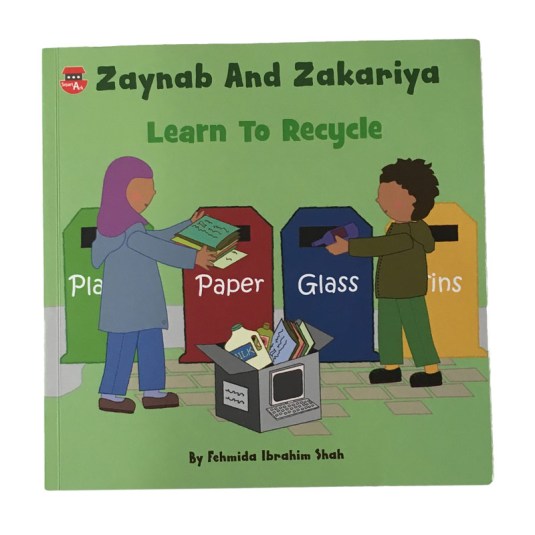
I’ve seen a few other environmentally inclined children’s books in Islamic School libraries over the years, but this one is one of the better ones in terms of its comprehensive thoroughness, proactive nature and presentation.
Zaynab and Zakariya help each other learn about recycling paper, tin, glass, and then reach out to their parents at the library to learn exactly how recycling works, what happens to trash, and how they can do their part to help the Earth. I like that the kids, don’t just drop a few items in a bin, flip off a light, and turn off the water, they actually help their mom start to compost, they seek out items made from recycled materials at a store to purchase, and learn about catching rainwater with their father. The text is a bit heavy and is probably more suited for at least 1st grade and up if read in a group setting, younger kids would enjoy it in bits and pieces, and would absolutely benefit if some hands on activities could be incorporated.
The book is 28 pages, sturdily bound and has a glossary of terms in the back. The book is small, about 9×9 and the pictures feature no faces. The story line is framed in an Islamic context and Quranic verses are highlighted and mentioned in the story.
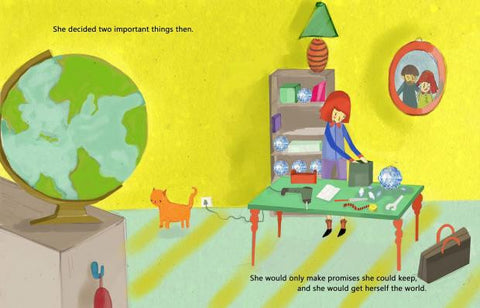
Don’t let this 32 page book with minimal text fool you in to thinking that big ideas, strong emotions, and tremendous self empowerment are not effectively conveyed, because despite my initial feelings toward the book, they really are. I would say the target audience is 4 to 8 year olds, but I know plenty of adults that could use the reminder that promises should be kept, especially ones made to one’s self.
On my first reading of the book, I didn’t love the pictures, and while I loved the way the emotions were conveyed when the little girl had to deal with the broken promises, I thought that the jump to being promised the world by another, was a bit abrupt and mature. However, the ideas stayed with me, and the whimsical pictures grew on me, and the more I thought about how so much of our culture revolves around messages of, “happily ever after” and being “saved” that it can never be too early to articulate that we can be in control of our dreams, our happiness, and our futures.
There isn’t anything Islamic in the book, so that caught me off guard as this was the first Zanib Mian book I’ve read that didn’t have at least a main character illustrated as Muslim. It doesn’t articulate if the boy who promised her the world is a husband or a boyfriend, or even what happened to him, as this isn’t his story. He is just one more example of someone who broke a promise.
Overall, a nice large book with a good strong message that shows how if you want the world, you have to go get it yourself, and only make promises you can keep.
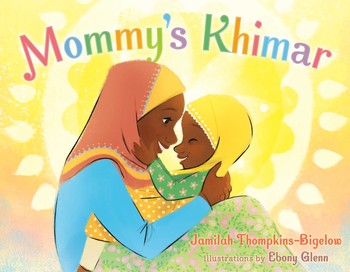
Children playing dress-up with their mother’s clothes is a universal activity, that most can relate to. Playing dress-up in your mother’s khimar is what makes this book both familiar and stereotype breaking in a way that is actually pretty powerful.
In this 40 page hardback book targeting 4-8 year olds, Salaam Reads, once again brings Muslim characters to the masses, without alienating or talking down to either Muslim or non Muslims readers.
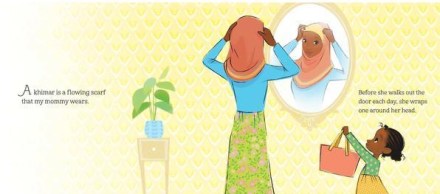
The story starts off with a little girl explaining that “A khimar is a flowing scarf that my mommy wears. Before she walks out the door each day, she wraps one around her head.” She then marvels at the variety of scarves her mother has, commenting on the colors, and prints, and designs, that by the time she is ready to use them as her favorite make-believe accessory, readers will be wishing they too could have such an assortment.
From using a khimar to be a queen with a golden train, to being a shooting star, the reader also along the way learns that she loves the connection the khimars offer her of her mother, when she isn’t near. The ladies at the masjid are also part of that connection so that when she dreams of all the fantastical pretend things she can be, she also knows they too are with her. Even her grandma, Mom-Mom, who exclaims “Sweet Jesus” when she sees her in her yellow khimar, and loves her although she doesn’t go to the mosque like the little girl does, is a part of the love and support the little girl feels by those around her when she is wrapped up in her mother’s khimar. I love that it stresses even though her grandma is not Muslim they love each other because they are family. Muslims and Islam are never mentioned outright, just the mosque and the ladies saying Assalamu alaikum, hint at the khimar being worn for religious reasons.
Perhaps the best part is the pictures. The illustrations with their yellowish hues radiate warmth and the faces and smiles are good for the soul. You can feel the love the little girl both receives and gives to those around her through the pictures that perfectly compliment the simple text.
The diversity of the book in the main character being a girl, a child of color, and a Muslim, is such a beautiful thing to see. Stories like this are powerful tools when children see themselves in books with positive messages, and remind us all how much more diversity it needed in literature to both highlight our differences, and celebrate our similarities.
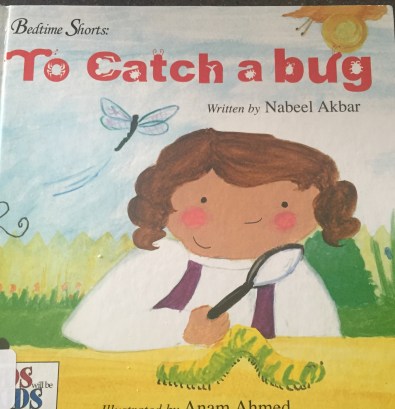
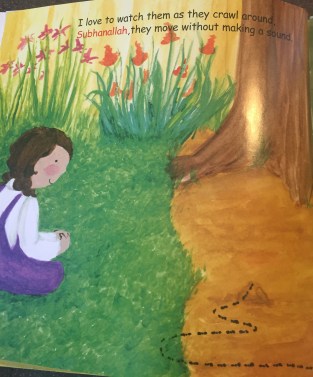
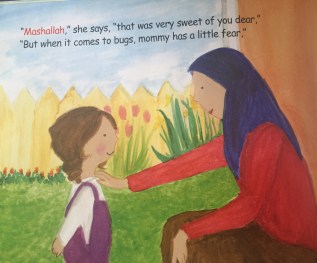
This adorable preschool age book written in verse features a little girl who is fascinated by the bugs and creatures outside. Highlighting Allah’s creations and adding in some humor, the little girl’s mom doesn’t love bugs very much, makes the book a silly read-a-loud that doesn’t get boring.
The 8×8 size, 16 pages, makes it perfect for bedtime as it is labeled as a “bedtime short. ” The text size and length is ideal for the age group and the pictures perfectly engage the listeners with their chunky simplicity and brightness.
The mom wears hijab, and Islamic phrases such as Subhanallah, Alhamdulillah, Inshallah, Bismillah are used, but not defined in the text, their is a glossary at the beginning. Thus, it would work for non-Muslims, but the intended audience, i think, are little Muslim kids.
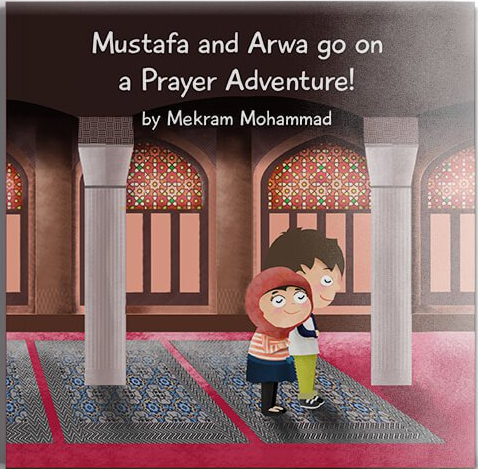
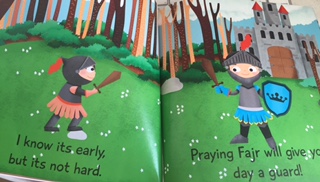
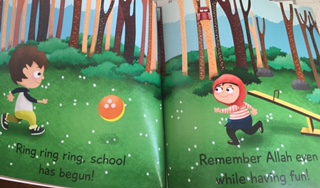
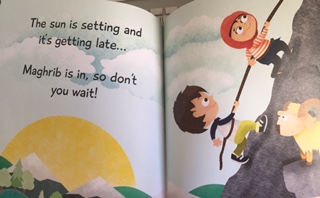
This short rhyming book introduces toddlers and little ones to the five daily prayers as it presents the brother sister duo on a typical day. Ok, so maybe not a typical day, unless dressing up as knights and battling each other, winning medals, and climbing mountains is typical. But, it presents the salats in time sequence that little ones can understand, more than as hours on a clock or as the various position of the sun. Fajr is early, and it guards your day, then you go to school, but the book reminds you to remember Allah, then you take a break for duhr and if you do, inshaAllah Allah will help you pass, then you come home and have a snack and then pray Asr, etcetera. By combining daily activities like spending time with family and reading Quran with the five prayers makes the routine seem doable and inshaAllah making it regular will truly allow us all to battle, win, and reach new heights, ameen.
The book is a great tool to learn the names of the prayers, and their order, while strengthening a child’s Muslim identity. There is no glossary or further detail about Salah or how it is performed, but I think assumes that that the reader would be able to provide additional information to the listener. The book is more to get children excited to pray, and get closer to Allah (swt).
The illustratrions are adorable and the font and text appealing to little children. The book is one in an adventure series by Muslim Pillars, and I look forward to reading Mustafa and Arwa’s other adventures.
In terms of plot and and believability, this 274 page 6.3 reading level book has moments of unrealistic twists, but the historical flashbacks and context make up for it as it delves into Pakistan, India partition without getting overly bogged down in politics and bitterness. You can tell that the author writes from a place of love and warmth, as she talks about all sides involved: Pakistan, India, Great Britain. The stories, fictional and historical, that weave through the novel make it informative and entertaining irregardless of one’s prior knowledge.
SYNOPSIS:
Maya is 12, and a little shy, especially compared to her older sister Zara. The book starts with her writing a journal entry about her visit to Pakistan in an airplane somewhere over the ocean. Maya, her older sister Zara, and their mother are heading to Karachi from America because of the death of Maya’s beloved grandfather. Frequent visitors to Pakistan, Maya is familiar with the sights, traditions, and language. As other family members arrive, Maya and Zara overhear their elderly grandmother planning to runaway to India to retrieve family heirlooms that were left during partition. The plan had been in the works for the whole family to go, visas were already obtained, but with the unexpected death, the urgency is amplified. Grandma wants to find a ring to bury with her husband. In Islamic custom burials happen very very quickly, often the same day, so the delay and sending the body to America, is something you just have to go with as the reader. Rather than convince Grandma to stay, the girls threaten to tell their mother if she doesn’t take them along, and the next thing you know the trio are off to India and on a treasure hunt. There is a map at the beginning of the book, which is very helpful. However, the adventure isn’t straightforward, not only in the trio’s adventures, but in that grandma ends up in the hospital, Zara and Maya decide to pursue the lost items on their own, and then Zara and Maya get separated. Twelve-year-old Maya then is forced out of her shell as she is kidnapped, and running for her life, trying to keep her promises, and also in desperately trying to save her family from having to pay a ransom to save her. A lot happens, and the intensity amplifies as it starts out as a elementary aged family story and turns into a middle school adventure. A long the way are beautiful passages about the scenery, amazingly simplified, but factually and emotionally accurate explanations about partition and ultimately, through Maya, about finding your voice.
WHY I LIKE IT:
The framing of the fictional story and the historical context is wonderful. Partition, is such a pivotal moment for those that lived through it, but has less and less relevance to today’s generation that lives abroad. So, to find a book that makes the gist of the events come through, is why I love using fiction to connect people and ideas. I am making my daughter read this tomorrow, no question. She needs to know what her own grandmother endured, what decisions her family had to wrestle with, and this book allows us to have those discussions in an informed way. I’m sure many would disagree and say that the reader should know about partition before reading the book, but I think the tidbits and delicate way the author convey the horrors, the agony, the manipulation, and the struggles in todays time, is far better than I could do to a sixth grader.
Maya’s abilities seem to grow overnight, so while she was an ok protagonist, she might annoy some. I actually had to google in the middle of reading how old Maya is, at times she seems like she is eight or nine and at other times like she is 15. I do like that Maya constantly remarks how alike India and Pakistan are, a reality that today’s generation definitely agrees with, but is often afraid to voice to their parents. I also like that there are good and bad everywhere, a theme that doesn’t get old, especially in books that deal with cultural and religious elements as presented to a wide audience.
There isn’t much religion in the book, the characters don’t stop and pray or wear hijab, but the setting does allow for mention of masjids, and a kind Imam back in California, the characters identify as Muslim and they discuss Muslims as a minority and political entity regularly. One of the treasures the grandma is looking to retrieve is an old Qur’an with the family tree drawn within. The book talks about how intertwined the two countries and many religions of India are, and Maya’s name articulates many of these crossroads. In the end, perhaps the best lesson from the book, is how much alike we all really are.
There is a wonderful Author’s note in the back, along with a glossary.
FLAGS:
The book has some violent images as it discusses trains coming from India to Pakistan with only a few living aboard and vice versa. The intensity as Maya is robbed, and then kidnapped, and then held hostage, could also be jarring for some younger readers.
TOOLS FOR LEADING THE DISCUSSION:
Like all her other books, I would absolutely include this in a Book Club, there is a lot to discuss, lots to understand, and lots to enjoy.
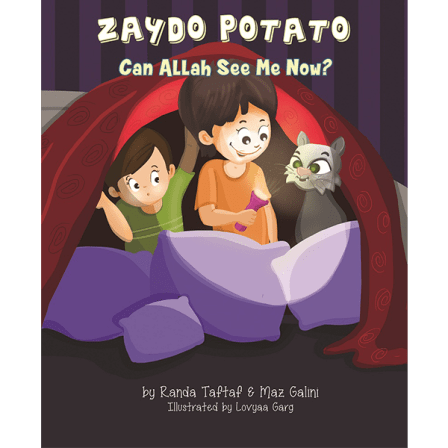
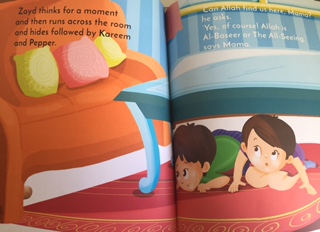
The book starts off simple enough with a little boy, Zayd playing hide-and-seek with his friend (or maybe cousin), Kareem, and his cat Pepper, when the challenge of hiding where they can’t be found, spawns a lesson in how Allah (swt) is always watching and watching over us. As the kids hide in different places, the mom uses the names of Allah (swt) to emphasize the point. The story presents the names of Al-Baseer, the All-seeing, Al Aleem, the All-knowing, Al-Khabeer, the All-aware, Al-Raqeeb, the Watchful, and Al-Shaheed, the Witness.
The book is 32 pages, with the story taking up 24 of those pages. An ayat from the Quran, surah Hadid verse 4, starts the story and there is a glossary of the names of Allah at the end. There is also some suggested activities for the book. Hidden on each page is Pepper the cat and a potato. There are other activities of finding shapes, counting blocks, finding different animals, etcetera, that encourage children to go back to the book to engage in the pictures, and inshaAllah the message presented.
There are two books thus far in the series and one E-book, the order doesn’t matter, as each is a standalone book. The husband and wife authoring team also have a publishing company, Rummana Publishing Inc, and based on their website seem to have plans for more in the future. This book came out about six months ago, and with its Glossy cover and large colorful pages, children will enjoy the story and activites. The pictures are warm and engaging, and overall they are very well done. The sentences are short, and the amont of words on the page is appropriate for the target audience. There seems to be some arrant spacing on new text lines, but I doubt anyone would notice, and a few sentences are awkward either in their wording or lacking commas, but again, it is minor.
A good story premise, easily conveyed to younger Muslims, makes the book an asset for Muslim children establishing a foundation and building a relationship with Allah swt.
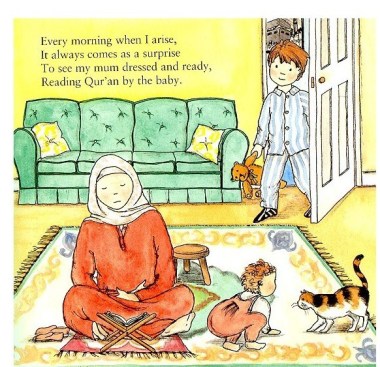
This book published in 1999 was one of the first books I remember reading regularly to my Sunday school class, and reading it now as a mum myself makes it warm me all the more. In 34 warmly colored illustrations, this 8×8 book shares the story of how a little boy sees his mom. How impressed he is by her and how truly he loves her for all that she does, all that she is, and all that she shares with him.
As the story progresses from what she does within the home and family, to what she does for others, the little boy also imagines himself all grown up and his mum as a nan. He imagines that she will need him and he is ready and willing for when that time comes, to take care of her.
The book and illustrations target ages 3-6. Written in rhyming couplets, four lines per page, the story moves at a steady pace and the pictures are detailed and familiar enough to engage most kids at bed time or in small settings.
There are little Islamic specific tidbits sprinkled throughout that give parents or readers a chance to use it as a more specific teachable moment. Saying “salam, reading Quran, thanking Allah for the food they have, praying salat, giving charity, visiting the elderly, celebrating eid, obeying her, and caring for her in her old age to achieve jannah, inshaAllah.
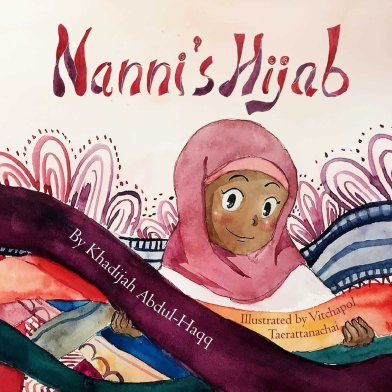
MashaAllah, there are so many things to like about this 36 page, brightly illustrated, elementary aged story. Nanni, the main character, is spunky. Not only is she strong enough to wear hijab to school, but she also is brave enough to confidently handle a bully on her own. Surrounded by a supportive teacher, friends, classmates, and her mom, Nanni’s creativity and understanding that Allah swt will help her find a way to handle her predicament results in a happy ending, and many empowering messages.
The book would work for most children, but I think second grade and up would get the most out of it. The girl might be young to be wearing hijab, but it seems like she wears it because she wants too. I like that the illustrations have her and her mom uncovered at home, and that there is a glossary at the back, opening up the book to muslim and non muslim kids alike.
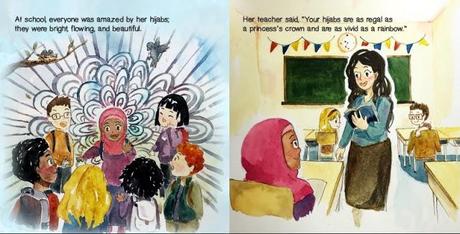
I also really like the larger messages of acceptance, trying new things, and doing better when you know better. The supporting cast in the book resonates with muslims who go to schools where they are the minority, but have support and encouragement to practice their faith none-the-less. Nanni’s teacher remarks that her “hijabs are as regal as a princess’s crown,” and the other students like seeing what color or design she is wearing each day. Although a children’s book, the author does very clearly explain that the hijab is part of Nanni’s faith, although not mentioned by name, and that it is an act of worship. Nanni wants to handle the problem on her own, and for as bad as she wants to punch Leslie, she knows it isn’t the right thing to do. As she wrestles with what is the best approach, she puts her trust in Allah, swt, which perhaps is the greatest lesson for us all in the book, alhumdulillah.
After reading this book, I really, really want to meet (and be friends with) the author, she writes from the point of view of Omar, a nine year old boy, and his perspective and voice are so authentic and relevant that while the book targets 3rd through 5th grade, I am certain kids and adults, Muslims and non-muslims, boys and girls, and everyone else, will all thoroughly enjoy this laugh-out-loud 164 page book.
SYNOPSIS:
Omar is starting at a new school, we don’t know why, and while he is nervous, he has a good attitude about it. His parents are supportive scientists and he has an older sister, Maryam who can be a bit mean in a big sister way, and a little brother Esa, who he secretly loves. All are practicing muslims who remind me a lot of the people I know. We say our duaas, we pray, we laugh at the funny stereotypes and just try and be good neighbors and people. Omar’s neighbor is hilarious, Mrs. Rogers, doesn’t like Omar’s family, or “the Muslims” as she calls them, but they just keep being themselves and when she falls and gets hurt, she starts to realize they are good people who care about her. She even starts showing up for iftar every night in Ramadan and counts down like a space ship launch until it is time to eat.
Using his Islamic upbringing, and seeing how is family handles problems, gives Omar a lot of tools for starting at a new school. But Omar is the protagonist, the hero, so he also has a super imagination that involves H2O, his dragon, that shows up to help him out when things get rough. And unfortunately, a bully by the name of Daniel makes things rough for Omar. He tells Omar that all Muslims and all Asians are going to be kicked out of the country, and this really sticks with Omar. He verifies it with a cousin, and learns it could be a possibility. So, the underlying anxiety is there, but most of the book that focuses on the bullying aspects involve the day-to-day comments, physical pushing, and efforts of Omar to avoid Daniel. When they do meet up, however, the result is often comical, as Omar and H20 confidently navigate the situation at hand. Between visiting a different mosque in London each week, learning to read the Quran, celebrating Ramadan, and just being a kid with new friends and a fun family, Omar eventually does win Daniel over after the two of them get lost in the London Underground. And all of us that came along for the ride are better for it, alhumdulillah.
WHY I LIKE IT:
There is so much to love about this book. Seriously. The accuracy of family life depicted is spot on and the Islamic elements are so interwoven that non Muslims would truly learn about Islam through learning about Omar, but not in a preachy way, and Muslims will see themselves on every. single. page. I love that Omar doesn’t ever seem embarrassed to be who he is. He is a cool kid for his confidence alone, and being able to laugh at a bully and not have it shake your core belief and self image is so powerful. The characters are well developed, from little Esa to Omar’s teacher, by viewing them through his eyes, you see enough of their personality to remember them, and appreciate them. The only exception to this was Maryam, I really didn’t feel like I got much on her, but I have a feeling there will be more books, and she will develop too. The book reads like a diary, until a tinge of foreshadowing of the changing relationship between Omar and Daniel pops up to setup the climax. The chapters are short, the fonts and doodles endearing and engaging, and the size of the book, really makes it fun for elementary aged children. The only possible gripe for American children, is that it is a British book, and you might have to google or ask what a few things are, yeah we are selfish like that, but its good for us to learn what pains au chocolate are, or crumpets, or nappies.
FLAGS:
The book is clean.
TOOLS FOR LEADING THE DISCUSSION:
Oh this should be required reading for every kid. I know I will be trying to implement this every where I go. This would be awesome for a elementary book club, and especially great in Islamic schools for struggling readers. In much the same way that teachers use humor to engage students, this book has heart and humor and a surprising amount of information, that I can see it being connected to a lot character building supplements in various curriculums, at least I hope it is, we need voices like this, both within our community and to serve as a representative of us to the larger society.







 I love that it stresses even though her grandma is not Muslim they love each other because they are family. Muslims and Islam are never mentioned outright, just the mosque and the ladies saying Assalamu alaikum, hint at the khimar being worn for religious reasons.











 Islamic School Librarian