Category Archives: Middle School

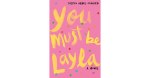
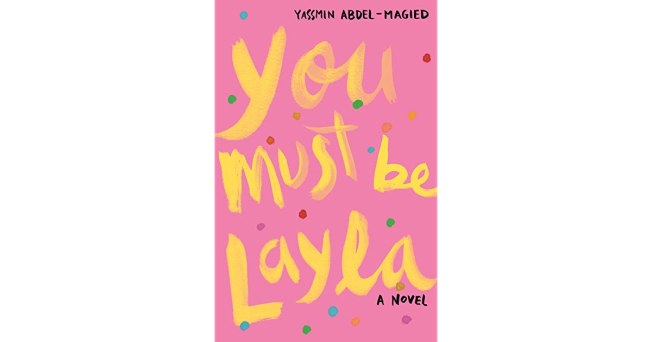
You Must Be Layla by Yassmin Abdel-Magied

Standard
You Must Be Layla by Yassmin Abdel-Magied

layla

This OWN story, upper middle grades book, is heavy on the pop culture, relatable on the Islamic family presentation and honest in its portrayal of Islamaphobia, yet somehow the tidiness in which everything wrapped up seemed too forced and a bit flat.  At 293 pages, including a three page glossary, the book is a quick read meant mainly for girls.  It involves robotics, academic achievement, and invention, while also discussing crushes, a character coming out to his family and friends, and mention of girls not praying at certain times of the month.

SYNOPSIS:

Layla lives in Australia and goes to the Islamic School of Brisbane. Her Sudanese family: older brother, younger twin brothers, and parents, her Doctor mom and medical machine tech dad, are active Muslims and proud of their culture.  They assimilate to Australian norms in varying degrees, but with all the kids at ISB, Layla doesn’t feel all that different in her school and social life.  Unfortunately she wants more, she wants to be an adventurer, and when she meets Adam over the break and learns about the various opportunities he has it his school, Layla decides she wants to prove herself on a larger stage.  Going in to “shut down” mode Layla has tunnel vision to ace the scholarship and entrance exam and go to a new school.

She gets in to Mary Maxmillion Grammar School and when she goes to meet the board they let her know that the decision to accept a girl like her was not unanimous.  Layla is an immigrant, she is black, she wears hijab, she is loud and proud, and apparently very smart, but as one trustee asks, is she brave?  On the first day of school she arrives late to first period, insults the teacher repeatedly and also makes friends with a group of slightly diverse boys.  At the end of the day however, Peter, a boy who had insulted her earlier, reinforces his disapproval of her being allowed at their school and pushes her.  Standing her ground, she verbal attacks and then head butts the boy in front of a large portion of the school at dismissal.  No one offers any help, nor speaks up when she is suspended for a week, her scholarship and admission put on probation, no one even asks for her side of the story, Peter, is let off completely free, as he is also the son of the Board Chairman.

Layla decides to prove she belongs at the school she is going to win a prestigious robotics competition and since everyone already is on a team, she decides to go for it solo.  The only problem, is she doesn’t know what to invent.  When she returns to school, her friend that she is crushing hard on is acting weird, and she gets caught up in a lie of sorts that serves as both the idea and silliness turned cleverness of the book.  While choking on gummy worms, she says she is working on an edible actuator for her robot, and somehow has to make that come to fruition.

The rest of the book is Layla making a lot of silly errors of judgement: missing classes being in SD mode in the workshop, forgetting to file the paperwork and registration to actually compete in the competition, and leads up to the resolution between her and Peter, learning her crush is gay, and deciding to be herself and proud of it.

WHY I LIKE IT:

I actually like the majority of the book, I really like how Islam is presented and lived.  They pray and say salam and cover, and recite tasbeeha to reflect, and quote hadith very naturally, even how others attack them, and the anger that Layla’s brother Ozzie feels at his inability to get a part time job reads and feels very authentic.  I also like how one of the teacher’s own experience as being a descendant of the forgotten generation and being a first nations ethnicity is woven in.  I felt the side character being gay was added and forced in as an after thought and I don’t know why, as it didn’t show Layla to be a particularly good friend.  She handled his coming out well, but when he was miserable she was wrapped up in her own stuff and didn’t reach out very well, even though he ended up being the spark for her invention.  Her friend at ISB is also an under developed character, that while I get is used to show another side of Layla, in many ways also showed her to be a rather poor friend.

I found the pop culture references annoying, not in and of themselves, but in knowing that they will date and make the book irrelevant in a few short years.  There is a lot of repetition of phrases and ideas that a few times when I put the book down I struggled to re-find my place (I know bookmarks, right?) but certain refrains and paragraphs seem so very similar.  I

There is a lot of good information about Sudan and their food and culture and traditions.  There is also a decent amount about Muslims in Australia.  I like that even within her family there are different views on how much to assimilate, and how much to fight back against perceptions, the fact that there is a lot of gray makes non Muslims and non immigrants reading the book hopefully realize how diverse all people are and to not assume anyone is only one way.  I would have liked more about Layla’s mom and being recruited to come to Australia, and how she was perceived at work, by patients and colleagues.  I also would have liked some sort of resolution about Ozzie and his job search.  Really though my biggest complaint is Layla, herself.  What does it even mean to want to be an adventurer? I like that she is fallible and human and in some ways she does grow, but I felt like her being smart and a go-getter is the foundation of the story, but that she didn’t seem to have much common sense seems a bit off.  Yes she is loud and funny and puts in hard work, but the way she talks to teachers, and misses classes and deadlines, and behaves seems like a disconnect from the pages constantly telling me how smart she is.  To me, part of being smart is knowing when to lash out and when to listen, I don’t feel like her growth arc was all that great, in a nut shell, she changed schools and confronted a bully, that is the story, while not a bad story, it could have been so much more.

FLAGS:

There is crushing, violence, a gay character, mention of alcohol at a party Layla didn’t attend, talk of hooking up in passing and some language.  There is lying but it is acknowledged guiltily, and not familiar with Australian slang, regular use of the phrase, Janey Mack, which according to google is a replacement for Jesus Christ.

TOOLS FOR LEADING THE DISCUSSION:

I don’t know why I wouldn’t use this book as a book club selection.  It just didn’t strike me as something they would benefit from.  I wouldn’t be opposed to someone picking it up and reading it in my house, but I doubt I’ll recommend it to my daughter and she is the ideal reader: she wears hijab, is in 8th grade at an Islamic school, and loves to read.  The book is really not memorable as good or bad, it just fell flat and I doubt I’ll read it again, luckily it only took two sittings to read, so I don’t feel like it was a waste of time, but seeing as I had to pay cover price and international shipping, I kind of regret rushing to buy it.

Teacher guide: https://www.penguin.com.au/content/resources/TR_YouMustBeLayla.pdf

The Candle and the Flame by Nafiza Azad

Standard
The Candle and the Flame by Nafiza Azad

flame

It takes about 124 pages to be swept away to the city of Noor, but once it happens, it is hard to come back.  The 391 page fantasy story takes a while to get going, but the character driven plot filled with amazingly strong and diverse women is worth the slow start.  Middle school readers and up (AR 5.8) will enjoy the blend of Islamic imagery, sub-continent Asian culture, fire, Ifrits, Djinn, family, relate-ablity and good quality story telling.  The fact that it is a main stream book, with so much religion and culture makes it all the more remarkable in its universal appeal.

SYNOPSIS:

Fatima is a Muslim girl adopted by a Hindu family, only everyone in the entire city was killed eight years ago except for Fatima, her adopted sister, and an elderly lady, when the Shayateen attacked.  The orderly Ifrit were asked to defeat the Shayateen and protect the city, and when they did, the wealthy returned along with people from other cities.  Thus Noor is now a vibrant city of different backgrounds, cultures, religions, and languages repopulated and ruled in halves by the Maharaja, Aarush and Ifrit Emir, Zulfikar.

Fatima works as a messenger and her favorite place to deliver packages to is an old book shop owned by Firdaus, an Ifrit she regards as a fatherly figure.  He has taught her languages and provides her a place to learn and grow.  When he dies in front of Fatima, she is forever changed, literally, he transfers his powers to her, and she is now not only part human, part Ifrit, but also the Name Giver, an incredibly powerful and important being in bringing the smokeless Djinn from their wold to her hers.

With rebel forces threatening the Maharaja’s rule, Ghul and Shayateen entering the city, a taint threatening the leader of the Ifrit, a traitor in each palace, and a budding romance between Fatima and Zulfiqar, the characters pull you in and create an enjoyable story that is vivid, fantastic, and hard to put down.

WHY I LIKE IT:

The story doesn’t have a neat and tidy plot culminating in a climax, but the character arcs and vivid world building pull you in and keep you interested.  I love that the characters are different and complex and unique, and that women are so so strong and celebrated for their strength in all spheres, not at the expense of the males, but solidly in their own right.  It is refreshing and glorious to see the matriarchal Ifrit world contrasted with the human world, and the strong females that emerge in both.

I love that there is so much diversity and tolerance and the book doesn’t shy away from presenting faith practices and acceptance in such an honest manner.  There is a four page glossary and it is needed, yet not overwhelming at the same time.  The most read page in the book for me however, was the Dramatis Personae page listing the characters.  Until that 124 page mark, I was constantly flipping back trying to keep everyone straight, not so much because the characters are confusing, but “what” they are took a little while to stick.

I got sucked in by this book truly, I ignored my children during our Corona virus quarantine one day to read the second half, and I don’t regret it one bit.  The romance, was a bit cheesy at the end, but it was clean, and sweet and presented as a way forward, not as a settling or sacrificing choice for either character which was greatly appreciated.

FLAGS:

There are a few kisses once the two main characters are married.  There is stalking and attempted sexual assault by a character, but Fatima more than took care of that with the support of many strong females.  There is mention of a homosexual relationship, but not dwelled on, and I think one could argue that there is  possibly something more going on between two of the females, but it isn’t explored.  There is death and killing and violence, but nothing extreme.

TOOLS FOR LEADING THE DISCUSSION:

I had hoped to sneak this in for book club next month, but with school closed indefinitely, it might have to wait until next year. I think girls will gravitate more to it than boys, but I think that is ok, because often girls need more of a nudge, in my experience, to give fantasy a try.  I am trying to convince my daughter to read it, but the first 100 pages are pretty slow, so if I can’t force her through it, I don’t know what chance I’ll have, here’s hoping.

NPR Review: https://www.npr.org/2019/05/18/724120066/language-has-magic-in-the-candle-and-the-flame

Interview with Nafiza Azad and Hafsah Faizal (We Hunt the Flame) https://www.slj.com/?detailStory=hafsah-faizal-and-nafiza-azad-interview

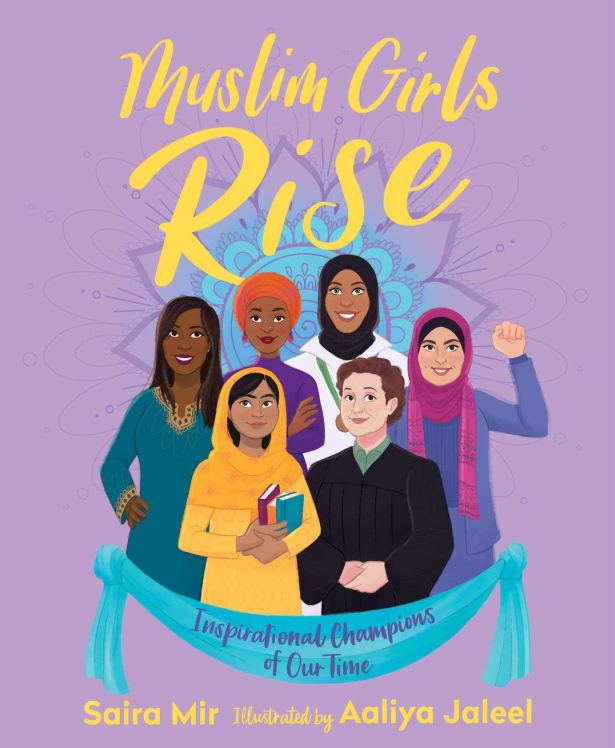
Muslim Girls Rise: Inspirational Champions of Our Time by Saira Mir illustrated by Aaliya Jaleel

Standard
Muslim Girls Rise: Inspirational Champions of Our Time by Saira Mir illustrated by Aaliya Jaleel

rise

Women you have heard of, some you are meeting for the first time. Some you like, some you disagree with, women that cover, women that don’t, some young, others older, some athletic, some academic, some a little bit of both.  One fictional, a few political, but in the end, all strong women of today, all Muslim, all unique, from all over the world, all known for paving the way for others to follow.

C51C5834-B3C5-4D19-94B3-99B21ADF83EA

In 42 pages, 19 females are highlighted and illustrated to inspire Muslim and non Muslim boys and girls alike, but really Muslim girls will get the most out of it.  Sure a female gets mentioned here or there in other compilations of influential people of our time, but this one, well, this one seems mostly for us.

2D8175C8-0798-4AC1-BF15-D0A9C284AEA9

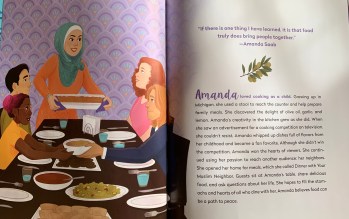
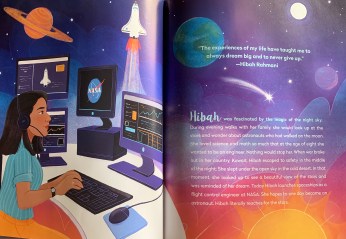
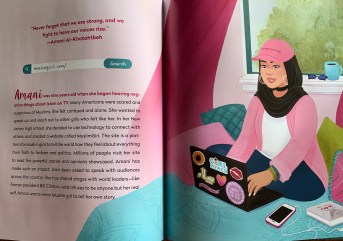
There are famous females in science, activism, fashion, film, sport, education, media influencers, make-up artists, you name it, and Muslim’s participate, so finally a book shining a light on the best of the best.  With each person getting a full two page spread, a few tidbits about who they are and what they are “famous” for are detailed in easy to read sentences that inspire, and if you haven’t heard of them before, enough general knowledge to get acquainted.  A few felt a little generic, but once you have a name, Googling them or researching them, is obviously, not difficult.

6D798E55-709C-442A-8DFF-4BA184C960E1

I wish there was a bit more information detailing who was chosen and why.  At first I thought it was  US or “western” movers and shakers, but then you have Maria Toorpakai Wazir, the tennis player in Pakistan, and Shirin Ebadi from Iran.  So then I thought ok, they are all contemporary, but Maryam Mirzakhani passed away in 2017.  Needless to say, one could argue that the list is arbitrary, and I think I would agree.

85FF7A9C-FD80-4F37-A1DE-B8726762E9CB

One could also argue, that these women may make history for notable things, but that they might say or do things that you might take issue with, and again, I agree.  They are people, they are fallible, and diverse, and have different perspectives and life experiences, but that’s ok, infact I think that might even be the point.  We all have different passions, and paths, and views and yet at the end of the day we should be able to lift each other up and inspire.  I think every person who reads this book will find someone that sounds or feels or looks like them, and that is a good thing, no, a great thing!

9C6EB606-F612-40BF-A947-092D2B76F1FE

My favorite was the Kamala Khan entry, because I didn’t realize the G. Willow Wilson was Muslim.  I erroneously assumed the other co-creator, Sana Amanat gave Kamala’s back story and home life its sense of OWN Voice, and I love that I learned I was wrong from a book.

2EC5EAF4-87F4-406C-B4D1-C95341536B66

The illustrations are right on and do an amazing job of conveying the character and the inspiration of the collection.  The book is much needed and I hope they do a similar style book for Muslim women in other time periods.

Special gratitude and appreciation to Gayartri Sethi (IG @desibookaunty) for gifting me this book for no other reason than to share the power and strength of women, and being a leader in that, by sending me a beautiful book.  May I learn from your generosity and pay it forward! Thank you.

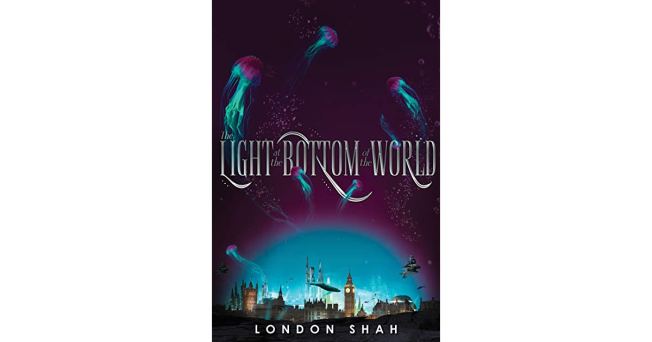
The Light at the Bottom of the World by London Shah

Standard
The Light at the Bottom of the World by London Shah

light at the bottom

At the risk of sounding pretentious or like I have written a book before, sadly this really reads like a debut novel.  At 311 pages, there is a lot to love about this Muslim authored, Muslim protagonist sci-fi/dystopian adventure, but I have so many more questions about everything after reading the book, than I did before I started, that unless the next book (assuming there will be one), really steps it up- all the world building will have fallen flat with the lack of character connection I felt. At times I had to force myself to read through the lulls in the story, while at other times, I sacrificed precious sleep to read just a bit more.  The story is pretty clean and would have no problem letting my 5th grader read it, even while knowing it will have more appeal to my 8th grader.

SYNOPSIS:

It is 2099, and Earth has flooded forcing everyone to live underwater.  Set in London, 16-year-old Leyla McQueen, a submersible racer, lives alone with her dog Jojo.  Her mother has passed away and her father has recently been taken away to an unknown place for an unknown reason.  It is Christmas, and Muslim Leyla spends the day with her best friends, twins Theo and Tabby.  With futuristic technology, the wealthy twins show the reader what life under the sea entails and the world the characters now inhabit.  Pausing to recall the day the Earth flooded, New Years brings a huge race, the London Marathon, and Leyla somehow gets one of the 100 spots to enter the dangerous submersible race.  The winner gets whatever they want, and Leyla hopes to win, so that she might ask for her father to be released.

By opting to not harm someone, Leyla’s last minute reactions earn her the championship title of the race, however, her request to have her father freed is denied and instead she is gifted a submarine and the attention of the authorities who have ransacked her apartment, and stolen and destroyed her home.  Feeling like she has no reason to stay in London, she plots to escape the borders and go search for her father alone.  A family friend, she calls Grandpa, knows more than he has ever let on, and forces a friend’s son to keep an eye on Leyla, Ari.

Ari and Leyla explore the ocean, while Leyla whines and makes poor decisions, narrowly getting out of each situation, but not seeming to really learn her lesson.  As people appear and help them along the way, she finds where her father is being held, but not much else, and then poof, a few action scenes later to try and rescue her father, and Ari is captured and the book ends.

WHY I LIKE IT:

You have to respect the author who’s bio on the back flap of a Disney, Hyperion published book starts off with, “a British-born Muslim of Afghan descent,” and who dedicates the book to “my fellow Pathans.  We too are worthy of taking the helm.” I love it! Seriously, way to be so confident in who you are, and your story, that you own it and wear it with pride.  Truly, I felt empowered and can only imagine what Pathan girls everywhere would feel opening the book.

Similarly, Leyla, owns her Islam by praying, reading Quran, saying Bismillah before she races, and inshaAllah when she hopes in for things in the future.  She does get a bit close to Ari and doesn’t find that a problem.  She doesn’t cover, and there are no other Muslim characters in the book, but she is definitely religious, and it is seamlessly woven into her character without mentioning anything about what Islam is or stands for, but giving it authentic attention.

There are a few twists, one particularly large one, but not a whole lot of answers, or details.  There is no understanding as to why Leyla’s father has been taken, what happened to everyone other than those in the UK (especially Afghanistan, where Leyla presumably would have family), why so many people are willing to help Leyla find her dad, why Grandpa tells Leyla nothing at all, about Ari’s friend who died, and so much more.  So often it just feels that Leyla is whining and getting no where in her rash and stubbornness, but everyone seems to love her. Perhaps, everyone but me.  I really never felt connected to her, and her annoyingly ever-present dog.  There is more telling about how great she is or her father is, and very little showing.  I think if there is a second book, it could really elevate this one, but as it stands, so little is resolved, explained, or emotional resonance, that I don’t know that the characters or book will leave a lasting impression.

FLAGS:

Some language and a kiss.  There is death, and disease, and battles and government lies.

TOOLS FOR LEADING THE DISCUSSION:

I’m tempted to do this as a middle school book club selection, despite the one-dimensional characters, simply because it is clean and might introduce students to a genre they might not otherwise read.

Author’s website: https://www.londonshah.com/


Luv Ya Bunches by Lauren Miracle

Standard
Luv Ya Bunches by Lauren Miracle

bunchesA book about 5th grade friendships told from the perspective of four different girls in a variety of styles: instant messages, chatroom conversations, video scripts, and traditional text.  The author seems to have a checklist of diverse characters and afflictions that all must make an appearance in the 335 page story.  It is written on an AR 4.4, but with one of the main characters having two moms, details of a suicide mentioned, talk of pole dancing, male anatomy joked about, thongs, crushes, and mental illness, four girls coming together to form friendships and take down a bully, might raise more questions for young readers than they are ready to handle.  Yasaman the Muslim girl in the group, also borders on perpetuating more stereotypes than she breaks, and while I definitely don’t think this book is a good fit for 4th and 5th graders, I don’t really recommend it for readers of any age, there are just better books out there.

SYNOPSIS:

Asian American Katie-Rose doesn’t have friends, unless you count her neighbor Max, but she doesn’t.  She dreams of having blond haired Camilla as a best friend, but the Camilla she went to Pioneer camp with is not the Milla at school who hangs out with Modessa (aka Medussa) and Quin, and is popular.  Katie-Rose also dreams about being a cinematographer or director, she isn’t sure yet, but she loves to imagine scenes and scripts and how things ideally should play out, even when in reality they never quite seem to do so.

Milla, isn’t sure if she wants to stay friends with Modessa and Quin, they aren’t nice and she has a lot more fun with Katie-Rose, but somehow she always ends up going back to the popular crowd.  She also has a lot of anxiety and needs various totems with her at all time to feel secure.  When her little plastic turtle goes missing, she struggles to stay composed, and her and her turtle will end up changing a lot at Rivendell Elementary.

Violet, is the new girl at school and she is not liking her life at home or at school.  Her mom is in a mental hospital and she misses her desperately, her dad brings home fast food every night for dinner and life just isn’t the same since she moved to California.  Immediately able to tell who the popular kids are at school, she hasn’t decided which group of friends is the best fit for her, but when she stumbles on Tally the turtle, and doesn’t immediately return it to Milla, she has to understand what that says about her, and figure out if she is strong enough to make things right.

Yasaman is the quiet computer wiz, she is also Turkish-American, Muslim, and a hijabi.  She designs a platform where kids who are too young to join Facebook can chat, stream videos and send cupcakes.  The only problem is, she has no friends to get to join.  When Katie-Rose and her strike up a friendship, the first seeds of the four flower named girls are planted, but it will take all four of them to put Modessa in her place, rescue Tally, and deal with stereotypes, emotions, and family along the way.

WHY I LIKE IT:

I love that a Muslim, muhajaba is included in the quartet, and that her religion, her scarf, her culture, and her belief in Allah, actually are sprinkled in.  I don’t love how in the book’s efforts to include such diversity, that it also seems to fall for a lot of the stereotypes that it on the surface seems to be dispelling.  Katie-Rose asks her if she even knows what YouTube is before being made aware of how computer savvy she is.  All this is to subtly show the assumption that Muslims are not aware of technology and whatnot, and set the record straight, but also regularly thrown in are side comments from Yasaman that her father would never let her wear something, or she wouldn’t be allowed to do that because of her dad, definitely reinforcing a male dominated, authoritarian, out-of-touch patriarchal view.  Even her mother, an artist, is shown to demand a lot of Yasaman and be incredibly strict.  A lot of things aren’t spelled out, they are just dropped in and assumed that the reader get’s it.  But only Yasaman’s parents are portrayed this way.  Milla’s two mom’s are caring, Violet and her dad seem close, and Katie-Rose’s parents are rarely highlighted.  So, I felt like it was noticeable, and not in a positive way.

I’m still completely confused as why pole dancing and male anatomy made appearances in the book.  And the pole dancing reference appeared not once, but twice when Yasaman is talking to an older cousin who is talking about a friend who’s aunt is a pole dancer, and then later when Katie-Rose’s babysitter also mentions the same friend.  They also discuss people as being slutty and boy crazy and skanky.  The male anatomy isn’t spelled out it is hidden with a girl with major orthodontia reading a Wikapedia page on the greek satyrs, discussing their physical pleasures and talents.

There is also a lot of mental health issues that I’m glad are present, but I’m not sure if they are handled seriously enough.  I’m glad they are addressed, because awareness is a good thing, but discussing how someone swallowed pills to commit suicide and even though she changed her mind still died, and not giving any context seems to make the concept come across as a bit trivial to me in its presentation.  Same goes for Camilla’s anxiety and Violet’s mom being in a mental hospital.  These girls have some major stuff going on that their preoccupation with a snotty group of girls, and the obsession of mud being consumed in an ice cream shake, seems a bit off.

Overall, the girls seem incredible perceptive and articulate in their self reflection and understanding of social personas, that I found their banter completely disjointed.  I don’t think the author’s voice is consistent, and the heavy stuff is too much coming from 5th graders in my opinion.

FLAGS:

Stereotypes, and discrimination against Yasaman and her younger sister Nigar.  Possible triggers with talk of suicide.  Milla has two moms, it is never labeled or made an issue, she just refers to them as Mom Abigail and Mom Joyce. Talk of boy private parts and erections, crushes, pole dancing, words such as skanky, and slutty and dingleberry (poop hanging on) used.  There is lying and bullying and retaliation and poetic justice.

TOOLS FOR LEADING THE DISCUSSION:

I wouldn’t use this book for a book club or even have it in the classroom.  I think it gets a bit crass unnecessarily and the cute flowery cover and inside flap, makes it all the more surprising.  You might expect some potty humor in other books, but knowing it is there allows the reader to make a decision to read it or not, I would imagine most Muslim parents would see four diverse girls on the cover, one wearing hijab, get excited and hand the book to their 3rd or 4th or 5th grade daughter and have no idea what the book also includes in passing, with no relevance to the story lines highlighted on the inside flaps and back of the book.

Allies by Alan Gratz

Standard
Allies by Alan Gratz
allies.jpg

This is the second Alan Gratz multi-perspective historical fiction novel I’m reviewing for its inclusion of a Muslim character.  While in Refugee it seemed a natural choice to include a Muslim family, I was completely shocked that he would feature one in a WWII D-Day novel.  With numerous storylines spread over 322 pages the book is quick, fast paced, intense and emotional.  An enjoyable read for history lovers and curious kids fifth grade and up, it is an AR 5.6 and older kids will benefit from it too.

SYNOPSIS:

The characters and timeline are fictionalized to all take place on D-Day, June 6, 1944, as the Allied forces and French resistance come together to storm German occupied France on the beaches of Normandy.  Many of the details do come from history though as detailed in the Author Notes at the end of the book.

The book starts out following Dee, a German national who left for America to escape the Nazi’s and is now returning in a Higgins boat to fight them. Knowing no one will understand, including his friend Sid, a Jew from New York, he keeps this knowledge to himself and focuses on the task ahead.

Samira and her mother are the focus of the next mission and highlight the role of the French Resistance, the Maquis.  What makes their story more meaningful is that they are spies with the French Resistance, but they are French Algerians, not really a part of France at all, and they are Muslim.  In Samira’s back story we learn how she must remove her hijab and how she is treated different at school because Algeria and France are at odds.  When her mother is taken by the Nazis before she can deliver the message to the Resistance, Samira vows to do it and get her mother back as well.

19-year-old James from Winnipeg Canada is a paratrooper who volunteered for combat to feel empowered after years of bullying. His buddy in the story Sam is a Cree Indian from Quebec, who has few rights at home, and hopes to have more success in the military.

Medic Henry is scrambling along on the beach helping anyone and everyone he can.  Having left behind a segregated US, even the military has reservations about African Americans saving and serving. As he performs one heroic act after another being questioned and doubted and insulted all along the way, readers see how ridiculous and infuriating racism is on every level.

We meet Private Bill Richards who drives a Sherman tank and is following in his fathers WWI footsteps.  But who is unfortunately killed before reaching Bayeux.   And finally we meet Monique Marchand, a French 13 year old girl, who gets caught up in the invasion because she left her swim suit in the beach hut the day before and has returned to retrieve it. Determined to do something other than cower in fear, she starts helping fallen soldiers and meets up with American journalist Dorothy, a strong woman determined to not be stopped on the basis of gender.

All the story lines criss and cross as the invasion is a chaotic mess and everyone is dropped, disembarked, or arriving in the wrong place at the wrong time.  Surviving the day is an immediate challenge and not one that everyone will succeed at.  The larger success of the mission will depend on some lucky breaks and a whole lot of teamwork.

WHY I LIKE IT:

I love that the story somehow isn’t political at all in the traditional war story, war strategy sense.  But the strength at least for me, wasn’t the horrific battle at hand, which is truly violent and abhorrent, but the relationships between the people.   The realizing what is driving them, what matters and more importantly how hard our prejudices are.  The larger story of the Allies shows British, Americans, and Canadians coming together to defeat he Nazis, but yet, a girl, an African American, and a Cree are treated as “other” irregardless of how beneficial they are even in matters of life and death.

As for the story of Samira, she is a tough girl, both clever and brave.  To have a Muslim in  an American/westerm story of D-Day and a young girl at that, to me was pretty remarkable.  There isn’t mention of faith or anything other than that she is told to take off her scarf and continues to wear a small kerchief on her head anyway, but for Muslim kids all over, this character and how she behaves will spark a sense of extra pride in the Allies success over Hitler, just as the other minority characters will for their representation in such a dramatic event.

FLAGS:

There is a bit of mild profanity.  There is violence and death, and blood, not too bad, but the point is clear, the beach isn’t pretty.

TOOLS FOR LEADING THE DISCUSSION:

I think this book would be a great supplement to any WWII history lesson.  There are great resources at the end, and maps at the beginning and a high energy, short chaptered book that doesn’t skimp on character building or war intensity.

Author’s website: http://www.alangratz.com


The Star Outside My Window by Onjali Q. Rauf

Standard
The Star Outside My Window by Onjali Q. Rauf

star outside.jpg

Woah! Domestic abuse, foster care, murder, astronomy, and above all hope and bravery. It is so, so much, and so beautifully dealt with from the perspective of a child, that I’m still living in Aniyah’s world and praying she is doing ok.  As the beginning of the book states, it is a story written for everyone, but it then goes on to say that there could be triggers and difficult things to read. So please, while it may be written for ages nine and up, you should know what your child can handle before suggesting they read such a heartbreaking 306 page book, and if they aren’t able to handle it yet, make a mental note to have a discussion when they are ready, it is important.

SYNOPSIS:

The book starts with a map of London and the chapters start with constellations, maps to the stars, and a little girl who wants to be a star hunter.  Drawing on Simba from the Lion King and wholeheartedly believing that stars are people who’s hearts were so big that when they die they light up the night, she maps the stars outside her foster house window, on the lookout for a new star, her mom.  Not remembering all the details that brought her to this foster home, she and her little brother Noah are trying to figure out their new life, the foster home rules, the loud pain they felt, and if they are winning the game of hide-and-seek with their father.

Unable to speak, Aniya, breaks her silence when a news story on TV tells of a star breaking the rules of gravity and flying by Earth.  Convinced it is their mom, Aniyah and Noah with the help of fellow foster kids Travis and Ben hatch a plan to go 73.6 miles from Waverly Village to the Royal Observatory in Greenwich, to make sure the star hunters name the star the correct name, and not the random computer generated one the contest rules dictate.

WHY I LIKE IT:

The book is inspired by the author’s aunt who was a victim of domestic abuse and killed by her husband.  The love and pain she feels at her loss, I believe is conveyed through the pages and felt by readers of all ages.  I had my 10 year old son and my 12 year old daughter read the book, because this book’s topics are heavy and weighty, but handled with such sensitivity and childlike innocence that it is a great introduction to the topic, without being overly heavy and weighty.  The author is amazing, and I was curious how she would follow up her amazing debut novel The Boy at the Back of the Class, and I think this one is just as powerful, if not more so. 

All of the foster kids suffer from some form abuse and there is even a note at the beginning about how the author does not like the term “domestic abuse” and there are resources and information at the end of the book for children or adults suffering or how to help someone they know suffering abuse.  There is also a page about Herstory, the constellations, and some personal anecdotes about the author’s aunt.

The book is truly heartbreaking because as an adult reading the book I could easily figure out what happened, that the father killed the mother, and that the games the mom would have the kids play were not games at all, but ways to mask what was going on. The book is very subtle in how it talks about what the mom and kids endured and some kids will not get it, and others will, either way, parents should be aware and available to discuss that abuse is never ok and that if their friends or someone they know is suffering/surviving, there is help.

The book is powerful also in the way the foster kids for the most part stick together, I think the way they are so willing to help and risk their own chances at adoption is selfless and memorable.  Also the way they put up with Noah, a little kid, who gets annoying, but handled lovingly,  because family means so so much when you don’t have one. 

On the surface though, it is an adventure story, can a ragtag diverse group of kids with little money, injuries and a deadline travel nearly a hundred miles to name a star?  Its fast paced, interesting, and emotional on many levels.

There is nothing Islamic in the book, not even a Muslim name in passing, but the author is Muslim and the story universal.

FLAGS:

Halloween is when they run away.  There is a lot of lying, but they know it.  Lying when the mom covers her bruises and marks, and how she is doing, lying when the kids run away and steal the bikes and sneak on a bus without paying, and break in to the observatory.  The kids feel guilty and know right from wrong in every instance, but when they opt to do something uncouth they rationalize it because they have to name that star!

TOOLS FOR LEADING THE DISCUSSION:

I’m seriously considering reading this as a middle school book club selection.  It is written for a younger audience, but I think I want to open up the topic of abuse and have the school counselor come and listen to the discussion.  The book is that good, and that important, and that powerful, that a discussion and lessons, will keep these characters’ stories in the middle schoolers’ minds as they grow and hopefully teach them empathy, compassion, appreciation, and patience.


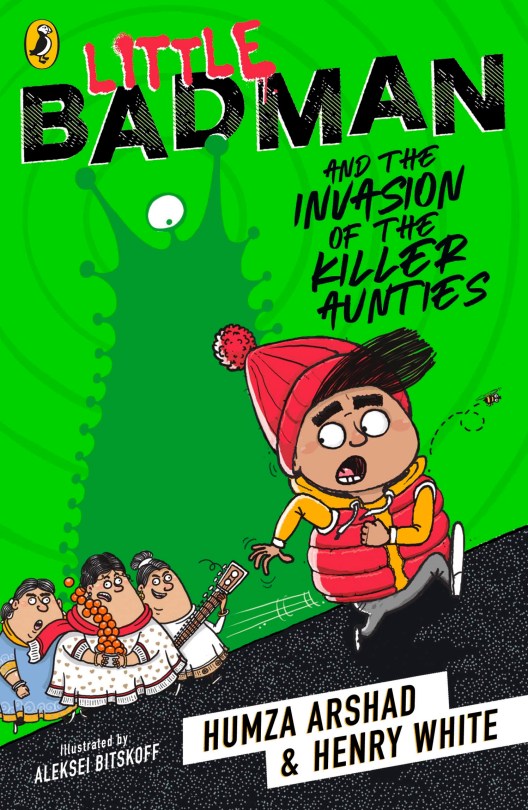
Little Badman and the Invasion of the Killer Aunties by Humza Arshad & Henry White illustrated by Aleksei Bitskoff

Standard
Little Badman and the Invasion of the Killer Aunties by Humza Arshad & Henry White illustrated by Aleksei Bitskoff

badman

It’s been a while since I’ve read such an over the top silly book that has a lot of heart.  It is 352 pages that remind me of the the My Teacher is an Alien book series of my youth smashed up with the Weirder School/Diary of a Wimpy Kid series of today.  Meant for upper elementary with some bad words (hell and damn), the story is Pakistani-British representation with many Muslim named characters, a Muslim author, and a shout out to a KFC in another town that is halal.  Don’t read it if if you want to learn anything, but definitely pick it up if you want to roll your eyes, giggle, and ponder a world where Desi aunties are the perfect disguise for force feeding an entire community delicious food as part of their evil plan to take over the world.

aleksei-bitskoff-little-badman-1

SYNOPSIS:

Humza Mohammed Khan is an 11 year old Pakistani kid in Britain who thinks of himself as the next big rapper, Little Badman.  He dreams big and talks even bigger as he struts around primary school getting in trouble and trying to film his music video on his friend Umer’s extremely old Nokia flip phone.  With a normal enough mom, a hyper exaggerating father, and a handful of their friends known as Aunties and Uncles, Humza gets in trouble regularly enough, but overall seems to have a good heart.

Things at school slowly start to change after their teacher gets stung by a bee named Mustafa, that Umer brought to school to be his pet.  Weird as that might be, it is even more odd, when their teacher is replaced by a volunteer auntie.  Every day it seems like a teacher goes missing, and is replaced by some asian kids’ aunt.  When the supper ladies are replaced and the food improves, no one is complaining.  When every volunteer starts bringing snacks to school, no problem.  Who doesn’t love gulab jams, and samosas, and butter chicken all day long every day?  Well, as the school puts on the pounds and all the teachers and staff are officially missing, Humza, Umer and their former nemesis Wendy, start to get worried.  Humza’s Uncle who he calls Grandpa, claims his wife Auntie Uzma is not really his wife, and helps Humza investigate.

Secret meetings in supermarkets, teachers and grandpa vanishing, and Humza seeing a giant slug coming out of the substitute librarian, means that Little Badman is going to have to run away from cricket practice, not get sent in a crate to Pakistan, face his stage fright, and save the day from the aliens taking over the aunties.

little-badman-inline

WHY I LIKE IT:

I like that it is cultural rep and own voice in its telling.  Humza is Pakistani and his cultural baggage is hilarious and part of him, and no explanations are needed.  In his world people are from lots of places and they all live and play and learn together and they eat caramel apples and toffee and jilabies.  The diversity is great and not articulated, it just is what it is, and they all have to work together to save the day. I think my favorite character is Grandpa, who Humza has to learn to appreciate and not just see as an old almost dead guy and Humza’s dad who exaggerates everything and takes his cricket very seriously.  At the end Humza has to have a heart to heart with his dad and his uncle, Grandpa and it makes this over the top nutty story really kind of sweet too.

There is no “Islam” in it aside from Muslim names and mention in a rap of a halal KFC.  I kind of like that they are Muslim kids and it appeals to a larger audience, sure something praying or something at some point might have been nice, but it isn’t a book that you’d be expecting spiritual nuggets from, so it is ok.

aleksei-bitskoff-little-badman-3

FLAGS:

The words damn and hell are used.  There is disrespect of authority, parents, and teachers as well as lying.

TOOLS FOR LEADING THE DISCUSSION:

I had my ten year old read it and he thought it was ok, but was uncomfortable with the language, which I was glad, but I told him I thought he could handle it, and know what is appropriate to use.  That being said, school libraries should have the book, maybe not classroom libraries though, and I probably wouldn’t do it as a book club.  I will have my other kids read it though, cause like I said, it is silly and fun.

Interview with comedian author Humza Arshad: https://www.booktrust.org.uk/news-and-features/features/2019/march/meet-little-badman/


The Broken Kingdom by H.G. Hussein

Standard
The Broken Kingdom by H.G. Hussein

broken kingdom.jpg

An engaging chapter book that blends adventure, friendship, battles, mystery, and faith over 292 pages of easy reading and rich storytelling.  The book appeals to readers 10 and up with it being completely clean and age appropriate for anyone younger who can handle the storyline.  The characters are not just active and practicing Muslims, but the story too, is Islamic in nature.   The story is unabashedly pro-Islam and slightly dogmatic, but not overly preachy and faith is woven in seamlessly throughout the story.

SYNOPSIS:

The Sultan of the Islamic Empire is having a recurring dream that involves a floating city falling when a flying object hits it, when he asks his guiding Imam what it means he learns that the city will be destroyed unless the Sultan assists.  Not knowing where the city is, what the object is, and trusting the Sheikh explicitly, a retired soldier is brought back in to service to find the city and save it.  Adam, before he leaves the capital is joined by two others to help him on his journey, Ali and Umar.  Ali is a quiet man whose voice when reciting is absolutely beautiful and whose eyesight and archery skills are unparalleled.  Umar is the Muezzin and the Grand Mosque and a seemingly close figure to the Sultan with familial ties to the area.  The trio sets off to Benghazi to talk with some Bedouins who were ambushed by some man-beasts and are too afraid to speak of the encounter.  It is believed that their experience and the dream are linked.

To reach Benghazi they must travel first by boat for about a week, while at sea they come across an abandoned vessel that has but one survivor and a lion aboard.  After the lion is killed and the injured man brought with them, they are able to continue to try and get information from the Bedouins.  Finally, the Bedouins and the trio are off to the place of the attack and the journey moves on.  When a rockslide and attack from these same mysterious beasts separates the group, Adam, Ali, and Umar are on their own to make there way through the mountains and figure out the threat on their own without the Bedouins.  They journey through a river within a mountain for days on end before meeting soldiers that take them back to their unnamed city.  The city is the one from the dream.  And as they must search to understand what plagues the inhabitants, how to defeat it, and how to survive, they suffer loses, confusion and only a few answers.   They do save the city from the immediate threat, but not from a larger looming one.

WHY I LIKE IT:

The book reads really smooth, a lot of self published chapter books are all over the place, and this one, sticks to the story pretty well.  There are a few tangents, such as the lion on the ship, that really have very little baring on the story, except to show maybe how good of an archer Ali is, however, most are mildly amusing and thus not terribly frustrating.  There are a few smaller incidents that make the book a little less cohesive, for example a passage about a man named Tarek, who brings the Sultan a message and is rewarded with gold, or such detail about Umar not being allowed to go on the assignment and then the Sultan allowing him to go, perhaps it is to show the Sultan’s generosity and willingness to take other people’s opinions in to consideration, but they aren’t particularly smooth anecdotes to the book and read a bit unpolished.  Often these little dives into side issues with fair amounts of detail made me think they would play a role later in the book, but by-and-large, they don’t. One that particularly stood out was Adam meeting the Chief’s daughter in the forbidden woods. I still really want to know why she and her children were there.  I also wanted more information about the man-beast figures and the man and woman that were so quickly killed, and the markings on the trees and in the caves (trying not to spoil too much), in the climax.

I love that the book is Islamic fiction from top to bottom, there are lots of morals exposed and teachings mentioned in real tangible situations.  The character’s pray and carry themselves at all times as Muslims and it is refreshing to read.  Characters in the book take shahada based on the manners of the Muslim characters and the readers see and understand repeatedly the power actions and values have in defining a person.  One of my favorite exchanges in the book is when Adam tells Ali, “The main reason for failure is manners.  To be specific, lack of manners.”  The details continue, and hopefully reinforce and articulate what parents everywhere are trying to teach their children.

The font and binding and all are adequate, I don’t love the cover though.  It seems this is the second cover, and I wish it was more eye catching, it is really bland, and unfortunately won’t compel readers to pick it up.  I also really wish their was a map.

FLAGS:

There is violence, nothing sensationalized or celebrated and it even mentions how heavy hearted characters should be about going in to battle and taking a life.

TOOLS FOR LEADING THE DISCUSSION:

I would love to do this as a middle school book club book. I’d love to hear how the students take the Sultan being referred to as Allah’s representative on Earth.  I get Leader of the Believers, and even Caliph, but I felt this description to be a bit grandiose.  I actually thought it was perhaps a Shia perspective, nothing wrong with that, it just wasn’t something I’d ever heard before and yes I assumed, but the author said, “Of course not.“  He then said, “The Caliph must ensure that the laws of Allah, Most High, are present on Earth.  Every Caliph represented the Creator ensuring Shariah was present, the same as every Prophet and Messenger.” Still not completely clear, I asked a trusted source (not Google) who said it comes from the Ummayads under Muawiyah. So, I’m not sure if anyone else would be hung-up on this, but it is something that stood out to me, although definitely not making the book something to avoid.

I think kids will have strong opinions on the mystery at hand being the book ends on a cliff hanger.  With a lot of questions still up in the air and no real right or wrong answer, I think discussing the book would be a lot of fun.

The book’s website: https://www.thebrokenkingdom.com/


Piece by Afshan Malik

Standard
Piece by Afshan Malik

Pieces.jpg

This 168 page young adult book from Daybreak Press focuses on a small Muslim family in Texas, that has their own stresses and interpersonal relationships, but are thrown in to a whirlwind when the father of the family returns home from a medical mission to Syria and finds himself in the psych ward broken and troubled.  The effects each of the character’s struggles have on them as well as those they care about, makes for a haunting yet relatable read for fourteen year olds and up.

SYNOPSIS:

The Jamal family is made up of Hannah and her older high school aged sister Noreen and their physician parents Dahlia and Adam.  Hannah runs track and is more introverted in handling friends and her father’s life altering condition.  Noreen on the other hand is ultra organized and rational in her approach to life, much more like her OB mother.  To cope with the stress of her father’s return she commits herself to more clubs at school and staring at her phone.

Hannah doesn’t seem to have a lot of friends, and when the track team understands that Hannah’s dad is dead and Hannah doesn’t correct them until later, her comfortable acquaintances turn on her and she will have to learn to stand up for herself and use her voice in the course of the book.  Noreen’s character arc is a bit more dramatic as her involvement in yearbook club brings new people in to her life, mainly a boy, who might not be as a genuine in his goals as she is, and thus their climax results in a trip to the police station.  Dahlia has a close friend, and Adam has a few as well, but the story really stays pretty streamline in exploring the relationships of the family and how little things and big things affect them all.

WHY I LIKE IT:

I love that the book takes on a serious issue like PTSD and is framed in such reality.  The scene where the dad blurs his past memories with the current real happenings, is done very well.  It conveys how fractured his brain is while showing the stress his situation lends to the mood of the home is powerful. There is also a very real situation of attempted physical and sexual assault that occurs when Noreen finds herself in a position with a male classmate who attempts to take advantage of her.  The book holds back in details, and she is able to defend herself, keeping the book clean, while still implying what his intent was, and how fortunate she is to get away.

More superficially, but also more relatable is the girls bickering and fighting and pushing each other’s buttons, and the mom trying to help, but is alas is frequently at a loss at what to do with them.  The situations the girls face at school are probable and relatable that I think a lot of middle school and high school readers will see themselves trying to balance extra curricular activities, friends, finding a quite place to pray and keeping their hijabs coordinating.  The family is Muslim and they dress the part, talk the talk, and pray together regularly.  Islam is very present, but not preachy, it is just what the characters believe and what they use to shape their view of many of the tests they are facing.

There are a few hiccups that are worth noting, but don’t overly deter for my appreciation of the story.  I struggled with the writing style in the first few chapters.  It took a bit to feel a connection to the characters and get what was going on sorted out.  It is written in 3rd person omniscient (I believe, it’s been a while) with each chapter more or less focusing on one of the four main characters.  As a result a handful of times the narrative gets awkward in explaining what one of the characters is doing or thinking, because the focus is on someone else, or the timeline overlaps a bit.  It doesn’t happen an awful lot, but the book is under 200 pages, so it is annoying that it happens at all, let alone more than once.

Story wise the characters seem oddly isolated.  The book tells us how small the town is, and shows us how everyone knows the parents regularly, the girls seem to be pretty lonely.  There isn’t any warmth from the schools or neighbors in helping them deal with their dad coming home so wounded.  In a town they have lived in for so long, this seems off to me.  Also if the town is so small, and the family so religious, there is an imam who visits once, you’d think there would be more of an Islamic community presence for the mom and girls to find support from.

FLAGS:

There is violence in the remembering of what happened in Syria.  There is some Islamaphobic talk as Hannah endures some verbal bullying and the attempted physical and sexual assault on Noreen.

TOOLS FOR LEADING THE DISCUSSION:

I would consider this as a possible middle school book club choice.   It tackless some big things, and uses Islamic boundaries to talk about mental illness and sexual violence which is a huge plus when addressing our youth.  Noreen isn’t in a relationship or even overtly infatuated with the guy who puts her in a compromising situation.  But even if she was doing something “wrong” what he did is not ok, and the fact that the authorities believe her, and she plans to discuss it with her mom, and she is not further victimized by speaking out, is something our kids need to see and understand.

There are discussion questions at the end and I think males and females will benefit from reading and discussing this book.  Unfortunately, and possibly the only other disappointment in the book is the price.  Nearly twenty bucks for a short YA paperback book makes it hard to buy classroom sets for such activities, and I’m sure will even keep the avid reader debating whether they should purchase it or not.