Category Archives: 2nd through 4th grade

From Far Away by Robert Munsch and Saossan Askar illustrated by Rebecca Green

Standard
From Far Away by Robert Munsch and Saossan Askar illustrated by Rebecca Green

from far away

Robert Munsch is a staple in most classrooms and libraries, but somehow, much to my embarrassment, I just learned about this book.  Originally published in 1995 with a different illustrator, I read the newer version that was rereleased in 2017.  I’m not sure how they differ, but they stem from an autobiographical experience of the co-author Saossan Askar, and her leaving of the war in Lebanon.  She wrote to the author and their letters back and forth are how the book came to fruition. 

IMG_4986

The 24 page picture book is an AR 3.5 and my guess it is because of the content a bit more than the reading level.  While it never gets graphic or sensationalized, she does leave a war zone of bombs and shootings, and the words may trigger fear in younger children.

IMG_4987

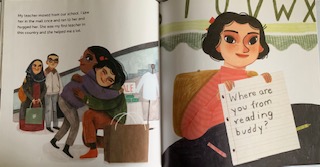
As the book progresses, the focus is much more on Saoussan settling in to her new life and the hiccups along the way.  From not knowing what anyone is saying, to sneaking out of class to go to the bathroom, and being frightened by a paper skeleton.  The book gives concrete examples that while silly, really show how someone unfamiliar with a new culture could be very confused and even scared.  

IMG_4989

The book has a happy ending with Saoussan adjusting and making friends and even becoming the best reader and speller in her class.  She also gets in trouble often for talking too much.  

IMG_4990

The book, like many in the genre of discussing war and refugees on a child’s level has its strengths and weaknesses.  The heart of the story I would say is wonderful, the illustrations lively and engaging, some of the transitions and details, however, are a bit abrupt and unsatisfying.  Once you know that it is based on reality and came about through letters, it makes more sense, but even that is a concept older readers will appreciate more than younger ones will.
IMG_4991

I checked the book out from the public library and I think does a great job of inspiring empathy.  It is vague as to what conflict is being left which makes it timeless in that I, unfortunately don’t see refugees disappearing soon.  The mom wears hijab, but there is no mention of religion in the book.

Here are the letters from his website: https://robertmunsch.com/book/from-far-away

From Far Away started with this letter:

To Robert Munsch
I am a little girl. My name is Saoussan. I am seven years old. I am in grade two now. I came to Canada one and half year ago. I didn’t know how to speak English at all. I was just sitting and listening. A lot of funny things happened to me.

Children were trying to talk to me, but I was not able to answer them. I began to talk a little by little.

I finished grade one and now I am in grade two. The teacher now is complaining to my dad that I am talking a lot in the class and I read and write a lot of stories.

One day I found a book called Thomas’s Snowsuit. I read it and I laughed with my family.

I went to the library and I brought some of your books. I enjoyed reading them. I even read them to my dad that he laughed so hard he could not stop laughing.

Please come to our school we want to hear a story from you and we want to see you.
I wrote back and asked her what “funny things” had happened. Saoussan wrote back telling me about her first Halloween in Canada:
To: Robert Munsch
Thank you for your letter. My teacher read it to the class and he said: I am not going to tell the class the funny thing that happened to her when she was in kindergarten and I am not going to embarrass you.

I don’t remember all of the funny things. But I remember one thing.

When I wanted to go to the washroom I didn’t know how to say I want to go to the washroom. That’s why I used to crawl to the door and when the teacher turns her head and looks at the other side I crawl under my friend’s desk and when someone opens the door I crawl out and go to the washroom.

When I come back from the washroom I wait beside the door and when someone opens the door I crawl in and go to my desk.

Once I crawled to the washroom. When I opened the washroom door I saw a skeleton. Then I screamed: Aaaaahhhhhhhhh!

Everybody came out. My teacher, Mrs. Garwan came, opened the washroom door and she tried to tell me that it is Halloween time and the skeleton is paper.

I didn’t understand her and I didn’t know what Halloween is.

She jumped up and down and danced around to explain to me that Halloween is just fun, but I thought the skeleton made her crazy and I screamed louder.

Then she hugged me to make me feel better and I jumped on her lap and the pee went down my knees. She put me down because she got wet.

Now I am in grade 2/3 and I am the best reader and speller in the class. This year when it was Halloween I weared a mask and a costume and we did a party at school. Then I went with my sister trick or treating to the neighbours.

Please, please, please, please, please, please, please, please come to our school.

I liked her letters so much that I decided to turn them into a book.

So Saoussan and I wrote a lot of letters back and forth and we made the letter into a book. Saoussan and I are both the authors and we split the royalties.

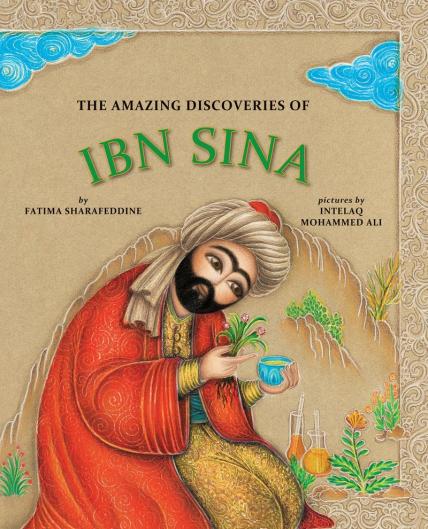
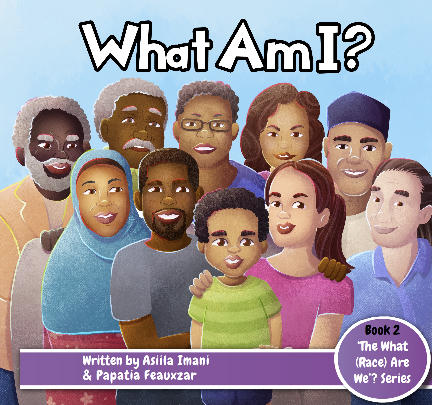
What Am I? Book 2 ‘The What Race are we Series’ by Asiila Imani and Papatia Feauxzar illustrated by Juliana Paz

Standard
What Am I? Book 2 ‘The What Race are we Series’ by Asiila Imani and Papatia Feauxzar illustrated by Juliana Paz

IMG_4825.jpg

This incredibly important 37 page picture book highlighting a little boys heritage will speak to children who see themselves in his quest to answer what he is, as well as (hopefully) inspire them to search out their own family ancestry and unique make up.

IMG_4828

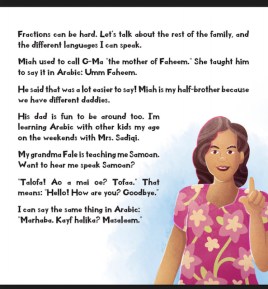
The book is not a traditional story book, in fact there isn’t much of a storyline, but the concepts presented show how beautiful and amazing multi-cultural and multi-ethnic families can be.  A lot of cultural information is conveyed and celebrated about Samoan and Pacific Island traditions as well as Islamic ones.

IMG_4831IMG_4832

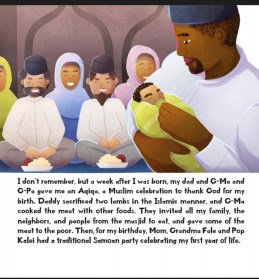
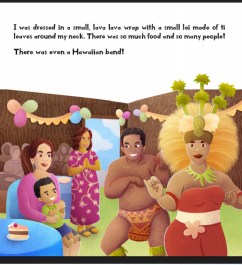
There is an aqiqa at the time of his birth as well as a Samoan party with a Hawaiian band.  Some members of his family cover, while other’s don’t.  He remarks how he has extra grandparents which equal extra blessings, and how he has a half brother because they have different dads.

IMG_4830

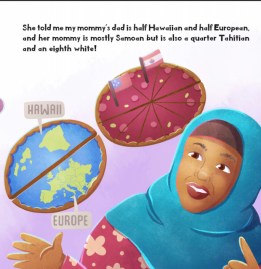
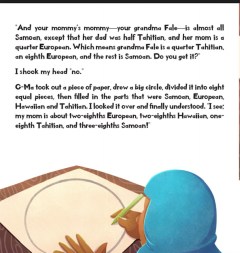
In addition to geography, there is also a STEM component as six-year-old Toa Idris learns he is a quarter this and half that through understanding fractions as visualized by slices of a pizza.  At one point Idris remarks that, “I can’t keep all those people and places straight,” and after reading the book half a dozen times, I honestly couldn’t either.  But, I think that is ok.  The point of the book is that being diverse is amazing, and having people love you is important, and culture and tradition and faith all make you richer.

IMG_4829 The text on each page is presented in a fun font, as are the pictures.  Really there is just one picture that makes Idris look angry and it is used in the story and the title page, which is unfortunate, I think it is supposed to have him look pensive, but it seems a bit off to me, where all the other pictures ooze with warmth and richness.

IMG_4826

I honestly don’t know what age group would benefit the most from the book.  Younger kids that may have been asked what their culture is will be empowered by having it reinforced that they are made just how Allah swt planned them to be, older readers will be able to create their own pizza slices, so to speak, and understand their own pieces, but I feel like both groups might need some coaching from an adult.  There are family trees at the beginning that almost become reference pages while reading the story and trying to keep everyone straight, that make the book almost interactive.  Muslim and non Muslim reader alike would learn about new cultures, and benefit from the “Extras” at the end.  Honestly, overall there is just a lot of information tossed around in the book, which isn’t a bad thing, it just might make it a bit more hit or miss if it will work for your child.

Before Birth, Beyond Life: A Muslim Mother’s Ode by Zenubia Arsalan illustrated by Heshan Gunasekara

Standard
Before Birth, Beyond Life: A Muslim Mother’s Ode by Zenubia Arsalan illustrated by Heshan Gunasekara

birthbefore birth

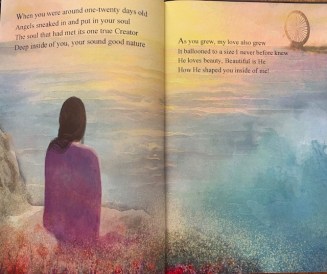
This 24 page book written in rhyme explains with love and Islamic oversight the circle of life.  From before birth and what happens after death, the tone and images of the book really are very beautiful and dream like.  The author suggests the book for ages 6-9, but I think even toddlers will enjoy the poetry and illustrations.

IMG_4378

The book is told from a mother to her child explaining that she is the answer to her  prayers, but that there is the One, the Creator, who knows and loves her even more.

IMG_4379

It details that everything about her is perfect and exact according to the will of Allah swt, even before her birth Allah knows and has decreed everything.

IMG_4380

Once born, your mom loves and prays and watches you grow, but at an appointed time you, like all of us will leave this world for the next.

IMG_4381

And that in the afterlife, inshaAllah once again we will be reunited.

Children are rarely sad when loved ones pass away, often pointing out that they are with Allah Subhanawatala now, and this book stems from that peace and comfort in knowing there is a world beyond this one.  Not just for children, this book would make a perfect gift for expectant mothers or as a reminder for older kids in families suffering from loss.
I have the paperback 9 x 6 size book as I’m here in the US, but a larger hardback version exists elsewhere and I think the illustrations would benefit from the larger size.  Also, the pictures are a shoutout to Dubai and I think kids who have been there or live there will equally enjoy the skyline on a number of the pages.
There is a talking points ebook for the book that you can get for free at https://littlemutaqeen.com/talkingpointsbefore/ that will assist you in presenting the information and concepts explored to older and more curious kids.  It talks about how to broach potentially awkward concepts (pregnancy, birth, death) and a maintain body positive message, clarity of heaven and hell, and so much more. I highly recommend it.


Yaseen’s Big Dream by Umm Juwariyah illustrated by Azra Momin

Standard
Yaseen’s Big Dream by Umm Juwariyah illustrated by Azra Momin

IMG_3404.jpg

Kids love to stretch their imagination and do the impossible, but for Yaseen Muhammad, his dreams at night are his favorite activity to see just how far his abilities can go.  In this 21 page paperback 8.5 x 8.5 square book, Yaseen Muhammad will imagine his best day ever as the President of the United States and share with kids 1st through 3rd grade exactly what he will make happen, inshaAllah, when he wakes up.

IMG_3401

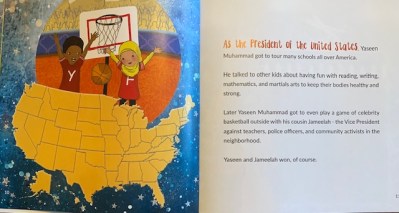
In a very busy day as the first kid president, Yaseen Muhammad dreams of starting the day leading morning prayer in the Oval Office, and then getting his family to help him prepare a special lunch for everyone in every state.  He’ll visit schools all over America and play celebrity basketball with his cousin and vice President Jameelah. He’s Jedda will teach people to start their own gardens, and he’ll give a speech on TV, after all why not, “Nothing is Impossible.”

The pictures are lively and descriptive that the reader and listeners will enjoy looking at them.  The characters are visibly Muslim as the women wear hijab, and in the text it mentions the characters praying, and Yaseen Muhammad dreaming he is the imam.  There is a lot of text on the pages, but the story flows and the information serves a purpose in establishing who Yaseen Muhammad is and connecting him and his dream to the readers.  The text is uniformly on the right with the pictures on the left making the book very convenient if sharing during story time and you are like me and hold the book in your left hand when reading to a group.

IMG_3402

The only thing that struck me as off, was in the illustration of Jameelah and Yaseen playing basketball. Yaseen’s t-shirt has a Y on it and Jameelas an F. Not a J for Jameelah or a Y signaling they are on the same team.  It is minor, but all my kids noticed it too and wondered why.  

A couple of places I stumbled over some of the grammar and wording, but after reading it aloud a hundred times (exaggeration, slightly) to figure out why, I don’t think anything is wrong, it is just a bit awkward, but it is probably me.  For example when Yaseen is speaking to the whole world on TV he says “Every kid can make a difference in your community, in your state, in your country, and even in the world. Dream Big.”  Seems like it should be, Every kid can make a difference in “their” community, in “their” state, no?

IMG_3403

Overall, a good empowering story for all children and one that highlights African American Muslims in text and illustrations.  A great book to have in rotation to encourage kids to dream, make the world better, and believe in themselves.  Alhumdulillah.


Who Will Help Me Make Iftar by Asmaa Hussein illustrated by Saliha Caliskan

Standard
Who Will Help Me Make Iftar by Asmaa Hussein illustrated by Saliha Caliskan

IMG_3796

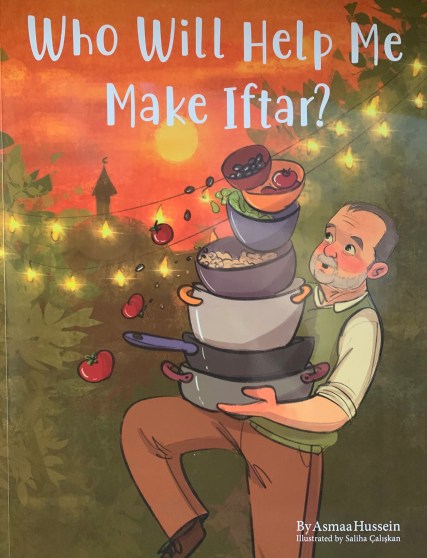
This sweet story shows how even when people refuse to help, we should treat them with kindness, as our actions should be to please Allah alone, and inshaAllah in real life, much like in the story, people will fix their ways and offer their help in return.  This new story reads very much like the old(er) favorite Nabeel’s New Pants, where everyone is too busy to help, but then come around to realizing that helping one another is a way to show people we care.  This 32 page 8.5 x 11 soft back story is well bound with large glossy pages and clear text.  The story works well for ages 4 and up, as they will understand the moral message and inshaAllah feel inspired to find ways to help as well.  

IMG_3797

It is a 40 year tradition that Mustafa Amce and his wife Ayse Teyze feed iftar to their friends and families on the first day of Ramadan.  This year, however, Ayse is not well and Mustafa is confident he can enlist the help of neighbors and family to help him keep the tradition alive. 

IMG_3798

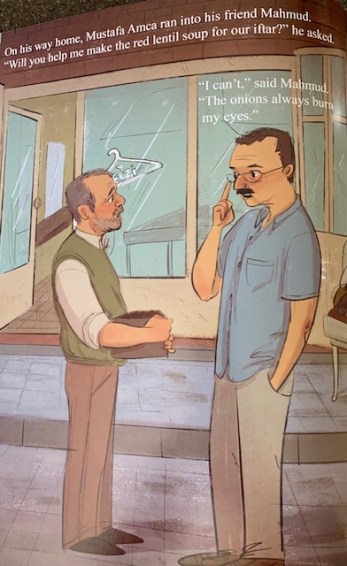
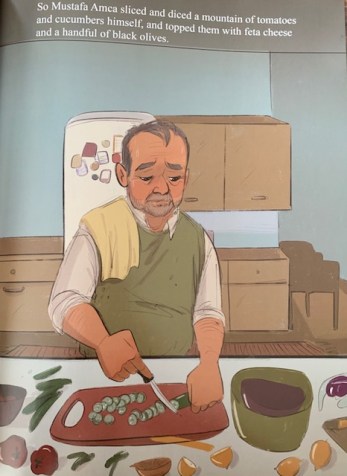
Unfortunately, everyone has an excuse.  His daughter is tired, his grand daughter is too busy with her video games and his neighbor doesn’t want to get his new shirt dirty.  Their sad reasons don’t stop old Mustafa Amce, and he makes the salad, and cooks the rice and beef by himself.

IMG_3799

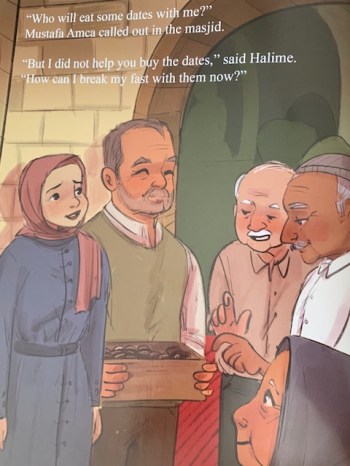
When iftar time arrives, he offers sweet dates to those at the masjid and invites everyone to come to his courtyard to break their fasts together.  All those that had early refused to assist him feel incredibly guilty and don’t want to take advantage of a lovely meal. Mustafa reminds them that, “God loves those who are generous especially to their families, neighbors, and guests.  and I always want Got to love me.” So they join in the delicious meal.

IMG_3800

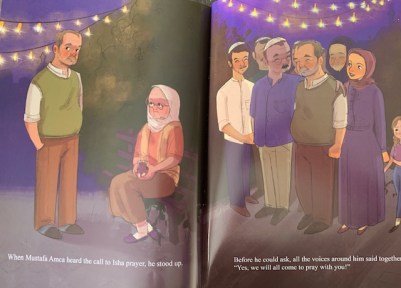
After food Ayse Teyze shows that while she might be ill, she can still save the day when her husband realizes he has forgotten to prepare dessert.  The guests then offer to wash the dishes and sweep the floor and take the leftovers to the poor.  And best of all when the athan for isha prayer calls out they all without prompting stand to join Mustafa Amce in praying salat together.

IMG_3801

The names are Turkish with a pronunciation guide at the end, as well as a paragraph about Ramadan.  The book would work for non Muslims and Muslims alike as the story is set in Ramadan, but more about coming together to help out.  The illustrations are large and detailed and descriptive.  You see the warmth between Mustafa and his wife as well as the apologetic feelings from those that were unwilling to help. 

IMG_3803

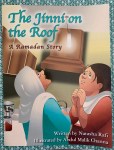
The Jinni on the Roof: A Ramadan Story by Natasha Rafi illustrated by Abdul Malik Channa

Standard
The Jinni on the Roof: A Ramadan Story by Natasha Rafi illustrated by Abdul Malik Channa

IMG_3592

This 37 page culturally Pakistani Ramadan story is super sweet and fun.  There is so much I feel like my critical self should not like about the story, but by about page 15 each time I read it, I find my self full on smiling and thoroughly enjoying little Raza’s antics and his endearing grandma’s method for dealing with him.

IMG_3594

Raza is too young to fast, but with a house full of relatives gathered for Ramadan, Raza awakens to the sound of his uncle snoring before the siren to signal the start of fasting and the azan calling the worshippers to pray echo through Lahore.  Before he can go back to sleep, however, he hears the cook heading up the stairs to wake up grandma and then the smell of the food hits him and he wants a paratha more than anything.

IMG_3595

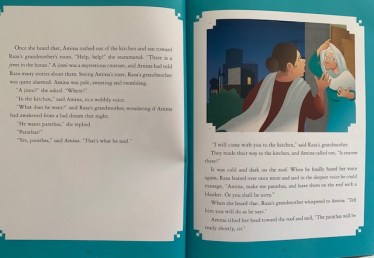
Raza embarks on a mission that involves him sneaking up to the roof, pretending to be a jinni and scaring Amina the cook through the chimney to convince her to send up food and a blanket.  

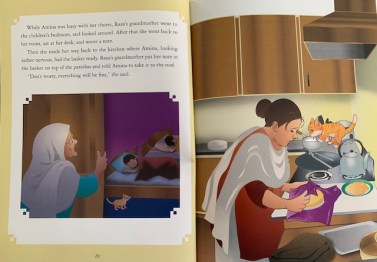
Scared out of her wits, Amina gets the grandma, culturally wards off evil, and delivers the goods to the jinni on the roof.  But the joke is on Raza who is out-witted by his grandma and gets the punishment of washing dishes for the rest of Ramadan, and learning that fasting a whole day will take a lot of will power, if he couldn’t even wait a few hours to get his beloved parathas.

IMG_3596

The book informs the reader that the following year Raza is able to successfully fast, that he is rewarded with gifts and that all is well and forgiven.  There is a glossary, information about Ramadan and a recipe at the end of the story as well.

I love that the plan just happens, it isn’t premeditated or considered, so it takes the reader along for the ride as it is unfolding.  It isn’t a deep story, but there is room for discussion as to whether Raza was naughty, or just caught up in the moment.

IMG_3597

The book is illustrated well and with big 8.5 x 11 pages, the book is engaging for first and second grade readers and listeners, as there is a lot of text on the pages.  The book takes a bit to find its stride as the author tries to use Urdu words, show their Arabic counterparts and then describe them in English. 

IMG_3598

There is a lot of cultural stage setting with everyone in grandmas house, the traditions of the family, of Ramadan, etc.  I think Desi familiar kids will get the most out of the book, but theoretically Muslim kids and non Muslims too could learn and enjoy it too.  I wish jinn and jinni were explained just a bit in the text, not just in the glossary, along with why an 8 year old wouldn’t be fasting or be required to do so. 

IMG_3599

My own kids, aged 8, 9, and 12, struggled on the first two pages, but when I told them to keep reading they zoomed through the rest smiling and ended saying it was good while giggling and shaking their heads.  We are Pakistani American and I think they enjoyed seeing familiar words and phrases in the book and sympathizing with Raza as well, and his sneaky plan that almost nearly worked.


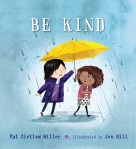
Be Kind by Pat Zietlow Miller illustrated by Jen Hill

Standard
Be Kind by Pat Zietlow Miller illustrated by Jen Hill

be kind

I usually post chapter books on Fridays, but on this one week anniversary of the horrific Mosque attacks in New Zealand, my fragile heart is being kept together by the pictures and notes shared on social media about the kindness people are bestowing on one another.  Company’s setting up prayer spaces for Muslim employees, communities standing guard outside masjids, friends leaving flowers for their Muslim acquaintances, strangers donning hijabs in solidarity, individuals carrying signs of welcome and unity, truly the list goes on and on.  Muslims and non-Muslims reaching out to one another, Kiwis and the rest of the world coming together.  And yet I know so many people are at a loss at what to do, and how to respond to their feelings in an appropriate manner.  I know I often am.  Thats why books like this one are so important for children to learn how to be kind.  We often tell them to be nice or kind, but what does that mean? What does that look like? How do we know if it worked? As adults we often don’t know, so while this book isn’t written or illustrated by a Muslim, there are Muslims in it, and that is why after seeing another blogger a few weeks ago mention it, I want to share it with all of you.  The illustrations show a little girl saying hi to a desi garbed man named Omar, and two hijab clad girls in her view of the world, amongst so many other diverse faces and characters, because that’s the point right? We are one, each of us responsible to one another to be kind.  

IMG_3389

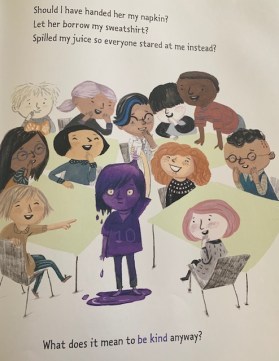
The book starts off with Tanisha spilling grape juice all over her new dress and a classmate being at a loss as to how to console her.  She makes what she thinks is a reassuring comment to Tanisha, but it isn’t received that way, and the little girl ponders and reevaluates what it will take to be kind to Tanisha and what kindness is in general.

IMG_3386

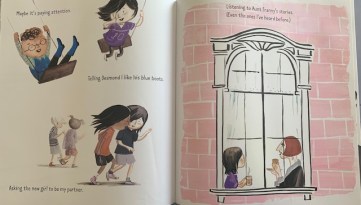
As she works to unravel what kindness is, she explores also what it can look like.  I love that it is seen in terms of action, giving ideas to stay with the reader.  It discusses that sometimes it is easy like saying hello, or not littering, and how important just using a persons name can make someone feel.

IMG_3388

But, it also talks about how sometimes kindness can be hard, requiring patience and a little bravery. I can only imagine how brave people had to be to enter a mosque for the first time and step out of their comfort zones to offer their support.  

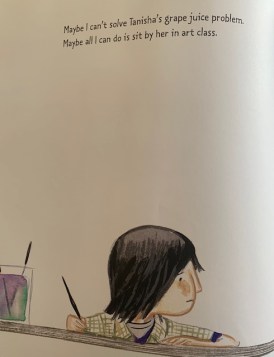
The book then takes an important pause when it acknowledges that maybe all this little girl can do to help Tanisha is to sit by her.  I think Muslims around the world are in awe of the Prime Minister of New Zealand for all she is doing, but also for just showing up and hugging people and listening.  A rare gift in todays wold of soundbites.  

IMG_3390

The little girl then imagines her small acts of kindness joining others and making the world a better place.  My favorite part is actually the end.  Tanisha never smiles and tells the little girl thank you, there is no big praise for being kind.  In fact, I bet the little girl doesn’t even know the power her actions had on the little girl.  We the reader know because we see Tanisha hanging the picture up in her room.  But, that let down is real life.  We can’t be kind because of the reward, we must learn to be kind because it is the right thing to do.  And often when people are kind to us, the effect isn’t instantaneous, its weight manifests in the dark when we are looking for hope and reassurance and for this book to contain all of that, in 32 pages with only few words (AR 2.2) is truly amazing.

IMG_3391

The illustrations are gorgeous and engaging.  The hardback 9×10 format makes this book a great addition to any library and should be read regularly.  It isn’t enough to not be mean, action and intention need to be taught so that we all might be more kind, inshaAllah.


Bashirah and the Amazing Bean Pie by Ameenah Muhammad-Diggins illustrated by Amir Doumy

Standard
Bashirah and the Amazing Bean Pie by Ameenah Muhammad-Diggins illustrated by Amir Doumy

bashirah

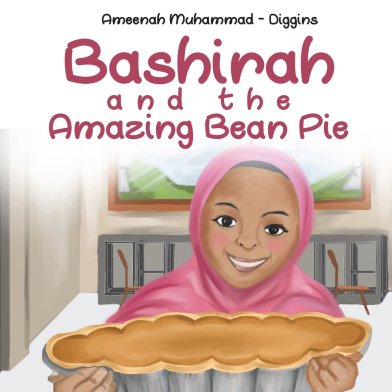
Oh, how glorious to learn something new while having things you know presented so well at the same time.  In 42 pages the reader will feel all the excitement of Eid (it doesn’t specify which one, nor does it really matter), sharing your culture with your classmates, participating in a family tradition, cooking with your grandfather, sharing with neighbors, and learning some life lessons about diversity from the Quran.  Ages 5 and up will enjoy the story and seeing Eid being celebrated, and older kids that know about Eid will love learning about bean pies and appreciate the African American Muslim culture, if they don’t already know about it, and those that do will hopefully feel proud to see it represented.  The best part is that there is a recipe at the end, that I can’t wait to try.

IMG_3237

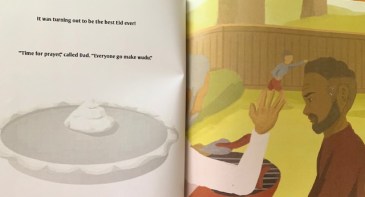
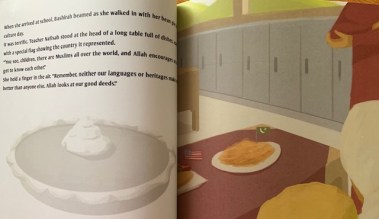
It is the end of the school day and the teacher is reminding the students that Monday is Culture Day and they need to bring a dish to share, over the weekend it is also Eid.  Bashirah is excited that this is the first year she will get to make her own bean Pie with her Pop-pop who is going to teach her the family recipe.

IMG_3238

At home Bashirah can’t stay still as her mom puts on the finishing touches of her Eid outfit, she is so excited for all the fun about to happen.

IMG_3239

Early the next morning the family all heads out to the Masjid for Eid Salat in their beautiful clothes.

IMG_3240

After prayers its cooking and eating time as Bashirah and Pop-pop make the pies and enjoy a big meal as a family.  Three generations make salat together, food is taken to the neighbors, and then the big reveal.  All the desserts, including Bashirah’s are served, and alhumdulillah it is delicious!

IMG_3241

Back at school on Monday the teacher reminds them all that, “neither our languages or heritages make us better than anyone else.  Allah looks at our good deeds.” She quotes Surah Hujurat, ayat 13 “Oh, mankind indeed we have made you into nations and tribes, that you may know one another.  Indeed the noblest of you in the sight of Allah (swt) is the best in conduct.” And they all dive in to the delicious desserts including Bashirah’s wonderful pie.

IMG_3243

My only criticisms of the book are the margins and the amount of text on the pages.  I have a hard time reading the book aloud to small groups as the margins are so small and run in to the binding.  Also, some pages have one sentence on them, some have nearly a half a page of text.  This disparity can be off putting at the start of the book to appeal to younger listeners and early readers.

IMG_3244

The illustrations are warm watercolor complimentary pictures.  There is nothing wrong with them, but I wish they were just a tad more defined and vibrant like the picture on the cover.  I love the warmth they radiate, but a little more detail would give the listeners something more to look at on the text heavy pages.

IMG_3242

All in all a great book that I am glad I own and can share with my own children and those in my community, now if I can convince someone to make me a bean pie I’ll really be set, alhumdulillah!


My Name was Hussein by Hristo Kyuchukov illustrated by Allan Eitzen

Standard
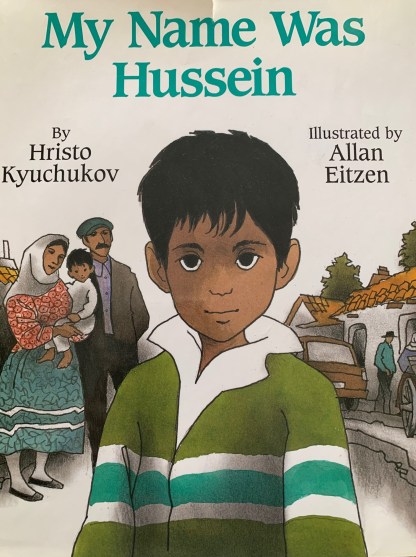
My Name was Hussein by Hristo Kyuchukov illustrated by Allan Eitzen

IMG_3215

It isn’t often that a 32 page AR 2.4 picture book will haunt you after you read the last page.  Especially a book with short simple sentences, that is poorly organized and reads like two separate nearly disjointed stories, but alas this book has stayed with me for months and upon rereading it to write this review, the images and empathy and reflections stirred have not lessened.  This is an important book to read, to think about, and to return to sporadically as your children and their understanding of the larger world grows and evolves.

IMG_3217

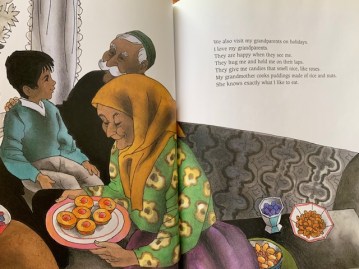
Hussein is a Roma, or a gypsy living in a small village in Bulgaria.  Their ancestors migrated many years ago from India and they are Muslim.  Hussein and his family love Ramadan and the delicious smells of food and warmth of grandparents and family all year round, but particularly during the blessed month.  

IMG_3218

Eid is the best, with family and fun and new clothes.  Hussein loves his life and his name.  It was his grandfather’s name and his grandfather’s grandfather’s name.  But then one day all that changes.

IMG_3219

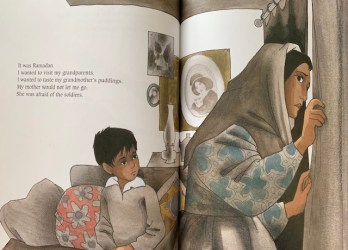
Tanks and soldiers with guns come to their village and close that mosque and tear up their identity cards and tell all the minorities that they must choose Christian names and give up their culture and identities.

IMG_3220

Hussein and his family do not want to give up Islam and their names and their traditions, but they don’t know what to do.  Feeling like they have no choice they change their names and Hussein asks the reader at the end if you would call him Hussein or Harry?  

IMG_3221

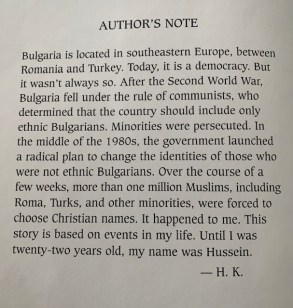
The last page of the book is an author’s note, and tells that this is based on his own life story.  That in the 1980s Bulgarian minorities were forced to change their identities.  That more than one million Muslims, including Roma, Turks and other minorities were forced to choose Christian names and that until he was 22 years old, his name was Hussein.

The illustrations are illuminating to the images that the simple words discuss.  Truly they are a powerful and integral part of the story.  The women wear hijab and the use of color to set the tone is spot on.  The book is hardbound and the 8×10 size allow the pictures to be enjoyed fully.

IMG_3222

The book published in 2004, was not easy to find which is unfortunate as it really sheds light on a recent history not known in the US at all, and one that should be known and remembered.  The first part of the book reads like a Ramadan story detailing iftaar and Eid and how Ramadan is celebrated by this culture, but the second half goes back to Ramadan and how it is different with the soldiers and the pressure to give up who they are.  There aren’t a lot of details about who the soldiers are or why they have come or what they are going to do to the Romas, but the fact that in recent history and this was what people were faced with, should be a powerful reminder to us all at how fragile this world is and make us appreciate that we aren’t forced to make such a decision.


The House of Ibn Kathir: The Competition Begins by S.N. Jalali

Standard
The House of Ibn Kathir: The Competition Begins by S.N. Jalali

IMG_3210

At 254 pages this boarding school story beautifully blends Islamic information, mystery, and compelling characters embarking on a new stage of their lives.  I was pleasantly surprised at how easy and engaging this book for upper elementary aged children reads and would strongly recommend it for grades 3-5.

SYNOPSIS:

Eleven year old Yusif is about to begin his first year at the prestigious Dar Al Ilm Academy a few hours away from his family, friends, and home.  Nervous to be on his own, he is excited to be giving his dream of memorizing the Quran the chance to become a reality.  When he arrives at the old mansion turned beautiful campus, he is paired up with Reda, a student to help him get situated and before you know it the two are fast friends.  When they get put in the same house, Ibn Kathir, with Warsoma and Daud, the four friends embark on a year of adventure and bonding as well as growth and learning.  Along the way they learn some Islamic history, they understand important hadith and Quranic Ayats and are challenged to live according to the sunnah even when tempers and frustrations abound.  When items start to go missing the boys and their house will have to keep their cool, not accuse anyone, but figure out what is going on all at the same time.  When the culprits are uncovered, they will be further tested to hold a grudge, offer forgiveness, or even extend an invitation to friendship. 

IMG_3211

WHY I LIKE IT:

This idyllic story and predictable mystery will appeal to impressionable readers that can’t see what is coming and can still be inspired by the beauty of such a protected environment.  The window might be small for such readers, but well worth the attempt as the book is well written and the characters well developed.  The boys are diverse and kind and helpful and all the things we want our children to be, especially when they are away from us.  Each character has their strengths and weaknesses and the friends accept them and celebrate one another rather than try and force them to change. The four houses and the characters vying for year captain and having fun along the way reminds me of a Harry Potter spinoff, but alas I think that is just my ignorance of the British school system.  I love that the four houses and their namesakes are detailed at the end as well as there being a glossary of terms.  There are illustrations every chapter or so that are appealing and offer a nice visual of the boys’ world.  The text, line spacing, chapter breaks and all are perfect for the demographic and while the fictional story is solid, I am happy to report I learned a number of things as well. 

IMG_3212

FLAGS:

None, alhumduillah

TOOLS FOR LEADING THE DISCUSSION: 

I can’t find much on the author or even on any future books, which is unfortunate because I think it would be great for an elementary book club selection, and I may read it to my 4th and 5th grade Lunch Bunch group after we finish The Great Race to Sycamore Street.  I think it should be in Islamic School Libraries and classrooms as its cover will hold its own and compel kids to pick it up off the shelf.

Book trailer: http://www.ibnkathir.co.uk/trailerfullhd.html

Book website:http://www.ibnkathir.co.uk/index.html