Tag Archives: Non Fiction

Little People, Big Dreams: Muhammad Ali by Isabel Sanchez Vegara illustrated by Brosmind

Standard
Little People, Big Dreams: Muhammad Ali by Isabel Sanchez Vegara illustrated by Brosmind

muhammad ali

A few things surprised me in this latest addition to the non fiction biography series Little People, Big Dreams. First that a police officer told him to learn how to fight if he wanted to face the thief that stole his bike.  Second, that the 32 page book targeting 5 to 8 year old children has an AR level of 4.8 and finally that it does mention his conversion to Islam and shows him praying.

IMG_7247

The biography hits a lot of major milestones in the boxer’s life after showing he once was a little kid too.  He was born in Kentucky, had a younger brother and after his bicycle was stolen he started learning how to box.  He wasn’t the strongest fighter, but he was fast.

IMG_7243

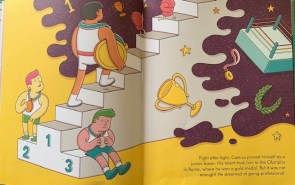
He won a gold medal at the Olympics in Rome, and then set his sights on being a professional boxer and becoming the world heavyweight champion.  Its nice that on this page the illustrations show that part of that pursuit involved physical training but the books and meditation show internal growth was valued and pursued as well.

IMG_7244

It shows how he used to taunt his opponents and that some thought it poetry, while other’s thrash talk. It also makes it clear that he used his voice to speak out for things important to him at a time when it was dangerous and accepted the consequences, whether it was African American rights or the war.

IMG_7246

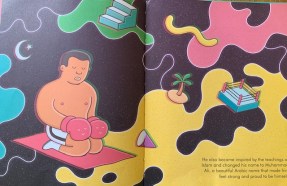
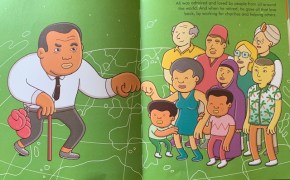
The page about him becoming Muslim explains that he was inspired by Islam, changed his name and “felt strong and proud to be himself.”  After his ban from boxing, he won the heavyweight belt three times before retiring and dedicating his life to community and giving back.

IMG_7248

The book ends with a timeline and some real pictures of Muhammad Ali, along with some other books you can turn to for more information.  The illustrations are comical yet detailed in their emotion and the information that is conveyed.  Kids will enjoy them and find they give life to the simple text on the pages.

IMG_7245

I got my copy from the library and my children aged 4-12 enjoyed the book as they have the other books in the series.

IMG_7249


The Unwanted: Stories of the Syrian Refugees by Don Brown

Standard
The Unwanted: Stories of the Syrian Refugees by Don Brown

unwanted

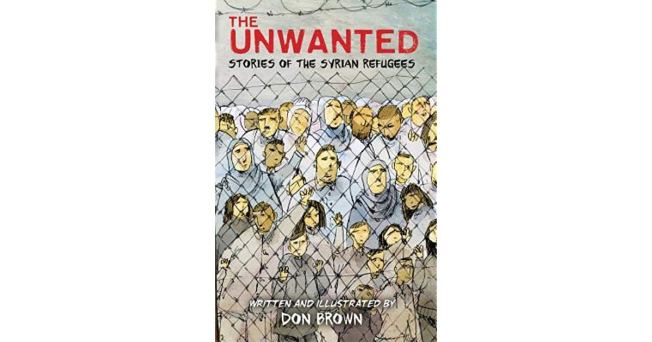
I try and keep an eye on what is available at Scholastic regarding Muslim characters and Muslim authors since for many kids the Scholastic Book Orders might be the most interaction they have with seeing available books, and for others, they may see a book in a library or other book store that they have seen on a Scholastic flyer and pick it up for that reason of familiarity.  Granted I might be completely wrong in this assessment and just be trying to justify my review of a non fiction 103 page AR 5.7 graphic novel that talks about Muslims and refugees, but nonetheless I try and read the Scholastic books that feature Muslim representation to a very captive audience.

IMG_6981

SYNOPSIS:

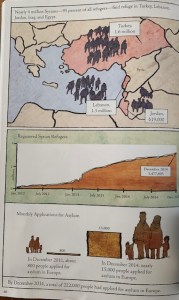
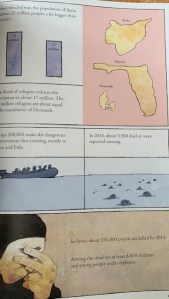
The book takes facts about the plight and flight of the Syrians as they are forced to leave their homes due to war, and the horrors they face on their journeys to finding a new place to call home, and illustrates them.  The book focuses more on the exodus than on the politics that forced them to leave.  There are no characters or story lines, but rather illustrations to the headlines, articles, and facts that detail the truths about the collective experiences of many Syrians.  It seems every single sentence is referenced at the back of the book, which is probably a good thing as it is non fiction and this is a researched book, not a book of anecdotal stories or an OWN voice retelling.

IMG_6985

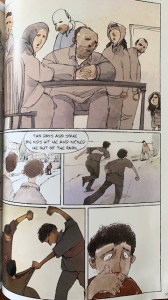
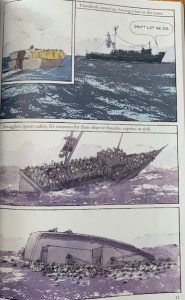
The book in muted tones tells how the young boys scrawling graffiti is what is attributed to the spark that set Syria ablaze with frustrated citizens standing up to an oppressive regime.  The pictures show different factions policing the people for trying to have pianos, to kicking people out of the homes and torturing them or killing them.  As the situation elevates and no end is in sight the book, then follows people leaving by foot into neighboring countries, and then fanning out as border countries refuse to let more people stay.  Eventually, many are forced on to rafts to countries further away, but as their resources deplete, many Syrians have no where to go and are unwanted.

IMG_6984

WHY I LIKE THE BOOK:

I like that it is real and graphic and violent, it doesn’t show everyone getting a happy ending.  I think many children’s books focus on the heroes trying to help or people having a happily ever after, but by upper elementary, readers need to know that the situation is dire and no resolution is in sight.  The author tries to explain the Sunni and Shia differences by using Christian divisions as examples, and he shows jihadists torturing people, and he does use statements about Islam and music, and I don’t know how a child would take these labels as they don’t come with much explanation.  On the other hand he does highlight that some countries would only take Christian Syrians, so I don’t think he is advocating one faith over another, but the details about Muslims for some reason seemed a little forced to me.

IMG_6983

I think his agenda or purpose was to show how the world, with the exception of a few countries, have really turned their back on refugees.  It says in a footnote at the end “that in the first three months of 2018,” for example, “the United States has accepted 11 (refugees) for resettlement.” The facts, the maps, the diagrams, really drive home the point and do evoke an emotional response, which I think is needed.  A few of the pictures are also incredibly resonating, such as the one of the man stating he couldn’t save his family from drowning.

IMG_6992

FLAGS:

The book shows violence and death.

IMG_6982

TOOLS FOR LEADING THE DISCUSSION:

The shortness of the book, might not make it an ideal candidate for a Book Club, but the value in such a book makes it a great addition to any and every classroom.  I don’t know how many children will read this book on their own.  It isn’t fun or compelling, its factual and depressing.  But, I think it is important.  Nonfiction is often hard to convince children to read, so I like that it is a graphic novel and I like that the information can all be verified.  I think children need to be encouraged to read things that might not be easy and fun, and have a way to discuss how such readings make them feel.  Furthermore, If you are a teacher teaching references, this book is a great example.


Malala’s Magic Pencil by Malala Yousafzai illustrated by Kerascoet

Standard
Malala’s Magic Pencil by Malala Yousafzai illustrated by Kerascoet

malala

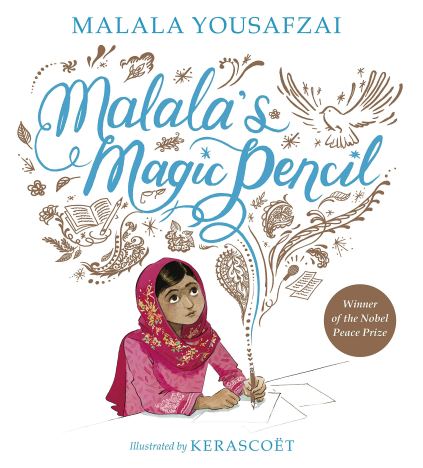
I’m going to try my best to review a nonfiction autobiographical book and focus on the story, not on the author because yikes, Pakistanis have strong opinions about Malala, and I have no desire to get pulled in to an argument.  I’m half Pakistani, I know the position of both sides.

IMG_6245

I have read both the Young Readers Edition and original I Am Malala books, so I didn’t jump to review this book in 2017 when this AR 3.6 40 page re-re-telling of her story came out.  After reading numerous other children’s books about girls in the subcontinent striving to go to school and be educated, I thought maybe the controversy had calmed down and I could read this large hardbound book a bit more objectively, and thus focus on the story a bit more.

IMG_6246

The book is listed as a biography, not an autobiography, so I’m not sure Malala even wrote the book, but none the less it is a synopsis of her story for younger elementary children.

IMG_6247

Starting off a bit like Harold and the Purple Crayon, Malala asks if the reader believes in magic, and then tells what she would do if she had a magic pencil to draw things that would make other’s happy like a proper soccer ball for her brothers and a way to stop time so she could sleep in a little longer in the morning.

IMG_6249

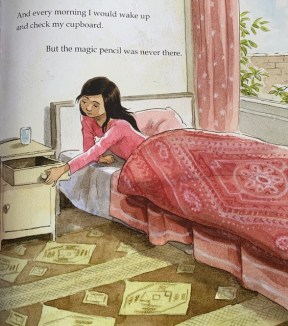
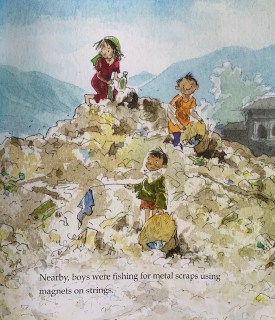
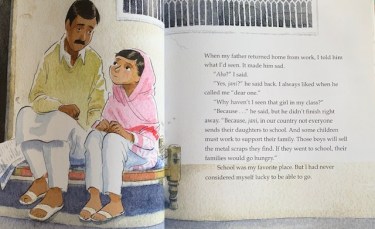
Every night she hopes for a magic pencil, and every morning she is sad one hasn’t appeared.  As she starts to notice the world around her she realizes that the kids looking for food and metal scraps in the junk yard, have it much much worse.  She asks her father about it and learns that if the children were in school their family’s might go hungry.

IMG_6250

As she notices “real” problems around her, her ideas for what her magic pencil could fix, evolves and develops into a burgeoning social conscience.  But quickly her naive outlook is changed when dangerous men start to appear on the streets and girls in her class stop coming to school.

IMG_6251

Her magic pencil finds real world power when she uses her words and her voice to make a stand and people start to pay attention.  The rest of the book highlights how she made progress despite the attempt to stop her and how she now uses her “magic pencil” to work to make a more peaceful world.

IMG_6252

The surface story is incredibly hopeful and would motivate young children to notice the world around them and do what they can to improve it. Inquiring children might be alarmed at children going through trash, or want a lot more information about who the scary men are and why they don’t want girls going to school and why she gets to travel around and tell her story. Information that is given at the end of the book in an afterwards of sorts.

IMG_6253

Most pages have sparse text and the ones that have a lot are kept on level and avoid being preachy.  Even the attempt on her life is present, but not detailed, sufficing to say that they tried to silence her, but failed.

The illustrations are beautiful and tell the story as much as the words do.  The book does not mention religion, but in the pictures where she is out of the house her hair is covered, but not when she is at home in bed and whatnot.  Obviously it is how she carries her self in real life.

Overall, I think the book is incredibly well done and inspiring to young readers.  Anytime a modern day figure can show children that they too have a voice and can use it, I think it is a good thing.  The fact that the voice comes from a minority, a female, a person with a name and culture different than the ones in most western children’s text books is also a plus.  I hope if nothing else it opens a window to children that there are a lot of amazingly strong and courageous people in all cultures and to seek out their stories.

IMG_6254

The Amazing Discoveries of Ibn Sina by Fatima Sharafeddine illustrated by Intelaq Mohammed Ali

Standard
The Amazing Discoveries of Ibn Sina by Fatima Sharafeddine illustrated by Intelaq Mohammed Ali

ibn sina.jpg

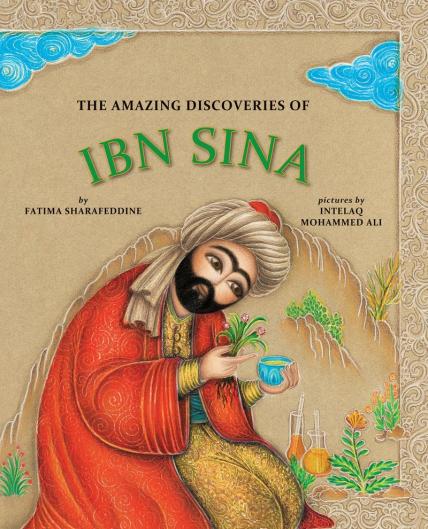
This non fiction, 32 page book is important in introducing 3rd graders and up to a very influential Muslim that shaped the world.  I try to keep to fiction reviews, but as someone who didn’t learn about Avicenna/Ibn Sina until college, I feel like the sooner we can inspire our Muslim children to know some of these remarkable historical figures and get their stories into western curriculums the better for us all.

IMG_5007

The book is told in first person and is translated from Arabic so parts are a bit awkward, such as when he is telling when he died, and parts do sound a little arrogant, but all that aside the book stays on task in describing Ibn Sina’s accomplishments and not getting distracted by historical, political, or cultural influences.  Some could argue that some context would be nice, but for 8 and 9 year olds, the facts are impressive enough and the streamline approach I think makes it something they can grasp.

IMG_5008

The book is beautifully done with a 9×12 hard cover and glossy pages.  The colored pencil pictures are beautiful and rich on most pages, with the neck and eyes a bit distracting on others.

IMG_5009

The book of course mentions his contributions to medicine but also includes his Islamic knowledge of memorizing the Quran and studying Islamic Law, cultural knowledge of knowing volumes of Persian poetry, architecture, literature, music as well as his extensive studying of philosophy, logic, linguistics, and more.

IMG_5010

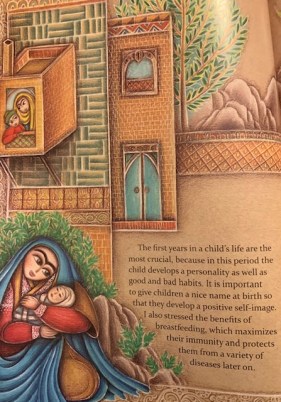
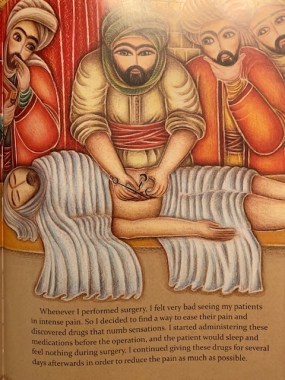
It also mentions some of his findings, which do a great job of showing readers how relevant and important his work was then and now.  Understanding how children should be educated, how infections passed, that light travels faster than sound, anesthesia for surgical patients, to name a very, very few.

IMG_5011

I checked out the book from the public library and made my kids all read it, well not the 3 year old, and I think Islamic school teachers and Muslim parents really need to try and expose their kids to his accomplishments, get them excited about how their faith promotes questioning and education and then work on getting historical figures such as Abou Ali al-Hussein ibn Abdullah ibn al-Hassan ibn Ali ibn Sina more widely known in the greater society.

The Young Muslim’s Mindful Book of Wellbeing by Zanib Mian

Standard
The Young Muslim’s Mindful Book of Wellbeing by Zanib Mian

wellbeing.jpg

This tiny book (5.5 inches square) is non fiction and I’m reviewing it, because I think it has a lot of value and will appeal to the parents that check out this site for book suggestions for their middle grade children.  The flower on the cover and the topic, might naturally turn away boys, but the depicted character that presents the information is a boy and while it is a token gesture, it is a nice one, to try and make the book and it’s contents appeal to all children.  Irregardless of if you have teens, or tweens, or toddlers, girls or boys, I think parents should read the book and use the concepts and framing presented when talking with their children.  At least that is what I hope to do.  One doesn’t need to wait until their child comes home crying from friend drama, or losing out on something they desperately wanted, to implement the lessons and reassuring bits of mindfulness, it should be the established foundation of how to handle emotions in a healthy way, inshaAllah.

SYNOPSIS:

The book is broken into 14 chapters based on topics covered, and the directions encourage the reader to read them all in order the first time through, then going back to certain sections as needed.  The headings include: How to be happy, A Way Out of Every Problem, How to Feel OK If You Wanted Something, but Didn’t Get It, Friends, Feeling Sad, and Talking to Allah.  The information is presented in a positive reassuring manner that helps the reader to feel like others have felt this way too, and to try some of the suggestions.  It doesn’t belittle or talk down to the feelings one might be having which is great, as the concept of Allah (swt) is incorporated onto every page.  Strengthening ones relationship with Allah as a way to cope with stresses and know that He is always there, is the central theme throughout.

The book offers advice on dealing with negative people, negative thoughts, and finding your own positivity and strength with the help of Allah no matter what.  The book isn’t dry though, it engages the reader and uses examples children can relate to and comparisons that are tangible.  At one point the book talks about shields that reflect back whatever you are giving off.  So when you are shining from the inside, you feel better, and so do others around you.  When talking about seeing the bigger picture, the book urges the reader to consider seeing an entire room through a key hole and likening it to how we see our own lives seeing only what is happening right now.

The book also takes into account that somethings may take work to feel better, and that it isn’t an easy fix to feel good, but inshaAllah worth the effort.  The end summarizes in two points what the previous 36 pages articulate and explore, concluding how to make you shine and be your best self.

WHY I LIKE IT:

I love that we are talking to and with children, not just toddlers, about their feelings.  We aren’t telling them to just cheer up or be happy or get over it.  We are giving them tools that they can carry throughout their lives, inshaAllah.  The pages are text heavy, granted the book is small, but the book is thick and the amount of words on the pages could intimidate some, but like I said earlier, even if the child won’t read it, parents will benefit from it and implementing it in the home.  Also just having the book sitting around will urge kids to pick it up and thumb through it, I would almost guarantee it.

My critiques are the presentation.  I am no expert on the content and what I read seemed logical, and I liked it.  Vague I know, hence I don’t review non fiction often, because what do I know?  As for the physical annoyances of the book, it is too small.  It doesn’t need to be huge, but for the topics covered, it is trivialized by the size, in my opinion. 

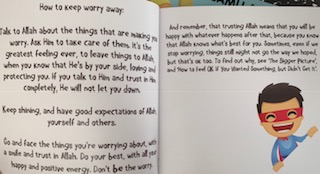
I don’t mind the font, I mind that it changes size so often and for no other reason it seems than to fit everything on the page.  Nearly every chapter is a different size font, but sometimes its even within the same chapter.  A few times for example the page on the left appears to be a size 14 font and the text in the same chapter on the right is like an 11, making it seem inconsistent and jarring..  If the idea needed to be bolded, or shouted or whispered, I support playing with font size, but this is not the case, it is so that the picture and text can all fit without having to turn the page, and its not the best solution I feel, its too distracting. 
IMG_2672.jpg

The other inconsistency that I found a bit odd, are the illustrations.  The little boy on the cover with his yellow flower and yellow shirt take you through maybe 80% of the book, but on occasion other characters pop up, which is fine, when they are drawn in the same manner, like the frog.  But the random appearance of the full color super hero, reminiscent of My Dad’s Beard book, and the full color Migo and Ali looking bears, there’s also a one time appearance of a girl in full color, seems bizarre.  I don’t see the cameos as adding a shoutout to the content and author, but more like the books from the 90s that used free clipart to illustrate the pages that otherwise would be text only. 

FLAGS:

None

TOOLS FOR LEADING THE DISCUSSION:

I think this would be a great book for a school counselor to use as a guideline for group discussions.  I think it could be done from the library, but a counselor and students would really benefit from the book and the manner in which the material speaks and empowers youth to shine.

Twenty-Two Cents: Muhammad Yunus and the Village Bank by Paula Yoo illustrated by Jamel Akib

Standard
Twenty-Two Cents: Muhammad Yunus and the Village Bank by Paula Yoo illustrated by Jamel Akib

22CentsCover

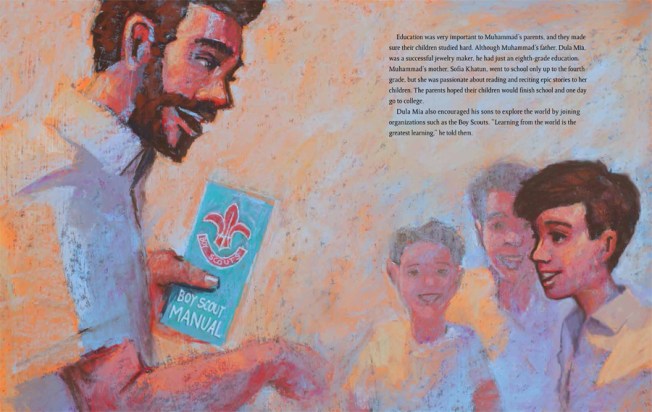
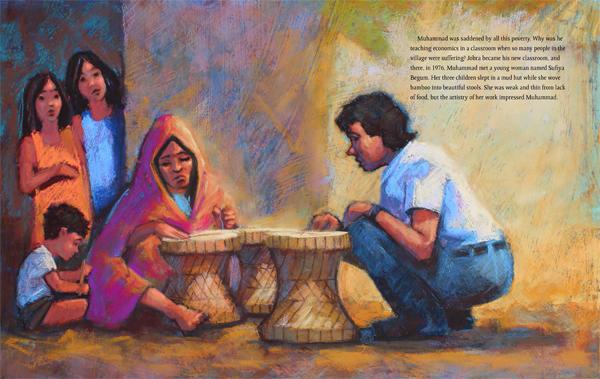
This 40 page biography written on an AR 6.5 level, tells the story of Nobel Prize winner Muhammad Yunus and his microcredit banking initiative.  The book topic is inspiring and for the most part the author does a good job of bringing it down to a middle school level. You can tell the author tries to flesh out Muhammad Yunus by starting the book with him as a boy, and relaying how he was raised and how his parents and boy scouts shaped him.  Despite her efforts however, at times it reads more like a resume, not a children’s picture book.

22_cents_3

Other than his accomplishments, and work history, I didn’t learn anything about him that made him relatable as a person, nor did I learn much about Bangladesh, or Islam.  And yes, I know it is a biography, but it felt like it was a void that needed filling.   I did learn about the program he started, a few of the obstacles that had to be overcome and I particularly liked that those receiving the microloans also had to learn about money, finance, and banking to pass a test before getting approved  And that 94% of those receiving the help have been women.  Grameen Bank is now a global bank, and the help he has given to so many is truly inspiring and something our youth should understand through humanitarian, economic, and compassionate lenses.

The title comes from the incident that brought Muhammad Yunus’ desire to help to fruition. He saw a woman weaving a beautiful basket, and learned that she could not afford the supplies to weave the basket, to sell in the market and as a result needed a loan.  Banks would not loan the equivilant of 22 cents because it was too small, and money lenders would charge so much interest, that after the basket sold, and the money lender repaid, there was scarce enough funds to purchase enough food for the family, let alone enough to buy new supplies, and thus the cycle was unbreakable.  He wanted to make her and those like her independent, not needing charity or the kindness of others to get her ahead, and thus the seven day course, test, and microcredit system evolved.

22 inside

The illustrations I think are both rich and well done.  The effect of the watercolors flesh out the text heavy pages with detail, but don’t create a distraction from the concepts and accomplishments being presented.  Following the story is a two page afterward telling additional awards and continuing the story of Muhammad Yunus with two real life photographs.


Lost and Found Cat: The True Story of Kunkush’s Incredible Journey by Doug Kuntz and Amy Shrodes illustrated by Sue Cornelison

Standard
Lost and Found Cat: The True Story of Kunkush’s Incredible Journey by Doug Kuntz and Amy Shrodes illustrated by Sue Cornelison

kunkush

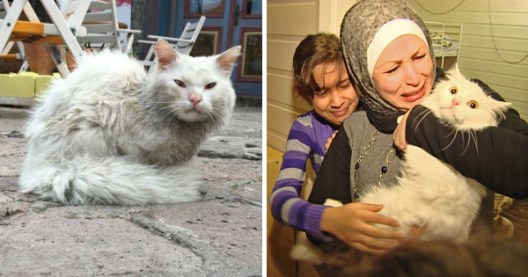
Often children’s stories of refugees fleeing war are hopeful in a forced way that seems to want to protect them from the reality of what is going on in the world.  As adults we often cling to the ones with happy endings for our children and for ourselves, because the tragic ones are too numerous and overwhelming to comprehend.  This book marvelously does a great job for those older children in the middle that are beginning to understand the world around them, while not bombarding them with the severity of how cruel we can be to one another.  This true story instead focuses on a beloved cat and all the humans of different backgrounds, all over the world that help reunite her with her family.  Giving hope, but also showing the difficulty in the world, and the effects even one person can have in making a difference.

cat

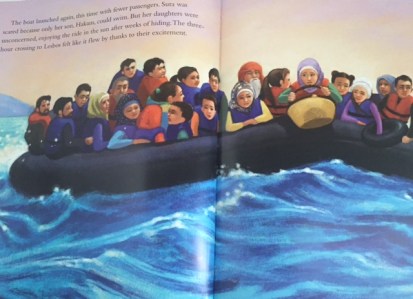
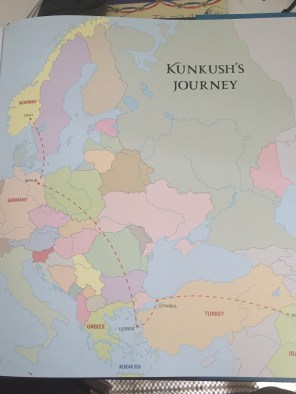
Kunkush’s family goes to great pains to get themselves (all 6 of them) out of Mosul, and away from the war.  That the fact they sneak their beloved cat with them, shows just how much a member of the family he is. They drive through the night, and walk for days over a mountain, they reach a Kurdish village where they sneak the cat on a bus to Turkey, they then have to cross the Aegean Sea to Greece, only to land in Lesbos and have Kunkush disappear.  The family searches as long as they can, but alas have to move on to their new home.  From here the story switches from following the family to following the cat and all the people determined to reunite him with his family.  Unfortunately, they don’t know where the family is.  Amy, a volunteer, takes the cat to the vet to get cleaned up, and then creates an internet campaign to try and find his family.  People from all over the world donate to his care, and his travel expenses.  Eventually, Amy takes the cat to Germany, where many refugees have resettled and continues her search.  Finally, word gets to the family in Norway, and Doug, a photographer, arranges to fly the cat to her new home. Alhumdulillah.

img_3838.jpgOne could argue that countless people are misplaced each day due to war, and we overlook it because it is easier than dealing with it, so why care about a cat.  And to that I challenge the skeptic, animal lover or not, to read this book and not have your heart-strings tugged.
IMG_3839The book is done beautifully.  The pictures are warm and endearing and are the only proof that the family is Muslim, by their hijabs.  The love the family has for their pet is expressed in the illustrations, and even more so by the real photographs at the end of the book following the Note from Doug and Amy.  At 48 pages the book works really well for 3rd grade and up (it isn’t AR) who can marvel at the cat’s journey.  I particularly think this book is a great way to show children another aspect of refugees.  There are a fair amount of books that talk about the refugee experience or show refugees getting adjusted to a new home.  But, this is a great way to show that refugees are not just defined by a word.  They are vibrant individual people just like everyone else.  By focusing on the cat and his journey, the reader sees what a refugee goes through, particularly this family, and hopefully will stop and think about it.   But it doesn’t just show the family in that capacity, it shows them as a vibrant family who loves and desperately misses their cat- something more children may be able to relate to.
kunkush (1)

Nasreen’s Secret School: A True Story From Afghanistan by Jeanette Winter

Standard

nasreens secret school.jpg

It is widely written about, even amongst children’s literature, that in parts of the world, girls are not allowed to go to school, but that many find ways to do so anyway.  What sets this book apart is that it is based on a true story, and while there is some hope for Nasreen, overall it is a really melancholy tale without a happy ending.  At 40 pages, author Jeanette Winter once again conveys a story that shows compassion instead of judgement and undeniable admiration for her characters.  Written on a 4.2 level, the story packs a lot into small, simple sentences, and her illustrations do not shy away from the realities of Afghanistan.  While I was surprised to see that twice the book was challenged, in 2014 and 2016, for showing Muslims praying and for violence, I was glad that it was never banned.   The strength and determination of Afghani women should not be silenced, it should be shared and celebrated.


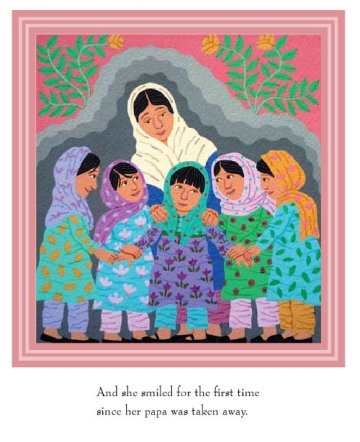
The story is told from the point of view of Nasreen’s grandmother.  She is heartbroken that her granddaughter is not allowed to attend school and practice the arts as she was, and even her daughter-in-law, were able to do as children.  Since the Taliban has come things are dark.  Things get worse when one night soldiers come and take Nasreen’s father with no explanation.  When he doesn’t return, Nasreen’s mother leaves to find him, displaying her own strength to independently take on a society that doesn’t permit her to go out alone.  Unfortunately she does not return either, and Nasreen stops speaking.  Grandma learns of a secret school for girls.  Determined that Nasreen should know of the outside world, great risks are taken for many girls to learn in a private home a few doors down.  Dodging Taliban soldiers and neighborhood boys helping keep their school a distraction starts to pay off as Nasreen finds a friend and starts to open her heart.  The book ends with mom and dad still missing, but hope for Nasreen to see through the window education has opened for her, inshaAllah.

secret2


Malcolm Little: The Boy Who Grew Up to Become Malcolm X by Ilyasah Shabazz illustrated by AG Ford

Standard
Malcolm Little: The Boy Who Grew Up to Become Malcolm X by Ilyasah Shabazz illustrated by AG Ford

malcolm-little-9781442412163_hr.jpg

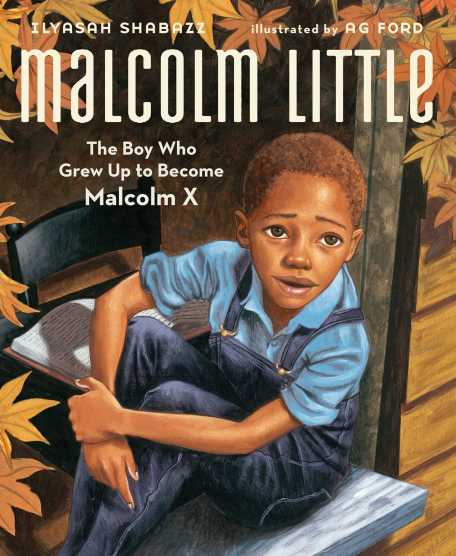
I had hoped to have a handful of selections to review for Black History Month, but alas I started too late in collecting titles, inshaAllah next year I will be better organized.  I did want to share this beautiful book though, as a great story of hope and love, that I don’t think is often included when we study Malcolm X or talk about him today.  This is the story of his parents and the philosophy of equality they tried to raise him in before hatred and bigotry destroyed his family, before he went to prison, before he became “Detroit Red,” a member of the Nation of Islam, before he became a civil rights leader, a Muslim, before he became Malcolm X.  This is a story, based on love, written by his daughter to give children of all ages something to think about.

malcolm-louise-300x300

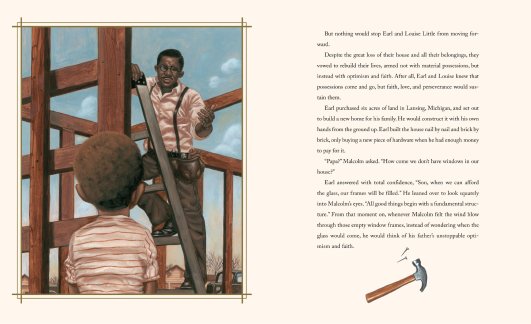
The story of Malcolm Little, is a story that I feel cannot be rushed, it is very heavy in text and at 48 pages, the warm beautiful pictures make it accessible in pieces to younger children, but it is written on an AR 6.5 level (sixth grade fifth month).  The book tells about how his mother and father met, believed in universal equality and justice, and started a family where these values took center stage.  The family suffered for their beliefs and their home was burnt down, but they rebuilt and the family continued to find strength and see the power of possibility.  The books shows the lessons taught in everyday activities such as raising a garden, doing laundry, reading books, doing homework, and even fishing.

When Malcolm’s father was killed, however, and his mother taken away, the family was forced to separate and Malcolm to deal with an unwelcoming world, more or less alone.  The book ends with Malcolm in 7th grade so, to young readers who have maybe only heard his name in passing the book is full of hope and roots for the man he would become.  It is almost a fairytale start to a man who would be cut down in his prime years later.  They will understand how unfair society treated his family, how warm and educated and strong his mother, Louise was, and how inspiring his father as a preacher was. The takeaway will be how Malcolm’s upbringing and personality allowed for him to rise up and refuse to stay down during horrific events in his life.

malcolmx.jpg

For older elementary and middle schoolers it is a story of possibility, of how quickly things can change, and the effect of hate.  They should also see how institutionalized and normative the oppression of African Americans was and how it really wasn’t that long ago.  When Malcolm’s English teacher Mr. Ostrowski tells Malcolm that he as an African American should not have such high expectations, readers should realize that the acts of the Ku Klux Klan may be viewed as “extreme” but society as a whole was systematically enabling such bigoted acts.  The lessons passed on to Malcolm by his parents are universal themes of hope and love and equality that still have to be stood up for today, and even young listeners can grasp that, and also grasp that because of their skin color alone they were seen as second class citizens.

The book shows depth to a historical character that gives some insight to what made him so dynamic.  Many young readers will be surprised at how quickly Malcolm’s world unraveled, and some of the reasons why, while empathizing with the injustice of it.  The Author’s Note at the end is also fascinating as it details the family members and their stories about the characters in the book.   I liked the softness of the book and the smaller lessons for children that it presented.  It didn’t shy away from the violence and prejudice that the Little family faced, but presented it through a lens of optimism to hopefully inspire children to carry on with the social activism that still needs to be done.


Malala: A Brave Girl from Pakistan/Iqbal: A Brave Boy from Pakistan by Jeanette Winters

Standard

Malala Iqbal

Again I break from my fiction preference to review another book about these two remarkable individuals: Malala and Iqbal.  In this beautiful book linking two brave children from Pakistan, Jeanette Winter’s brings their stories to a young audience in a powerfully simplistic way.  Written on an AR 3.6 level, each story is 20 pages and presented in a flip book format.  Before each story there is a brief Author’s Note about each character in a broader view, for context to be given as needed to the adults to share with the children listening to the book, or for older children to read and deepen their understanding and appreciation.  The sentences are short and the font and presentation is inviting to even early readers.  The pictures are wonderful and do a tremendous job showing the intensity of the environment Malala and Iqbal face, while not frightening the reader.

The Malala portion of the book starts with the Taliban asking for her on the bus and like her biography, then takes the reader to the threats and deterrents they made to girls in school, but on an audience appropriate level.  It tells how they stopped wearing uniforms so that they could be harder to identify and how even burning the girls school didn’t stop them. It then returns to her being shot and going from the hospital in Swat to one in England.  It concludes with her speaking to the U.N. on her 16th birthday.

Malala

The story of Iqbal is a bit harder I think for children to understand as they may not know what a loom is or have ever thought about who makes carpets.  Also the words bondage, Peshgi, outlawed, and mourners are not in their vocabulary .  They should understand that he is sold for an unpaid $12 debt, but that too may need to be stressed and explained. If the kids can grasp this, I really think children as young as kindergarten can appreciate his story.  I love that the author didn’t shy away from the fact that he was shot and killed.   Even if they do not understand all the facets that make Iqbal’s work so incredible.  They will feel inspired that someone so young was so brave.  Iqbal