Tag Archives: Non Fiction

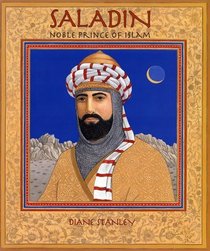
Saladin: Noble Prince of Islam by Diane Stanley

Standard

saladin

This is a beautiful historical biography of Salah al-Din, known in the west as Saladin, that I felt worth sharing despite it not being fiction.  Written on an AR Level of 7.0 the 48 pages are highly wordy, and cover a lot of historical ground.  There is a post script, a glossary and bibliography at the end.  The pictures are detailed and bright and inviting, but even for a 7th grader, I think the book would be a challenge.  If one has an interest in the time, or has studied it and knows some of the supporting characters, the book in fantastically interesting, and insightful for the format.  To an average middle school or even high school student, they might thumb through it and keep it on the shelf as a reference tool, but that might be about it.

Saladin inside page

With any historical account, particularly those trying to simplify and appeal to children, the author gets to pick in what historical light to present the events.  The book starts with an Author’s Note detailing the fight for Jerusalem up until the first crusade. It then begins with the story of Saladin’s life.  Born in 1138, he was named Yusuf ibn Ayyub, and then tells a bit about his upbringing and the basic tenants of Islam.  It explains how he came to power and how the truce with the Franks was broken by Reginald.  It then details the battles, the follies and plans of both sides.  It shows the honor that Saladin had for his enemies and even the respect he had from Richard the Lionheart.  It shows the politicking in Europe and the toll of the Crusades on the people there and in the Middle East.  The book also tries to show Saladin outside of his battle armor as a family man who was devoted to his wife Ismat.  “When she (Ismat) died, Saladin was lying in his tent, seriously ill.  His advisors kept the news from him for three months, until he was fully recovered, for fear the shock might kill him.”

Saladin died in 1193 and  knowing that he was dying he passed on advice to his son oh how to be king.  “Win the hearts of your people and watch over their prosperity; for it is to secure their happiness that you are appointed by God and by me. . . I have become as great as I am because I have won men’s heart’s by gentleness and kindness.”  The book states that he was so generous and unconcerned with money and luxury that when he died he didn’t even have money to pay for his simple burial.  

Admittedly I know very little about the historical accuracies or slant of the author.  I do know that it does inspire pride for Muslims and hope that people of different faiths can one day again co-exist in Palestine and the world, inshaAllah.


The Grand Mosque of Paris: A Story of How Muslims Rescued Jews During the Holocaust by Karen Gray Ruelle and Deborah Durland Desaix

Standard

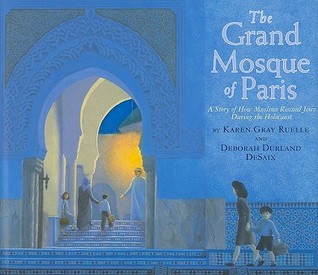
The Grand Mosque of ParisThis beautiful, beautiful book tells of a little and sparsely known event in history.  During the holocaust The Grand Mosque of Paris served as a place of refuge for many North African Jews.  Many who passed through the vast gardens and beautiful Mosque were given fake documents of conversion, tombstones with their family names inscribed, and access to truly underground passageways (subterranean mazes), as the Muslims of Paris offered assistance to keep their Jewish brother’s and sister’s safe from the Nazi regime. Many of the stories were recently uncovered and with the passage of time, so much of the information has been lost.  As a result the book is a bit choppy, each page tells what is known about the Muslims’ assistance in some capacity, but does not flow to the next page.  So there are generalized recountings of children being hidden with other families, the efforts of the Kabyle Ressistance (Berbers from Algeria) to smuggle Jews to safety, etc.. There are also a few specific examples of Salim Halali, a young Berber Jew from Algeria, two friends one a Muslim the other a Jew seeking shelter, a Tunisian Jew who stayed at the Mosque for over two years,and a few others, but with the exception of the use of the Grand Mosque and a Doctor Ahmed Somia very little flows throughout the book.  Thus making it more of a historical account than a story.

Truly the book would not work for story time, it is geared for children (and adults) ages 12 and up,  it has an AR level of 7.1.  I would imagine it would be an amazing addition to any class studying World War II and finding the humanity offered in one of the bleakest times of our world.  It should, in my opinion, be standard required reading in Islamic School curriculum to supplement WWII study.  The hope and pride one feels when reading this book, shows how rich our faith’s are in coming together.  It would also work in understanding how history is lost, and the importance of perserving it.  There is an Afterword on page 34 that is very informative and interesting.  It is followed by a Glossary, Acknowledgements, References, Bibliography, Recommended Book and Films, and an Index.

The book also sparked my interest to know more about, not just how Muslim’s helped Jews during the Holocaust, but also how Muslims were treated in France.  The book says, “The Grand Mosque shimmered like a mirage, the white domes and the glittering mosaics of the minaret in stark contrast to the muted colors of Paris.  When the mosque was built in 1926, the North African countries of Algeria, Morocco, and Tunisia were under French rule, and many Muslims had come to Paris from those countries.  The land for the mosque was given by the French government, in exchange for a symbolic payment of one franc, to thank the half-million Muslim soldiers who had fought for France during the First World War.”

The Grand Mosque of Paris1.jpg

I have already read the book more then once, and gone back and read passages multiple times.  It is as fascinating as it is informative, and a great addition on any book shelf.


How to Get Hijab Ready: A Guide for Muslim Girls Ages 8 to 11 by Aisha Elwan & Megan Wyatt illustrated by Sarah Hafeez

Standard

How-to-get-Hijab-Ready

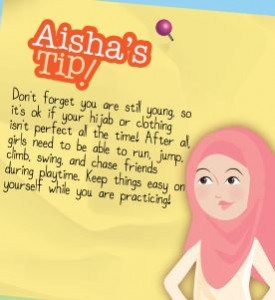
Yes I know it isn’t fiction, but How to Get Hijab Ready is such a fabulous and much needed book that any positive attention I can direct toward it, I feel is effort well spent, Alhumdulillah.  The book is obviously meant for 8 to 11 year old girls contemplating hijab.  The beauty of this how-to book is that it answers everything from how to accessorize one’s hijab to dealing with bullies in a beautiful manner.  Not only are the pictures bright and colorful, but the presentation is clear, precise and inspiring.  The authors do not talk down to the readers, nor do they make it seem like a burden as they discuss hadith, ayats from the Qur’an, challenges and fashion sense.  The book is divided into sections: The Basics, Getting Started, Having Conversations,  Worries and Concerns, and finally Your Reward for Good Deeds. Each section addresses different topics and “Aisha’s Tips” are scattered throughout to give 12-and-a-half-year-old Aisha’s tips on the subject at hand.

Aishas-Tip-275x300

Truly this book is a gift to moms and daughters alike.  I plan to let my daughter look through it for a few days and then sit down with her to discuss.  It functions as both a how-to manual as well as a reference guide and I can see it being looked at A LOT.  Additionally I can see my daughter discussing it with both Muslim and non-Muslim peers.  I think the book offers confidence, direction, and pride as young girls will find inspiration from young Aisha while having many of their concerns about hijab answered in a fun, hip way.

My only criticism is that it wasn’t around when I was a young girl.  For some hijab is an unknown, for some it is a stress, and for some it is a natural expression of faith, and subhanAllah this book in just 51 colorful pages manages to convey information, smiles, and excitement irregardless of your background.

project-708-body-Screen_Shot_2015-02-21_at_11.49_.38_AM_

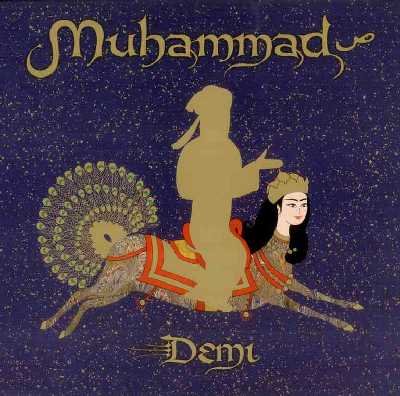
Muhammad (SAW) By Demi

Standard

muhammad-cover-pic

This book attempts the enormous task of creating a picture book biography for kids about Prophet Muhammad (Peace and Blessings Be  Upon Him).  While the text seems adequate and engaging for children with a basic knowledge of RasulAllah’s life, I think it would overwhelm any young non-Muslim reader.  The story starts with Prophet Muhammad’s birth and tells about the major aspects of his life, both as a family man and as a leader.  The text includes ayats from the Qur’an and hadith.  THe information is presented as fact, it doesn’t preface statements by saying, “Muslim’s believe,” making the book a solid, yet dense, book for Muslims of all ages and a good introduction to Islam and Prophet Muhammad (pbuh) for older non-Muslims as well.

The book has an AR level of 6.7 and is beautifully illustrated.  Some of the illustrations are borderline irreverent, but it is clear that Demi truly respects the Islamic tradition of not depicting Prophet Muhammad (pbuh).   I think it is more jarring because most Islamic books do not depict the angels, buraq, or any of the prophets, where Demi does in her book.  Prophet Muhammad is depicted by a gold silhouette and the proper blessings are bestowed upon him whenever mentioned in the text.

Demi includes a foreword at the begining of her book that explains some of the diction choices and background on the artistic style used, there is also a bibliography at the end of her 42 page story.  The book is ok for independent readers or in small groups to discuss, however for anyone younger than 3rd grade, it is probably just too much information.

Ramadan by Susan L. Douglass Illustrated by Jeni Reeves

Standard

ramadanThis is a non Fiction book about Ramadan that is thorough and accessible.  It has an AR level of 3.7 (third grade, seventh month), and with the short sentences and well-spaced text, I wanted to include this book so that those looking for an informative book for their independent readers (second grade and up) would consider this one.  At 48 pages, the book isn’t divided up into chapters but there are headings that keep the book flowing from one topic to the next. The illustrations supplement the text giving them context and there is a list of “New Words” in the back making this book appropriate for Muslim and non Muslims alike.  

Overall a good read for those looking to learn more about Muslims and Ramadan, or for those looking to see themselves in a book that isn’t too childish. The book is clean and factual, and keeps a nice balance between giving solid information and overwhelming the reader with details.  The book also includes examples of Ramadan in other countries as well as students fasting in America.  We have this book in our school library and the students that have stumbled upon it are excited to check it out, and when they ace the AR test they are absolutely beaming.  


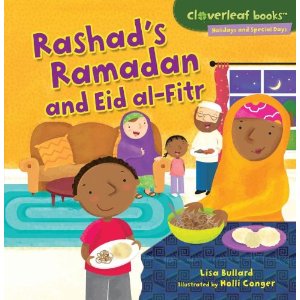
Rashad’s Ramadan and Eid al-Fitr by Lisa Bullard Ilustrated by Holli Conger

Standard

rashads ramadan

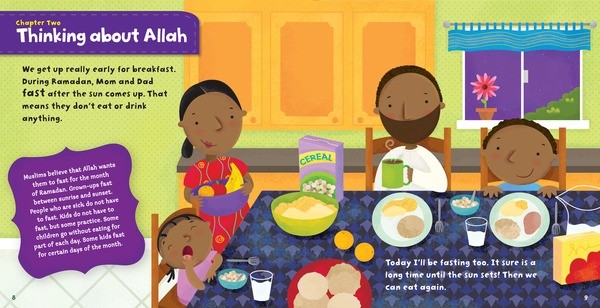
This is a non fiction picture book that tells a very basic story about Ramadan through Rashad’s young voice, with informative sidebars giving facts and details about Islam, Ramadan, and Eid. Broken into four chapters the book is very concise at just 24 pages, highlighting the key aspects of Ramadan: Where’s the Moon, Thinking About Allah, Thinking About Others, and  A Big Celebration.

?????

With an AR level of 2.7 this book is perfect to read along with your child, Muslim or non, letting them read the story, and you adding the information and answering any questions they may have about Ramadan.  There is a glossary in the back, as well as a page of “Resource Information” to learn more.  It may seem a bit “childish” for some, but it is a great introduction, and/or a good review of the basics for toddlers to third grade.

The pictures are bright and colorful, yet simple enough to not overwhelm the information being conveyed.  They definitely make you smile to see the little smiling faces and convey the excitement of the holiday.

Traveling Man, The Journey of Ibn Battuta, 1325-1354 By James Rumford

Standard

travelingThis is a fascinating book about 14th century explorer Ibn Battuta. Born in Morrocco, Ibn Battuta, travelled to China, Russia, through Africa, totaling some 75,000 miles in all and returning to document his travels and lessons. A devout Muslim he performed Hajj and saw the beauty of Islam in much of his travels. The book is beautifully done, as the words flow around the pages in both English and Arabic calligraphy. The story is simple enough to be read aloud in a Social Studies class or poured over independently time and again. It has an AR level of 4.0 and I think if it correlates with a lesson about Ibn Battuta, or is read in conjunction with lessons of Marco Polo and even Christopher Columbus, the book will be well received. I can’t forsee anyone younger than second grade truly understanding his journey, and how remarkable it was then, and still is today. This non-fiction book is clean and imaginative in summarizing his travels. Adults as well as children will spend time analiyzing the pictures and maps included in this 34 page book.

I Am Nujood, Age 10 and Divorced By Nujood Ali with Delphine Minoui

Standard

nujood

I don’t often read non-fiction, but like I am Malala, I am Nujood , Age 10 and Divorced seemed too compelling to turn down, plus it isn’t a long book, just 188 pages even with the epilogue, reading group guide, notes and acknowledgements.  Written on a 6.2 reading level, the story of this young girl, is not well developed.  Her plight is powerful, but the telling of her story is awkward, unrelatable and in no way does her justice.  I never felt a connection to Nujood, naturally on the premise I was cheering her on, but I would have cheered anyone in her position on.  I don’t feel like I know her, or know her family, or really any characters in the book.  It seems that Delphine Minoui  tried to write the book as if she were Nujood, a ten year old with minimal education,  instead of finding away to balance Nujood’s voice and story, while adding the detail and back story to give the reader a connection and understanding to what and why this was allowed to occur.

SYNOPSIS:

Nujood is a Yemeni girl from the small mountainous village of Khardji, after scandal rocks the sister just older than Nujood, there are too many kids that the order and ages of them all is a mental workout for her mother, the family leaves everything and moves to the city of Sana’a.  Poor and with little hope, Nujood is given/sold to a man three times her age.  After months of abuse she sneaks away and finds a judge at a court house where she finds courage and her voice to proclaim, “I want a divorce.”  From there she must recount her story to both lawyers, journalists, and anyone that can help her as she works to break a long tradition of girls marrying young and save herself.

WHY I LIKE IT:

I like that something that is perhaps a societal norm in Yemen was made public and that we can hopefully now do something to help these young girls.  I don’t think it would work as a book club book or a novel study in a middle school setting as the details of rape and drug use are present.  They are not explicit, but I think that sharing excerpts from the book would be sufficient in explaining why this is such a tragedy and needs to be stopped.  The characters are all Muslim with various levels of belief and practice. While sad and heartbreaking, her story is hopeful at the end.

FLAGS:

Details of her rape, her sister’s affair is mentioned, and some minor drug use is common amongst the men.

I am Malala By Malala Yousafzai and Christina Lamb

Standard

malala pic big

Naturally we all have heard Malala’s story and while some are inspired by it, some seem to have major hostility toward her and her approach.  Chosing to take her at face value and be inspired by her, I was generally looking forward to reading her story before I ever entertained thoughts of using it as a teaching tool in a school.  It is an AR reading level of 7.1 so once I obtained the book I rushed to read it before the end of the school year to see if perhaps our 7th and 8th grade students could read it and leave for the summer realizing the blessing that an education can be from someone who has had to risk it all, just for the chance to learn.  However upon completion I think that the dates, and history of Pakistan would ultimately drag the book on for the majority of Middle-Schoolers and her message and inspiration would be lost.  For adults looking for a book club book however, I would highly recommend it.  As a half Pakistani-American growing up spending my summers in Pakistan, I could relate and recall so much of what she wrote about.  I think most adults of any background would similarly be able to recall major news events, and be able to follow along.  I think anyone younger would find it incredibly difficult and possibly dull to get through.  I think that students would benefit from learning about her story and then only reading excerpts from the book.  There are some very moving sections that I think the average middle schooler would be impacted by, and the included pictures amongst the 327 pages would give them a glimpse into her world.   I on the other hand, couldn’t put it down, the book reads very quickly and bounces around all over the place, which actually didn’t bother me, I enjoyed her descriptions of her town and family and friends.  While Malala wrote it with an author, I think the tone is very much that of a young girl and thus the style works for me.  Political views aside the book made me smile, made me cry, and makes me feel better off having read it.

SYNOPSIS:

Malala is a Pashtun girl in the Swat Valley in Pakistan.  In a culture that keeps females behind doors and cloth, her father is the anomaly and encourages her to be educated, free, and vocal.  As 9/11 occurs, the Taliban sets in, the west wages war on Afghanistan, Osama bin Laden is killed, governments change in Pakistan, floods and earthquakes destroy the land, Malala and her family struggle to survive, improve their community, and advocate for the right of women to be educated.  All this climaxes in the Taliban boarding her school van and shooting her in the face at point-blank range.  She is then rushed to various hospitals before being taken to Birmingham, England. 

WHY I LIKE IT: 

It gives hope and shows that there are people making a differences and despite the risks, do want to change things in the world.  It is a great example that one person can make a difference.  Her family and her are active Muslims, that reflect on the Quran and try to understand where the Taliban is wrong in their interpretation.  Religion is a defining factor in every aspect from personal to culturally to government, and presents just how different each person seems to manipulate religion to their own benefit.   It might seem odd for some that she is writing this memoir of sorts when she has barely lived a long enough life to reflect back upon.  It also is perhaps overly optimistic as the story is ongoing, what she will do now is unanswered because it is not yet been given a chance to unfold.  I think the story is strong enough to cut through the criticism, and can be very powerful from both a child’s point of view, and from her parents.  Most readers if they can get through the intermingling of her story and that of her country will be affected by her plight.

FLAGS:

Violence, but done in a newscast style, not overly sensationalized, but details are given.