Tag Archives: Muslim Friends

Samira’s Trip to the Masjid by Yara Kaleemah illustrated by Aveira Cartoon

Standard

img_8520

I’m a big fan of books featuring BIPOC leads in everyday situations, but when the quality of the product is subpar, I truly am conflicted if I should mention the book, or just tuck it away and pretend I never read it.  I’ve had this book tucked away for a while now, but I am pulling it out to bring attention to the importance of editors, proofers and revising.  The bar has been raised, Islamic fiction is becoming more and more mainstream.  The quality of many self published books rival and exceed traditionally published options, that to be putting out content that contains grammar errors (missing words, punctuation, random line breaks), spelling errors, voice and point of view inconsistencies, illustration errors, and content mishaps in a 26 page picture book, is not acceptable.  I feel like you are hurting the goal of representation and reflection, more than boosting it, when it is not well done.  I know that is harsh, but sadly minorities always have to do things better, it isn’t right, but it is the way it is.  You can argue my opinion that the story is too wordy or text heavy, but the technical components and final package in a $12 book, really need to be resolved.  The overall concept of the story is lovely: the Islamic details, the reminders about the sunnahs of Jummah, the little girl being excited to wear her favorite scarf and see a friend at the masjid, it really had a lot of potential.

img_8522

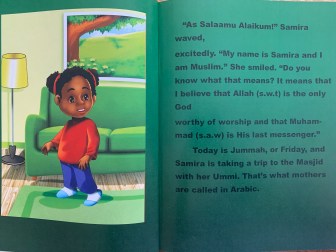
Samira greets the reader with As Salaamu Alaikum, as the fourth wall is breached and introduces herself as being a Muslim.  She then explains what being a Muslim is and tells the reader it is Jummah.  She asks her Ummi why we go to the masjid on Friday, before chiming in with all the information she in fact does know about Jummah.

img_8524

The next page details wudu as she prepares to go to the Masjid.  She then explains hijab as she tries to find her favorite green khimar with polka dots.  The words hijab, scarf and khimar are used interchangeable, causing a bit of confusion,  She explains that hijab is required by Allah swt to guard your chastity and that He also requires us to wear a khimar to the masjid.  I wish it would have clarified that we have to be covered when we pray, not necessarily just going to the masjid as she is a child, and many masjids are more than just places to pray, often having community halls and gyms.

img_8525

As the story continues she cannot find her favorite khimar no matter where she looks.  Ummi tries to give her some places to check, but in typical mom fashion, Samira can’t find it anywhere, and mom can find it immediately.  Samira shares some information about wearing your best clothes and they are off to the masjid not wanting to be late and hoping to get to the masjid first as the angels keep a record.  She finds her friend, and settles in to listen to the khutbah (misspelled as “Iman’s lecture” in the book).

img_8527

The conclusion of the book says “that even though Samira couldn’t find her favorite khimar, she was happy to take a trip to the masjid…”.  But she did find her favorite khimar? And on the very last page she is wearing the same shirts as she was at the masjid, but the polka dots have vanished from her green scarf?

img_8526

I’m hoping the author, illustrator, and publisher will clean up the book and someday republish it, we need these voices and images.

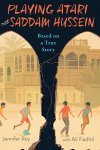
Playing Atari with Saddam Hussein: Based on a True Story by Jennifer Roy with Ali Fadhil

Standard
Playing Atari with Saddam Hussein: Based on a True Story by Jennifer Roy with Ali Fadhil

atari

This 165 page AR 3.9 book about the 42 days in 1991 that Iraq was at war with the United States is told from an 11 year old half Kurdish Christian boy’s perspective, but he mentions that he has friends that are Muslim and culturally and historically the book is relevant, important, and engaging as well.  I had my 9, 11, and 13 year old read it to gain perspective of the Gulf War, the difference between politics and people, and to see diverse religions co-existing despite stereotypes, especially in the middle east.

SYNOPSIS:

Ali gets the highest score on his Atari console the day that the bombs start falling.  Ali and his brothers Shirzad and Ahmed, and sister Shireen along with their parents retreat to the safest room in the upper middle class home to hopefully stay safe.  With experience of surviving the Iran-Iraq war which ended just three years earlier, the kids camp out at night in the room farthest from the nearby school and spend their days playing soccer in the abandoned streets.  The safe room was determined by knowing that Saddam uses his own people as human shields and places military installments in public service locations so that he can use propaganda to try and convince people that the enemy is bombing schools and hospitals intentionally to harm the innocent.

When the electricity goes out and the water cuts off, the family is forced to accept government rations.  Their dad is a dentist, but as he is essentially property of the state, he is forced to work as a medic and is often absent from home.  The family lives in Basra, which is in southern Iraq and near to the invaded Kuwait, thus all the troops pass through the city and the children spend their days keeping up their house, playing soccer with their friend Mustafa and trying to avoid the bullies Omar and Umar who’s father is in Saddam’s Ba’ath Party.

Ali speaks English because of his love of American TV and feels that if he can meet some US soldiers he will convince them that he should be in America not in Saddam’s Iraq.  He loves Superman, video games, soccer, his family, and his country, but the people, not the leader, he loathes Saddam, even though he knows he can’t ever speak ill of him.

A trip to get rations results in Ali seeing public executions and a colleague of his math professor mother’s getting hauled away.  A visit from their cousin gives them news that their father is missing. Life is not easy for the family, and yet they know they have it better than a lot of other people.  After the war, once again the family will have to put back together their lives and carry on.

The book concludes with a 14 year jump and Ali translating at the trial of Saddam Hussein where the leader who has been hiding is found guilty and sentenced to be killed by hanging.

WHY I LIKE IT:

I love that Ali is so relatable, he could really be a kid anywhere which makes what he sees and hears and experiences all the more intense.  The way that the book shows how the soldiers are forced to be soldiers, the citizenry at the mercy of the government, and the inability to speak freely so very real and frightening, is strong, but not traumatizing to the reading audience.  Even Ali being forced to observe the killing of  people in the street is handled with the target audience in mind.  They are Kurdish and had to deal with that within Iraqi society, which is a nice added layer to understanding that Iraqis are not a single monolith.  I love how the family had to go to the governor’s house and how nice his son was, even though, they are all Ba’ath Party members and part of the larger oppressive system.  It shows that things aren’t always black and white, and to convey all this to eight and nine year olds so clearly is quite remarkable.

I also like that the book holds up over time.  My kids had no idea what Atari is or was, but they could understand that it is a video game, and that it was an escape during the night for Ali to imagine he was playing a game trying to catch the falling bombs as a way to be brave and endure.

FLAGS:

Execution, death.

TOOLS FOR LEADING THE DISCUSSION:

I would consider this for a middle school book club, it is a bit short and definitely more middle grades, but it would allow kids to identify and imagine and discuss war through the fictional characters and voice their understandings of an authoritarian government structure, which would be interesting.

Author’s Reading Guide: http://www.jenniferroy.com/wp-content/uploads/2017/05/Playing-Atari-Teacher-Guide.pdf


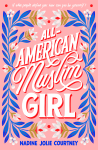
All-American Muslim Girl by Nadine Jolie Courtney

Standard
All-American Muslim Girl by Nadine Jolie Courtney

Book-Cover-All-American-Muslim-Girl

The power of own voice books is that while you may not agree with everything presented, you appreciate that it is being presented.  This 417 page high school young adult book is authentic and relatable and regardless of if you agree with the characters’ approaches, decisions, and understanding, you see and learn something about fictional characters that feels so real that you hopefully will find yourself in “real” life being a bit more understanding, kind, and accepting.

SYNOPSIS:

Allie is 16 and with her red hair and fair skin, she can pass for an all-American teen.  The only child of a college history professor and child development psychologist her family moves around a lot, but her dad’s extended family congregates in Dallas, and that is the anchor of family and love that warms the book.  Allie’s father Muhammad aka Mo is Circassian and his family speaks Arabic, including Allie’s grandma, Teta, who doesn’t speak any English.  Allie’s mom is a convert, but neither practice religion, and while Allie’s mom appreciates it, it is an incredibly hands off topic for Mo.  And Allie, well, she doesn’t speak Circassian or Arabic and knows nothing of Islam, and reinvents herself in each new school and city she finds her self in.

With Islamaphobia on the rise and Allie using her white privilege to neutralize a situation on an airplane, the reader sees as soon as they start the book, that Allie has a lot of skills to read people and understand how to handle complex situations, but that she hasn’t yet found her self.  As someone who can blend in and transform, the book is her journey to understand her heritage, her beliefs, what she wants in life and move toward finding her voice.  Much like Randa Abdel Fattah’s books which often turn the narrative from a Muslim girl rebelling against her faith and parents, this book has a young protagonist rebelling and turning to her faith.  The book seems to stem from a auto biographical place and the journey of learning about yourself, accepting yourself, and growing is universal.

Desperate to learn about Islam, Allie starts reading the Quran and hanging out with Muslims. While she knows Islam is not a monolith as she has family who cover, some that don’t, some that pray, some that don’t, some that fast, parents who drink, she still feels on the outside when she begins meeting with some Muslim girls at their weekly Quran study group.  As she gets to know the girls, she realizes how truly different Islam is for all of them, and how their experiences shape their views as well.  There is a convert, a black Muslim, a lesbian, some girls that cover, some that can’t read Arabic, some that find praying behind men misogynistic, some that feel unmosqued, they listen to music and read horoscopes, and Allie has a boyfriend.

Allie’s boyfriend, Wells, isn’t just incredibly cute and sweet, and accepting as he learns about Allie’s faith and her journey to understand it, but he is also the son of a cable shock jock toting that refugees should be stopped, and Muslims banned, yeah it is complicated.  As Allie learns more about who she is, she finds her self lying to everyone, and as she finds the courage to speak her truth, she must accept the consequences it has on those around her that she cares about.  Interwoven is a beautiful story line about her and her Teta’s relationship that is heartfelt and genuine and emotionally taxing when tragedy strikes.

WHY I LIKE IT:

I love that this book exists, and that it is written for Muslims and non Muslims alike. I think non Muslims will see that there are all types of Muslims, and we should be reminded that everyone has their own tests and is on their own path.  Paradoxically I love that it isn’t preachy, but desperately wish there was more emotional connection to Allah swt and RasulAllah, because honestly its a gaping void that makes some of the story fall flat for me.  I get that Islam is different for everyone, but while the book pushes so much that Allie wants to know about it to connect and fit in with her family, I feel like there isn’t much “spirituality” to her approach which kind of makes someone accepting religion seem lacking.  Her approach to prayer and fasting is almost robotic, and yes she says she likes it, but there isn’t any emotional resonance in her perhaps having an internal dialogue with God, or crying out to Him when her grandmother is in the hospital, instead it is read this passage from the Quran, or say this prescribed supplication, which makes her conundrum about her boyfriend, seem arbitrary.  Allie’s non believing, non practicing parents seem to have a softer spot for God, as Allie’s mom says something to the effect of it is hard to stop believing once you start, and Allie’s mom asserting multiple times that while she doesn’t practice she converted for herself, no one else.

I also kind of struggle with the attempt of getting every type of Muslim in the book to show that there isn’t a good Muslim bad Muslim dichotomy to the larger audience, but as a result seems to make the point that Islam can be changed to fit today’s world and that line makes me a bit nervous.  It is fiction, it is quite possibly the author’s own experience,  but I felt like the part of continued growth and working to follow the tenants of Islam got left out.  We all have our tests, and we all sin, but to just say ok, this is me and this is my Islam and stop there, halts the journey and character’s arc rather abruptly.

I love that the book really does a good job of laying out that there are problems, misogyny, racism, stereotypes, everywhere, not just Islam or religion, but in societal structures too, it is really shown across platforms and very seamlessly.  I like that a fair amount of side characters are fleshed out, and compassion extended even when opinions differ.  There is a lot of acceptance consistently shown from the characters and those that don’t show it are called out on it as well.

I wanted more on Allie’s dad though, to know what exactly his religious complexity entailed, I felt like I missed something, maybe I did, but just to say his relationship with religion is complicated or complex, left me wondering and wanting for details.

As it seems with so many of these YA books with female Muslim protagonists, the non Muslim boyfriends are absolutely amazing with their understanding, and patience (think A Very Large Expanse of Sea, The Lines We Cross, The Acquaintance), truly fictionalized high school boys, high five.

FLAGS:

There is Islamaphobia, kissing, drinking, death, racism, sexism, LGBTQ characters and discussions.  There is lying and talk of sex.

TOOLS FOR LEADING THE DISCUSSION:

This book is a bit advanced for middle school, the concepts and the acceptance of those concepts might not be conducive to Islamic School book clubs of high school level either.  That isn’t too say that kids can’t handle it or shouldn’t read it, but I think when presented from a school, it is assumed that you are endorsing an interpretation or practice of Islam, and this book might push that for some.

There aren’t a lot of author interviews or teaching guides, online, but if you do choice to read and discuss, you will be fine, there are a lot of layers, a lot to celebrate, and a lot to relate to in Allie’s story.

 

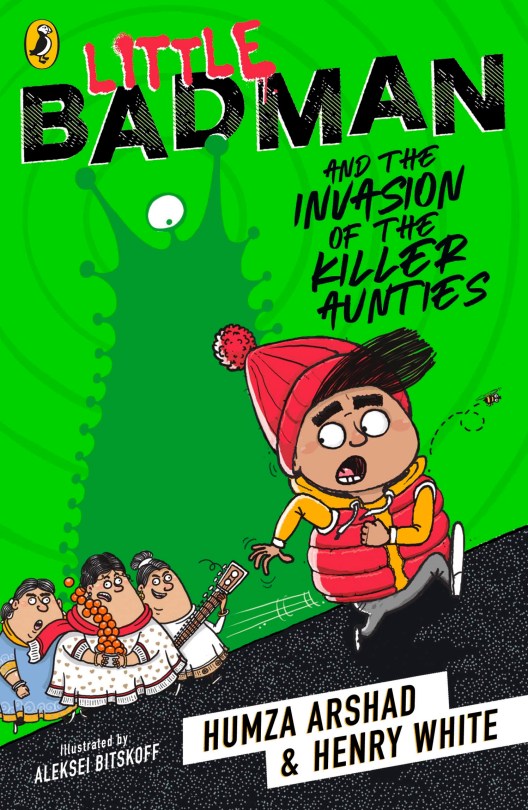
Little Badman and the Invasion of the Killer Aunties by Humza Arshad & Henry White illustrated by Aleksei Bitskoff

Standard
Little Badman and the Invasion of the Killer Aunties by Humza Arshad & Henry White illustrated by Aleksei Bitskoff

badman

It’s been a while since I’ve read such an over the top silly book that has a lot of heart.  It is 352 pages that remind me of the the My Teacher is an Alien book series of my youth smashed up with the Weirder School/Diary of a Wimpy Kid series of today.  Meant for upper elementary with some bad words (hell and damn), the story is Pakistani-British representation with many Muslim named characters, a Muslim author, and a shout out to a KFC in another town that is halal.  Don’t read it if if you want to learn anything, but definitely pick it up if you want to roll your eyes, giggle, and ponder a world where Desi aunties are the perfect disguise for force feeding an entire community delicious food as part of their evil plan to take over the world.

aleksei-bitskoff-little-badman-1

SYNOPSIS:

Humza Mohammed Khan is an 11 year old Pakistani kid in Britain who thinks of himself as the next big rapper, Little Badman.  He dreams big and talks even bigger as he struts around primary school getting in trouble and trying to film his music video on his friend Umer’s extremely old Nokia flip phone.  With a normal enough mom, a hyper exaggerating father, and a handful of their friends known as Aunties and Uncles, Humza gets in trouble regularly enough, but overall seems to have a good heart.

Things at school slowly start to change after their teacher gets stung by a bee named Mustafa, that Umer brought to school to be his pet.  Weird as that might be, it is even more odd, when their teacher is replaced by a volunteer auntie.  Every day it seems like a teacher goes missing, and is replaced by some asian kids’ aunt.  When the supper ladies are replaced and the food improves, no one is complaining.  When every volunteer starts bringing snacks to school, no problem.  Who doesn’t love gulab jams, and samosas, and butter chicken all day long every day?  Well, as the school puts on the pounds and all the teachers and staff are officially missing, Humza, Umer and their former nemesis Wendy, start to get worried.  Humza’s Uncle who he calls Grandpa, claims his wife Auntie Uzma is not really his wife, and helps Humza investigate.

Secret meetings in supermarkets, teachers and grandpa vanishing, and Humza seeing a giant slug coming out of the substitute librarian, means that Little Badman is going to have to run away from cricket practice, not get sent in a crate to Pakistan, face his stage fright, and save the day from the aliens taking over the aunties.

little-badman-inline

WHY I LIKE IT:

I like that it is cultural rep and own voice in its telling.  Humza is Pakistani and his cultural baggage is hilarious and part of him, and no explanations are needed.  In his world people are from lots of places and they all live and play and learn together and they eat caramel apples and toffee and jilabies.  The diversity is great and not articulated, it just is what it is, and they all have to work together to save the day. I think my favorite character is Grandpa, who Humza has to learn to appreciate and not just see as an old almost dead guy and Humza’s dad who exaggerates everything and takes his cricket very seriously.  At the end Humza has to have a heart to heart with his dad and his uncle, Grandpa and it makes this over the top nutty story really kind of sweet too.

There is no “Islam” in it aside from Muslim names and mention in a rap of a halal KFC.  I kind of like that they are Muslim kids and it appeals to a larger audience, sure something praying or something at some point might have been nice, but it isn’t a book that you’d be expecting spiritual nuggets from, so it is ok.

aleksei-bitskoff-little-badman-3

FLAGS:

The words damn and hell are used.  There is disrespect of authority, parents, and teachers as well as lying.

TOOLS FOR LEADING THE DISCUSSION:

I had my ten year old read it and he thought it was ok, but was uncomfortable with the language, which I was glad, but I told him I thought he could handle it, and know what is appropriate to use.  That being said, school libraries should have the book, maybe not classroom libraries though, and I probably wouldn’t do it as a book club.  I will have my other kids read it though, cause like I said, it is silly and fun.

Interview with comedian author Humza Arshad: https://www.booktrust.org.uk/news-and-features/features/2019/march/meet-little-badman/


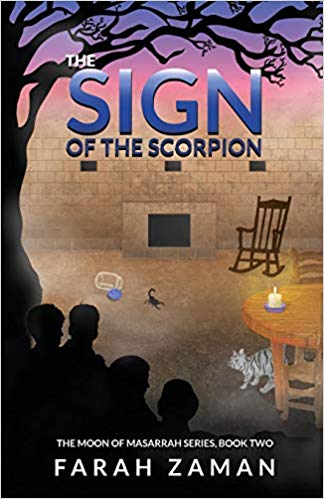
The Sign of the Scorpion by Farah Zaman

Standard
The Sign of the Scorpion by Farah Zaman

scorpion

This is the second book in the Moon of Masarrah series, but can be read as a stand alone book if you are looking for a linear story with fast paced action, intense twists, decently developed characters and quality writing that brings the sleuthing of Muslim characters to life.  At 229 pages including the glossary, the book reads to me as a middle grades book, but the last 50 pages place a lot of emphasis on accusations of a character molesting servants in the castle and another character having an affair, which might be more appropriate for older readers.  Perhaps middle school readers would be a better target audience, but I’m waiting to hear back from the author regarding who she had in mind when she wrote it.  The author said she wrote it for Young Adult, ages 12 and up in mind.

SYNOPSIS:

Brother and sister, Adam and Layla are reunited with their friends, siblings, Zaid and Zahra after last summers intense adventure involving a diamond.  This summer as a result, they are the honored guests of Shaykh Sulaiman at his dessert home, Dukhan Castle. They arrive to find out that the Shaykh is bedridden from a stroke after learning his son has died.  With a house full of relatives with reasons to want their claim to the Shaykh’s fortune, the four teenagers start putting odd occurrences of a ghoul in white, a hooded horseman, a gypsy woman’s tale, and the idea that there has been foul play, together to try and arrive at the truth of what is going on.  As they piece more and more together about the tutor, the cousin, the fiance, the grandson, and a mysterious mole-man following them, they themselves get tangled in the sinister plot of revenge and must keep an eye out to figure out who the scorpion, Al-Aqrab, is before one of them ends up dead.

WHY I LIKE IT:

Set in a fictious land, the detail is the perfect balance between setting a stage and over describing it.  The book did not drag for me at any place, nor did I find myself confused about what was going on and why.  Granted I probably could not tell Adam apart from Zaid and Layla from Zahra, but the book is about their adventure and figuring out whats going on, not about their relationships or back story.  And with the focus on all the possible perpetrators and their motives taking center stage, having four people gathering clues makes the information come easier and smoother.

All the characters are Muslim.  Some of the women cover and some do not, some stop to pray and make regular references to Islamic hadith or Quranic Ayats, and some are suspects.  For example when they are exploring the dungeons beneath the castle, they liken the caves to the Sleepers in the Cave mentioned in Surah Kahf.  The book never gets anywhere near preachy, nor do the few references ever get annoying, they just flesh out that the characters are Muslim, and thus they see the world through that lens.

FLAGS:

The book has murder, lying, deception, all the ingredients for a good who done it.  And while the details are all clean regarding how the four teens interact with the opposite genders, the climax of the book is the coming to light of allegations of molestation and a failed marriage is attributed to a presumed affair.  No definition of the words is given, and I reread many of the passages and I don’t know that there is even enough context clues to decipher what the word molest means in the text.  Most kids however, could easily ask Siri or Hey Google or whatnot and may have more questions about what it means to sexually assault a person, specifically a woman or child, and why someone would do it.  I leave that for parents to decide at what age those in their charge can grasp such a word and concept.

TOOLS FOR LEADING THE DISCUSSION:

I’m torn on teaching the book as the linear telling might not appeal to older kids, but the motive and revenge isn’t appropriate for younger kids.  I think if used to discuss broader issues the book could be really powerful, and not just a fun read.  I could see discussing with 9th graders or so the seriousness of false accusations, drawing on the Me Too movement and how sexual crimes and transgressions should be handled and treated.  I think the book could be a springboard for those discussions and seeing the effects of believing or not believing, and perhaps suspending judgement until research can be done.  In the case of the book, it would not have been difficult to pursue the allegations, while protecting any potential victims.


NOTE:

The first book in the series, The Moon of Masarrah, was originally published under the title, The Treasure at Bayan Bluffs, some changes have been made in the new printing, so while I don’t normally review second books in a series, I felt this book might bring attention to the new title of the first book and drum up interest for the upcoming third book in the series.  No, I don’t benefit in any way and I purchase my copies just like you, the stories are just really well done and I want readers to give them a try.  Happy Reading!

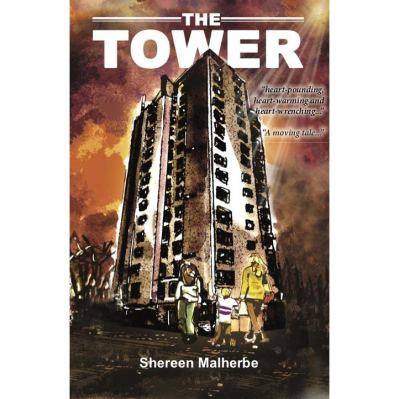
The Tower by Shereen Malherbe

Standard
The Tower by Shereen Malherbe

the tower

At 246 pages I’m not sure if this book would be classified as Young Adult, but I think it could be, as its message, focus and presentation makes it a valuable thought provoking read.  And the cleanliness of everything being resolved so neatly might almost be too coincidental for older, more jaded readers, where I personally wasn’t too bothered by how much emotional action was packed in to the book and how quickly it was resolved as the characters were compelling and the pacing made it an enjoyable quick read.

SYNOPSIS:

The story follows two women, Reem and Leah as their very different worlds and circumstances come together when they move in to the same apartment building.

Reem is a Syrian refugee whose past is presented in bits and pieces as her fragmented memories surface in the story.  She is searching for her 10 year old brother Adar, as well as trying to create a future for her self in London.

Leah has recently lost her husband, left her training as a doctor, and is trying to make a life for her and her son, Elijah, away from her parents’ shadow of expectation and demands.

When the two ladies meet, neither is completely settled or functioning, yet the desperation each is feeling causes Reem to ask for Leah’s help, and Leah agreeing.  The two become friends as they share parts of their world with one another and slowly start to heal.

Then Reem’s secret pregnancy comes to light, her abusive husband finds her, Leah’s posh friends abandon her, and their apartment building, the tower, catches fire.  Granted it doesn’t all happen that quick and there are lots of details that make their pasts, their friendship, and their goals for the future believable and inspiring, as well as making the pain for those lost in the fire emotionally wrenching.

As the two women once again try and survive hardship, this time together, they make progress before a terrorist attack on the mosque again sets them back.  Through all these major plot points details about how Reem got to England, and the atrocities she suffered that her mind blocked out are made clear.  Additionally, more about Leah and her families involvement in the tower fire and their friends’ involvement in human trafficking all tie the lose ends up. In the final pages there is hope and resilience and respect from the reader for the brave characters brought to life and their determination to persevere.

WHY I LIKE IT:

I love that it is a very personal, character driven story about a horrific fire, reminiscent of the Grenfell fire which claimed the lives of over 70 people.  I also absolutely love how Islam is presented.  The Muslim characters are tangibly real.  Reem wants to fast because it is Ramadan, but has the excuse that she is pregnant, but tries anyway.  She prays, she covers, she meets a Muslim that doesn’t cover, but they pray together at the mosque later and become great friends.  Leah is interested in Islam and asks questions and when she cooks for her Muslim friends she gets halal meat.  There is an amazingly helpful character Mo in the story who Leah is crushing on, but he refuses to be alone with her, or touch her, and when she tells him of her feelings, he says that everything she likes isn’t him it is his religion.  Leah and Reem discuss how the sunnah’s of the Prophet influence Mo and his brother and it is quite detailed.  Quranic ayats are quoted in character’s dialogues in natural presentations, not preachy or misplaced.  It hints at the end, when Leah has joined Doctors Without Borders and is in the Middle East that perhaps she has taken shahada, but it isn’t a plot point and isn’t mentioned explicitly.

My biggest complaint about the book is the random foreshadowing that pulls out from the story to hint that something more is going to happen between certain characters or be of more importance later.  I think it happened three times, and each time completely unnecessary. The story and characters and writing are clear and done well enough that needing the hint sells it all short and it wasn’t just annoying and irritating, it really kind of made me mad.  Here I was feeling an attachment for a character or what they were experiencing only to be reminded that there will be more, rather than letting me go along for the ride with the character.

I also was bothered by the font and spacing.  It is really tight on the pages, but with big margins, that a little breathing room would have been nice.  So, much happens in the book, that I wanted to be able to relish in each event and often I felt the presentation made it rushed and I found myself skimming, more than I would have liked.  I would have also liked to know what parts, if any, were based on or inspired by real events: the tower fire, human trafficking, stealing organs, artifacts coming out of Syria, refugee treatment in London, etc.

FLAGS:

There are memories of war and dead bodies.  The stealing of organs and dumping of bodies into the ocean.  There is a lot of death after the fire and after the shooting at the mosque.  There is a lot of blood, a terrorist act, a baby being delivered, a drunk man at a party.  Nothing is overly sensationalized, but it is a gripping book with some intense moments.

TOOLS FOR LEADING THE DISCUSSION:

I don’t know if middle school can handle the book, the characters are older, so it won’t resonate with them like a traditional YA book would, but I’m tempted to have my almost 13 year old read it so we can discuss.  I will most definitely suggest it to the high school book club adviser as there is a ton to discuss and relate to in this action packed book.

Author’s website and Q and A: https://shereenmalherbe.com/


More to the Story by Hena Khan

Standard
More to the Story by Hena Khan

more to the story.jpg

For a book written by an accomplished author for 3rd to 7th graders focusing on a Muslim family, I was surprised at how despite wanting to absolutely love this book, I only kind of liked it.  For the first 100 of 271 pages, I really kept hoping there was going to be more to the story.  Luckily the story did pick up, but I couldn’t get passed how much crushing all the sisters were doing on the one boy in the story, and how much stronger I wanted the main character to become.

SYNOPSIS:

Told from Jameela, “Jam’s” perspective, the second of four daughters living with their parents in Georgia, the story focuses on the interpersonal relationships of the members of the family and their parents’ close friends who’s nephew has moved in with them from England, Ali.  All the kids are close in age and of Pakistani ethnicity, and are Muslim.  As the reader gets to know Maryam, Jam, Bisma, and Aleeza, you see the characters develop pretty well and their quirks and personalities emerge.  Jam is more tomboyish than the gorgeous Maryam who likes to bake.  Jam and Bisma share a room and are closer than Jam and Aleeza, the baby of the family who Jam finds is becoming a brat.  Jam also enjoys watching football and eating spicy food with her dad and desperately wants to be an award winning journalist like her grandfather.  She puts out a family newsletter and is ecstatic to be named the feature’s editor as she starts 7th grade.  Ali is a year older and has moved to stay with his aunt and uncle until his mom and sister can join them.  He spends a lot of time with the sisters and in Little Women inspired fashion the little ones want his attention, Jam is a little jealous to learn he finds himself tongue tied when talking to the beautiful Maryam and Maryam in 9th grade is drawn to Ali, but doesn’t vocalize it too much.  And then as the story picks up speed, Jam says, “In a matter of weeks, Baba got a new job and moved across the world, Bisma got sick and has to be in the hospital, and I messed up everything with Ali and the paper. How did my whole life get turned upside down so quickly?”  

The rest of the book is dealing with Baba working in the Middle East, Bisma being diagnosed with lymphoma, Jameela learning some journalistic basics, and Ali and Jameela becoming a bit more than just friends. 

WHY I LIKE IT:

I love that a Muslims desi family is being represented in an own voice novel that mentions religion as a natural part of their life, and doesn’t apologize or overly explain it.  That being said, I feel like the book is trying to present “us” to the outside so to speak, rather than empower our own.  And I point this out, because I feel like it could have done both.  Dialogue between Ali and Jameela about how they might date as they get older, how Ali can’t see any of the sisters having an arranged marriage.  How when Maryam gets asked to a dance her mom doesn’t mention any religious reason her daughter should say no.  None of the girls wear hijab, and they mention that they don’t wear hijab, at one point Jam knows she should get up and pray, but doesn’t.  I don’t expect a fictional story to teach our upper elementary age kids how to behave that is a parent’s job, but to have some basic Islamic tenants brushed aside after being mentioned is worth noting.  Had the book just been more cultural, maybe I wouldn’t be so critical, but Muslim girls are going to be excited to see themselves in this book and some of the messages might tilt a little more liberal than some parents would expect.  It is one thing when our girls read a book with a romantic twist and we say that, that is not for us, but when a book celebrates us not just crushing, but vocalizing those crushes and moving in to a gray area (they hug but it could be an innocent friend hug) and they make a point to be next to each other, Muslim parents should be aware.  In the larger society it wouldn’t even register on the radar, hence I point it out.

Another thing that kind of bothered me and was again related to Jameela and Ali’s relationship was that when Jameela cut her hair in support of Bisma losing hers with chemo treatments, she seems to need Ali’s approval.  I get that she wanted him to see her and all that, but I really wanted her to be strong enough in and of her self that even if she looked awful she would own it and not let it define her and not let a boy’s opinion about her physical appearance weigh that heavily on her.  Again I know 4th grade girls start noticing boys and having crushes and middle school is only worse, but I just was hoping that her strength and confidence would come from her own growth arc, not from someone else, let alone someone she likes. Side-note here too about the hair, it is donated to make a wig, which I know might also be a sensitive subject regarding if that is allowed in Islam or not.

In terms of the cancer and the sister’s rallying together all that I thoroughly enjoyed and found the most interesting passages in the book.  I think the understanding of a real subject and finding a way to help and deal with this was executed expertly and powerfully without sensationalizing the concern or simplifying the experience either.

FLAGS:

The book is clean, but there is a lot of mention of how Ali affects the girls.  And potentially depending your own opinions on the hair being donated.

TOOLS FOR LEADING THE DISCUSSION:

I wouldn’t do this as a book club book, I’m actually hesitant in even recommending it to my 12 year old daughter.  I know she has read worse, but again me handing her a book about Muslim girls might make her understanding of what we expect regarding boy/girl interactions to be a bit muddled.


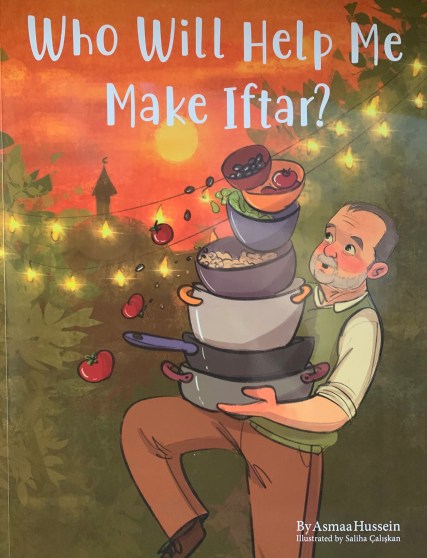
Who Will Help Me Make Iftar by Asmaa Hussein illustrated by Saliha Caliskan

Standard
Who Will Help Me Make Iftar by Asmaa Hussein illustrated by Saliha Caliskan

IMG_3796

This sweet story shows how even when people refuse to help, we should treat them with kindness, as our actions should be to please Allah alone, and inshaAllah in real life, much like in the story, people will fix their ways and offer their help in return.  This new story reads very much like the old(er) favorite Nabeel’s New Pants, where everyone is too busy to help, but then come around to realizing that helping one another is a way to show people we care.  This 32 page 8.5 x 11 soft back story is well bound with large glossy pages and clear text.  The story works well for ages 4 and up, as they will understand the moral message and inshaAllah feel inspired to find ways to help as well.  

IMG_3797

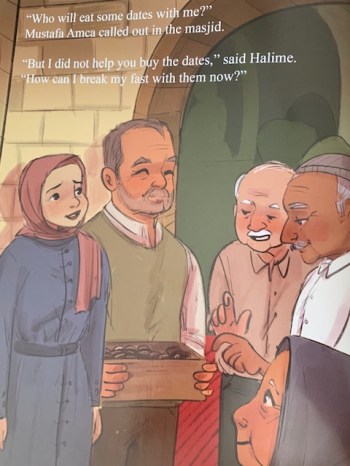
It is a 40 year tradition that Mustafa Amce and his wife Ayse Teyze feed iftar to their friends and families on the first day of Ramadan.  This year, however, Ayse is not well and Mustafa is confident he can enlist the help of neighbors and family to help him keep the tradition alive. 

IMG_3798

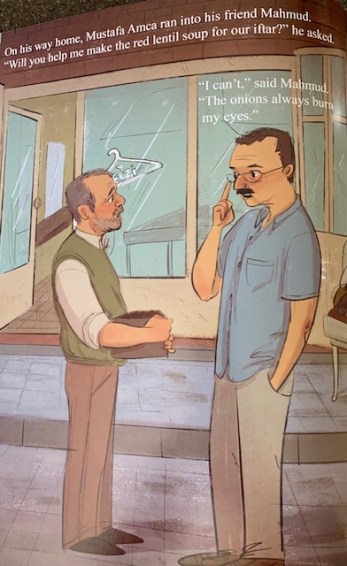
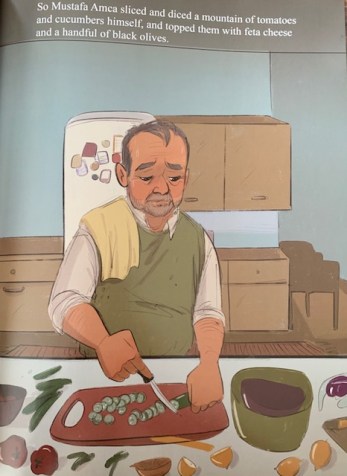
Unfortunately, everyone has an excuse.  His daughter is tired, his grand daughter is too busy with her video games and his neighbor doesn’t want to get his new shirt dirty.  Their sad reasons don’t stop old Mustafa Amce, and he makes the salad, and cooks the rice and beef by himself.

IMG_3799

When iftar time arrives, he offers sweet dates to those at the masjid and invites everyone to come to his courtyard to break their fasts together.  All those that had early refused to assist him feel incredibly guilty and don’t want to take advantage of a lovely meal. Mustafa reminds them that, “God loves those who are generous especially to their families, neighbors, and guests.  and I always want Got to love me.” So they join in the delicious meal.

IMG_3800

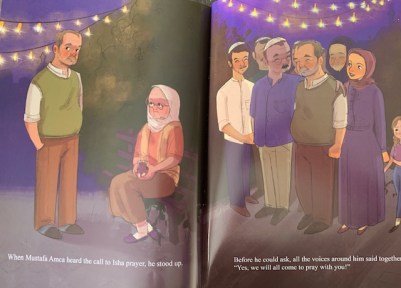
After food Ayse Teyze shows that while she might be ill, she can still save the day when her husband realizes he has forgotten to prepare dessert.  The guests then offer to wash the dishes and sweep the floor and take the leftovers to the poor.  And best of all when the athan for isha prayer calls out they all without prompting stand to join Mustafa Amce in praying salat together.

IMG_3801

The names are Turkish with a pronunciation guide at the end, as well as a paragraph about Ramadan.  The book would work for non Muslims and Muslims alike as the story is set in Ramadan, but more about coming together to help out.  The illustrations are large and detailed and descriptive.  You see the warmth between Mustafa and his wife as well as the apologetic feelings from those that were unwilling to help. 

IMG_3803

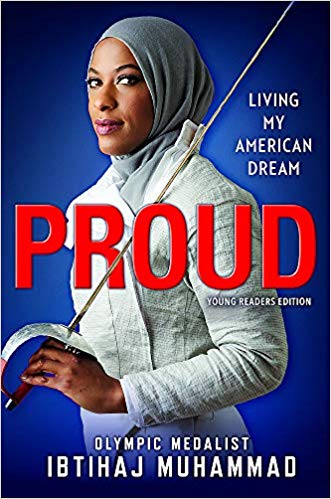
Proud: Living My American Dream (Young Readers Edition) by Ibtihaj Muhammad

Standard
Proud: Living My American Dream (Young Readers Edition) by Ibtihaj Muhammad

proud.jpg

I had high expectations for a memoir about such an inspiring figure, so I treaded timidly into the book waiting to be disappointed, but after finishing the book in two days (high praise considering I have four kids), I realized I was holding my breath for nothing, the book and Ibtihaj are amazing! Now three days after I started, my daughter too has read it and I have ordered a handful of copies to offer as my next Middle School Book Club selection.  Inspirational, real, Islamic, hopeful, empowering, check, check, check, check, and well written too.  A great story and a great role model, alhumdulillah.  The Young Reader’s Edition is an AR 6.7 and 304 pages including Acknowledgements, Glossary of Fencing Terms, Ibtihaj’s Advice, and Q and A with Ibithaj.

SYNOPSIS:

Ibtihaj begins her life story establishing her background of who her parents are, how they met, how they came to Islam and how they are raising their children.  She also details how she is different and realizes it from a young age, whether it is substitutes not being able, or willing, to pronounce her first name, or not being able to sleep over at her friends’ houses.  She also sets the stage for the environment of Newark that she was born into and how it differs racially and economically from Maplewood where she spent most of her childhood.  The story then is pretty linear walking through some of the challenges of being highly driven and motivated and determined to succeed and get in college.  How she is first introduced to fencing and why she gives it a second chance after initially not liking it.   Along the way the reader gets to know how Islam influences her point of view as Allah is very central to her decisions and expectations of herself.  The quick pace is not depressing, while others at times do treat her differently she definitely doesn’t paint herself or seem to see herself as a victim or as privileged, she is just herself and this is her story.  It isn’t all rosy and it isn’t harsh, she is putting one foot in front of the other and there is amazing support from her family, and some of her coaches and some of her teammates, but not everyone and that is a very important part of her story too, which I think provides even more for young readers to relate and learn from.  Anyone not familiar with fencing and how the sport and its rankings work will learn so much reading this book, but thankfully not be overwhelmed with it all either.  The book ends shortly after the Olympics and her historic bronze medal win.  The title may reflect her being proud of what she accomplished and continues to pursue and her pride in being a Black American Muslim Woman, but I think anyone who reads the book will just be proud that someone like her exists, and that maybe some small part of ourselves can be great too.

WHY I LIKE IT:

I love that the book leaves in some of the naysayers and difficult coaches and teammates.  I really think it is easy to assume that people are great and things should all work out when you are competing on an international level, but alas no, completely not the case, yet differences aside, they still had to win an individual sport as a team. 

 I also love that she is truly what she claims, the way she practices Islam is who she is and she loves her family and her faith.  There are no contradictions she excels and perseveres and finds herself while acknowledging all parts of herself and it is so inspiring.  She portrays Islam as a way of life, she prays and fasts and has days when her iman is low and days her faith is rewarding.  She focuses on what she can control and has to learn to accept what Allah swt has decreed for her.  She has Muslim friends, and non Muslim friends and through it all she is finding her place and is surrounded by love and support from her family.  It really is a feel good story and we should all pray that it continues to be.  She doesn’t portray Islam as limiting, nor as her family an exception to what a Muslim home is, and this level of dawah can really change perceptions.  The book is not preachy or arrogant, it is simply her story and Islam is a part of it.

I like that she went to a prestigious university and it didn’t make all her dreams come true, she still had to work hard and find herself and humble herself to work at a dollar store to scrape by, it shows tenacity and a glimpse of the real world that privileged middle schoolers might not have had to consider before.

FLAGS:

The book is clean.  It talks about how uncomfortable she was at her first fencing lesson with her coach having to reposition her stances and thus touch her, and it discusses how she felt listening to music was ok in Islam even though her parents disagreed.  A few sentences at most, collectively, but kids will have thoughts on it.

TOOLS FOR LEADING THE DISCUSSION:

My 12 year old daughter read the book in a few hours and discussed it with me for even longer.  It was as if some tidbit from the book would blossom inside her and she would consider it, and want to discuss it, from why she would not talk to the kids she was substituting about fencing, to why her coach made her switch to saber, I don’t think there is a shortage of things to discuss, or more importantly listen to from the young readers.

There is a ton about her online as she became the first American Muslim to medal and the first to compete in hijab.  I highly recommend this book for book club, and will  hopefully add how our meeting went in a few weeks.


The House of Ibn Kathir: The Competition Begins by S.N. Jalali

Standard
The House of Ibn Kathir: The Competition Begins by S.N. Jalali

IMG_3210

At 254 pages this boarding school story beautifully blends Islamic information, mystery, and compelling characters embarking on a new stage of their lives.  I was pleasantly surprised at how easy and engaging this book for upper elementary aged children reads and would strongly recommend it for grades 3-5.

SYNOPSIS:

Eleven year old Yusif is about to begin his first year at the prestigious Dar Al Ilm Academy a few hours away from his family, friends, and home.  Nervous to be on his own, he is excited to be giving his dream of memorizing the Quran the chance to become a reality.  When he arrives at the old mansion turned beautiful campus, he is paired up with Reda, a student to help him get situated and before you know it the two are fast friends.  When they get put in the same house, Ibn Kathir, with Warsoma and Daud, the four friends embark on a year of adventure and bonding as well as growth and learning.  Along the way they learn some Islamic history, they understand important hadith and Quranic Ayats and are challenged to live according to the sunnah even when tempers and frustrations abound.  When items start to go missing the boys and their house will have to keep their cool, not accuse anyone, but figure out what is going on all at the same time.  When the culprits are uncovered, they will be further tested to hold a grudge, offer forgiveness, or even extend an invitation to friendship. 

IMG_3211

WHY I LIKE IT:

This idyllic story and predictable mystery will appeal to impressionable readers that can’t see what is coming and can still be inspired by the beauty of such a protected environment.  The window might be small for such readers, but well worth the attempt as the book is well written and the characters well developed.  The boys are diverse and kind and helpful and all the things we want our children to be, especially when they are away from us.  Each character has their strengths and weaknesses and the friends accept them and celebrate one another rather than try and force them to change. The four houses and the characters vying for year captain and having fun along the way reminds me of a Harry Potter spinoff, but alas I think that is just my ignorance of the British school system.  I love that the four houses and their namesakes are detailed at the end as well as there being a glossary of terms.  There are illustrations every chapter or so that are appealing and offer a nice visual of the boys’ world.  The text, line spacing, chapter breaks and all are perfect for the demographic and while the fictional story is solid, I am happy to report I learned a number of things as well. 

IMG_3212

FLAGS:

None, alhumduillah

TOOLS FOR LEADING THE DISCUSSION: 

I can’t find much on the author or even on any future books, which is unfortunate because I think it would be great for an elementary book club selection, and I may read it to my 4th and 5th grade Lunch Bunch group after we finish The Great Race to Sycamore Street.  I think it should be in Islamic School Libraries and classrooms as its cover will hold its own and compel kids to pick it up off the shelf.

Book trailer: http://www.ibnkathir.co.uk/trailerfullhd.html

Book website:http://www.ibnkathir.co.uk/index.html