Tag Archives: Muslim Characters

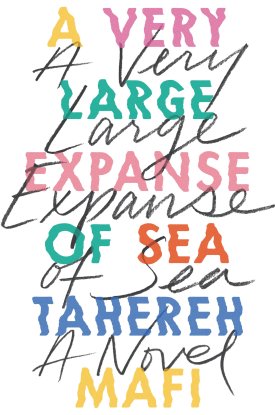
A Very Large Expanse of Sea by Tahereh Mafi

Standard
A Very Large Expanse of Sea by Tahereh Mafi

avleos

The book is often marketed as a Muslim coming of age story in a post 9/11 world.  The contemporary work is semi-autobiographical, but really I think the positioning is a bit misleading.  It’s a love story, and the main character is Muslim, and her environment is awful and she is angry. Its an engaging read, I read all 310 pages in one sitting, but I don’t know that the take-away will enlighten anyone about Islam, or really what it was like to be Muslim in the years after 9/11, I think people will remember how sweet the couple is and wonder how much of it mirrors the author and her husband, author Ransom Riggs (Miss Peregrine’s Peculiar Children), but not suddenly become knowledgable about more than what the main character experiences and endures.   I appreciate that the book challenges the stereotypes of Muslim women, there is authenticity as it comes from a writer who lives it, and I do think it shows evolution of attitudes that teens can benefit from.  The book is not yet in the AR database as it just came out, but I would imagine high school and up.  

SYNOPSIS:

Shirin’s Persian-American family moves a lot.  Her and her older brother are incredibly close as their parents are rather aloof to the day-to-day experiences the kids endure.  That isn’t too say her parents aren’t around, they eat two meals a day together and the parent’s are warm, but Shirin’s brother Navid is a much more present.  The story starts with 16-year-old Shirin starting her 12th new school.  Conditioned to not make eye contact, remember faces, or get affected by the trivialities around her, the reader sees how angry she is as she curses at a teacher that assumes she needs ESL not Honors.  Knowing how fleeting her time in any location can be, as her parents are constantly trying to find better jobs, Shirin doesn’t feel compelled to make friends or get attached to anyone or anything.  This intimidating vibe similarly keeps offers at bay, for the most part.  When she gets paired up with Ocean to dissect a cat, he tries to talk to her, and this throws her off her game.  Most every interaction she experiences at school are people making racist comments and being very one dimensional and bigoted.  Ocean tries to be nice, an attitude so foreign to Shirin that it begins to force her to change.  Simultaneously, Navid, who is charismatic and has no problem finding friends wherever they go, decides to put his and his sister’s dream into action and they start a break dancing club at school.  Three other kids join, and start becoming, not just Navid’s friends, but Shirin’s as well.  

Shirin and Ocean fall in love, despite Shirin fearing what the backlash will be for ocean.  She doesn’t really know anything about him, but feels strongly that all the racial slurs thrown at her on a daily bases will effect him and ultimately make them wish they didn’t pursue a relationship. She draws line after line in the sand, and crosses them all.  Only then does she learn how blind she has been, he is in two of her classes, not just one, he is a year older than her, and he is the golden star of the high school basketball team.  Being that the story is told from Shirin’s perspective, this is surprising to the reader as well.  The town turns on the pair and things get really ugly for Ocean who is willing to risk it all for Shirin.  Threats by the basketball coach, pictures of Shirin without her hijab being taken, accusations of terrorist ties and sympathies all challenge the couple and shape Shirin.

WHY I LIKE IT:

I really like the twist of having the relationship be difficult for the non Muslim, rather than going with the assumed Muslim girl having to sneak around.  Not saying that I support it, but interestingly she never mentions that what she is doing is going against anything religious.  She mentions twice that her parents wouldn’t like her with any guy, and that they view her as a child still, but she doesn’t explore Islamically any boundaries regarding their relationship.  She hides talking on the phone to Ocean, because her parents are adamant she gets enough sleep at night.  That is about it.  Shirin discusses that she wears hijab like an armor that she gets to pick who she shows her hair too.  I love the strength in that, but wish there was a bit of doctrine to back it up too.  At one point a Muslim, non hijabi, at school calls her out for wearing hijab and having a boyfriend, but she essential tells her it is none of her business, which it isn’t and who is to say that one sin is worse than another, but still it befuddles what exactly Shirin believes and why.  The book just paints her as a Persian Muslim, but never explores what that means other than the superficial outward appearance.  They do fast in Ramadan, no explanation about why is given, just that they not eat or drink during daylight hours, and right near the end, Shirin remarks how her mom asks her and her brother every morning if they have prayed and they lie and say yes, their mother sighs and tells them to make sure they pray the afternoon one, to which they lie and agree, only to have their mother sigh again.  AstagfirAllah, that is awful lying, and lying about Salat, but it is so real, I audibly chuckled.  

I like that the parents aren’t harsh, they just seem disinterested.  I didn’t want to read another book about the parent’s being the gatekeepers and bad guys, so that was really refreshing.  They mention they don’t celebrate Christmas, but they have an open door policy on Thanksgiving for any friends wanting to come.  I did hope for a bit more about them, why they don’t talk to the kids about moving, what makes them tick, because really they seem to have a solid relationship with the kids, they are just clueless to their social experiences and school environment stresses.

I love the growth and self reflection of Shirin, she holds a mirror to herself and she and readers are better for it.  She has to realize that she is doing so much of what she is accusing others of doing.  I love the support and genuine concern of the breakdancers and her brother.  It resonated to me as a girl with an older brother and the relationship feels very genuine. I just wanted to know more about Navid. 

FLAGS:

There is a lot of cursing. kissing, hand holding, romance, lying, and ditching school.  There is a brief mention of graffiti being sprayed.  There is racial slurs, threats of violence, violent physical outbursts by people of authority.  When a student throws a cinnamon roll at Shirin, Navid and his friends beat the kid up severely, it isn’t detailed, but it is mentioned.  Ocean  also gets suspended for a few games for a fight he engages in, and there is some detail of Shirin getting jumped in a previous city for wearing hijab.

TOOLS FOR LEADING THE DISCUSSION:

I don’t think I could in good conscience present this to a group of Muslim students.  I wouldn’t want them to think I was endorsing the violence and language and romance.  Like so many books of the genre though, if someone found it and read it on their own, I’d love to chat with them about it, as it is well written.

Youtube video about the book by the author: https://www.hypable.com/tahereh-mafi-a-very-large-expanse-of-sea-tour/
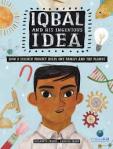
Iqbal and His Ingenious Idea: How a Science Project Helps One Family and the Planet by Elizabeth Suneby and Rebecca Green

Standard
Iqbal and His Ingenious Idea: How a Science Project Helps One Family and the Planet by Elizabeth Suneby and Rebecca Green

iqbal

It is a bit odd that this story is fiction, when it reads so much like a piece of nonfiction.  It is a picture book, but has an AR level of 4th grade 4th month.  So, while the story is great and highlights a country and culture, Bangladesh, not often seen, I don’t know that this book would appeal to many kids.  The kids that it does appeal to though and that can find it in a library or bookstore (not sure where it would be shelved), I think will not just like it, but possibly find it both inspiring and worth reading again and again.

IMG_2086

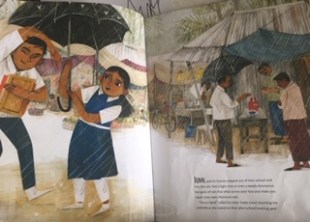
It is monsoon season in Bangladesh and the rains make Iqbal’s mom have to cook indoors.  As a result, she and the baby, Rupa are constantly coughing from breathing all the smoke from the woodburning stove.  Iqbal’s father mentions a propane stove he saw in the market, but the family cannot afford it, despite wishing that they could. 

Iqbal’s school has just announced the School Science Fair and the winners get cash prizes, if Iqbal can win, maybe he can buy his family the new stove.  His little sister Sadia offers her services to help him win and be his assistant.

IMG_2087

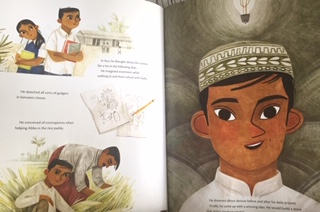
After a lot of thinking, pondering, and dreaming, Iqbal decides on the perfect project: a stove that didn’t produce smoke.

With the help of his teacher at school to find ideas and articles and plans on the internet, Iqbal and his sister build a solar cooker with foil and an old umbrella. 

IMG_2088

The science fair is a success, Iqbal wins, the family buys the stove and propane with the winnings, and when it isn’t raining, the family is able to use the solar stove Iqbal and Sadia built.

The book draws on ideas of sustainability, pollution, economic viability, problem solving, and education.  The culture provides the backdrop making all of these issues relevant and real, and mentioning Ramadan, Eid, and prayer provides some depth to the characters and adds to their culture.

IMG_2089

A lot of reviews online criticize that the mom is cooking and that the kids test an egg on the solar cooker and call her to eat it if it is supposed to be Ramadan, but I personally promise you, during Ramadan, we are always cooking.  And if she is nursing the baby, the mom wouldn’t be required to fast, there’s a lot of other reason she couldn’t/wouldn’t be fasting, but really, it is such a small portion mentioned in passing, no detail needs to be given, and it didn’t bother me at all.

Another complaint about the book is that if money is so tight the kids wouldn’t be at a school where they can just make copies, and buy eggs on their own.  I think there is some truth to this, but maybe a wealthy doner funds the school.  I think you could argue it either way.  I don’t know that the family is poor, it is the overall society, so kids could have pocket money, a propane stove is probably imported at least from a larger city so the expense would be more, similarily the infustruction of electricity and gas lines could hint more at why they cook the way they do.  Needless to say the family is smiling in the pictures, they have food, and they seem to be doing ok.  So the fact that the school printed a few articles and the kids bought some eggs without asking permission, didn’t bother me greatly.

IMG_2090

The illustrations are expressive and show the family connections and emotions.  I like that they bring to life a country many wouldn’t know, even if I wish it weren’t a work of fiction, but based on some child actually there.  

The end of the book has information about clean cookstoves, how to build one yourself, and a glossary.  The large 9×12 hardbound book would hold up well to multiple readings, and the amount of text on the pages would work well as a read-a-loud to younger kids who would find the subject matter interesting.  

IMG_2091


She Wore Red Trainers by Nai’ma B. Robert

Standard
She Wore Red Trainers by Nai’ma B. Robert

red.gif

After having fairly good luck with the Muslim YA Romance Novel Genre in An Acquaintance and Saints and Misfits, I was willing to give She Wore Red Trainers a try.  Na’ima B. Robert has written a lot of books and this 261 page book was an easy and entertaining read.  There are no plot twists, deep thoughts, or intense drama, its a light read that infuses religion and environment into a story that will be great for 14-16 year olds that have slim pickings of relevant, Islamic, “halal” fiction options.

SYNOPSIS:

The story is told from two 18-year-olds’ perspectives, Ali and Amirah. It goes back and forth and while the perspective is obvious, the bottom of the page identifies the character so there is no chance for confusion.

Ali has begrudgingly moved to London with his brothers and father.  Not very religious before his mother’s death, he and his father and younger brother have made a new start and commitment to Islam since losing her to cancer.  The middle brother, resists this, but isn’t too critical in the story, other than to add a voice to the concept that people have to come to Islam on their own, that the relationship between a person and Allah is not cookie cutter or often simple. 

Amira too has a past and a lot on her plate as she strives to balance her chaotic family life and moving past decisions of her rebellious self.  The two meet and in the brief second before gazes are lowered, they fall in love.  Ok, so it isn’t that cliche’ but it is close.

The two, as the dedication of the book states, “are striving to keep it halal.”  They have a few encounters and the sparks are there, but they both have their own stories and supporting cast of friends as well. It isn’t until the very end, SPOILER, they get married.

Yup. impromptu wedding of 18 year olds.  It isn’t out of left field though, there are passages that contemplate the Islamic merits of a young marriage, and perhaps that is the depth of the book, as far as giving the reader something to think about. That and choosing Islam and actively living it.

WHY I LIKE IT:

The stuff that makes the book interesting, isn’t really even the two love birds, it is the context.  The struggle of Amirah’s complex family situation with a mom that has had multiple husbands, and is suffering from depression.  Amirah also has a creepy stepdad (makes her uncomfortable and seems to make sexual advances toward her) and a sketchy past that isn’t really articulated but is hinted at enough to know that she did rebel briefly by running away and experimented with drugs and alcohol before realizing it wasn’t the life she wanted.  She takes tremendous care of her younger siblings, one who is deaf, and respects her older brother tremendously.  Her friends are not overly developed but provide enough diversity that the reader will see themselves in someone even if just fleetingly.

Similarly Ali is fleshed out by the company he keeps.  He has very religiously devout friends, a few rebellious ones and countless opportunities to define who he is.  His home life is a little chaotic, but they’ve gone through the destruction and are in the rebuilding phase. 

I like that the characters are fallible and represent a wide spectrum of religiosity.  The book isn’t political, nor does it discuss culture really, but it is meant for Muslim readers.  The characters throw in Arabic terms and while there is a glossary at the back, the religious rules, the contemplation of hadith and ayats, understanding Islamic divorce and the stress to be well established before marriage make it a book for those that can relate.  I love that part of keeping it halal is that they don’t talk and text.  I know that makes it a bit unbelievable, but I like that the line is drawn and established.

I wish that the past of many of the characters was clearer.  Not overly sensationalized, but a tiny bit more.  I wanted more information on what Ali’s dad’s new job was, and how far away they would be moving.  I wanted to know how Amira’s family would manage without her and the creepy stepdad, would the mom be able to step up and care for her kids.  I wanted more details about Amira’s family in general and why her older brother had to leave his studies permanently in Saudi Arabia, and wasn’t able to just delay graduation.  

I can’t criticize the writing too much because I did read the book in one sitting and it kept my interest.  I didn’t expect it to be deep or thought provoking, so for a light summer read, it was good enough.  I felt like the ending was a bit rushed, and yes there are some far fetched ideas, but I think it’s a romance novel, halal or not, so yeah, there are going to be some places that forgiveness is needed.

FLAGS:

There is mention of hooking up, drug and alcohol use, virginity, and a creepy sexual predator in the stepdad. It isn’t appropriate for middle school, but not so vulgar that one would need to be 18 to read.  I think high schoolers won’t find it too cheesy, and not be shocked by the content either.  Granted it depends on the reader. but I think it is better to be safe than sorry.

TOOLS FOR LEADING THE DISCUSSION:

I would consider the book for a high school book club. Might have to get parental permission, but I think it works well to consider how to have it all so to speak.  How to live within Islam and be smart about your choices.  The book doesn’t offer a lot to think about and mull over, but if you were a teenager, I would imagine that the book presents a lot of what you are feeling.  There is a lot to relate to in the friends, the deen, the emotions, and the temptations.  It also shows that just because families are Muslim, doesn’t mean that they are not complicated and troubled, a scenario that many would find reassuring at least superficially in the book.

Interview with the Author: http://www.kubepublishing.com/an-interview-with-naima-b-robert-about-her-forthcoming-book-she-wore-red-trainers/

Peg + Cat: The Eid al-Adha Adventure by Jennifer Oxley and Billy Aronson

Standard
Peg + Cat: The Eid al-Adha Adventure by Jennifer Oxley and Billy Aronson

peg.jpg

Easily the most anticipated Eid al-Adha book to come out this year, the book does not disappoint.  Following the episode, the book, is 32 pages and while ok for ages 3 and up, like the show, it really is geared to children able to grasp the math concepts presented.

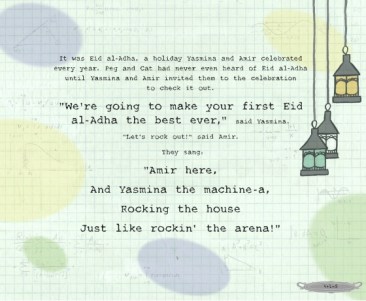
The book’s story is that it is Eid al-Adha, and Peg and Cat are learning about it with their friends Yasmina and Amir. The holiday facts don’t seem forced and words like hijab. oud, and Eid Mubarak, are integrated naturally.  The concept of giving charity, giving to those with LESS, becomes the set-up for learning about more than, and less than. 

peg4

A few pages later the tradition of dividing meat into three parts: one to keep, one for friends, and one for the poor, sets up a lesson on fractions and using a pan balance.  The really big problem, involves moving crates.  They count down from seven to calm down, and then use all their lessons learned to solve the problem and help a neighbor.

peg5.jpg

The illustrations are straight from the show in all their adorable glory, I’m not sure why Yasmina has some strange tree branch looking loose hairs poking out of the top of her scarf.  I love that the page numbers are math problems (2 +1=3 for the 3rd page).  And the hardback with slip cover workpages on the underneath side, are a nice treat.  I was especially greatful the picture on the slip cover is the same as on the book, so the cover can be discarded, as will ultimately occur with multiple readings.

peg2

Books like this are great ways to introduce an Islamic tradition to non Muslims in a non preachy, non threatening way.  By seeing beloved characters with Muslim friends helps shape perceptions and increase understanding, inshaAllah everyone wins, alhumdulillah.

No Ordinary Day by George Green

Standard
No Ordinary Day by George Green

no ordinary day.jpg

I was really, really excited to get this book in my hands.  An early chapter book, about Islam and sports, with diverse characters, that seemed to be the start of a series featuring the “Childhood Champions,” seemed to have the potential to fill a gaping void in Islamic fiction.  And while the book shows promise and has a lot going for it, it falls short of what it could be, and perhaps with the ever growing book options, what it should be. 

To be clear the Islamic lessons and values are on point as are the pictures, it is the holes in the story, the random text layout inside and the lack of depth that keep this book from reaching its full potential.

SYNOPSIS:

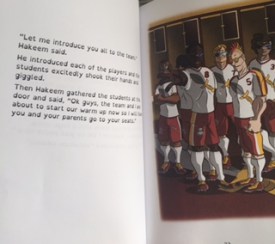
Ibrahim normally needs help to get up for school on Mondays, but not on this day. On this day they were promised a surprise at school and Ibrahim can’t wait to see what it is.  When the 8-year-old gets to school he and his friends are delighted to meet Hakeem Muhammad a soccer star on the California Spartan’s Team in town to play against the local Harlem Knights.  To win one of the five tickets that he is giving away the students have to recite some ayats from Juz Amma and tell why it is important that they study the Quran.  Ibrahim goes first, and we don’t know what he recites, but he says that studying Quran makes him feel happy and inspired.  Which to me didn’t really meet the criteria of the competition.  The next student is also a member of the “Childhood Champions,” but we know nothing about Jannah, other than the one page bio at the beginning of the book.  Jannah recites some mystery ayats and says that knowing the meaning helps her with reciting, a bit more of an appropriate answer, but still kind of not fulfilling the question in my opinion.

ordinary1

All five kids in the crew win tickets for them and their families for the game that night.  A limo picks them up and they get to meet Hakeem in the locker room.  When they arrive  he is praying, so they wait, say salam, chat, and then are shown to the VIP box.  The game is close, Hakeem scores the winning goal for the Spartans and the kids go home happy. No real problem or solution, the climax is just the game.

WHY I LIKE IT:

I love that the font was chosen to help kids with dyslexia and the full color internal pictures are a nice plus.  I don’t understand how it was determined how much text is on a page, as it is so varied and inconsistent, that it seems like a draft rather than a final copy.

I love that this book is about Muslims and for Muslims, the star athlete prays, and connects with Allah swt, and is proud of it.  His praying before the game is not weird to his teammates, which is awesome for kids to see.  The conversation after his salat with the kids is also pretty powerful, but the setup is incredibly awkward. Yasin won a ticket for reciting Quran, so why the answer about why he is praying before the game started with explaining that he prays five times a day, seems jarring to the flow of the book and story.  I liked the insight about praying and being grateful whether they win or lose, but the catalyst for the exchange was really forced.   Loved that Hakeem made sajood when he scored and that Ibrahim was asking Allah for help.

I wish the ayats the kids recited would have been shared.  I think the book is for muslim kids, so it would have helped if they really inspired something tangible that the readers could relate to.  The book is very bland and it could be much more memorable.  I’ve read the book three times, and couldn’t tell you any of the students names.  I had to look back to write this review.


I’m not a soccer expert, but I think the winning goal would have been called back for offsides, I’m hoping I’m mistaken.  The breaking a world record for loudest fans seemed a stretch, but kids 6-8 probably would be bothered by it or find it out of place.  The book says it is for ages 6-12, but I can’t see kids 12 years old getting much out of this 40 page book.  

FLAGS:

None the book is completely clean.

TOOLS FOR LEADING THE DISCUSSION:

The book wouldn’t work for a book club selection, but I would probably have it in a school library for kids transitioning to chapter books, and in a classroom for excitement and novelty.  There isn’t anything “wrong” with the book, it just needs a good editor and a little more.  It really is almost there.

https://www.launchgood.com/project/childhood_champions__no_ordinary_day_a_book_for_muslim_children#!/


Controlling Your Anger by Saaliha & Ali

Standard
Controlling Your Anger by Saaliha & Ali

anger cover

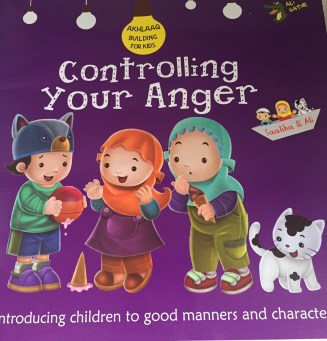
I love little picture books for toddlers and early elementary kids that introduce children to Akhlaaq, good manners and characters.  The book’s tone, however, seemed a bit off to me, so I put it away a month ago and pulled it out again today to read it, knowing I would have forgotten most of my initial thoughts, but somehow, they resurfaced with a vengeance, unfortunately.  And while the pictures and binding and theme are all absolutely wonderful in this 23 page book, I didn’t like the main character at all, and being it is based on a real person, a child, I feel awful saying that.

anger

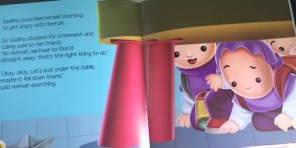
Saaliha starts the book keeping her anger just under the surface as her friend Hannah has borrowed and lost her pencil.  Hannah says she’ll look for it after lunch, and Saaliha controls her anger and basically says that it needs to be found now because it is the right thing to do.  All of that is fine, but for some reason she seems bossy and controlling and I really don’t know why.  Maybe because once they look for the pencil and then find it, Saaliha gives her peer (and thus the reader) a teaching moment by saying that she knew she didn’t lose it on purpose.  Hannah’s response is more believable when she feels embarrassed and admits she should be more careful, but I found Saaliha’s reaction smug because she was so close to getting mad, and then to be self-righteous about it, seemed a little passive aggressive to me.  

anger3

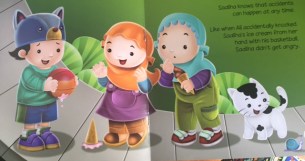
As the book continues, Saaliha recounts that accidents can happen at any time and to not get mad, which is great, it gives the example of when her younger brother Ali, accidentally knocked her ice cream out of her hand with his basketball or when he broke her pencil.   She seems to have a thing with pencils, there should have been a different example.

anger2

It then moves on to an incident with a friend, Jalal, who took a donut without asking, but it was an accident for not asking as he normally asks.  The repetition of the word accident here, I get is to carry the concept, but that doesn’t seem like an accident, it seems like he forgot, and an apology should have been in order, not Saaliha having to justify it solely.  Being it is a book about Akhlaaq I feel like the illustration of Jalal winking and eating the donut, seemed off.  

anger1

I like that Saaliha reminds her friends not to get angry as anger comes from Shaitan, but then when the book says she always says A’uthu Billahi Mina Shaitan Nir Rajeem to keep her anger in check, one wonders why in the opening scenario she didn’t say it.

I can’t pinpoint why I didn’t love this book, or maybe I just didn’t like the main character and I would probably give the series another try, but I’d like to hear your thoughts if you have read the book, and more importantly what your children thought of it.


Mikaeel and Malaika: The Quest for Love

Standard
Mikaeel and Malaika: The Quest for Love

mikaeel.jpg

The beautiful hardback book is pricey, but fun.  I didn’t have any expectations when I read it, but now that I’ve read it three times and had my children read it, and my mom a reading specialist/teacher of 45 years read it, I feel pretty confident in saying, its a well-done book.  I think it can get a bit cumbersome when reading aloud, because some lines rhyme and some don’t, but on the third read through I read it to six kids ages two to nine and all throughly enjoyed it.

maandm

The sibling superhero duo are on a quest to find out how to have a pure heart.  They try praying aloud, praying quietly, then they go and talk to the Big Boss, their dad, who speaks in rhyming clues.  The play on words might make the book utterly confusing to children younger than five, or kids of all ages if full attention isn’t being given when read aloud.  For independent readers, they will delight in the words that sound the same yet have completely independent meanings.

mandm2

Eventually their quest also takes them to Agent M.O.M who loves them more than anyone else they can imagine, but the big reveal is that Allah (swt) loves us even more.  I don’t know that it is crystal clear that getting a pure heart involves loving the one who loves us most. But, I think by the end, the readers are just entertained that they figured out Allah loves them more than anyone else in the world and is the creator of us all.  The last page has an ayat from Surah Rehman, ” So which of the favors of your Lord would you deny?” Which again adds one more thing to the story about being grateful for all that Allah has given us, keeping it from being a completely streamlined story, but adding to the overall love and appreciation for Allah.

mandm1

The illustrations are absolutely beautiful and engaging, the amount of text and the font is perfect for ages 6-8 and the messages is fun and educational.  I hope that there are more in the series, alhumdulillah.


Eid by Maria Migo

Standard
Eid by Maria Migo

eid cover

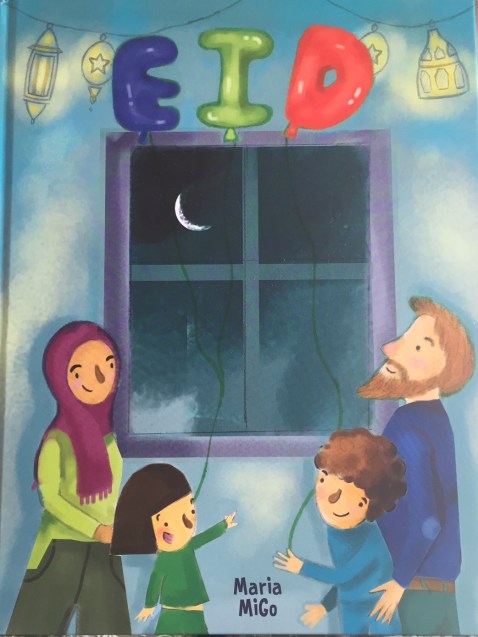
This linear story works great for toddlers that might not remember what a typical eid day is like, or those that do well to know what to expect.  There isn’t a ton of detail, but each page has a sentence or two that move the story from spotting the moon, to putting on new clothes, going for prayers, opening presents, and falling asleep at the end of the day dreaming of next year.

eid4

The gentle pictures convey that Eid is a time of family and love, but don’t necessarily convey that chaos and excitement of the day.  The kids are smiling, as are their parents, and the interaction is playful and safe.  I feel like this book is really ideal for kids with anxiety or that need some reassurance when their daily schedule is altered.  For kindergarten kids and older for the most part, I think they might find the book a glorified timeline list.  After one reading, I’m sure they will not ask for another nor remember much from the 32 page book.

IMG_0478

As seems to be the unwritten rule for books like this, the story is framed through a brother sister duo, however the simplicity of the text doesn’t name them, nor give them any role other then to show what an Eid day is like.  

FullSizeRender (100)

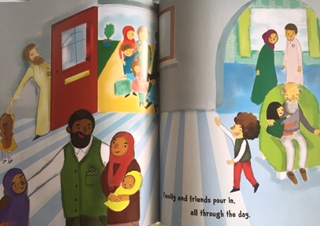
I like that they do go to the mosque and that it remarks that it is a little squished.  I also like that it mentions Eid is in summer, and implies that it isn’t always, something that could be discussed with older readers.  It doesn’t clarify if it is Eid al Fitr or Eid al Adha, so it would work for both.  The hard back binding and size are beautiful and ideal for story time and bedtime.  

FullSizeRender (99)

It isn’t my favorite book, but there is nothing wrong with it.  The Muslim Children’s Books publisher seems to have changed the cover, I’m not sure if anything else has changed.  The book would be a great addition to a book shelf, or in an Eid basket, but I don’t know that it has the wow-power to be a great stand alone gift or book to generate excitement for the blessed holiday.  


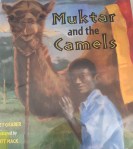
Muktar and the Camels by Janet Graber illustrated by Scott Mack

Standard
Muktar and the Camels by Janet Graber illustrated by Scott Mack

FullSizeRender (39)

On the border of Somalia and Kenya, there isn’t a library, or a book mobile, there is a traveling camel library! While the main character is more excited about the camels, at least his friend is excited about the books in this AR 3.2 story.

Muktar is an orphan who dreams of his life before his parents were killed as a nomad tending to their camels.  Their teacher, Mr. Hassan calls him lazy as he dreams of the camels he misses, but one day, a librarian from Garissa comes on camel to bring books to the orphanage, and while Ismail and the other kids are excited for the books, Muktar is drawn to the desert beasts.  Muktar notices that one of the three camels is injured and recalling the root to help sooth the ailment, he tears his shirt, treats the wound, and covers it.  When seeing his abilities, the librarian, Mr. Mohamed asks him to come with him to tend the camels as they travel with books through the desert.

muktar insideThe story definitely makes readers appreciate the life they have, and realize how simple and harsh others’ lives can be.  I like the mention of the foods, giving insight into the culture, but I didn’t like the harshness of the adults.  The calling the boys lazy, not taking Muktar food as he tends the camels, not being concerned about the injured camel until Muktar insists he notices, all made me a bit sad.  Yes I was glad that Muktar was able to resume a nomadic life with camels, but he wasn’t given a say in it.  And sure I’m glad that his friend Ismail will get books and be able to work toward being a teacher, but somehow it wasn’t a warm book, and I can’t quite identify why.

The pictures, however, are warm and detailed in the present, with Muktar’s memories being more hazy and muted.  There isn’t any mention of religion, but being the characters are Somali and their names being what they are you can assume they are Muslim. There is a short author’s note at the end that tells about the war causing the nomads to become orphans and the library service that works to share books.

FullSizeRender (38)

Brave by Svetlana Chmakova

Standard
Brave by Svetlana Chmakova

bravecover.jpg

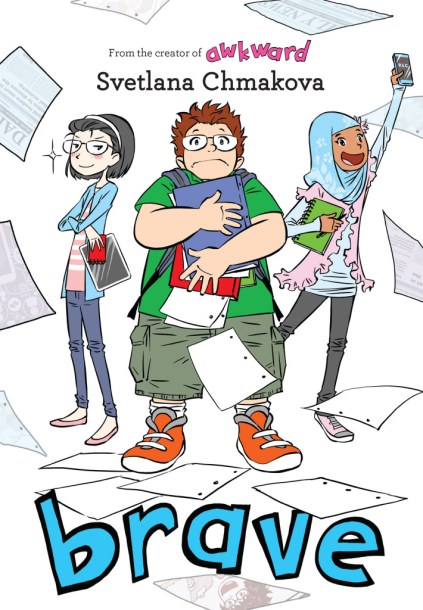
Often these days, minority groups are feeling more and more marginalized in a blaring world that is increasingly divisive and polarized.  So to see a book in my child’s Scholastic Magazine with a muhajaba on the cover, and not a main character, in a book about bullying, where she isn’t the instigator or recipient, made my minority heart swell with hope.  This 238 page graphic novel (AR 2.8) is a quick, quick read for middle schoolers, and one with a good message, that is more self empowering than preachy.  A companion book to Awkward (which I haven’t read, but hope to soon), the author takes us into Middle School through the eyes of Jensen, a kid who is struggling to find his place and escapes into his daydreams to conquer every day stresses.


SYNOPSIS:

Jensen wants to be a NASA scientist, but he isn’t good at math.  He loves to draw, but the Art Club is consumed with an upcoming event he knows nothing about, he is harassed by two bullies every chance they get, and occasionally he is asked by the newspaper staff to do menial work.  Yet, somehow despite having no friends, and a constant barrage of things going against him, he doesn’t see himself as a victim or as the recipient of bullying.  Rather, he falls into regular day dreams where he is the main character in a video game and all these battles have to be overcome to reach the end.  The surrounding characters have their own little stories, and you get to know a bit about them through Jensen, but the author doesn’t let any of them be painted with a singular stroke.  You see the athletes, being kind and sticking up for kids getting picked on, one being a math wiz.  The journalism staff of Jenny, Akila, and Felipe, run the school, but have their own stresses and internal struggles.  The circle of activity comes to a head when a student is expelled over the dress code, and all the various groups in Jensen’s world have to come together to make change.  In the process he realizes that he is being bullied, and that something needs to be done.  He also realizes nobody has it all together and he has a part to do to help others as well.

WHY I LIKE IT:

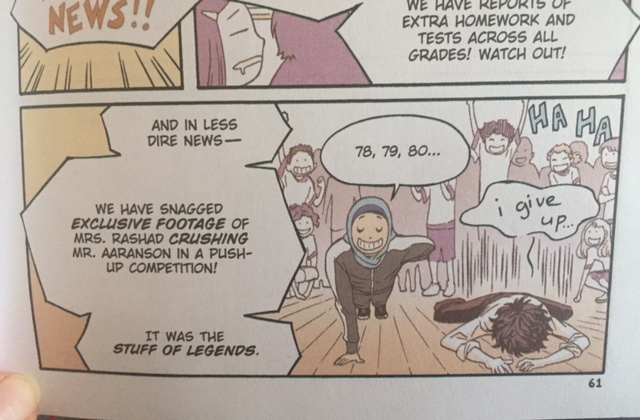
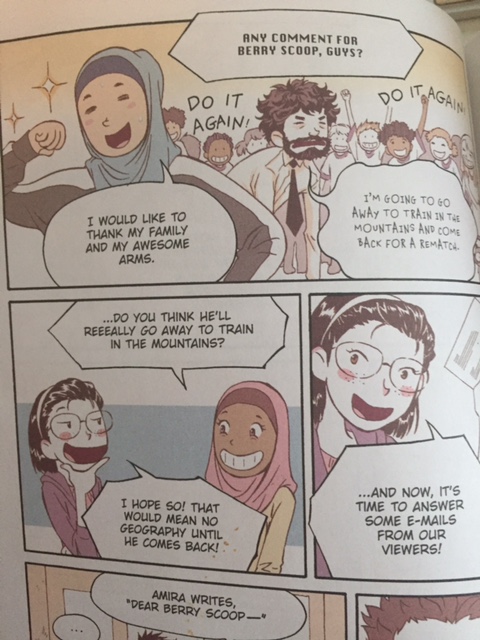
First I like it because there are Muslims in the book, that are just characters in the book.  They don’t represent all Muslims, they aren’t “different” or “other.”  Akila wants to be a journalist and she is smart, and she is kind, but she fights with her best friend, the bossy Jenny, and it is Jensen that has to help them see their errors.  I also like that the P.E. teacher, Mrs. Rashad, is a hijab wearing Muslim, that beats the social studies teacher in push-ups. I mean what an amazing way to break a hundred stereotypes, by not mentioning them, and just showing them as normal. A muslim woman, working, being physical fabulous, and being modest, ya we need more of this. There is no mention of their religion, their clothing, their hijabs, nothing.

FullSizeRender (27)FullSizeRender (28)

I also like that the students in some cases didn’t realize that they were bullying.  I think this happens a lot, where maybe someone won’t let you sit by them because they are saving a seat for someone else, but the second or third time it happens, the recipient feels alienated, where the aggressor may not even be aware.  The book explores lots of ways of bullying, but because it is filtered through the character, it leaves a lot of room for discussion about how people treat us, and how we treat others, and where a lot of pain can come from the misinterpretation on both ends.

There is a lot of diversity in the book, boys, girls, skin tones, body sizes, physical abilities, handicaps, intelligence, etc. that come up to varying degrees, but do at least offer the readers real ways to see themselves in the pages.  The book has a very tidy, happily ever after feel, which is ok I think for middle school. The book has a specific audience. Elementary will just find everyone mean, high schoolers will find it childish, but as social relationships get more challenging in middle school, I think this demographic will often have to find the courage to be brave to get through unscathed.

FLAGS:

None. One character has a boyfriend, maybe. But it is clean with pretty much everything, it even says for All Ages ont he back.

TOOLS FOR LEADING THE DISCUSSION:

I would love to do this as a book club book.  I don’t think it would need any prompting or guides. My 6th grade daughter said it was “ok” yet has brought it up at least ten times since she read it, and has come and sat by me to watch me read it.  I think, she has had some similar issues and to be able to talk about them through the characters, has been liberating for her, and furthered my conviction that fiction has power.

The Author’s website: https://svetlania.com/