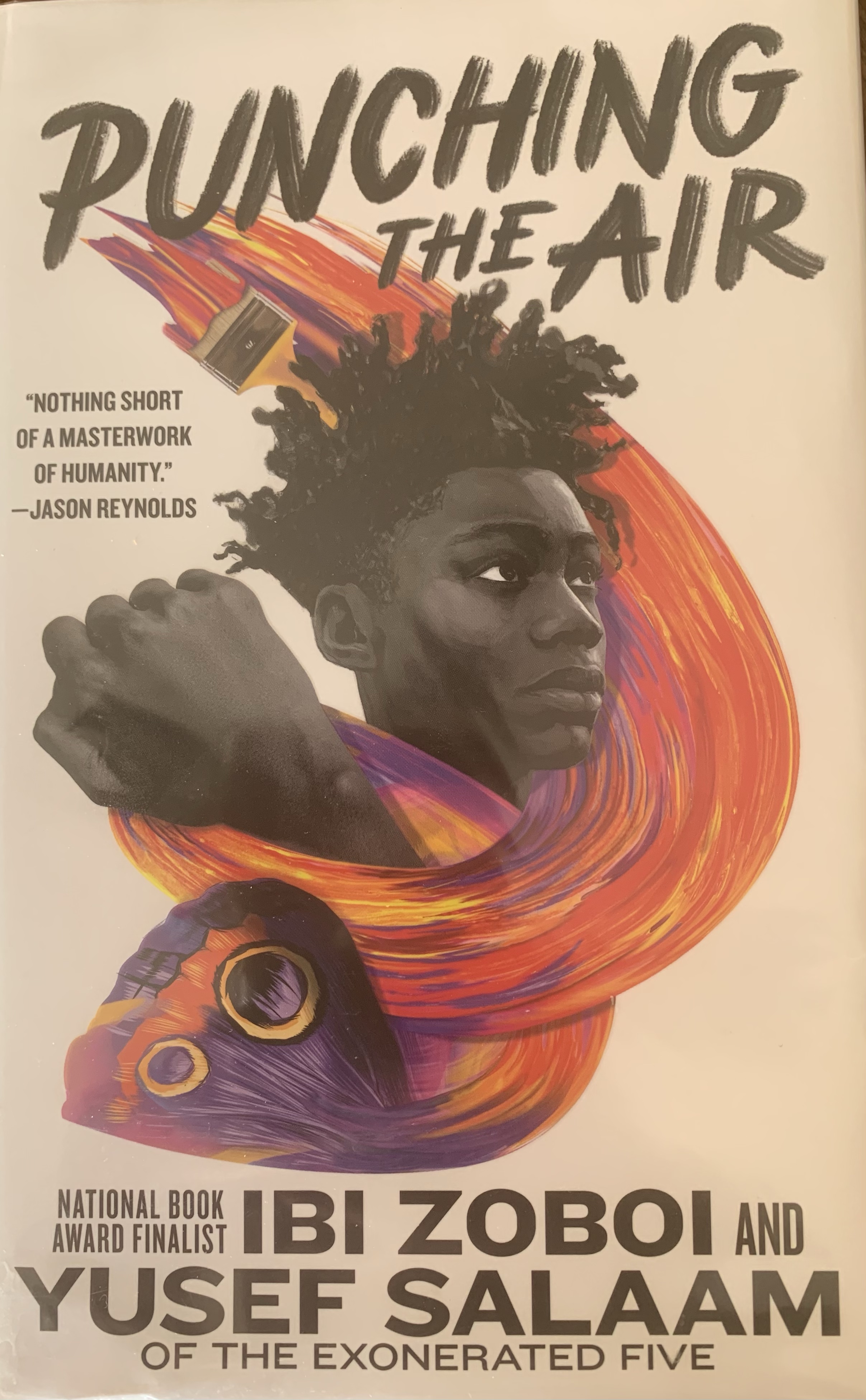
Four hundred pages of painfully powerful verse that you will have to force yourself to slow down and not rush through. Yes, you want to know what happens to the young, black, muslim teen writing his truth, but to read it too quickly will deprive you of feeling and contemplating and absorbing the message that if, you, like me are a white (ish) person of privilege, need to surround yourself regularly with to understand. The OWN voice narrative is co-written by one of the Central Park Exonerated Five and should be required reading for everyone 14 and up.
SYNOPSIS:
Amal Shahid is 16 years old, and maintains he is being wrongfully accused of a crime that has left a white boy unconscious. He acknowledges he threw the first punch, but is adamant that he didn’t throw the last. From his trial to his incarceration in a juvenile detention facility, the narrative pushes forward as he adapts to confinement with flash backs to pivotal moments in his life. He is a gifted artist and writer and his creativity and ability to express himself is what will hopefully provide him a way to survive.
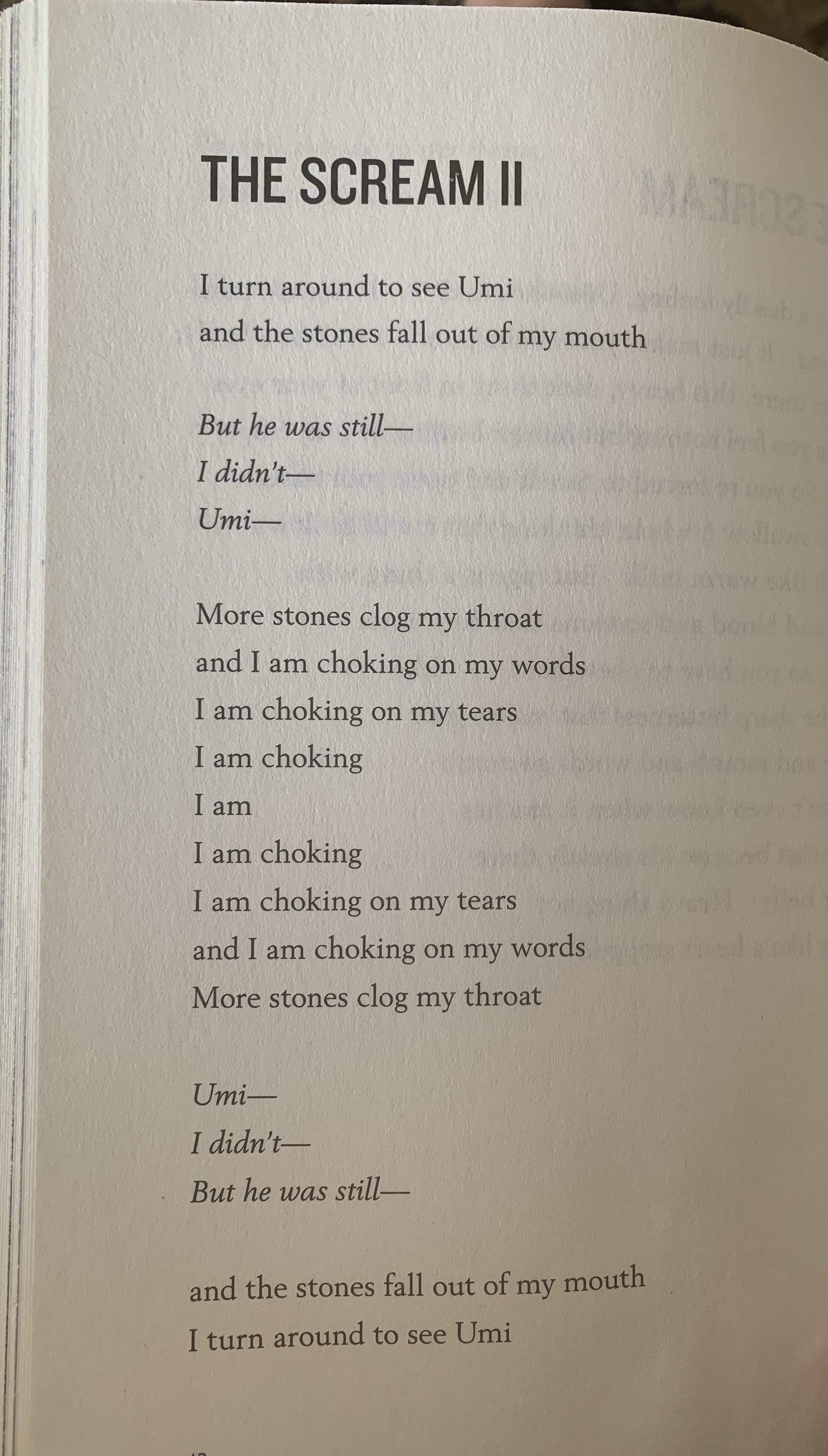
I know I’m leaving this vague, because truly I cannot do it justice. I started taking pictures of powerful sections, and when I found myself taking pictures of nearly every page, I realized that the book is something to be experienced in its entirety and will include just a few internal pages to tempt you.
WHY I LIKE IT:
The book is impactful in that it claims only to share the protagonist’s truth, it doesn’t get off tangent from that, but allows for the reader to add to the narrative their own understanding to make it personal and resonate most profoundly. His situation involves so many injustices plagued upon him only because of his skin color, and a system that is designed to keep racism alive and powerful. He was at the wrong place at the wrong time perhaps, but while the book is heavy, hope is ever present. I’d like to believe it is because of those that refuse to give up on Amal. I was swept away by the power of a mother’s love. Truly, what strength for a young man in Amal’s situation to have the world betray him so often in his young life, to find unflinching love, support, belief, and determination in his mother.
I love that his mother is a practicing Muslim, his grandmother attends church, and he loves them both and values their spirituality. Allah, the Quran, and Islam are mentioned regularly. It never is preachy, or gives much doctrine, but it is present, and is a tangible part of how Amal sees the world.
FLAGS:
There is language and violence. He has a crush on a girl and she writes him letters, nothing obscene. There is racism, bullying, racial slurs.
TOOLS FOR LEADING THE DISCUSSION:
There is so much to discuss in this book, and so many resources online. I think the book might be too mature for my middle school book club, but I am suggesting it to the high school book club. This book needs to be read, discussed, breathed in, and experienced. Plus the author’s real life experiences should be incorporated into the discussion as well as the student’s understanding of how present racism is and how they can use their voices and influence to create real, lasting, change, inshaAllah.
This 157 page young adult book is translated from Arabic and while at times the story seems intentionally choppy, at other times it seems that the translation is making it more jarring than it needs to be. I found the book interesting and powerful, in much the way a short story can be, but the length was awkward, as it was too long for a short story, and not long enough to really read as a novel with detail and depth and connection. I love the growth and retaking of control that the protagonist embodies and I absolutely love the ending being left intentionally unresolved. There is no mention of religion in this story set in Lebanon, until nearly the end when it states that she is Muslim. I wonder if the translation took out some of the ‘Salams’ and ‘inshaAllahs’ that would have clarified it a bit even if prayer, or the athan or any outward signs of being a Muslim are clearly absent. The book is probably fine for ages 13 and up.
SYNOPSIS:
Faten is essentially sold in to servitude by her family. Her family lives in a village outside Beirut and when money gets tight she is forced to go and work as a house keeper/maid for the Zein family. Once a month Faten’s father comes and collects her salary showing little to know affection for the eldest of his children. The small Zein family has two daughters and lives in a flat. While the girls are in school, Faten cooks and cleans and dreams of being a nurse. The family is not particularly cruel to Faten, they often refer to her simply as ‘girl,’ but they are not particularly kind to her either. The highlight of Faten’s day is watching a young man across the street that drives a dark blue car, come home, study, and play piano. On occasion she catches his eye, so he knows she exists, but the two know nothing about one another. On Faten’s 17th birthday she decides she is going to gift her self something, and writes a letter to the blond man across the street. She has her only friend in Beirut, Rosalynn, a much older house servant in the apartment downstairs from Sierra Leon, deliver the letter which asks the boy to meet her so that she might seek his help in a very important manner.
When Faten and Marwan meet, Faten asks him to obtain information about how she might study nursing and change her future. The two secretly meet with Rosalynn’s help on Sunday’s, Faten’s one day off. Faten borrows May’s books to study as she learns what exams she must take to make her dream a reality. Marwan helps her with questions she needs assistance with and Faten and Marwan become close friends, with both feeling some attraction for one another just beneath the surface. One day however, they are discovered by a friend of Mrs. Zein at a beach side cafe, drinking coffee and Faten is forbidden from leaving the apartment as a result. With the oldest girl, May, married now, and nothing to look forward to on her days off, Faten dives in to her studies and is more determined than ever to pass her exams.
To even take the multiple day exam requires a few lies, a few favors, and the willingness to take a huge risk. When the Zein’s find out she is let go, and now must face her parents back in the village. With the help of her childhood friend, Faten clings to hope, confidence in her ability, and determination to pave her own way on her own terms.
WHY I LIKE IT:
I love that while Faten is the victim of cruel parents, and an unfortunate circumstance, she rises up and fights for control. I love that she has feelings for Marwan, but that they don’t overshadow her future goals, nor does she become overly dependent on him. I really love her strength in handling the situation with him when it is good, when it is tested, and when she has to walk away. There are elements of it being a love story, but that is just one thread of the book, her charting her own path is much more the central story line. I wish her religion and his religion would have come to the surface more, and sooner. Lebanon is a diverse place and just saying they were of two different faiths could have provided a lot of insight and fleshing out of the culture and the dynamics the two would have faced. The classism is a bit obvious, but even when that is explored it provides a better understanding to the characters and to the arc they are moving on. I like that her childhood friend and family are so loving and that her mom is not completely written off as a passive flat character. Overall, I like the story and the book, set in the 80’s it really could have gone a lot of ways, but it held close to the theme and provided enough side details that it felt grounded, believable and ultimately was enjoyable to read.
FLAGS:
When May is entertaining suitors there is some ogling that young kids might question. There is a lot of lying and deception and the possible romance between Faten and Marwan that in the text is pretty clean, but there is some hand holding if memory serves and implied desire for the friendship to be more.
TOOLS FOR LEADING THE DISCUSSION:
The book offers a lot in terms of classism and forced labor to be discussed and the cliffhanger ending between Marwan and Faten would allow the readers to decide if they could be together despite their different faiths, economic status and families, or not. I probably wouldn’t do it as a book club, but if I were a high school teacher, I might offer some sort of extra credit assignment involving the book, as the ending really lends itself to the reader projecting the characters’ futures based on their own perspectives which would be fascinating to hear.
This book did not work for me. Despite the fact that the main character is Muslim and it is Ramadan, no matter how much I wanted to connect with this multicultural lead and her friends, and see myself in her as she navigates high school, I just could not. The writing was choppy 3rd person which distanced the main character for me, the crude language on every page, the drugs and alcohol in every scene, the detailed sexual encounters throughout, the lacking growth of the characters and the muddled point of the book in general made the book difficult to read. The book is an AR 4.9 but content wise is more suited for mature 18 year olds. Even this review might be a little too much, I’ll do my best to keep it clean. Ultimately this book missed the mark for me in showing females defining themselves, celebrating friendships and diversity, or even just creating characters to cheer for as they navigate life.
SYNOPSIS:
Leila is half Iraqi Muslim from her dad’s side and half American Catholic from her mother. She doesn’t know how to pray as her father isn’t religious, but celebrates Ramadan and Christmas and defines the world on her own terms. She is fearless and owns herself, hence she hates her name and goes by Lulu instead. The book opens with her making out with a boy in a closet which she kind of regrets and then goes to join up with her friends at the party to drink and get high and attack one another for their poor choices resulting in drama. In this instance Lulu’s anger pushes a boy in the pool, and then the four friends devise a way to get home and work out the lies they will need to tell to the parents involved. This scenario with only slight variations repeats five or six times in the book.
Lulu is the fearless one, Lo, short for Delores, is the leader, Audrey is an alcoholic math whiz and Emma, not to be underestimated and often is forgotten (literally) is coming out in her first lesbian relationship. Yes these labels are limiting and stereotypical, especially in a book calling for girl power or what not, but sadly that is really the only space they flesh out, not a whole lot more is known about them. The girls defend each other fiercely to outsiders, but are truly awful and angry to one another all the time. They break apart and Lulu doesn’t really know why, so the path back to one another isn’t really cathartic. They pull a prank to get back at a boy that crossed the line with Lulu, but it fizzles when the threat of what the prank could do is enough to keep him away and they don’t have to complete it completely.
Between the parties there are some sub plots that weave in and out. Lulu has to spend time with Iraqi family friends who don’t accept her and are critical, in Arabic, of her mother. This gives some cultural layer to the story, but the characters are pretty flat and petty and hypocritical. The bombings in Paris a few years earlier, and the resulting bullying by classmates hardened Lulu, but there isn’t much info on how awful they treated her or how it defined her, so not much sympathy is garnered by the event nor does it help the reader get inside Lulu’s head. There is also a sweeter love story brewing than the one night stands that define Lulu, but then she goes with her mother to get birth control so she can sleep with him all while making it clear that he isn’t her boyfriend, she just wants to have sex with him- which she does on her seventeenth birthday.
Eventually the girls are back together and gushing with tales of sorrow and personal growth and vows that they will always be like sisters.
WHY I LIKE IT:
I don’t mind the premise so much as the execution of it. I get that people practice Islam differently, but I really don’t get the need to even bring her religion in to such a story. Culture maybe, but even that is a stretch. I don’t know if the story would be better if it was first person, I would like to think so, as not connecting with the main character was such an obstacle for me. I wanted to see her grow and change or at least have clarity in her decisions even if I didn’t agree with them or couldn’t relate to them. I wanted to feel her remorse or the weight of her decisions, but was often just told in passing that something scared her or was hard for her, not shown it. The theme of not belonging anywhere is a legit one, but I don’t know that this book explored it, it just sort of brushed by it almost as a trial to see if the emotions would stick. Which for a character built up to be unapologetic and unafraid to suddenly want a victim label without any real emotional ties, didn’t work for me. There are such holes in the story, that at times things didn’t seem believable or details were so specific with no context that I didn’t get their purpose. I would have loved to know more about her brothers and the tests they went through, or why her family was so loyal to the Arabs around them. I desperately wanted something that showed a different side of Lulu not just the anger and “F everyone who wants to change me” mantra. People are scared of her and she enjoys that power, but I don’t get why they are scared and why she enjoys it. It seems like a big part of her story and of the book in general to miss. Yes she is independent, and I get that can be misread, but she almost seems one dimensional and flat which defies the concept of defining yourself on your own terms and carving out where you want to belong among groups that see you as other, right?
The character is pretty open that she knows little about Islam, she also claims she isn’t interested. She fasts not so much because it is a commandment but more to appreciate poor people. She says this, but actions don’t seem to back it up. She tries not to drink during Ramadan but she still smokes, gets high, makes out, and lies once the sun goes down. At one point she calls a bride and her mother whores, and refuses to apologize, so her dad gets a fatwa issued. Lulu’s mom mentions that something went all Shiite on the situation, so I’m not sure if the fatwa issuing for such a specific thing is a shiite thing or something I’m just not aware of or familiar with as a tool for handling family dramas.
FLAGS:
The whole book really. Sex, drugs, alcohol, sexual assault, lying, cheating, blackout drunk, vaping, talk of orgasms and going down, lesbian relationship, hetero relationships, sexual encounters, language etc etc etc.
TOOLS FOR LEADING THE DISCUSSION:
Would never cross my mind to share or suggest this book. Even religion representation issues aside, I don’t know that there is really a single “healthy” relationship highlighted among the main characters, some of the side characters maybe, but not enough information is given to really make that case. The characters just all seem so angry, not saying teenage years aren’t angry and messy, but this one doesn’t seem to add much perspective to that singular thought unfortunately.
This 36 page book for ages five through eight is a cute story about being brave, facing your fears, challenging your perceptions, celebrating differences and giving friendship a chance. Recently translated and published in English, this Arabic inspired folktale is timeless and important for readers of all ages to learn from.
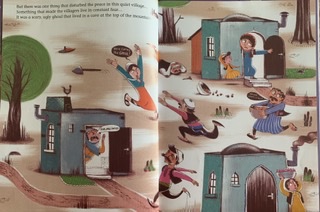
Hasan the Brave is a young boy that lives in a mountain village. The children are told not to laugh out loud, the adults tiptoe to their fields, and the fear of being eaten by the ghoul that lives in a cave on top of the mountain consumes them all.
But Hasan isn’t buying it and starts asking questions. Why is everyone afraid of the ghoul, he asks his aunt one day in the olive grove? She tells him because he is covered in hair, has one eye, long claws, sharp teeth and his favorite food is little boys and girls. Unconvinced Hasan asks his dad if anyone in the village has been hurt by the ghoul. His dad can’t think of anyone. He asks his mom if the Ghoul ever ate anyone in the village? She can’t think of anyone, but has heard plenty of rumors and wants him to not disturb the ghoul none-the-less.
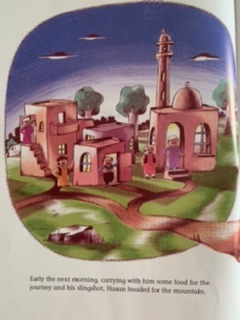
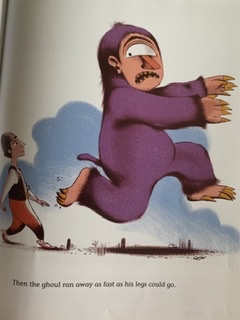
Hasan is tired of being scared and decides he will climb the mountain. Everyone in the village tries to warn him against it, but he is Hasan the Brave after all and is determined to go. When he gets to the top of the mountain and relishes at the beautiful view he proclaims that he is fearless and that he won’t be afraid of the ghoul. Then he sees the ghoul, and after the ghoul sizes him up, the ghoul runs away.
Hasan goes to investigate why such a monster is scared of him and learns that the ghoul is scared of people because they have two eyes instead of one, they do not have thick hair like him, they have strange hair, small teeth, and they eat ghouls. Ghouls, Hasan finds out are vegetarians.
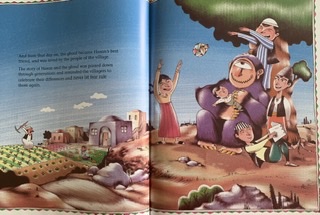
The two laugh at their assumptions, and run off to play together. From that day on the two are best friends and the people in the village pass on stories to remind future generations to celebrate differences and not let fear rule them again.
There are a few women in hijab, the villagers say inshaAllah, but there is nothing religious in the book. The illustrations are detailed and colorful in a muted manner. Overall a fun book with a great lesson.
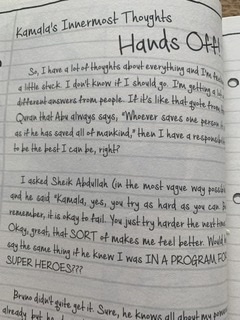
This is the first book in a new middle grade Marvel series told from Kamala Khan’s perspective. Part graphic novel, part screen shots, emails, diaries, fan fiction and doodles, the book features a diverse group of young marvel characters and even some quotes from the Quran. At 175 pages the book has action, humor and themes of team work, self improvement, friendship, second chances, and balancing life that will appeal to boys and girls that are fans of comics, but might be a little scattered for those that only know the main superheroes from pop culture.
SYNOPSIS:
Kamala Khan aka Ms. Marvel is doing a good job keeping villains out of her New Jersey neighborhood, but she is also causing damage to property in the process. When she gets caught on camera destroying a building, a letter from Captain Marvel follows with an invitation to join the Avengers Institute. Already balancing school, her writing of fan fiction and her super hero obligations, Kamala worries if she can handle one more thing and if she is up for making new friends. But, it is Carol Danvers asking, so she reflects on a quote from the Quran her dad always says and talks to Sheikh Abdullah, and ultimately decides to give it a try.
At the Institute she makes friends with Miles Morales (Spiderman) and Doreen Green (Squirrel Girl). The three of them are assigned to be a team for the Academic Decathlon at the end of the semester and to succeed they have to learn about trusting each other, team work, making smart decisions and communicating. Their biggest and most sinister rivals are Max Frankenstein, Kid Immortus, Death Locket and Kid Apocalypse. with the group leader, Kid Immortus being focused on Ms. Marvel and convinced that if he can clone her atoms he too can engorge. Kid Apocalypse however, has a class with Kamala and the two of them are kind of becoming friends. Throw in teachers like Beast from X-Men, Lockjaw teaching interdimensional travel and diplomacy, and an independent study class with Ant-man and there is a lot of fan girling going on.
WHY I LIKE IT:
I love that they are super heroes, but the book is about everyday real world struggles. The book doesn’t have a plot or climax so to speak, but more lays the foundation for the rest of the series and gives young readers a lot to relate to with new school awkwardness. There are strong themes of being a good friend, a good loser, seeing the good in others and really understanding what it takes to make a team work. There are some great lines, “politicians don’t have anything on aunties,” that speak to Kamala’s desi environment and I absolutely love that Kamala Khan mentions an imam, quotes the Quran twice, has a friend that wears hijab, and a mom that does too.
FLAGS:
The book is pretty clean.
TOOLS FOR LEADING THE DISCUSSION:
I don’t think it would work as a book club selection, but I think readers 3rd or 4th grade and up that love super heroes will enjoy the fun dynamic read.
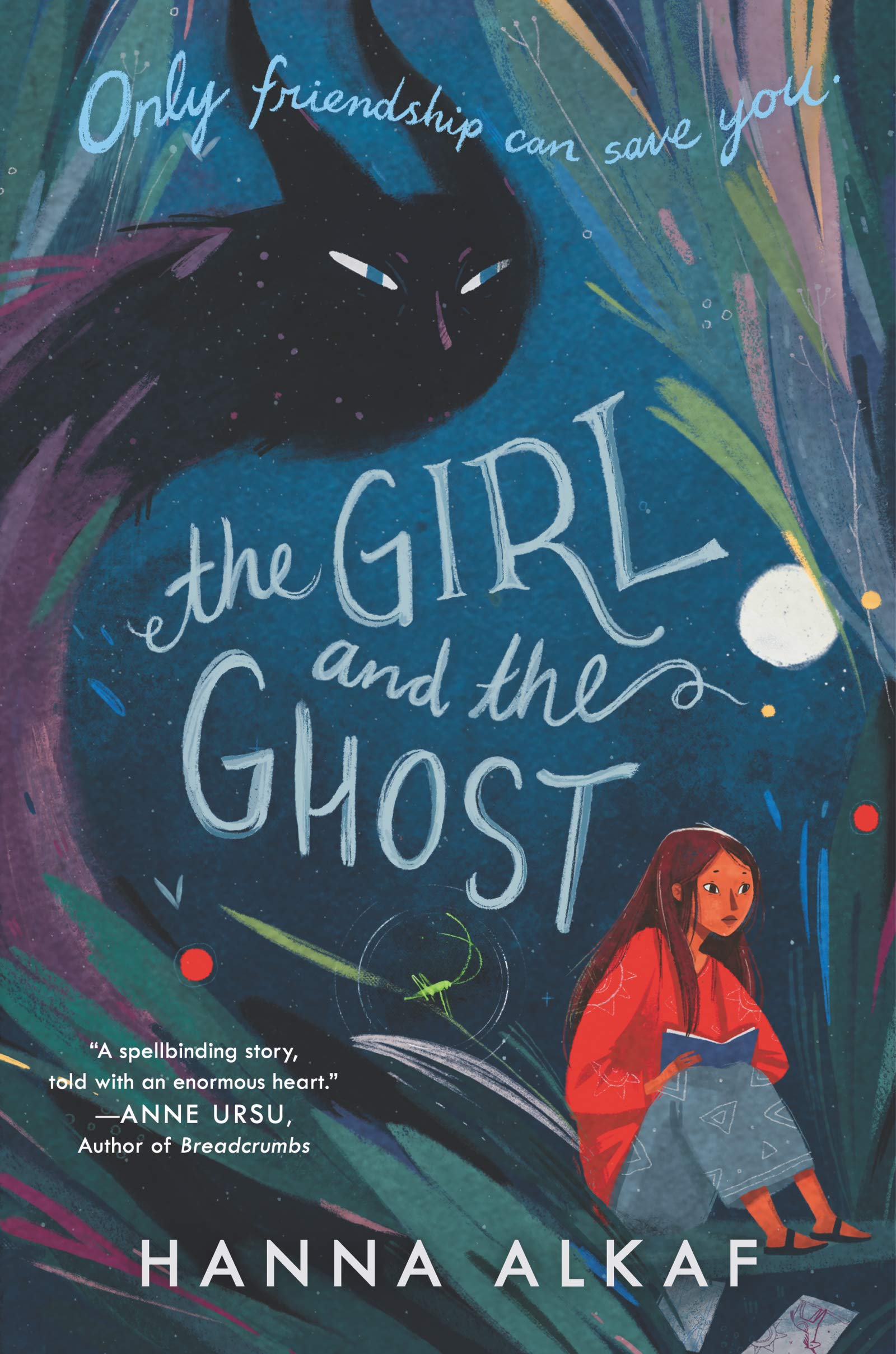
A book meant for middle grades, 8-12 year olds, that has depth and layers and culture and strength is not something you find very often. Over 275 pages, the book is at times dark and haunting, but what is truly remarkable is that it doesn’t talk down to young readers and with its pop cultural references and relate-ability, the book is not dreary. In fact, the true “haunting” occurs after the book is finished and the concepts of friendship, being alive, and forgiveness stick around and require thought and consideration. The book is based on a Malyasian folktale, how much is a fleshing out, or simply a starting point, I do not know, but I do know that the characters are memorable, the concept thought provoking, the writing flawless, and the intertwining of Malay culture, Muslim characters and the supernatural, a combination that makes for an enjoyable read.
SYNOPSIS:
When an old witch dies, her pelesit, her ghostly demon, is passed on to her granddaughter Suraya. Suraya lives with her mother, a teacher, and is lonely and emotionally neglected. An adventurous girl, the pelesit, keeps the small girl safe, but waits to reveal himself to her in the form of a grasshopper when she is older. When he does reveal himself to her, she asks him his name, and he doesn’t know it, so she names him Pink.
Suraya and Pink become best friends, and he provides company for her as she receives very little from her mother and has no friends. Suraya had no knowledge of her grandmother and Pink modifies the stories to leave out how evil, cruel and vindictive she was through him. As an evil being with no heart these acts never bothered him, although he stopped enjoying them long before she died. With Suraya however, he feels things. He is sad that she is unloved by her mother, teased by the other children, and that she doesn’t have the things other kids have. Suraya is kind, and forgiving, and tries so hard not to let things bother her. Pink however, with a twitch of his antenna can make things happen. Bad things. Things that might at first seem like a part of life, but when Suraya catches on, she scolds Pink. She makes him promise never to use his magic to hurt people, ever. He reluctantly agrees, she is his master after all. Unfortunately he doesn’t keep his promise.
On Pink’s prodding, Suraya makes friends with a new girl at school, Jing, and their friendship makes Pink jealous. He harms Jing and Suraya decides she no longer wants to be his master. As a result Pink is determined to make Suraya’s life miserable. As desperation mounts, Suraya tells her mom about Pink and a pawang is called in to separate the spirit from Suraya. Something seems off about the pawang, and when Suraya investigates, she realizes that she must save Pink from him. Together with Jing, Pink and Suraya are off on an adventure against the pawang and might just learn more than Pink’s backstory in their efforts along the way.
WHY I LIKE IT:
I love that Suraya and her family are Muslim and that Jing is not and they are best friends. Suraya and her family pray, celebrate Eid, give salams when at the graveyard, but obviously also believe in magic and ghosts, and somehow in the story it doesn’t seem to be contradictory or odd. I love Suraya’s strength. None of the relationships in her life are good. Yet, she is good, and she forgives and fights to make those close to her better. Pink is manipulative and controlling and abusive, but she still fights for him to be treated better and that says more about her, than whatever he is. Suraya’s mom is distant and neglectful, but yet, there is still realistic hope that their future can be and will be better. I love that all these layers are there and yet are subtle too. Kids are smart and they will bring their own experiences, understanding, and expectations to decipher these relationships, and that is amazing. I love that the characters in the story may be so different than the typical western reader, but they will still see themselves in this poor Malay girl from a small village, in her best friend Jing who lives and breathes Star Wars, or even in the religions pawang who is a power hungry charlatan; toxic friendships and family secrets make the book universal.
FLAGS:
Pink makes it look like blood is on a girls back side, implying a girls fear of leaking, but it isn’t explicit or named. There is death and dying and supernatural and lying.
TOOLS FOR LEADING THE DISCUSSION:
I am thinking strongly about using this as a book club book, as the discussion would be delicious and varied among the participants.
This claims to be a companion book to The Gauntlet, but it does rely heavily on details from the first to make sense of who some of the characters are as this book does little to explain them and advance their story. In reality the book is very similar to the first book, but sadly not as fun. I was disappointed in the 295 page AR 5.2 book, but my fourth and fifth grade boys enjoyed it as they had few expectations and the fast pace kept the book fun.
SYNOPSIS:
It has been four years since Bengali American Ahmad Mirza has left the game world, Paheli, with his sister Farah and her friends. The old board game has been destroyed and the reboot focuses on a new video game setup. This time around Ahmad is the main character and with his ADHD he finds himself getting in trouble a lot in school and desperate for a friend. When a mysterious package holding a video game shows up and Winnie sticks up for him, things are possibly looking up. When all of New York freezes at the insertion of the game, however it clearly is not. Winnie and Ahmed are off to battle the Architect and MasterMind to unfreeze their beloved city and escape Paheli.
Different battles and characters inch the duo closer to winning, but facing their fears and being sidetracked by remnants of the last game trying to return make everything complicated. Ahmed’s uncle returns to the game, giant mice try and help, crazy monkeys distract, and flying rickshaws populate the eastern inspired world filled with Bengali, and Arab references.
WHY I LIKE IT:
I love that it is a Muslim kid with some struggles at the helm, but there is really so very little character building that it ultimately doesn’t count for much in the long run. Just like the first book, the characters are taken from the “real” world and transported to a game world and they must win the game to return home. The book is fast paced and fantastical, but I constantly felt confused. The challenges were disjointed, there wasn’t a clear objective, Ahmed didn’t recall being there before or that Vijay bhai had somehow come back with them, the mice help and then they are absent, and there wasn’t really a big reveal or explanation resolving any of it. It felt all over the place and with little world building I didn’t feel like I could even picture what Paheli looked like, so forget feeling what the characters felt or imaging the intensity that that the game was running on. It seemed like an updated version of the first book, but not done as well at all.
FLAGS:
Pretty clean, some intensity, some fighting/battling, death, nothing detailed nor grotesque.
TOOLS FOR LEADING THE DISCUSSION:
I think the book is great to have in a classroom or on a home book shelf especially if the Gauntlet was enjoyed, but I wouldn’t use it as a book club book because it doesn’t offer much to talk about. There isn’t a cathartic release or even an under current of family and friendship and loyalty, it really is just surface level story telling.
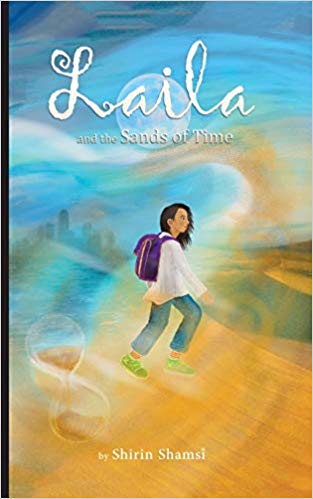
This 127 page book has a lot of potential, but ultimately didn’t win me over. It is one of those that needs a good editor to encourage the author to flesh out the characters, take advantage of a potentially cathartic resolution, and fill the gaping holes in the story. Meant for ages 8-12 the tiny font, and tight spacing, make the book really dense and intimidating to look at and read. The book, as written, should be well over 200 pages, if spaced appropriately for the target audience. Once you accept the presentation and get in to the story, it isn’t an awful read, it just could have and should have been so much more. I hope the author revisits it and polishes it up- the time travel, the science DNA component, and the death of the protagonist’s parents, offer a lot for Muslim and non Muslim readers to sink their teeth in and be swept away by, but ultimately, I don’t know that most readers will be motivated to finish the book, and those that do, won’t remember anything about it.
SYNOPSIS:
Laila’s dad has recently died, and with her mother having died years earlier, Laila is now 13 and an orphan living with her stepmom and baby sister. Feeling resentful that her dad remarried and had a child that took time away from her in his final span of life, doesn’t make Laila a very kind person at home. Her best friend Beth, even points out how cold she is to her family. With school vacations approaching, Laila is headed for Umrah with her dad’s brother, her uncle, and his wife. While making tawaf, Laila loses her aunt and uncle in the crowd and finds herself transported to 7th century Arabia. She hears a baby crying and learns that the baby’s life is in danger. To save her, she must get the baby, the baby’s mom and baby’s sister from Makkah to Yathrib. The only way to do that is to join a caravan, and they can only join a caravan if they have a male escort. So Laila chops off her hair, acts like a boy, and gets them in the caravan. They meet bandits along the way, but nothing too scary, they arrive in Medina and right before they meet RasulAllah, Laila finds herself back in the present. She is in a hospital, but the doctors do not know what is wrong with her so they release her. She returns to the US, relays the story to Beth, and decides that at an upcoming field trip to study DNA, she is going to submit the baby’s hair that she still has for dating. The results show it is from 1400 years ago and a family heirloom of her step moms reveals that the baby is a great great great great… grandmother of her’s. Resolved to open her heart to her family, Laila is a changed person, alhumdulillah.
WHY I LIKE IT:
I love the premise, it is like Sophia’s Journal and When Wings Expand thrown together and scrambled. Laila is struggling with her faith and is trying to find it, while also finding a way to move forward after losing her father. There are just a lot of things that aren’t answered, are contradictory, or don’t make sense. It says she learned Arabic because her mother spoke it, her dad is desi, but really no hiccups speaking in 7th century Arabia other than forgetting the word for scissors? She at one point said she was a cousin from the north, but while on the caravan mentioned that she had never travelled through the desert. There really should have been more action with the thieves and the regrouping when the men came back. Similarly, her gender reveal should have been a bigger deal than it was. I was hoping there would be a mention of if her hair was long or short when she awoke in the hospital, I don’t think I missed it, but maybe, or maybe it wasn’t there. Once back home, there really needed to be a reunion scene with Laila and her stepmom and half sister, I mean the whole point of the time travel was to save a baby. Really? Nothing? I was disappointed that it was glossed over and mentioned as a retelling to Beth and pushed aside. The second climax is when the DNA testing is being questioned, but I didn’t get the need for the babysitter and everything to be rearranged for a two second conversation with the principal accusing Laila of theft, a phone call should have sufficed, plus when Laila and Beth mention it to the scientist, it seems everyone was questioned, but Beth wasn’t, something wasn’t consistent there either. Overall, the book needed more action for a book that involves time travel and more emotional attachment and character connection for a book that involves a newly orphaned young teen girl.
I like the conveying of Islamic facts and information and history in a fairly smooth way. At the beginning, Umrah being explained was a little text bookish, but it smoothed out as the book progressed. I love the little flashbacks at the beginning of each chapter, I wish there would have been some information about the remarriage of her father and her emotions on the matter at that time. It is one thing to be grieving, but really she is a brat to her step mom, and if the uncle and aunt live right there, not sure where they live, someone should really be working on getting them all some family therapy, not a quality situation for anyone.
FLAGS:
none
TOOLS FOR LEADING THE DISCUSSION:
I wouldn’t use the book as a book club selection, nor would I think it would get read if on a classroom shelf. I might use the premise of going back in time to meet Prophet Muhammad, as a writing prompt though. Would be a good assignment with factual and Islamic references to get kids stretching their imagination to make it all come together and work.
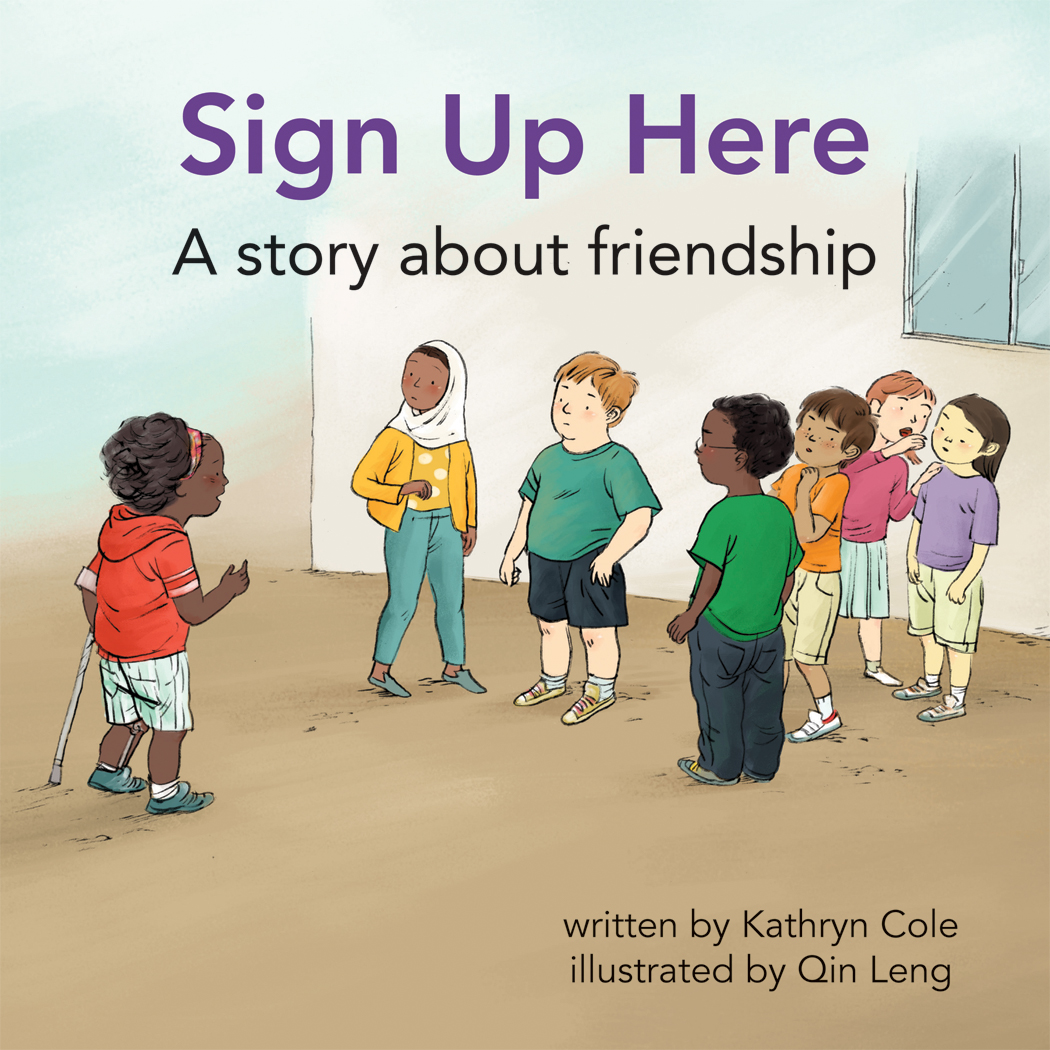
I debated reviewing this book, but seeing as it is one in a series of four, and Nadia a hijab wearing girl of color, is included in them, I thought I should draw attention to these diverse books that teach moral lessons. Over 24 pages this book for preschool to second graders focuses on inclusion and friendship.
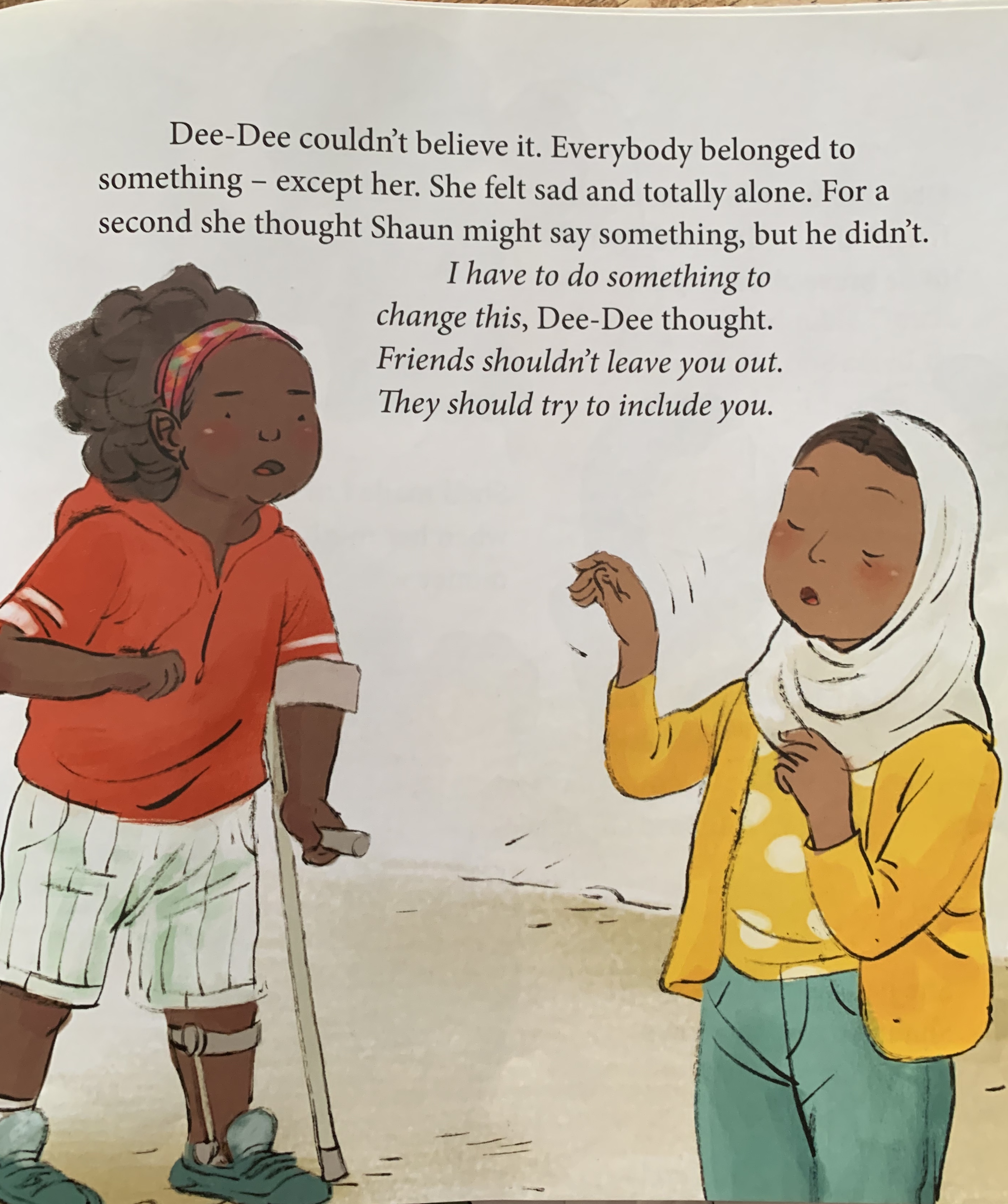
The diverse group of classroom kids (skin color, hair color, body shapes, mobility) have different likes, and exclude Dee-Dee from joining in any of their clubs. One group after another tell her no, even though she knows she is a good friend to all of them.
Dee-Dee decides she has to do something to change this and asks her teacher Ms. Crosby for some art supplies. Curious as to what she needs them for, Dee-Dee lays out her plan and how her friends’ exclusion is making her feel.
Dee-Dee starts the Friendship club where all you have to do is sign up and treat others the way you would like to be treated. You then pick a sign that has an attribute of being a good friend as a reminder or something to work on: be kind, show respect, care, etc.
Everyone realizes they were mean to Dee-Dee, apologizes and phew, the friends are all back together without anyone getting mad, or in trouble, but rather realizing their mistake fixing it and resolving to do better. Great problem solving Dee-Dee!
I love that the group is so diverse. Nadia, the Muslim girl excludes Dee-Dee too, and has to learn to include others. I’m sure everyone will relate to feeling left out, or being the perpetrator of exclusion in the book and learn how to voice how it makes you feel, and how to not do it to others.
And yes Nadia probably doesn’t have to wear hijab, but alas, for reasons unknown to the reader she is wearing it, and is visibly showing her faith at a young age.
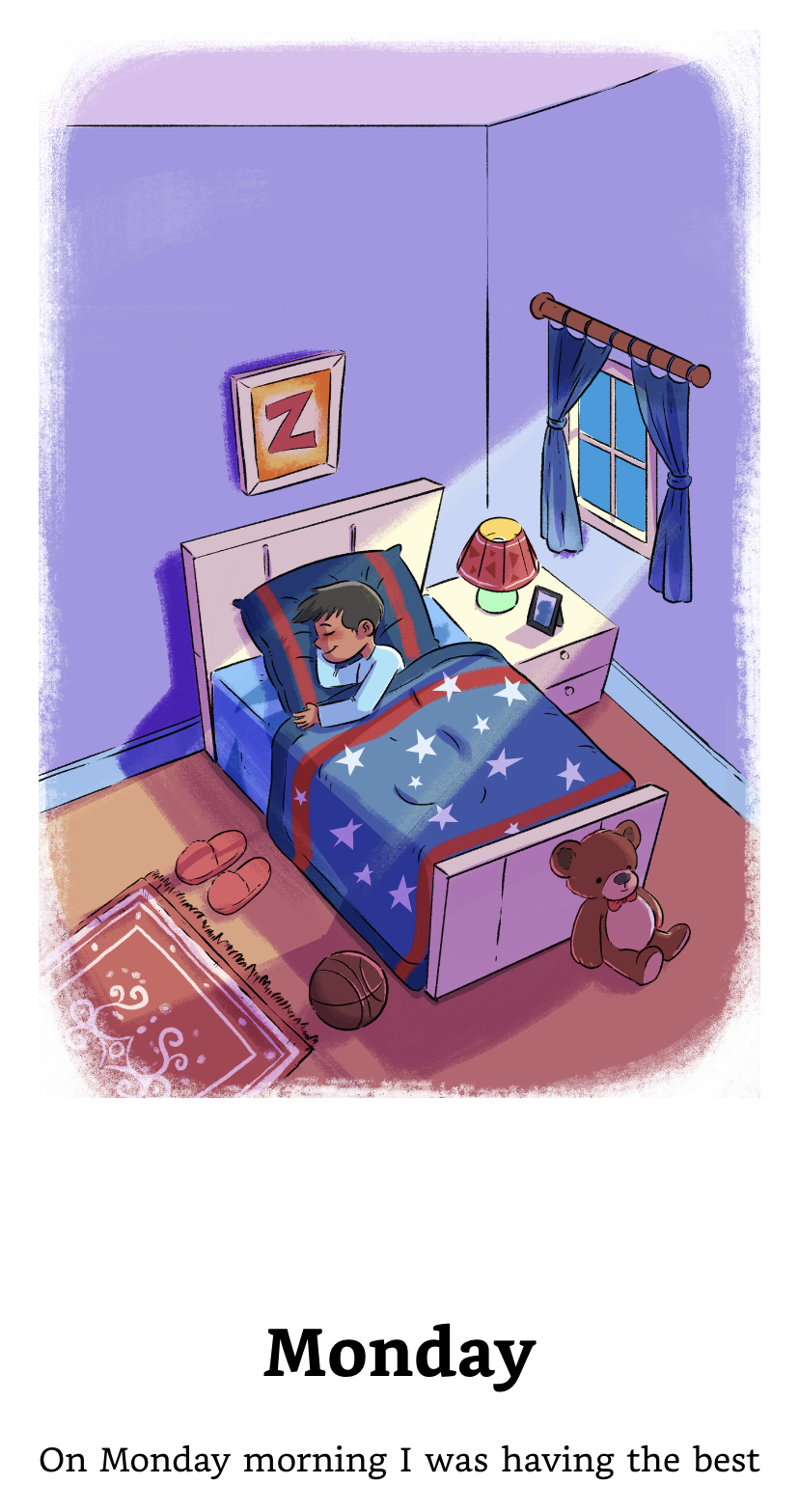
A very relatable 31 page early elementary chapter book about not only establishing salat, but doing it for the right reasons. The book is not preachy or reprimanding, and even with a moral purpose, Zain manages to connect with readers and be funny and likable along the way. Told from the view of the young narrator, realization is achieved, confessions made, understanding gained, and inshaAllah regular prayer established. A great book to share with your own children when salat integrity is in question, and a great reminder of the power of salat that kids will enjoy reading even when it is not, alhumdulillah.
SYNOPSIS:
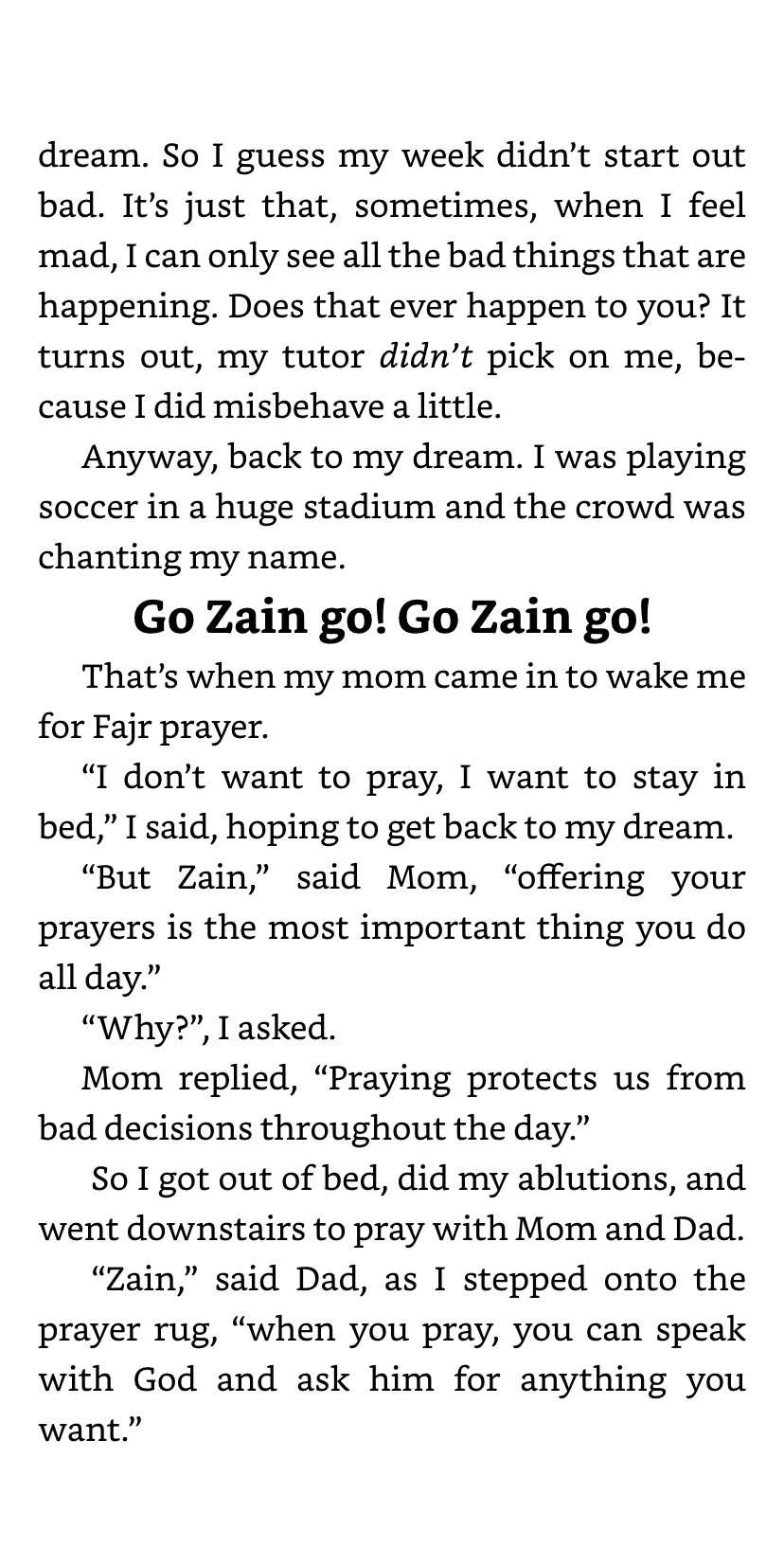
Zain starts off by introducing himself as a kid who lives with his parents and is having an awful week. He rewinds and begins with recapping Monday. Right away he acknowledges that Monday actually started out ok as he was having an awesome dream, but that sometimes when he is mad he only sees and remembers the bad things. Because of his awesome dream he didn’t want wake up and pray Fajr, but his parents reminded him that when you pray you can ask anything you want from God and that praying protects us from bad decisions. He drags himself up to pray and asks God to help him on his spelling test. Later that day he took his test, said Bismillah, and aced it. So he concludes that maybe Monday wasn’t so bad, and Tuesday wasn’t either.
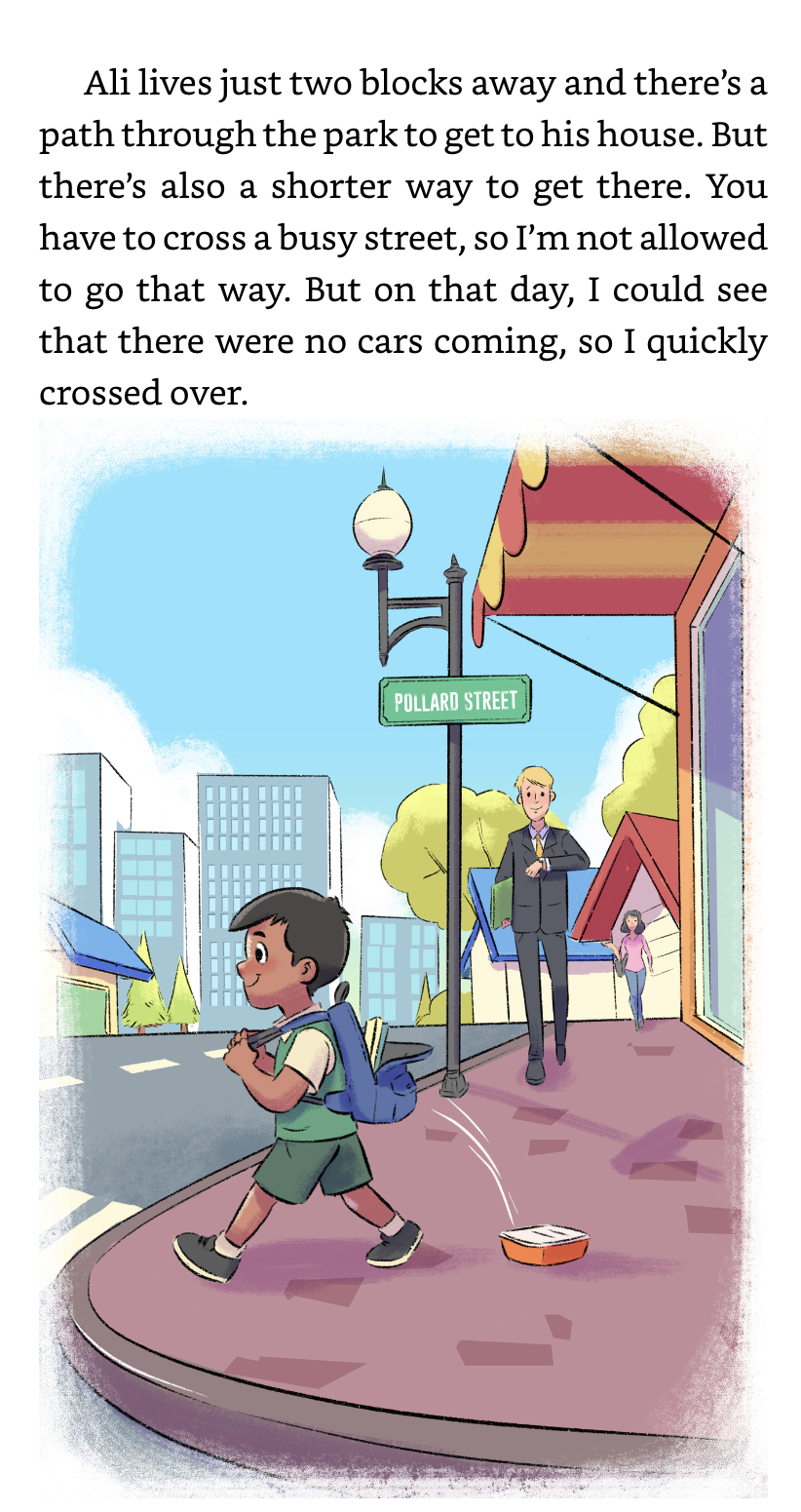
On Tuesday, Zain sticks up for his neighbor Joey who is being picked on by some older bullies. Later that night Joey’s parents come over to thank him and take him out for ice cream in appreciation. Wednesday, starts out great at school, and after school he gets to bake blueberry muffins with his mom. When the muffins are done he was suppose to pray Asr and then take the muffins to his friend Ali’s house. His mom reminds him to take the safe way and not cross the busy street. But, Zain forgot to pray Asr and sees no cars coming and chooses to take the short cut across the road. When he gets to Ali’s house his backpack is open and the muffins are missing.
The rest of the week continues with highs and lows. Many of the lows coming when he doesn’t pray. At one point a friend comes to tell him to come to the park to play soccer, and he knows his mom is going to ask him to wait a so they can pray together, so he pretends not to hear and rushes out the door. Another day he chooses to not miss the end of a show he is watching to pray and heads off to tutoring without praying at all.
When the book rejoins Zain in the present he is feeling bad about kicking a friend playing soccer, cheating on a math test, and not getting to taste his muffins. He unloads everything that has happened over the week, and his parents calmly and patiently ask him if he has been praying. When Zain realizes he has been neglectful his mom likens prayer to bricks in a wall that help keep bad things out. His parents tell him that when we miss our prayers, we end up with holes in our wall and bad ideas can sneak in. Resolved to stay strong, Zain wakes up the next morning to pray Fajr and have a good day, inshaAllah.
WHY I LIKE IT:
I love that it stays with a young kids perspective and doesn’t get weighed down with hadith and ayats and lectures. The parents let him learn from his mistakes and he comes to his own realization, not through their reprimanding or catching him in his deceitfulness. The book is a great way to remind kids that it is their responsibility to pray and that Allah swt knows everything, so that connection has to be made between the person and their creator, it isn’t something you do only when someone is watching or telling you to do it. I do wish that when he did resolve to pray that there would have been a bit of an outpouring to Allah. I love that he had tears in his eyes when he told his parents everything, but I think it would have been really powerful to see Zain ask Allah to forgive him and to help him keep his wall strong.
The book reads smoothly, and the illustrations are well done and inviting. Early chapter book readers will enjoy the font and format and knowing where the story is going with the days of the week chapters. On one occasion I wish the word “wudu” would have been used instead of ablution, and I’m not sure what Zain has against carrots, but nothing too major will keep kids from enjoying the story and understanding it.
FLAGS:
none.
TOOLS FOR LEADING THE DISCUSSION:
This book is for children learning to pray and realizing how important salat is. So while it won’t work for a book club, I really hope teachers in Islamic Schools and Sunday Schools will read the book aloud or assign it to their students. It is a great teaching tool, a great reminder, and a fun story too.



 This 157 page young adult book is translated from Arabic and while at times the story seems intentionally choppy, at other times it seems that the translation is making it more jarring than it needs to be. I found the book interesting and powerful, in much the way a short story can be, but the length was awkward, as it was too long for a short story, and not long enough to really read as a novel with detail and depth and connection. I love the growth and retaking of control that the protagonist embodies and I absolutely love the ending being left intentionally unresolved. There is no mention of religion in this story set in Lebanon, until nearly the end when it states that she is Muslim. I wonder if the translation took out some of the ‘Salams’ and ‘inshaAllahs’ that would have clarified it a bit even if prayer, or the athan or any outward signs of being a Muslim are clearly absent. The book is probably fine for ages 13 and up.

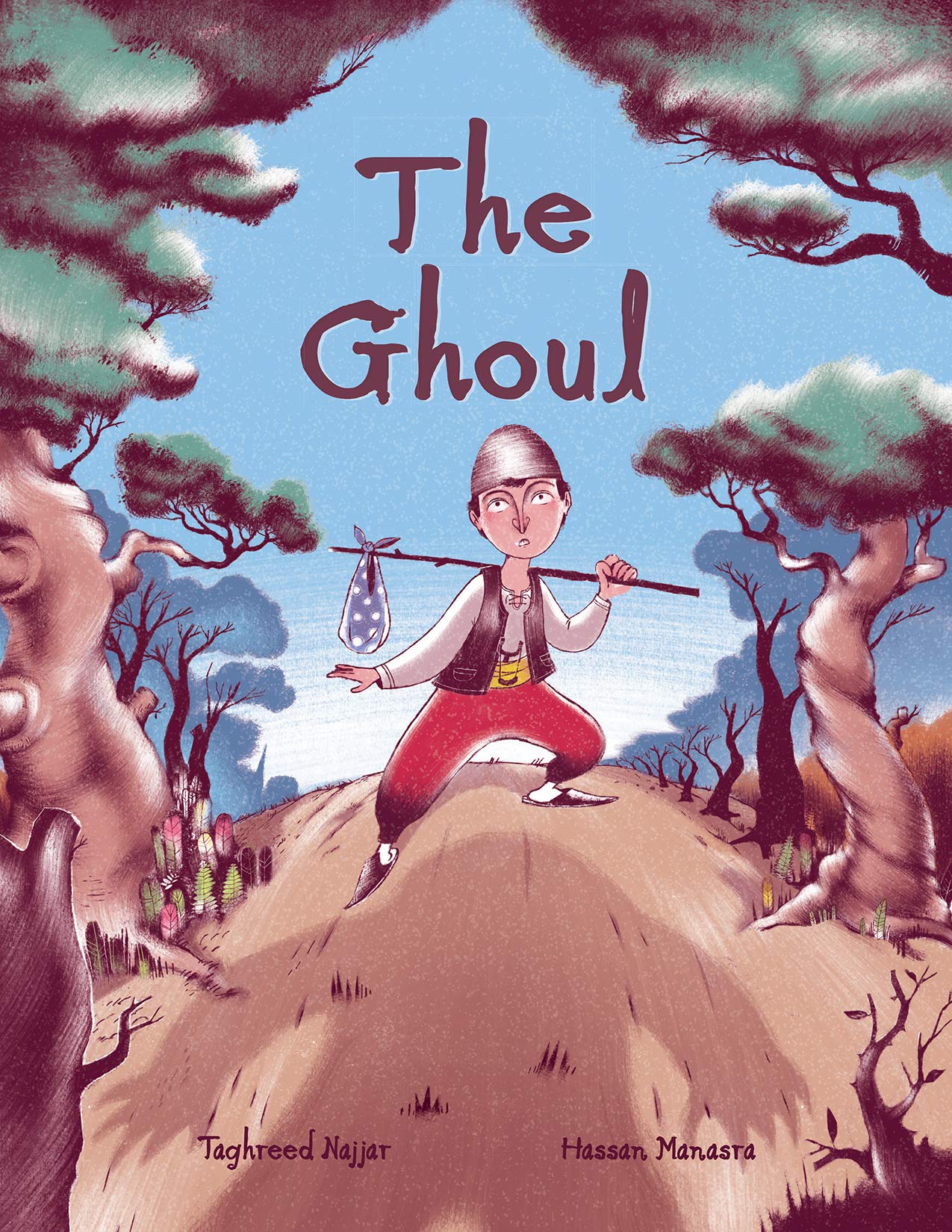 This 36 page book for ages five through eight is a cute story about being brave, facing your fears, challenging your perceptions, celebrating differences and giving friendship a chance. Recently translated and published in English, this Arabic inspired folktale is timeless and important for readers of all ages to learn from.