Tag Archives: life

Burcu: No One Wants to Play with Me! by Nursen Sirin illustrated by Nese Inan

Standard
Burcu: No One Wants to Play with Me! by Nursen Sirin illustrated by Nese Inan

IMG_2348

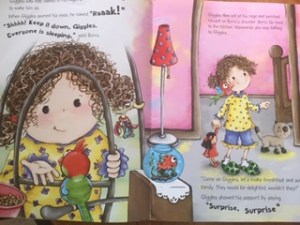
This 32 page, 9×12 story book, for ages five and up, focuses on character education and is meant to be a relatable story with clear lessons about how to behave and deal with situations in life.  The opening page bullets all the lessons readers should learn from the story and the end of the book offers directions to make a balloon craft.  

IMG_2354

I don’t mind books with lessons and morals so clearly delineated, and I like that the morals come from such an adorable character with a whole cast of supporters, and a number of books to her series.  

IMG_2353

My problem is more the story itself, for a lesson on how to make new friends, and dealing with the universal struggle of moving and feeling like ‘no one wants to play with me.”  The book spends nearly seven pages on Burcu making a surprise breakfast for her family before hearing the news that she is moving because the landlord says they should.

IMG_2352

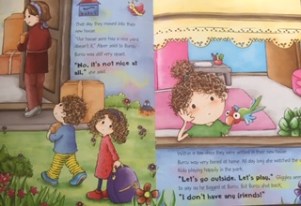
They pack and move seemingly the same day, and then the point of the book gets going.  Burcu has to say goodbye to her friends and doesn’t feel like even going out at the new house to make new ones.

IMG_2351

Her brother, Alper, has no problem making new friends, and finally Burcu gives it a try.  Only a little girl attempts to get to know her and Burcu dismisses her because she is so young.  She tries to be included with the other children, but they don’t know her and aren’t willing to let her play.

IMG_2350

Burcu finally confides in her dad, that she can’t get anyone except the little girl to play with her.  Her dad encourages her to give the little girl a chance.  Burcu does and finds out they are the same age, she just looks really young, and then all the kids are friends and happy.

IMG_2349

The real hero to me is the little girl, Katherine, who didn’t give up on an ageist Burcu that didn’t want to play with her.  Seems odd that Burcu wanted a friend, and then was arrogant to complain about the one she got.  Plus, I would imagine kids who have moved and don’t have friends, would turn to a book like this for tips and hints, and ways to feel less alone.  The book offers none of that.  It doesn’t tell how finally Burcu makes friends, or gets included, other than it took time.  Which is great, but not exactly helpful if you are five and crying everyday because no one will play with you.

The writing is very dry.  I think it has been translated from Turkish, many of the sentences are passive voice, and the sentences choppy.  The book doesn’t have any glaring errors, it just seems like it would work as a story time, or as part of a lesson, and  maybe once as a bedtime story, but not a book that kids will clamor to hear over and over again.

IMG_2355

There is nothing Islamic in the story, but most of the major online Islamic bookshops carry the Burcu series, so I would imagine the authors, and publishers are Muslim.

Overall, the book sets off to teach a great lesson, but falls a bit short.  The illustrations are adorable and the large size and playful font are very well done, the diction, not so much.  The books are reasonably priced and if you see a title that works for a lesson, or theme you are discussing, I think you can make the books work.  If you are looking for a book to read over and over to your kids, you might, however, be disappointed.


Power Forward: Zayd Saleem, Chasing the Dream by Hena Khan illustrated by Sally Wern Comport

Standard
Power Forward: Zayd Saleem, Chasing the Dream by Hena Khan illustrated by Sally Wern Comport

power forward

I enjoy Hena Khan’s books, I love basketball, and I love that this three book series is written for 3rd-5th graders.  I didn’t love the cover, however, which I attribute to the reason I waited so long to start reading the book, I know, lame.  But luckily the books were in the public library and I had a few hours on my hands and was able to consume the first two books, and look into ways to get the third one ASAP!  Written on an AR 3.8 level the 126 pages fly by, the second book On Point is 130 pages and an AR 4.0, and the third book in the series, Bounce Back comes out in October.

SYNOPSIS:

Zayd Saleem is in 4th grade and is desperately trying to move from the D squad basketball team to the Gold team with his best friend Adam.  The only problem is he is a pretty scrawny kid, and he has committed a lot of his day to practicing violin.  His desperation forces him to be less than honest and the consequences that follow may strip him of the chance to even try out for the team at all.  The basketball story is intertwined with a rich cultural Pakistani-American backdrop and familial characters that are relatable and fairly fleshed out.  Zayd’s mamoo, maternal uncle, has agreed to meet someone to consider marriage, which brings out some humor as the whole family, including grandma and grandpa, have big roles to play.  Zayd also has to figure out why he gets such stomach aches as he makes regular notes in his food diary, and has to balance the universal themes of friends, school, and homework, as well.

WHY I LIKE IT:

The font and spacing is wonderful for the target demographic, sprinkle in the illustrations and the book is not intimidating in length or size.  The book is very real and relatable, kids of all backgrounds will relate to the basketball storyline and the video games and players mentioned.  I loved the cultural environment.  My kids absolutely loved the mentioning of the Pakistani food that they eat, and customs they participate in, and dynamics they know all too well.  I don’t know that a non Desi (someone from the Indian subcontinent) will get it, love it, and not be turned off by it.  The books are published through Salaam Reads and I would imagine the author and publisher know what they are doing, and the library has numerous copies, so clearly, I’m over thinking it, but I really want to get feedback on the cultural aspect, because it is done really well and I think it would show promise for future books.  

I love that the book is about a boy and basketball, but it isn’t limited to being a boy book or a sports book.  The story moves seamlessly through all facets of the characters life that makes it pretty memorable for what could have just been a sports story with a moral.  The “life lessons” are clear and obvious, but not overly elevated.  The little mistakes that Zayd makes are a part of his life, as are the consequences, but his family helps him through them, and help him learn.

There isn’t anything preachy or blatant about Islam in the book, but the characters are Muslim and it mentions that the parents are heading to the mosque at one point to help with a fundraiser.  

FLAGS:

There is lying, but that is kind of the lesson being worked through.

TOOLS FOR LEADING THE DISCUSSION:

I recently agreed to help a teacher with her “Lunch Bunch.”  Once a week students can opt to eat lunch in the library and have a book read to them.  They must commit for the duration of the book and I think for a 4th and 5th grade group this book would be a lot of fun.  It would probably only take two sessions to read and with the diverse class I can see if they get the cultural stuff or if it just bogs down the story to them.

Author’s website: https://www.henakhan.com/power-forward/


Digging Deep by Jake Maddox text by Wendy L. Brandes illustrated by Katie Wood

Standard
Digging Deep by Jake Maddox text by Wendy L. Brandes illustrated by Katie Wood

IMG_1855

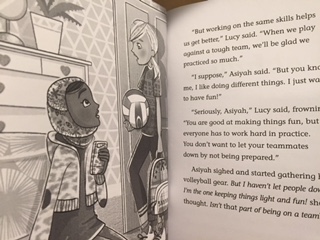
It is great to see a beautiful hijabi on the front of a sports book, written by a non Muslim, published by a major publisher, and having the story have nothing to do with the cloth on her head, but rather the skills on the court.  Teaching lessons about teamwork and self-worth, there is a whole series of these books about different sports with different main characters, and this one focuses on volleyball and a girl named Asiyah Najjar.  I’d maybe recommend this 63 page book to kids starting to feel confident with early chapter books, but more on that later.

SYNOPSIS:

Asiyah plays rec volleyball and enjoys it, but when her friend Lucy convinces her to try out for the traveling team, she has to not just be good enough to make the team, but focused enough to not let her teammates down.  With daily practices, comedian Asiyah feels like everyone is taking the new team way too serious and she questions if she wants to continue.  She loves playing the piano and with school work, her time is being consumed by volleyball.  When she overhears her friends doubting her commitment to the team, she, with the support of her brother, decides to dig deep and give it one last, serious, try.

WHY I LIKE IT:

I love that Asiyah mentions in the first chapter that she is nervous about the traveling team, because of her hijab and that people in town know “what it is, and why I wear it,” she says.  She never mentions that she is Muslim or why she wears it, just states that the people around her know. Religion and faith are never brought up again.

IMG_1856

There are some slightly off things in this book for me.  According to the publisher, the book is meant to appeal to 8-11 year olds,  but to me, the style of the book is aimed for 6-8 year olds.  Those who need pictures and a large font and big spaces between lines and short chapters.  The illustrations, however, in the book make the main character and her friends seem like high school students, with their heavily makeup looking faces, or at least middle school with the main character wearing hijab.  After reading the book, twice, I still don’t know how old the main characters are.  They seem pretty independent, but then when Asiyah’s parents have to run some errands, her brother Rad walks her and Lucy to volleyball practice, like an escort.  

That’s another thing, of all the ethnic or religious names that could have been chosen, Rad seems like an odd choice in that it will come across as funny to readers and kind of mitigate the amazingness of having a socially accepted female Muslim athlete on the cover, again, just my opinion.

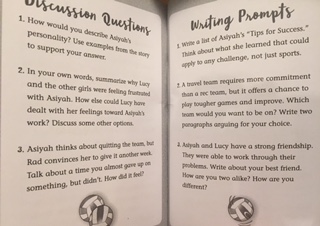
Another slightly confusing thing for me is that the book is a “Jake Maddox book,” but he isn’t really the author.  After looking in to it, I think it is more like a series or type of sports book that other’s write for and include his standards, “each of his stories is stamped with teamwork, fair play, and a strong sense of self-worth and discipline (http://www.capstonepub.com/consumer/products/digging-deep/).” The book is ok for 2nd graders, the lessons learned will resonate in the moment and teach a point, but the characters will be quickly forgotten.  The book has questions at the end and a glossary of volleyball terms which would be great for kids interested in volleyball.  

IMG_1858

FLAGS:

Clean, the characters listen to music and Asiyah plays the piano.

TOOLS FOR LEADING THE DISCUSSION:

I wouldn’t do this for a book club book, but with the standards of sportsmanship and the integrity I’d probably have it in my classroom.  The book is a super short read, so reading it would help boost struggling reader’s confidence, and with so many books in the series, if the child likes sports, they will have lots of options with positive messages to engage with.

IMG_1857

Mustafa by Marie-Louise Gay

Standard
Mustafa by Marie-Louise Gay

mustafa book.jpg

This 40 page book caught my attention because I have a son named Mustafa, and the illustrations looked endearing and fun.  The author/illustrator was inspired to write the story when she visited Croatia and saw the resilience of the children.  She also remarks on her website, that children in new places can all relate to the nuanced uneasiness and gradual fitting in process that takes place universally (http://marielouisegay.com/blog/).

IMG_1816

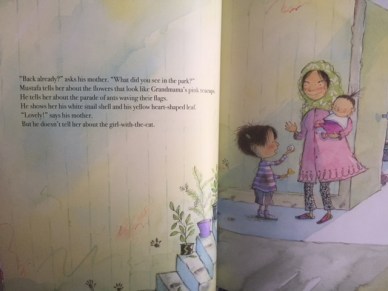
The text is prose-like as young Mustafa ventures from his apartment each day to the park nearby.  He notices things he has never seen before and compares them to the destruction he recalls of his homeland.  He also finds things that remind him of home and things that look familiar. From little ladybugs and a heart-shaped leaf, to the changing leaf colors and kids dressed up in costumes, there is so much to take in and understand.

IMG_1818

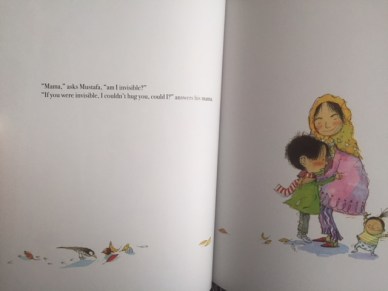
As the days go on, he begins to wonder if he is invisible.  Finally, a little girl with a cat makes a small beckoning gesture to him that doesn’t need language to be understood, and just like that, the world gets a little more welcoming.  This gentle story shows what being new can feel like, and reminds us that sometimes all it takes is a simple act of kindness to change so much.

IMG_1820

The book mentions that Mustafa came on a long journey, but does not specify where he has come from.  He draws his house being bombed in the dirt with a stick and mentions loud noises and fire.  The mother wears hijab, and obviously his name would identify them as Muslims, but other than that there is no reference or mention of religion.

IMG_1817

Overall, the book would be great for ages 4-8.  The passages are a little long, but with the illustrations and relatable concepts, I think children will reflect on what the author is trying to convey, and be able to process what Mustafa has been through, and how hard even the littlest things can be in a new place.

She Wore Red Trainers by Nai’ma B. Robert

Standard
She Wore Red Trainers by Nai’ma B. Robert

red.gif

After having fairly good luck with the Muslim YA Romance Novel Genre in An Acquaintance and Saints and Misfits, I was willing to give She Wore Red Trainers a try.  Na’ima B. Robert has written a lot of books and this 261 page book was an easy and entertaining read.  There are no plot twists, deep thoughts, or intense drama, its a light read that infuses religion and environment into a story that will be great for 14-16 year olds that have slim pickings of relevant, Islamic, “halal” fiction options.

SYNOPSIS:

The story is told from two 18-year-olds’ perspectives, Ali and Amirah. It goes back and forth and while the perspective is obvious, the bottom of the page identifies the character so there is no chance for confusion.

Ali has begrudgingly moved to London with his brothers and father.  Not very religious before his mother’s death, he and his father and younger brother have made a new start and commitment to Islam since losing her to cancer.  The middle brother, resists this, but isn’t too critical in the story, other than to add a voice to the concept that people have to come to Islam on their own, that the relationship between a person and Allah is not cookie cutter or often simple. 

Amira too has a past and a lot on her plate as she strives to balance her chaotic family life and moving past decisions of her rebellious self.  The two meet and in the brief second before gazes are lowered, they fall in love.  Ok, so it isn’t that cliche’ but it is close.

The two, as the dedication of the book states, “are striving to keep it halal.”  They have a few encounters and the sparks are there, but they both have their own stories and supporting cast of friends as well. It isn’t until the very end, SPOILER, they get married.

Yup. impromptu wedding of 18 year olds.  It isn’t out of left field though, there are passages that contemplate the Islamic merits of a young marriage, and perhaps that is the depth of the book, as far as giving the reader something to think about. That and choosing Islam and actively living it.

WHY I LIKE IT:

The stuff that makes the book interesting, isn’t really even the two love birds, it is the context.  The struggle of Amirah’s complex family situation with a mom that has had multiple husbands, and is suffering from depression.  Amirah also has a creepy stepdad (makes her uncomfortable and seems to make sexual advances toward her) and a sketchy past that isn’t really articulated but is hinted at enough to know that she did rebel briefly by running away and experimented with drugs and alcohol before realizing it wasn’t the life she wanted.  She takes tremendous care of her younger siblings, one who is deaf, and respects her older brother tremendously.  Her friends are not overly developed but provide enough diversity that the reader will see themselves in someone even if just fleetingly.

Similarly Ali is fleshed out by the company he keeps.  He has very religiously devout friends, a few rebellious ones and countless opportunities to define who he is.  His home life is a little chaotic, but they’ve gone through the destruction and are in the rebuilding phase. 

I like that the characters are fallible and represent a wide spectrum of religiosity.  The book isn’t political, nor does it discuss culture really, but it is meant for Muslim readers.  The characters throw in Arabic terms and while there is a glossary at the back, the religious rules, the contemplation of hadith and ayats, understanding Islamic divorce and the stress to be well established before marriage make it a book for those that can relate.  I love that part of keeping it halal is that they don’t talk and text.  I know that makes it a bit unbelievable, but I like that the line is drawn and established.

I wish that the past of many of the characters was clearer.  Not overly sensationalized, but a tiny bit more.  I wanted more information on what Ali’s dad’s new job was, and how far away they would be moving.  I wanted to know how Amira’s family would manage without her and the creepy stepdad, would the mom be able to step up and care for her kids.  I wanted more details about Amira’s family in general and why her older brother had to leave his studies permanently in Saudi Arabia, and wasn’t able to just delay graduation.  

I can’t criticize the writing too much because I did read the book in one sitting and it kept my interest.  I didn’t expect it to be deep or thought provoking, so for a light summer read, it was good enough.  I felt like the ending was a bit rushed, and yes there are some far fetched ideas, but I think it’s a romance novel, halal or not, so yeah, there are going to be some places that forgiveness is needed.

FLAGS:

There is mention of hooking up, drug and alcohol use, virginity, and a creepy sexual predator in the stepdad. It isn’t appropriate for middle school, but not so vulgar that one would need to be 18 to read.  I think high schoolers won’t find it too cheesy, and not be shocked by the content either.  Granted it depends on the reader. but I think it is better to be safe than sorry.

TOOLS FOR LEADING THE DISCUSSION:

I would consider the book for a high school book club. Might have to get parental permission, but I think it works well to consider how to have it all so to speak.  How to live within Islam and be smart about your choices.  The book doesn’t offer a lot to think about and mull over, but if you were a teenager, I would imagine that the book presents a lot of what you are feeling.  There is a lot to relate to in the friends, the deen, the emotions, and the temptations.  It also shows that just because families are Muslim, doesn’t mean that they are not complicated and troubled, a scenario that many would find reassuring at least superficially in the book.

Interview with the Author: http://www.kubepublishing.com/an-interview-with-naima-b-robert-about-her-forthcoming-book-she-wore-red-trainers/

Snatched Asmaa Hussein illustrated by Svaitoslav Diachyk

Standard
Snatched Asmaa Hussein illustrated by Svaitoslav Diachyk

snatched

The premise is simple, Omar ate something that didn’t belong to him, and the guilt is weighing on him heavily.  The beauty of the book is how, with his mom’s help and his own determination, he makes things right.  

snatched3

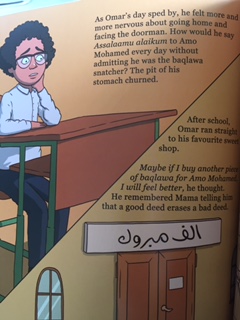
Set in Egypt, Omar eats the doorman’s baqlawa, and while he knows he shouldn’t have, he doesn’t know what to do about it.  The doorman, Amo Mohamed, blames the cat and Omar tries to move past the theft.  But the guilt builds up and he even dreams about baqlawa, eventually telling his mom so he can start to fix things.  

snatched1

After isha prayer, the two of them make some new baqlawa.  I love that the mom doesn’t get mad, but she is firm that while, “we made the baqlawa together,”  she tells him, “you have to talk to Amo Mohamed on your own.”  

Omar confesses his crime to the door man and apologizes, Amo Mohamed in turn apologizes to the cat, and all enjoy a piece of baqlawa together with smiles.

snatched4

The last page in the 38 page book is a glossary and is headed by a hadith by Prophet Muhammad, “Be conscious of God wherever you are.  Follow the bad deed with a good one to erase it, and engage others with beautiful character.”

The illustrations aren’t amazing, but they are sufficient and help walk the reader through the story.  I like that the mom covers when out and about, but not in the home.  The story is great for ages 4 and up, but the amount of text on the page and book length might make independent reading more geared to second and third graders. 

snatched2

The book would work for muslim and non-muslim children a like and does a good job of showing a universal situation in a culturally rich environment.


A Moon for Moe and Mo by Jane Breskin Zalben Illustrated by Mehrdokht Amini

Standard
A Moon for Moe and Mo by Jane Breskin Zalben Illustrated by Mehrdokht Amini

IMG_1514Based on the release date of this book (August), I preordered it in the Spring with the Peg+Cat book thinking they were both about Eid al-Adha.  Oops.  As someone who reads a lot, I really need to learn how to read.  This book is not about Eid al-Adha, it actually mentions Ramadan, but just as a context point, so rather than wait til next Ramadan to post the review, I though, lets do it now and celebrate how much we all have in common and build bridges of friendship across religious lines during this blessed month of Thul Hija.
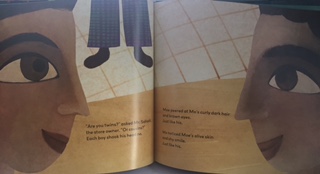
Set in Brooklyn, New York, Moses and Mohammed live on opposite ends of the same street.  One day they accompany their moms to a store in the middle of the street, and when the boys start touching things they shouldn’t their mothers’ reprimands reveal their shared nickname, Mo/Moe.  

IMG_1520

The boys then pause to look at each other and notice the same dark hair, brown eyes, olive skin, and shy smile.  Add in to the mix that one of them has a bouncy ball, and the boys become quick friends, while their mothers shop.

IMG_1519

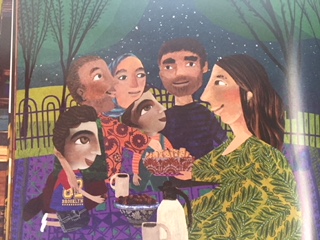
The boys hope to see each other again, but don’t.  Weeks pass, and the Feldman family is busy getting ready for Rosh Hashanah and the Hassan family is preparing for Ramadan.  Another chance meeting happens at the park, and the boys are thrilled.  The mom’s are seen chatting and then, the boys are missing, and the moms are panicked.  They are found playing in the dirt, but the relief from the moms, bonds the families who plan an evening picnic together.

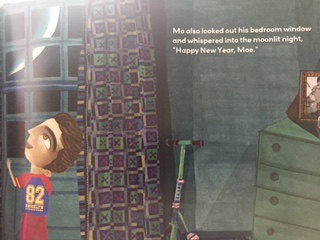
The book concludes with the boys in their own homes looking at the same moon and wishing each other a blessed Ramadan and Happy New Year to themselves.

IMG_1516

The book reminds me a lot of Yaffa and Fatimah, Shalom, Salaam, in the way the two characters, one of Jewish faith, and one of Muslim, occupy the same environment and come to know and appreciate one another as friends.

IMG_1517

The illustrations are by the same artist that illustrated Hena Khan’s color and shape books, and they are vivid and fun.  I’ve read the book a few times, and flipped through it a few more times just to marvel at the pictures and the world of these two sweet families.

A great book, that I hope to use in an interfaith story time when the opportunity arises!

IMG_1518

Sidenote, the shop keeper is the nicest one ever, he gives the boys taffy, and warm falafel, and doesn’t scold them.  The book mentions a few foods and at the end of the book there is a factual paragraph about the holiday and a recipe to try.  There is also an Author Note and Illustrator Note at the end of the 48  page book.  The book would be perfect for 5-8 year olds, but younger kids and older kids will enjoy the book as well.


The Most Pleasant Festival of Sacrifice: Little Barul’s Eid Celebration by Munise Ulker Illustrated by Beyza Soylu

Standard
The Most Pleasant Festival of Sacrifice: Little Barul’s Eid Celebration by Munise Ulker Illustrated by Beyza Soylu

batul.jpg

This book is beautiful, it feels great in your hands, the raised glitter embellishments in the illustrations, the price point, everything except the text.  The gist of the story is even fine, the execution is just off.  It reads very much like it has been translated from another language in to English, and yes my privilege might be showing, but the phrasing, the passive voice, the orphanage, all make the book with its massive text passages hard to convince kids younger than 7 to sit through.

batul9

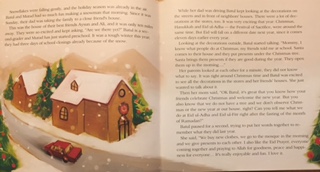
The story starts off with parents and two kids , Murad and Batul, driving to a friend’s house for dinner, commenting on the Christmas decorations that they see.  The parents ask what the kids know about Eid al-Adha that is coming up and the kids remember how much fun they had in Turkey.  Except it is really awkward to get this bit of information out.  They discuss Eid last year, and then remind each other that they were in Turkey, and how it was much more fun.  Noting that international travel is expensive and they won’t be able to go again, the Mom over dinner discusses how they can make Eid fun for the kids with her friend.

batul2

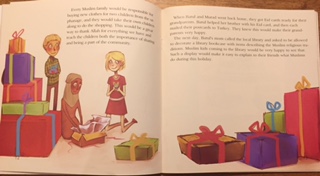
It is decided that the Muslim and non Muslims will celebrate together and include a local orphanage.  “Each Muslim family would be responsible for buying new clothes for two children from the orphanage, and they would take their own children along to do the shopping.” This would teach the kids to thank Allah and learn about community and sharing.  A great lesson overall, again just a concept presented in a really wordy, round about, awkwardly forced manner.

The Mom contacts the library and gets permission to decorate an information table, the kids make Eid cards for their grandfather in Turkey, at Sunday school they make gifts for friends.  They learn about Zakat and sacrificing an animal like Allah commanded Abraham to do, they even send cards to their neighbors.  Oddly though remarking how fun it is to get candy outside of Halloween.  After the first two pages explaining Christmas and telling that Muslims don’t celebrate it, I found it odd that they would, 15 pages later, be referencing Halloween. 

bat

Some of the sentences also don’t made sense.  About half way through I didn’t understand what the author meant by the boys “celebrating each other’s Eid” after they put their new clothes on and went to Eid prayer.

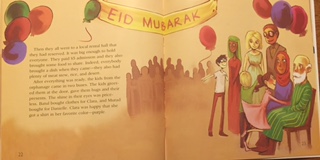
Once at the party, they give specific details of how much they charged everyone, yet no details about the food they all brought.  The kids enjoy a pinata and everyone including the orphans get Eid gifts.  Despite everyone’s fun the party has to end, and the orphans return to the orphanage and Murad and Batul declare they “will always remember this Eid.”

batul3

The illustrations are great, it is really yet another example of a book just needing a good editor.  From the very beginning, even the title isn’t really right, the book isn’t even mainly about Batul, to the random details shared, the book is just too long and too unpolished.  It is really unfortunate, because it has so much going for it on its 32 pages.  The main points however, I feel are lost about Eid and the reason it is so dear to Muslims everywhere.

Skunk Girl by Sheba Karim

Standard

skunk girl

Having been pleasantly surprised with a few recent reads in the romance/islamic fiction genre I thought to give this slightly more cultural take a try.  Unfortunately, this book didn’t surprise me pleasantly, but rather left me disappointed and slightly annoyed.  At 231 pages and an AR 5.2, the book would have worked much better framed as a memoir or semi autobiographical dairy, as it stands as a novel there is no point to the story, no real character connection, no real lasting impression.  There are a few comical concepts, but only because I am Pakistani-Muslim and female did I get them, and sadly those few instances, aren’t enough to carry the book and make it worth recommending.

SYNOPSIS:

Nina Khan is in high school in a small New York town and her strict parents don’t let her do the typical high school stuff like date or talk to boys.  Her parents are not religious, unless her mom’s family is visiting and they put on an act.  Her parents aren’t awful, however, they are educated, kind, and quirky, but culturally strict none-the-less.  Nina has two amazing school friends, that she has grown up with that accept her and her social limitations for the most part.  When Nina falls for the new boy in school, Asher, though, they work overtime to figure out how to get them together.  In addition to the boy dilemma the other stress is Nina feeling like she is in her older sister’s shadow.  An older sister who is a genius and is away at Harvard. There’s a girl at school that annoys Nina, but really their interactions are petty and annoy the reader more than anyone else.

As Nina’s friends hook up with boys and Nina has various interactions with Asher, one involving him seeing down the back of her sweater and thus her stripe of back hair, we are also introduced to some of her Desi friends.  In my opinion the passages about her conversations with the ethnic kids trying to find their way in life and in love and still maintain their culture and religious values, is way more entertaining than the bantering back and forth with Helena and Bridget.  If the author were to rewrite the book as a diary or biography, and focus more on the Desi friends, the book would probably be more interesting, compelling, and relevant.

The climax, if there is one, is when Nina’s parents go out of town and she is able to sneak off to a party and try alcohol, getting blackout drunk, and then going on a ski weekend with Asher, making-out with him and then deciding that that’s not for her.  At least I think that is what she decided.  She decided she can’t be with him, and she heads off to Pakistan with her sister to meet her parents, but thats it.  There isn’t really a climax, there isn’t an ending. Literary structure might allow you to do one, but not having either a point or a conclusion, makes the book fall flat.

WHY I LIKE IT:

I read the whole book, so it wasn’t so atrocious that I couldn’t get through it, it just seemed to focus on the wrong things in the narrative and not make the main character relatable.  I wanted to grow with her, but her reflection at the end didn’t really make a strong point for her, so it didn’t make one for the reader either.  I think part of this is that the author, frustratingly to me, interchanges religion and culture a lot.  And while she might get them kind of right, I think non Muslims and non Pakistanis might find the two muddled.  She asks Allah to help her make a good impression with and Asher, yet constantly uses the Pakistani culture as the reason why she can’t date and drink in the first place.  My thinking is that the religion should trump the culture, but because being brown and Paki and Muslim are all viewed as being the same, the logic is kind of lost.  And granted in some households it really is that way with religion and culture, but the nuances aren’t explored, explained, or even acknowledged, unfortunately.

It is clear that the author knows Islam and Pakistan, her love of them (assumption) just doesn’t come through.  Her off hand remarks about a lota, and ayatul kursi, and her Pakistani ranking system are funny, and momentarily relatable.  Unfortunately, so often it seems the story is positioned so that the religion and culture are stifling and the western world is being denied to her.  Honestly after reading the book, I’m not really sure why she doesn’t rebel and do what she wants, the story doesn’t really show what she gets out of doing what her parents want her to do, and why it would matter to her in the long run to do what she wants as a “rebellious” teen.  

FLAGS:

There is alcohol mentioned and consumed.  There are a lot of relationship topics  explored throughout the book including the minor characters deciding to have sex and the  main character kissing.  For mature readers, high school and up.

TOOLS FOR LEADING THE DISCUSSION:

I wouldn’t present this book to a book club, nor can I see myself suggesting anyone to read it.