Tag Archives: desi

Lulu in the Spotlight: A South Asian Wedding Story by Natasha Khan Kazi

Standard
Lulu in the Spotlight: A South Asian Wedding Story by Natasha Khan Kazi

This adorable 40 page culture focused picture book explores a Desi tradition with layers of competition, frustration, mystery, problem solving, kindness, and joy woven in.  Lulu likes the groom and his family, but at her cousin Amirah’s wedding, the games are about to begin, and she has a plan to win the money for team bride, and prove she is old enough to share in the spotlight. Each of the traditional teasing games though find Lulu pushed aside, until the joota chupai, where the shoes go missing.  With Nani’s encouragement to stay true to herself, Lulu gets a chance to shine by doing it her way, and bringing the families together. There are a few visible hijabis in the illustrations of this Muslim author/illustrated book and the backmatter really makes the traditional references accessible to all readers.  As a Pakistani American, my children haven’t attended cultural weddings with all the traditions, fun, and games, and this book is already a favorite in discussing what this family does, where our families might do it a bit different, and how they can twist it to fit an upcoming wedding we have this summer.  The bright large pages, add to the text and illustrations truly conveying the excitement, emotions, and colors of South Asian weddings.  By focusing on one tradition, and not trying to include everything about the multiday affairs, the book stays on message and maintains an in the moment tone, keeping the readers engaged, well done.

The book opens at the mehndi ceremony of Lulu’s cousin, and while the dances are taking place, Lulu is scheming.  She knows the next day there will be chances to make some prize money from blocking the groom and stealing his shoes, and she is determined to capitalize. Normally it is just the bride’s side against the groom’s side, but Lulu has to battle her own cousins for a role in the games.  Tarek says she is too little.  Zara is clever at negotiating, and Farah is athletic and gets places fast.  In the past, Lulu hasn’t been included, but this time, this wedding, she is ready.

On the groom’s side it is Kamal, Sameer’s little brother that serves as Lulu’s biggest competition, and who trips her as she heads for the shoes. Frustration and sadness have damped the festivities for Lulu, yet she still is helpful and kind.  With the games wrapping up, a dejected Lulu finds solace in her grandmother’s lap.  When Nani shares why the shoe stealing tradition still is carried out, Lulu knows just what to do to find the spotlight her way.


The Matchmaker by Aisha Saeed

Standard
The Matchmaker by Aisha Saeed

There is no Islam, save being told a wedding took place in a mosque, in this 320 page adult book by a Muslim author.  The thriller, mystery, romance, is fairly clean, save some drugs, killings, kissing, and normalized dating, yet I would probably be fine with mature teens reading it, if so inclined.  By the end, I enjoyed the book, but it took me three attempts to get past the 30% mark as the opening was painful with its numerous characters being name dropped, the setting being established, and getting the characters into position.  But then slowly the exposition gave way to story telling and intrigue, and the second half was a decent read.  Honestly, my biggest problem with the book is that I just didn’t like the main character, or any of the characters really, and I don’t know why.  They didn’t have some clear flaw or annoying habits, they just felt distant and bland, which resulted in the plot carrying the book, and me not really caring if the protagonist was killed or harmed, I know- harsh.  I cannot deny though, that what kept me reading was to see who was behind it all and I did figure it out, but continued on just the same to be sure, and that is a testament to the author’s writing skill, even if it took a minute for the pacing, plot, twists and climax to pull me in.

SYNOPSIS:
Nura Khan runs an elite matchmaking service in Atlanta, from hands on to a dating app, her and her team match people of all backgrounds and faiths.  She herself has a long time friend who acts as a fiancé for image purposes, and a recently retired aunt who’s bad days have meant family dynamics have changed.  As a third generation matchmaker, Nura is in charge and knows what she is doing, until suddenly her image, her reputation, and her matches start faltering.  Not confined to just heartbreak, there is also stalking, threatening notes, kidnappings, and attempted murder, which suddenly thrust Nura into a world she is ill prepared for, and one that seems to put her in the crosshairs of someone determined to see her demise.

WHY I LIKE IT:

It wasn’t a heavy thriller or heavy romance, it was an easy read that didn’t “other” desi culture and I found that refreshing. That being said, I always wish her books had Islam in them.  I also liked that the climax and second half honestly didn’t feel overly forced, I’m not a writer so take it with a grain of salt that I complain that the beginning was dry and too much telling, but then the second half flew by and loose ends were more or less tied up in a satisfactory way. I’m aware that the second half was a result of what was a established in the first part, but none-the-less I hope future books will make the two halves less cumbersome and inconsistent. I also really hope future books will have more character appeal.  There was a lot of potential to care deeply about the main characters, from the aunt, to the best friend, to Nura herself, but they lacked spark, and sadly just felt like vehicles for a plot that wasn’t dependent on them, their experiences, their flaws, and their personalities.

FLAGS:

Dating and relationships of all faiths, persuasions and labels, kissing, attempted murder, killing, plotting, lying, scheming, kidnapping, drugging, physical abuse, assault, deception.

TOOLS FOR LEADING THE DISCUSSION:

With no Islam I wouldn’t do this as a high school book club, but amongst friends it would be a fun group read.

Abdullah’s Bear Needs a Name by Yasmin Hanif illustrated by Sophie Benmouyal

Standard
Abdullah’s Bear Needs a Name by Yasmin Hanif illustrated by Sophie Benmouyal

I love the idea behind this 28 page book, and the illustrations are pretty great too, but I felt like the story needed a little more depth to convey meaningful emotion, appreciation, and connection.  It starts with an Eid gift, but there is nothing tying it to the holiday after the first spread.  And while it shows both Islam and Desi culture in action, I wanted to hear the stories of his family, and the connection to his culture that helps him name his bear.  I also feel like the premise was a little rocky, did everyone get family heirlooms for gifts? Did they get other gifts? Why was he gifted this special stuffed toy and not his older or younger siblings? Would a kid really be that excited to get a hand me down stuffed bear? Once you read the author’s intent, and the inspiration for the story, an adult could connect the dots and help a reader recognize the internalized othering being overcome, and discuss it, but I don’t know if all kids would not pick a cultural name for a toy, or see that Abdullah didn’t consider reflective names either.

The book starts with the reader dropped into an Eid day celebration.  Abdullah is handed a gift by his parents and when he unwraps it he finds himself the new owner of an old well-loved teddy bear.  His father was the previous owner, but refuses to tell Abdullah the bear’s name, urging him to discover it on his own.

Abdullah loves the bear, and takes it with him to the store, to school, to cricket, to madrasa Everywhere he goes he tries out names: old names at the museum, classmates names, but nothing seems to fit.  When his Abba tells him a story about his grandfather, he finally finds the perfect name for his bear.

I really like the details in the illustrations, they bring the story to life and feel authentic: the store names, the Eid spread, the activities.  I feel like this book is so close to being a standout, but I don’t know that kids who don’t find themselves exactly in Abdullah’s mindset, would be able to relate and connect to what transpires.  Unfortunately, it is unclear if he grows and learns from the experience, or if it was contained to this one incident. 


The Best Eid Ever by Sufiya Ahmed illustrated by Hazem Asif

Standard
The Best Eid Ever by Sufiya Ahmed illustrated by Hazem Asif

This book blends some facts about Ramadan and Eid with cultural practices, showing a day in the life of a family celebrating, and a sprinkling of a story line to keep elementary aged kids invested. The back of the book labels it as an introduction to Ramadan and Eid and I think that is a pretty solid summary.  Aisha is eight, and apparently too young to fast from sunrise to sunset.  I wonder if she is old enough to fast from dawn to sunset as Islamically prescribed? Yes, I’m petty, but it is wrong to say sunrise to sunset, and I’m not backing down. This year her aunt, Chachi Amal has made a scavenger hunt for her and her brother to find their Eid presents, but first there is henna to apply, decorations to hang up, Eid prayers to attend, desserts to be shared with neighbors, and lunch to be had, before the three question scavenger hunt can commence, and presents can be located.  The backmatter has information about Ramadan, Muslims, Eid, and a glossary.  The book would work well for a generic class or library story time. I don’t imagine Muslim kids will find it particularly memorable and ask for it more than once.  It is a Desi family, with the Chachi being Libyan and sharing desserts. hinting at the diversity of Muslims, and I can see kids wanting parents to hide their gifts and make a scavenger hunt, which is sweet and a nice idea to build on.

The book starts with Aisha looking outside to see if the moon can be spotted and Eid determined.  Samir and Dad come in and say that the mosque has declared Eid tomorrow.  Eid is Aisha’s favorite festival, she loves Ramadan, eating iftar with her fasting family, and she loves dates. This year her Chachi has hidden their gifts and made a scavenger hunt for the kids to follow.

Aisha can’t wait, but her Mom says they have other traditions first, and Aisha has henna painted on her hands.  They have to dry for at least two hours, so she watches a show while Dad and Samir decorate.  Then it is time for bed, and the scavenger hunt will have to wait.

Early in the morning is no time for a scavenger hunt, Mom is in the kitchen and they have to get to Eid prayers. After salat, and wishing everyone Eid Mubarak, Aisha is ready for the clues, but her and Samir are sent to deliver sweets to the neighbors.  When they return home, they can’t get to presents because it is lunch time. Finally, the scavenger hunt begins, the clues are solved, the presents found, and the day “the Best Eid Ever.”

I purchased this book from Crescent Moon Store, code ISL will save you 10%.

Yours, Eventually by Nura Maznavi

Standard
Yours, Eventually by Nura Maznavi

It has been a while since I’ve read Austen’s Persuasion, and I should probably remedy that, but alas, here I am reviewing another adult, Desi-fied, Muslim tinged retelling, and am embarrassed to admit I was absorbed and invested, as if I had no idea how it would play out. Sure there were author liberties, but the heart of the story hits the same beats (that I recall) and works so well when adapted for our faith and culture. It isn’t halal halal, nor is it Muslim focused, the culture and cultural expectations are definitely more centered for the Pakistani American Muslim cast. The characters are all Muslim, a few wear hijab, they abstain from alcohol, date with intent to marry, attend Bismillahs, but they aren’t shown praying, or viewing life through an Islamic lens, or Muslim conscience. There are a few kisses and hand holds, and male/female close friendships, but for an adult read, the Muslim authored 400 page novel is pretty notably clean.

SYNOPSIS:
Asma is in her final year of Emergency Medicine residency and the pressure to get married is ever mounting. With her father making poor financial choices, he and Asma’s oldest sister Iman, are moving out of their Palo Alto mansion and heading back to Sacramento. Culture won’t let Asma live alone, so she is forced to crash on an air mattress at her youngest sister, Maryam’s house in the room of her three year old twin nephews. Asma feels it is her responsibility to take care of everyone since her mother passed away, but with the family splitting up, she has to decide for once, what she wants. Eight years ago she did what she was told and broke off her engagement with Farook. Unfortunately, she has regretted it every day since and never moved on. When of all people, Farook’s sister moves into Asma’s old house, a chance encounter brings the two face to face. When Farook starts courting Maryam’s sister in law, things get particularly tense. Throw in a dozen or more side characters, amp up the drama, and settle in to see how it all unfolds.

WHY I LIKE IT:

If my recollection of the original source material holds, it takes a while to get all the characters in their desired place and position for the story to sweep the reader away, and this version does the same. At times I worried that threads and characters were being overlooked, but by the end, most everything felt resolved. I did feel Fatima’s story was underdeveloped and showed Asma as being a bit of a bad friend, and there is no way three year olds would recognize someone from a picture taken 8 years earlier, but I know, romance books require some suspension of reality to work. The premise of the plot is even a bit shaky, but once you are rooting for the characters you aren’t too worried about why they need a second chance. For the most part the writing is fairly smooth, a fair amount of characters the author managed to keep annoying, but not completely unredeemable, and I appreciated the restraint. The pacing at times was a little sluggish, with a lot of characters that the reader needed to connect with resulting in telling and not showing, so I was a bit disappointed that end felt rushed. I wanted to bask in the resolution of all that angst, longing looks, and obstacles being overcome.

There is quite a bit of commentary about pushing back on stereotypes, expectations, and cultural weight. There are aunties doing the match making and gossiping, and plenty of folks chasing wealth above all else, it doesn’t weigh down the storyline, but it at times does get a bit repetitive and shallow.

FLAGS:

Romance, kissing, hugging, holding hands, lying, death, pyramid scheme, alcohol, consumerism,

TOOLS FOR LEADING THE DISCUSSION:
I might let this be in a school library, it is clearly adult with the characters nearly 30 years old, but high school romance lovers will enjoy this, and it isn’t overly mature for ages 16 and up.

The Djinn Waits A Hundred Years by Shubnum Khan

Standard
The Djinn Waits A Hundred Years by Shubnum Khan

img_8259-1

I didn’t realize how many characters this 308 page adult book has until I sat down to write this review.  The slow peeling back of layers into their backstories, motivations, perspectives, and insecurities, makes you get to know them in a way that feels real and deep, but in no way can be succinctly explained in a review.  First off to clarify, I feel the title is a bit of click bait, the djinn is there, but not a big part of the book, there is also a ghost, who is a more impactful character, so the vibe is more haunting than Islamic lens.  In fact, a few characters are Muslim, but that is about it.  The writing though, oh the writing is quite lovely and immersive.  The culture of desi characters in South Africa, the slivers of colonization and caste that get commentary, and the heartache of all those who have called, and do call Akbar Manzil home, will linger even if the details fade over time.  I listened to the audio book, so it is possible that triggers or flags might have been missed, for the most part the book is relatively clean, death, murder, attempted murder, and supernatural beings being the most obvious.

SYNOPSIS:

The main character is very much the grand estate of Akbar Manzil, a palatial home off the coast of South Africa that shaped lives and futures and hid horrors and loss.  In modern times it has been subdivided into apartments where lives and futures are still shaped and horrors and loss are also hid, and hid from.  When Sana and her father arrive to take up residence, the past and the present begin to unite, a djinn that has never left the house is stirred, and the more Sana pokes and prods, and the more she understands about the original inhabitants of the home, the more the house pushes back.

I don’t know how much to tell, as spoilers aren’t so easily defined in this book.  The family in the past is a man from India, Akbar, who falls in love with the area, builds a house despite his wife hating it all and desperate to leave, opens a sugar factory, his mother comes to live with them, they have two children, servants, friends, he stocks the gardens with monkeys, giraffes, a lion, and then one day he is enamored by a Hindu worker, Meena, at the factory and takes her as his second wife.  The jealously and family drama reaches a crescendo when she is pregnant and has a little boy.  Beyond the family storyline is a djinn also enamored by Meena, who takes up residence in the house to be close to her.

In present times, the other tenants in the house have their own baggage, loss, regret, and fears that cause daily squabbles and plottings.  Sana deals with the loss of her mother who hated her, and a dead sister who haunts her.  There is also Pinky in love with Shah Rukh Khan, Zuleikha a former famous pianist who has lost her edge, the Doctor who owns the home, a mother waiting for her son to visit, a parrot named Mr. Patel, Fancy, Razia Bibi, and so on. The house is occupied, but hollow, not full, and the the lingering djinn seems to always lurk just beyond the surface, in the corners and shadows that haunt them all.

WHY I LIKE IT:
I like that the writing keeps you hooked, even at times when there is no rising action, or conflict, you are genuinely drawn in and invested in just learning about the characters and how their lives, both those in the past and the present, intersect.  I didn’t like the fact that there is a djinn and a ghost, I feel like the ghost negates the realness that djinn.  It is possible that the ghost was a metaphor, or symbolism, but it was a little off to me, to have both as I understood it.  I don’t know how I feel about the vagueness of the final climax, yes I’m trying not to give anything away, but SPOILER: who set the fire?

FLAGS:

Loss, death, ghosts, djinn, murder, attempted murder, lying plotting, manipulation, music.

TOOLS FOR LEADING THE DISCUSSION:

I don’t know that this would work for an Islamic school book club, that doesn’t mean it wouldn’t work, but rather I need someone to discuss with me, so that I feel like I understood some of the lingering threads that are unresolved.  Basically, I would need to have someone explain parts to me, before I could help 15-16 year olds and up make sense of it all.

Hidden Fires by Sairish Hussain

Standard
Hidden Fires by Sairish Hussain

I will not be getting over this book any time soon. It broke my heart, and all my other critical organs, in the most delightfully well-done way possible, and undoubtedly I am better for it. I don’t read a lot of adult fiction these days, and with some diabetic retinopathy concerns, I couldn’t read the 384 page adult book about generational trauma, partition, the Grenfell Tower fire, family dynamics, bullying, self-harm, and resilience, but was pulled in to the audio book version instead. The Desi-British voices of Yusuf, Rubi, and Hassan were refreshing to my American ears.  The multi-perspective book told in parts richly develops the characters, their relationships, and their current, past, and future struggles.  The author is Muslim, as are the characters, and while they all practice in their own way, it is undoubtedly who they are, and their Islamic identity is not questioned, feared, blamed, or apologized for.

SYNOPSIS:
The book weaves three distinct voices. Yusuf, is an 80 year old an immigrant who lived through partition, raised his family in the UK, has lost his wife a year prior, and is struggling with haunting memories of the past, failing health, regular loss of friends, and loneliness.  Hassan, Yusuf’s youngest son is a workaholic who is married to a non Muslim, non Desi who is suffering from fibromyalgia and who’s mother unexpectedly passes away in Spain.  Rubi, is Hassan’s 16 year old girl who is overweight, bullied, lonely and about to take her GCSE exams when she is dumped on her grandfather Yusuf’s door while her parents head to Spain.  The book opens in Ramadan the night of the Grenfell Tower fire and the horrific event affects them all, stirs memories, and shapes futures.  From there the layers of each character slowly unravel as they cope with the swiftly changing present as they desperately work to break free from the past.  As dementia plagues Yusuf, Rubi finds purpose in being needed, and Hassan is forced to re-prioritize his life before it is too late.

WHY I LIKE IT:
The book takes a slow approach to building up the characters and their back stories. It is almost feels like world building as a book would if it were a fantasy, it doesn’t info dump, but at some point the hooks are so deeply embedded that you really cannot leave the characters and their world and you have to finish the book, just to ensure they are ok.  Because I listened to the book, I feel like there might have been some Islamic content that was not completely ok, but again I was having vision issues and couldn’t note where to go back and check.  I think it is fine, and because it is an adult read, I think the audience can discern accuracy, but please know, I’m not 100% green lighting the Islamic rep.  It is undoubtedly well done and fasting and praying are a part of the characters, but their relationship to their faith and their understanding of it, is presented as theirs, it doesn’t get preachy or make broad statements about Muslims everywhere or Islamic doctrine.  

FLAGS:
There is body shaming, self-harm, trauma, death, torture, killing, lying, abuse, fear, guilt, dementia, bullying, assault, physical violence, drug use (mentioned), attempted suicide (mentioned), music, theft, make-up, close male and female relationships, Muslim marrying a non-Muslim, hallucinations.

TOOLS FOR LEADING THE DISCUSSION:
I think mature high school seniors or possibly even juniors could benefit from this book with discussions.  I think Rubi’s voice tied to her father and grandfather, will really open up youngsters perspectives, and provide a great vehicle to hear their thoughts, fears, worries, concerns about body image, self harm, aging grandparents, accessibility to parents, etc..

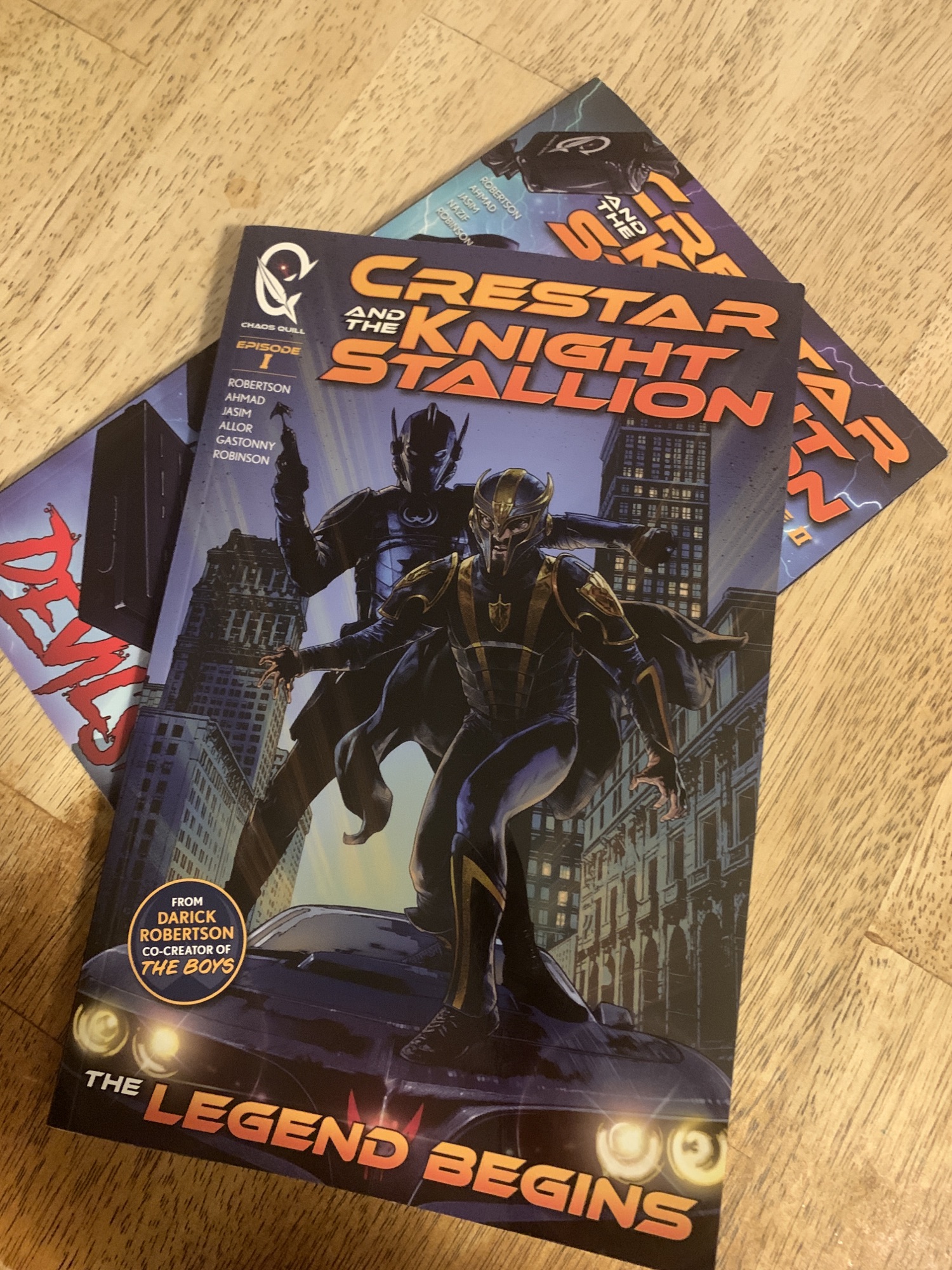
Crestar and the Knight Stallion: The Legend Begins by Robertson, Ahmad, Jasim, Gastonny, and Robinson

Standard
Crestar and the Knight Stallion: The Legend Begins by Robertson, Ahmad, Jasim, Gastonny, and Robinson

This new comic book series combines a lot of exciting elements.  It is a comic book and soon to be live action movie, it is both action and comedic,  it features Desi (Pakistani) and Arab (Iraqi) representation in the title roles, as it is in part written and created by the “characters” themselves. There are Muslim hijabi side characters, cultural Islamic phrases, and a whole lot of saving the day in a plagued Dearborn, Michigan setting.  I admittedly am still very much an outsider to comic books, what all goes in to them, their target audience, and what norms and expectations they carry.  So, I say what I am about to say from a very non critical, simply informative stance, when I say it has what I would consider mature content for elementary aged kids.  The comedy found in the offhand comments, the profanities that are substituted with symbols, surprised me. I anticipated a level of violence and killing, and appreciate that this book doesn’t have the near naked females being shown as many comics do, but I don’t think it is appropriate for younger audiences, probably more middle school and up.  I have not seen the live action, in a different format it might hit different so to speak, but I’m sharing some pictures of the text so that families can decide if the comic books are a good fit for their readers or not.

I love the idea of Muslim rep superheroes, that one is an Iraqi immigrant having to find himself in American society and accept himself, that Crestar is mysterious and his background and motives not known, the cultural and religious infusions, and matchmaking stresses are all amazing subplots to the evil that is destroying the community.  Theft and killings are the norm, Crestar is fighting back, when he discovers Ali has survived an explosion, he begins testing him with the hopes he will join him as the Knight Stallion. The first book is an introduction to the characters, the setting, and the protagonists meeting, it ends hinting that Crestar and the Knight Stallion will be working together, which isn’t much of a surprise given the title of the series, but it sets the stage.

I am not going to write a full review, because I can’t. I just really don’t know if the superhero parts are new and unique or tired and tropey because I don’t know enough about comics to have a valid opinion.  There are trailers online and the first two comic books available are top industry quality in terms of graphics, binding, length etc.

If You’re Not the One by Farah Naz Rishi

Standard
If You’re Not the One by Farah Naz Rishi

I suggest one reads my ENTIRE review of this book before deciding if it is right for you, because just the first few lines might signal that I liked this book, and honestly it was just ok, but I really liked parts of it. The protagonist is Muslim, it isn’t something that guides her view of the world or dictates her actions, but she is unapologetic, and it is not something she is grappling with. She prays, makes duas, it mentions a hadith, so I appreciate that it is there and always just below the surface. The “romance” might not be halal, halal, but it definitely isn’t raunchy and stays close to the line even when it crosses it. The male and female character are very close friends, and spend a lot of time alone together even before SPOILER there is hugging and a kiss, it is a rom-com after all. I loved the annotations, especially reading an e-version flipping to the protagonists commentary of her thoughts and then flipping back was easy and fun. I think my favorite line in a long time in the book is her translating rice to chawal (see images). My biggest frustration though, with the book is how close it mirrors the author’s biography, Sorry for the Inconvenience, which I read just over a month ago. Truly, it was like the biography was the book and this was the movie adaptation. Sure the younger brother was switched out for a younger sister, and this wasn’t as gritty or traumatic, but the romantic literary beats were all more or less the same: childhood betrothed, falling for a friend who made a bad first impression, dad being sick, parents and their on again off again divorce, medical diagnosis, it really is two versions of the same story, which meant I was never invested in the fictionalized characters, or on the edge of my seat to see what would happen next. When you have seen the behind the scenes inside scoop so to speak, it is hard to get on board with the faded carbon copy. Add in the consistent lack of communication, telling instead of showing, unlikability of the protagonist, and the non existent foundation of any of the relationships, and it made it hard to get lost in the fluff of the moment.


Side note: I had a whole paragraph rant about the cover, but when I went to post my review on Goodreads (still banned from Amazon) I saw that there is a newer cover with Marlow wearing yellow crocs. I have no idea why the illustrator and publisher would have arcs with the male lead in flip flops, but I think by now it is common knowledge there is often a lack of communication between authors and illustrators. sigh.


SYNOPSIS:
Anisa is in college, she has worked hard to get in to the all girl’s school near where her almost fiancé Isaac is already enrolled. When she takes a class on Isaac’s campus she meets Marlow, who makes a poor first impression on the very “perfect” Anisa. When Marlow and Anisa get paired up for a class paper, Marlow also offers his services as a “love coach” to help Anisa reconnect with a drifting away Isaac. The more time Anisa and Marlow spend together, and the more Anisa learns about Isaac , the more she ultimately learns about herself and what she wants out of a partner.


WHY I LIKE IT: (SPOILERS)
I’ve read a few of the author’s books, so I know she can write, which irritated me even more that this book felt so flat. Anisa and Isaac have been “together” for over six years, but know nothing about each other, don’t talk or text, and as much as the book wants to make it seem like it is an all of the sudden thing, it provides no real tangible suggestion that they have ever had any sort of connection. So why did they decide to be potentially engaged???? All the parents are on board, but how did the two of them set this into motion? With the exception of Isaac visiting her one late night before he went to school, there is so little for the reader to be emotionally invested in. Anisa has terrible communication with every character in the book, not just Isaac, even with Marlow and her family, the side characters all keep in touch just fine, and it is never addressed as a quirk, it just is accepted. If your dad was sick, or your parents divorcing, wouldn’t you be texting them periodically, or non stop? And text between characters are shown on the page, so how is Anisa texting Marlow throughout the 352 pages, but then goes MIA the last 20? It didn’t work for me clearly.

Additionally, I was so tired about hearing how perfect Anisa is, when it never seemed to show it, sure the duplicity with her outward appearance and home appearance was well done, but it never really shows up in any other facet of her life. She is unorganized, has few friends, doesn’t seem to be a very present daughter and sister, the repetitive telling and lack of showing, gave the book no foundation. I know romance-y type books often have to fudge common sense at times, but with no foundation at all, it was hard to be invested in any twists or swooning gestures. I think I just didn’t really like Anisa, and I weirdly feel guilty about it, because she so closes mirrors the author, and I liked the author’s self portrayal in her earlier memoir.


FLAGS:
Close male/female friendships, hugging, kissing, lying, “cheating,” talk of titillating role playing video games (otome) not details so much as shaming and teasing about Anisa playing them (the word porn is tossed in a few times).

TOOLS FOR LEADING THE DISCUSSION:
I think I’d shelve this book in an Islamic school library for high school students. I don’t think I would promote it, but I think those romance loving high school girls will enjoy and be able to handle this story. It won’t work for a book club, but it does make clear that Anisa “dates” with intent to marry, there is reassurance that she wants to marry a Muslim, that Marlow has been reading about Islam, but that Anisa isn’t going to force him, and that societal expectations and appearances aren’t impossible to push back on- which I think are good considerations for 16 and up readers to see fleshed out.

Kicked Out by A.M. Dassu

Standard
Kicked Out by A.M. Dassu

81h06Amch6L._AC_UF1000,1000_QL80_

The first few chapters of this 336 page middle grade book were rough. It is a stand-alone companion novel, and I have read the previous works, so I don’t know if my expectation of myself to know the characters being introduced, was additionally muddled because the memories were faint, or as I actually suspect, the writing at the beginning is just weak. Like really weak, but I’m stubborn, and I kept reading, and I was rewarded, alhumdulillah. The book found its voice, its pacing, its heart, its relatability, its layers and I am so glad that I didn’t dnf it. The characters, their community, their tenacity, the exploration of family really stays on level with providing the reader insight and messaging to make them reflect on their own lives, without feeling preached to. The focus of football (soccer) keeps the book light and hopeful, while the difficult themes of deportation, Islamophobia, refugees, theft, absent parents, self doubt, forgiveness and second chances with adults, thread in and out. Many of the characters are Muslim, halal food is normalized as is saying salam, it isn’t focused on Islam but the kids make duas before they start a sting operation and when life changes are presented, also they consider Qadr of Allah when things occur. It feels authentic, and Muslim kids will enjoy that the focus isn’t a religious or cultural identity crisis, but just part of who they are as they take on this next chapter of their lives, non Muslims will feel the same.

SYNOPSIS:
Ali, Mark, and Sami are living it up since Mark’s mom won the lottery and they move in to a mansion with a pool. Sami’s brother Aadam starts doing the lawns to help pay for his lawyer fees to appeal his deportation, and things are looking up, expect for Mark’s mom’s new boyfriend though, he seems to be a bit of a racist. It all comes pouring down when Aadam is accused of stealing money, the boys are no longer allowed at the house, and Mark is prevented from hang out with his friends. Ali and Sami are not about to take this treatment without a fight, they have an idea to raise some money for Aadam with a charity football match, and Mark knows his mom is being influenced by her boyfriend and doesn’t abandon his friends. Ali though, is preoccupied, his absent father shows back up, and his step-brother has just been enrolled in their school. It is a lot but together Ali, Sami, and Mark support each other, stand up for what they believe in, and find ways to make sure they and Aadam are not “kicked out.”

WHY I LIKE IT:
I love the commentary on refugees, that it isn’t a political issue, but a human one. The exploration of found family and born family, and giving family second chances impressed me in a middle grade book. I also liked the kids hyping up the community and getting creative to solve a problem, rather than wait for the adults to step in. Whether it was to raise money for legal fees, or solve a mystery and clear someone’s name, these kids really have each other’s backs while dealing with a lot of heavy stresses. They mess up and make mistakes, but the book spending time to show them come back from them is a level of emotional intelligence and maturity that I think readers will benefit from.

I was thrown at a passage that mentioned that Ali can’t go to the mosque because he doesn’t have his dad around. Which made no sense to me as the kid goes to restaurants, parks, stores, on buses, on his bike alone throughout the book. Alhumdulillah, I have wiser folks I can ask concerns to, and my Lit Sister Zainab explained that in fact in the UK some masjids don’t allow women all the time and kids are not encouraged to come unsupervised, so if that stands out to you as well for being completely off, recognize it doesn’t mean it is wrong, like I did.

Truly the book is terrible at the beginning. The barrage of character names, the unlikability of Ali because of how he treats his brother, and the stress of how winning the lottery has made Mark’s life better, is all over the place. I must have read the first three chapters at least four times, before I just decided to plow through and see if the pieces fell in to place, which alhumdulillah, they did.

FLAGS:
Lying, stereotypes, racism, Islamophobia, accusations, theft, lottery, Mark has a crush on Grace, but it is subtle, anger, jealousy.

SPOILER: Ali’s dad was in love with a lady before he married Ali’s mom. His parent’s had him marry Ali’s mom to tame their “wild son” and at some point in the marriage, the dad had a nikkah with the first lady and eventually left Ali, his mom, and two siblings for his other family. The focus is how Ali feels about having his dad leave their family, being jealous of his step brother, and dealing with his return. It doesn’t make it a religious issue or judge if this was permissible, it really stays focused on the parent children relationship and the emotions involved in the leaving, not staying in touch, and the returning. I think middle grade can handle it.