Tag Archives: basketball

Game Changers: Stories of Hijabi Athletes from around the World by Charlene Smith illustrated by Natalya Tariq

Standard
Game Changers: Stories of Hijabi Athletes from around the World by Charlene Smith illustrated by Natalya Tariq

This 80 page compilation of hijabi athletes from around the world focuses on 13 women that the author interviewed first hand.  Featuring athletes, sports and even countries that might be relatively unfamiliar to the targeted middle grade audience, the book will appeal to both boys and girls, Muslims and non Muslims.  Many included were the first to play with hijab, or the first female to play in their country, but each journey and experience is unique.  Each hijabi athelete and their sport is introduced to the reader over four pages with beautiful artwork, and pulled quotes.  A common issue I have with these types of books is wondering how those featured were chosen, and while this book doesn’t articulate it clearly, at least it sets some parameters in the forward and introduction, that for me at least, allowed me to appreciate the book that much more.  The book ends with four pages of “More Hijabi Athletes” that could have been included, as well as information on perseverance, hijab, modest sportswear, a glossary, resources, index, and acknowledgements.  There are real photographs included at he beginning and end of the book of various featured athlete in action. 


I can’t really review this non fiction book in my normal style, so I will simply say that the writing is clear and easy, at times details seemed overly vague, but to keep the continuity of the tone, and the reader engaged, I understand why specifics perhaps were not included.  In the first feature, I wish the infamous photograph would have been shared so the reader could see for themselves what the text was discussing.  Overall, this resource to inspire our Muslim girls is much needed and beautifully done.  I absolutely love the artwork. LOVE IT. The women are beautiful, strong, and the artwork conveys that for each of the 13 athletes.

The athletes featured:

Egyptian beach volleyball player Doaa Elghobashy
UAE hockey player Fatima Al Ali
Basketball player Fitriya Muhamed
Afghani soccer player Hajar Abulfazl
Syrian-American runner Rahaf Khatib
Basketball Player Kiandra Browne
Pakistani weightlifter Kulsoom Abdullah
Parkour Sara Mudallal
Downhill Mountain Bike Racer Sumayyah Green 
Iranian Triathlete Shirin Gerami
Kenyan Archer Shehzana Anwar
Wrestler Latifah McBryde
Skateboarder Nadeen Alhamad


We Are Big Time by Hena Khan Illustrated by Safiya Zerrougui

Standard
We Are Big Time by Hena Khan Illustrated by Safiya Zerrougui

With themes of being new in school, balancing sports and school, teamwork, focusing on the positive and pushing back on media stereotypes, this 240 page middle grade graphic novel inspired by a true story is a feel good story that can be enjoyed by all.  The all hijab wearing Muslim high school girls’ basketball team is researched and noted in the backmatter, and while often Hena Khan books feel performative, the tone of this is not identity based. The characters are Muslim, they are not questioning their religion, and in fact push back on the media who try and make it about what they have to overcome by practicing their faith, rather than on their abilities on the court.  That isn’t to say that the Islamic representation is strong.  For characters in an Islamic school, a whole page is dedicated to being the new kid in each class, but only one “salaam” is offered.  The team informs their non Muslim coach when they need to pray which is nice, but surprisingly with a Muslim author and Muslim illustrator when the protagonist prays at home with her family, the men and women erroneously stand together.  The framing, the setup, the accomplishments are all Muslim centered, but the book is not particularly Islam centered. The take away of teamwork, hard work, and normalizing Muslim hijabi women in sports is well done, and I think an easy book for kids to identify with as they read the panels of Aliya dealing with stresses and changes, on and off the court. This book releases next month, and I encourage you to consider for yourself if you feel the author has done enough with her platform to speak about Palestine before supporting or not supporting the book.

SYNOPSIS:
The book starts with Aliya, her two brothers and parents stuck in a car headed from Tampa to Milwaukee.  They are relocating to be closer to her grandparents, and the kids are not excited.  The first day for the trio at Peace Academy stands out because the school is big.  Aliya who has played rec basketball in the past, now decides to try out for the school team.  Tryouts are a bust, only nine girls show, so they all make the team.  With hopes of turning a failing program around, the school has hired a new coach, a non Muslim who used to play Division 1 ball.  It seems Aliya might start to make friends with her teammates, but then she is named co-captain which ruffles some feathers, her grades start slipping, and the team still isn’t winning. When the media takes an interest in the team, the pressure mounts to represent themselves, their school, their faith, and show what they can do on the court.

WHY I LIKE IT:
I love that identity is not in question and that the characters articulate the worries they have about their representation in the media, not because of something they’ve said or even Islamophobia, but just based on the framing of the questions, and assumptions that abound.

I read a black and white arc, so at times I didn’t know who was the dad and who was the older brother, but even with that confusion, the beginning is a bit stilted.  The dad doesn’t know if his daughter was any good at basketball, and the dialogue is so flat to set the stage, that I was glad it only lasted a few pages.  I appreciated that the parents were stressing grades, but were not overly narrow minded, they were presented in a very level headed supportive way as to not fall into a common desi/immigrant stereotype.

I don’t know why the prayer scene is wrong, but the more I try and tell myself it was just a mistake, the more mad I get.  This is why beta reading is so important, Muslim kids will notice, it will make the book feel just that much less authentic, and it so easily could/should have been fixed.

FLAGS:

None, a little bit of Islamophobia, but it is pretty clean

TOOLS FOR LEADING THE DISCUSSION:

The graphic novel format makes the book a pretty quick read, and most of the discussion points are handled in the text, so I don’t know that a book club would benefit.  I do think having it on the shelf for kids to pick up and read, will keep the book bouncing from one reader to the next.  I know my kids have all read it…that’s the beauty of graphic novels, just having it around means it gets picked up, read, and often finished, despite the readers age or even interest.

Lion on the Inside: How One Girl Changed Basketball by Bilqis Abdul-Qaadir with Judith Henderson illustrated by Katherine Ahmed

Standard
Lion on the Inside: How One Girl Changed Basketball by Bilqis Abdul-Qaadir with Judith Henderson illustrated by Katherine Ahmed

This nonfiction picture book memoir is about Bilqis Abdul-Qaadir’s love of basketball, accomplishments, and ultimate decision to choose her hijab over her career.  For elementary readers the 40 page book reads like a story, and shows what it means to work hard, be talented, stay true to yourself, and be willing to fight for what you believe in.  As the Massachusetts State high school basketball scoring record holder and the first NCAA hijab wearing Muslim basketball player, she was forced to leave the fight on the court and instead fight to change the rules regarding headgear for women playing international professional basketball.  She won the fight, but unfortunately it was too late for her, she now advocates for Muslim girls in sports to not have to choose to cover or play.

The book has a flow as it starts from her being born into a basketball family, and shooting hoops at three.  She plays with her brothers with her grandma, Mudgie, always cheering her on.  Her mother’s strength grounds her and at age 12 she puts on her mother’s hijab and heads out to play ball.

At 14 she is wearing her own hijab and playing on the high school team, her hijab is her super power, and reminder to be fierce, faithful, and kind. When the ref halts the game and says she can’t wear her hijab, her team stands with her, until the game resumes.

She gets a full scholarship to the University of Memphis and plays her final season at Indiana State.  She meets President Obama and beats him in a game.  When she decides to play international though, again she gets told she can’t unless she removes her hijab. She chooses her faith, and when she finally gets the ban overturned, it is too late for her, but not for other Muslim girls.

The book concludes with some photographs, additional information, discussion questions, and places to discover more.  I appreciate that it shows her praying, but I wish it gave just a little insight as to why Muslim women cover, why it is part of our faith.

I found my copy at the library, it is available to purchase here.

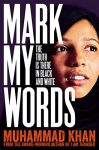
Mark My Words: The Truth is There in Black and White by Muhammad Khan

Standard
Mark My Words: The Truth is There in Black and White by Muhammad Khan

This 304 page YA/Teen book was surprisingly well written, gripping, relevant, and engaging.  I say “surprisingly” because the cover and title don’t scream pick-me-up-and-read-me, at all.  If I’m being completely honest, it looks like a self published book from the 90s, not one about to be released on June 1, 2022.  Appearances aside, it reads real and raw and even though it is very British and I didn’t understand a lot of the slang or the framing, I still was very invested.  The main character is Muslim and while part of the plot is focused on her identity, it isn’t her doubting herself, it is her in all her facets taking on stresses in her life, sticking up for what’s right, and going to bat against some very heavy hitters in the community.  The book has drugs, parties, racism, islamophobia, lying, crushes, cross dressers, gay and straight characters and relationships, privilege, assault, theft, robbery, language, hate crimes, talk of condoms, rape, sexual assault- it is raw, but the Muslim characters know who they are and engage in the environment around them as informed practicing Muslims.  The main character wears hijab and when she goes undercover she wears a wig and that conversation with herself if it is ok or not takes place, as she starts to have feelings for a boy and she tries to justify if it is ok for her, that conversation in her mind also is written out, many of her friends are of different sexual orientation and there is no judging or preaching, she accepts and celebrates them and they do the same for her. The drug use is never glorified and racism and misogyny are called out. The author is a teacher and it states in the backmatter the role his classroom and the students have in his writing and I think it shows.  The book says ages 12 and up, but I think for the content, critique on systemic racism, details about drug and drug use, gentrification, and media bias, the book is better suited for 16 year old readers and up.

SYNOPSIS:

Fifteen year old Dua’s school is under renovations which means her whole grade is being integrated with students at Minerva College, an elite private school on the other side of town.  It is an exam year, and what should be a dream for hard working Dua to get a foot in the door at her ideal school, quickly becomes anything but.  The kids from Bodley are made the scapegoats for a growing drug problem and the journalist in Dua is not standing for it.  When she doesn’t make the Minerva paper, she decides to start her own, and the dirt her and her news crew start uncovering isn’t mere gossip, it is outright illegal.  While journalism starts taking over her school life, Dua’s home life is quickly crumbling.  Her mother is falling apart mentally, failing to get to work, and struggling to keep her own demons at bay.  When Dua’s slightly estranged father tries to step in to help, Dua has to reconcile her past relationship with him and find a way to move forward.  In between all the drama at school and home is Dua’s time on the basketball court, and star Minerva Rugby player, Hugo, has taken an interest in her Kobe sneakers, and her.  The two spend some flirty time on the court leaving Dua with some decisions to make, and her questioning who to trust as everything starts to blow up.

WHY I LIKE IT:

I love how fierce and strong Dua is.  Yes, she over does it at times, but just as fiercely as she pushes for what is right in her mind, she acknowledges her errors and works to correct them.  She is Muslim because she is Muslim it is never a label she wears for attention or for someone else, it is who she is.  I love that there are also Muslim side characters including the principal.  Dua and Huda, another girl at school are always getting mistaken for one another, which is a great OWN voice (even though the author is male) inclusion.  Additionally Huda has a boyfriend, and when in the midst of a conversation she refers to him as her fiancé, Dua freezes, and Huda explains that they are getting married as soon as they turn 16 since dating is Haram and their parents all know.  I love that there is no explaining or judging at 16 year olds getting married, it just is what it is. Most of the book is written in that tone, that there are girls wearing hijab, and yes it gets pulled off at some point, there are guys writing make-up columns, there are gay guys explaining sub groups within the minority, but it all comes across as judgement free.  When racist, or homophobic, or Islamophobic, or misogynistic, or classist comments are made, other characters call them out, not to debate or preach, but to just emphasize the live and let live tone the book seems to advocate.

I was thrilled to see Dua’s best friend Liam wears hearing aids and that is very much a part of him, it isn’t a label stuck on and forgotten.  It is joked about, it is a daily presence and the author notes it in the backmatter as well.

There were some side storylines that felt a little under devolved, I would have liked a stronger emotional arc in Dua’s mom’s mental health deterioration, as well as what drove her parents to divorce.  The book is fast paced, so I wouldn’t want a lot more back story, but a little more to connect with would have been nice.

Honestly it took a few attempts to get in to the story, just because I’m American and the book is British.  I finally just read through the first twenty pages and kept going and then I was fine.  I know that is my own bias, but it is worth noting since the title, and cover aren’t attractive and then once you start it isn’t immediately clear what is going on, that some determination might be required before the book becomes difficult to put down.

FLAGS:

Drugs, drug use, sexual assault, physical assault, corrupt police, racial profiling, gentrification, systemic racism, media bias, partying, deception, bribery, expulsion, mental health, bullying, cross dressing, relationships, attraction, misogyny, hate crimes, threats, corruption, property damage, theft, stealing, cursing, language, alcohol consumption, dealing, to name a few, it is a contemporary high school setting with students taking on racist elitists.

TOOLS FOR LEADING THE DISCUSSION:

I know the flag list seems long, but I think there is a lot of sleuthing, action, character and story building and investment that give the book a lot of heart.  I think it could be shared in an Islamic high school and would result with some amazing discussions.  If you want to grab a copy, you can go through this link that will benefit me, I think Amazon gives me 2.2% back, lol, but when you pay for your own books, truly every little bit helps! Happy Reading!

Wrong Side of the Court by H.N. Khan

Standard
Wrong Side of the Court by H.N. Khan

court

I don’t know what it is about male protagonist sports novels, but they often seem to be overly crass and crude.  Perhaps that is the real life environment that inspires such writings, or perhaps it is just male voiced YA books, but in this one in particular it seemed to stand out because the storytelling by-and-large is really enjoyable, it just has a lot of flags, A LOT.  Beside the language, sexual innuendos, drug use, violence and romance, it also has a few religious and cultural concerns that are possibly just specific to the niche that I review for, but did have me shaking my head out of confusion and sighing in disappointment. To its credit there is a decent amount of Islam featured, some male friendships that are quite heartwarming, and some emotional depth that presents really well.  The 312 page book is marketed to readers 12 and up, but there is no way I would encourage the book for anyone that young, Muslim or not.  For Muslim youth specifically I would say 17 plus.

SYNOPSIS:

The book is told from the perspective of fifteen year old Fawad who lives in Regent Park with his mom and sister.  He dreams of being the first Pakistani NBA player and the linear story bounces in time at the start and he sometimes even speaks to the reader, but the story is all his.  Regent park is a poor part of town pressed right up against a wealthy part of Toronto and the neighborhood is rough.  Fawad is a good kid: he doesn’t go out much after dark since his father died, he helps his mom, doesn’t run with a gang, he gets good grades, loves basketball, and doesn’t have a girlfriend, not yet anyway.  The story starts with him reliving the final minutes of a summer league basketball game where he opted to pass out of fear of the ever looming threat of Omar, rather than take the shot himself.  Omar ends up missing and they lose, oh yeah and Omar is the imam’s son.  Under the protection of Abshir, Fawad’s friend Yousuf’s older brother: Omar, Yousuf, and Arif have someone looking out for them on the streets.  Arif has some help from the Bengali crew, and Yousuf is Somali, but there are not enough Pakistani’s to make a stand or demand respect when out and about.  When Abshir gets murdered, Yousuf retreats into himself his music and smoking joints, Arif keeps his playboy ways to take his mind off things when he isn’t reciting Quran beautifully in classes at the masjid, and Fawad makes the high school basketball team and finds a girlfriend. Things with Omar physically escalate as well, while things at home have his mom putting in to action plans for Fawad to marry his cousin in Pakistan.

WHY I LIKE IT:

I really like that Islam and culture are presented powerfully with OWN voice strength and detail.  Things are not defined or over explained and if you don’t know what haram or Ramadan or an imam are, figure it out.  I rarely find myself wishing the ending of books were different.  You hear a lot about that in movies, that they didn’t screen well or something, and so the ending was changed, and that is how I feel about this book.  *SPOILERS* Fawad and Omar should not have resolved their issues so easily, it was more than a respect thing, there was blood and hospitalizations.  We never even knew why they had issues in the first place. Arif and Nermin should not have hooked up. The whole book she comes across as the strong Muslim hijabi that blurs the lines by side hugging her guy friends, but not being ok with it, then she shows up to a dance, and then hooks up with Arif, didn’t like that at all.  I get the mixed signals of Fawad having a girlfriend from his mom, and while he seems to be connected to the mosque it never shares that he understands Islam more than just I have to do this and I can’t do this, but I didn’t like him going back to Ashley and wanted him to choose his own self-worth and respect over accepting her apology and going back to her.  I do not understand why Fawad waited so long to tell his mother about Nusrat. It was nothing that would upset his mom, I don’t get why he dragged it out.  I do love that the cousins were friends or friendly, but were fronting to their parents, but it was unnecessarily dragged out, and the more it got dragged out, the more complicated and intertwined it got with Fawad having a girlfriend.

I did not get the mom and sister relationship at all.  The mom seems to have just given up on her, but they seem to spend a lot of time together, so that was a disconnect for me.  At first I kind of liked the twist on the stereotype that the boy was not allowed freedoms to go out, but the sister was, but it kind of unraveled in the logic department.  I am desi, (half anyway) and the stereotype is that the boys are earning before they get married.  So to be arranging Fawad’s wedding at age 15 is bonkers.  To be arranging anybody’s wedding at that age is, but it is so contrary to custom, that I couldn’t even ignore it and move on, it was constantly blocking the story from being smooth.  The mom’s rationale is that she wants a daughter-in-law to take care of her.  Again kind of bogus, but maybe there is some truth there, unfortunately there is the big gaping hole that she, the mom, doesn’t take care of her in-laws, so why the difference of expectation.  Suffice it to say the mom and sister are both road bumps in the story for me.

I was impressed at how much basketball play-by-play was in the book and how it didn’t get boring.  I love that there were plenty of male role models in the community and that the three boys really looked out for each other, supported each other, were connected to each other’s families, etc..  I didn’t like the abusive religious imam trope.  I’m glad that Omar’s dad wasn’t blind to his son, but to be abusive was uncalled for.

I don’t know why Nermin is called, “Arabic,” at one point, that is clearly erroneous and I wish that the condom talk and sexual innuendos were greatly reduced.  There isn’t a lot of resolution regarding who killed Abshir, if Fawad caused any permanent damage by playing, or what the future holds for any of the characters and their relationships, but it was a quick read and held my intention and I did quite enjoy the writing.

FLAGS:
Lying, violence, murder, physical assault, kissing, making out, talk of arousal, talk of condoms and sex and getting physical.  Drugs and alcohol and addiction.  Child abuse, theft, stealing, threats.

TOOLS FOR LEADING THE DISCUSSION:

There is no way I could teach this to middle school or high school in an Islamic school.

Here to Stay by Sara Farizan

Standard
Here to Stay by Sara Farizan

img_8899

I really thought this book was a middle school book when I picked it up: the cover illustration, the length (265 pages), the larger font and generous spacing, but then I started reading it and the first two chapters alone have cursing, underage drinking, mention of sex and making out, straight and lesbian couples, and bullying.  The main character’s voice was enjoyable enough and the writing smooth, so I kept reading, but ultimately, I don’t know that high schoolers will find the climax that griping, and it definitely isn’t for middle schoolers, so I’m not sure who the target audience is.  The character never identifies as Muslim, nor does he correct or clarify to the many people around him that assume he is Muslim.  His deceased father was Arab Christian and his mother, Iranian Muslim that doesn’t “speak to God much since (his) dad died,” yet he is the victim of Islamaphobia and bullied as being a terrorist.  Pork is put in his locker, a doctored image of him dressed as an extremist is emailed out to the entire school, but he never says I am Muslim or I am not Muslim.  Perhaps when dealing with ridiculous bullies it doesn’t matter, but even commenting on that would, for me, have given the book more purpose.  The book was a quick easy read, and I enjoyed the basketball aspects and a few of the characters, but the constant drinking, predictability, and lack of intensity renders the book rather forgettable.  I’m only reviewing it so that if other’s see it and assume it is a middle school sports book that they will be aware that it is for older readers, has a decent amount of gay and straight non graphic romance, a lot of alcohol use, and crude talk.

SYNOPSIS:

Bijan is on loan to the Varsity basketball team from JV and when the star player gets in foul trouble, he is put in.  Bijan is a decent player, and when his intensity brings the team within range of a win and his winning shot seals the victory, Bijan is no longer just another face in the crowd at his private school, he is getting a lot of attention.  Most of the attention is initially appreciated, parties, a chance to talk to his crush Elle, leniency in turning in assignments, but things quickly change when a manipulated image is sent out to the entire school community- students, teachers, faculty, alumni, board- showing Bijan as a terrorist.  Was he targeted because of his brown skin, his instant popularity, his volunteering with a committee to change the school mascot from the Gunners to something less violent? The school says they will try and find the culprit, but it doesn’t look hopeful and Bijan just wants it to all go away. 

Bijan’s new stardom has him hanging out with the Varsity team after games and suddenly interfering with their social life. Bijan gets in a fight with a teammate, breaks up a fight between a teammate and his girlfriend, and finds himself being teased for being Muslim and brown.  The school is predominately white and Bijan stands out.  He notes who says his name, and who conveniently avoids it.  Physical altercations elevate whenever alcohol is present, which is often, but no clear motive is established.   The students’ parents are involved in trying to force the school to be more proactive against bullying and the board, staff and students squabble over the mascot. When Drew’s girlfriend breaks up for him in favor of a girl, another email is sent out shaming the girls’ relationship. Bijan and friends figure out who is responsible and everyone concludes that the two emails were sent by the same person, but Bijan has his doubts. 

The school basketball team makes it into the New England tournament and with the team on the road, the alcohol and physical assaults on and off the court escalate. When the opposing team’s fans dress up in turbans and beards and chant USA, Bijan has had enough and refuses to play.  He confronts his coach about never saying his name, and when they return to school the culprit of the email and of the pork in the locker is identified.  Bijan gives a speech about not being a terrorist while internally thinking of parts of the Quran and stats that he could be sharing, but isn’t.  Spoiler: he also gets the girl.

WHY I LIKE IT:

I like that it isn’t a nerd to hero story that it so easily could have been.  Bijan is smart and clever and grounded.  He is a solid basketball player and has his flaws as well as his strengths.  It doesn’t seem that popularity has changed him, people are just now noticing him.  I enjoyed his wit and humor and friendship with Sean.  The commentary in Bijan’s head, voiced by NBA commentators, reflects what he feels and what he thinks, it is critical and entertaining and gives a great vehicle into conveying his thoughts.  

I felt a fair amount of the plot was predictable and obvious.  It was clear pretty quickly that Erin and Stephanie were in to each other, that Noah was jealous and capable of sabotage.  Drew had his own financial concerns, but seemed to obviously be the red herring to Jessica’s privilege.  Even the email and the taunting seemed fairly tame, Bijan himself didn’t seem that bothered by the email. Not saying it is ok, but in a book where the characters are drinking and filling lockers with meat, the severity wasn’t that gravitating.  And about the meat, I think it warranted more discussion.  Whether the pork offended him on a religious level or not, meat or food or anything of that magnitude stuffed into a gym locker is worthy of freaking out over.  

Bijan never says he is Muslim, he does remark that he doesn’t read Arabic or Farsi.  He doesn’t drink at the first few parties because he is terrified his mom will freak out.  He drinks at a later party.  At one party someone remarks that “Allah won’t mind,” and he doesn’t really respond.  His mom, it is hinted at, has been hung over before and may have drunk in high school and consumes wine at her book club.  When Bijan and Elle are figuring things out between them, she wonders if it is ok because of…and it kind of trails off to imply perhaps his religion, to which there really isn’t a response.

FLAGS:

Drinking alcohol, language, relationships (straight and lesbian), crude jokes and references.  There is kissing between a boy and a girl and two girls that is overheard by the main character.  Sex and making out are referenced but not detailed.

TOOLS FOR LEADING THE DISCUSSION:

I wouldn’t do this for a middle school book club or suggest it for the high schoolers.

Sasquatch in the Paint by Kareem Abdul-Jabbar and Raymond Obstfeld

Standard

sasquatch

My tween boys read the first two books in the Streetball Crew Series and recommended I read book one because there is a Muslim character and I’m a fan of the basketball all-star author who draws on his own life and experiences growing up in the story.  It is 265 pages, an AR 4.5, and while the story is decent, and I enjoyed the majority of it, I didn’t love it.  I was not thrilled at the choppiness of the story telling and ultimately the way Islam was presented.  Obviously there are plenty of Muslims that will occasionally eat pork and who get violent as they get more religious, but I don’t think it is the norm and definitely isn’t a message most middle grade Muslim readers would identify with, nor want non Muslims assuming about Muslims as a whole.  The book randomly has a sudden Muslim chapter toward the end and attributes some threats on the main character as being from Muslims becoming more devout.  The main character is not Muslim, this is a side character and her family, and you don’t find out til the book is nearly over that she is Muslim. I worry how younger readers will be affected by the negativity toward Islam, as it really isn’t explored or even part of the story.  There is enough going on in 8th grade Theo’s life with out the insertion of religion.  I was glad I read it so that I could discuss it with my boys, but I would encourage the book for more middle school aged kids, if at all.  The book involves basketball as a subplot, but has larger life lessons and developments away from the game.  Do be aware one of the young characters smokes cigarettes, there is female objectification talk among the male characters, racism is discussed, there is some physical assault, and beer, R-rated movies, tattoos, branding, and dating are mentioned in this coming of age book.

SYNOPSIS:

Theo is 13, in 8th grade, and over the summer has grown six inches.  He identifies as a science nerd and a geek and is on the Academic Olympic team at his school.  He now, however, finds himself on the school basketball team, and has no idea what he is doing.  Towering over everyone, he is assumed to be good, but his lanky body and new found size brings him ridicule and teasing. His life long best friend, a fellow geek, can’t figure out why he won’t just quit the basketball team, but Theo is oddly enough,  enjoying the concept of team, and suddenly being recognized in the halls.  When he joins a pickup game to improve his skills however, he gets in a fight with another kid, get’s threatened by some guys on motorcycles, and teased by a weird girl named Rain.

Outside of school it is just Theo and his police officer dad. Theo’s mom has recently passed away and the two are creating a new normal, that is until Theo finds out his father is giving online dating a try.   After the first abysmal basketball game, Theo is forced to go visit his cousin in LA who is a tiny bit older than him, but much rougher.  He constantly teases Theo and puts him down.  He claims to be a great musician, but no one has ever heard his music, and suddenly on this visit, he seems a bit more insightful, which has Theo confused. 

With Theo being pulled in multiple directions, he risks being kicked off the basketball team, moved down to alternate on the Brain Game Team, killed on Friday by the motorcycle gang and to top it all off, a CD of his cousins music has been stolen from Theo’s backpack and band has gone viral with one of the songs.

WHY I LIKE IT:

I like that it is a coming of age book for boys.  I feel like there are a lot of girl books out there, but this one really does get into a young males head.  It isn’t always pretty, and while women/girls are at times objectified in his thoughts and while chatting with his friends, I think he realizes it and doesn’t treat or talk to women in a negative way.  I like that race is discussed as he is one of 14 black kids in his school of 600.  There are times when he or his family are treated different for their skin color, but his mom never allowed him to accept it to be a reason for not being the best ‘you’ and she would make them put money in a jar any time they blamed race for something bad happening, a tradition they continue even though she has passed.  I like the pop cultural references, a lot of books overdo it, this book makes it pretty smooth and relatable.

*Spoiler Warning* So Rain, turns out to be Matar, Arabic for Rain, she has convinced her aunt and uncle to let her change schools while her parents are in Iraq (her mom is Iraqi, her father a Quaker from Pennsylvania) and call her by her American name and let her wear American clothes (no hijab).  The motorcycle villains, are her cousins, who were trying to find her and were threatening  Theo to try and find out where she was.  Their frustration with her behavior and dress is what prompted them to hit Rain which made her run.  Rain and Theo discuss why after September 11, she was tired of being accused of being a terrorist and so she wanted a fresh start.  Her uncle and aunt are noted as being nice, but clearly the devout Muslim cousins are what will be remembered.  She also discusses sometimes eating pork, that hijab is modesty in the Quran, not a requirement to cover your hair, and that she is Muslim, but doesn’t know if she will be when she is older.

The book didn’t find its flow for me until nearly half way through, maybe about page 100 or so.  It seemed to struggle to get all the characters introduced, flesh them out, and then decide what the book should be about.  Once it got through all that it flowed better, but still left me confused as to why there was a spontaneous breakfast party, why a lawyer would so quickly get involved in the music case, why Theo was withdrawing from his friends, why Rain wouldn’t just talk to Theo, how Rain had friends she could stay with after just starting at the school, how Rain could switch schools without her parents there. Really the Rain character in general seemed really forced.

FLAGS:

I listed most of the potential concerns in the opening paragraph so that anyone, like me that would think, ‘oh fabulous a middle grade sports book by a Muslim author’ would be aware that there are a few potentially concerning elements.

TOOLS FOR LEADING THE DISCUSSION:

I wouldn’t do this as a book club selection, it is a little all over the place, my 11 year old disagrees and thinks it would be a great book club read, so I’ll leave it to you to decide.

Video interviews with Kareem Abdul-Jabbar about the book:

https://video.disney.com/watch/sasquatch-in-the-paint-with-kareem-abdul-jabbar-4e8f920a40dec5fcc9be6a5d


Shirley & Jamila Save Their Summer by Gillian Goerz

Standard
Shirley & Jamila Save Their Summer by Gillian Goerz

img_7124

This graphic novel jammed pack with sleuthing, friendship, and diversity is perfect for ages 8 and up.  The inclusive cast shows motive and growth keeping anyone from being entirely good or completely villainous and strikes a wonderful balance of insight, community building, and relatable fun.  From the main character’s mom wearing hijab, and random hijabis in the background panels, to characters of color, and characters with social obstacles, there are also bullies, cancer survivors, a character with two moms, working parents, and a missing gecko all coming together over 221 pages to leave the reader waiting for the next book in the series.

SYNOPSIS:

Jamila has just moved to the neighborhood and with older brothers as role models, she just wants to spend her summer shooting hoops and taking it easy.  Her mom, on the other hand, wants to send her off to science camp.  Shirley, is incredibly perceptive and wants to spend her summer solving neighborhood crimes, the ones adults won’t or can’t help with, but her mother has signed her up for dance camp.  When the girls cross paths at a yard sale, Shirley uses her wits to convince her mom and Jamila’s mom to let them spend the summer together at the basketball courts, thus both girls get what they want.  The two girls aren’t exactly friends, but the arrangement benefits them both, and the days go smoothly, until a gecko goes missing and Shirley and Jamila have to decide to break their parents’ rules to leave the courts and venture to the swimming pool to investigate.  Jamila and Shirley hit a snag in their understanding of one another and realize they want to be friends, something neither of them currently have.  As they work Oliver and Vee’s case to find Enoch the gecko, the reader meets lots of neighborhood characters, from life guards to daycare informants.  And as the clues come together so do a group of kids, all needing friendship, kindness, and a little understanding.

WHY I LIKE IT:

I love the Nancy Drew, Great Brain, Encyclopedia Brown, vibe of the story.  It is funny and plausible and about so much more than just the case.  It is quick and well drawn, and really just a joy overall.  I love the diversity and teamwork and innocence of a summer and some good old fashion kids using their brains to save the day.

Other than the mom wearing a scarf when out of the home and a few hijabis in the background there is no textual mention of religion.  The mom at one point says something in Urdu and the family has Muslim names.

FLAGS:

One of the side characters mentions that she has two moms.  It is mentioned once, it isn’t dwelled on, and in many ways I think a great way to explain to your kids, if they mention it, that they might have friends and classmates with different family structures.  I love that fiction allows for this conversations to occur in the abstract so to speak, you can guide your children how to handle these differences while talking about fictional characters, and imparting your families view of such matters in an open and hopefully non judgmental or hateful way.

TOOLS FOR LEADING THE DISCUSSION:

As always with graphic novels, they just aren’t the best format for book clubs as they are usually quick reads.  The target audience for this is middle grades as well and while middle schoolers might enjoy it, they would read it in less than a half an hour and there really wouldn’t be much to discuss once the case is solved.  I would highly recommend checking your local public library for the book, that is where I found my copy, and happy reading!

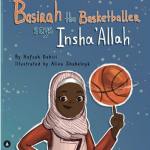
Basirah the Basketballer says Insha’Allah by Hafsah Dabiri illustrated by Alina Shabelnyk

Standard
Basirah the Basketballer says Insha’Allah by Hafsah Dabiri illustrated by Alina Shabelnyk

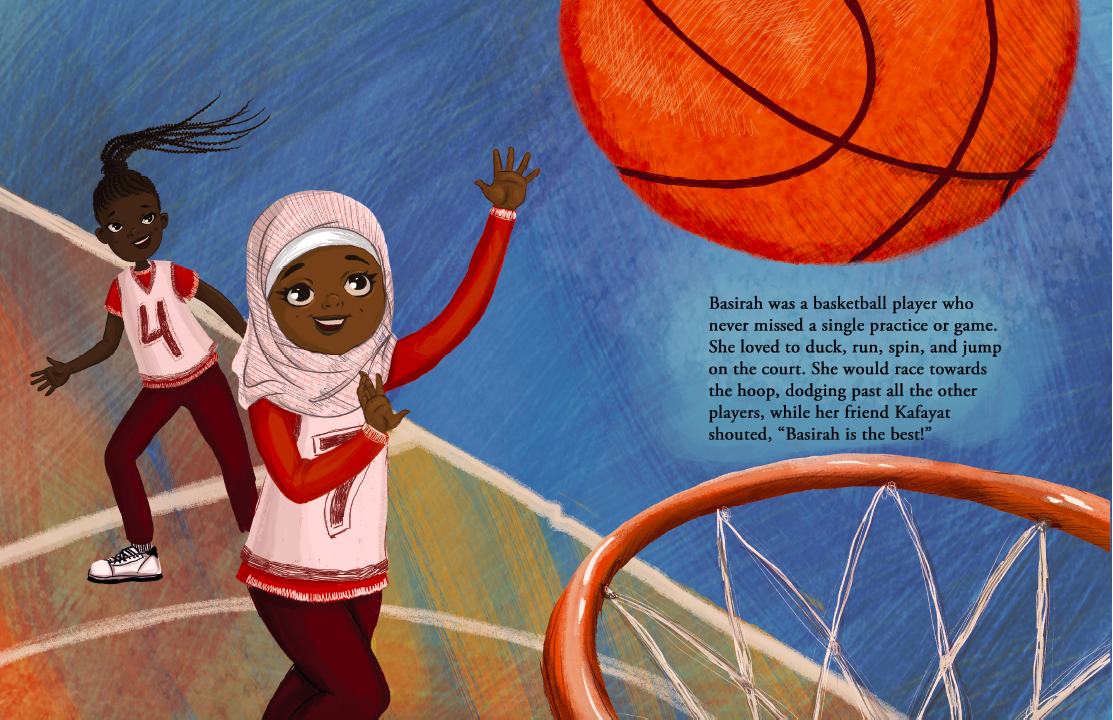
basket.jpg

Another sports book starring a smart girl with a supportive father, seems like a trend, and I like it.  The book is relatable to ages 5 and up whether they play basketball or not, and will remind even slightly older children how “insha’Allah” really works.  It features a girl, but boys will gain a lot from the book as the lessons are for us all.

basirah1

Basirah loves basketball and with supportive teammates and mad skills, she should be a shoo-in for team captain.  But when her dad reminds her that if it hasn’t happened yet she needs to say insha’Allah, she realizes the power of leaving things to God.  

Testing out her new knowledge of asking God to make happen things she really, really wants, over many of the 30 pages in the story, makes the climax that much stronger and her dad’s wisdom that much more memorable. I’m trying not to spoil the story, even though it is a children’s picture book, it isn’t without a bit of tension and resolution that really makes the book shine.

basirah2

This book can be taken at face value with a little bit of a lesson for little ones, or a lot deeper for more reflective readers.  Understanding that things we ask God for often come or don’t come to test us, is a lesson we all need. I hope if read with an adult, the adult will also push the listener to consider why we should do things in the first place, what are intentions are, as Basirah leaves the door open for that discussion at the end, but doesn’t quite articulate it for independent readers.

basirah3

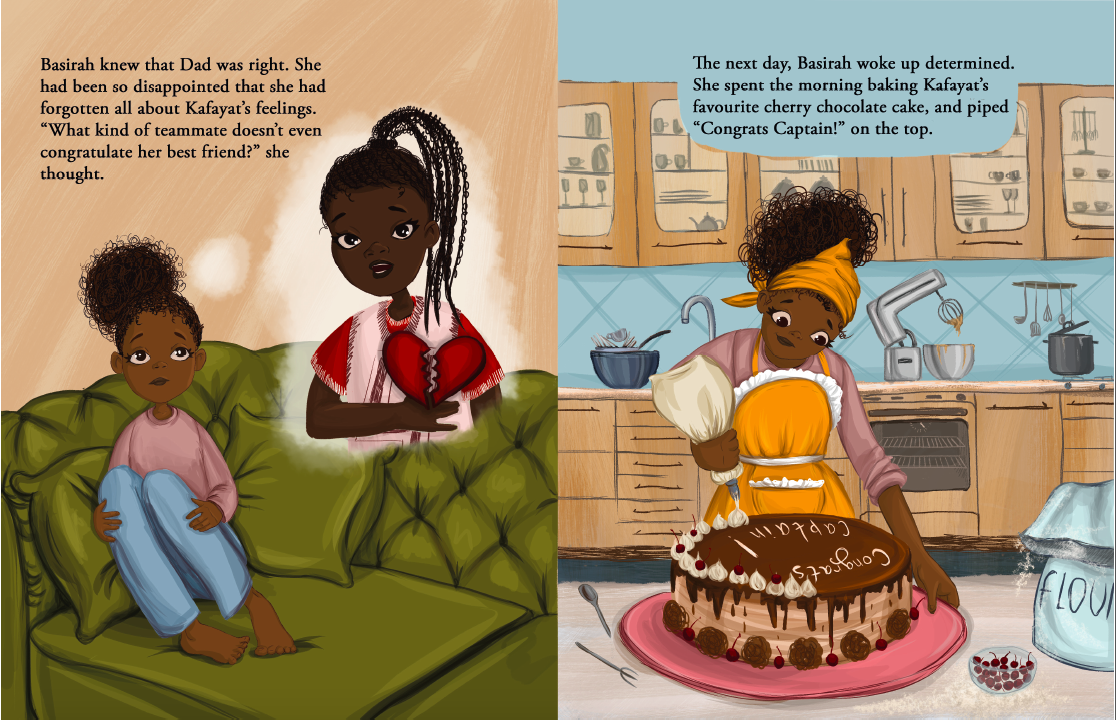
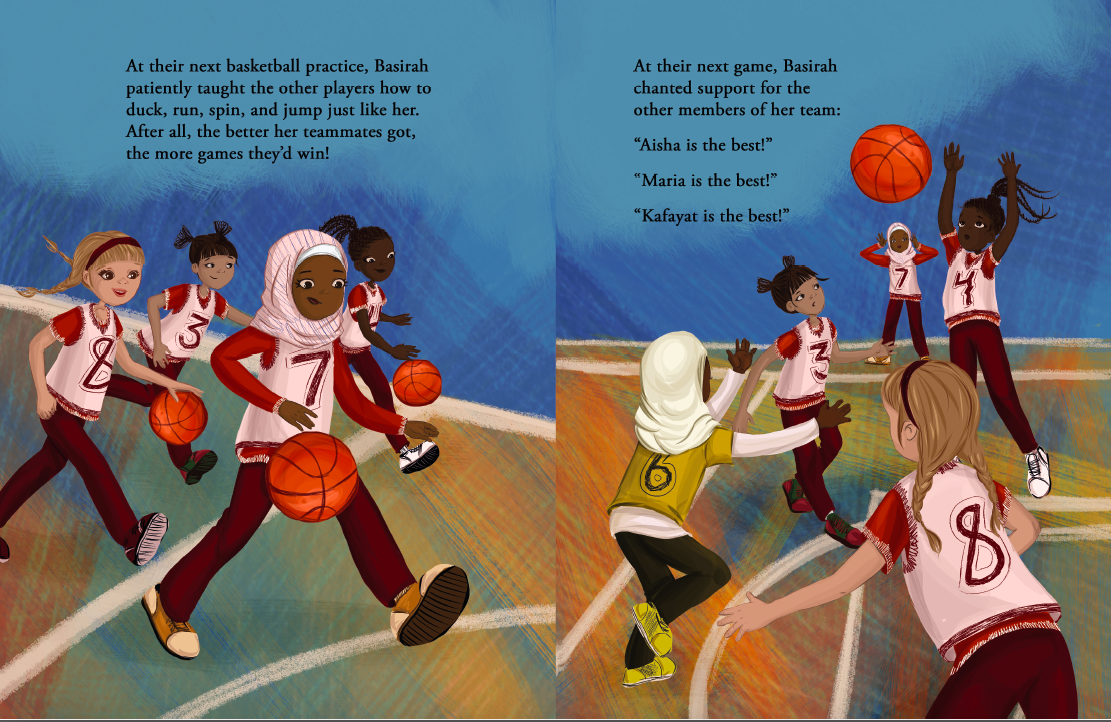
I love that at home Basirah is not covered, but is when she is out.  I love that her school is diverse with students of different colors and head coverings and that her coach is female and a muhajaba as well.  I love that Basirah and her father seem incredibly close, and that she listens to him, and he to her, before lessons are espoused and course of action plotted.  The book is not preachy, but lessons are there and the reader will get “it” right along with Basirah allowing her strength to radiate off the page and inshaAllah empower the reader as well.

basirah4

I find it interesting that the book doesn’t mention Allah and uses the word God, given that the phrase the book focuses around is insha’Allah.  I would imagine the intended audience is Muslim, but there is not specific mention of Islam.  It would work for non Muslims, but I think they would wonder why she says such a phrase and where it comes from.

basirah5

Basirah is presumably in middle school, as she has multiple classes and can bake a cake independently, her age seems a bit fluid, but many 11-14 year olds do tend to be independent in some areas and rather clueless in others, so while I did notice that she seems very naive in knowing what insha’Allah means and how it works in some parts of the story and very mature, and hijab wearing, and willing to grow from her situation in others, I’ve concluded it is plausible.

The book is 8.5 x 11 vertical, well bound, shiny glossy full color pages with clear and easily readable font.  The sentence length and amount of text on the page is not too overwhelming and the spacing keeps it inviting for new fluent readers.  

I love that Ruqaya’s Bookshelf (https://ruqayasbookshelf.com/) has new books out, three to be exact.  Whether the stories work or don’t work for you, I think their presentation and quality, give the books a longevity and find themselves being pulled out for different kids, at different times, when different lessons are needed.  They are well packaged in terms of illustrations and colors and size for the most part, and when I hear they are publishing new stories, I find myself ordering them without even reading the content synopsis.  Thank you for helping get these stories out, may Allah swt reward you!
 

Sadia by Colleen Nelson

Standard
Sadia by Colleen Nelson

sadia.jpg

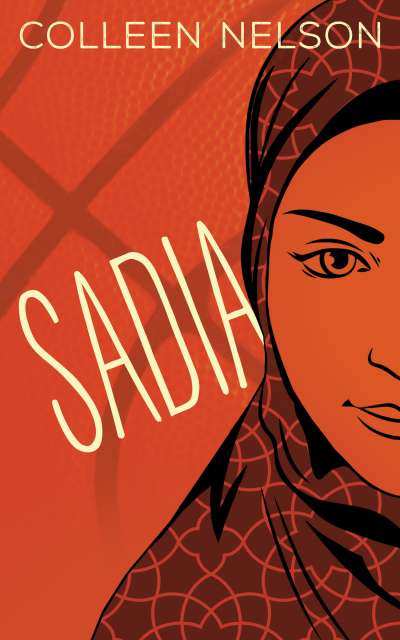
A middle school sports book with a female lead who wears hijab written by a non muslim.  The book could really go a lot of ways, I held my breath for all 239 pages waiting for something to go totally awry, and thankfully it never did.  In fact I read the book nearly straight through and while meant for ages 12 to 15, I quite enjoyed it.

SYNOPSIS:

Ninth Grader Sadia Ahmadi is an immigrant from Syria, her family left before things got “bad,” and while she has adjusted to life in Canada, High School is testing her in other ways.  Her best friend Mariam, an immigrant from Egypt, has started dejabbing, taking off her hijab to fit in it seems any chance she gets.  This is taken as a betrayal by Sadia and their friendship waxes and wanes throughout the book as each girl has to figure out who she is in relationship to hijab, and how to judge and/or accept each other and their choices.  Throw in a new refugee girl Amira from Syria who doesn’t speak English, a co-ed basketball tournament that doesn’t allow any headgear to be worn during games, a cute boy on the team and an awesome teacher with interesting assignments and you have the book in a nutshell.

WHY I LIKE IT:

I like Sadia, she is believable and strong.  She is well liked, athletic, she has a good relationship with her parents, brother and teachers, she prays and fasts and owns who she is, but she isn’t perfect.  She is hypocritical at times, and acknowledges it, she is tempted by parties, and boys and taking off her own hijab to play ball, and has to confront it about herself.  She doesn’t do things like pray on time, like she knows she should, but there she is and I am so impressed that the author picked up on so many nuances of Muslim life in her research or in her own observations as a teacher.  Yes, Amira has an awkward observation about Miriam being Muslim and not wearing hijab that seems really one dimensional considering large numbers of Muslims in Egypt and Syria don’t cover, but I don’t know if that was the author’s attempt to draw the issue to the light or if it was just a misstep.  

I like that there is a cute boy that accepts Sadia and who she likes as well, but they don’t do anything.  So often, these books become overrun by the romance story line and this one doesn’t, thankfully.  It seems to find a realistic balance, that she has feelings, but isn’t going to act on them, and based on her mom figuring out when she is lying that she won’t try and sneak behind her mom’s back.

Issues of halal food are mentioned in passing and it fleshes out that the girl is Muslim, not just going through the motions.  At times it is hard to know if her choices are based on belief and faith or expectation, but for an early YA/Middle School book, I think it suffices.  She mentions modesty as a reason for hijab, but also a lot of parental and cultural expectation.  One central theme the reader just has to go with, is that Sadia and the rest of the characters in the book, and there are a fair amount of Muslims, don’t know about any other ways to wear hijab for sports.  I get that Mariam and her sewing ability is a huge arc in the story, but they have smart phones, and its a contemporary piece, they have to know about Ibtihaj Muhammad in the Olympics, Bilqis Abdul-Qaadir, and Nike making athletic hijabs.  So, to make the story work you do have to turn a blind eye to the fact Muslima’s have taken to sports in the mainstream and that there is no way they can all be that clueless about her fabric, style, and covering options.

I love that the issue of refugees is addressed in the periphery, and the issues are given a human face.   I love that Sadia’s parents are religious, but not left as simple stereotypes, they deal with Islamaphobia, but aren’t looking for sympathy.

There is always the case, that the hijab becomes a stereotyped item as the story involves characters torn to wear it or not, but I loved how judgements were called in to questions and there wasn’t an easy answer.  The side friends in the story are all way too good to be true, but I think the whole book has a bit of a pollyanna feel to it, and in this case it was ok to error on the side of kindness than become overtly sensationalized and whiney.

The biggest hurdle this book faces is, is it the author’s story to tell. And I don’t know, I review a lot of books, and many are by Muslims and they get stuff wrong in my opinion, or they go so extreme to be accepted.  So, I don’t know, I think the book had heart, I didn’t know if the tournament would let Sadia play, I didn’t know if she would sneak off to the party, I didn’t know if she would cross the line with Josh, and I was curious, and invested and sucked in to it all.  Is it a book to teach others about Muslims or a book for Muslims to see themselves? I think all of the above.  Muslim’s should control their own narrative, but I think when author’s get so much right, we have to take some reassurance in the idea that we are being accepted by the larger society, and our stories are being told with love by other’s too.

FLAGS:

There is romance and lying, but no kissing, just hints at emotions or an errant arm flung over a shoulder during a huddle or photo.  There is mention of drinking at the parties, but Sadia doesn’t end up attending.

TOOLS FOR LEADING THE DISCUSSION:

I don’t know that I would do this as a book club selection, but if I met the right group of kids, I would definitely reconsider.  There is a lot of basketball, which I quite enjoyed, but I could see other’s maybe getting bored by the play-by-play.  I’ll make my daughter read it in a few years, and I look forward to discussing hijab and how she feels about it after.  It does raise the subject, and ask you to check your judgements on yourself and on others.

Author’s Website: http://www.colleennelsonauthor.com/