Category Archives: strong women

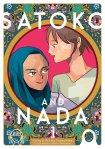
Satoko and Nada 1 by Yupechika

Standard
Satoko and Nada 1 by Yupechika

satoko.jpg

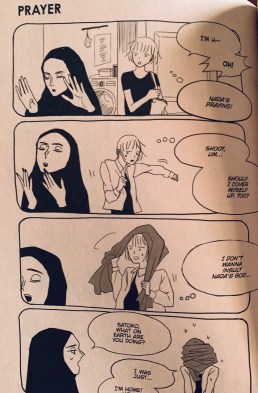
A manga series about two college roommates who have come to America to study, Nada from Saudi Arabia and Satoko from Japan.  Written by a Japanese author and translated into English, there is a lot about Muslims, particularly Muslims from Saudi, as the two characters get to know each other and become friends.  Their interactions work to dispel a lot of stereotypes and promote how rewarding getting to know people different from your self can be.  Volume one (there are three) is 127 pages, read right to left in four panel pages, and is fairly clean for all ages (they do buy underwear and bras at one point), but would most likely appeal to female readers in 4th or 5th grade and up.
8CE09DE5-2BEB-48C0-9157-96B13CC78CD9

SYNOPSIS:

The book is about two girls getting to know each other, learning about each other’s culture, and navigating life in America.  There isn’t really a plot or a story line outside of this basic framework, and with a heading every page or two it reads like a quick scene about the topic expressed in the heading.  So, for example there are headings of Veils, Ramadan, Birthday, MashAllah Choice, etc, and then a few panels showing the girls having an interaction about it, resulting in understanding, humor, or a lesson.

In a bit of a stereotype twist, Nada is more street savvy then Satoko when approached by a stranger for a ride, and thus Nada hasto educate her a bit.  The book brings in a Christian American character and a third generation Japanese character learning Japanese, to further show how assumptions plague as all and how simple conversation and an open mind, can lead to some amazing friendships.

WHY I LIKE IT:

The book is really choppy, but you get used to it and soon you forget that it isn’t a typical story.  I admittedly haven’t read a lot of manga so, I have no idea if this is the norm, or something unique.  I love that its upfront about stereotypes, if it was an American writing it, or a even a Muslim it would probably come across as preachy or arrogant, but somehow it doesn’t seem like the two characters have much baggage, nor feel a need to defend their culture by putting another’s down.  They deal with issues such as women driving in Saudi, differences between hijab, burka, abaya, niqab, being around alcohol,  the joy of a fatwa allowing soy sauce and its alcohol content to be permissible, etc.  Some things are cited for clarity and something are very Saudi, but it really contains a lot of information, about Islam that I am pretty impressed by.  There isn’t a ton about Japanese culture since I would assume it was written for Japanese readers, so it would be redundant, but I did learn, according to Satoko, how religion is viewed by Japanese, how putting age and gender and race on forms seems incredibly personal, and some information about food.

FLAGS:

There is a possible failed abduction, not sure what the guys intention was, but the girls treated it as such.  The girls do go buy undergarments, so they are visually depicted.  There is mention of alcohol.

2DF66805-A246-4150-89BA-E7E1EAF90E90
TOOLS FOR LEADING THE DISCUSSION:

I wouldn’t do this as a traditional book club, but I think I am going to get a copy of the series to pass around my daughters middle school group of friends, to

one- give them a taste of manga

two- see what they think of the Islamic rep from a Japanese paradigm and

three- give us all something to chat about

The book is fun, I got it at the public library and think it might open up a new book type for kids to try and a new point of view for many of us to consider.

My Grandma and Me by Mina Javaherbin illustrated by Lindsey Yankey

Standard
My Grandma and Me by Mina Javaherbin illustrated by Lindsey Yankey

grandma and me

I absolutely love that this 32 page picture book for children five and up breaks so many stereotypes and highlights so many commonalities between all people, everywhere.  I strongly believe that books like this, can change people’s perspective, and as a children’s books can prevent negative biases from forming in the first place.

IMG_8078

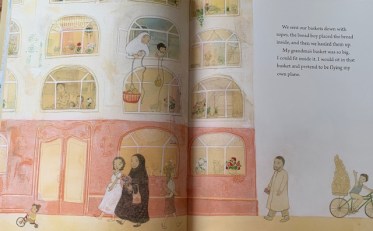
Set in Iran, a little girl absolutely loves and adores her grandma.  They pray together, they buy bread together and they share that bread with their best friends, their Christian neighbors next door.  While the little girl and her friend Annette play, the two grandmas chat, drink coffee and knit blankets to donate to the mosque and Annette’s Grandma’s church.

IMG_8079

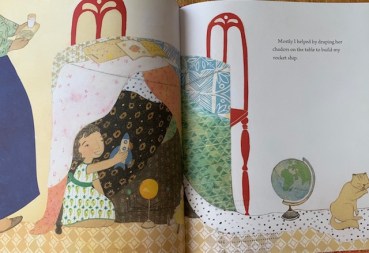
Grandma sews chadors to wear, and Mina helps.  But, mostly she uses the scarves to make rocket ship forts, and capes to fly to outer space in.  When she returns to base camp grandma has cookies for her and wants to hear about her adventures.

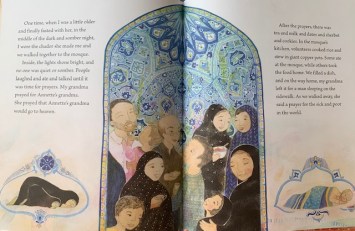
In Ramadan, the little girl wakes up early to eat with grandma even though she is too young too fast.  When she gets older, they go to the mosque together at night too, after they have broken their fast.

IMG_8082

One time she hears her grandma praying for Annette’s grandma to go to heaven.  The next day Annette tells Mina she heard her grandma praying at church for her grandma to go to heaven.  The little girl imagines the two grandmas knitting and laughing together in heaven, on Mars, on Earth, anywhere.

IMG_8081

The book ends with the little girl stating past tense how wonderful her grandma was and  that she still wants to be like her.

The book touches on family, interfaith, love, helping others, faith, religion, friendship, culture, and is just really really sweet.  I wish I loved the pictures, as much as I love the story, but I don’t.  I think I like most of them with their texture and details, unfortunately the faces in some just seem a little off to me.

I absolutely love that there is no over explaining, and no glossary, the author seamlessly brings words like namaz, and Ramadan and chador in to the story, normalizing them as the pretend play, and familial bonds are so universal.

IMG_8083


The Star Outside My Window by Onjali Q. Rauf

Standard
The Star Outside My Window by Onjali Q. Rauf

star outside.jpg

Woah! Domestic abuse, foster care, murder, astronomy, and above all hope and bravery. It is so, so much, and so beautifully dealt with from the perspective of a child, that I’m still living in Aniyah’s world and praying she is doing ok.  As the beginning of the book states, it is a story written for everyone, but it then goes on to say that there could be triggers and difficult things to read. So please, while it may be written for ages nine and up, you should know what your child can handle before suggesting they read such a heartbreaking 306 page book, and if they aren’t able to handle it yet, make a mental note to have a discussion when they are ready, it is important.

SYNOPSIS:

The book starts with a map of London and the chapters start with constellations, maps to the stars, and a little girl who wants to be a star hunter.  Drawing on Simba from the Lion King and wholeheartedly believing that stars are people who’s hearts were so big that when they die they light up the night, she maps the stars outside her foster house window, on the lookout for a new star, her mom.  Not remembering all the details that brought her to this foster home, she and her little brother Noah are trying to figure out their new life, the foster home rules, the loud pain they felt, and if they are winning the game of hide-and-seek with their father.

Unable to speak, Aniya, breaks her silence when a news story on TV tells of a star breaking the rules of gravity and flying by Earth.  Convinced it is their mom, Aniyah and Noah with the help of fellow foster kids Travis and Ben hatch a plan to go 73.6 miles from Waverly Village to the Royal Observatory in Greenwich, to make sure the star hunters name the star the correct name, and not the random computer generated one the contest rules dictate.

WHY I LIKE IT:

The book is inspired by the author’s aunt who was a victim of domestic abuse and killed by her husband.  The love and pain she feels at her loss, I believe is conveyed through the pages and felt by readers of all ages.  I had my 10 year old son and my 12 year old daughter read the book, because this book’s topics are heavy and weighty, but handled with such sensitivity and childlike innocence that it is a great introduction to the topic, without being overly heavy and weighty.  The author is amazing, and I was curious how she would follow up her amazing debut novel The Boy at the Back of the Class, and I think this one is just as powerful, if not more so. 

All of the foster kids suffer from some form abuse and there is even a note at the beginning about how the author does not like the term “domestic abuse” and there are resources and information at the end of the book for children or adults suffering or how to help someone they know suffering abuse.  There is also a page about Herstory, the constellations, and some personal anecdotes about the author’s aunt.

The book is truly heartbreaking because as an adult reading the book I could easily figure out what happened, that the father killed the mother, and that the games the mom would have the kids play were not games at all, but ways to mask what was going on. The book is very subtle in how it talks about what the mom and kids endured and some kids will not get it, and others will, either way, parents should be aware and available to discuss that abuse is never ok and that if their friends or someone they know is suffering/surviving, there is help.

The book is powerful also in the way the foster kids for the most part stick together, I think the way they are so willing to help and risk their own chances at adoption is selfless and memorable.  Also the way they put up with Noah, a little kid, who gets annoying, but handled lovingly,  because family means so so much when you don’t have one. 

On the surface though, it is an adventure story, can a ragtag diverse group of kids with little money, injuries and a deadline travel nearly a hundred miles to name a star?  Its fast paced, interesting, and emotional on many levels.

There is nothing Islamic in the book, not even a Muslim name in passing, but the author is Muslim and the story universal.

FLAGS:

Halloween is when they run away.  There is a lot of lying, but they know it.  Lying when the mom covers her bruises and marks, and how she is doing, lying when the kids run away and steal the bikes and sneak on a bus without paying, and break in to the observatory.  The kids feel guilty and know right from wrong in every instance, but when they opt to do something uncouth they rationalize it because they have to name that star!

TOOLS FOR LEADING THE DISCUSSION:

I’m seriously considering reading this as a middle school book club selection.  It is written for a younger audience, but I think I want to open up the topic of abuse and have the school counselor come and listen to the discussion.  The book is that good, and that important, and that powerful, that a discussion and lessons, will keep these characters’ stories in the middle schoolers’ minds as they grow and hopefully teach them empathy, compassion, appreciation, and patience.


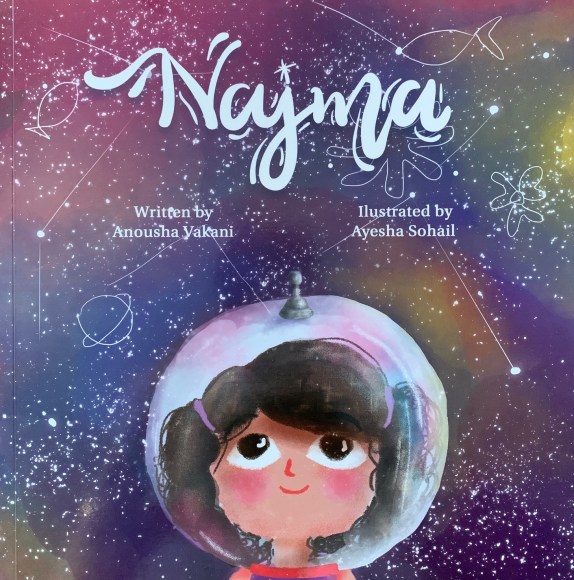
Najma by Anousha Vakani illustrated by Ayesha Sohail

Standard
Najma by Anousha Vakani illustrated by Ayesha Sohail


IMG_7194

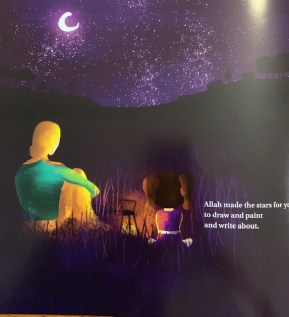
In a world of new STEM books and female powered books, this 28 page fact driven story adds one more empowering element, Islam.  With beautiful pictures on thick glossy pages, the 10×10 book is both educational and endearing for boys and girls ages 6 and up.

IMG_7183

There isn’t a story with a climax or moral, but there are characters, Najma and her astronomer Mom, who move the book along, and keep it “grounded” so to speak.

IMG_7184

Little Najma loves the stars and space above her, she knows Allah created them, but she wants to know more about them, what they provide, and how Allah made them.

IMG_7185

Mama and Najma look through a telescope as Mama teaches the life cycle of a star in simple terms over 11 pages.


Najma then asks what stars are for, and Mama tells her the benefits of the sun that Allah swt made for us and the stars as well.  Mama explains Allah only has to say, Be and it is.

IMG_7188

Every scientific concept, and daily life example is tied back to Allah swt.  And with Najma’s adorable little face, and the beautiful complimentary illustrations, the book conveys facts about the universe, love between mother and child, and awe at Allah’s signs.IMG_7189

Thank you Crescent Moon Store for amazingly fast delivery of this brand new book.  InshaAllah there will be more books like this combining science, Allah, and strong females for us all to learn from and enjoy.


An Ember in the Ashes by Sabaa Tahir

Standard
An Ember in the Ashes by Sabaa Tahir

Our local library automatically renews books, so I’ve had this 446 page AR 5.0 novel sitting on my night stand since October.  I got the online version when I went overseas, and I even downloaded the audio book.  Needless to say, I never opened it, in any form.  And then four days ago, I did.  I read the first page and then the second, and soon enough I knew that I would quickly be annoyed by my children needing food, and clean clothes and rides to school because, I was no longer present in the day-to-day functions of my life, I was in Serra hoping for happy endings and being really angry, like ready to contact the Muslim author during certain scenes, as I felt tears reminiscent of when Cedric Diggory was killed in book 4 of Harry Potter brimming.  The book was amazing, and yes, my kids are fairly well cared for, but there are two more books in the series out, and the fourth one apparently in the works.  I hope to read the series, but I have a feeling, this epic fantasy series will not be a happy read, it is dark, and violent, and definitely more suited for high school readers because of content then the AR level would suggest.  

SYNOPSIS:

Told from two different characters ‘perspectives: Laia and Elias, the world of Serra has tastes of the Roman Empire, current political headlines, Middle Eastern names, subcontinent ideas and lots of action.  Laia is a Scholar, an oppressed people who a half a millennium ago crumbled beneath the Martial invasion.  Her parents led a resistance and were killed a long with a sister.  She and her brother, Darin, are now raised by the grandparents: gentle people who heal others, keep their heads down, and don’t make waves.  The story quickly advances with Martials raiding the family home and Masks, the elite warriors of the Martials, killing Laia’s grandparents and imprisoning Darin.  Laia escapes by running, but hates herself for not staying and fighting for her brother, the only family she has left.

Elias on the other hand is a Martial soldier about to graduate as a Mask from Blackcliff Academy, a brutal (that’s putting it mildly) nearly all boy’s military school.  Abandoned by his mother as a baby, Elias is contemplating running away from the school, as his soul and conscience can no longer be pushed aside to complete the acts he is expected to do.  The complications abound, however, as the Commandant, is his mother, who wants nothing more than to see him dead, the penalty for desertion is death, but the penalty for most every infraction is a severe beating, and if death happens in the process, so be it.

The two characters come together as Laia reaches out to the Resistance to find help in rescuing her brother and in exchange is assigned to be the Commandant’s personal slave.  As the Empire is on the cusp of change, a new emperor is to be selected from the top four of the current graduating class, Elias, is the top of his class.  The four trials will leave one triumphant and the new leader, second place will be the Blood Shrike, the emperors blood bonded butcher, the others will be killed. 

The trails are named: Courage, Cunning, Strength and Loyalty and are administered by immortal, mind reading, cave dwelling Augurs.  The trails are vicious and cruel and evoke not only putting friends against friends, and test one’s fears, but they are amplified by creatures such as jinns, efrits, ghuls and wraiths.

WHY I LIKE IT:

The book is incredibly well written.  The way the author builds her characters’ worlds is seamless and smooth.  I didn’t get lost or confused, I never once felt bored by explanations or felt that something didn’t make sense, a feeling that makes fantasy stories cumbersome and daunting to me, and what I feared all those months looking at the book, too afraid to open it and dive in. 

The action and characters are well developed.  While the book is fast paced, I felt every character was given some nuance and depth.  It really isn’t a good vs. evil story.  Each character has more than one trait at any given time, and it makes them delightful to interact with and mull over.  There are strong females and sprinkled in ethnic names like Sana, Illyas, Tariq, Afya Ara-Nur, Mazen, Zain, Zara.  The subcontinent concept of Izzat, honor, is prominent among the Resistance and Scholars which is a nice bit of resonance in this fictional world as well.  And the concept of jinns, and the stories about their role in the book, reads like Arab folklore.

FLAGS:

The book has profanity, not a lot, but it is there, especially when talking about women.  The violence is incredibly graphic, killings, beatings, brutality, whippings, suffering, and death are on nearly every page.  The Martials are ruthless not only with those they occupy, but even amongst themselves: the students fight to their death, they lock their own children in cages without food so that only the strong of their society survive.  But even worse is that many of the people outside of the ruling elite are taken as slaves, and thus women are seen as property and rape abounds.  Rape by name is mentioned a lot, but it isn’t graphic, save one or two climactic points, if anything it is more disturbing because it is the norm and is accepted.  Prostitutes are mentioned, again, nothing detailed, but mentioned that the boys at the academy visit the docks to see prostitutes.  As Laia is being sold to a slave master, he considers placing her in the brothels rather than at the school.  Laia is nearly raped by a student, and a simmulated rape saves her at another time, in both instances the higher ups dismiss that there is anything wrong with raping a slave and the winner of the third trial is even given a slave for the night.  When the Masks kill Laia’s grandparents, one says he will rape Laia before he kills her.  So it is very much a part of the culture of the book, but it isn’t defined, just the words are used, which means I think high school kids could handle it, because it is not celebrated or graphic, but younger than that will have too many questions that can’t be swept away easily given the environment of the book.  

TOOLS FOR LEADING THE DISCUSSION:

This book could work for a high school book club, because there is so much to talk about.  It won’t work for middle school, and I will keep my daughter from reading it until she is in 9th or 10th grade probably, even though she has read Hunger Games and the Divergent series.  Just want her a little older to handle all the rape references, in more mature way.

As for teaching or presenting this book, this series has a HUGE fandom, you can find everything on the book online and with little effort (maps, character lists, chat groups etc.).

The Author’s website: https://www.sabaatahir.com/

Teaching Books: https://www.teachingbooks.net/tb.cgi?a=1&tid=42018&s=n

One of many book trailers: https://www.youtube.com/watch?v=sbvyCrkVT7M

Enjoy! Happy Reading!

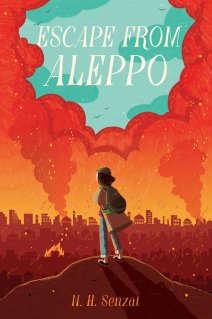
Escape From Aleppo by N.H. Senzai

Standard
Escape From Aleppo by N.H. Senzai

escape from aleppo.jpg

N.H. Senzai’s newest book (published in January 2018), gives a face and a voice to the grave situation in Syria.  Like Senzai’s other books, she uses the rich culture and history of a country to inform the reader, and a compelling front story to keep middle school readers entertained.  This 336 page book is not in the AR data base yet, but fourth grade and up should be able to follow the story and be able to handle the violence and destruction presented.  The story is unique in the genre, in that it doesn’t focus on getting to a safe country, but rather on the heroine’s journey to simply get out of a dangerous one, Syria.  The storyline is fairly linear with flashbacks of life before the war making the story informative, but not necessarily gripping.  I wanted to love it, but found myself forgetting about it when I stopped reading.  

SYNOPSIS:

Fourteen-year-old Nadia, has a fun full life in Syria: a large extended family, she stars in a commercial, has good friends, and a lot of opportunity and perhaps privilege.  All that, however, slowly disappears as civil unrest and ultimately war consume the country.  As a child she gets glimpses of the changes coming, but is able to still hide in her ignorance and focus on things like her nail polish and Arab Idol.  As food gets short however, she sneaks out to get bread with some cousins, and is hit by shrapnel.  While, her leg is able to heal, her anxiety of going out alters her life and makes her family’s attempt to get to the Turkish border later, a hard mental obstacle she must face.  Her inability to move quickly with the family on their covert escape route, and the bomb that hits their home, separates her from her family and leads to her getting left behind.  As she tries to remember how to get to the designated meeting location, she must navigate Syrian soldiers, rebel factions, ISIS, secret police, violence, hunger, and being lost.  With her cat, Mishmish, for companionship, Nadia reaches the location only to find that her family has left for Turkey and will wait on the border for her.  Luckily for Nadia, amidst this devastating news, she meets an old man, Ammo Mazen, and his Donkey, Jamilah, willing to help her reach the border.  Along the way the two face long odds of surviving, not only from the war around them, but also the weather, the old man’s illness and lack of food and water.  As they journey through Aleppo, snippets of history and culture are shared, two more children join their journey and mysteries as to who Ammo Mazen really is come to light. 

WHY I LIKE IT:

The book’s premise is simple, allowing the reader to focus on Nadia and her companions and not get bogged down in the political factions and names and alliances.  The book is not about all of the aggressors, it is about a girl trying to reach her family, and the growth and ability to choose kindness that she learns along the way.  The girl is not religious, but culturally it is a part of her environment.  Her companion Tarek, is religious and he spouts Islamic tidbits as they journey, adding some knowledge to be conveyed about Islam which is sometimes informative and sometimes comical as his character is often a bit awkward. 

I love the cultural beauty that is conveyed, and the heaviness in Syrian’s heart that “What had taken five thousand years to build had taken less than two to ravage.” The saving of historical artifacts, the showing of cooperation between people of different faiths as the characters meet in mosques and churches and meet people of all backgrounds, makes the loss of humanity and history so palpable. 

I also love that there is an Author’s Note at the end.  The whole book I kept having to shush my mind as I felt like this was the story of Mariam in Senzai’s book Shooting Kabul.  Yes that takes place in Afghanistan, but it was so similar in that it was a girl getting separated from her family in an escape attempt during a war, and sure enough she mentions that, that is where Nadia’s story grew from.  

FLAGS:

There is a lot of violence and death, but nothing gruesome or sensationalized.

TOOLS FOR LEADING THE DISCUSSION:

This would be a great Book Club choice, because it would encourage readers to keep at it and finish the book.  While reading it, the book is wonderful, but for some reason, I had to urge myself to pick it up and start it again.  Perhaps it is because I have read all of Senzai’s books and I was pretty confident all would end well, or because I’ve read quite a few books now about war and refugees and Syria, but while it reads quick it did take me longer than it should to finish it.  I think parts of the book that detail a lot of the skirmishes and fighting might be hard to visualize in the mind’s eye so as an assignment or Book Club selection would benefit the readers to allow them to discuss all the mini climaxes, understand the terrain and architecture, and to really put themselves in Nadia’s shoes.  The transformation in Nadia from a brat, more or less, to a compassionate, strong, determined young woman is a journey that I would love to hear feedback from other kids about.  I think they would definitely have thoughts and opinions that would really bring the humanity of us all out, and make us connect with the plight of those trying to get out of such horrific circumstances.

Publisher’s Page: http://www.simonandschuster.com/books/Escape-from-Aleppo/N-H-Senzai/9781481472173

Teaching Guide: https://www.teachervision.com/teacher-discussion-guide/escape-aleppo-reading-guide

Author’s Page: http://www.nhsenzai.com/escape-from-allepo/


Amal Unbound by Aisha Saeed

Standard
Amal Unbound by Aisha Saeed

amal unbound.jpg

This book was suggested to me and I was thrilled to find it at the public library so quickly after its May 8, 2018 release date.  I love that it is an AR 4.2 and 226 pages about a girl standing up for her self, determined to be educated, and facing whatever society, and culture, and circumstance throw at her.  The protagonist is 12, but I think most middle school readers will find the story a bit too idyllic, perhaps even too simplistic and neat.  I really think the AR level of 4.2 is spot on in terms of writing level, interest, and story telling: 3rd through 5th graders will benefit the most from this inspiring, memorable and informative tale.

SYNOPSIS:

Amal lives in a small Pakistani village.   The book opens with her begrudgingly having to take time off from school, as the oldest, to help her mother who is about to deliver her fifth daughter.  The stage is quickly set to show a supportive father, but the cultural stress involved in educating a girl is incredibly strong.  The priority is to care for the home when push comes to shove and this fight is simplified in the book, but not completely belittled.  Right away we also see some class divisions with servants and landowners and the various positions in between.  It is easy to judge those with money as being evil, but the author does show some nuances in character aside from wealth and position.  As Amal’s mom struggles with recovering after the baby, it is decided that Amal will miss more school.  This devastates Amal who dreams of being a teacher.  Burdened by keeping up the house and carrying for everyone’s meals, laundry, and watching her younger sisters constantly, frustration mounts and she snaps when an arrogant man tries to take her pomegranate in the market.  Her simply saying no, is the catalyst that changes her life as the man she stands up to, Jawad Sahib, is the wealthy land owner everyone in town is indebted to.  Saved by his mother, Nasreen Baji, who is in need of a personal servant, Amal is now forced to pay off an impossible debt to a cruel powerful family. 

In  many ways the story doesn’t really get good, until Amal enters the Khan family’s world, about 50 pages in to it, but obviously the character building and detail is necessary, so if you find your kid is getting a bit bored, encourage them to keep going.  

Once, she arrives at the Khan compound, she begins to make friends, and enemies, and similarly see just how ruthless Jawad Sahib is, and can be.  As she finds her own voice and realizes her own role in determining how others treat her, what her future holds, and what power she does have, she is forced to wrestles with the choices in front of her. Ultimately, the reader will cheer for her to take a stand and be bold in doing what is right, no matter the cost.  And while one can guess, because of the target demographic, that it has a happy ending, I won’t spoil the climax, the resolution, or outcome of the young heroine.

WHY I LIKE IT:

I love that despite the themes, the story isn’t depressing, in many ways it is informative and inspiring. I think the fact that things are not left to ponder but clearly articulated, has its merits in a book for elementary children who might be overwhelmed by the cultural aspects to think critically on their own.  At the beginning, with the birth of yet another daughter, the biggest concern is that the mom is depressed because she hasn’t had a boy.  The mom even apologizes to the dad about this.  The neighbors, friends, everyone seems so upset about it, but Amal doesn’t understand why the women particularly seem disappointed, when they themselves were little girls once, and this simplistic point of view on such a complex and real issue, is so spot on and obvious, I loved it.  The mom and dad point out that it is God’s doing and they clarify that they are not sad the baby is a girl, and to me it seems obvious the mom is suffering from postpartum depression, but the book only describes it, it doesn’t identify it.  I also love that there is perspective on how while Amal is in forced servitude and thus not free, either is her female boss, who is unable to go visit her family, or to garden.  This helps amplify that even the wealthiest woman, is still limited to be truly free in the context of the character’s world.  

I like that the book is culturally authentic and not judgemental.  There are strong females, supportive male friends, and plenty of details to show that the author is writing about what she knows, and that she loves her culture.  Islam is mentioned only a few times with regards to prayer time, but nothing more.  There is nothing about praying for anything specific, or covering, or religious beliefs, practices, or traditions.   The book like the author’s first book Written in the Stars, almost oddly leaves religion out, and stresses culture.  Because this book is for a younger audience, it isn’t as obvious, and if I didn’t write reviews about books I probably wouldn’t notice.  

The presentation of culture, the idea of indentured servitude, and females being educated is balanced and explained pretty well.  At most many of the readers will know little of Pakistan, but may have heard of Malala, and the author talks about her in the Author Note.  I like that this book shows a fictional strong female in a similar vein as Malala, but also shows that it isn’t an outside force, the Taliban, preventing her from an education, but in some ways a whole societal view.  I think this expansion of paradigm is really the most powerful thing about this book.  It is important to understand that people may want their daughters educated, and opportunities may be available, but sometimes more is needed.   A lot more to change tradition, on a lot of different fronts.

The book also does a good job of showing some of the paradoxes that exist in developing countries as well: Amal rides in a car for the first time, but also is handed a cell phone from her mom, she knows all about email but has never used a computer.  For readers to see that somethings are very similar to their own lives, and some things are foreign, will make Amal and what she stands for have staying power and relevance, long after the end of the book.

FLAGS:

There is talk of physical violence when people are murdered, crops burned, and Amal is slapped.  There is some lying, but the truth comes out. Overall: clean.


TOOLS FOR LEADING THE DISCUSSION:

I would absolutely present this book as an Elementary Book Club selection and I would encourage teachers to use it as a novel study.  There is a lot of perspective to be had from this book, and its clean simple style will keep the keep points in focus.

Author’s website: http://aishasaeed.com/amalunbound/

Q & A with the Author: https://www.publishersweekly.com/pw/by-topic/childrens/childrens-authors/article/76814-q-a-with-aisha-saeed.html

Discussion Guide: http://www.penguin.com/wp-content/uploads/2018/05/AmalUnbound_Brochure.pdf

Amina’s Voice by Hena Khan

Standard
Amina’s Voice by Hena Khan

amina voice

This book really marked a shift in Islamic fiction for me and the genre.  First of all I was waiting for the book to come out.  I didn’t stumble upon it or hear about it from someone else.  I knew when it was going to be released, and I knew I wanted to read it. Additionally it was the first books published by Salaam Reads, an imprint of Simon and Schuster. Which according to their website was “founded in 2016, Salaam Reads is an imprint that aims to introduce readers of all faiths and backgrounds to a wide variety of Muslim children and families, and offer Muslim kids an opportunity to see themselves reflected positively in published works.”  This is big, huge in fact.  The bar has been raised, and a platform has been given, no more excuses.

Alhumdulillah, Amina’s Voice is a beautiful 197 page book for children ages 8-12.  The book is not AR, but probably will be in a few weeks.  I think it is spot on for 3rd through 5th grade in terms of content, message, and appeal.  The book caters to females and Muslims, but naturally is not limited to those two demographics exclusively.  There are characters of a variety of ethnic and religious backgrounds in the novel that play significant roles in saving the day and keeping the book powerfully optimistic and inspiring.

SYNOPSIS:

Amina is starting middle school and everything is changing for Amina. Her friends are acting different, her older brother is skirting with trouble and her religious uncle is coming to visit from Pakistan.  Internally, she doesn’t like the spotlight but desperately wants to get out from behind the piano to sing.  All of this combines in a climax that pivots around the destruction of the mosque she attends and her having to find her voice, and use it to take center stage in her own life.

WHY I LIKE IT:

There is a lot going on in the book, but it doesn’t get over whelming with Amina’s voice keeping the reader focused on her and her view of the events around her.  The author does a good job of getting inside a 12 year-old girls head without being condescending or heartless.  The reader feels her stress that she is losing her best friend, Soojin to Emily, a girl who used to torment the two “ethnic” girls, without belittling her concerns.  You also feel her love of Islam and struggle to understand if music and singing is permissible within Islamic rules.  The book is realistic fiction with school, friendships, and family guiding the story.  Everything from the ups and downs of group projects, inside jokes between siblings, and trying to pronounce the big HAA in Arabic.  The macro of middle elementary years combined with the micro facets of culture, religion, and current events, and you speak to a section of readers that will connect with Amina and what she goes through in a very authentic, relatable story.

The only points that gave me pause is the premise and music in the book.  It is a point of disagreement amongst nearly every group of Muslims, so to have the Imam sitting and listening to her play the piano, is a bit hard for me to accept as the norm, no matter how cool Imam Malik is.  Additionally, I wish that Amina’s mom had some depth, and the relationship between Amina and her uncle, Thaya Jaan, was fleshed out just a tad more.  In both cases I felt something was lacking, and I wanted more.

FLAGS:

Nothing major, but a few minor issues, that a parent may want to be aware of for younger readers.  Mustafa, Amina’s brother, is seeing skipping Sunday school class and reeking of cigarette smoke.  He denies it, and the issue is definitely not glorified.  There is also crushes discussed amongst Amina’s friends and when Amina spills a secret, she has to own up to it and work it out to maintain her friendships.  The destruction of the mosque could also be upsetting to younger readers.  It isn’t graphic, but her emotional response and the intensity of it, is the climax, and a very real part of our world sadly. For parents, this fictional vandalization could possibly be a great place to start a discussion from if your children are somehow unaware of the current status of Islam in the west.  It also shows that people are good, as the whole larger community, comes together to show unity, love, and respect are values to us all, alhumdulillah.

TOOLS FOR LEADING THE DISCUSSION:

This book would be perfect for a 3rd through 5th book club.  If I was starting a new book club I would start with this book.  It has it all. It has real issues, religious issues, universal issues, and heart.  All while staying on age level and all in a realistic fiction safe space to have an opinion about objectively.  The discussions after the book is read will flow naturally, but just in case:

Reading Group Guide:  http://www.simonandschuster.com/books/Aminas-Voice/Hena-Khan/9781481492065/reading_group_guide

Author’s Page: https://www.henakhan.com/


Jannah Jewels by Umm Nura illustrated by Nayzak Al-Hilali

Standard

Strong muslim girls  (check)

Historical fiction (check)

Elementary level chapter book (check)

Beautifully illustrated (check)

Action, adventure, fun (check, check, check)

Really what more can you want from a book, or better yet a series of books?

The premise of Jannah Jewels is four Muslim girls each with specific skills that travel back in time to various places in the world to retrieve artifacts to save the world before the “villians” do.  Along the way they share knowledge of hadith, Quran, and Muslim achievements and advancements while meeting with influential Muslims.  I mean really, what is there not to like.  This is historical Islamic Fiction for 2nd through 5th grade at its finest, yay!
So far there are nine books in the series, and based on the premise that they must find 12 artifacts to put in a golden clock, I would assume there will be 12 books.  I decided to review only the first two as I think they set the stage and give the reader a good feel for the series’ standards, the tone, and direction the consequent books will follow.  The series is to be read in order and they range in length from 69 pages to 165.  Each book has a description of the main characters, a visual of the supporting characters and is followed after the story by a sneak peek at the next book, a glossary, and some manga anime of the heroines.  Some of the books are co authored (Ustadha S. Karim & Tayyaba Syed), but based on the website http://www.jannahjewels.com Umm Nura is the main author and creator of the series.

SYNOPSIS:

Hidayah sees a woman with a bow and arrow and watches her for many days until finally she musters the courage to meet her.  This meeting is the start of Hadiyah’s training in present day with the Master Archer.  The story however, starts with a prologue of the past and how different approaches to archery have lead to a rift between those entrusted to keeping evil at bay.   The collision of those actions and today occur as Hidayah and her friends Jaide, Sarah, and Iman are chosen to retrieve artifacts scattered around the world and throughout time.  They must bring these artifacts and place them in the golden clock before Jaffar and his son Khan do, to obtain a secret locked away inside.  Each girl has incredible skills and strength as well as fears and doubts.  The stories are action pact as well as enlightening and empowering.  The girls are smart, strong, and supportive of one another and they use team work to make for a smart inspiring read.

In the first book the foundation is laid and the details of time travel and the task are put forth, it is a tiny bit cumbersome, but is quickly believable and accepted as the action picks up.  The Jannah Jewels travel to Timbuktu and meet with Mansa Musa to rescue a lost manuscript.  In the second book they journey to China aboard the ships of Chinese Muslim Admiral Zheng He to recover a medicinal plant.  The recap of the first book and the premise of what has to be done is seamless and quick.  Thus allowing the story to move further below the surface to provide more insight into who the four girls are, and understanding into what occurred in the past that made the Jannah Jewel adventures necessary.

WHY I LIKE IT:

I love historical fiction, so Islamic historical fiction is like a gift, when done right.  To give young muslims a glimpse at some of the remarkable accomplishments and contributions Muslims have made throughout time, in a manner they don’t even know they are learning it, is so needed.  Our kids should know about Mansa Musa, Al-Kindi, Fatima Al-Fihri, Sultan Muhammad II, and more, and sadly many are not tempted to pick up a non fiction book to learn about them.

The Jannah Jewels are also admirable and have the ability to inspire our girls to be better Muslimah’s through their examples of intelligence, strength, and deen. Each book reveals more about their hobbies, passions, and past, and does a good job of giving them each their own personalities. That being said, these books are engaging for both boys and girls.  My own children have read the first four multiple times as have I.  Initially I didn’t think my son would be interested as it seems like a very “girl power” type read, but the story is strong enough and the characters have depth that they work well for all kids and their parents.

In addition to the stories, visually the books are absolutely gorgeous and appealing.  The manga anime style of art is bright and colorful on the covers, and detailed and complimentary throughout the text.


FLAGS:

None, alhumdulillah

TOOLS FOR LEADING THE DISCUSSION:

The website is engaging for those wanting to know about the characters and writing team.  The FAQ section is good background as well.  www.jannahjewels.com

The books aren’t complicated as they are for elementary aged children, that anything more than the story is not needed.  If your readers are like mine, however, you will need some reference books or google on hand for those that would like to learn more.  I think these books would be great in a classroom setting to get students reading.  I also think they would work well in 1st grade for read a loud story time.  I don’t know that they would be ideal for book club, but definitely could be used to compliment lessons in Language Arts and Social Studies.