Category Archives: Story Time

Mustafa and Arwa go on a Prayer Adventure by Mekram Mohammad

Standard
Mustafa and Arwa go on a Prayer Adventure by Mekram Mohammad

mustafa-and-arwa.jpg

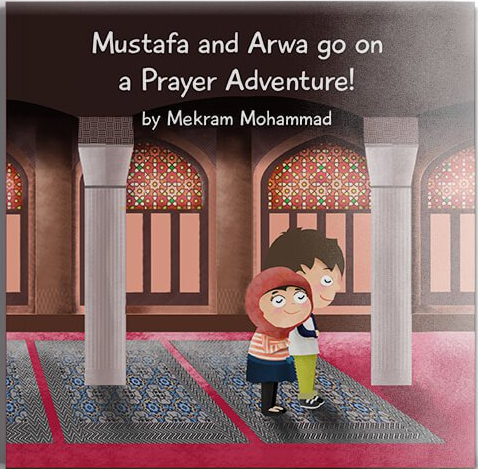
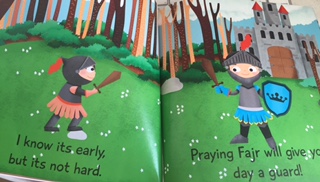
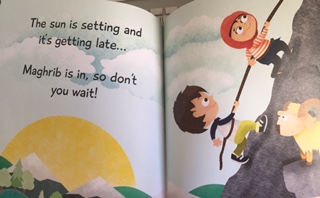
This short rhyming book introduces toddlers and little ones to the five daily prayers as it presents the brother sister duo on a typical day.  Ok, so maybe not a typical day, unless dressing up as knights and battling each other, winning medals, and climbing mountains is typical.  But, it presents the salats in time sequence that little ones can understand, more than as hours on a clock or as the various position of the sun.  Fajr is early, and it guards your day, then you go to school, but the book reminds you to remember Allah, then you take a break for duhr and if you do, inshaAllah Allah will help you pass, then you come home and have a snack and then pray Asr, etcetera.  By combining daily activities like spending time with family and reading Quran with the five prayers makes the routine seem doable and inshaAllah making it regular will truly allow us all to battle, win, and reach new heights, ameen.
FullSizeRender (57)

The book is a great tool to learn the names of the prayers, and their order, while strengthening a child’s Muslim identity.  There is no glossary or further detail about Salah or how it is performed, but I think assumes that that the reader would be able to provide additional information to the listener.  The book is more to get children excited to pray, and get closer to Allah (swt).
FullSizeRender (56)

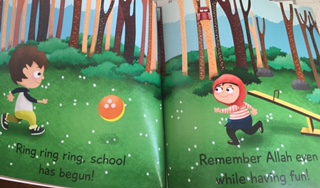
The illustratrions are adorable and the font and text appealing  to little children.  The book is one in an adventure series by Muslim Pillars, and I look forward to reading Mustafa and Arwa’s other adventures.
FullSizeRender (55)

I’m New Here by Anne Sibley O’Brien

Standard
I’m New Here by Anne Sibley O’Brien

Im-New-Here-by-Anne-Sibley-OBrien-on-BookDragon

Three new kids, not just at school, but to America as well. Maria is from Guatemala, Jin from Korea, and Fatimah from Somalia.  All three telling about what they are faced with as they settle in to their new life and routine, and all tell a bit about how things were back home.  FullSizeRender (48)

This book is not entertaining or fun, it is educational.  Written for ages 5-8 this book is very straightforward as the three characters stories are interwoven to show the growth and settling in that they experience.  The simple sentences, allow the reader to learn real, tangible ways that this children are finding the transition hard.  It also alleviates any sense of pity as it shows the full lives they had before coming to America. 

FullSizeRender (49)

I love that the other kids in the class are involved in real life ways to help welcome the new kids to class. Sometimes we are harsh on kids that don’t show empathy or compassion, forgetting that often they don’t know how.  This book works for adults and children in all situations.  We all need to put ourselves in other peoples shoes and see what struggles they are facing, we all need to help one another, and we all need to facilitate environments where these actions can take place.

FullSizeRender (50)

The book in many ways would fit well with One Green Apple, as it gives the perspective from the character who is new and articulates some of the obstacles they are facing, while also showing the interactions that help one to feel welcome and comfortable.

The pictures are crucial to the story as they show the feelings of the children and give context to the simple storyline.  I love that their is so much additional diversity in the illustrations: children of all body shapes, there is a student in a wheel chair, Fatimah wears a hijab, and there are male and female teachers in the book.

FullSizeRender (51)

The Author’s Note at the end of the 32 page story tells of her experience as a white American child living in South Korea, and some of her feelings and thoughts of being in a new country.  There is no mention of Islam, just implies Fatimah is a Muslim based on her dress, her mother’s clothing, and her country of origin.  

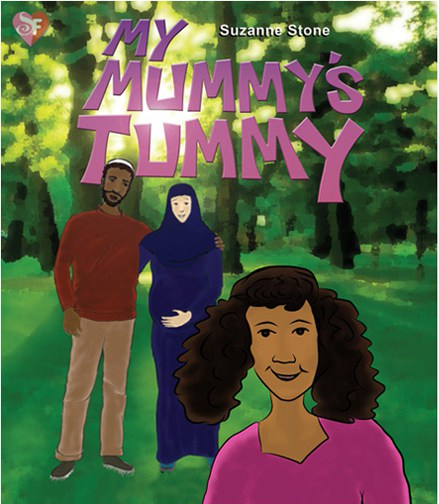
My Mummy’s Tummy by Suzanne Stone illustrated by Suzanne Stone and Omar Faruq

Standard
My Mummy’s Tummy by Suzanne Stone illustrated by Suzanne Stone and Omar Faruq

mummy-tummy.jpg

The copy I have is called My Mummy’s Tummy, but the binding says My Mummy’s Fat Tummy, I would assume that they are the same book except for this one word, and I’m hoping they opted to remove it at the last minute.  Actually, while on the title, it only  works well for the first four pages and yes, it sets up the story of a new sibling, by page five, the baby is born and mom’s tummy is the least of big sister, Maryam’s worries.

mummy tummy

The 24 page rhyming book, is a good introduction to what kids ages 3-6 can expect with a new sibling.  From Mummy’s large tummy, to having to stay with an Aunt when Mummy’s tummy starts hurting, Maryam is excited to have a new baby sister, except it ends up being a baby brother.  And while she is promised someone to play with, initially all he does is cry and sleep.  With gentle prodding by her parents and islamic reminders of patience and kindness, by the end of the book the baby is nearly one and his favorite person is his big sister Maryam, alhumdulillah.

mummy tummy

I love the diversity of the parents, and the acknowledging that changes are hard without being condescending or dismissive.  The book stays positive and hopeful and reminds us to keep Allah close to us when dealing with challenges and dreaming of the future.


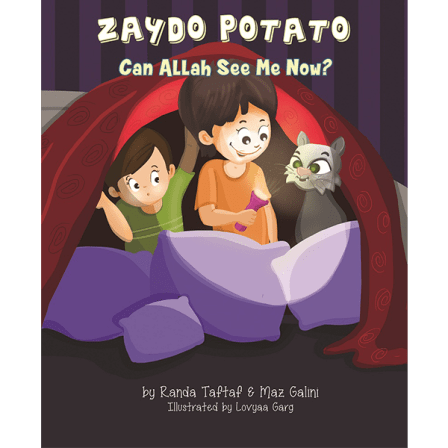
Zaydo Potato: Can Allah See Me Now? by Randa Taftaf and Maz Galini illustrated by Lovyaa Garg

Standard
Zaydo Potato: Can Allah See Me Now? by Randa Taftaf and Maz Galini illustrated by Lovyaa Garg

zaydo

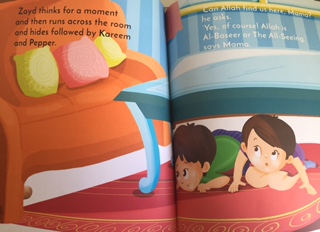
The book starts off simple enough with a little boy, Zayd playing hide-and-seek with his friend (or maybe cousin), Kareem, and his cat Pepper, when the challenge of hiding where they can’t be found, spawns a lesson in how Allah (swt) is always watching and watching over us.  As the kids hide in different places, the mom uses the names of Allah (swt) to emphasize the point.  The story presents the names of Al-Baseer, the All-seeing, Al Aleem, the All-knowing, Al-Khabeer, the All-aware, Al-Raqeeb, the Watchful, and Al-Shaheed, the Witness.

FullSizeRender (53)

The book is 32 pages, with the story taking up 24 of those pages. An ayat from the Quran, surah Hadid verse 4, starts the story and there is a glossary of the names of Allah at the end.  There is also some suggested activities for the book.  Hidden on each page is Pepper the cat and a potato.  There are other activities of finding shapes, counting blocks, finding different animals, etcetera,  that encourage children to go back to the book to engage in the pictures, and inshaAllah the message presented.

FullSizeRender (52)

There are two books thus far in the series and one E-book, the order doesn’t matter, as each is a standalone book.  The husband and wife authoring team also have a publishing company, Rummana Publishing Inc, and based on their website seem to have plans for more in the future.  This book came out about six months ago, and with its Glossy cover and large colorful pages, children will enjoy the story and activites.  The pictures are warm and engaging, and overall they are very well done.  The sentences are short, and the amont of words on the page is appropriate for the target audience.  There seems to be some arrant spacing on new text lines, but I doubt anyone would notice, and a few sentences are awkward either in their wording or lacking commas, but again, it is minor.

FullSizeRender (54)

A good story premise, easily conveyed to younger Muslims, makes the book an asset for Muslim children establishing a foundation and building a relationship with Allah swt.


My Mum is a Wonder by Michele Messaoudi illustrated by Rukiah Peckham

Standard
My Mum is a Wonder by Michele Messaoudi illustrated by Rukiah Peckham

my mum.jpg

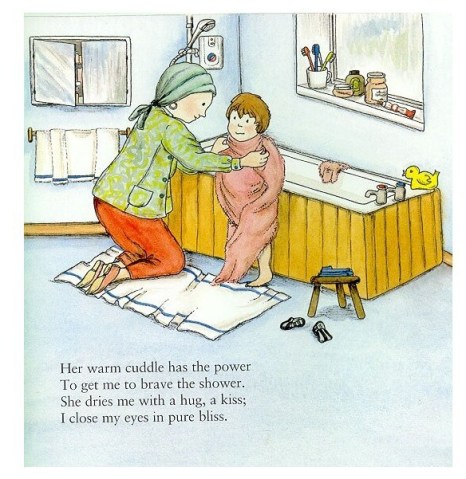
This book published in 1999 was one of the first books I remember reading regularly to my Sunday school class, and reading it now as a mum myself makes it warm me all the more.  In 34 warmly colored illustrations, this 8×8 book shares the story of how a little boy sees his mom.  How impressed he is by her and how truly he loves her for all that she does, all that she is, and all that she shares with him.

inside-mum.jpg

As the story progresses from what she does within the home and family, to what she does for others, the little boy also imagines himself all grown up and his mum as a nan.  He imagines that she will need him and he is ready and willing for when that time comes, to take care of her.

mum-inside-3.jpg

The book and illustrations target ages 3-6.  Written in rhyming couplets, four lines per page, the story moves at a steady pace and the pictures are detailed and familiar enough to engage most kids at bed time or in small settings.

mum inside 2

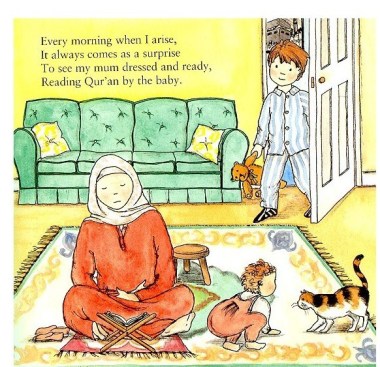
There are little Islamic specific tidbits sprinkled throughout that give parents or readers a chance to use it as a more specific teachable moment.  Saying “salam, reading Quran, thanking Allah for the food they have, praying salat, giving charity, visiting the elderly, celebrating eid, obeying her, and caring for her in her old age to achieve jannah, inshaAllah.


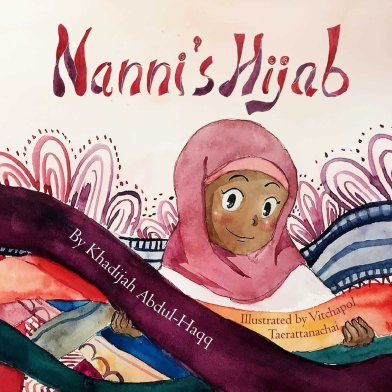
Nanni’s Hijab by Khadijah Abdul-Haqq illustrated by Vitchapol Taerattanachai

Standard
Nanni’s Hijab by Khadijah Abdul-Haqq illustrated by Vitchapol Taerattanachai

Nanni's Hijab

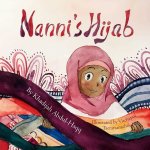
MashaAllah, there are so many things to like about this 36 page, brightly illustrated, elementary aged story.  Nanni, the main character, is spunky.  Not only is she strong enough to wear hijab to school, but she also is brave enough to confidently handle a bully on her own.  Surrounded by a supportive teacher, friends, classmates, and her mom, Nanni’s creativity and understanding that Allah swt will help her find a way to handle her predicament results in a happy ending, and many empowering messages.

nannis-hijab-childrens-book-review-L-Yo6YBS

The book would work for most children, but I think second grade and up would get the most out of it.  The girl might be young to be wearing hijab, but it seems like she wears it because she wants too.  I like that the illustrations have her and her mom uncovered at home, and that there is a glossary at the back, opening up the book to muslim and non muslim kids alike.

DVBz_rcVwAILbLM

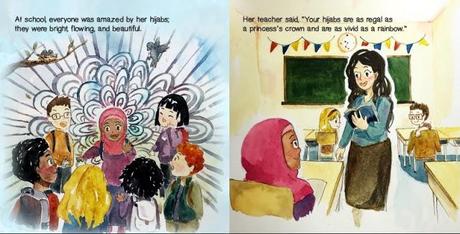
I also really like the larger messages of acceptance, trying new things, and doing better when you know better.  The supporting cast in the book resonates with muslims who go to schools where they are the minority, but have support and encouragement to practice their faith none-the-less.  Nanni’s teacher remarks that her “hijabs are as regal as a princess’s crown,” and the other students like seeing what color or design she is wearing each day.  Although a children’s book, the author does very clearly explain that the hijab is part of Nanni’s faith, although not mentioned by name, and that it is an act of worship. Nanni wants to handle the problem on her own, and for as bad as she wants to punch Leslie, she knows it isn’t the right thing to do.  As she wrestles with what is the best approach, she puts her trust in Allah, swt, which perhaps is the greatest lesson for us all in the book, alhumdulillah.

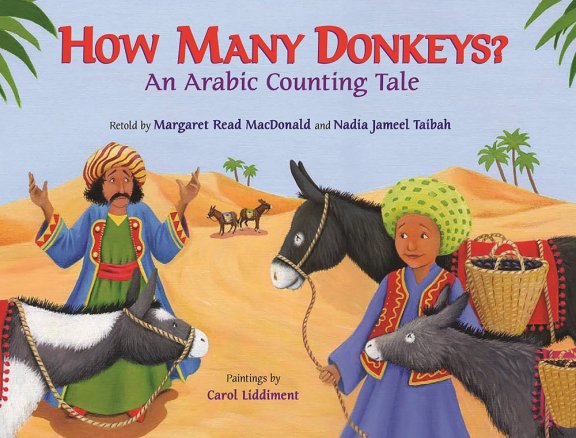
How Many Donkeys? An Arabic Counting Tale retold by Margaret Read MacDonald and Nadia Jameel Taibah illustrated by Carol Liddiment

Standard
How Many Donkeys? An Arabic Counting Tale retold by Margaret Read MacDonald and Nadia Jameel Taibah illustrated by Carol Liddiment

how many donkeys

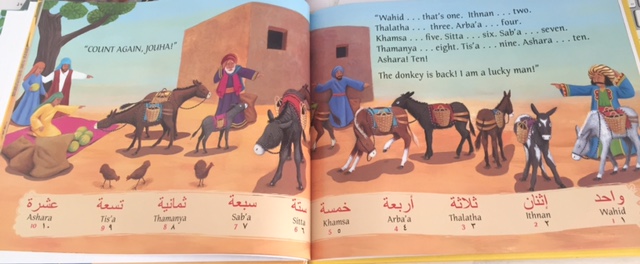
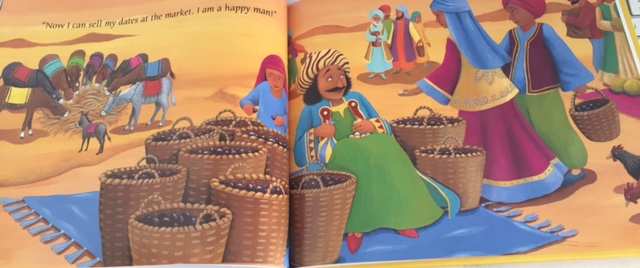
Whether you know a little bit of Arabic or none at all, this incredibly repetitive counting book will have you able to count to ten in Arabic by the end of its 32 pages.  FullSizeRender (35)Even if you know how already, your little one will enjoy figuring out why the main character Jouha can’t figure out how many camels he has in his caravan.  While Jouha thinks, it has to do with whether one runs off while he is riding, and comes back when he is walking, hopefully by the second or third time, most kids will realize that he isn’t lucky or unlucky, he is just forgetting to count the one he is riding atop of.  Probably good for ages 3-7, the book is silly in its repetition, and the beautiful painted illustrations bring the characters emotions to life.
FullSizeRender (37)

There isn’t anything Islamic, but it is definitely cultural as it retells an Middle Eastern folk tale.  The character, a wise fool, is also seen as Goha in Egypt and similar to Nasredeen Hodja in Turkey, all this background is stared at the beginning of the book.  There is also information to hear the story online in a read along program http://www.av2books.com, or to hear the author say the arabic numbers at http://www.margaretreadmacdonald,com.

FullSizeRender (36)

The Wooden Sword by Ann Redisch Stampler illustrated by Carol Liddiment

Standard
The Wooden Sword by Ann Redisch Stampler illustrated by Carol Liddiment

wooden sword

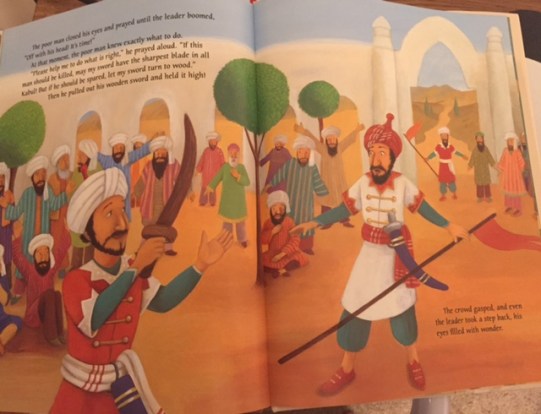
A Muslim Afghani Shah tests a poor Jewish man in this “softened” Jewish folktale.  I say softened because the author’s note at the end implies that she is retelling a well-known story in the Jewish tradition that often features mean-spirited characters.  In this version, however, the interaction between the rich Shah and the poor man, the Muslim and the Jew, are framed in contrast to show mutual respect, similar values, and the trust one has in God.  

sword3

This 32 page, AR 4.6 picture book, is beautifully illustrated and would work fabulous in interfaith settings, as well as in any lesson teaching how we should trust God in all things.  For children not of Islamic, or Jewish, or Afghani backgrounds, there is very little preaching and would still work very well as a moral narrative or even as a culture lesson, as it is a folktale.  From a current events standpoint, it would also do well with older children, as it shows that Muslim and Jews co-existed quite nicely once upon a time in Afghanistan as well.  

sword

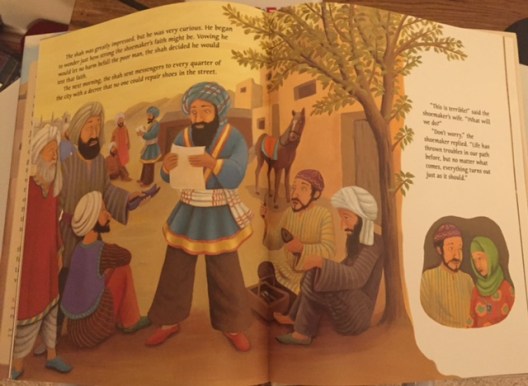
The plot is warm, although the Shah is clearly abusing his power as he meets a poor shoemaker and passes royal decree after royal decree to test the man’s faith that “everything turns out just as it should” and that God will provide.  The Shah decrees no one can repair shoes in the street, followed by banning the selling of water in the streets, and so on, until finally the poor man finds him self in the Shah’s Royal Guard without a sword, ordered to kill someone.  Not wanting to spoil how he handled the prediciment, I’ll suffice to say, in the end the poor man is made the shah’s advisor and presumably all is well. 

sword1

Throughout the tests, we also meet the poor man’s wife, who is supportive and very hospitable as they feed the Shah dressed as a peasant and offer him what little they have.  Her clothing is incredibly similar to what Muslims in Afghanistan wear, and makes me want to research this aspect for accuracy and to satisfy my own curiosity.    

Overall, a sweet interfaith folktale that I hope to share at our next interfaith storytime.

It Must Have Been You! by Zanib Mian illustrated by Fatima Mian

Standard
It Must Have Been You! by Zanib Mian illustrated by Fatima Mian

it must have been you.jpg

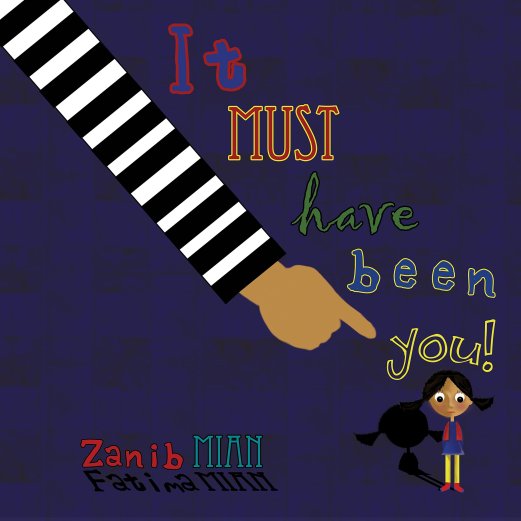
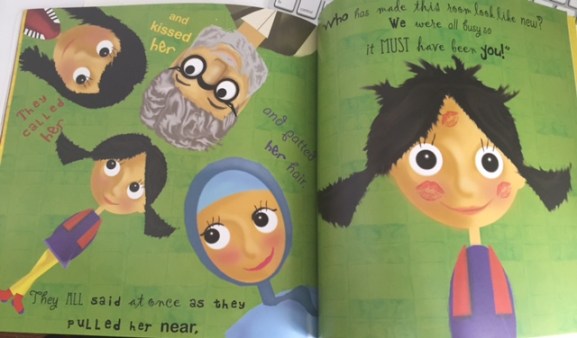
This rhyming 32 page book follows around a small girl, “about the same age as you,” who seems to make a mess every where she goes.  She never lies or even responds to the accusations of her unintentional messes, as she gets caught each time by someone in her family who points their finger and identifies the clues that led them to their answer. Luckily, she uses this pattern to her advantage as she cleans up and makes her family a card resulting in hugs, kisses, and love.

FullSizeRender (34)

Written for younger kids (4-6), the book is bright and colorful and very well done.  Even two and three year olds will enjoy the sing-song rhythm and chunky engaging illustrations.  The pages are thick and the binding solid, especially for a soft back book.  The 10 x 10 square size works well for story time and bedtime alike.  However, because the text is incorporated into the illustrations, if you are reading to a group, you will want to read it a few times before you present.  Looking at it straight on, the word order is much more clear and if you are reading it with emerging readers, I would recommend pointing to the words as you read, so as to help guide your listeners.  The fonts get a little crazy, which is part of the fun, but again may require some assistance to help the younger readers decipher the words.  Older independent readers (up to age 7 perhaps) might like the slight challenge of figuring out what word comes next, so that the story makes sense.

FullSizeRender (33)

The mom wears hijab and that is the only islamic reference or overt implication.  A fun book that thus far with multiple readings has yet to get monotonous and boring, yay!

FullSizeRender (32)

The Man with Bad Manners by Idries Shah illustrated by Rose Mary Santiago

Standard
The Man with Bad Manners by Idries Shah illustrated by Rose Mary Santiago

bad manners.jpg

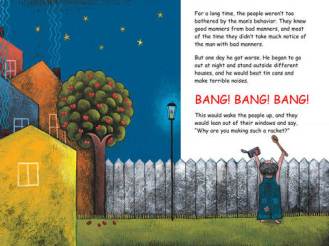
This story has a good moral, but the path there is a little twisted.  A village is annoyed by a man with awful manners and when he leaves for vacation, a clever boy convinces everyone to teach him a lesson and get him to change his ways when he returns.  They replant his field, paint his house, and rearrange his furniture to convince him upon his return that this is not his village or home or fields.  

bad manners1

When he does come back, he is confused and sad that he doesn’t know where he comes from, at which time the village tells him what they did, and agree to put everything back if he promises to change.  

bad manners2

The 32 page brightly illustrated book tells an Afghani tale in a western setting.  The chunky cartoonish illustrations show great imagination and encourage the reader to look at the effects of bad manners in a different way.  The clever boy, also goes about things in an extreme manner, which hopefully gets the reader to question if it was successful and perhaps how they would have handled the situation.  Another book that urges, thinking outside the box, with some discussion and reflection.  There is some lying, breaking and entering and other questionable actions, but I think most kids will realize it to be a silly story to teach a lesson, and all is forgiven because in the end they did live happily ever after.

bad manners4

The book is not AR but easily works for Kindergarten to 3rd grade.  There is nothing in the text or illustrations that suggests the book has any religious or cultural ties.

manners