Category Archives: Story Time

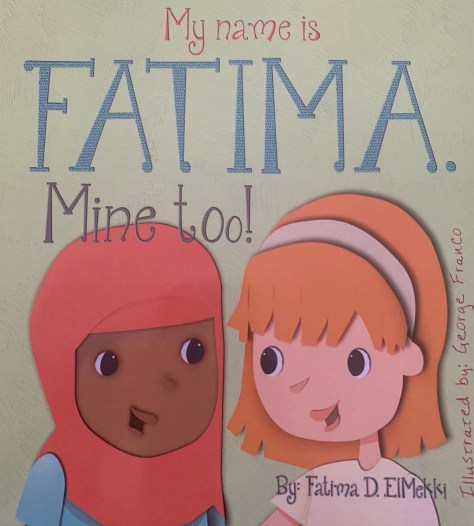
My Name is Fatima. Mine Too! by Fatima D. ElMekki illustrated by George Franco

Standard
My Name is Fatima. Mine Too! by Fatima D. ElMekki illustrated by George Franco

IMG_1926

This book is interfaith, and learning your own roots, and asking questions about your heritage and faith all rolled in to a cute little package for children.  But despite it’s length, 28 pages, and cute little girls on the cover, the book is for more first grade/second grade and older children, rather than toddlers. 

IMG_1927

The message that we are more alike than different is a great message, even for the littlest of readers, but this book goes a little deeper, and the didactic approach will bore them a bit.  Older kids for sure 2nd and up will benefit from the exchanges between Fatima and Fatima and learning both valuable religious lessons about their namesakes as well as respect and friendship for those with different beliefs.

IMG_1928

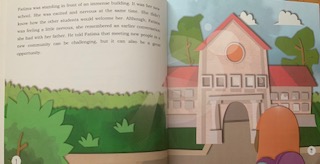
Fatima is from the Democratic Republic of Congo and on her first day of school in a America she tries to remember her father’s advice, that meeting new people can be a challenge, but also an opportunity.  

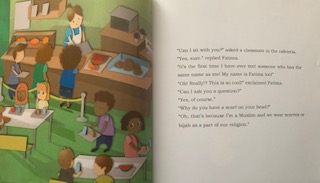
At lunch a little girl asks to sit with her, excited to meet someone with her same name.  Fatima asks her why she wears a scarf, and listens to her explain it is because she is Muslim and the hijab is part of her religion.  

IMG_1929

At recess, Muslim Fatima tells non Muslim Fatima that she is named after Prophet Muhammad (saw)’s daughter and asks her who she is named after and if asks she is Muslim, too.  The other Fatima says that she is Catholic and that she doesn’t know why her parents named her Fatima, but that she will find out and let her know.

IMG_1930

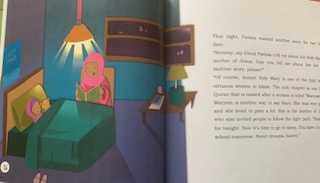
That night Catholic Fatima learns that her mom had gone to Fatima, a city in Portugal, a famous city for all the miracles that have happened there and the apparition of Mary, the Mother of Jesus.  Fatima’s mom had gone there to pray for a baby and promised if she got pregnant that she would name the baby Fatima.

IMG_1931

The next day Catholic Fatima tells Muslim Fatima and also asks her if she has heard of Mary, the mother of Jesus.  Muslim Fatima says she has heard of her, but doesn’t know much and that she will ask her parents and let her know.

Muslim Fatima learns that Mary is one of the four virtuous women in Islam and that there is a chapter in the Quran named after her.  When she tells Catholic Fatima the next day at school, the girls marvel at how much they have in common.  They are BFFs despite their differences and beautiful ones at that.

IMG_1932

I love that the book is framed in opposites to show similarities.  I also love that it shows women in our respective faiths with similar values, similar names, and Mary’s role in both our traditions.  So often, when we are building bridges we discuss how Yusuf is Joseph and Musa is Moses, Yahya is John and we go through the old Prophets, this was a nice change in perspective.

IMG_1935

The illustrations are nothing to get excited by, but they do show smiling warm characters and family members.  They serve as a distraction from the text heavy pages that do nothing to grasp the reader with their plan font and majority white backgrounds.

IMG_1933

This book would work for Muslim children, Catholic children, really all children.  It talks about faith, but as the characters view it, not in a one is better or more right than another.  There is a second book in the series about Fatima inviting Fatima to an Iftar party  that I look forward to checking out soon.  I hope it is a little more rich in dialogue and character building instead of just a foil to disseminate the information between the two faiths, but even if it isn’t I still think the book has value and you should check it out.

IMG_1934


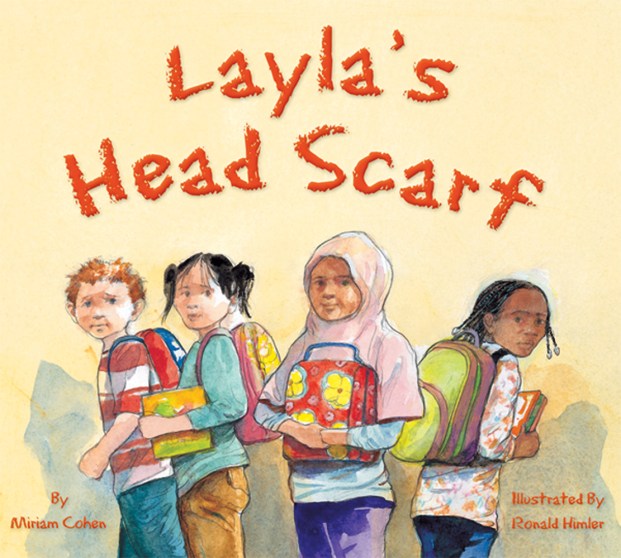
Layla’s Head Scarf by Miriam Cohen illustrated by Ronald Himler

Standard
Layla’s Head Scarf by Miriam Cohen illustrated by Ronald Himler

cover layla

It isn’t often that I feel compelled to list all the things I like about a book and all the things I don’t like about a book and count them up to see what I think about a book.  Especially when the book is only 32 pages and an AR 3.2, but this book has me on the fence.

layla2-e1543798774981.jpg

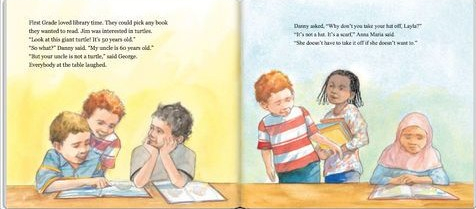
It is Layla’s first day of school and presumably she is shy.  That’s what the other kids say at least.  The story follows her and the class throughout a typical first grade day, there is no climax or problem, there is just her and her classmates moving from circle time, to the library, to lunch, to recess, to art, and then her joining in at circle time the next day.  

Along the way the kids comment on her scarf, the librarian brings her a book about her country with pictures of sun and sand and veiled women.  The lunch lady looks at her rice and pea pie and says it looks yummy, the kids tell her to take off her hat to play easier, other characters stick up for her and try to correct other classmates that it isn’t a hat, it is a scarf. 

layla

During art time, she paints her family and the women all wear hijabs, a few kids say they look funny, a few others stick up for her, she ends up crying, but the kids come together to make her feel better and to articulate that in America people can wear what they want.  Some kids talk about family members wearing yarmulkas and others about braiding their hair, but there is no reason given for why Layla wears a hijab.

I don’t think any of the kids are intentionally mean or malicious, they are curious and not given any answers by Layla or any of the adults.  As a result when the book is over, the reader similarly has no answers.  Despite that though, I think readers will get the power of kindness and with some (a lot of) discussion, understand how we can help people feel comfortable and celebrate differences.

layal

Here is my pro and con list about the book:

PROS:

Book about hijab is included in a mainstream series meant for 1st graders (We Love First Grade!) 

Kindness comes through.

Kids stick up for each other.

Librarian found a book about Layla’s country and read it to the kids.

Kids include Layla while playing.

Illustrations are soft and realistic.

Diversity in the classroom.

CONS:

The book is about hijab, but nothing is learned about hijab.

Lots of stereotypes: girl doesn’t speak englishF from the desert, different food. 

Focus is on differences not similarities.

1st graders aren’t required to wear hijab.

Islam isn’t mentioned, but the Jewish kid mentions his faith.

Don’t learn what her lunch is called or what country she is from.

If she doesn’t speak English how did she label everyone in her picture?

Clearly she understands English, she is just shy, so why does she mess up the song at the end?

layal1

Luckily the book was in the public library, so I don’t feel like I bought something that I am unhappy with.  I don’t know that I would recommend it to anyone, but it is always nice to see a muhajaba in a story, and there isn’t anything “wrong” with the book, it just lacks a lot of detail unfortunately.

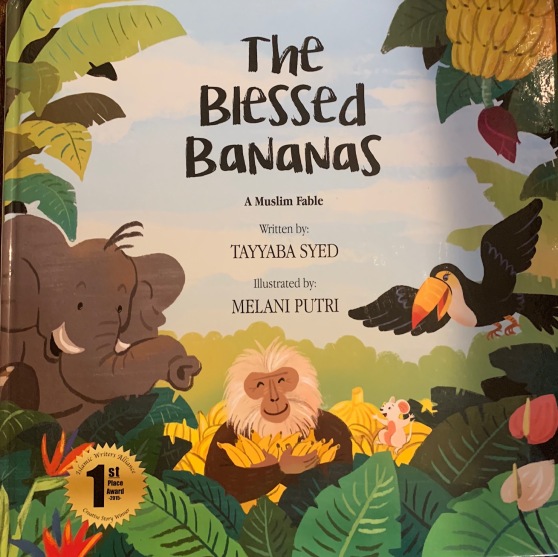
The Blessed Bananas: A Muslim Fable by Tayyaba Syed illustrated by Melani Putri

Standard
The Blessed Bananas: A Muslim Fable by Tayyaba Syed illustrated by Melani Putri

IMG_1798.jpg

 A fable with lessons of kindness centered around the Salawat, definitely is a great premise and for the most part I really enjoyed the book. 

IMG_1799

The 8.5 by 8.5 hardcover, 50 page book feels great in your hands and the illustrations are sweet and expressive.  The book is long, and is text heavy so I’d say the target audience is maybe 6 to 10 years old.   The font is incredibly small and irritating.   It should have been larger and more inviting to children in my opinion.  It doesn’t match the size, binding, and illustrations, and actually becomes a distraction if trying to read it in a group setting.  

IMG_1801

The story itself is smooth and intentional.  Rico, a blessed, yet ungrateful monkey, lives atop an ever abundant banana tree.  However, he attributes his blessings to his own hands and does not thank Allah swt.  He is mean and greedy toward people and animals alike.  Yet, something is missing in his life and he doesn’t know what. 

IMG_1800

When a little mouse, Chico, comes to him to ask for a banana and gets scolded at instead.  Chico makes dua for Rico asking Allah to guide the monkey to goodness.

IMG_1802

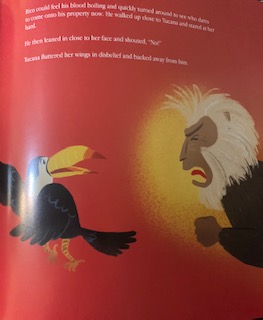
Tucana, a toucan, then stops in Rico’s banana tree after a long flight to be rebuffed by a foul tempered monkey who wants to be left alone.  When Tucana  leaves she forgives Rico for his rudeness and asks Allah to be merciful to him as well.

IMG_1803

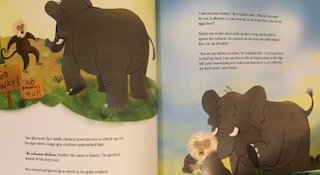
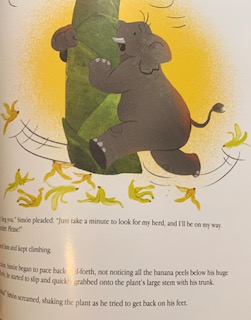
Rico then makes signs to keep people and animals away.  Which works for a while, but along comes Simon, an elephant, one afternoon to ask the monkey to climb his tree and help direct him back to his herd.  Rico of course refuses, and Simon reminds him that they are brothers in Islam and to please help. He begins shouting at the elephant to leave, and as Simon is pacing back and forth, he slips on the banana peels, grabs the tree to support himself and shakes the tree back and forth in the process.

IMG_1806

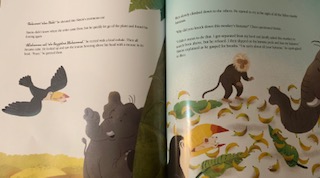
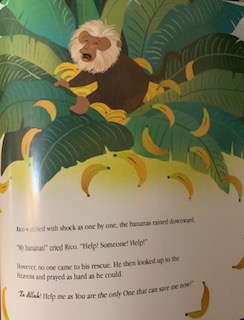
Rico begins hollering for help and sure enough the animals he had turned away previously, return to help him.  They had forgiven him as they hope Allah will forgive us all.  To calm the monkey, chico shouts, “Salawaat’alan Nabi!” in Simon’s ear and when he recites “Allahuma sali’ala Sayyidina Muhammad,” peace and calmness is restored.

IMG_1811 (1)

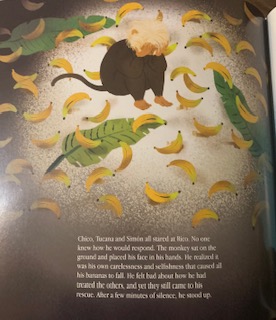
With all the bananas on the floor, many mushy and trampled, Rico has to decide if he learned a lesson, and how he will put his new knowledge into action, or if he will resume his life of ungratefulness.

IMG_1807

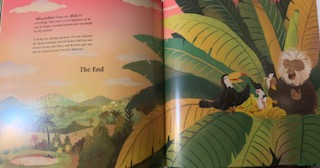
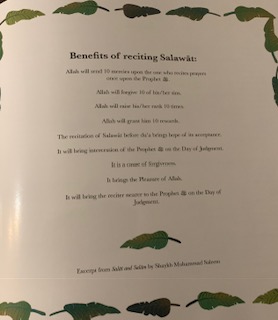
The book ends with each animals favorite banana recipe, information about the author and illustrator and benefits of reciting Salawat and an ayat from the Quran.
IMG_1810

The story and how it weaves Islam into the lessons is beautifully done, my only hiccup is the constant refrain of Rico counting his bananas.  I realize it is a fable, and maybe with talking animals interacting with humans, reality is notably suspended.  But, it seems misplaced to me.  How do you constantly count a perishable item? Does Rico only eat a certain amount a day? How many new ones grow a day? What is the number that he is adamant to have at all times? So, many questions, that I didn’t get why he was counting them, why he was irritated when he lost count, and why this detail was in the story and a big part of the story none-the-less.  Like the font, its a minor detail, but a distracting one for me unfortunately.  Clearly, however, I’m in the minority as the book has won the Moonbeam Children’s Book Award and the Islamic Writer’s Alliance Creative Story, so give it a read, and let me know your thoughts, jazakhAllah kher.

IMG_1809


Raihanna’s Jennah by Qamaer Hassan illustrated by Yasushi Matsuoka

Standard
Raihanna’s Jennah by Qamaer Hassan illustrated by Yasushi Matsuoka

IMG_0047

Raihanna is back and learning about Jennah with her two best friends, Safiya and her cousin Maryam.  In this beautiful 8×10 book, the character who last fasted her first Ramadan fast is now having a sleep over and learning just how wondrous and worth the wait heaven will be.

IMG_0048

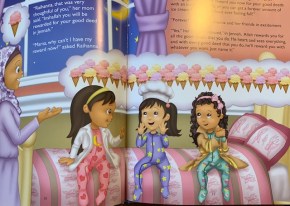
The story starts with the three girls parallel playing as a veterinarian, firefighter and world class chef.  When hunger strikes and the cookie jar only has one cookie, Raihanna has to decide to eat it or divide it into thirds.  

With mom looking on as Raihanna decides to share, a teachable moment about jennah presents itself.  The mom, in her consistent purple uniform, tells Raihanna she will be rewarded in jennah for her good deed.  Which leads Raihanna to ask why she can’t be rewarded now.  The explanation is a bit text heavy, but using ice cream to explain a reward in this world, and having whatever you want in the next, sets up the format and story line for the rest of the book.

IMG_0049

The girls start off asking for pretty simple things like kittens and bikes.  But mom encourages them to think of something beyond their imagination.  The girls come up with castles and world’s made of candy, and flying like birds, and golden kitchens. 

IMG_0050

The mom responds virtually the same after each girl expresses what she would want.  She says, “…beyond your wildest dreams,”  then, “…beyond your imagination,” then “beyond belief,” then “beyond description,” then back to, “…beyond your imagination.”   It gets a bit repetitive, but not necessarily in a good way because it doesn’t function as a refrain that the little ones will pick up on.  It just gets annoying I think for the reader if the book is requested too often.  I wish she would have maybe picked one, giving the book a comforting pattern, and something that the young ones could remember and benefit more from.  The book is for preschool to early elementary kids, but because of the amount of text on the page, it will be read to that age group, not read independently.

IMG_0051

As with the first book, I love the warm colorful cartoonish illustrations, they both attract and engage children as young as two or three.  The hard back binding and glossy pages also make it sturdy and a wonderful gift.  This is a book for Muslim children that I think little girls especially will enjoy. I sincerely hope there will be more books in the Raihanna series.

Allah Knows All About Me by Yasmin Mussa

Standard
Allah Knows All About Me by Yasmin Mussa

IMG_0013.jpg

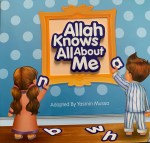
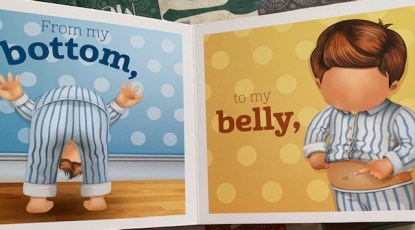
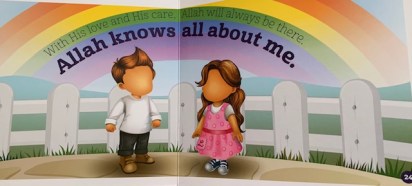
This adorable 24 page board book by Learning Roots has been adapted (with permission) from a book by Kate Toms called “God Knows All About Me.”  The 7.5 x 7 book is perfect for little toddler hands, and the repetition will help convey even to little ones that Allah is ever-present and all-knowing.

IMG_0015

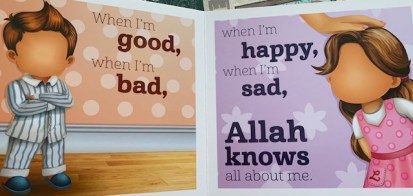
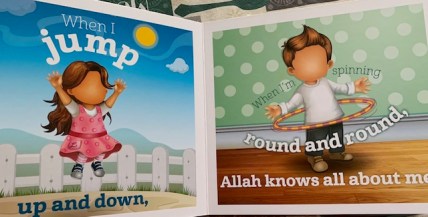
The illustrations are soft and warm and as with all Learning Roots books, I believe, the characters do not have faces.  The text is large and clear and many of the stanzas are silly is they show bottoms and talk of being smelly.

IMG_0016

It covers Allah swt knowing us from our heads to our toes, when we are happy and sad, when it is raining or snowing, in all situations, all hours of the day, all environments, He knows and is always there.

IMG_0017

The reassurance that we are never alone or never apart from Allah’s love is a great message that is well done in this little book. A mention of Allah’s applicable 99 names might have been a nice addition at the end, but perhaps being the book is redone from an existing book, it wasn’t possible.  Hopefully parents will take the book to the next step and teach kids all of Allah’s many attributes in ways similar to how the presence of Allah is presented in this one.

IMG_0018

Burcu: No One Wants to Play with Me! by Nursen Sirin illustrated by Nese Inan

Standard
Burcu: No One Wants to Play with Me! by Nursen Sirin illustrated by Nese Inan

IMG_2348

This 32 page, 9×12 story book, for ages five and up, focuses on character education and is meant to be a relatable story with clear lessons about how to behave and deal with situations in life.  The opening page bullets all the lessons readers should learn from the story and the end of the book offers directions to make a balloon craft.  

IMG_2354

I don’t mind books with lessons and morals so clearly delineated, and I like that the morals come from such an adorable character with a whole cast of supporters, and a number of books to her series.  

IMG_2353

My problem is more the story itself, for a lesson on how to make new friends, and dealing with the universal struggle of moving and feeling like ‘no one wants to play with me.”  The book spends nearly seven pages on Burcu making a surprise breakfast for her family before hearing the news that she is moving because the landlord says they should.

IMG_2352

They pack and move seemingly the same day, and then the point of the book gets going.  Burcu has to say goodbye to her friends and doesn’t feel like even going out at the new house to make new ones.

IMG_2351

Her brother, Alper, has no problem making new friends, and finally Burcu gives it a try.  Only a little girl attempts to get to know her and Burcu dismisses her because she is so young.  She tries to be included with the other children, but they don’t know her and aren’t willing to let her play.

IMG_2350

Burcu finally confides in her dad, that she can’t get anyone except the little girl to play with her.  Her dad encourages her to give the little girl a chance.  Burcu does and finds out they are the same age, she just looks really young, and then all the kids are friends and happy.

IMG_2349

The real hero to me is the little girl, Katherine, who didn’t give up on an ageist Burcu that didn’t want to play with her.  Seems odd that Burcu wanted a friend, and then was arrogant to complain about the one she got.  Plus, I would imagine kids who have moved and don’t have friends, would turn to a book like this for tips and hints, and ways to feel less alone.  The book offers none of that.  It doesn’t tell how finally Burcu makes friends, or gets included, other than it took time.  Which is great, but not exactly helpful if you are five and crying everyday because no one will play with you.

The writing is very dry.  I think it has been translated from Turkish, many of the sentences are passive voice, and the sentences choppy.  The book doesn’t have any glaring errors, it just seems like it would work as a story time, or as part of a lesson, and  maybe once as a bedtime story, but not a book that kids will clamor to hear over and over again.

IMG_2355

There is nothing Islamic in the story, but most of the major online Islamic bookshops carry the Burcu series, so I would imagine the authors, and publishers are Muslim.

Overall, the book sets off to teach a great lesson, but falls a bit short.  The illustrations are adorable and the large size and playful font are very well done, the diction, not so much.  The books are reasonably priced and if you see a title that works for a lesson, or theme you are discussing, I think you can make the books work.  If you are looking for a book to read over and over to your kids, you might, however, be disappointed.


A Whale of A Wish by Razana Noor illustrated by Rahima Begum

Standard
A Whale of A Wish by Razana Noor illustrated by Rahima Begum

IMG_2254

I’ve seen this book on Amazon countless times, and not really been interested in a Prophet story written in rhyme.  It seemed like it would be overly forced and  there’s enough slightly creepy songs out there trying to be clever in their retellings, that I never added it to my cart.  But, when Noura over at Crescent Moon Store convinced me to take a look and hooked me up, I trusted her, and am glad I was so terribly wrong.

IMG_2255

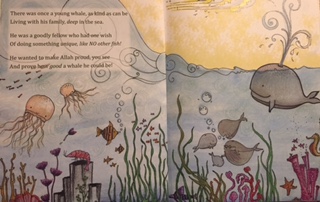
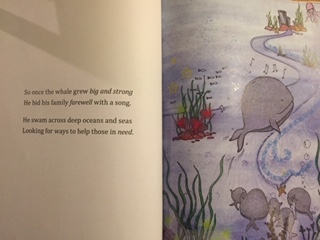
The story of Yunus (AS) is told from the whale’s perspective.  And shows how he always wanted to do something unique and swims around helping those in need.  He even befriends his foe, a giant squid.

IMG_2256

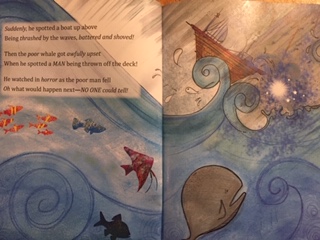
When he feels compelled to swim to the surface in the middle of the storm, Allah commands him to swallow Prophet Yunus and later commands him to return him to land.

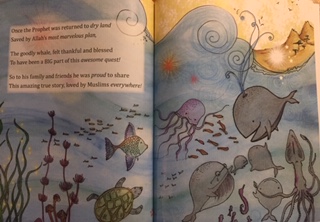
The whale listens to Prophet Yunus praying all day and night and feels blessed to be part of Allah’s big plan.  His dua is also included at the end in english and arabic and arabic transliteration.
IMG_2257

The 18 page book is 8×10 inches in size and the illustrations are sweet, soft, happy and well done.  Children two and up will enjoy the story, and while it is meant for Muslim children, I believe Christian and Jewish children will recognize the story and with some oversight would enjoy it too.

IMG_2258

The rhyme is surprisingly not as forced as I feared.  On only one occasion the rhyme is a  stretch: squid, bit, but the meter is regular and flows easily making the story great for  story time and bedtime alike. 


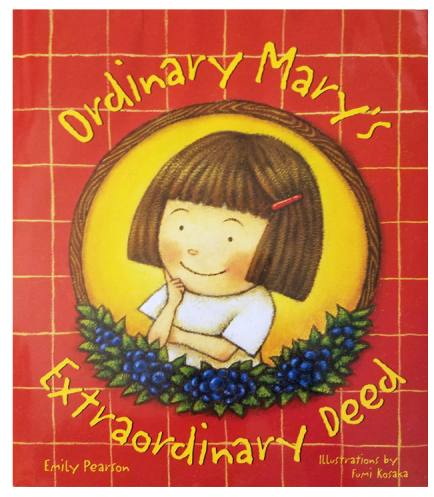
Ordinary Mary’s Extraordinary Deed by Emily Pearson illustrated by Fumi Kosaka

Standard
Ordinary Mary’s Extraordinary Deed by Emily Pearson illustrated by Fumi Kosaka

ordinary-mary.png

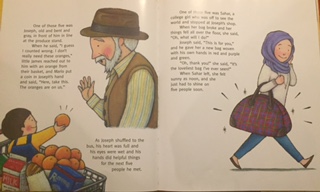
Once again I picked up a book for the message that it explored, making a difference, and found myself smiling triumphantly when a flip of a page revealed a Muslim lady depicted in an illustration, and her culturally Islamic name gracing the page. 

The book is an AR 4.2, and while there are a lot of words on each of the 32 pages, and the concept of an act multiplying might be hard for little ones to grasp, I think patient kindergarteners and first graders will grasp enough to make the story enjoyable.

IMG_2114

Ordinary Mary is so very ordinary, but she changes the world.  It all starts when she leaves berries for a neighbor.  And that neighbor, Mrs. Bishop, takes the berries and makes blueberry muffins and secretly gives them to five people.

IMG_2113

Each of those five people in turn give or do something kind to five people and over 30 billion people are impacted.  But there are not that many people on the planet, so there is love left over and extra to give.

IMG_2112

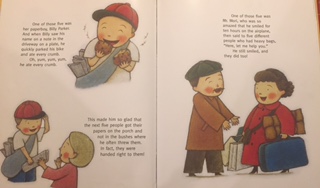
The book doesn’t follow all 30 billion obviously, but it picks and follows one person to show how the chain works before showing the mathematical growth in numbers.  Mrs.  Bishop gave a plate to the paperboy Billy Parker, who handed the next five people their newspaper personally instead of tossing it in their bushes.  One of the people that got their newspaper smiled for 10 hours on his flight, and helped people with their bags, etc etc.  

IMG_2109

The book shows that giving something can be something tangible, or a compliment, or a phone call, or a smile.  Over long distances,  the kind deed comes back to Mary and the message too, comes full circle.

IMG_2110

Along the line is Sahar, a college student who’s bag breaks and she benefits from a kind man who was just gifted oranges at the grocery store when he didn’t have enough money.  She in turn compliments a woman on a boat who is distraught and unsure. An important character in the link, and an import illustration of inclusion.

IMG_2111

There author mentions a variety of names, male and female, and the illustrator represents a fair amount of diversity of age, color, gender, religions, socio economic, ethnicity and mobility.  Truly, we all have the potentially to change the world.


Iqbal and His Ingenious Idea: How a Science Project Helps One Family and the Planet by Elizabeth Suneby and Rebecca Green

Standard
Iqbal and His Ingenious Idea: How a Science Project Helps One Family and the Planet by Elizabeth Suneby and Rebecca Green

iqbal

It is a bit odd that this story is fiction, when it reads so much like a piece of nonfiction.  It is a picture book, but has an AR level of 4th grade 4th month.  So, while the story is great and highlights a country and culture, Bangladesh, not often seen, I don’t know that this book would appeal to many kids.  The kids that it does appeal to though and that can find it in a library or bookstore (not sure where it would be shelved), I think will not just like it, but possibly find it both inspiring and worth reading again and again.

IMG_2086

It is monsoon season in Bangladesh and the rains make Iqbal’s mom have to cook indoors.  As a result, she and the baby, Rupa are constantly coughing from breathing all the smoke from the woodburning stove.  Iqbal’s father mentions a propane stove he saw in the market, but the family cannot afford it, despite wishing that they could. 

Iqbal’s school has just announced the School Science Fair and the winners get cash prizes, if Iqbal can win, maybe he can buy his family the new stove.  His little sister Sadia offers her services to help him win and be his assistant.

IMG_2087

After a lot of thinking, pondering, and dreaming, Iqbal decides on the perfect project: a stove that didn’t produce smoke.

With the help of his teacher at school to find ideas and articles and plans on the internet, Iqbal and his sister build a solar cooker with foil and an old umbrella. 

IMG_2088

The science fair is a success, Iqbal wins, the family buys the stove and propane with the winnings, and when it isn’t raining, the family is able to use the solar stove Iqbal and Sadia built.

The book draws on ideas of sustainability, pollution, economic viability, problem solving, and education.  The culture provides the backdrop making all of these issues relevant and real, and mentioning Ramadan, Eid, and prayer provides some depth to the characters and adds to their culture.

IMG_2089

A lot of reviews online criticize that the mom is cooking and that the kids test an egg on the solar cooker and call her to eat it if it is supposed to be Ramadan, but I personally promise you, during Ramadan, we are always cooking.  And if she is nursing the baby, the mom wouldn’t be required to fast, there’s a lot of other reason she couldn’t/wouldn’t be fasting, but really, it is such a small portion mentioned in passing, no detail needs to be given, and it didn’t bother me at all.

Another complaint about the book is that if money is so tight the kids wouldn’t be at a school where they can just make copies, and buy eggs on their own.  I think there is some truth to this, but maybe a wealthy doner funds the school.  I think you could argue it either way.  I don’t know that the family is poor, it is the overall society, so kids could have pocket money, a propane stove is probably imported at least from a larger city so the expense would be more, similarily the infustruction of electricity and gas lines could hint more at why they cook the way they do.  Needless to say the family is smiling in the pictures, they have food, and they seem to be doing ok.  So the fact that the school printed a few articles and the kids bought some eggs without asking permission, didn’t bother me greatly.

IMG_2090

The illustrations are expressive and show the family connections and emotions.  I like that they bring to life a country many wouldn’t know, even if I wish it weren’t a work of fiction, but based on some child actually there.  

The end of the book has information about clean cookstoves, how to build one yourself, and a glossary.  The large 9×12 hardbound book would hold up well to multiple readings, and the amount of text on the pages would work well as a read-a-loud to younger kids who would find the subject matter interesting.  

IMG_2091


Imagine by Shoohada Khanom illustrated by Faiza Benauvda and Vicky Amrullah

Standard

IMG_2052

A bright and colorful, well illustrated book for preschoolers to stretch their imaginations with and giggle at, while never straying too far from an Islamic concept or reference.  The book mentions something  Islamic on nearly every one of the 32 pages: dhikr, Quran, Ramadan, Prophet Yunus, salah, saying salam, Eid. 

I absolutely love the premise of the book, asking whales about Prophet Yunus, having an octopus help serve iftaar, it really is a lot of fun. The illustrations are great.  The 8.5 by 8.5 book size completely filled with colors and friendly faces, are well done and engaging.  The amount of text on the page is appropriate for the age group and the binding and weight is adequate, nothing to get excited about at a $13 price point.

The book is written in four line stanzas, but I really struggled to not get tongue-tied on nearly every page.  I think the loose rhyme is fine, it just seems really forced in some places, and non-existent in others.  And even when it isn’t forced, the rhythm is a tad off.  I read it to myself and struggled, so I scooped up my 3-year-old and tried twice to read it to him before making a final attempt to make it flow, and feeling somewhat successful.  I think part of it is me, I try to read it like I’m doing a story time, and not like a bedtime story.  But here: read this page and see if you agree.

IMG_2054

I think it is me, and now I’m projecting all my issues on you the reader, and this cute book, I apologize, but here’s one more.  I feel like I’m becoming a broken record when I complain about the price of books and lacking editors.  I promise I have atrocious grammar myself, and make a ton of mistakes typing these reviews, texting my friends and posting on Facebook.  I can’t even blame auto-correct half the time.  So, when I spot errors, and can’t get through a stanza in a children’s book, I get grumpy.  I paid money for this, the author spent a ton of time on it, and the illustrators too, and the publishers…maybe that is the problem.  I love the idea of small publishing companies and self publishing, but why am I once again sitting here with a beautiful children’s book in my hands shaking my head at a really silly mistake.

“I’d try climb on top of another,”

IMG_2047

Sigh.