Category Archives: Story Time

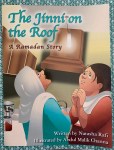
Mustafa and Arwa go on a Ramadan Adventure by Mekram Mohammad

Standard
Mustafa and Arwa go on a Ramadan Adventure by Mekram Mohammad

IMG_3184

Ramadan is two months away and this little book is a great way to introduce and stir up excitement for little Muslim toddlers and preschoolers. It could work for non Muslims, but the general overview given would need some details and explanations, and this book seems more geared to introduce excitement and a few key concepts for the blessed month.

IMG_3190

In 27 rhyming pages the brother sister duo explore some of the feelings of the month, activities that make the month special and what to expect at suhur, iftar, and taraweeh at night.  

IMG_3185

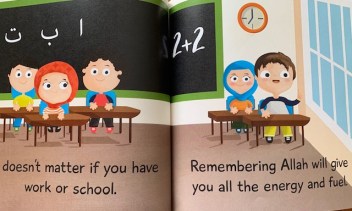
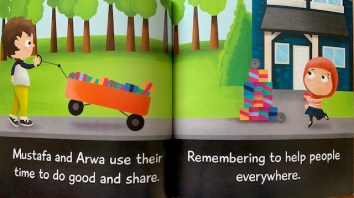
I like that it makes it clear that you don’t eat one bite, that you fast even if you are at work or school, that you use your time to do good and help people, and that you ask Allah for paradise.  

IMG_3188

The end is Eid and while the text presents some great general info, the illustrations are what really give the minimal clear text life.  Seeing the kids giving presents to people and looking for the moon and enjoying iftar together with smiling faces, show kids the warmth of Ramadan.  

IMG_3186

The book doesn’t have a story, it just talks about Ramadan, but the tone in this book and in Mustafa and Arwa go on a Prayer Adventure is very fun and light.  It doesn’t get into rules or articulate what little kids are expected or required to do, or even why Muslims do it, it just gives them some knowledge and some emotion to create the feeling of it being a grand adventure.

IMG_3189

The book is paperback 8.5 x 8.5 and the thickness, sheen and quality of the pages makes it durable and enjoyable to read at story time (in small groups) and bedtime alike.  This book most likely will be on repeat in the weeks leading up to Ramadan and then referenced throughout the month to remind children about what they are seeing and experiencing.  

Adam & the Tummy Monsters by Zanib Mian illustrated by Maria M. Goncalves

Standard
Adam & the Tummy Monsters by Zanib Mian illustrated by Maria M. Goncalves

IMG_3157

Book two in the Adam Series was the first Zanib Mian book I ever read, and for the last three years I’ve been looking for the first book.  So, while thrilled to finally find it secondhand in the US, I realize my review of it is a bit selfish.  I’m hoping that if it appeals to you that maybe we can encourage the author to re-release it somehow or write more books in the series, I’m not entirely sure how publishing and copyrights work, but I feel like it is worth a shot.  There aren’t a lot of early readers with Muslim characters out there, let alone ones that are done well.  The book is 32 pages, hard back and is would work for 5 year olds and up that know their site words and are pretty fluent at sounding out new words. Ideally, kids that have had the story read to them a few time will be able to pick it up faster, as the story is compelling, the spacing between lines and the variety of fonts will hold their interest, but some pages do have a lot of text and some words are a bit complex. 

IMG_3158

SYNOPSIS:

Adam has a tummy ache, aka tummy monsters, and while he doesn’t want “yucky medicine” from the doctor, he is happy when his dad, puts on a silly hat and assumes the role of “Detective Doodle” to solve the case.  They determine that he ate porridge for breakfast, but so did Adam’s sister and brother, who are feeling fine, so that can’t be it.  He washed his hands before eating, and said “Bismillah” before he started too.  It seems he followed all the eating rules, but when Adam’s sister Mariam stumbles on a scene in the playroom, the culprit is uncovered.
IMG_3160

WHY I LIKE IT:

I love that the family has a silly approach to a very common childhood problem.  I also love that while, solving the case, reminders about eating etiquette are sneaked in without being preachy or cumbersome.  Once the reason for the tummy ache is uncovered, Adam’s parents don’t scold him, but it is safe to say he probably learns his lesson.

The pictures are engaging and colorful.  The mom wears hijab, and the characters are warm and happy.  The background color of the pages changes and sets a nice tone for the book.  

In the text, Adam isn’t asked if he said bismillah, but rather if he said, “in the name of God,” but in the illustration, a speaking bubble has him saying bismillah, which makes me wonder if the author was trying to make the book accessible to both Muslims and non Muslims alike.  It definitely could be, I think the story is fun and the consequences for gorging on chocolate pretty universal.

IMG_3159

FLAGS:

None

TOOLS FOR LEADING THE DISCUSSION:

Like the second Adam book, this book will work perfect for story time in small groups  and bedtime on repeat.  I think in a classroom it would be great to have small groups read the story and then discuss.  Not a traditional Book Club, obviously for the length of the book and the target audience, but I do think that even little kids will have a lot to say about Adam and his silly family.  More importantly, I think they all will have stories of their own “tummy monsters” to contribute and discuss.

Basirah the Basketballer says Insha’Allah by Hafsah Dabiri illustrated by Alina Shabelnyk

Standard
Basirah the Basketballer says Insha’Allah by Hafsah Dabiri illustrated by Alina Shabelnyk

basket.jpg

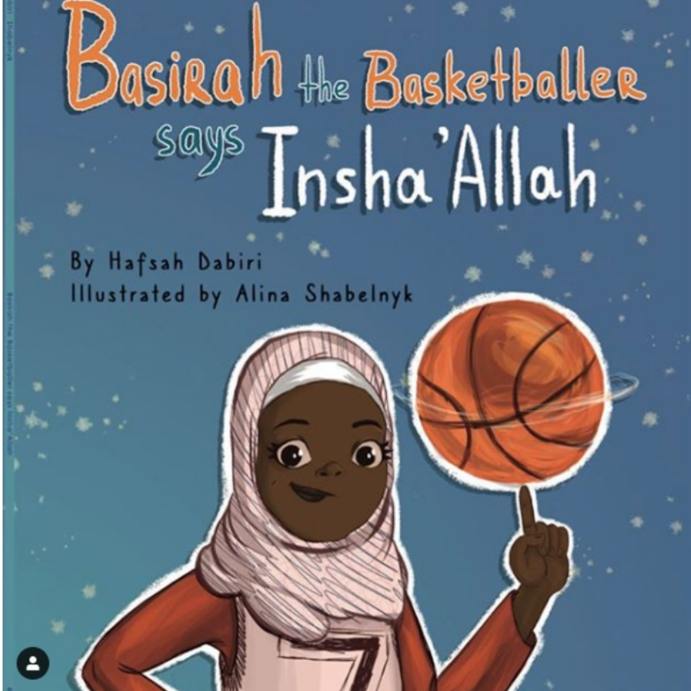
Another sports book starring a smart girl with a supportive father, seems like a trend, and I like it.  The book is relatable to ages 5 and up whether they play basketball or not, and will remind even slightly older children how “insha’Allah” really works.  It features a girl, but boys will gain a lot from the book as the lessons are for us all.

basirah1

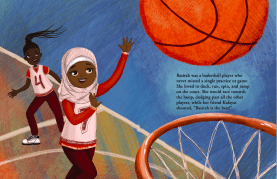
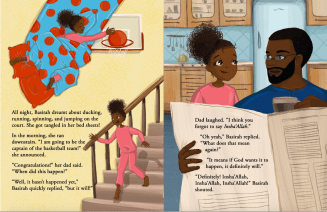
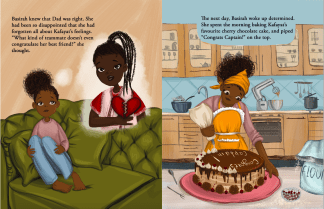
Basirah loves basketball and with supportive teammates and mad skills, she should be a shoo-in for team captain.  But when her dad reminds her that if it hasn’t happened yet she needs to say insha’Allah, she realizes the power of leaving things to God.  

Testing out her new knowledge of asking God to make happen things she really, really wants, over many of the 30 pages in the story, makes the climax that much stronger and her dad’s wisdom that much more memorable. I’m trying not to spoil the story, even though it is a children’s picture book, it isn’t without a bit of tension and resolution that really makes the book shine.
basirah2

This book can be taken at face value with a little bit of a lesson for little ones, or a lot deeper for more reflective readers.  Understanding that things we ask God for often come or don’t come to test us, is a lesson we all need. I hope if read with an adult, the adult will also push the listener to consider why we should do things in the first place, what are intentions are, as Basirah leaves the door open for that discussion at the end, but doesn’t quite articulate it for independent readers.

basirah3

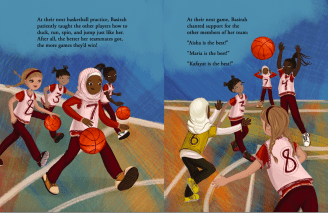
I love that at home Basirah is not covered, but is when she is out.  I love that her school is diverse with students of different colors and head coverings and that her coach is female and a muhajaba as well.  I love that Basirah and her father seem incredibly close, and that she listens to him, and he to her, before lessons are espoused and course of action plotted.  The book is not preachy, but lessons are there and the reader will get “it” right along with Basirah allowing her strength to radiate off the page and inshaAllah empower the reader as well.

basirah4

I find it interesting that the book doesn’t mention Allah and uses the word God, given that the phrase the book focuses around is insha’Allah.  I would imagine the intended audience is Muslim, but there is not specific mention of Islam.  It would work for non Muslims, but I think they would wonder why she says such a phrase and where it comes from.

basirah5

Basirah is presumably in middle school, as she has multiple classes and can bake a cake independently, her age seems a bit fluid, but many 11-14 year olds do tend to be independent in some areas and rather clueless in others, so while I did notice that she seems very naive in knowing what insha’Allah means and how it works in some parts of the story and very mature, and hijab wearing, and willing to grow from her situation in others, I’ve concluded it is plausible.

The book is 8.5 x 11 vertical, well bound, shiny glossy full color pages with clear and easily readable font.  The sentence length and amount of text on the page is not too overwhelming and the spacing keeps it inviting for new fluent readers.  

I love that Ruqaya’s Bookshelf (https://ruqayasbookshelf.com/) has new books out, three to be exact.  Whether the stories work or don’t work for you, I think their presentation and quality, give the books a longevity and find themselves being pulled out for different kids, at different times, when different lessons are needed.  They are well packaged in terms of illustrations and colors and size for the most part, and when I hear they are publishing new stories, I find myself ordering them without even reading the content synopsis.  Thank you for helping get these stories out, may Allah swt reward you!


The Jiu-Jitsu Ponytail by Mir Khalid Ali illustrated by Taahira Halim

Standard
The Jiu-Jitsu Ponytail by Mir Khalid Ali illustrated by Taahira Halim

IMG_2909

A determined girl battles her ponytail, her own self-doubt and her opponents on the jiu-jitsu mat in 38 beautifully illustrated pictures and clear every day language.  Perfect for little girls and their dads ages five and up.

IMG_2910

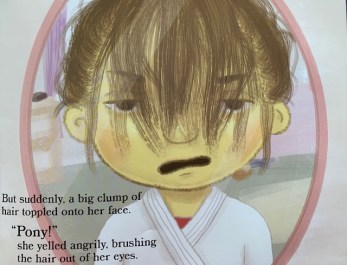
Noor has been counting down the days until her first jiu-jitsu tournament, but the morning of the tournament a battle first takes place between her and her unruly hair.  Determined to tame it on her own, even when her father offers her help, she steps on to the mat for her first fight.

IMG_2911

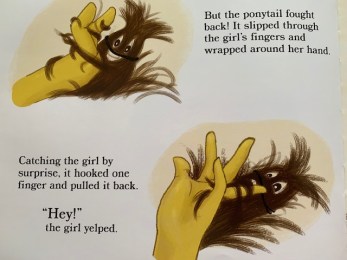
Squirming with nerves, her ponytail breaks free from the desperate tape used to keep it contained and covers Noor’s eyes forcing her to tap out and concede the match.

IMG_2912

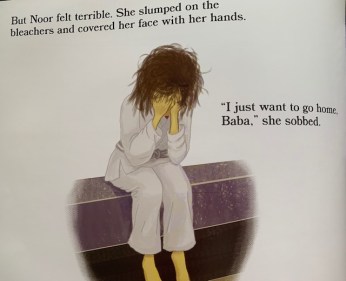
Walking off the mat, Noor’s Baba hugs her and compliments her on her bravery.  Noor is having none of it and just wants to go home.  Rather than argue with her, Baba goes to talk to her coach giving Noor some space to battle her self-doubt on her own.

IMG_2913

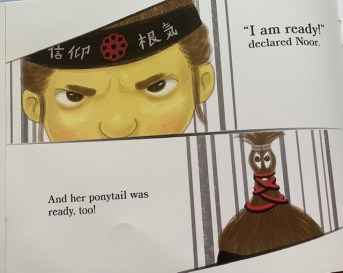
Deciding she has worked hard and trained hard, and been supported every step of her way she asks her baba to help her tie up her hair.  Together her and her jiu-jitsu ponytail take on the remaining opponents and persevere.  

IMG_2914

The book shows great heart in the supporting cast each of us have around us, in this case the father takes his cues from his daughter, never wavering in his support, but not forcing her to do anything either.  The little girl is determined, but also learns that it is ok to ask for help and above all to not give up on yourself.

IMG_2915

The personification of the ponytail adds a layer of humor to the story that works well for little kids that might just take the story on face value.  Even they will learn something about jiu-jitsu with the visual displays of the different moves and of martial arts tournaments in general.  Two of my children thought the ponytail hilarious, and two slightly creepy.  The subtlety of its personification allows its role of being a separate entity and just feeling like it has a mind of its own to be determined by the reader.

IMG_2916

There is nothing Islamic in the book, but the author and illustrator are Muslim, and the use of the little girls name, Noor Kareem, and her calling her father Baba will have a special appeal to Muslim children (plus her name written in Arabic on her bedroom wall), just as children who do jiu-jitsu will find themselves in the pages.  The book appeals to all children and reminds them they can overcome and inshaAllah be supported in the process.

IMG_2917

The illustrations in this 8 x 10 horizontal hardback book are beautiful and detailed.  They allow the reader to understand what is going on without the book being overly burdened with text.  The font is clear and well sized making the book ideal for both bedtime and story time, alhumdulillah.

IMG_2918

Under My Hijab by Hena Khan illustrated by Aaliya Jaleel

Standard
Under My Hijab by Hena Khan illustrated by Aaliya Jaleel

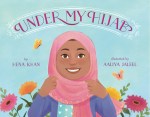
UNDER MY HIJAB final front cover JPEG.JPG

I know, (sigh) another hijab book, but I promise it is good and you won’t be sad you bought…”another hijab book,” and  alhumdulillah, it’s a Hena Khan book, so public libraries will have it or at least they should be willing to order it if requested.  

IMG_2878

Written in rhyming four line stanzas the story is told from a young girl’s perspective about the women in her life.  The first two page spread shows the strong female as she interacts in the world and covers her self, with the following two page spread, showing her in her home, uncovered.

IMG_2879

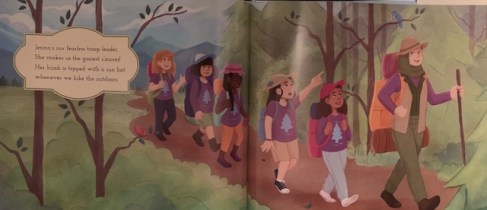
From Grandma, to Mama, to Auntie, to troop leader, to siblings and friends, the reader sees hijabs wrapped in styles as different as the person wearing them.  They also see Muslim women as doctors, artists, Tae Kwon Do students, bakers, leaders, and everything in between.

IMG_2880

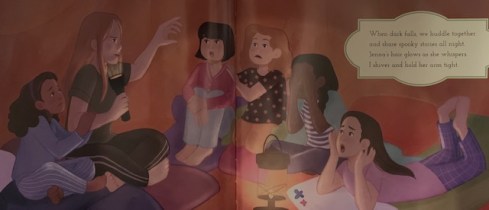
The illustrations are beautiful and perfect.  They radiant warmth and familiarity, while adding details to make the pages hold your attention a few minutes longer and smile with the diversity presented. The martial art scene is spot on!

IMG_2876

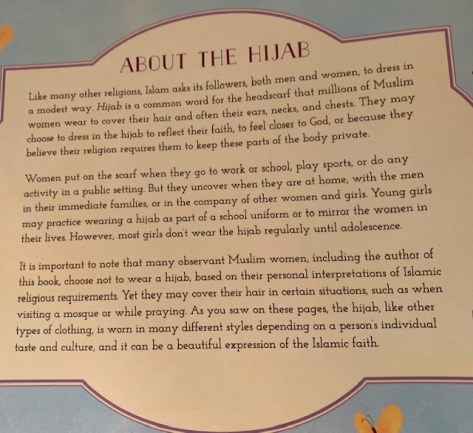
I wish they showed a niqabi, and maybe someone that doesn’t cover all the time, but at certain times of prayer or entering a mosque, like the author, who talks about herself and hijab in general in the afterward entitled: About the Hijab.  

IMG_2882

I love that the book is for children and I desperately hope adults will read it too.  It breaks down so many stereotypes, and answers so many questions in a seemingly effortless presentation.  How many times have all hijabis been asked if we sleep in our scarves or shower in them.  I love that there are shades of brown skin tones, and blond haired hijabi’s too.  

IMG_2877

And most importantly I love that it shows Muslim women to be strong and varied and to have full, independent beautiful colorful lives.  That hijab is a choice and it is strength and beauty and personal.

IMG_2881

The book does not talk about the reasons for wearing hijab, or get into the religion.  The book is a great size for story time and bedtime at 10 x 8 horizontal, hardbound, and 32 pages.  Ages four and up will enjoy this book repeatedly,  and older kids, especially girls considering covering or just starting to cover will enjoy it as well.

Alhumdulillah! Well done!

Forgive the glare in the pictures, they aren’t in the book 🙂

Allah Gave Me Two Eyes to See. . . by Fatia M. D’Oyen illustrated by Stevan Stratford

Standard
Allah Gave Me Two Eyes to See. . . by Fatia M. D’Oyen illustrated by Stevan Stratford

img_2783

This series (Allah Gave me Two Hands and Feet, Allah Gave Me a Nose to Smell, Allah Gave Me a Tongue to Taste, Allah Gave Me Two Ears to Hear) has been around for over 15 years and is a staple in most Islamic School libraries, and Islamic preschool classes.  They aren’t really fiction in that there is a story, but they are rhyming verses thanking Allah for our five senses in a hard 8 x 8 bound, 32 page, 3-5 year old age appropriate book.

img_2784

Allah Gave Me Two Eyes to See, starts with eyes, but covers all five senses equally.  The book uses rhyming lines to give examples of what we can explore through our senses to understand Allah’s gifts.

img_2785

After the senses, the book tells us about Allah giving us a mind to think, and a heart to love, and how we should thank him for all we have been given.  The pictures aren’t great, but they aren’t off-putting.  It gives kids the chance to connect words to pictures in a very literal sense as it shows exactly what is being mentioned in the text.

img_2786

While I questioned to review this book or not, I thought I should because it is such a staple in preschool through kindergarten classes when discussing the body parts, gratitude and the five senses.  So many other books discuss the blessings all around us, but might require a little more discussion for this age group to understand how we know Allah through our senses and through our experiences.  

img_2787

I used this book when I used to teach Sunday school, I saw my mom a preschool teacher for years and years use this book when introducing the senses, and when I was asked recently to read books about body parts, I reached for the series to see if they were still relevant and sure enough they are, Alhumdulillah.

img_2788


We’re off to make ‘Umrah by Sana Munshey illustrated by Eman Salem

Standard
We’re off to make ‘Umrah by Sana Munshey illustrated by Eman Salem

img_2719

Its surprising how few books about Umrah there are for children.  As a religious act that many children are included in, there really should be more, but alhumdulillah this fun one exists, and conveys the steps of Umrah in rhyming fashion for ages 4 and up.

Told from a little boy’s perspective about his family’s journey, a little history is given, before the major parts of Umrah are explored.  The book prefaces the story with a note to parents and teachers making sure they know the book is a semi-fictional narrative meant to reinforce learning, it isn’t a comprehensive guide. 

img_2720

Full page pictures with four line stanza groups detail the steps about the journey and flight to Mecca, including defining and using the arabic words for the talbiyah, putting on ihram, crossing meeqat and praying rak’atayn.  The step-by-step approach is warm and exciting, as the pictures show smiling faces and the words balance information and enthusiasm of being in Mecca for the first time.

img_2721

Details about praying, rich and poor, side by side are included, making tawaf, seeing the black stone, seeing Maqam Ibrahim, drinking Zamzam water, a bit of history about Sa’i, and the little boy feeling tired going back and forth between Safa and Marwa are all given in a well paced narrative that is neither rushed, nor overly forced (just a little to keep the rhyme scheme :)).  The steps of Umrah conclude with the family members getting hair cuts and then a quick trip to Madinah.

img_2722

There is a glossary at the end of the 32 page book, that is nice for older kids, or as a way to reinforce words used to describe the journey.  I think the strength of the book is really that it shows what to expect during Umrah.  Children about to go will benefit from the mapping of the events and getting a heads up on what awaits them.  Children that have gone will have a handy way to remember what they did.  Children learning about Hajj perhaps, will be able to see how Umrah is shorter and be able to see what the similarities and differences are in a simple manner.  Even children who have no connection yet to Umrah will benefit from the vocabulary and excitement shared in the story.  While the story is aimed at younger kids, even middle elementary age kids will enjoy reading it once or twice.

img_2723

The book claims to come with a poster and paper dolls to reinact the steps of Umrah, but I purchased my book second hand and they weren’t present.  Hence, I didn’t comment on their quality, but it sounds like a wonderful supplement to the book.

img_2724


Zara and Hakeem Learn ‘Alhumdulillah’ by Shabeena Rehman illustrated by Kevin Payne

Standard
Zara and Hakeem Learn ‘Alhumdulillah’ by Shabeena Rehman illustrated by Kevin Payne

IMG_2686.jpg

Board books from the UK! The glory of a well bound chunky book for toddlers to tote around, chew on and hopefully learn something from, with all the joy of international shipping.  I delayed buying these books for so long, because of it, and finally I gave in and just in the nick of time as I have started a weekly preschool story time, and this series is perfect for three and four year olds with limited attention spans and in need of repetition.

Zara and Hakeem, a brother and sister duo wake up to find their mother not feeling well, and instructions that they will have to help Daddy, Grandad and Grandma with the daily chores.  Then Mummy sneezes and says, Alhumdulillah.

img_2687

It seems the books  all have a pattern, something happens that sets the stage, then Hakeem and Zara pause and think hard about what to say, there is then an English translation/explanation about the meaning and then a universal, Muslims from all around the world say or do this, before the story resumes.

I don’t mind the break in the story, but the phrasing is a bit cumbersome and slightly off in this book.  Why are the kids thinking hard about what to say, when Mummy had just said it? If they were thinking hard about what she had said or where confused why she said it, I feel like it would make more sense. 

img_2688

I really like that the book shows that all Muslims say something the same, it is a good time to start to show this age bracket that they are connected to something bigger, without overwhelming them.  

The story continues with Hakeem helping daddy vacuum and Hakeem sneezing when some dust flies up.  Then Daddy and Zara mow the lawn when the grass makes Zara sneeze, everyone, Grandad, Grandma, all take a turn sneezing in different scenarios and everyone practicing to say Alhumdulillah.  

img_2690

By dinner, Mummy is feeling better, but Daddy has a sneeze attack and takes to laying down as he is not feeling well, and tomorrow the kids will have to help Mummy with the chores.  A humorous full circle, that even toddlers will laugh at.

The kids I read the book to, loved the loud Atchoos and the cute illustrations, a few of the older four year olds, wanted to know why Yar Hamukumallah was not also said.  They also wanted to know why when the dad sneezed four times they only said Alhumdulillah three times.  I read a variety of books about being sick and we talked about using tissues and sneezing into our elbows, washing our hands, and not coming to school when we are sick.  The book was great to explore how mom was sick and dad must have caught her cold.  But that sneezing from pepper and cat hair, didn’t mean you were sick.  The kids also saw that everyone in the house has to help out, sick or not, old or young, male or female, which is always a great lesson to reinforce, Alhumdulillah.

img_2691

The book is 18 pages of text.  The illustrations show the mom and grandma in hijab, they are bright and colorful and engaging.  Children will enjoy getting carried away with the sneezes and the Alhumdulillahs when read aloud and will enjoy looking back at the pictures and details independently afterward.  This is a great story to put on repeat and then watch your own toddler retell the story on their own.

Overall, well worth the shipping! I hope US bookstores will stock the series as our little ones need books that are funny, clever, and well done.

img_2689

P is for Palestine: A Palestine Alphabet Book by Golbarg Bashi illustrated by Golrokh Nafisi

Standard
P is for Palestine: A Palestine Alphabet Book by Golbarg Bashi illustrated by Golrokh Nafisi

p for pale

I first heard about this book maybe a year ago when it was making waves for including such passages as “I is for Intifada, Intifada is Arabic for rising up for what is right, if you are a kid or a grownup!” The book was in limited supply however and hard to find.  Recently a 2nd edition came out and is widely available in major outlets. 

IMG_2401

The book follows the well established genre of giving each letter in the alphabet a page to depict in picture and words details about a given subject.  The form usually rhymes and appeals to little kids learning about something specific, and adults, who enjoy the topic at hand.  

IMG_2399

While this book is fabulous because it exists, and praiseworthy because it celebrates Palestine, Christmas and Eid and the birthplace of Jesus and Lebneh and Quds and olives and grape leaves and everything else that makes Palestine so close to one’s heart, the stanzas themselves are really forced and inconsistent in rhyme and meter.

IMG_2400

Granted, one doesn’t buy or even pick up a book like this for its literary merits, but the text is really a bit all over the place.  “Can we sing the ABC anywhere? With a woolly bear or in thin air? L is for Labneh is like yogurt.  I eat it for lunch, wearing my loafer! B is for Bethlehem, my birthplace with the best Baklawas, put it on a plate not in a vase! K is for Kuffiya, the best kind you can hang on a hook in Hebron souk! E is for Eid, it means Festival, like the Muslim Eid al-Fitr when we eat enticing eats, get excited over gifts, and enjoy seeing out extended families. J is for jesus, Jesus was born in my hometown (Bethlehem), not Jamestown!”

IMG_2403

I of course overlooked some of the awkwardness because the illustrations are lively and beautiful and the parts I thought needed explaining, I chalked up to me not being Palestine, nor having visited there.  

Many of the passages are touching and memorable and make the book so important.  M is for Miftah, Key of Return…Mama’s Mama, and my Jiddah’s Mama’s, for which I yearn! T is for Thob, a traditional dress wtih tatreez (embroidered pieces).  Takes time to make, with thousands of tiny threads, if you please!

IMG_2405

There is an Appendix in the back, giving a tad more information on the main idea mentioned for each letter.  There is also a Publisher’s note.  While there was some controversy that the book is anti Semitic or spreading propaganda, I think the book comes from a place of love and culture.  There is Christian and Muslim concepts and a character named David making grape leaves.  It does not mention Israel or Zionism blatantly, which I think shows that Palestine has its own culture and isn’t solely defined  by the crimes committed against them.  Interestingly, the author is from Iran.


Hassan and Aneesa Go to Masjid by Yasmeen Rahim illustrated by Omar Burgess

Standard
Hassan and Aneesa Go to Masjid by Yasmeen Rahim illustrated by Omar Burgess

IMG_1911

I don’t often do two books in the same series, let alone three, but for as much as I enjoyed Hassan and Aneesa Love Ramadan and Hassan and Aneesa Celebrate Eid, I was a little disappointed in this story.  For starters, the title seems like it should read, Go to “the” Masjid, no? 

IMG_1912

The story starts off with the notion that this is Aneesa’a first time to the masjid, which seems bit off.  Presumably mom and Hassan have been before, but mom’s excitement, and Hassan’s questions through the book, and knowledge about masjid etiquette make you wonder if it is their first time too.  A little odd, if you’ve read their other books, but ok, I’ll accept it and move on.

The family starts by marveling at the exterior architecture.  They enter and separate, Hassan going with his dad and Aneesa going with her mom, as it points out that men and women pray in separate areas.  It is a good tidbit of information, but again, it just seems a bit off in the way it is phrased that Aneesa wouldn’t know this.  

IMG_1913

The tone of the book is almost negative, again, a striking contrast to the other stories.  Aneesa splashes and wastes water when making wudu, doesn’t she make wudu at home? And the mom gets her clothes ruined in the process making her upset.  The illustration shows her to look really mad!

I would think a little context about not wasting water or even sharing the hadith about not wasting even if making wudu in a river, would have been a great lesson to convey, but instead the pictures show a lot of water by others also being wasted, and only mom looking really frustrated.

IMG_1914

The two of them, put their shoes up and marvel at the dome and the soft carpet.  Aneesa then sees that the ladies prayer area over looks the mens and she begins screaming for Hassan.  Her mom corrects her and points out that “you should speak quietly in a masjid.  You might disturb someone if you shout.”

IMG_1915

Hassan turns and waves, and then rushes off to see a school friend.  But, first he is reproached for nearly walking in front of someone praying.  Again a good tidbit, but the phrasing of how the information is shared is rather negative, and these repetitive reprimands don’t make the book joyful.

IMG_1916

Hassan then learns about he mihrab and the mimbar before the athan is called and they all pray.  After salat they put some sadaqa in a box and the family heads home.

The illustrations are as sweet as ever, and the price very reasonable, but this book, compared to others in the series, is really wordy and there is a lot of text on EVERY one of the 20 pages.

IMG_1917

The framing of the book is awkward, thus making some of the behavior issues come off as negative, it is a minor thing that keeps the book from being great.  If the premise would have been maybe the kids talking about their favorite things about the masjid and reminding themselves to talk quiet and not waste water, the tone overall would have been lighter while still being really informative.

IMG_1918

If this is your first Hassan and Aneesa book, you might not be bothered, but if you find it a little off putting, try the other two.  The books says for ages 2 and up, but I think it would be better for 4 and up.  The younger kids you could tell them the story while showing them the pictures: what to expect at the mosque and how to behave, but there are too many words, and they will probably have a hard time staying focused.  Older four and five year olds, will enjoy seeing things they recognize and maybe learning some of the vocabulary for the architecture and being reminded on proper behavior at the masjid.