Category Archives: Picture book

My Mum is a Wonder by Michele Messaoudi illustrated by Rukiah Peckham

Standard
My Mum is a Wonder by Michele Messaoudi illustrated by Rukiah Peckham

my mum.jpg

This book published in 1999 was one of the first books I remember reading regularly to my Sunday school class, and reading it now as a mum myself makes it warm me all the more.  In 34 warmly colored illustrations, this 8×8 book shares the story of how a little boy sees his mom.  How impressed he is by her and how truly he loves her for all that she does, all that she is, and all that she shares with him.

inside-mum.jpg

As the story progresses from what she does within the home and family, to what she does for others, the little boy also imagines himself all grown up and his mum as a nan.  He imagines that she will need him and he is ready and willing for when that time comes, to take care of her.

mum-inside-3.jpg

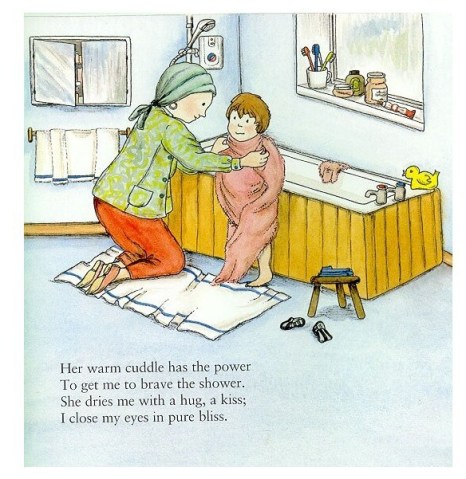
The book and illustrations target ages 3-6.  Written in rhyming couplets, four lines per page, the story moves at a steady pace and the pictures are detailed and familiar enough to engage most kids at bed time or in small settings.

mum inside 2

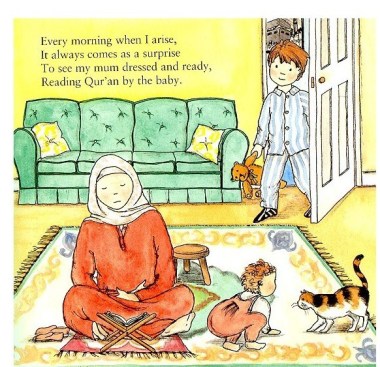
There are little Islamic specific tidbits sprinkled throughout that give parents or readers a chance to use it as a more specific teachable moment.  Saying “salam, reading Quran, thanking Allah for the food they have, praying salat, giving charity, visiting the elderly, celebrating eid, obeying her, and caring for her in her old age to achieve jannah, inshaAllah.


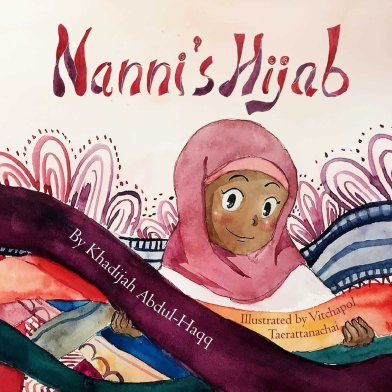
Nanni’s Hijab by Khadijah Abdul-Haqq illustrated by Vitchapol Taerattanachai

Standard
Nanni’s Hijab by Khadijah Abdul-Haqq illustrated by Vitchapol Taerattanachai

Nanni's Hijab

MashaAllah, there are so many things to like about this 36 page, brightly illustrated, elementary aged story.  Nanni, the main character, is spunky.  Not only is she strong enough to wear hijab to school, but she also is brave enough to confidently handle a bully on her own.  Surrounded by a supportive teacher, friends, classmates, and her mom, Nanni’s creativity and understanding that Allah swt will help her find a way to handle her predicament results in a happy ending, and many empowering messages.

nannis-hijab-childrens-book-review-L-Yo6YBS

The book would work for most children, but I think second grade and up would get the most out of it.  The girl might be young to be wearing hijab, but it seems like she wears it because she wants too.  I like that the illustrations have her and her mom uncovered at home, and that there is a glossary at the back, opening up the book to muslim and non muslim kids alike.

DVBz_rcVwAILbLM

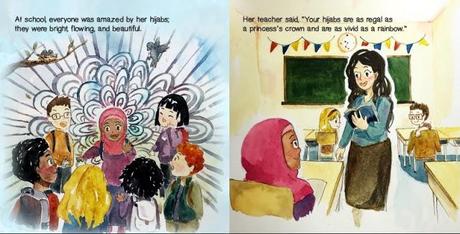
I also really like the larger messages of acceptance, trying new things, and doing better when you know better.  The supporting cast in the book resonates with muslims who go to schools where they are the minority, but have support and encouragement to practice their faith none-the-less.  Nanni’s teacher remarks that her “hijabs are as regal as a princess’s crown,” and the other students like seeing what color or design she is wearing each day.  Although a children’s book, the author does very clearly explain that the hijab is part of Nanni’s faith, although not mentioned by name, and that it is an act of worship. Nanni wants to handle the problem on her own, and for as bad as she wants to punch Leslie, she knows it isn’t the right thing to do.  As she wrestles with what is the best approach, she puts her trust in Allah, swt, which perhaps is the greatest lesson for us all in the book, alhumdulillah.

Muktar and the Camels by Janet Graber illustrated by Scott Mack

Standard
Muktar and the Camels by Janet Graber illustrated by Scott Mack

FullSizeRender (39)

On the border of Somalia and Kenya, there isn’t a library, or a book mobile, there is a traveling camel library! While the main character is more excited about the camels, at least his friend is excited about the books in this AR 3.2 story.

Muktar is an orphan who dreams of his life before his parents were killed as a nomad tending to their camels.  Their teacher, Mr. Hassan calls him lazy as he dreams of the camels he misses, but one day, a librarian from Garissa comes on camel to bring books to the orphanage, and while Ismail and the other kids are excited for the books, Muktar is drawn to the desert beasts.  Muktar notices that one of the three camels is injured and recalling the root to help sooth the ailment, he tears his shirt, treats the wound, and covers it.  When seeing his abilities, the librarian, Mr. Mohamed asks him to come with him to tend the camels as they travel with books through the desert.

muktar insideThe story definitely makes readers appreciate the life they have, and realize how simple and harsh others’ lives can be.  I like the mention of the foods, giving insight into the culture, but I didn’t like the harshness of the adults.  The calling the boys lazy, not taking Muktar food as he tends the camels, not being concerned about the injured camel until Muktar insists he notices, all made me a bit sad.  Yes I was glad that Muktar was able to resume a nomadic life with camels, but he wasn’t given a say in it.  And sure I’m glad that his friend Ismail will get books and be able to work toward being a teacher, but somehow it wasn’t a warm book, and I can’t quite identify why.

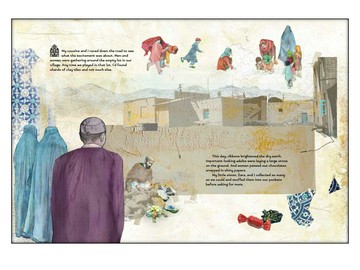
The pictures, however, are warm and detailed in the present, with Muktar’s memories being more hazy and muted.  There isn’t any mention of religion, but being the characters are Somali and their names being what they are you can assume they are Muslim. There is a short author’s note at the end that tells about the war causing the nomads to become orphans and the library service that works to share books.

FullSizeRender (38)

Razia’s Ray of Hope: One Girl’s dream of an Education by Elizabeth Suneby illustrated by Suana Verelst

Standard
Razia’s Ray of Hope: One Girl’s dream of an Education by Elizabeth Suneby illustrated by Suana Verelst

razia

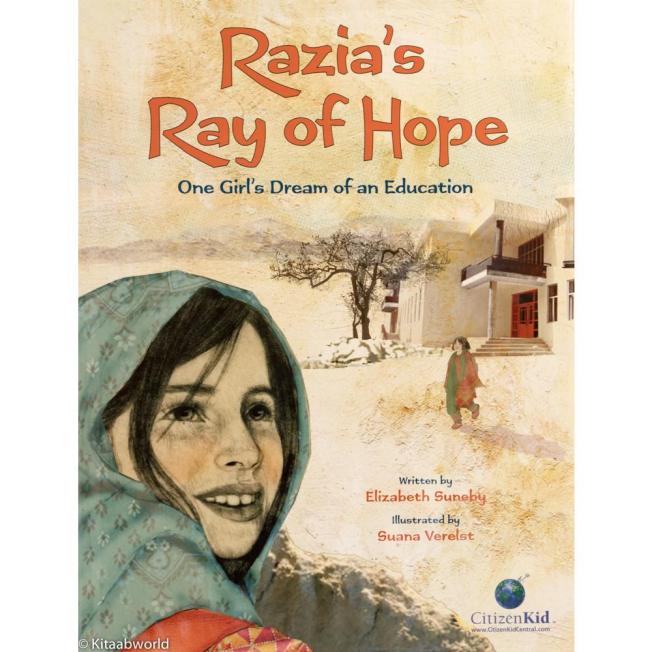
I usually love books about girls, and education and hope, but for some reason, I didn’t love this book.  I really like the pictures with their mixed media feel and textures, but I found small things annoying in the book, that based on other online reviews really put me in the tiny minority.  Most people seem to drool over this 32 page AR 4.1 picture book, I, however, think there are a lot of inspiring books about girls in Afghanistan dreaming of an education that one needs to do something different, and do it well to win me over.

So the basic premise, in this text heavy, tiny font, book, is that Razia learns they are building a new school close to her home in Afghanistan for girls, and wants to go.  Her grandfather also wants her to go, but one of her older brothers, Aziz, won’t allow it, so she isn’t allowed to go.  No historical lead up explaining why her grandfather talks about days when women were educated, and now it is a rarity.  No summation on the Taliban or the 17 years of war that the grandfather mentions.  So, unless the reader knows some background on Afghanistan, the story may not resonate with them or provide needed context for connection and appreciation.  Even the afterward, about the real founder of the school, offers very little context.  The brother’s decision is final until one day he falls ill and can’t read the medication directions, and Razia can, eventually he relents and she is allowed to go. The story hints that the rocks around the school are from the quarry he works at so he now feels confident she will be safe, and that his initial refusal was a concern for safety.  They hug and seem loving, and once school starts Razia has to learn as much as she can to be able to go home and teach Aziz and her mom.

razia1

I like that when she initially is told no, she doesn’t sit and assume a helpless manner, but rather goes to the school and meets the founder herself.  I find it odd, and irksome that the head of the school is also named Razia and it isn’t even noted. I get that is her real name, but why have the two main characters in a book have the same name and then not even acknowledge it? I didn’t get why the little girl couldn’t have a different name, seems distracting to me, and imply that every girl has the same name in Afghanistan.  I also didn’t get the hierarchy. The grandfather wants her to go, the father and uncles have legit concerns of where she is needed in helping the family farm and orchard, but why did the brother’s opinion trump them all? There is no mention of Islam, but they wear hijabs and burkas, so I think the stereotype is implied.  And that was another thing, they made it seem like she would be corrupted if she went out alone or without the burka on, but then Aziz shakes the headmistress’s hand, as if that isn’t against religious and custom norms. I felt that the kindness of the brother at the end was disjointed too, a bit too forced. The grandpa seemed kind, but the rest of the family seemed cold and rigid and not overtly concerned with Razia’s well being and growth.  Yes, they did have a jerga, to discuss and consider it, but I felt like Razia never had a voice, and while education is important, having a voice is too.  More has to change in society and in literature to give me real hope, and this book sadly fell short.

razia2

How Many Donkeys? An Arabic Counting Tale retold by Margaret Read MacDonald and Nadia Jameel Taibah illustrated by Carol Liddiment

Standard
How Many Donkeys? An Arabic Counting Tale retold by Margaret Read MacDonald and Nadia Jameel Taibah illustrated by Carol Liddiment

how many donkeys

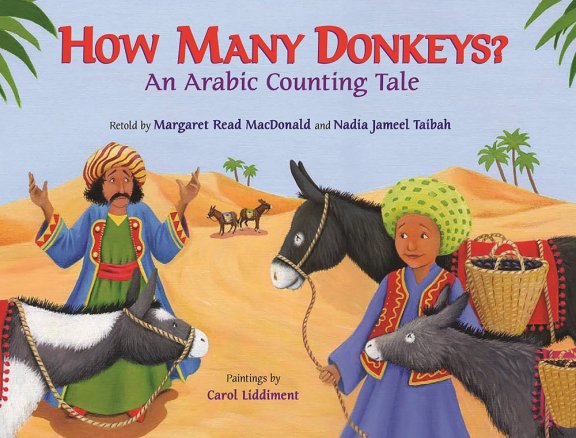
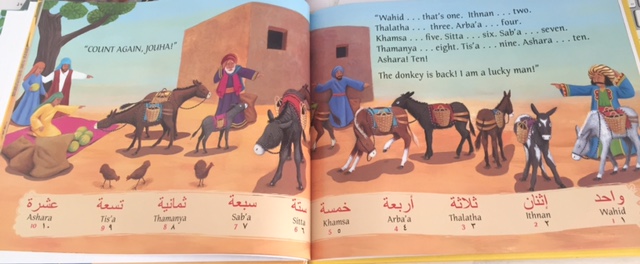
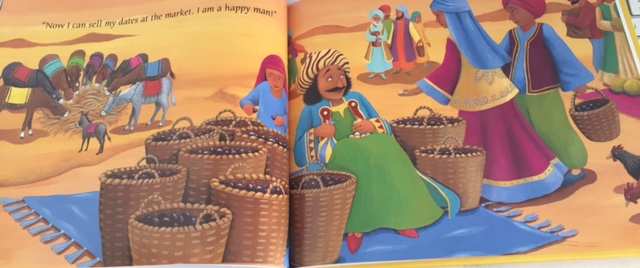
Whether you know a little bit of Arabic or none at all, this incredibly repetitive counting book will have you able to count to ten in Arabic by the end of its 32 pages.  FullSizeRender (35)Even if you know how already, your little one will enjoy figuring out why the main character Jouha can’t figure out how many camels he has in his caravan.  While Jouha thinks, it has to do with whether one runs off while he is riding, and comes back when he is walking, hopefully by the second or third time, most kids will realize that he isn’t lucky or unlucky, he is just forgetting to count the one he is riding atop of.  Probably good for ages 3-7, the book is silly in its repetition, and the beautiful painted illustrations bring the characters emotions to life.
FullSizeRender (37)

There isn’t anything Islamic, but it is definitely cultural as it retells an Middle Eastern folk tale.  The character, a wise fool, is also seen as Goha in Egypt and similar to Nasredeen Hodja in Turkey, all this background is stared at the beginning of the book.  There is also information to hear the story online in a read along program http://www.av2books.com, or to hear the author say the arabic numbers at http://www.margaretreadmacdonald,com.

FullSizeRender (36)

The Wooden Sword by Ann Redisch Stampler illustrated by Carol Liddiment

Standard
The Wooden Sword by Ann Redisch Stampler illustrated by Carol Liddiment

wooden sword

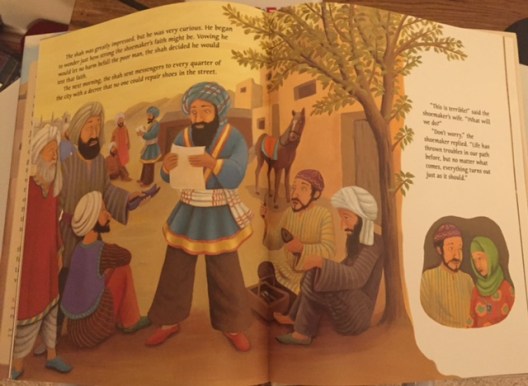
A Muslim Afghani Shah tests a poor Jewish man in this “softened” Jewish folktale.  I say softened because the author’s note at the end implies that she is retelling a well-known story in the Jewish tradition that often features mean-spirited characters.  In this version, however, the interaction between the rich Shah and the poor man, the Muslim and the Jew, are framed in contrast to show mutual respect, similar values, and the trust one has in God.  

sword3

This 32 page, AR 4.6 picture book, is beautifully illustrated and would work fabulous in interfaith settings, as well as in any lesson teaching how we should trust God in all things.  For children not of Islamic, or Jewish, or Afghani backgrounds, there is very little preaching and would still work very well as a moral narrative or even as a culture lesson, as it is a folktale.  From a current events standpoint, it would also do well with older children, as it shows that Muslim and Jews co-existed quite nicely once upon a time in Afghanistan as well.  

sword

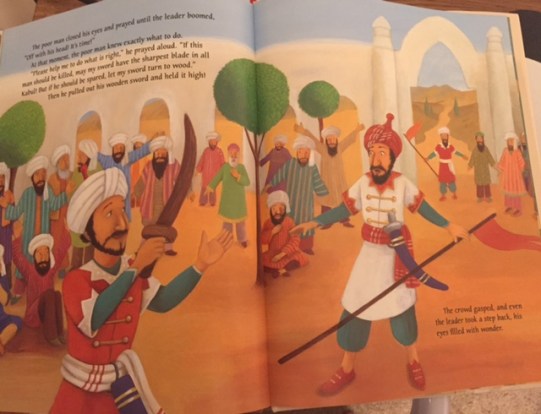
The plot is warm, although the Shah is clearly abusing his power as he meets a poor shoemaker and passes royal decree after royal decree to test the man’s faith that “everything turns out just as it should” and that God will provide.  The Shah decrees no one can repair shoes in the street, followed by banning the selling of water in the streets, and so on, until finally the poor man finds him self in the Shah’s Royal Guard without a sword, ordered to kill someone.  Not wanting to spoil how he handled the prediciment, I’ll suffice to say, in the end the poor man is made the shah’s advisor and presumably all is well. 

sword1

Throughout the tests, we also meet the poor man’s wife, who is supportive and very hospitable as they feed the Shah dressed as a peasant and offer him what little they have.  Her clothing is incredibly similar to what Muslims in Afghanistan wear, and makes me want to research this aspect for accuracy and to satisfy my own curiosity.    

Overall, a sweet interfaith folktale that I hope to share at our next interfaith storytime.

Twenty-Two Cents: Muhammad Yunus and the Village Bank by Paula Yoo illustrated by Jamel Akib

Standard
Twenty-Two Cents: Muhammad Yunus and the Village Bank by Paula Yoo illustrated by Jamel Akib

22CentsCover

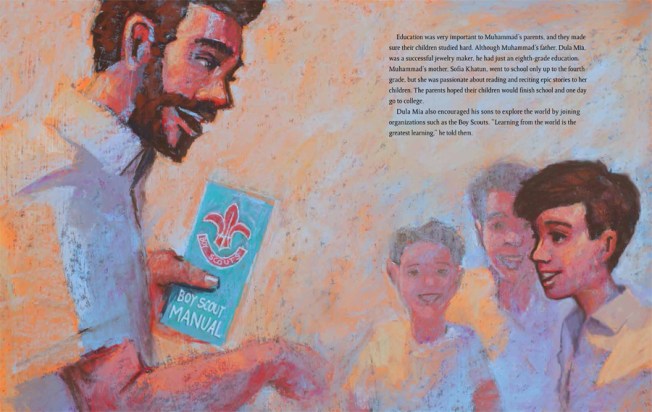
This 40 page biography written on an AR 6.5 level, tells the story of Nobel Prize winner Muhammad Yunus and his microcredit banking initiative.  The book topic is inspiring and for the most part the author does a good job of bringing it down to a middle school level. You can tell the author tries to flesh out Muhammad Yunus by starting the book with him as a boy, and relaying how he was raised and how his parents and boy scouts shaped him.  Despite her efforts however, at times it reads more like a resume, not a children’s picture book.

22_cents_3

Other than his accomplishments, and work history, I didn’t learn anything about him that made him relatable as a person, nor did I learn much about Bangladesh, or Islam.  And yes, I know it is a biography, but it felt like it was a void that needed filling.   I did learn about the program he started, a few of the obstacles that had to be overcome and I particularly liked that those receiving the microloans also had to learn about money, finance, and banking to pass a test before getting approved  And that 94% of those receiving the help have been women.  Grameen Bank is now a global bank, and the help he has given to so many is truly inspiring and something our youth should understand through humanitarian, economic, and compassionate lenses.

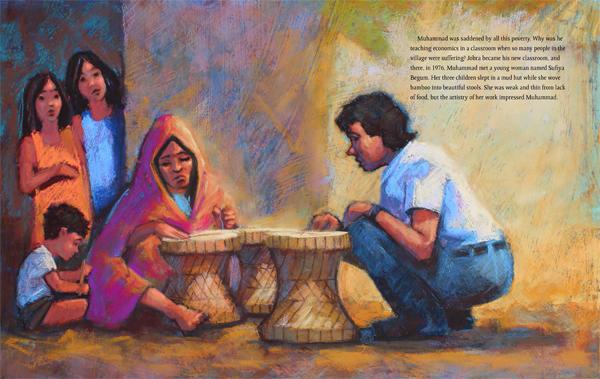
The title comes from the incident that brought Muhammad Yunus’ desire to help to fruition. He saw a woman weaving a beautiful basket, and learned that she could not afford the supplies to weave the basket, to sell in the market and as a result needed a loan.  Banks would not loan the equivilant of 22 cents because it was too small, and money lenders would charge so much interest, that after the basket sold, and the money lender repaid, there was scarce enough funds to purchase enough food for the family, let alone enough to buy new supplies, and thus the cycle was unbreakable.  He wanted to make her and those like her independent, not needing charity or the kindness of others to get her ahead, and thus the seven day course, test, and microcredit system evolved.

22 inside

The illustrations I think are both rich and well done.  The effect of the watercolors flesh out the text heavy pages with detail, but don’t create a distraction from the concepts and accomplishments being presented.  Following the story is a two page afterward telling additional awards and continuing the story of Muhammad Yunus with two real life photographs.


It Must Have Been You! by Zanib Mian illustrated by Fatima Mian

Standard
It Must Have Been You! by Zanib Mian illustrated by Fatima Mian

it must have been you.jpg

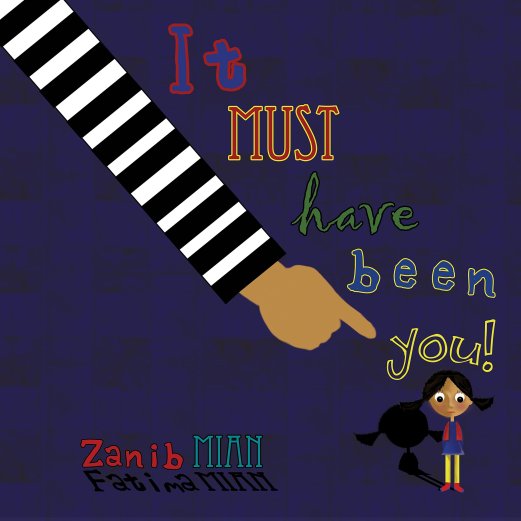
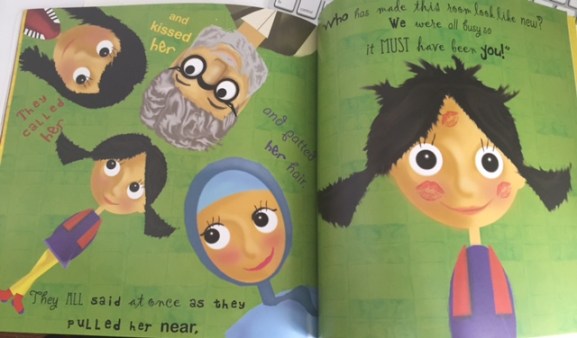
This rhyming 32 page book follows around a small girl, “about the same age as you,” who seems to make a mess every where she goes.  She never lies or even responds to the accusations of her unintentional messes, as she gets caught each time by someone in her family who points their finger and identifies the clues that led them to their answer. Luckily, she uses this pattern to her advantage as she cleans up and makes her family a card resulting in hugs, kisses, and love.

FullSizeRender (34)

Written for younger kids (4-6), the book is bright and colorful and very well done.  Even two and three year olds will enjoy the sing-song rhythm and chunky engaging illustrations.  The pages are thick and the binding solid, especially for a soft back book.  The 10 x 10 square size works well for story time and bedtime alike.  However, because the text is incorporated into the illustrations, if you are reading to a group, you will want to read it a few times before you present.  Looking at it straight on, the word order is much more clear and if you are reading it with emerging readers, I would recommend pointing to the words as you read, so as to help guide your listeners.  The fonts get a little crazy, which is part of the fun, but again may require some assistance to help the younger readers decipher the words.  Older independent readers (up to age 7 perhaps) might like the slight challenge of figuring out what word comes next, so that the story makes sense.

FullSizeRender (33)

The mom wears hijab and that is the only islamic reference or overt implication.  A fun book that thus far with multiple readings has yet to get monotonous and boring, yay!

FullSizeRender (32)

The Silly Chicken by Idries Shah illustrated by Jeff Jackson

Standard

silly-chicken.jpg

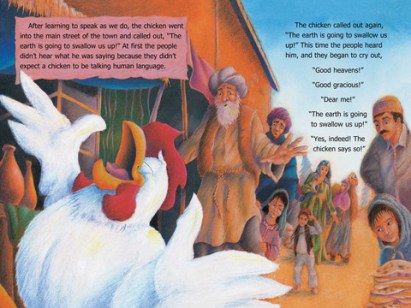
This story reads wonderfully aloud as it is silly, repetitive, and the message is more clear than in some of Idries Shah’s other Sufi inspired teaching books.  Written on an AR 4.0 level with 32 pages.  Some pages are heavily text laden while others just sprinkle a few words across a beautifully illustrated page.  Like his other books, the illustrations are truly spot on.  The lively faces on the characters, and colorful scenes bring the story to life and keep the audience engaged and giggling.

chicken

A man decides to learn how to speak “chicken,” when that doesn’t work, he teaches the chicken to speak our kind of language.  Fluent and conversational, the chicken then tells the villagers that, “The earth is going to swallow us up!”.  Everyone runs in all directions, up the mountain, down the mountain, across the meadow, around the world, but they can never get away from the earth.  When they return, they are upset with the chicken and ask how he knows that the earth is going to swallow them up, to which he replies that he doesn’t.  After they recap all the trouble he has put them through he poignantly laughs at them and asks, ” You think a chicken knows something just because he can talk?” Realizing how foolish they have been the chicken begins telling more outlandish things, just to make the people laugh, and isn’t taken seriously again.

silly chicken1

The message is clear, the characters funny, and the illustrations engaging. I finally found an Idries Shah book that I like! Yay, I guess for me they are hit or miss, and this one was definitely a hit!

chick

The Color of Home by Mary Hoffman illustrated by Karin Littlewood

Standard
The Color of Home by Mary Hoffman illustrated by Karin Littlewood

color of home

This powerful book about Hassan’s first day at school is a bit graphic, and incredibly important.  While it is a picture book, it is definitely not meant for small children.  The rich water color illustrations and the impactful text match the AR level 3.6 and would really appeal to thoughtful 2nd through 4th grade students.

A refugee from Somalia, Hassan finds it “tiring remembering even a few English words.”  He misses the color of Somalia, his cat, the warmth of the sun, and the freedom of learning out doors.  He doesn’t miss the violence though.

colour3(1)

When it is time to paint, Hassan paints his home and his family, all 9 of them, and his pets, in bright happy hews, much to the delight of his teacher.  But then, Hassan, engulfs his house with the red paint of flames, smudges out his Uncle Ahmed when the black bullets that take him down, and Hassan communicates his sadness to his teacher.

Hassan doesn’t take his picture home, he knows it will upset his mom and little sister, Naima.  The next day, a translator comes to help Hassan.  Fela is Somali and wears a black hijab, like Hassan’s mom, but western clothes, a new concept to the young boy.

color

Through Fela, Hassan opens up to his teacher and explains what it was like when the soldiers came and he had to hide under the bed.  How they had to leave without any of their stuff, including his beloved pet cat Musa.  All they could take was his father’s prayer rug and the Quran, as they set off on foot in the night.  He tells about leaving his grandparents and cousins behind and being scared on the plane.

Being able to share his fears, seems to help as he paints a new picture to share with his mom.  This one filled with his animals, and not with fire and bullets.  There is hope for Hassan as he looks forward to adding color to his new life and reminds himself to learn the english word for “home.”

colour2(1)

The book  is great for seeing the experience through Hassan’s eyes, and taking the reader through some of his adult like fears, and childish stresses.  Older kids should appreciate that what he has lived through is horrific, but his understanding as a child is slightly limited.  It should increase empathy, compassion, and kindness.

While the illustrations are rich and detailed they are very realistic.  This adds to the somberness of the book, and keeps this work of fiction a very real reminder of the world and what trials so many go through.

The characters are visibly Muslim, but there is no mention of religious doctrine, and readers may not know what a prayer rug is or a Quran.  They will be able to use context clues to figure out hijab, but there is not a glossary in the back.