Category Archives: Picture book

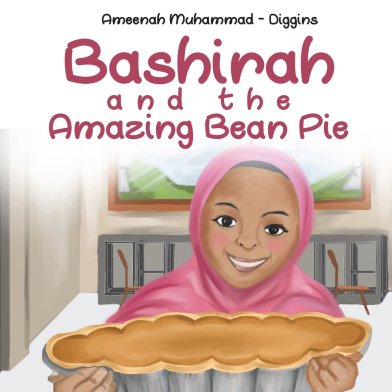
Bashirah and the Amazing Bean Pie by Ameenah Muhammad-Diggins illustrated by Amir Doumy

Standard
Bashirah and the Amazing Bean Pie by Ameenah Muhammad-Diggins illustrated by Amir Doumy

bashirah

Oh, how glorious to learn something new while having things you know presented so well at the same time.  In 42 pages the reader will feel all the excitement of Eid (it doesn’t specify which one, nor does it really matter), sharing your culture with your classmates, participating in a family tradition, cooking with your grandfather, sharing with neighbors, and learning some life lessons about diversity from the Quran.  Ages 5 and up will enjoy the story and seeing Eid being celebrated, and older kids that know about Eid will love learning about bean pies and appreciate the African American Muslim culture, if they don’t already know about it, and those that do will hopefully feel proud to see it represented.  The best part is that there is a recipe at the end, that I can’t wait to try.

IMG_3237

It is the end of the school day and the teacher is reminding the students that Monday is Culture Day and they need to bring a dish to share, over the weekend it is also Eid.  Bashirah is excited that this is the first year she will get to make her own bean Pie with her Pop-pop who is going to teach her the family recipe.
IMG_3238

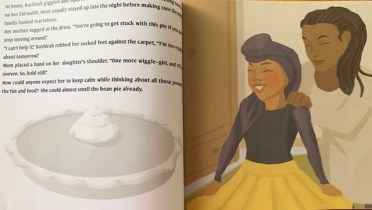
At home Bashirah can’t stay still as her mom puts on the finishing touches of her Eid outfit, she is so excited for all the fun about to happen.

IMG_3239

Early the next morning the family all heads out to the Masjid for Eid Salat in their beautiful clothes.

IMG_3240

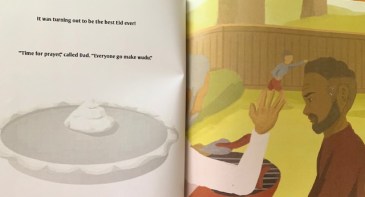
After prayers its cooking and eating time as Bashirah and Pop-pop make the pies and enjoy a big meal as a family.  Three generations make salat together, food is taken to the neighbors, and then the big reveal.  All the desserts, including Bashirah’s are served, and alhumdulillah it is delicious!
IMG_3241

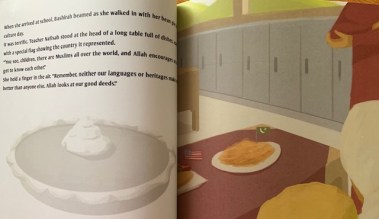
Back at school on Monday the teacher reminds them all that, “neither our languages or heritages make us better than anyone else.  Allah looks at our good deeds.” She quotes Surah Hujurat, ayat 13 “Oh, mankind indeed we have made you into nations and tribes, that you may know one another.  Indeed the noblest of you in the sight of Allah (swt) is the best in conduct.” And they all dive in to the delicious desserts including Bashirah’s wonderful pie.
IMG_3243

My only criticisms of the book are the margins and the amount of text on the pages.  I have a hard time reading the book aloud to small groups as the margins are so small and run in to the binding.  Also, some pages have one sentence on them, some have nearly a half a page of text.  This disparity can be off putting at the start of the book to appeal to younger listeners and early readers.

IMG_3244

The illustrations are warm watercolor complimentary pictures.  There is nothing wrong with them, but I wish they were just a tad more defined and vibrant like the picture on the cover.  I love the warmth they radiate, but a little more detail would give the listeners something more to look at on the text heavy pages.

IMG_3242

All in all a great book that I am glad I own and can share with my own children and those in my community, now if I can convince someone to make me a bean pie I’ll really be set, alhumdulillah!
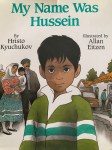
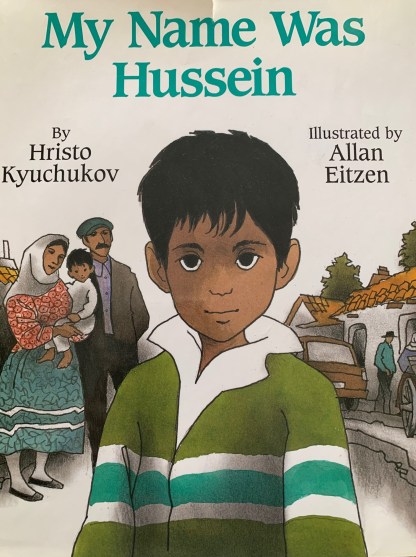
 

My Name was Hussein by Hristo Kyuchukov illustrated by Allan Eitzen

Standard
My Name was Hussein by Hristo Kyuchukov illustrated by Allan Eitzen

IMG_3215

It isn’t often that a 32 page AR 2.4 picture book will haunt you after you read the last page.  Especially a book with short simple sentences, that is poorly organized and reads like two separate nearly disjointed stories, but alas this book has stayed with me for months and upon rereading it to write this review, the images and empathy and reflections stirred have not lessened.  This is an important book to read, to think about, and to return to sporadically as your children and their understanding of the larger world grows and evolves.

IMG_3217

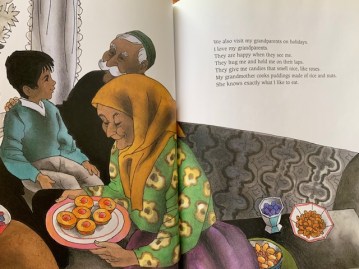
Hussein is a Roma, or a gypsy living in a small village in Bulgaria.  Their ancestors migrated many years ago from India and they are Muslim.  Hussein and his family love Ramadan and the delicious smells of food and warmth of grandparents and family all year round, but particularly during the blessed month.  

IMG_3218

Eid is the best, with family and fun and new clothes.  Hussein loves his life and his name.  It was his grandfather’s name and his grandfather’s grandfather’s name.  But then one day all that changes.

IMG_3219

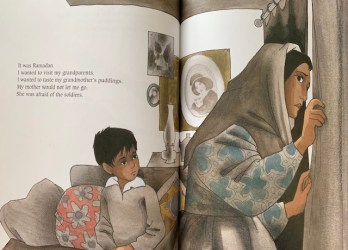
Tanks and soldiers with guns come to their village and close that mosque and tear up their identity cards and tell all the minorities that they must choose Christian names and give up their culture and identities.

IMG_3220

Hussein and his family do not want to give up Islam and their names and their traditions, but they don’t know what to do.  Feeling like they have no choice they change their names and Hussein asks the reader at the end if you would call him Hussein or Harry?  

IMG_3221

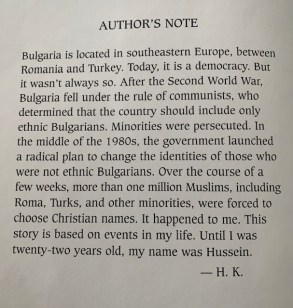
The last page of the book is an author’s note, and tells that this is based on his own life story.  That in the 1980s Bulgarian minorities were forced to change their identities.  That more than one million Muslims, including Roma, Turks and other minorities were forced to choose Christian names and that until he was 22 years old, his name was Hussein.

The illustrations are illuminating to the images that the simple words discuss.  Truly they are a powerful and integral part of the story.  The women wear hijab and the use of color to set the tone is spot on.  The book is hardbound and the 8×10 size allow the pictures to be enjoyed fully.

IMG_3222

The book published in 2004, was not easy to find which is unfortunate as it really sheds light on a recent history not known in the US at all, and one that should be known and remembered.  The first part of the book reads like a Ramadan story detailing iftaar and Eid and how Ramadan is celebrated by this culture, but the second half goes back to Ramadan and how it is different with the soldiers and the pressure to give up who they are.  There aren’t a lot of details about who the soldiers are or why they have come or what they are going to do to the Romas, but the fact that in recent history and this was what people were faced with, should be a powerful reminder to us all at how fragile this world is and make us appreciate that we aren’t forced to make such a decision.


Mustafa and Arwa go on a Ramadan Adventure by Mekram Mohammad

Standard
Mustafa and Arwa go on a Ramadan Adventure by Mekram Mohammad

IMG_3184

Ramadan is two months away and this little book is a great way to introduce and stir up excitement for little Muslim toddlers and preschoolers. It could work for non Muslims, but the general overview given would need some details and explanations, and this book seems more geared to introduce excitement and a few key concepts for the blessed month.

IMG_3190

In 27 rhyming pages the brother sister duo explore some of the feelings of the month, activities that make the month special and what to expect at suhur, iftar, and taraweeh at night.  

IMG_3185

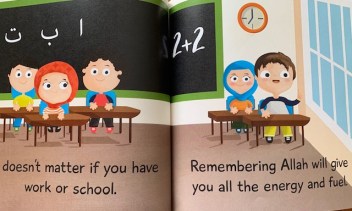
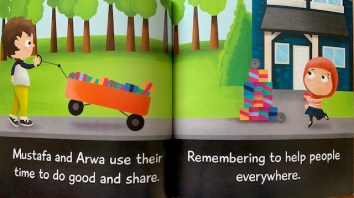
I like that it makes it clear that you don’t eat one bite, that you fast even if you are at work or school, that you use your time to do good and help people, and that you ask Allah for paradise.  

IMG_3188

The end is Eid and while the text presents some great general info, the illustrations are what really give the minimal clear text life.  Seeing the kids giving presents to people and looking for the moon and enjoying iftar together with smiling faces, show kids the warmth of Ramadan.  

IMG_3186

The book doesn’t have a story, it just talks about Ramadan, but the tone in this book and in Mustafa and Arwa go on a Prayer Adventure is very fun and light.  It doesn’t get into rules or articulate what little kids are expected or required to do, or even why Muslims do it, it just gives them some knowledge and some emotion to create the feeling of it being a grand adventure.

IMG_3189

The book is paperback 8.5 x 8.5 and the thickness, sheen and quality of the pages makes it durable and enjoyable to read at story time (in small groups) and bedtime alike.  This book most likely will be on repeat in the weeks leading up to Ramadan and then referenced throughout the month to remind children about what they are seeing and experiencing.  

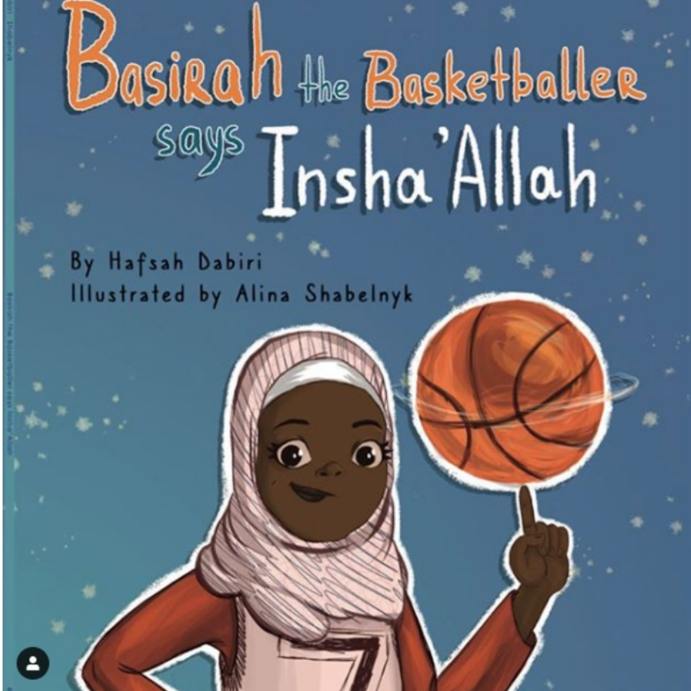
Basirah the Basketballer says Insha’Allah by Hafsah Dabiri illustrated by Alina Shabelnyk

Standard
Basirah the Basketballer says Insha’Allah by Hafsah Dabiri illustrated by Alina Shabelnyk

basket.jpg

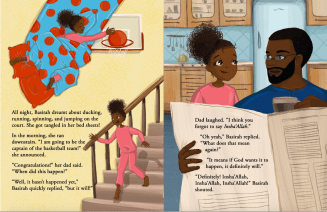
Another sports book starring a smart girl with a supportive father, seems like a trend, and I like it.  The book is relatable to ages 5 and up whether they play basketball or not, and will remind even slightly older children how “insha’Allah” really works.  It features a girl, but boys will gain a lot from the book as the lessons are for us all.

basirah1

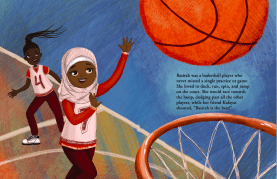
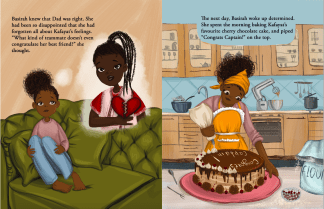
Basirah loves basketball and with supportive teammates and mad skills, she should be a shoo-in for team captain.  But when her dad reminds her that if it hasn’t happened yet she needs to say insha’Allah, she realizes the power of leaving things to God.  

Testing out her new knowledge of asking God to make happen things she really, really wants, over many of the 30 pages in the story, makes the climax that much stronger and her dad’s wisdom that much more memorable. I’m trying not to spoil the story, even though it is a children’s picture book, it isn’t without a bit of tension and resolution that really makes the book shine.

basirah2

This book can be taken at face value with a little bit of a lesson for little ones, or a lot deeper for more reflective readers.  Understanding that things we ask God for often come or don’t come to test us, is a lesson we all need. I hope if read with an adult, the adult will also push the listener to consider why we should do things in the first place, what are intentions are, as Basirah leaves the door open for that discussion at the end, but doesn’t quite articulate it for independent readers.

basirah3

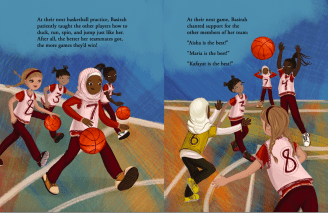
I love that at home Basirah is not covered, but is when she is out.  I love that her school is diverse with students of different colors and head coverings and that her coach is female and a muhajaba as well.  I love that Basirah and her father seem incredibly close, and that she listens to him, and he to her, before lessons are espoused and course of action plotted.  The book is not preachy, but lessons are there and the reader will get “it” right along with Basirah allowing her strength to radiate off the page and inshaAllah empower the reader as well.

basirah4

I find it interesting that the book doesn’t mention Allah and uses the word God, given that the phrase the book focuses around is insha’Allah.  I would imagine the intended audience is Muslim, but there is not specific mention of Islam.  It would work for non Muslims, but I think they would wonder why she says such a phrase and where it comes from.

basirah5

Basirah is presumably in middle school, as she has multiple classes and can bake a cake independently, her age seems a bit fluid, but many 11-14 year olds do tend to be independent in some areas and rather clueless in others, so while I did notice that she seems very naive in knowing what insha’Allah means and how it works in some parts of the story and very mature, and hijab wearing, and willing to grow from her situation in others, I’ve concluded it is plausible.

The book is 8.5 x 11 vertical, well bound, shiny glossy full color pages with clear and easily readable font.  The sentence length and amount of text on the page is not too overwhelming and the spacing keeps it inviting for new fluent readers.  

I love that Ruqaya’s Bookshelf (https://ruqayasbookshelf.com/) has new books out, three to be exact.  Whether the stories work or don’t work for you, I think their presentation and quality, give the books a longevity and find themselves being pulled out for different kids, at different times, when different lessons are needed.  They are well packaged in terms of illustrations and colors and size for the most part, and when I hear they are publishing new stories, I find myself ordering them without even reading the content synopsis.  Thank you for helping get these stories out, may Allah swt reward you!


Mansa Musa: The Lion of Mali by Kephra Burns illustrated by Leo & Dianne Dillon

Standard
Mansa Musa: The Lion of Mali by Kephra Burns illustrated by Leo & Dianne Dillon

mansa8

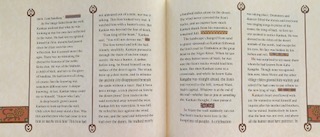
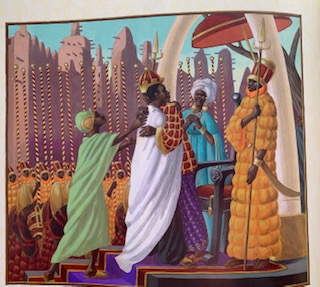
This beautiful work of historical fiction/folklore is both moving and visually breathtaking.  The 56 page book presents as a picture book, but with an AR 6.4 and the amount of text, it reads like a chapter book.  Thus, I’m going to review it as a chapter book, but keep in mind that it is hard bound, 11 x 9, horizontal and while there are frequent small story breaks, there are no chapter breaks.  

IMG_3078

SYNOPSIS:

There is little historical fact about Mansa Musa as a child, thus this story while rooted in fact about the time, about Mansa Musa as an adult, and about what is known regarding Mali and the Malinke and Tuareg tribes, is a work of imagined fiction.  The story begins with premonitions and dreams from Kankan Musa of the Kaba Kangaba tribe.  Kankan and his two brothers live with their mother, and do not know who their father was, a source of stress and teasing for the young boys.  Having just turned 14, Kankan is treated as an adult, but because he has yet proved himself as a hunter, he may sit with the adults, but not yet join their conversations.  Mali in the years after the great King Sundiata had passed away has begun to fade, but their wealth and hospitality still prospers in the desert. 

One day a desert nomad from the Tuareg tribe dressed in flowing blue robes appears and is welcomed by the village elders.  That night he regales stories about jinns, and the sea, and time spent in the desert, and fears he has for their King, when slave raiders tear through the night and kidnap Kankan.  When Kankan awakens days later, enslaved, the same mysterious man, Tariq al-Aya, again appears and buys him from the raiders.  Tariq vows to accompany Musa on his journey to learn who he is and the two spend seven years together learning about the desert, about the larger world, about themselves, in trial and test and challenges.

When Musa journeys back to his home, and Tariq disappears as mysteriously as he appeared, Musa must make himself known to the new Mansa of Mali and see if his wisdom and knowledge can ensure the success of Mali in the future.

IMG_3079

WHY I LIKE IT:

I’m not from Africa and my heart was cheering Musa on as if, my own families success was rooted in his growth and understanding of the world.  As a Muslim, I was proud to know of the success Mali found in Mansa Musa and the historical significance of his rule throughout time.   I wish there was more Islam in the book, his Hajj is well documented and thus tidbits of Mecca and his understanding of it is sprinkled through the story.  There is no talk about prayer or what Islam is, just that he is Muslim and that most of the villagers “had converted to Islam, but at the same time, they had not given up their traditional religious practices or their belief in the ancestors.”  It mentions at the end that he built mosques wherever he went, but prior to this it never mentions him spending any time in a mosque or worshiping in any way. 

I love that the story is told like all great stories, it makes you want to settle in and drink up the details and imagery and got lost in the pictures.  The author weaves in cultural phrases and descriptions, that hopefully readers can unravel from the context as there is not a glossary.  There is a map at the beginning, and author’s note at the end that reveals what is fact and what is fiction in the story.

IMG_3080

FLAGS:

None

IMG_3081

TOOLS FOR LEADING THE DISCUSSION:

This book should be in every school library and used in classrooms to learn about West Africa, cultures, 14th Century, Islamic history, culture, you name it.  I think this book would work wonderfully in home school environments, where the child could dictate how much to supplement, how much to cover, and the wisdom shared could really be understood.  This isn’t a book that most kids would pick up and read, they would need prodding and guidance, but be better for it.  

IMG_3082

Purity & Prayer: A Rhyming Picture Book of Sacred Rulings by Ameena Bint Abdir Rahman illustrated by Reyhana Ismail

Standard

IMG_2921

This book is definitely non fiction, and I’m reviewing it because I figure some of you like me, have looked at it online and wondered how it can do everything it claims.  The book is 50 pages, fully illustrated (with faces), meant for children before the age of accountability, written in rhyme about fiqh (wudu and salah) according to the Hanafi madhab, and everything is scholar supervised and checked.  I’ve read it a few times now, and yeah, it does all it claims to, and is a great tool and resource, and book to have around for kids of all ages, plus I think they’ll really enjoy it.

IMG_2922

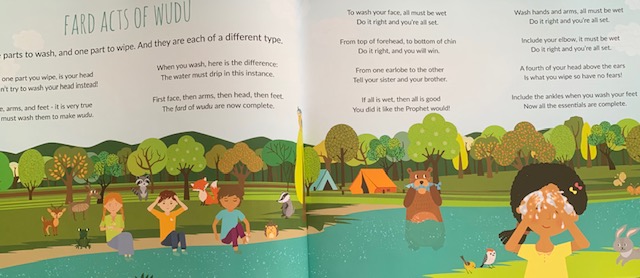
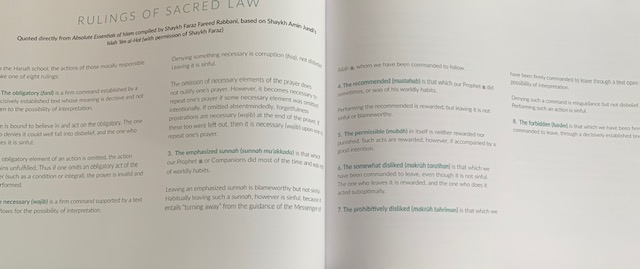
The book has a lot of information and disclaimers about how the author wrote the book and verified the information, there is a dua, preface, and Author’s Note at the beginning, and Rulings of Sacred Law by Shaykh Faraz Fareed Rabbani, an Appendix, References, Glossary of Arabic Terms, messages from the Fiqh Teachers, Author, and Illustrator at the end.

IMG_2925

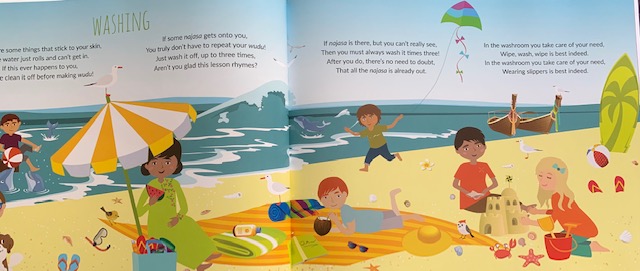
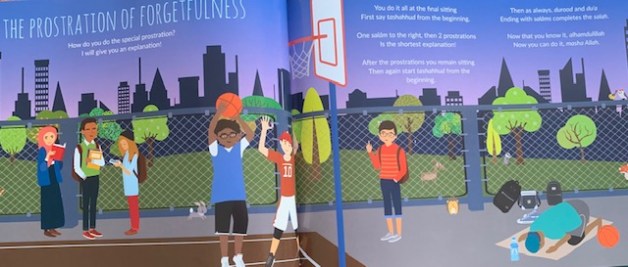
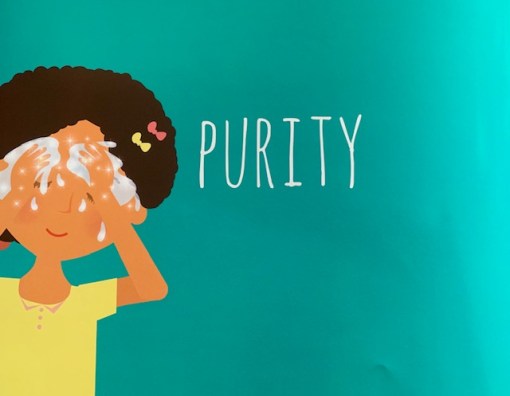
The 8.5 x 11 hard bound horizontal glossy book is divided into sections.  The first section is Du’a and Salah, followed by Purity which covers things like fard parts of wudu, what breaks wudu, etc..  The next section is Prayer and covers the fard conditions and integrals within prayer, wajib things you say, how you recite, postures, what breaks your salah, and incorporated in to the sections are what would need to be redone to make your salah valid.

IMG_2923

Each subheading is a two page spread with a title and either rhyming couplets or quatrains to convey the information.  While naturally at some parts the rhyme is incredibly forced, but because I found myself learning things, I wasn’t as bothered by it as I thought I would.  The repetition sometimes got jarring, but again, because the complex facts are being brought down to a child’s level ,and yet isn’t belittling, I’m willing to overlook a lot. 

I like that it isn’t just facts, the Appendix is there for that, but also similes and metaphors that will help put the concept in perspective.  Du’as can be made at any time like making a call to Allah.  Prayer is like visiting a friend, you have to go at the time you were invited, dressed nicely, wear appropriate clothing.  

IMG_2924

The breakdown of when you have to repeat the whole salah, or do a special prostration is incredibly helpful.  As is knowing what laughter breaks wudu and what breaks wudu and salah.  It is so great that children will see how detailed our religion is, and how everything has an explanation.  Yes, you shouldn’t laugh while praying, but clearly it happens, so when it does this is what you do.  The approach makes the book grow with children as their knowledge and awareness increases.

IMG_2926

I hope to read a two page spread each night with my kids, and have them discuss.  My kids range in age from 3-12 and while my 3 year old won’t add a lot, he will be entertained by the rhyme, fascinated by the pictures, and be included in the early introduction to fiqh.  InshaAllah the older kids will learn or review something and know how to find such knowledge if they have questions in the future.

IMG_2927

Undoubtedly, such a book, was a huge undertaking, may Allah swt reward all those involved, I was pleasantly surprised and greatly impressed at how the book reads, presents the information, and still connects to younger children, mashaAllah.


The Jiu-Jitsu Ponytail by Mir Khalid Ali illustrated by Taahira Halim

Standard
The Jiu-Jitsu Ponytail by Mir Khalid Ali illustrated by Taahira Halim

IMG_2909

A determined girl battles her ponytail, her own self-doubt and her opponents on the jiu-jitsu mat in 38 beautifully illustrated pictures and clear every day language.  Perfect for little girls and their dads ages five and up.

IMG_2910

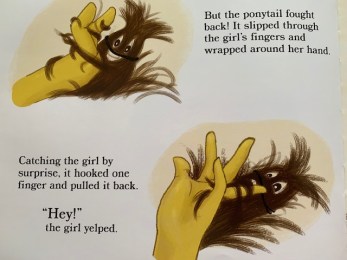
Noor has been counting down the days until her first jiu-jitsu tournament, but the morning of the tournament a battle first takes place between her and her unruly hair.  Determined to tame it on her own, even when her father offers her help, she steps on to the mat for her first fight.

IMG_2911

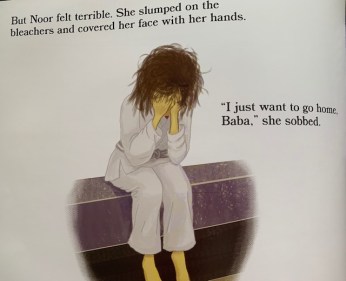
Squirming with nerves, her ponytail breaks free from the desperate tape used to keep it contained and covers Noor’s eyes forcing her to tap out and concede the match.

IMG_2912

Walking off the mat, Noor’s Baba hugs her and compliments her on her bravery.  Noor is having none of it and just wants to go home.  Rather than argue with her, Baba goes to talk to her coach giving Noor some space to battle her self-doubt on her own.

IMG_2913

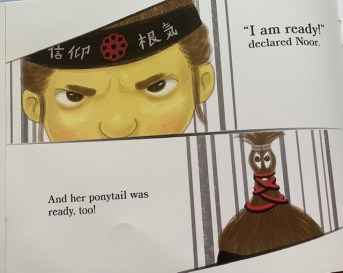
Deciding she has worked hard and trained hard, and been supported every step of her way she asks her baba to help her tie up her hair.  Together her and her jiu-jitsu ponytail take on the remaining opponents and persevere.  

IMG_2914

The book shows great heart in the supporting cast each of us have around us, in this case the father takes his cues from his daughter, never wavering in his support, but not forcing her to do anything either.  The little girl is determined, but also learns that it is ok to ask for help and above all to not give up on yourself.

IMG_2915

The personification of the ponytail adds a layer of humor to the story that works well for little kids that might just take the story on face value.  Even they will learn something about jiu-jitsu with the visual displays of the different moves and of martial arts tournaments in general.  Two of my children thought the ponytail hilarious, and two slightly creepy.  The subtlety of its personification allows its role of being a separate entity and just feeling like it has a mind of its own to be determined by the reader.

IMG_2916

There is nothing Islamic in the book, but the author and illustrator are Muslim, and the use of the little girls name, Noor Kareem, and her calling her father Baba will have a special appeal to Muslim children (plus her name written in Arabic on her bedroom wall), just as children who do jiu-jitsu will find themselves in the pages.  The book appeals to all children and reminds them they can overcome and inshaAllah be supported in the process.

IMG_2917

The illustrations in this 8 x 10 horizontal hardback book are beautiful and detailed.  They allow the reader to understand what is going on without the book being overly burdened with text.  The font is clear and well sized making the book ideal for both bedtime and story time, alhumdulillah.

IMG_2918

Under My Hijab by Hena Khan illustrated by Aaliya Jaleel

Standard
Under My Hijab by Hena Khan illustrated by Aaliya Jaleel

UNDER MY HIJAB final front cover JPEG.JPG

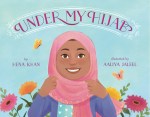
I know, (sigh) another hijab book, but I promise it is good and you won’t be sad you bought…”another hijab book,” and  alhumdulillah, it’s a Hena Khan book, so public libraries will have it or at least they should be willing to order it if requested.  

IMG_2878

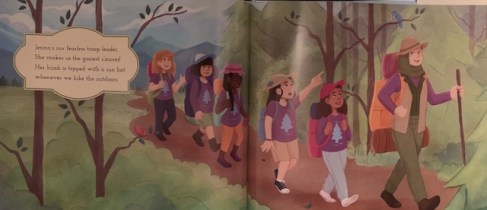
Written in rhyming four line stanzas the story is told from a young girl’s perspective about the women in her life.  The first two page spread shows the strong female as she interacts in the world and covers her self, with the following two page spread, showing her in her home, uncovered.

IMG_2879

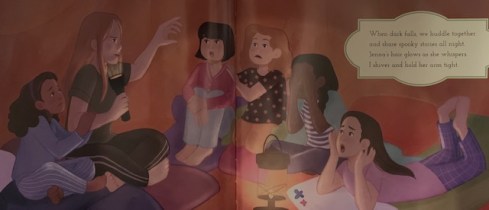
From Grandma, to Mama, to Auntie, to troop leader, to siblings and friends, the reader sees hijabs wrapped in styles as different as the person wearing them.  They also see Muslim women as doctors, artists, Tae Kwon Do students, bakers, leaders, and everything in between.

IMG_2880

The illustrations are beautiful and perfect.  They radiant warmth and familiarity, while adding details to make the pages hold your attention a few minutes longer and smile with the diversity presented. The martial art scene is spot on!

IMG_2876

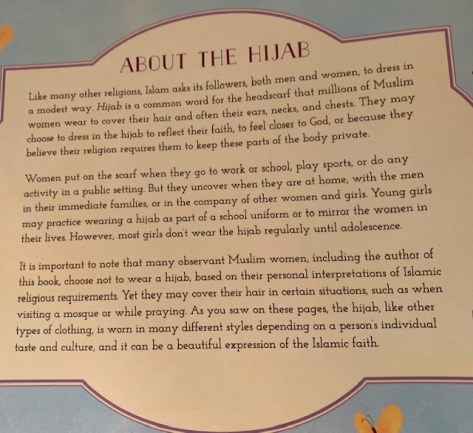
I wish they showed a niqabi, and maybe someone that doesn’t cover all the time, but at certain times of prayer or entering a mosque, like the author, who talks about herself and hijab in general in the afterward entitled: About the Hijab.  

IMG_2882

I love that the book is for children and I desperately hope adults will read it too.  It breaks down so many stereotypes, and answers so many questions in a seemingly effortless presentation.  How many times have all hijabis been asked if we sleep in our scarves or shower in them.  I love that there are shades of brown skin tones, and blond haired hijabi’s too.  

IMG_2877

And most importantly I love that it shows Muslim women to be strong and varied and to have full, independent beautiful colorful lives.  That hijab is a choice and it is strength and beauty and personal.

IMG_2881

The book does not talk about the reasons for wearing hijab, or get into the religion.  The book is a great size for story time and bedtime at 10 x 8 horizontal, hardbound, and 32 pages.  Ages four and up will enjoy this book repeatedly,  and older kids, especially girls considering covering or just starting to cover will enjoy it as well.

Alhumdulillah! Well done!
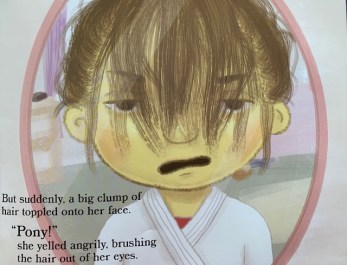
Forgive the glare in the pictures, they aren’t in the book 🙂

We’re off to make ‘Umrah by Sana Munshey illustrated by Eman Salem

Standard
We’re off to make ‘Umrah by Sana Munshey illustrated by Eman Salem

img_2719

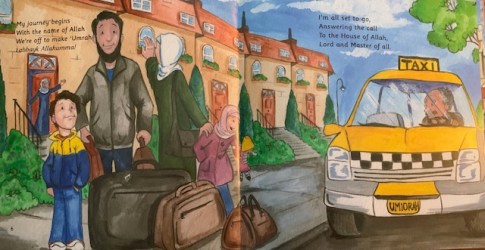
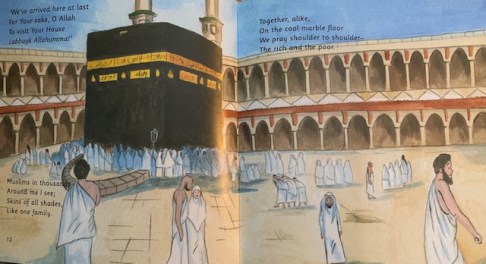
Its surprising how few books about Umrah there are for children.  As a religious act that many children are included in, there really should be more, but alhumdulillah this fun one exists, and conveys the steps of Umrah in rhyming fashion for ages 4 and up.

Told from a little boy’s perspective about his family’s journey, a little history is given, before the major parts of Umrah are explored.  The book prefaces the story with a note to parents and teachers making sure they know the book is a semi-fictional narrative meant to reinforce learning, it isn’t a comprehensive guide. 

img_2720

Full page pictures with four line stanza groups detail the steps about the journey and flight to Mecca, including defining and using the arabic words for the talbiyah, putting on ihram, crossing meeqat and praying rak’atayn.  The step-by-step approach is warm and exciting, as the pictures show smiling faces and the words balance information and enthusiasm of being in Mecca for the first time.

img_2721

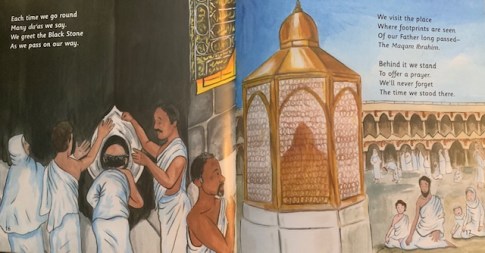
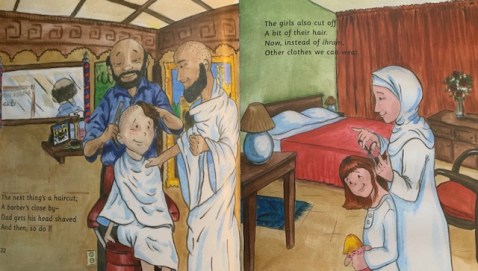
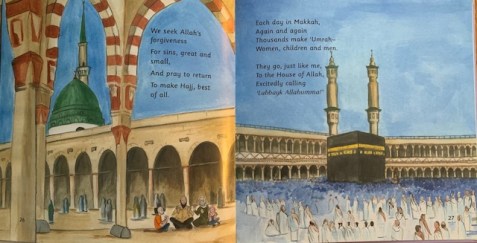
Details about praying, rich and poor, side by side are included, making tawaf, seeing the black stone, seeing Maqam Ibrahim, drinking Zamzam water, a bit of history about Sa’i, and the little boy feeling tired going back and forth between Safa and Marwa are all given in a well paced narrative that is neither rushed, nor overly forced (just a little to keep the rhyme scheme :)).  The steps of Umrah conclude with the family members getting hair cuts and then a quick trip to Madinah.

img_2722

There is a glossary at the end of the 32 page book, that is nice for older kids, or as a way to reinforce words used to describe the journey.  I think the strength of the book is really that it shows what to expect during Umrah.  Children about to go will benefit from the mapping of the events and getting a heads up on what awaits them.  Children that have gone will have a handy way to remember what they did.  Children learning about Hajj perhaps, will be able to see how Umrah is shorter and be able to see what the similarities and differences are in a simple manner.  Even children who have no connection yet to Umrah will benefit from the vocabulary and excitement shared in the story.  While the story is aimed at younger kids, even middle elementary age kids will enjoy reading it once or twice.

img_2723

The book claims to come with a poster and paper dolls to reinact the steps of Umrah, but I purchased my book second hand and they weren’t present.  Hence, I didn’t comment on their quality, but it sounds like a wonderful supplement to the book.

img_2724


Zara and Hakeem Learn ‘Alhumdulillah’ by Shabeena Rehman illustrated by Kevin Payne

Standard
Zara and Hakeem Learn ‘Alhumdulillah’ by Shabeena Rehman illustrated by Kevin Payne

IMG_2686.jpg

Board books from the UK! The glory of a well bound chunky book for toddlers to tote around, chew on and hopefully learn something from, with all the joy of international shipping.  I delayed buying these books for so long, because of it, and finally I gave in and just in the nick of time as I have started a weekly preschool story time, and this series is perfect for three and four year olds with limited attention spans and in need of repetition.

Zara and Hakeem, a brother and sister duo wake up to find their mother not feeling well, and instructions that they will have to help Daddy, Grandad and Grandma with the daily chores.  Then Mummy sneezes and says, Alhumdulillah.

img_2687

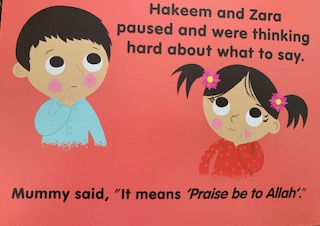
It seems the books  all have a pattern, something happens that sets the stage, then Hakeem and Zara pause and think hard about what to say, there is then an English translation/explanation about the meaning and then a universal, Muslims from all around the world say or do this, before the story resumes.

I don’t mind the break in the story, but the phrasing is a bit cumbersome and slightly off in this book.  Why are the kids thinking hard about what to say, when Mummy had just said it? If they were thinking hard about what she had said or where confused why she said it, I feel like it would make more sense. 

img_2688

I really like that the book shows that all Muslims say something the same, it is a good time to start to show this age bracket that they are connected to something bigger, without overwhelming them.  

The story continues with Hakeem helping daddy vacuum and Hakeem sneezing when some dust flies up.  Then Daddy and Zara mow the lawn when the grass makes Zara sneeze, everyone, Grandad, Grandma, all take a turn sneezing in different scenarios and everyone practicing to say Alhumdulillah.  

img_2690

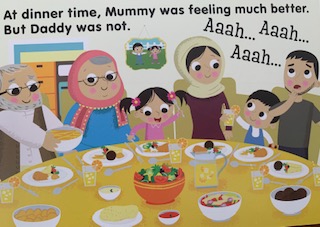
By dinner, Mummy is feeling better, but Daddy has a sneeze attack and takes to laying down as he is not feeling well, and tomorrow the kids will have to help Mummy with the chores.  A humorous full circle, that even toddlers will laugh at.

The kids I read the book to, loved the loud Atchoos and the cute illustrations, a few of the older four year olds, wanted to know why Yar Hamukumallah was not also said.  They also wanted to know why when the dad sneezed four times they only said Alhumdulillah three times.  I read a variety of books about being sick and we talked about using tissues and sneezing into our elbows, washing our hands, and not coming to school when we are sick.  The book was great to explore how mom was sick and dad must have caught her cold.  But that sneezing from pepper and cat hair, didn’t mean you were sick.  The kids also saw that everyone in the house has to help out, sick or not, old or young, male or female, which is always a great lesson to reinforce, Alhumdulillah.

img_2691

The book is 18 pages of text.  The illustrations show the mom and grandma in hijab, they are bright and colorful and engaging.  Children will enjoy getting carried away with the sneezes and the Alhumdulillahs when read aloud and will enjoy looking back at the pictures and details independently afterward.  This is a great story to put on repeat and then watch your own toddler retell the story on their own.

Overall, well worth the shipping! I hope US bookstores will stock the series as our little ones need books that are funny, clever, and well done.

img_2689