Category Archives: Muslim Illustrator

Zara’s New Eid Dress by Nafisah Abdul-Rahim

Standard
Zara’s New Eid Dress by Nafisah Abdul-Rahim

img_8802

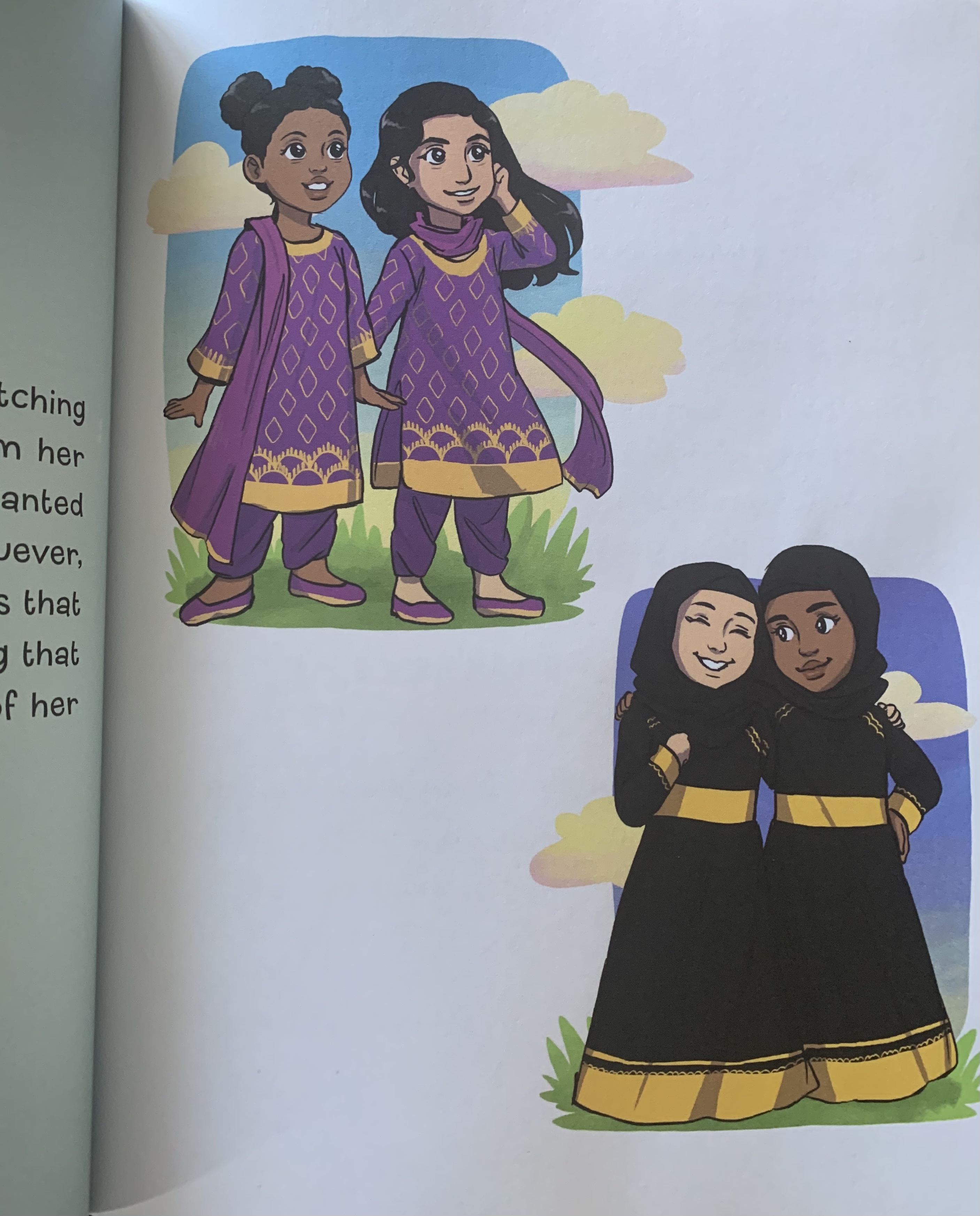
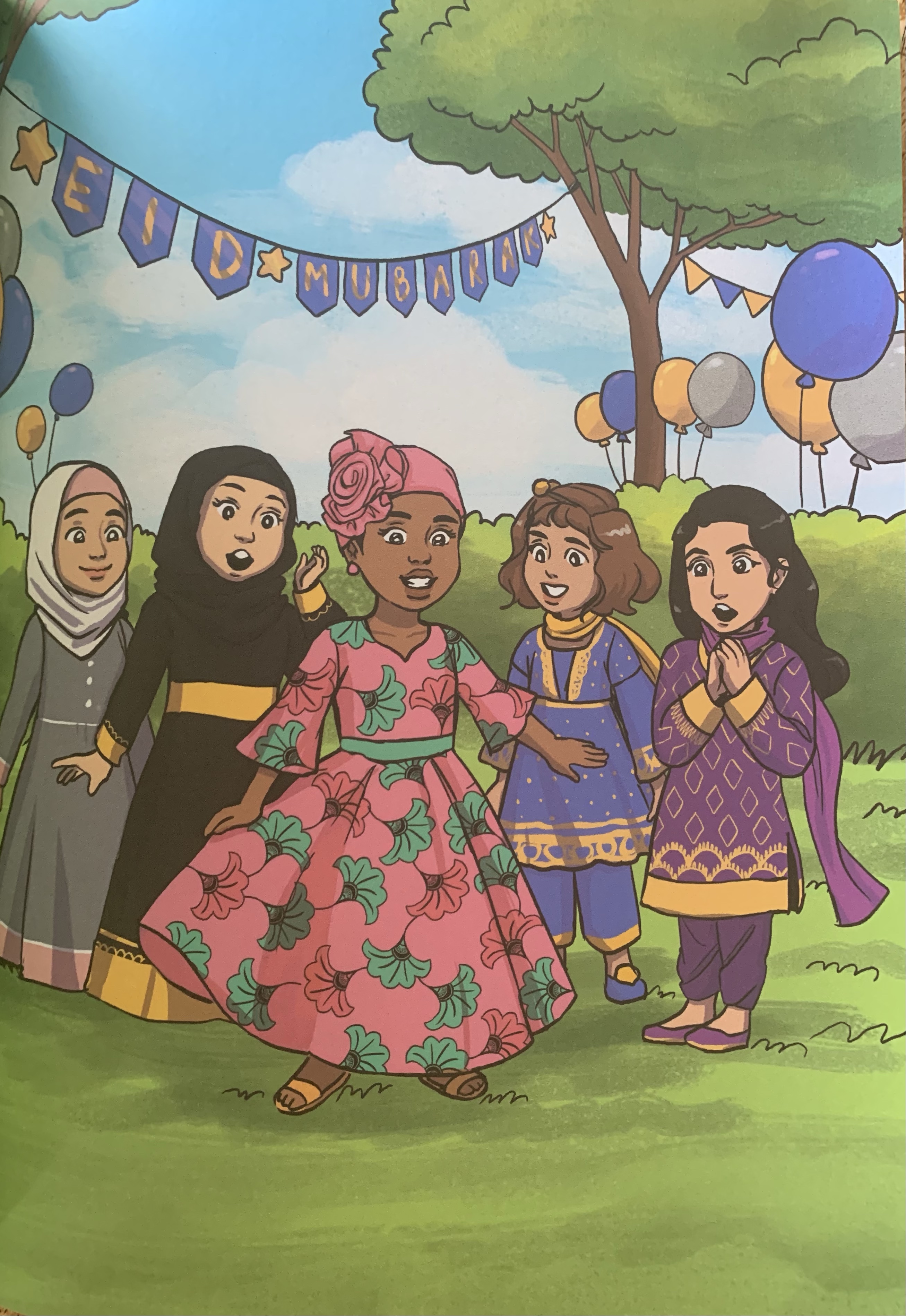
The search is on for an eid dress that reflects Zara’s African American Muslim culture.  This much needed representation highlights more of looking for a dress and the process of having one made, than providing information about Eid or the African American Muslim experience over its 30 pages.  Iftar is mentioned on one page in parentheses, so if you omit that word it could reflect either Eid preparation.  The book is cute if you are looking for a slice of life and coming together of a child, mother, and grandmother over the creation of a dress that has what Zara is wanting: pink, fluffy and containing flowers.  It falls short if you are looking for a book to learn about Eid, Ramadan, what a cultural African American Muslim dress would look like, or a peek into an under represented culture.  The illustrations are sufficient.  I felt the girl looked younger in some of the depictions, and I was surprised that the girl’s rain boots and clothes were worn over multiple days in her search for a dress, picking out fabric and inside her house when the dress is completed.  Similarly, on Eid day while her dress is stunning and fabulous, her friends are wearing the same eid clothes they wore at the start of the book from years past.

img_8804

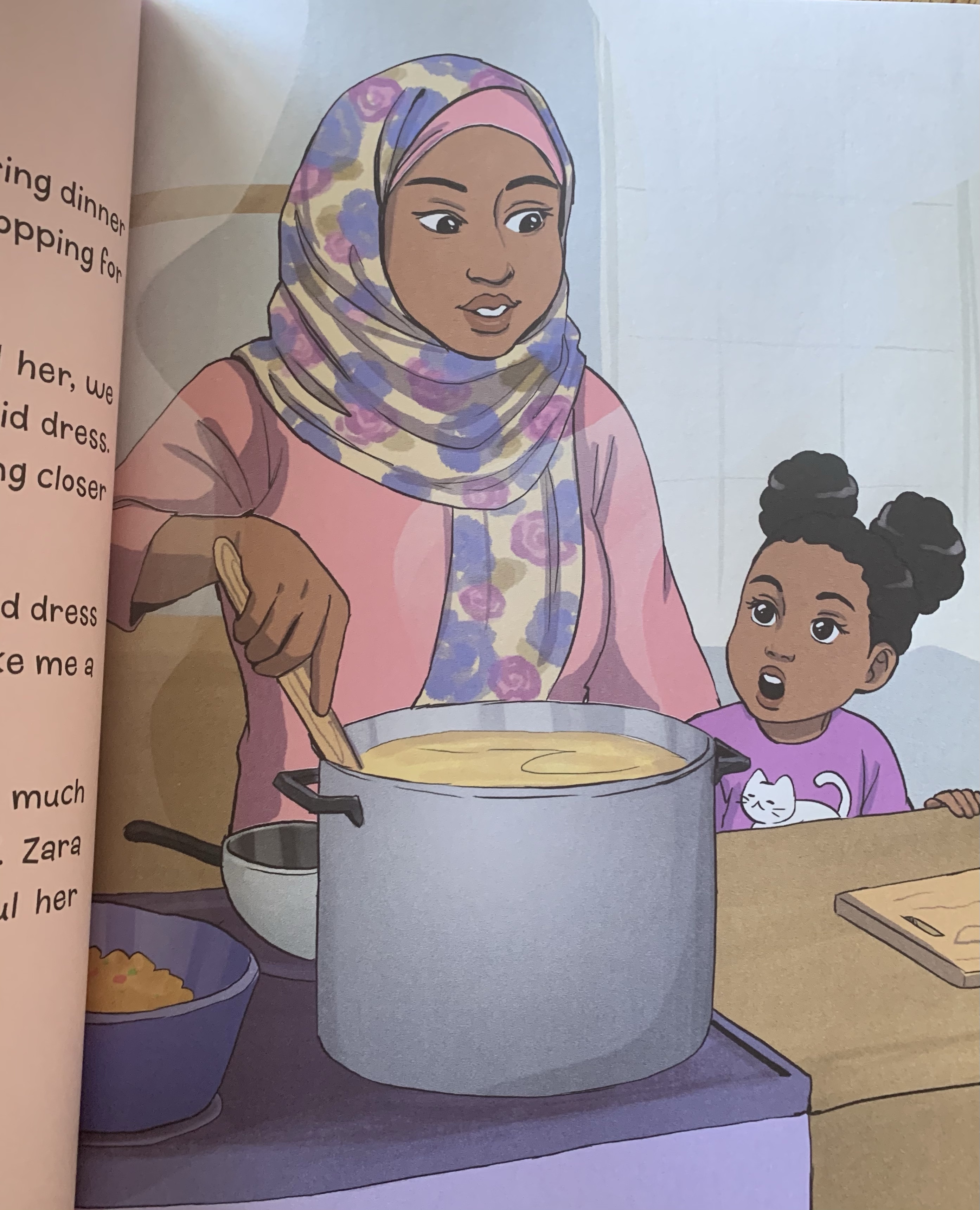
Zara has worn a salwar kameez from Pakistan with her friend Sana, an abaya like her friend Noura one year too, but this Eid, she wants a dress that shows “her own style, her heritage, a reflection of her culture as an African American Muslim.  As her mom is preparing iftar she asks when they can start shopping for her Eid dress.  She knows it won’t be easy to find and convinces her mother to start looking this weekend.

img_8805

She pulls on her rainboots as they head out the door to find “something bright, pink, fluffy, and has flowers on it.” They go to several stores and kind find anything just right.  Her mom suggests asking Nana to make it.  Zara’s mom recalls the fabulous dresses her mom used to make her to wear on Eid.

img_8806

Nana and Zara head out to the fabric store the next morning. First they find the pattern, then they find the fabric.  After a few days of hard work for Nana, the dress is complete.

img_8808

On Eid day, Zara meets up with her friends in her dress that is uniquely her own.

img_8812

Ramadan’s Coming by Rabia Bashir illustrated by Laila Ramadhani

Standard
Ramadan’s Coming by Rabia Bashir illustrated by Laila Ramadhani

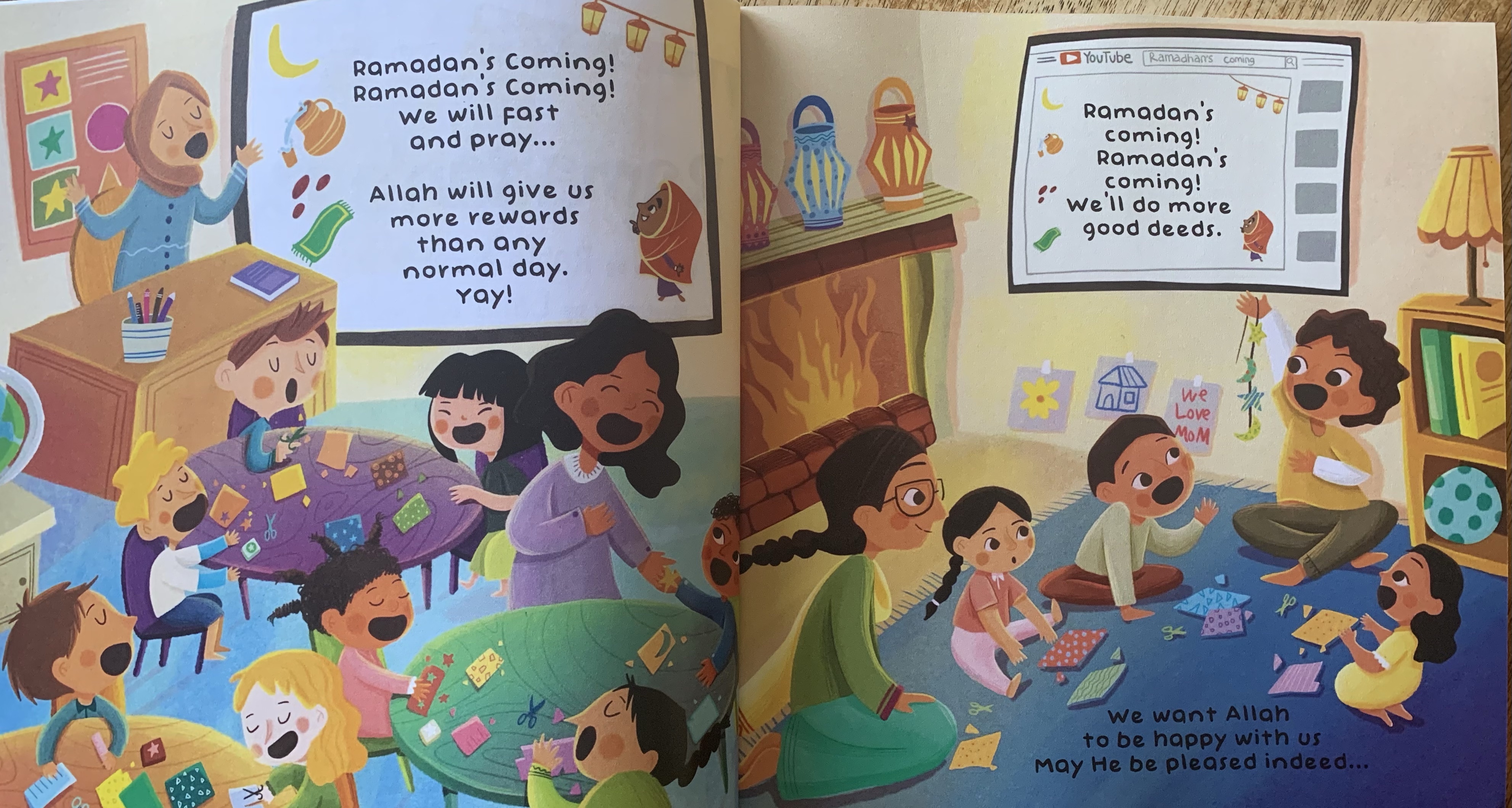
img_8785I think the illustrations in this 40 page picture song book are my favorite of the new 2021 books.  They are adorable and expressive and a big part of the story that the text alludes to, but doesn’t detail.  They also are a big part of the activities at the end of the book that encourage children to go back and find different Ramadan and Eid concepts to discuss and further understand.  I absolutely love that there is a glossary and a reference page that details and attributes the hadith implied in the simple sing song-y words.  The chorus is to the tune of jingle bells, and while I struggled to maintain the rhythm, the chorus reappears and if you are able to sing the book, your children will love it even more, haha, my voice and lack of rhythm forced me to read it, but either way it is absolutely delightful and informative for toddlers and up.

img_8787

It starts out with the refrain that Ramadan is here and we will fast and pray and that Allah (swt) will give us more rewards and we will do more good deeds, than on normal days.  It then shares that Ramadan is the month after Shaban when the Qur’an first came down and that we look for the crescent moon to know when Ramadan is here.  It is important to note that the words flow and are so concise you don’t even realize that much information has been conveyed.

img_8788

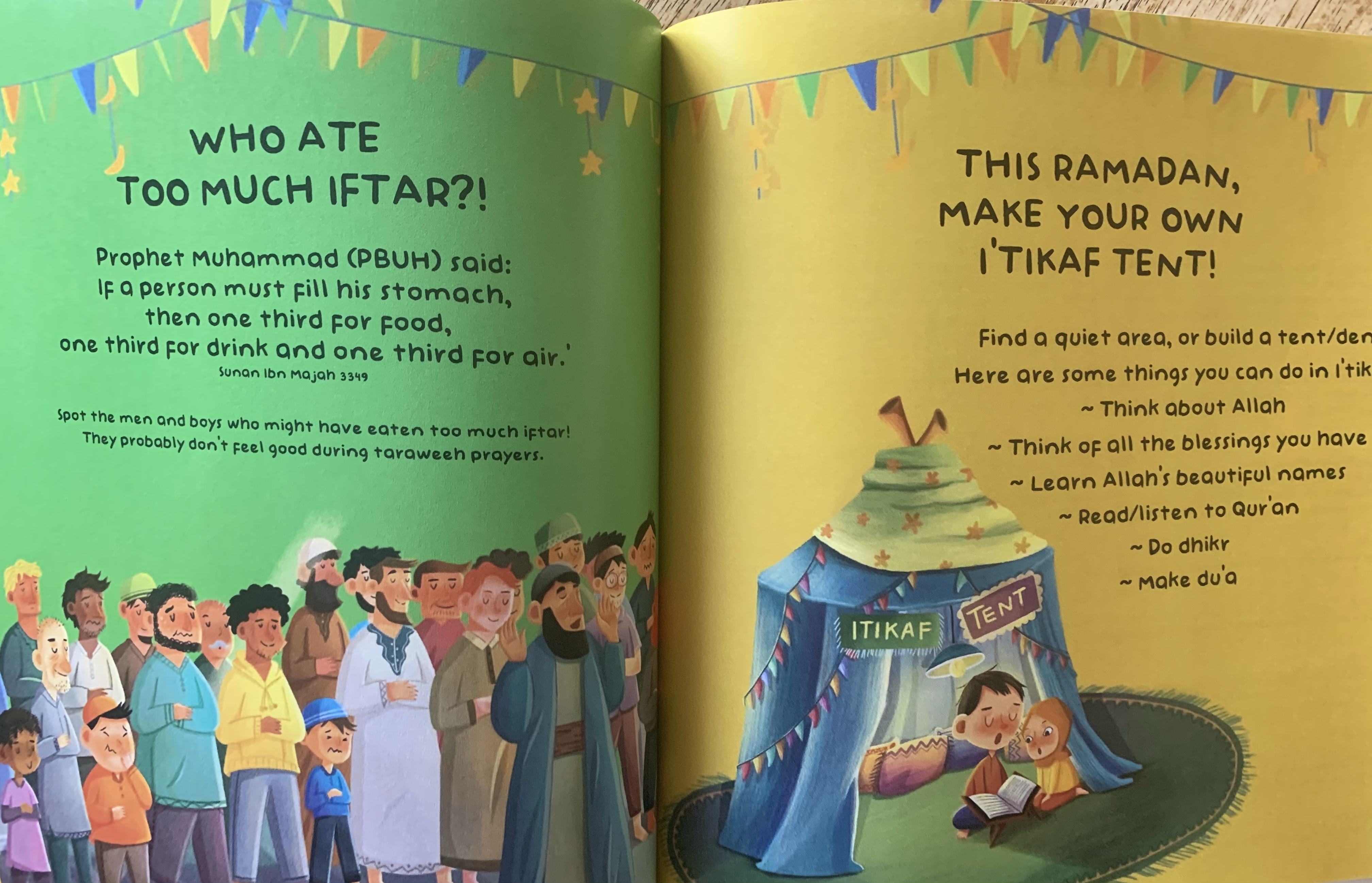
The chorus repeats and shows a family praying, kids helping vacuum, and giving socks to homeless.  The family then wakes up early for a healthy suhoor, no food or drink, thinking about how the poor must feel and then having iftar with a sticky sweet date and water.  Sometimes you eat so much your belly protrudes (a great vocabulary word for little ones). The next page has salat starting and those that ate too much wishing they would have left space for air and water.

img_8792

The chorus repeats again showing zakat being given, iftars being eaten in segregated large groups, before looking for Laylat ul Qadr takes place and some children read Qur’an in an itikaf tent. Then it is time for Eid hugs, salams, prayer, food and fun.

img_8791

On one page, the grammar of one line seems off, perhaps an extra word was added.  I contacted the author to see if it is an error as it is part of the chorus, but only appears wrong in one place and one time.  Even with the error, I would happily encourage this book for families with toddlers, preschoolers, and kindergarteners.  It will be read multiple times, and the pictures will hopefully offer something new with each reading as understanding increases.

img_8793

The copy I purchased from Amazon is 8.5 by 8.5 paperback, I’m not sure if they will be available from the publisher as a board book or without faces like so many of their books are.

Miss Never Pleased by Ayesha Marfani illustrated by Aisha Aamir

Standard
Miss Never Pleased by Ayesha Marfani illustrated by Aisha Aamir

IMG_1860 (1)

I’ve been accused of being brutal in my reviews.  And while I don’t enjoy being mean, I do take some pride in the attribute, as I am paying for these books myself (unless I get them at the library) and it takes time out of my day to write these reviews.  I don’t get paid, I do it because I love books, I like supporting Muslim authors and those including Muslim characters in their stories.  I take recommending books to others serious, and can’t remember things if I don’t write them down, so here I am.  With this review I don’t want to be rude, or overly critical nor do I want to sound pompous and arrogant and privileged, but at the same time, I ordered the book off of Amazon for $7.99 so a fair review shouldn’t hold punches to spare what the author is trying to do and appreciating that she is writing for a cultural audience. 

Please believe me it isn’t personal, I am reviewing it based on my same criteria I review all the books through, my own personal bias.  That being said, if the reader is living in Pakistan, or has recently lived in Pakistan and English is a second or fifth language the 70 page story with games and activities at the end is decent.  Meant for ages 7-12 in that situation, that are intrigued by the moral lesson presented, I think the plot holes can be forgiven.  For those without ties to Pakistan, or with loose ties like me (I’m half Pakistani and grew up spending my summers visiting family) the book will be choppy, culturally specific, confusing and lacking.

SYNOPSIS:

The book opens with Habiba being distraught over her world crashing down on her and the pain she has caused her relatives consuming her.  She then opens her diary that she has kept for six years, starting back when she was seven recounting how she as Miss Perfect justified her self in incident after incident.  Thirty-one incidents to be exact, detailing how she would rat out her cousins, or critique elders food, or her tell her friends how to dress and what to study because it was the honest thing to do.   How she would decide who should be friends with who, if her family should go on picnics and how she didn’t want gifts but didn’t want to not get gifts either.  All-in-all Habiba is a self righteous awful, awful girl, I don’t think it is her trying to be perfect, I think she is just awful.  At the beginning she attributes it to praise she received as a child from her mom and grandma, but for this behavior to have gone on for so many years, I don’t think it was their praise, it was their lack of discipline that leads up to her catastrophic moment.  She fails her exams and then learns what her family really thinks about her in a poem, with a way too forced rhyme scheme, left lying around.  The story then returns to her undoing and a faqeer coming to cure her and her parents taking the blame for her poor upbringing.  She crosses out the title on her journal from Miss Perfect to Miss Never Pleased, to presumably denote how nothing could satisfy her.  The story then skips forward to her returning after University as the best international psychologist.  

WHY I LIKE IT:

I love the concept of the book, that a girl thinking she was so perfect could realize in fact she is not.  The idea is great.  I think it is a bit sad that her parents and involved extended family took so little interest in correcting her behavior, but at the same time I didn’t think it believable that she was absolved of all responsibility either. 

I feel like this book was a great first draft.  It needs some fleshing out, and some continuity corrections.  Incident #3 makes no sense, it starts with a party, then her ruining the mood of everyone at the party, and then her crushing her cousin’s dream of being in a play for her own twisted reasons.  But the jump from one idea to another seems like something got edited out and the rest of the four-and-a-half-page story didn’t get altered to reflect the missing details.  I have no idea what the party was for, what a wish gift is, and why anyone in their right mind would take a child’s opinion regarding someone else’s life so strongly. 

There are also contradictions, for example on page 14 she makes a big huff about her cousin wanting to study to be a teacher saying she wouldn’t be good at it, then on page 49 saying she would be marvelous, and this is before her climactic change of heart.  There are some awkward passages as well, that I had to read a few times, which could have been do to a different style of English, but sometimes I think it was confusing on its own.  Page 24 was all over the place with her not wanting to thank people for giving her a gift because she deserved the gift, but then telling them she appreciated it, along with her saying the gift, a dress, appealed to her, but that they should not have gotten it because it was an inferior quality.  Inferior to what we don’t know. So she didn’t say thank you, but said she appreciated it, isn’t that the same thing?  She didn’t like the dress, but it had appealed to her? Very confusing and just one example.

I say it is for Pakistani’s because I don’t know that anyone outside the subcontinent would know what a faqeer is, yes there is a glossary at the back, but it seems assumed in the story as a religious practice, which I find some issue with.  When Habiba was trying to dress everyone she says that a fishtail would look nice on her cousins and she gets a blue one.  I have no idea what a fishtail is.  It is not really explained, an illustration would have been helpful, but is not provided. She also once refers to her cousin as “dark” in a negative connotation, and that seemed very out of place and inappropriate to me.  And ultimately, if you don’t know the Pakistani school system I’m not sure you would understand how important the exam she failed is, nor why the scores are in the newspaper,  or that they have to pick their fields of study so early.  That being said, how did she get to University and do so well? If at 13 they had to choose their college and she didn’t pass wouldn’t she not be allowed to continue? I am so confused. And then she comes back after University, but is already being written about in the papers as if she has had a long and successful career.

The book doesn’t tell how she makes things right with all those she wronged either, after so many incidents, I think a little self reflection and humbling should have occurred to those that felt her wrath for so many years.  There isn’t really even a solution, her dad comes and talks to her, she reads what people think about her and then boom, happily ever after.

The illustrations are sporadic, but not consistent in the book.  The style seems to be different in each sketch.


FLAGS:

The girl lies and is incredibly mean but there isn’t anything inappropriate in terms of language or violence.  Islam is mentioned at the end when she thanks Allah swt for His help.

TOOLS FOR LEADING THE DISCUSSION:

I wouldn’t do this as a book club because it is so short, and I don’t know that kids would be compelled to read past the first few pages if it was in a classroom library.  

Book Video https://www.youtube.com/watch?v=QWoCiEnvg5U

If this book would have been written 20 years ago or so, I think readers everywhere would have given it a try as there was so little to choose from in Islamic Fiction, but there are options now, and much better ones.  I feel awful that I didn’t love the book, but I can’t suggest it either.  I plan to read one more book of the author’s to see if this one just didn’t work for me, and I’ll let you know what I think.

Ali and the Moon by M.I. Kafray illustrated by Aaliya Jaleel

Standard
Ali and the Moon by M.I. Kafray illustrated by Aaliya Jaleel

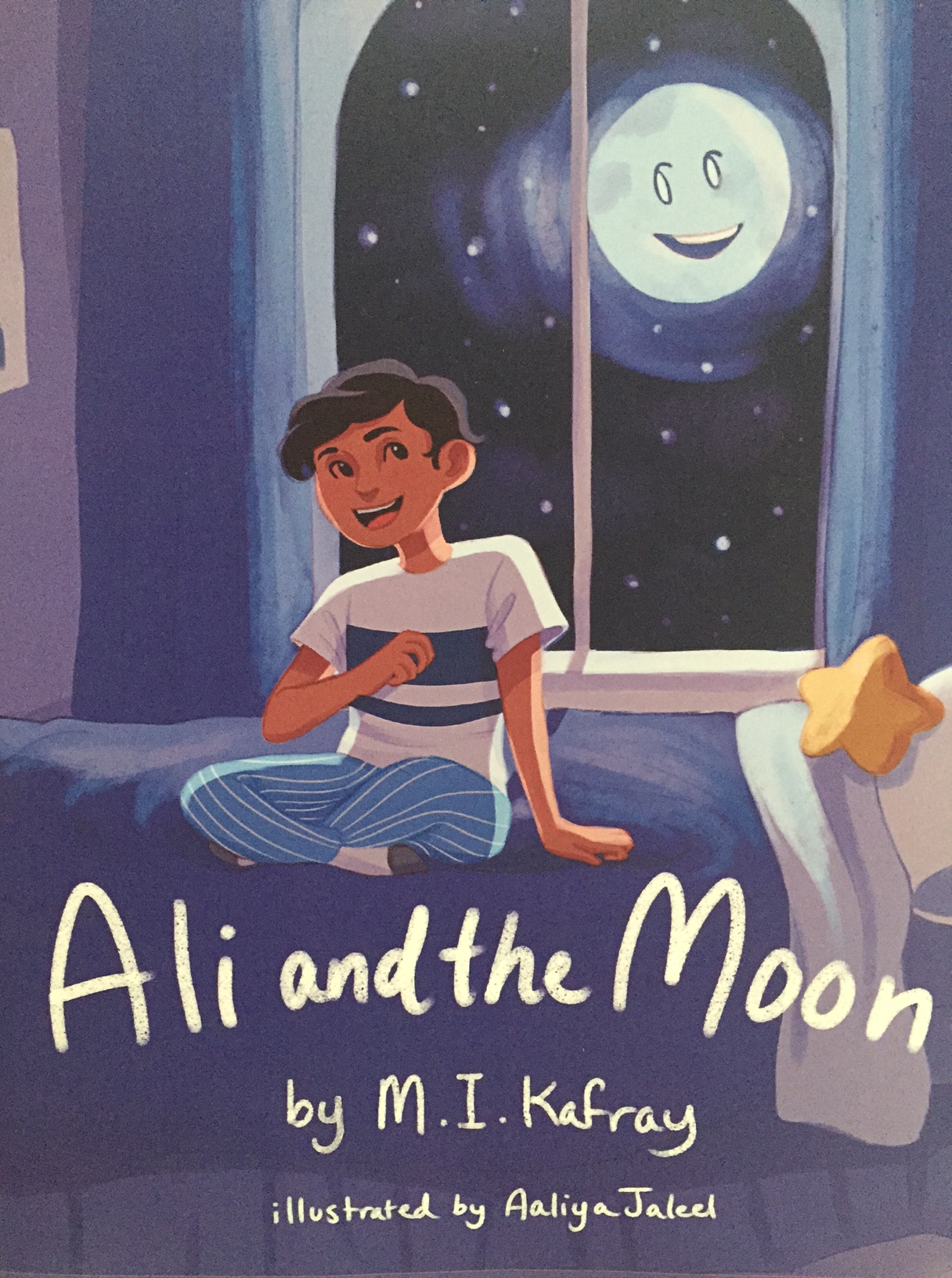
IMG_1421

I originally bought this book in Ramadan and had hoped to review it so that those looking for Ramadan books could benefit. But it isn’t Ramadan specific, just moon themed, and I really was so disappointed with the binding quality for the amount I paid for it, I didn’t think it was fair to review the story until I could get over the number of blank white pages in the book, and the overall copy-shop self-printed and bound vibe that the book emits as soon as you hold it.

The premise of the book is the hadith that if you see something bad you should change it with our hands, and if you can’t, then change it with your tongue, and if you can’t do that, then pray for them in your heart. 

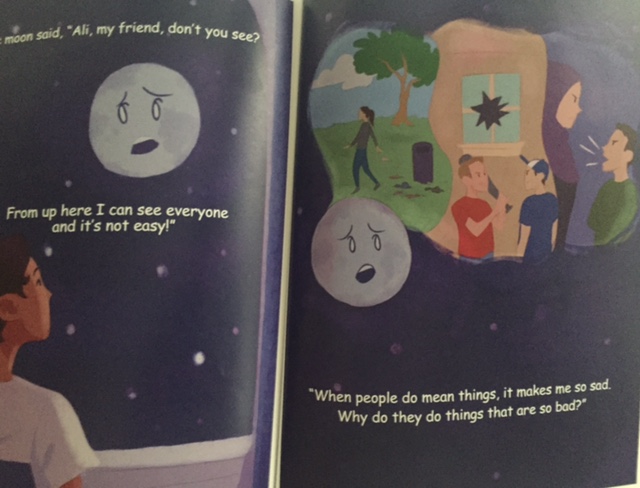
The 16 page book starts off a bit awkward, with the boy just staring at the moon, but by page five, the story hits its stride and is sweet.  The moon dims and is sad about the state of the world.  Ali starts talking to the moon in rhyming lines, and convinces him that there is still good in the world.  The moon and Ali decide that at night they will pray for the world and the people in it.

ali inside2

The end of the book has the hadith and the surahs one should say before going to sleep: Surah al-Ikhlaas, Surah al-Falaq, then Surah an-Nas and lastly, Ayatul Kursi.

The illustrations are cute, they are expressive and the moon and boy sweet.  I just wish the paper had more weight and that the story a bit longer.  A lot could be discussed with the premise of the Muslim boy talking to the moon with a great vantage point.  More specifics and more inspiration would have made this mediocre, albeit expensive book, great.

ali inside


Ms. Marvel No Normal & Generation Why by G. Willow Wilson illustrated byAdrian Alphona & Jacob Wyatt

Standard
Ms. Marvel No Normal & Generation Why by G. Willow Wilson illustrated byAdrian Alphona & Jacob Wyatt

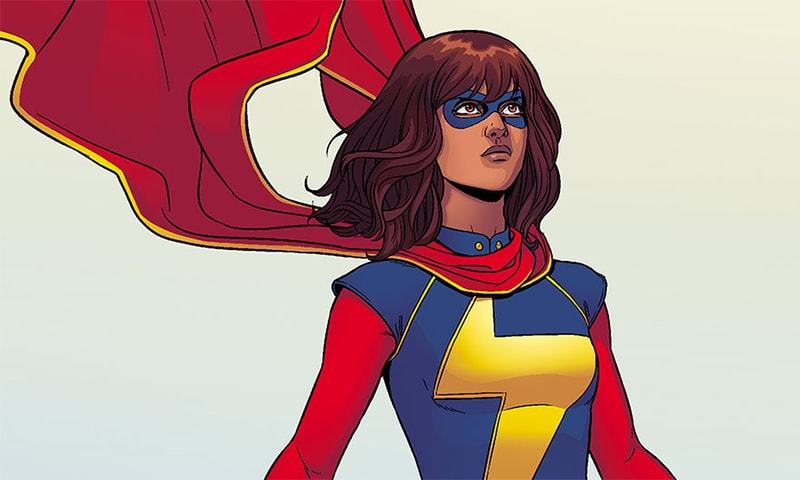
I have to be completely honest these are the first comic books I’ve ever read from cover to cover.  So, while I’m in no position to review the art work, or historical role of the original Ms. Marvel or even have a valid opinion on the superhero story lines, I do want to cover the Islamic elements because even as someone as outside the comic book world as I am, I knew that Marvel’s new Ms. Marvel is a Pakistani-American Muslim girl from Jersey and that’s pretty big.

I was intimidated to read No Normal, I ordered it from Scholastic and have had it on my shelf for a while, I was excited, but nervous. But then I ordered the second one, which is also a collection of 5 comic books, and thought, let’s do this.  Both collections are easy reads, and the text and what to read first in each story frame is clear.  As with comics and graphic novels the pictures convey much of the story so there isn’t a lot of “explanation,” but the story is compelling enough, that even a novice like me didn’t get too hung up on what was going on and how it could be possible.   While it may tempt younger children, I would hold off until the reader is a teen, especially if the reader is Muslim.  There is a bit of drug use and alcohol in No Normal and obviously violence, but at it’s core it is a story of a girl trying to discover who she is and there is some angsty teenage stuff that someone who hasn’t gone through the emotions, might take as attacks on Islam, parents, and culture.

Kamala Khan is a high school student in Jersey City, New Jersey.  She has a Muslim friend, Nakia, who wears hijab, and non Muslim friends of both genders that seem to support her faith and culture, almost more than she does.  The story opens with her sniffing bacon and her friends humoring her oddness.  Having grown up with the same group of friends around her, they understand her quirks and nerdiness and she seems to fit in.  As with most teens though, she feels on the “outside” and Kamala right away tries to seem cool with the more popular crowd.  She  is struggling to find herself within her Pakistani culture, her American life, her Islamic beliefs and teenage friends, information all presented in the first few pages while at the local convenience store hangout.  A lot for Kamala to balance and she hasn’t even discovered her “powers” yet.

Kamala’s parents initially seem more “cultural” than religious as her father chastises Kamala’s brother Aamir for being too religious, yet is constantly on Kamala, presumably because she is a girl.  In a fit of defiance against her parents strict curfew, Kamala sneaks out of the house to attend a party, accidentally drinks alcohol (she spits it out) and gets caught in some “fog” that gives her morphing, stretching, embiggening, and quick healing powers.

As Kamala tests how her powers work, and what they mean, there are a few funny asides that appeal to Muslim readers: she attempts to use her Burkini as a base for her super hero disguise, and her mother threatens to send her to the Sheikh if she gets caught sneaking out again.  Her parents start to grow on you though, the mom is a very stereotypical immigrant mother who cares for her daughter in a worrying nagging way, the dad actually tries to communicate with Kamala and comes across a little more genuine toward the end of the first collection.  Her brother seems to be level headed, but a minor influence.  He sticks up for her and tries to help, but it doesn’t seem like they are that close.   The final scene in No Normal left a little bit of a bitter taste in my mouth and I was glad that I already had Generation Why to dive right into and not let the conclusion of the first one fester in my head.  Kamala shows up to a wedding late, complete in Shalwar Kameez (Pakistani clothing) and gets in an argument with her mom.  Kamala says, “You and Baba want me to be a perfect little Muslim Girl–straight A’s, med school, no boys, no booze, then some hand picked rich husband from Karachi and a billion babies.”  The mom says, “Your father and I want the best for our only daughter our expectations are high so that your successes will be many.”  It goes back and fourth then the mom says she is grounded and the book ends with Kamala retorting, “wanna bet…?”  While I’m sure most every Muslim American teen has felt this way, I don’t think I’d want my 9 year-old-daughter thinking that is how narrow success is defined, or that being the best you can be is a punishment. It’s probably a realistic gripe, but to have it be the last impression, naturally brought out my defensive instincts.

A lot of the awkwardness and stage setting in No Normal is resolved by Generation Why and I found I enjoyed it a lot more than I thought I would.  I might even be anxiously waiting to see what happens next.  Kamala is sent to the Sheikh and while she is intentionally vague about telling him what is going on with her, she does suffice it to say she is trying to help people and he responds by telling her to do it with as much honor and skill as she can. I love that he wasn’t putting her down, but rather trying to mentor her spiritually to find her self and do so honorably.  Really the only other religious/cultural scene is when Lockjaw a giant dog with transporting abilities shows up to help Kamala and her parents say he can stay, but outside because he isn’t clean.  I don’t know if non-Muslims will fully understand why, but it made me chuckle.  It also made me like her family a bit more.  They are strict, but not unreasonable.  They didn’t say, “no” they found a compromise.

Generation Why contains more action than back story.  I’m not entirely sure why Wolverine shows up, I have no idea who the lady in charge of stuff is with Captain America, and I’m not sure why no one finds it odd that the Inventor is a bird man, but hey it is fun.  And it definitely had me cheering on Ms. Marvel as she empowers her generation and learns that being American Muslim might be the easiest of her identity issues when she learns she is inhuman.  It gets a little cheesy, but the foundation of comic books being good against evil, lends itself to that right?

Overall, I think I would recommend both collections are read together, as it gives a better picture of what Ms. Marvel is and can be.  I think thus far the author has done a good job of showing that she is Muslim and that her faith adds depth to the character.  Her tenacity, persistence, determination, compassion for animals, her humor, her nerdiness, all make her very like-able and admirable.  I probably wouldn’t do it as a Book Club selection, because our school only goes to 8th grade and being an Islamic School I don’t know that most of the students feel the identity crisis until possibly much later if at all.  But I think the books would work well for discussion with older kids.  Topics of what youth can do, their role in preserving the planet, discovering your sense of self and purposes are all there in comic book, super hero, action packed form!

Kamala Khan


Bismillah Soup by Asmaa Hussein illustrated by Amina Khan

Standard
Bismillah Soup by Asmaa Hussein illustrated by Amina Khan

Bismillah Soup

It is always a cause of giddiness to find a good book, but to have one recommended by a mutual friend of the author, makes it all the better. Bismillah Soup is a spin-off of the Stone Soup folktale, but without the “trickery” of the classic.  Hasan, wants to surprise his mom with a feast, but money is tight and when Hasan is sent to ask the local Imam for some rice, a plan: Bismillah Soup, forms that brings the entire community together.  The story takes place in Somalia and the cultural words that are peppered in to the story add detail and talking points to have with the kids.  As each community member shares something small, the enormous feast that is created is a wonderful example of what can be achieved when we each give our best to help others.  The book is 40 pages with a glossary at the back and is definitely one that can be read over and over to kids of all ages.  Even the littlest ones are able to grasp the beauty of coming together through the colorful and playful pictures.

soup-gallery-img1 (1)The real treat of the book however, is how it all comes together: the words, pictures, sentence structure, font, size, and diction all compliment each other on the same level.  I read a lot of books aloud as a children’s librarian, and while the rhyming ones are great for the littlest listeners, there is often a void of read-out-loud stories for the kindergarten and first grade levels.  And I am talking about all books, not just Islamic ones.  Most picture books in my experience are written on a third grade level, with longer blocks of texts, smaller fonts, a wider range of vocabulary and longer sentences.  These books are often beautiful and very tempting, however when I read them during story time I end up “summarizing” them, and telling the story rather than reading it.  Similarly, early readers often find them frustrating and too difficult to read independently. Bismillah Soup strikes a wonderful balance, mashaAllah.
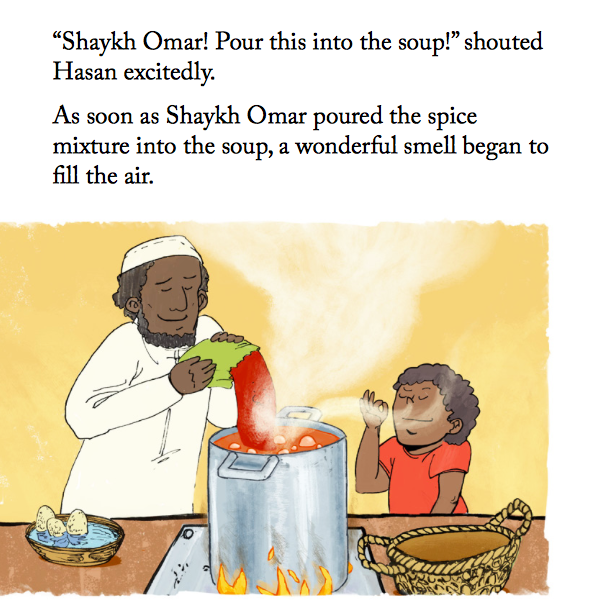
I read the story to my own children who enjoyed it and have found my first grader reading it independently twice this week.  Each time beaming with excitement to tell me something new he has gained from the book.  When I read it aloud to them, my kids marveled at how having a good intention and being so generous could benefit everyone. The first time my son read it independently he was in deep thought about how grateful Hasan was even though they didn’t have much food and how he was a determined problem solver.  The second time I found him reading it, he was so very impressed at the kindness of Shaykh Omar.  He really started to understand the subtle beauty of the character not just in helping Hasan’s family with food, but also supporting and working with the young boy to make the feast happen, alhumdulillah.  Screen-Shot-2015-08-29-at-12.06.00-AM

I highly recommend the book and I can’t wait to read it to my students at school next week, inshaAllah.  For more about the book, the author, and her other work you can go to the author’s website  http://www.ruqayasbookshelf.com