Category Archives: Muslim Character

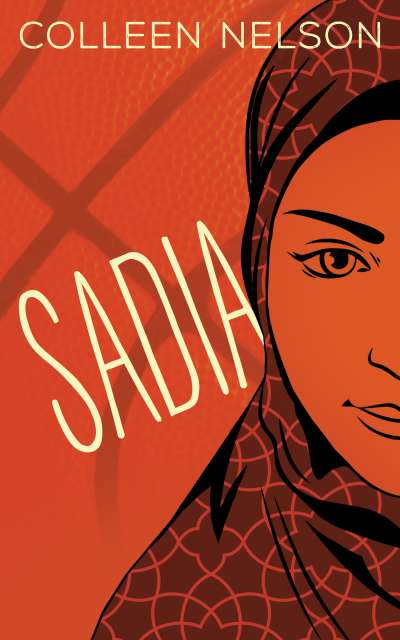
Sadia by Colleen Nelson

Standard
Sadia by Colleen Nelson

sadia.jpg

A middle school sports book with a female lead who wears hijab written by a non muslim.  The book could really go a lot of ways, I held my breath for all 239 pages waiting for something to go totally awry, and thankfully it never did.  In fact I read the book nearly straight through and while meant for ages 12 to 15, I quite enjoyed it.

SYNOPSIS:

Ninth Grader Sadia Ahmadi is an immigrant from Syria, her family left before things got “bad,” and while she has adjusted to life in Canada, High School is testing her in other ways.  Her best friend Mariam, an immigrant from Egypt, has started dejabbing, taking off her hijab to fit in it seems any chance she gets.  This is taken as a betrayal by Sadia and their friendship waxes and wanes throughout the book as each girl has to figure out who she is in relationship to hijab, and how to judge and/or accept each other and their choices.  Throw in a new refugee girl Amira from Syria who doesn’t speak English, a co-ed basketball tournament that doesn’t allow any headgear to be worn during games, a cute boy on the team and an awesome teacher with interesting assignments and you have the book in a nutshell.

WHY I LIKE IT:

I like Sadia, she is believable and strong.  She is well liked, athletic, she has a good relationship with her parents, brother and teachers, she prays and fasts and owns who she is, but she isn’t perfect.  She is hypocritical at times, and acknowledges it, she is tempted by parties, and boys and taking off her own hijab to play ball, and has to confront it about herself.  She doesn’t do things like pray on time, like she knows she should, but there she is and I am so impressed that the author picked up on so many nuances of Muslim life in her research or in her own observations as a teacher.  Yes, Amira has an awkward observation about Miriam being Muslim and not wearing hijab that seems really one dimensional considering large numbers of Muslims in Egypt and Syria don’t cover, but I don’t know if that was the author’s attempt to draw the issue to the light or if it was just a misstep.  

I like that there is a cute boy that accepts Sadia and who she likes as well, but they don’t do anything.  So often, these books become overrun by the romance story line and this one doesn’t, thankfully.  It seems to find a realistic balance, that she has feelings, but isn’t going to act on them, and based on her mom figuring out when she is lying that she won’t try and sneak behind her mom’s back.

Issues of halal food are mentioned in passing and it fleshes out that the girl is Muslim, not just going through the motions.  At times it is hard to know if her choices are based on belief and faith or expectation, but for an early YA/Middle School book, I think it suffices.  She mentions modesty as a reason for hijab, but also a lot of parental and cultural expectation.  One central theme the reader just has to go with, is that Sadia and the rest of the characters in the book, and there are a fair amount of Muslims, don’t know about any other ways to wear hijab for sports.  I get that Mariam and her sewing ability is a huge arc in the story, but they have smart phones, and its a contemporary piece, they have to know about Ibtihaj Muhammad in the Olympics, Bilqis Abdul-Qaadir, and Nike making athletic hijabs.  So, to make the story work you do have to turn a blind eye to the fact Muslima’s have taken to sports in the mainstream and that there is no way they can all be that clueless about her fabric, style, and covering options.

I love that the issue of refugees is addressed in the periphery, and the issues are given a human face.   I love that Sadia’s parents are religious, but not left as simple stereotypes, they deal with Islamaphobia, but aren’t looking for sympathy.

There is always the case, that the hijab becomes a stereotyped item as the story involves characters torn to wear it or not, but I loved how judgements were called in to questions and there wasn’t an easy answer.  The side friends in the story are all way too good to be true, but I think the whole book has a bit of a pollyanna feel to it, and in this case it was ok to error on the side of kindness than become overtly sensationalized and whiney.

The biggest hurdle this book faces is, is it the author’s story to tell. And I don’t know, I review a lot of books, and many are by Muslims and they get stuff wrong in my opinion, or they go so extreme to be accepted.  So, I don’t know, I think the book had heart, I didn’t know if the tournament would let Sadia play, I didn’t know if she would sneak off to the party, I didn’t know if she would cross the line with Josh, and I was curious, and invested and sucked in to it all.  Is it a book to teach others about Muslims or a book for Muslims to see themselves? I think all of the above.  Muslim’s should control their own narrative, but I think when author’s get so much right, we have to take some reassurance in the idea that we are being accepted by the larger society, and our stories are being told with love by other’s too.

FLAGS:

There is romance and lying, but no kissing, just hints at emotions or an errant arm flung over a shoulder during a huddle or photo.  There is mention of drinking at the parties, but Sadia doesn’t end up attending.

TOOLS FOR LEADING THE DISCUSSION:

I don’t know that I would do this as a book club selection, but if I met the right group of kids, I would definitely reconsider.  There is a lot of basketball, which I quite enjoyed, but I could see other’s maybe getting bored by the play-by-play.  I’ll make my daughter read it in a few years, and I look forward to discussing hijab and how she feels about it after.  It does raise the subject, and ask you to check your judgements on yourself and on others.

Author’s Website: http://www.colleennelsonauthor.com/
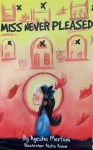


Miss Never Pleased by Ayesha Marfani illustrated by Aisha Aamir

Standard
Miss Never Pleased by Ayesha Marfani illustrated by Aisha Aamir

IMG_1860 (1)

I’ve been accused of being brutal in my reviews.  And while I don’t enjoy being mean, I do take some pride in the attribute, as I am paying for these books myself (unless I get them at the library) and it takes time out of my day to write these reviews.  I don’t get paid, I do it because I love books, I like supporting Muslim authors and those including Muslim characters in their stories.  I take recommending books to others serious, and can’t remember things if I don’t write them down, so here I am.  With this review I don’t want to be rude, or overly critical nor do I want to sound pompous and arrogant and privileged, but at the same time, I ordered the book off of Amazon for $7.99 so a fair review shouldn’t hold punches to spare what the author is trying to do and appreciating that she is writing for a cultural audience. 

Please believe me it isn’t personal, I am reviewing it based on my same criteria I review all the books through, my own personal bias.  That being said, if the reader is living in Pakistan, or has recently lived in Pakistan and English is a second or fifth language the 70 page story with games and activities at the end is decent.  Meant for ages 7-12 in that situation, that are intrigued by the moral lesson presented, I think the plot holes can be forgiven.  For those without ties to Pakistan, or with loose ties like me (I’m half Pakistani and grew up spending my summers visiting family) the book will be choppy, culturally specific, confusing and lacking.

SYNOPSIS:

The book opens with Habiba being distraught over her world crashing down on her and the pain she has caused her relatives consuming her.  She then opens her diary that she has kept for six years, starting back when she was seven recounting how she as Miss Perfect justified her self in incident after incident.  Thirty-one incidents to be exact, detailing how she would rat out her cousins, or critique elders food, or her tell her friends how to dress and what to study because it was the honest thing to do.   How she would decide who should be friends with who, if her family should go on picnics and how she didn’t want gifts but didn’t want to not get gifts either.  All-in-all Habiba is a self righteous awful, awful girl, I don’t think it is her trying to be perfect, I think she is just awful.  At the beginning she attributes it to praise she received as a child from her mom and grandma, but for this behavior to have gone on for so many years, I don’t think it was their praise, it was their lack of discipline that leads up to her catastrophic moment.  She fails her exams and then learns what her family really thinks about her in a poem, with a way too forced rhyme scheme, left lying around.  The story then returns to her undoing and a faqeer coming to cure her and her parents taking the blame for her poor upbringing.  She crosses out the title on her journal from Miss Perfect to Miss Never Pleased, to presumably denote how nothing could satisfy her.  The story then skips forward to her returning after University as the best international psychologist.  

WHY I LIKE IT:

I love the concept of the book, that a girl thinking she was so perfect could realize in fact she is not.  The idea is great.  I think it is a bit sad that her parents and involved extended family took so little interest in correcting her behavior, but at the same time I didn’t think it believable that she was absolved of all responsibility either. 

I feel like this book was a great first draft.  It needs some fleshing out, and some continuity corrections.  Incident #3 makes no sense, it starts with a party, then her ruining the mood of everyone at the party, and then her crushing her cousin’s dream of being in a play for her own twisted reasons.  But the jump from one idea to another seems like something got edited out and the rest of the four-and-a-half-page story didn’t get altered to reflect the missing details.  I have no idea what the party was for, what a wish gift is, and why anyone in their right mind would take a child’s opinion regarding someone else’s life so strongly. 

There are also contradictions, for example on page 14 she makes a big huff about her cousin wanting to study to be a teacher saying she wouldn’t be good at it, then on page 49 saying she would be marvelous, and this is before her climactic change of heart.  There are some awkward passages as well, that I had to read a few times, which could have been do to a different style of English, but sometimes I think it was confusing on its own.  Page 24 was all over the place with her not wanting to thank people for giving her a gift because she deserved the gift, but then telling them she appreciated it, along with her saying the gift, a dress, appealed to her, but that they should not have gotten it because it was an inferior quality.  Inferior to what we don’t know. So she didn’t say thank you, but said she appreciated it, isn’t that the same thing?  She didn’t like the dress, but it had appealed to her? Very confusing and just one example.

I say it is for Pakistani’s because I don’t know that anyone outside the subcontinent would know what a faqeer is, yes there is a glossary at the back, but it seems assumed in the story as a religious practice, which I find some issue with.  When Habiba was trying to dress everyone she says that a fishtail would look nice on her cousins and she gets a blue one.  I have no idea what a fishtail is.  It is not really explained, an illustration would have been helpful, but is not provided. She also once refers to her cousin as “dark” in a negative connotation, and that seemed very out of place and inappropriate to me.  And ultimately, if you don’t know the Pakistani school system I’m not sure you would understand how important the exam she failed is, nor why the scores are in the newspaper,  or that they have to pick their fields of study so early.  That being said, how did she get to University and do so well? If at 13 they had to choose their college and she didn’t pass wouldn’t she not be allowed to continue? I am so confused. And then she comes back after University, but is already being written about in the papers as if she has had a long and successful career.

The book doesn’t tell how she makes things right with all those she wronged either, after so many incidents, I think a little self reflection and humbling should have occurred to those that felt her wrath for so many years.  There isn’t really even a solution, her dad comes and talks to her, she reads what people think about her and then boom, happily ever after.

The illustrations are sporadic, but not consistent in the book.  The style seems to be different in each sketch.


FLAGS:

The girl lies and is incredibly mean but there isn’t anything inappropriate in terms of language or violence.  Islam is mentioned at the end when she thanks Allah swt for His help.

TOOLS FOR LEADING THE DISCUSSION:

I wouldn’t do this as a book club because it is so short, and I don’t know that kids would be compelled to read past the first few pages if it was in a classroom library.  

Book Video https://www.youtube.com/watch?v=QWoCiEnvg5U

If this book would have been written 20 years ago or so, I think readers everywhere would have given it a try as there was so little to choose from in Islamic Fiction, but there are options now, and much better ones.  I feel awful that I didn’t love the book, but I can’t suggest it either.  I plan to read one more book of the author’s to see if this one just didn’t work for me, and I’ll let you know what I think.

Digging Deep by Jake Maddox text by Wendy L. Brandes illustrated by Katie Wood

Standard
Digging Deep by Jake Maddox text by Wendy L. Brandes illustrated by Katie Wood

IMG_1855

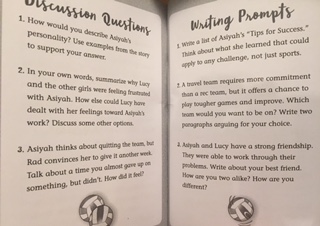
It is great to see a beautiful hijabi on the front of a sports book, written by a non Muslim, published by a major publisher, and having the story have nothing to do with the cloth on her head, but rather the skills on the court.  Teaching lessons about teamwork and self-worth, there is a whole series of these books about different sports with different main characters, and this one focuses on volleyball and a girl named Asiyah Najjar.  I’d maybe recommend this 63 page book to kids starting to feel confident with early chapter books, but more on that later.

SYNOPSIS:

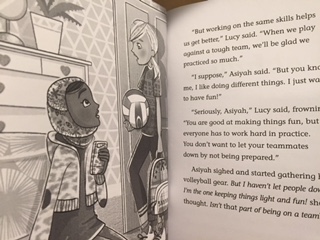
Asiyah plays rec volleyball and enjoys it, but when her friend Lucy convinces her to try out for the traveling team, she has to not just be good enough to make the team, but focused enough to not let her teammates down.  With daily practices, comedian Asiyah feels like everyone is taking the new team way too serious and she questions if she wants to continue.  She loves playing the piano and with school work, her time is being consumed by volleyball.  When she overhears her friends doubting her commitment to the team, she, with the support of her brother, decides to dig deep and give it one last, serious, try.

WHY I LIKE IT:

I love that Asiyah mentions in the first chapter that she is nervous about the traveling team, because of her hijab and that people in town know “what it is, and why I wear it,” she says.  She never mentions that she is Muslim or why she wears it, just states that the people around her know. Religion and faith are never brought up again.

IMG_1856

There are some slightly off things in this book for me.  According to the publisher, the book is meant to appeal to 8-11 year olds,  but to me, the style of the book is aimed for 6-8 year olds.  Those who need pictures and a large font and big spaces between lines and short chapters.  The illustrations, however, in the book make the main character and her friends seem like high school students, with their heavily makeup looking faces, or at least middle school with the main character wearing hijab.  After reading the book, twice, I still don’t know how old the main characters are.  They seem pretty independent, but then when Asiyah’s parents have to run some errands, her brother Rad walks her and Lucy to volleyball practice, like an escort.  

That’s another thing, of all the ethnic or religious names that could have been chosen, Rad seems like an odd choice in that it will come across as funny to readers and kind of mitigate the amazingness of having a socially accepted female Muslim athlete on the cover, again, just my opinion.

Another slightly confusing thing for me is that the book is a “Jake Maddox book,” but he isn’t really the author.  After looking in to it, I think it is more like a series or type of sports book that other’s write for and include his standards, “each of his stories is stamped with teamwork, fair play, and a strong sense of self-worth and discipline (http://www.capstonepub.com/consumer/products/digging-deep/).” The book is ok for 2nd graders, the lessons learned will resonate in the moment and teach a point, but the characters will be quickly forgotten.  The book has questions at the end and a glossary of volleyball terms which would be great for kids interested in volleyball.  

IMG_1858

FLAGS:

Clean, the characters listen to music and Asiyah plays the piano.

TOOLS FOR LEADING THE DISCUSSION:

I wouldn’t do this for a book club book, but with the standards of sportsmanship and the integrity I’d probably have it in my classroom.  The book is a super short read, so reading it would help boost struggling reader’s confidence, and with so many books in the series, if the child likes sports, they will have lots of options with positive messages to engage with.

IMG_1857

Snatched Asmaa Hussein illustrated by Svaitoslav Diachyk

Standard
Snatched Asmaa Hussein illustrated by Svaitoslav Diachyk

snatched

The premise is simple, Omar ate something that didn’t belong to him, and the guilt is weighing on him heavily.  The beauty of the book is how, with his mom’s help and his own determination, he makes things right.  

snatched3

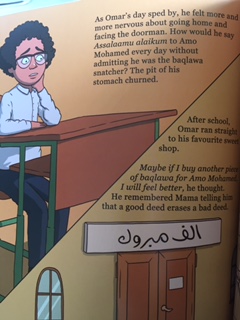
Set in Egypt, Omar eats the doorman’s baqlawa, and while he knows he shouldn’t have, he doesn’t know what to do about it.  The doorman, Amo Mohamed, blames the cat and Omar tries to move past the theft.  But the guilt builds up and he even dreams about baqlawa, eventually telling his mom so he can start to fix things.  

snatched1

After isha prayer, the two of them make some new baqlawa.  I love that the mom doesn’t get mad, but she is firm that while, “we made the baqlawa together,”  she tells him, “you have to talk to Amo Mohamed on your own.”  

Omar confesses his crime to the door man and apologizes, Amo Mohamed in turn apologizes to the cat, and all enjoy a piece of baqlawa together with smiles.

snatched4

The last page in the 38 page book is a glossary and is headed by a hadith by Prophet Muhammad, “Be conscious of God wherever you are.  Follow the bad deed with a good one to erase it, and engage others with beautiful character.”

The illustrations aren’t amazing, but they are sufficient and help walk the reader through the story.  I like that the mom covers when out and about, but not in the home.  The story is great for ages 4 and up, but the amount of text on the page and book length might make independent reading more geared to second and third graders. 

snatched2

The book would work for muslim and non-muslim children a like and does a good job of showing a universal situation in a culturally rich environment.


Ali and the Moon by M.I. Kafray illustrated by Aaliya Jaleel

Standard
Ali and the Moon by M.I. Kafray illustrated by Aaliya Jaleel

IMG_1421

I originally bought this book in Ramadan and had hoped to review it so that those looking for Ramadan books could benefit. But it isn’t Ramadan specific, just moon themed, and I really was so disappointed with the binding quality for the amount I paid for it, I didn’t think it was fair to review the story until I could get over the number of blank white pages in the book, and the overall copy-shop self-printed and bound vibe that the book emits as soon as you hold it.

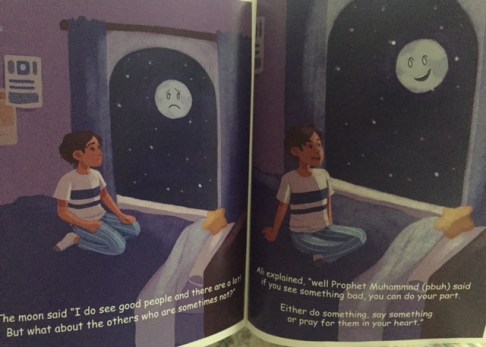
The premise of the book is the hadith that if you see something bad you should change it with our hands, and if you can’t, then change it with your tongue, and if you can’t do that, then pray for them in your heart. 

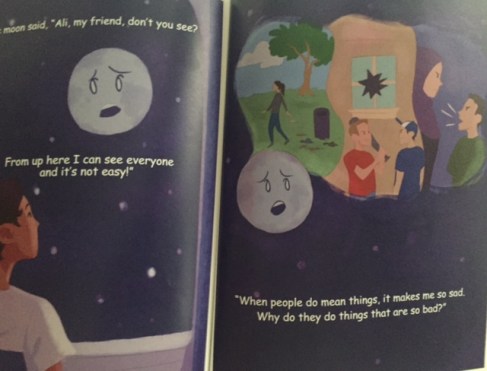
The 16 page book starts off a bit awkward, with the boy just staring at the moon, but by page five, the story hits its stride and is sweet.  The moon dims and is sad about the state of the world.  Ali starts talking to the moon in rhyming lines, and convinces him that there is still good in the world.  The moon and Ali decide that at night they will pray for the world and the people in it.

ali inside2

The end of the book has the hadith and the surahs one should say before going to sleep: Surah al-Ikhlaas, Surah al-Falaq, then Surah an-Nas and lastly, Ayatul Kursi.

The illustrations are cute, they are expressive and the moon and boy sweet.  I just wish the paper had more weight and that the story a bit longer.  A lot could be discussed with the premise of the Muslim boy talking to the moon with a great vantage point.  More specifics and more inspiration would have made this mediocre, albeit expensive book, great.

ali inside


Muhiima’s Quest by Rahma Rodaah illustrated by Daria Horb

Standard
Muhiima’s Quest by Rahma Rodaah illustrated by Daria Horb

IMG_0976

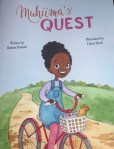
This picture book for ages 7 and up, reads incredibly smooth for the amount of text on each page, and the pictures are warm and expressive in this large (8.5 x 11) 32 page book.  Clearly the author is talented in writing and passionate about empowering her character to hold on to her culture and faith, however it seems overly forced at times.  

muhima

The premise is that it is Muhiima’s birthday, but that she doesn’t celebrate birthdays, her family only celebrates both Eids.  So when her mom hands her a surprise on the morning of her birthday and Muhiima asks if it is a birthday gift and her mom says, “kinda” it seems a bit like she is walking back from the premise. The tie-ins throughout the book as she journeys from location to location on her quest as a result seem forced.

muhima1

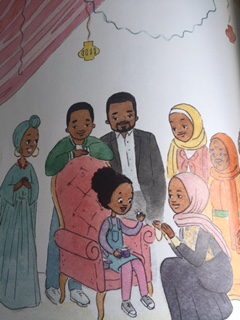
The map first leads her to her father’s book store to get wisdom and love and a gift that she can’t open until the end.  She also journeys to her Grandparent’s house, her Uncle’s basketball game, her Aunt’s beauty salon, and oddly her Masjid Quran Class, which apparently she is skipping, but stops to get the wisdom and gift from her teacher at, none-the-less.  Oddly enough, but at least noted, she reaches home to find everyone on her quest already there.

muhima3

On her way home, she sees her non-muslim friend Rosie celebrating her birthday and wishes she could have a birthday gathering with gifts and family too.  When she opens the door to her own home, she gets just that.  The passages detailing why it is hard to be different are incredibly relatable and poignant, but to then have Muhiima get the same thing with a different name, again seems like the author is walking back on her premise.

muhima2

The wisdom and advice the family gives to Muhiima is wonderful and powerful. I love that the character is a strong girl of color, and that her family is supportive and consistent.  They say Salaam, they pray, they go to the mosque.  Some of the little details were jarring, like why it didn’t specify what prayer, why it was her class that she visited at the mosque, how all the people got to her house before her, etc.  This minor glitches with the forced premise of relating the quest to her birthday, make the book overall a bit awkward.  This is so unfortunate because the advice and the quest are so endearing, while not being judgementat or preachy.  I don’t know how to fix it, I just hope, like really really really hope, that the author keeps writing and that her next book is a little more revised and editted.


Magnus Chase and the Gods of Asgard: The Sword of Summer by Rick Riordan

Standard
Magnus Chase and the Gods of Asgard: The Sword of Summer by Rick Riordan

The_Sword_of_Summer.jpg

Yes, that is a Rick Riordan book cover you see.  Yes, it is about Norse mythology.  Yes, the whole book is about fake gods and fictional demigods.  Yes, you are on the correct blog. 

Brace yourself, if you haven’t heard about Magnus Chase, son of the god Frey, whose series is now on book three, it is ok, Rick Riordan has brought a lot of mythology back to pop culture in a fairly short amount of time.  But this series stands out because get this, the Norse god Loki, (yeah the one featured in popular Marvel Avengers movies), in this series, has a daughter…named Samirah Al-Abbas…who wears hijab…and is a valkyrie…and is an Iraqi immigrant, and is a main character, and is really awesome.

The book is 497 pages and is also a pretty fun audio book.  It is an AR 4.8.

SYNOPSIS:

So, the basic plot is much like Percy Jackson, in that a young boy, in this case a homeless orphan, Magnus Chase, finds out that he is demigod and has to basically find some friends and save the world while learning about the given mythology that they belong to.  For Magnus, he learns about his father, Frey, the god of spring and summer, when he dies and is taken to Valhalla, a paradise for warriors in the service to Odin.  The whole book is about Magnus, who is now an einherjar, a member of Odin’s eternal army , trying to prevent ragnarok from happening.  Among his group of friends are Jack, the sword, Blitzen, a dwarf, Hearthstone, an alf, and Samirah (Sam).

WHY I LIKE IT:

By and large, Sam is pretty well developed as a practicing Muslima.  She is being raised by her grandparents and feels bad sneaking out to perform her valkyrie duties.  She is not at all comfortable being alone with males one-on-one, nor being seen with males as she has an arranged marriage to Amir Fadlan, her second cousin, when she gets older.  She wears a green hijab that doubles as a camouflage cloak, and she mentions going to the mosque with her grandma.  (In later books, according to my daughter, she also talks about fasting, how she is a practicing Muslimah and the daughter of Loki who handles all that Norse mythology throws at her.)  She is proud and strong, and really the only thing that makes no sense to me is why she takes off her hijab so freely when not in life threatening scenarios, I get when she uses the camouflage to hide in emergencies.  She apparently explains later that she considers the einherjar her extended family, but that wouldn’t make them her mehram, so it is still a bit sketchy.

Here is an interview question from Entertainment Weekly to Author Rick Riordan about Sam, and his answer: (http://ew.com/article/2015/10/14/rick-riordan-magnus-chase-interview/)

Speaking of Loki, one of my favorite characters in the book is Sam, or Samirah Al-Abbas. I think she’s a great example of a diverse character — not a white man, not a woman who’s there to be a love interest. She’s also seamlessly woven into the history of this myth. Can you talk about the conception of her character?

The idea for her started with the primary sources. The story that Sam tells in The Sword of Summer about an ambassador from the Caliph of Baghdad visiting the Vikings in Russia – that’s true. It really is one of our best sources because the Arabs of the time were reading and writing when nobody else was. That connection back then – that the world was a whole lot more connected even back then than we think of, that these cultures did not exist in these hermetically-sealed little bags, they were blending together all the time – that fascinated me. I thought, what would it be like to have a modern Muslim-American character who still had that connection to the Viking world like the Caliph of Baghdad did all those years ago?

And then again I started pulling on stories from students I’ve had in the past. One very powerful memory I have was being in my American history classroom on 9/11 and one of my students was a Muslim-American girl. She burst into tears when she heard the news, because she knew that her world, her life, had just changed, and had been defined for her in a way that she did not want and could only do so much to control. That really was powerful for me, and it inspired me to learn a lot about Islam and what the tradition actually was, as compared to what we hear about in the media and how it’s often distorted, and to honor her experience. Samirah kind of came out of that confluence of things.

FLAGS:

Obviously the whole story features multiple fake gods.  I don’t think it is celebrated though, they are beyond ridiculous, but if your kids can’t understand the idea of mythology or you think it is beyond the scope of fiction, that is your call. 

There is a ton of violence, as they prepare for ragnarok and just killing in general, some is gruesome. The book is not dark at all, however, it is in fact laugh out loud funny.  

There are some giants that get drunk, mention of mead, some jokes about Hel in reference to Helheim and the goddess of Helheim, Hel.  There are some “damns” scattered in as well. 

The stories of some of the gods is a bit scandalous, but for the most part the book doesn’t give much detail.  It does discuss Freya marrying dwarves for a day for their jewels and having kids with them.  There is flirting and mention of kissing.  There is also some mention of males being moms and animals and monsters being born of human parents, it is all very confusing.  But it is there. Also, my source, my 11 year old daughter, mentions that the rest of the series does have a gender fluid character named Alex.

TOOLS FOR LEADING THE DISCUSSION:

I doubt I’d do this as a book club book, but as any teacher or librarian knows, Rick Riordan fans are committed and enthusiastic.  I still keep in touch with many kids that weren’t big readers until the read Percy Jackson, and once they read the series multiple times, they then jumped to his other series.  So, while I wouldn’t use this as a book club book, there is a ton of kids that would love to discuss it with you, so read it, the bonding as a result will be well worth it.

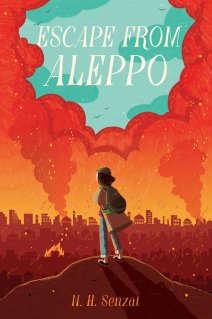
Escape From Aleppo by N.H. Senzai

Standard
Escape From Aleppo by N.H. Senzai

escape from aleppo.jpg

N.H. Senzai’s newest book (published in January 2018), gives a face and a voice to the grave situation in Syria.  Like Senzai’s other books, she uses the rich culture and history of a country to inform the reader, and a compelling front story to keep middle school readers entertained.  This 336 page book is not in the AR data base yet, but fourth grade and up should be able to follow the story and be able to handle the violence and destruction presented.  The story is unique in the genre, in that it doesn’t focus on getting to a safe country, but rather on the heroine’s journey to simply get out of a dangerous one, Syria.  The storyline is fairly linear with flashbacks of life before the war making the story informative, but not necessarily gripping.  I wanted to love it, but found myself forgetting about it when I stopped reading.  

SYNOPSIS:

Fourteen-year-old Nadia, has a fun full life in Syria: a large extended family, she stars in a commercial, has good friends, and a lot of opportunity and perhaps privilege.  All that, however, slowly disappears as civil unrest and ultimately war consume the country.  As a child she gets glimpses of the changes coming, but is able to still hide in her ignorance and focus on things like her nail polish and Arab Idol.  As food gets short however, she sneaks out to get bread with some cousins, and is hit by shrapnel.  While, her leg is able to heal, her anxiety of going out alters her life and makes her family’s attempt to get to the Turkish border later, a hard mental obstacle she must face.  Her inability to move quickly with the family on their covert escape route, and the bomb that hits their home, separates her from her family and leads to her getting left behind.  As she tries to remember how to get to the designated meeting location, she must navigate Syrian soldiers, rebel factions, ISIS, secret police, violence, hunger, and being lost.  With her cat, Mishmish, for companionship, Nadia reaches the location only to find that her family has left for Turkey and will wait on the border for her.  Luckily for Nadia, amidst this devastating news, she meets an old man, Ammo Mazen, and his Donkey, Jamilah, willing to help her reach the border.  Along the way the two face long odds of surviving, not only from the war around them, but also the weather, the old man’s illness and lack of food and water.  As they journey through Aleppo, snippets of history and culture are shared, two more children join their journey and mysteries as to who Ammo Mazen really is come to light. 

WHY I LIKE IT:

The book’s premise is simple, allowing the reader to focus on Nadia and her companions and not get bogged down in the political factions and names and alliances.  The book is not about all of the aggressors, it is about a girl trying to reach her family, and the growth and ability to choose kindness that she learns along the way.  The girl is not religious, but culturally it is a part of her environment.  Her companion Tarek, is religious and he spouts Islamic tidbits as they journey, adding some knowledge to be conveyed about Islam which is sometimes informative and sometimes comical as his character is often a bit awkward. 

I love the cultural beauty that is conveyed, and the heaviness in Syrian’s heart that “What had taken five thousand years to build had taken less than two to ravage.” The saving of historical artifacts, the showing of cooperation between people of different faiths as the characters meet in mosques and churches and meet people of all backgrounds, makes the loss of humanity and history so palpable. 

I also love that there is an Author’s Note at the end.  The whole book I kept having to shush my mind as I felt like this was the story of Mariam in Senzai’s book Shooting Kabul.  Yes that takes place in Afghanistan, but it was so similar in that it was a girl getting separated from her family in an escape attempt during a war, and sure enough she mentions that, that is where Nadia’s story grew from.  

FLAGS:

There is a lot of violence and death, but nothing gruesome or sensationalized.

TOOLS FOR LEADING THE DISCUSSION:

This would be a great Book Club choice, because it would encourage readers to keep at it and finish the book.  While reading it, the book is wonderful, but for some reason, I had to urge myself to pick it up and start it again.  Perhaps it is because I have read all of Senzai’s books and I was pretty confident all would end well, or because I’ve read quite a few books now about war and refugees and Syria, but while it reads quick it did take me longer than it should to finish it.  I think parts of the book that detail a lot of the skirmishes and fighting might be hard to visualize in the mind’s eye so as an assignment or Book Club selection would benefit the readers to allow them to discuss all the mini climaxes, understand the terrain and architecture, and to really put themselves in Nadia’s shoes.  The transformation in Nadia from a brat, more or less, to a compassionate, strong, determined young woman is a journey that I would love to hear feedback from other kids about.  I think they would definitely have thoughts and opinions that would really bring the humanity of us all out, and make us connect with the plight of those trying to get out of such horrific circumstances.

Publisher’s Page: http://www.simonandschuster.com/books/Escape-from-Aleppo/N-H-Senzai/9781481472173

Teaching Guide: https://www.teachervision.com/teacher-discussion-guide/escape-aleppo-reading-guide

Author’s Page: http://www.nhsenzai.com/escape-from-allepo/


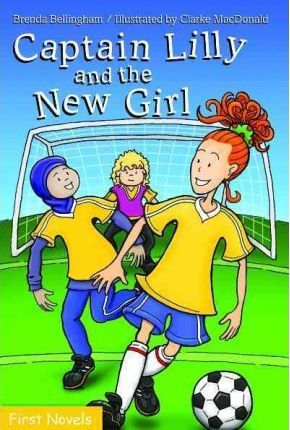
Captain Lilly and the New Girl by Brenda Bellingham illustrated by Clarke MacDonald

Standard
Captain Lilly and the New Girl by Brenda Bellingham illustrated by Clarke MacDonald

lilly.jpg

This book is part of First Novels, a collection of books in Canada that focuses on easy to read early chapter books that encourage kids to transition from leveled readers, while getting to know a single character in a realistic contemporary world.  There are a lot of Lilly books, but this one caught my attention because of the hijab wearing girl on the front, presumably the “new girl.”  At an AR 2.8 this 64 page book is great on so many levels, and really does meet the First Novel goal of presenting a simple theme and showing the main character grow.

SYNOPSIS:

Lilly is changing soccer teams, and only finds solace when many of her school friends will also be joining.  While each of the girls has different opinions and levels of enthusiasm about the team, they all are committed to one another as the “Wolves” stick together in a pack.  This loyalty is tested when a new girl is brought in to fill in for an injured wolf.  The foreigner, from America, wears a scarf, and just like with soccer, there are a lot of differing thoughts on the matter.  The reader see what Lilly feels as it is told from her perspective, which makes the issue not so much about the hijab itself, but about how a 9 or 10-year-old thinks and processes new concepts.  Ultimately, the Wolves as individuals and a team, have to decide what to do when an opposing team says that Sara has to take off her hijab if she wants to play.  

WHY I LIKE IT:

I love that the book is real, with strong independent girls.  The side characters aren’t cookie cutters of each other, they all have personalities and quirks, and I love that they don’t all agree, yet they all can make it work.  The book’s catalyst is the hijab, but it isn’t preachy and it is presented and understood through a non-muslim elementary-age character.   I don’t think Islam or Muslim is even mentioned, nor any culture, she is American, and the book takes place in Canada.  It addresses safety regarding the hijab, comfort in wearing sweats and not shorts, and being hot in a long sleeve shirt, issues that any reader can understand and ponder about.  The book isn’t gripping, but for the age group and the intent, it is spot on.  The font, spacing, size of the book, and simple illustrations, urge kids to read a “chapter book” and think about something they may not have ever thought about before.

FLAGS:

Clean, it does say words like “suck,” but it isn’t disrespectful.

TOOLS FOR LEADING THE DISCUSSION:

I wouldn’t use this as a Book Club book, because the kids can read it fairly quick, but I would probably read it aloud to kids and have them discuss, or have them somehow read it in groups and discuss.  There are a few websites that can help facilitate the discussion, but kids would definitely have opinions on how the situation was handed, how they might handle it, and what they think of the team’s sponsor.  

https://www.teachingbooks.net/tb.cgi?a=1&tid=40533

Click to access FirstNovels_Series_ActivityGuide.pdf

http://www.formac.ca/firstnovels


Amal Unbound by Aisha Saeed

Standard
Amal Unbound by Aisha Saeed

amal unbound.jpg

This book was suggested to me and I was thrilled to find it at the public library so quickly after its May 8, 2018 release date.  I love that it is an AR 4.2 and 226 pages about a girl standing up for her self, determined to be educated, and facing whatever society, and culture, and circumstance throw at her.  The protagonist is 12, but I think most middle school readers will find the story a bit too idyllic, perhaps even too simplistic and neat.  I really think the AR level of 4.2 is spot on in terms of writing level, interest, and story telling: 3rd through 5th graders will benefit the most from this inspiring, memorable and informative tale.

SYNOPSIS:

Amal lives in a small Pakistani village.   The book opens with her begrudgingly having to take time off from school, as the oldest, to help her mother who is about to deliver her fifth daughter.  The stage is quickly set to show a supportive father, but the cultural stress involved in educating a girl is incredibly strong.  The priority is to care for the home when push comes to shove and this fight is simplified in the book, but not completely belittled.  Right away we also see some class divisions with servants and landowners and the various positions in between.  It is easy to judge those with money as being evil, but the author does show some nuances in character aside from wealth and position.  As Amal’s mom struggles with recovering after the baby, it is decided that Amal will miss more school.  This devastates Amal who dreams of being a teacher.  Burdened by keeping up the house and carrying for everyone’s meals, laundry, and watching her younger sisters constantly, frustration mounts and she snaps when an arrogant man tries to take her pomegranate in the market.  Her simply saying no, is the catalyst that changes her life as the man she stands up to, Jawad Sahib, is the wealthy land owner everyone in town is indebted to.  Saved by his mother, Nasreen Baji, who is in need of a personal servant, Amal is now forced to pay off an impossible debt to a cruel powerful family. 

In  many ways the story doesn’t really get good, until Amal enters the Khan family’s world, about 50 pages in to it, but obviously the character building and detail is necessary, so if you find your kid is getting a bit bored, encourage them to keep going.  

Once, she arrives at the Khan compound, she begins to make friends, and enemies, and similarly see just how ruthless Jawad Sahib is, and can be.  As she finds her own voice and realizes her own role in determining how others treat her, what her future holds, and what power she does have, she is forced to wrestles with the choices in front of her. Ultimately, the reader will cheer for her to take a stand and be bold in doing what is right, no matter the cost.  And while one can guess, because of the target demographic, that it has a happy ending, I won’t spoil the climax, the resolution, or outcome of the young heroine.

WHY I LIKE IT:

I love that despite the themes, the story isn’t depressing, in many ways it is informative and inspiring. I think the fact that things are not left to ponder but clearly articulated, has its merits in a book for elementary children who might be overwhelmed by the cultural aspects to think critically on their own.  At the beginning, with the birth of yet another daughter, the biggest concern is that the mom is depressed because she hasn’t had a boy.  The mom even apologizes to the dad about this.  The neighbors, friends, everyone seems so upset about it, but Amal doesn’t understand why the women particularly seem disappointed, when they themselves were little girls once, and this simplistic point of view on such a complex and real issue, is so spot on and obvious, I loved it.  The mom and dad point out that it is God’s doing and they clarify that they are not sad the baby is a girl, and to me it seems obvious the mom is suffering from postpartum depression, but the book only describes it, it doesn’t identify it.  I also love that there is perspective on how while Amal is in forced servitude and thus not free, either is her female boss, who is unable to go visit her family, or to garden.  This helps amplify that even the wealthiest woman, is still limited to be truly free in the context of the character’s world.  

I like that the book is culturally authentic and not judgemental.  There are strong females, supportive male friends, and plenty of details to show that the author is writing about what she knows, and that she loves her culture.  Islam is mentioned only a few times with regards to prayer time, but nothing more.  There is nothing about praying for anything specific, or covering, or religious beliefs, practices, or traditions.   The book like the author’s first book Written in the Stars, almost oddly leaves religion out, and stresses culture.  Because this book is for a younger audience, it isn’t as obvious, and if I didn’t write reviews about books I probably wouldn’t notice.  

The presentation of culture, the idea of indentured servitude, and females being educated is balanced and explained pretty well.  At most many of the readers will know little of Pakistan, but may have heard of Malala, and the author talks about her in the Author Note.  I like that this book shows a fictional strong female in a similar vein as Malala, but also shows that it isn’t an outside force, the Taliban, preventing her from an education, but in some ways a whole societal view.  I think this expansion of paradigm is really the most powerful thing about this book.  It is important to understand that people may want their daughters educated, and opportunities may be available, but sometimes more is needed.   A lot more to change tradition, on a lot of different fronts.

The book also does a good job of showing some of the paradoxes that exist in developing countries as well: Amal rides in a car for the first time, but also is handed a cell phone from her mom, she knows all about email but has never used a computer.  For readers to see that somethings are very similar to their own lives, and some things are foreign, will make Amal and what she stands for have staying power and relevance, long after the end of the book.

FLAGS:

There is talk of physical violence when people are murdered, crops burned, and Amal is slapped.  There is some lying, but the truth comes out. Overall: clean.


TOOLS FOR LEADING THE DISCUSSION:

I would absolutely present this book as an Elementary Book Club selection and I would encourage teachers to use it as a novel study.  There is a lot of perspective to be had from this book, and its clean simple style will keep the keep points in focus.

Author’s website: http://aishasaeed.com/amalunbound/

Q & A with the Author: https://www.publishersweekly.com/pw/by-topic/childrens/childrens-authors/article/76814-q-a-with-aisha-saeed.html

Discussion Guide: http://www.penguin.com/wp-content/uploads/2018/05/AmalUnbound_Brochure.pdf