Category Archives: middle grades

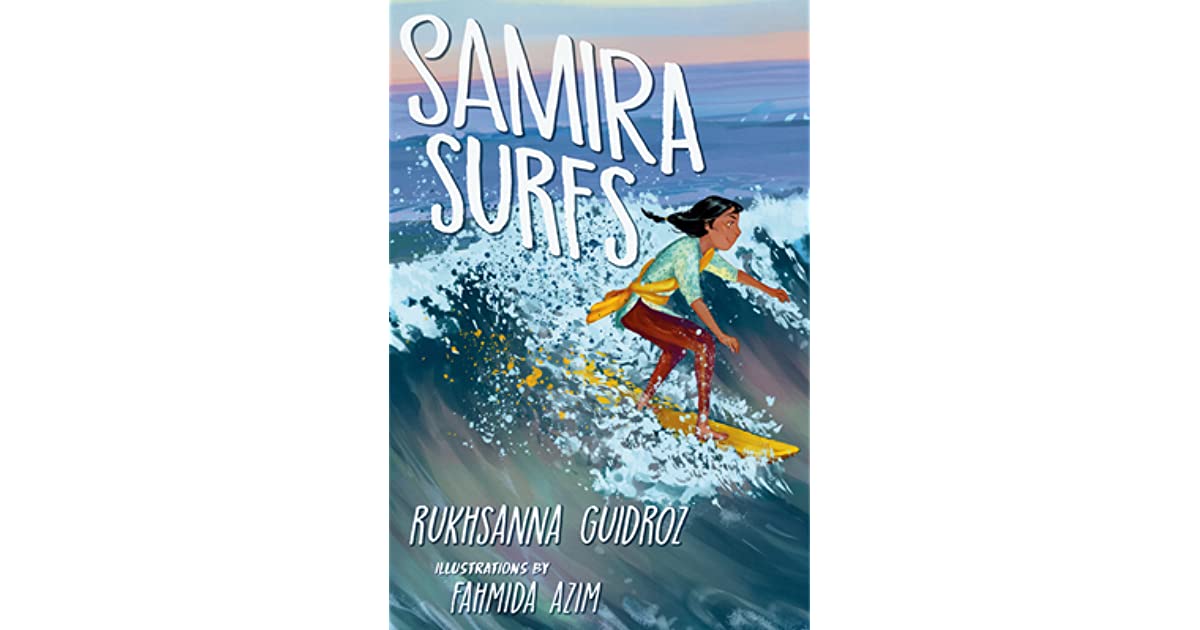
Samira Surfs by Rukhsanna Guidroz illustrated by Fahmida Azim

Standard
Samira Surfs by Rukhsanna Guidroz illustrated by Fahmida Azim

surfs

I have been anxiously waiting for this middle grades 411 page book in verse to be published.  The last few books I’ve read in this style with smart strong female protagonists have blown me away.  This book unfortunately really fell flat.  I think the difference is most OWN voice narrative do so well in prose when the emotion can be felt and explored deeply, so that when the story moves forward with sparse words the reader can forgive the gaps and jumps.  This didn’t have that insight, sadly, and just left a lot of holes for me. The author’s family on her father’s side is Muslim, she is Persian Indian Chinese, not Rohingya or Bangladeshi, and that isn’t to say that she can’t write a story about them, but it just felt lacking, and this is my assumption as to why.  The author is a surfer, and that is where the detail and passion really shines. The book is fine, it just didn’t inspire me or move me.  It checks boxes for having characters with strong Muslim identities, highlighting a persecuted population, showing diversity within subcultures, and showing universal similarities, so I’m glad the book was written and is available, I just wanted it to be so much more.

img_2388

SYNOPSIS:

Samira and her family have recently made the perilous escape from Burma to Bangladesh.  Burma decided that the Rohingya must be killed and convinced the majority Buddhist to turn on their Muslim neighbors.  Her parents and brother survived, but her grandparents, her Nana and Nani, drowned on the way.  Samira’s family were turned away from the over filled refugee camp in Cox’s Bazar and have set up with others, their own meager living on the outskirts.  Samira’s father works for very little illegally as a shrimper, her brother as a waiter, and she sells eggs on the beach to tourist.  Ever on the lookout for police and from angry Bangladeshis, life is lonely and frightening.  Slowly Samira starts to make friends with other girls, her brother Khaled is helping translate and is beloved by his employer.  When their father gets injured however, the family is thrown in turmoil as they need his income.  At this same time Samira starts to be tempted by the ocean and the surfer girls that seem so free and fearless as they take on the waves.  Knowing that her family will not support her surfing, her brother agrees to teach her how to surf in secret, like he is teaching her to read and write English.  A surfing contest is announced for boys and girls with a substantial monetary prize for the winner, but Samira is not allowed to be in the water, and the Bangladeshis in charge of the surf boards are not happy with how much potential Samira has to win the competition.

img_2389

WHY I LIKE IT:

I love that the story brings some awareness to the under represented Rohingya and that it shows resilience and strength.  It talks about religion, they opt not to fast in Ramadan because the father is weak after his accident and he proclaims that if he isn’t fasting no one should.  The men go to the mosque, the mom talks about hijab.  Cultural words are dropped in and foods mentioned.  The illustrations are fun and engaging and do a good job of breaking up the text and keeping the reader connected.  I loved the dad and his way of supporting his kids, I also loved the brother sister relationship, but ultimately, the plot holes just overwhelmed the straightforward story line.

I wanted to know more about the tourist near this refugee camp, who were they (Bangladeshis? foreigners?) and what was that dynamic like.  I wanted to know where the eggs came from and how that was set up as a job for Samira.  How come the family was nervous about Samira being on the water since that was how her grandparents died, but not her brother? I get that as a female grows the family might not want her in a bathing suit out swimming for modesty issues, but I didn’t like how the book just chopped it up to swimming being against Islam, clearly she was taught to swim and obviously it isn’t.  I was looking forward to some big reveal about the brothers notebook of drawings.  I thought maybe he would get them to a newspaper or get them shared somehow to give insight to what his people were experiencing.  It seemed like it was teased that there was going to be a climax there, but there wasn’t and it felt misleading.   I didn’t get the whole standoff with the other surfers protesting if Samira wasn’t allowed to surf they wouldn’t either.  If the organizers weren’t letting her that makes sense, but why would her parents care? There wasn’t a clear connection and the speed and vagueness in which it was resolved was disappointing as it was presumably the point of the story.

img_2390

FLAGS:

Fairly clean.  There is bullying and mention of death.

img_2379

TOOLS FOR LEADING THE DISCUSSION:

I don’t think I would do this for a middle school book club.  It is a solid middle grade read.  Possibly it could be used to supplement a larger unit of study about refugees or particularly the Rohingya.  Older readers will be left with more questions than they had when they began the book though, and wonder what the point of the story was at all.

img_2373

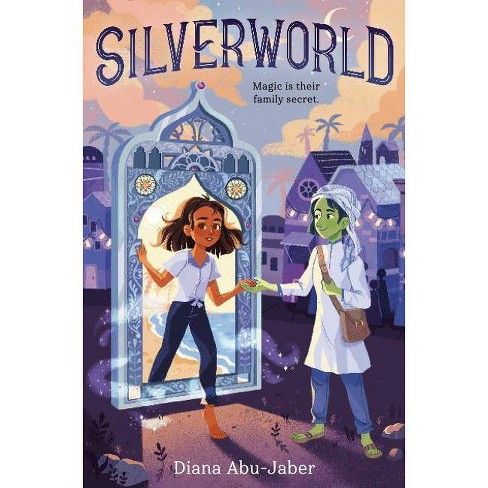
Silverworld by Diana Abu-Jaber

Standard
Silverworld by Diana Abu-Jaber

silverworld

At 304 pages this middle grades fantasy OWN voice book attempts to weave together a granddaughters love for her Teta, with her adventures in a mythical world that only she can save.  In much the same way of Narnia, or Gregor the Overlander, or even Alice in Wonderland, the book takes a realistic character and pushes them, in this case Samara aka Sami, just beyond, into a world filled with mystery, adventure, and lessons.  The Lebanese flavor sprinkled in adds a little depth and uniqueness to the story, and aids a bit in the world building, but it isn’t a strong presence outside of ifrits and character’s names.  Teta is a Beduin that has a prayer rug and tarot cards and a painting of the Virgin Mary that she calls Fatima, and Sami’s deceased dad was American and the house has Christmas lights.  At one point the book remarks that Teta “likes to pick and choose her beliefs.”  The premise starts with Teta showing signs of dementia: speaking in a language no one but Sami can understand, and not eating and seeming present, the resolution as a result could give children the wrong idea about treatments for such real conditions, and adults might want to make sure their middle graders wont be triggered by the decline of a loved one.  The book is written well and holds reader’s interest, the world building is decent and the character’s relatable, I don’t know that it is overly memorable, but it is a fun light magical read with culture and family and friendship at its core that readers will enjoy.

SYNOPSIS:

Sami and her brother Tony, along with their attorney mom Alia and maternal grandmother, Serafina, have just moved to Florida from Ithaca, New York.  The children’s father was killed and the family has moved a few blocks away from his sister to start anew.  Sami is not settling in, and to make matters worse, Teta has stopped talking coherently, and Aunt Ivory and Alia are looking for a nursing home to place her in.  For some reason though, when it is just Sami and her grandma, she can communicate just fine, and Teta tells stories of her adventures with her flicker Ashrafieh in Silverworld.  Sami doesn’t necessarily believe the stories are true, but she gets the idea to use her Teta’s fairy stories to try and save her grandma, but when she finds her Teta’s spell book and peers into an old beloved mirror, Sami is taken to Silverworld and realizes that it is not just her grandmother’s future at risk.

In a world of flickers and shadows, Sami finds two balancers that taker her in and guide her: Dorsom and Natala.  The world is a reflection of the Actual world, but the Shadow Nixie is consuming the land and taking prisoners.  The balance is off, and Sami is convinced that this darkness is what is also harming Teta.  Between shadow spies and giant rotifers, magic and prophesied destinies, Sami must push her fear away and accept that she can be the one to set things right.

WHY I LIKE IT:

I like that Sami has to step in to her own and fight for what she wants, even when she is afraid.  I love the relationship she has with her Teta it is very warm and palpable.  I feel like the “saving Silverworld will save her Teta thread,” however, is lost in the middle of the book, it might be the catalyst and might have worked out that way in the end, but I don’t know that the middle makes the case that the two efforts are one and the same.  I appreciate that there are glimpses of Lebanon in the story with the athan in the background and spinning dervishes, but outside of Teta and a bit of the food, the cultural elements seemed a bit forced and deliberate instead of stemming from a natural flowing place.  A bit odd since it is an OWN voice novel, but maybe I was just wanting more. I would have liked more information about how Teta settled in America, learned English etc., or about her tattoos and Beduin upbringing. Another thing that seemed off to me was the close relationship of Dorsom and Sami at the end.  I hadn’t over nearly 300 pages realized that they were that much closer than Sami and Natala.  I even went back to see if I had missed something, but I couldn’t find that I had.  I wasn’t entirely sure why they were going to see Nixie either, I mean yes it was logical for they type of book it is, but I don’t know that Sami really had a plan for Silverworld or her Teta, she was just going to Nixie’s castle to get there.  There were also a few inconsistencies such as Sami wishing her and Tony could go fishing or surfing, when the book has made it clear that Sami is afraid of the water, particularly the ocean.

FLAGS:

There is magic, killing, death. There is talk of goddesses, there is a female character, a shadow, that has two flicker husbands and children with them both.

TOOLS FOR LEADING THE DISCUSSION:

I don’t think this would appeal to middle school readers, it is a solid middle grade book.  I do think fourth and fifth grade shelves would benefit from having this book available to be picked up and enjoyed.

The Magical Reality of Nadia by Bassem Youssef and Catherine R. Daly illustrated by Douglas Holgate

Standard
The Magical Reality of Nadia by Bassem Youssef and Catherine R. Daly illustrated by Douglas Holgate

nadia

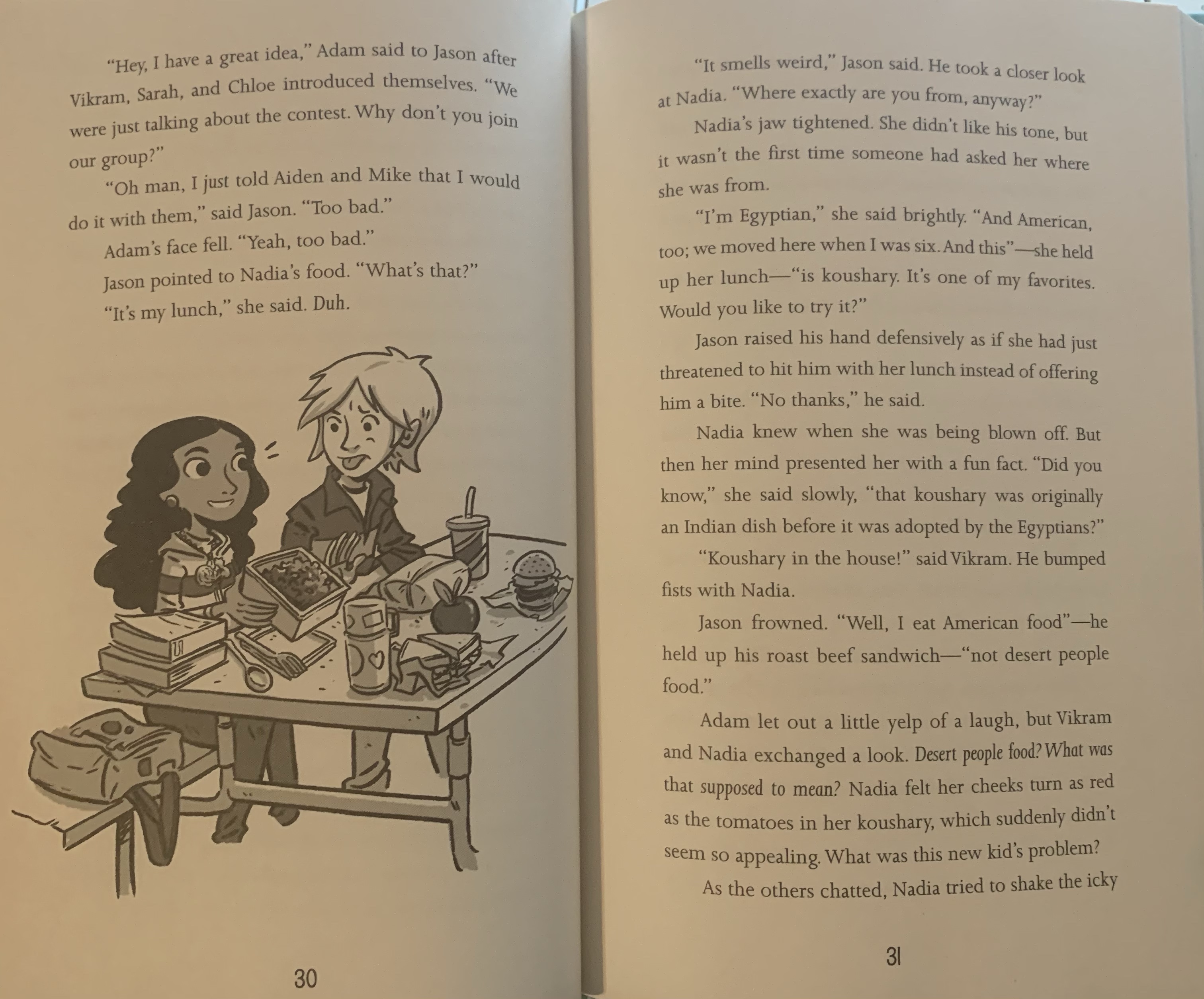
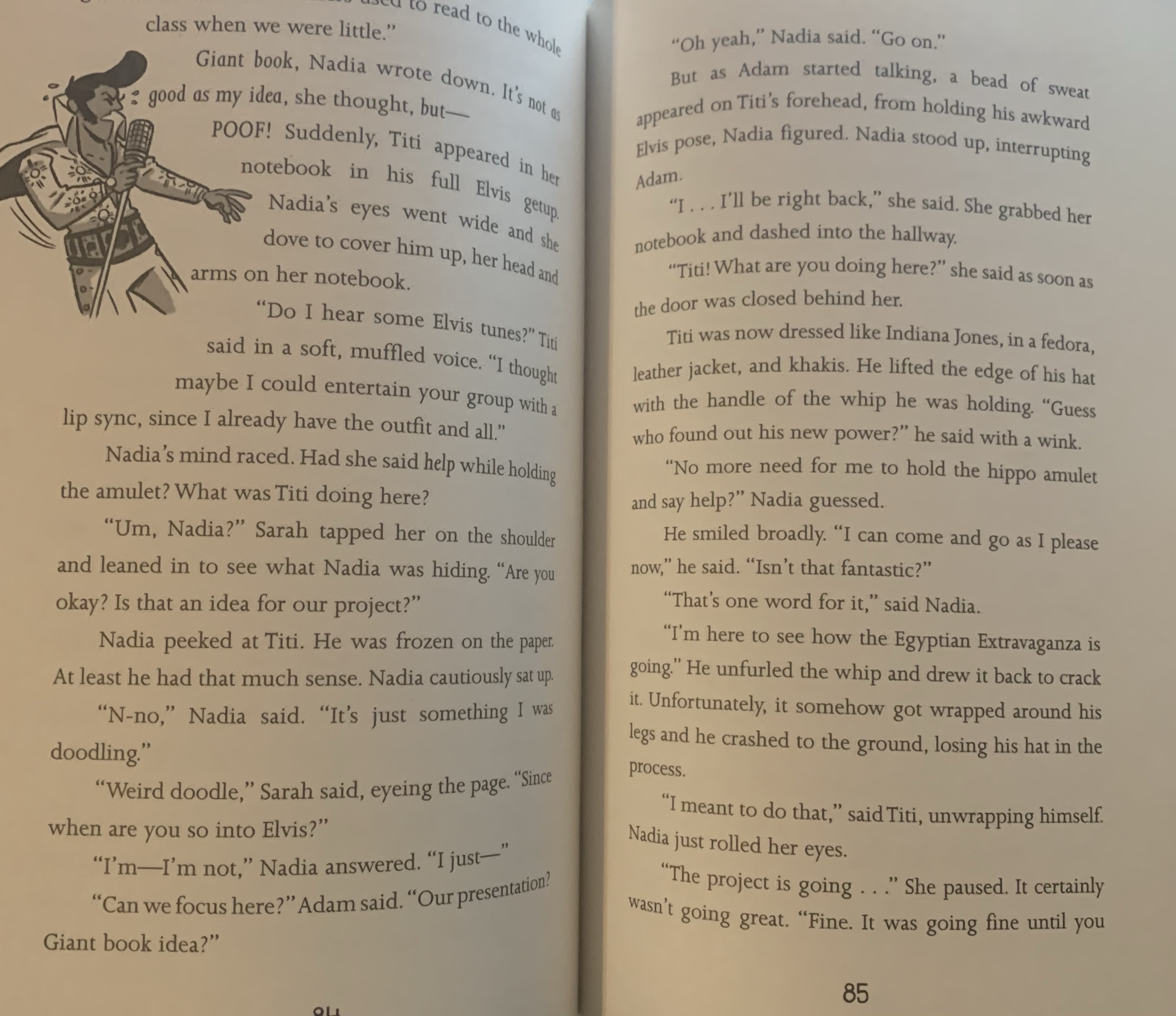
This middle grades AR 4.5 OWN voice book by Muslim author/comedian/surgeon/activists Bassem Youssef mixes text, comic strips, and illustrations over 166 pages to tell a story about ancient Egypt, friendship, leadership, xenophobia, and life sprinkled with magic.  It has a lot of potential, and I liked the lessons that Egyptian-American Nadia learns, but it just seemed lacking to me.  It seems to be book one in a series, and in many ways it reads like an introduction.  The magical element is underdeveloped to me and often just annoying.  The micro aggressions,  racism, and character’s ages would suggest upper middle grader readers would gravitate toward the book, but the overall writing style and length would more appeal to younger readers.  This disconnect makes the book hard to pin down and hard to connect with.  I’ll definitely check out future books in the series even though no religion is mentioned, because this brown girl has a lot of potential to break down Arab-American stereotypes and empower readers to be proud of where they and their families are from as universal obstacles are worked through.

img_1640

SYNOPSIS:

Nadia has just come back from a summer vacation visiting family and friends in Egypt and can’t wait to get ice cream with her best friend Adam.  She picked up an Egyptian comic book for him and is anxious to see if he likes it.  Except the comic book seems to have disappeared and when she asks her many bobble heads to help her find it, her necklace with a hippo amulet starts to glow and an ancient Egyptian teacher, Titi, starts talking to her from the now found comic book pages.  As Nadia figures out how to control this ancient man who lives around her neck and in papers around her, she also has to deal with a new kid that acts like a bully and has the admiration of her best friend Adam.  Nadia loves facts and her and her friends call themselves the Nerd Patrol.  Nadia can be a bit bossy though, and while usually her friends let it go, she seems to be stepping on toes lately, especially with Adam.  When a competition at school is announced that will result in an exhibit at the Museum of American History, Nadia will have to use her “genie” to get help coming up with ideas for her display, coping with a bully, restoring friendships, and learning how to be a leader before her friendships fall apart.

img_1641

WHY I LIKE IT:

I love that Nadia is so proud of her culture and doesn’t feel like she has to pick one of her hyphens over another.  She brings Egyptian food for lunch, wears Egyptian inspired clothing, and is still very “American” as well.  Ancient Egyptian tidbits as well as modern day Egyptian information seeps through and weaves into the story smoothly.  The  diverse side characters are also a plus.  I think her trying to handle the bully in multiple ways makes the story resonate with other kids and gives readers something to ponder over.  I worry that most readers, however, won’t know who Elvis Presley is, or get if Titi is really helping or not and how it all comes together for him.  I am curious to see if he is a major character in future books, because I still have a lot of questions about his knowledge and understanding of the world after being trapped in an amulet for so long. Really, she could have learned so much from him, she just scratched the surface.

img_1642

FLAGS:

There is teasing and bullying and racism, subtle and overt.

TOOLS FOR LEADING THE DISCUSSION:

This book is too short and superficial for a middle school book club selection, but it could be a fun read aloud in a 3rd or 4th grade class.

World in Between: Based on a True Refugee Story by Kenan Trebinčević and Susan Shapiro

Standard

world in between

I’ve read a lot of refugee stories over the years about people leaving a variety of countries, and while each one, no matter the quality of writing, is heartbreaking and important, this middle grades 384 page historical fiction/ fictionalized biography account stands out because it is written so incredibly well.  The story shows young Kenan’s life before the Balkan War in Bosnia, a year of the war, life in Vienna, and then in the USA.  The book is personable, relatable, and informative.  I had a very hard time putting it down despite knowing that the main character, the author, obviously survived; as the story is engaging and powerful and doesn’t rely on the horrific war to carry the character building and story arcs alone.  The character identifies as Muslim, but doesn’t actively practice or know much about Islam, sports and art are highlighted as universal activities that bridge cultures, language, and foster respect.  The book mentions drinking, kissing, hints at a crush, and features bullying, death, killing, and torture.  Suitable for mature fourth graders and up.

SYNOPSIS:

Kenan has a good life in Brčko, Yugoslavia, he is good at soccer, is an amazing artist, has a bunch of friends, a teacher he likes, loving extended family, his father owns a popular gym, and his mom is an office manager, sure his older brother picks on him sometimes and he gets called, “Bugs Bunny” because of his large protruding teeth, but when it all comes crashing down because of his religion, he is at a loss as to why it suddenly matters.  While neighbors and classmates start sneaking off in the night fearing that the Serbs are going to kill all the Muslims and Catholics, Kenan’s dad holds out hope that he is well loved by everyone at his gym, no matter their religion.  But the family waits too long to leave, and friends, neighbors, classmates, and teachers quickly turn in to enemies.  Kenan’s buddies threaten and abuse him, his favorite teacher holds him at gun point, and neighbors shoot holes in their water cans.  The family ultimately has to hunker down in their apartment without much water, food, and electricity.  They get to Kenan’s aunt’s house in a safe zone, but the men have to register and his father and brother are taken to a concentration camp.  Somehow they get released, but the family’s troubles are just beginning.  Along the way they will be betrayed by people they thought they could trust and helped by people that they thought hated them- no matter the country, no matter people’s religion.  The family will get to Austria and to Kenan’s uncle, but even being away from war doesn’t give them peace.  They don’t speak the language, they can’t work, they must take charity.  Eventually they find themselves in Connecticut, and while some American’s make their difficult lives even worse, some prove to be absolute angels to a family that is trying to make a life in a new country while the war wages on back home.

WHY I LIKE IT:

I love that stories about the Balkan War are becoming more and more available, it is long overdue, and I’m glad that through literature, authentic voices are keeping the memory of the horrific acts from being forgotten.  The story is compelling, a few threads I wanted resolved that weren’t (more information on his grandma, his uncle in Vienna, his aunt that they left behind), but the narrative is rich and does a great job staying relevant to its target audience and not overwhelming the reader with politics or sensationalized emotions.  The rawness of the experience being processed by the 11 year old protagonist is impactful enough and doesn’t need to be exaggerated.  The book is not depressing, in fact there is a lot of joy and hope and kindness.  

I love that Kenan acknowledges that he has been to the mosque once with his uncle, that they don’t fast in Ramadan, but they do celebrate Eid.  It hints that at times they may drink, but they are good about not eating pork, although they eat jell-o. In shop class in the United States his first project is a replica of the mosque in their neighborhood.  Their names are known to be Muslim in Bosnia, and that is enough for them to endure the ethnic cleansing, belief or adherence, is not a factor.

I love that sports and art are universal.  Math is too, but Kenan isn’t good at math.  He wins accolades in each country for his drawings, and gets respect from classmates for his athletic ability.  Not speaking the language is hard, but being able to prove yourself in other ways is a salvation for Kenan.  He is on teams, he goes to the World Cup, he gets in fights, he is honored in the newspaper.  Life in general grounds him, yet soccer and drawing give him a release to excel in.

I love the diversity of everyone in each country.  Heroes are seen in immigrants, minorities, Americans, a Methodist preacher, an Israeli bus driver, a Serb bus driver, a Serb soldier and his family, a .  There are awful immigrants, and white Americans, and Serbs- it really shows that some people are just good and kind, and some people are not, it isn’t linked to any faith or country or culture or neighborhood or skin tone.  I was surprised that at no point were their other Muslims.   We got to know so many wonderful Bosnians in the 90s as our family helped them get settled, that I was really hoping there would be some in Connecticut working with the churches that helped settle Kenan and his family.  That isn’t a critique of the book, though, just my disappointment in my fellow Muslim-Americans for not stepping up enough in real life to make the literary cut, I suppose.

FLAGS:

Violence, torture, death, bullying, killing, shooting, hints at sexual assault, physical assault, ethnic cleansing, genocide, war.  It mentions that Kenan’s brother got to kiss a girl and have a drink, but nothing more detailed than that.  Kenan has a crush on a girl, but it manifests periodically as him just wondering if she survived and is ok.

TOOLS FOR LEADING THE DISCUSSION:

This book is on a short list for me to use next year for middle school book club.  It is a little below grade level for my group, but book club is supposed to be fun and not a burden, so I think it will be perfect.  The kids are going to absolutely love Kenan.  He is so relatable and personable, that I don’t think any supplemental questions or discussion points will be needed.  Kids will have lots of thoughts about Islam in Bosnia, friends turn enemies, restarting in new countries again and again, anger at people that didn’t step up, glee when people did, jealousy when he gets to go to a World Cup game, and hopefully empathy for so many who’s world changed so quickly.  The biggest takeaways will be how it didn’t take much to help, and I hope all readers will recognize that we can be kind and we can help and we can respect and care enough to truly help others.  

Roots and Wings: How Shahzia Sikander Became an Artist by Shahzia Sikander and Amy Novesky illustrated by Hanna Barczyk

Standard
Roots and Wings: How Shahzia Sikander Became an  Artist by Shahzia Sikander and Amy Novesky illustrated by Hanna Barczyk

roots and wings

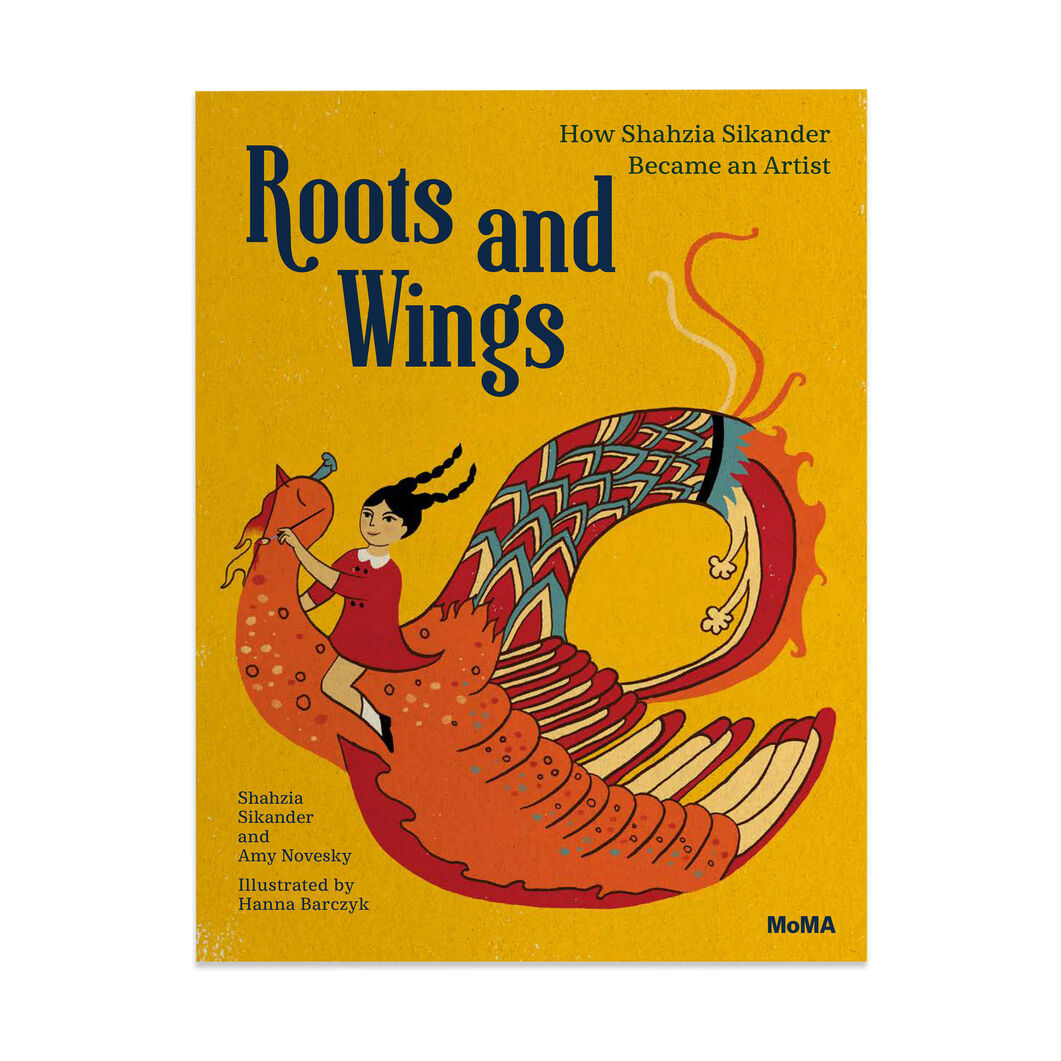
At 40 pages, this biography about Pakistani born artist Shahzia Sikander is filled with culture and experiences.  The story shows the influences of her family, the city of Lahore, her love of math, and her art education have in shaping her in to the artist she is today.  The book features photographs of her work at the end, but I found it odd that she didn’t illustrate the book herself.  The playful blocky pictures and text would appeal to first or second graders with some assistance, but would be better suited for readers a bit older if they are unfamiliar with some of the cultural and artistic vocabulary.  There is no mention of Islam in the book, when researching, it says her family is Muslim.  It seems she went to Catholic school, and a road trip was taken that included visiting the Sistine Chapel.  A few illustrations show people in hijab and it mentions the athan ringing out five times a day.  The book was interesting, but I wish I could have found it at the library, rather than purchasing it.  I don’t know that it will be read more than once, but that speaks more to personal preference, rather than the quality of the book. If you enjoy fine art, are from Lahore, are a fan of Shahzia Sikander’s work, you will definitely enjoy this book.

img_1695

The story starts with a girl stepping in to a painting with many rooms, filled with many people in a joint family.  It is her (Shahzia’s) home, and her family.  The rooms are filled with ancient fables, Russian fairy tales, poetry, English, Urdu, Bollywood songs, and American Westerns.

img_1696

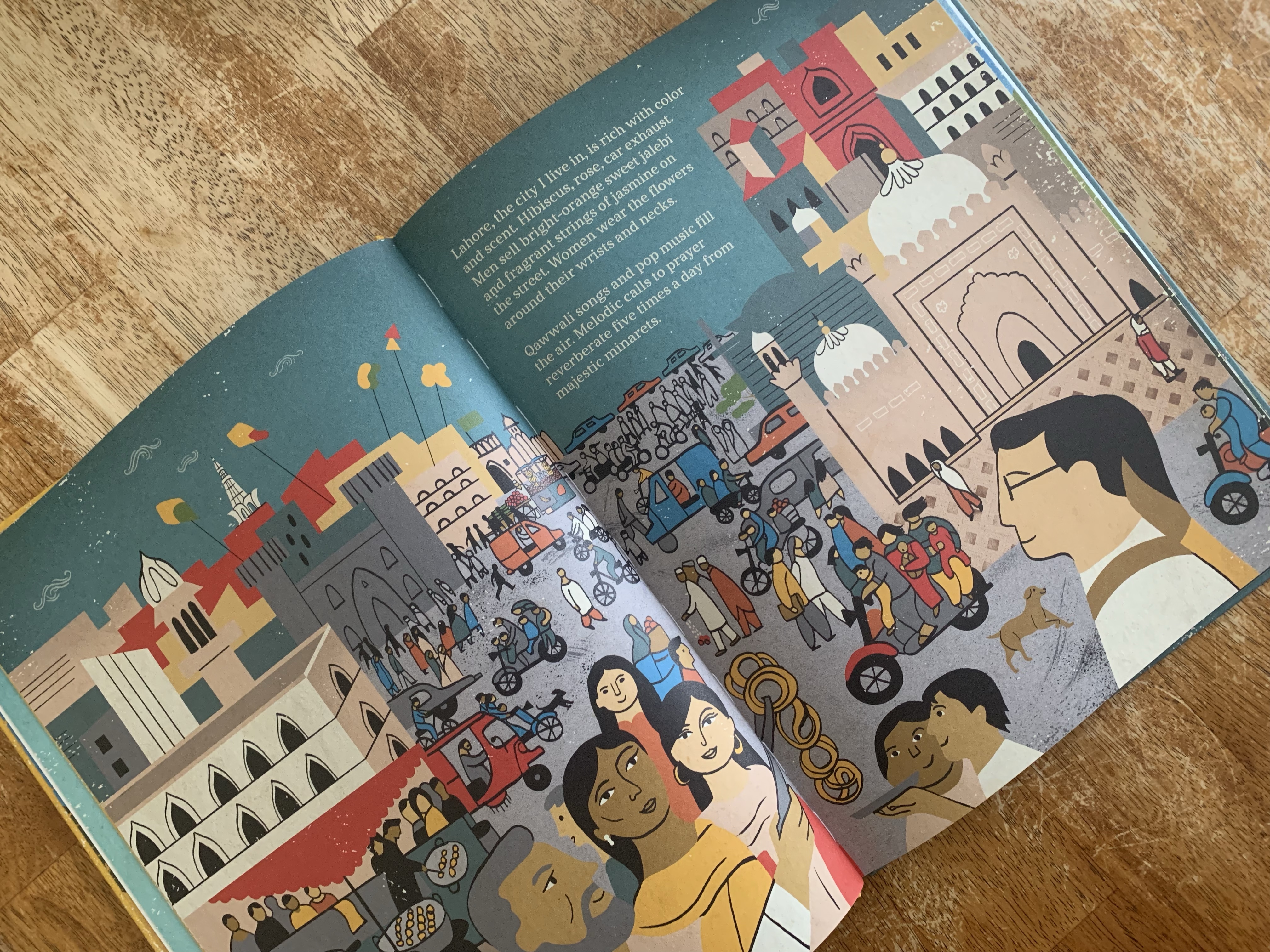
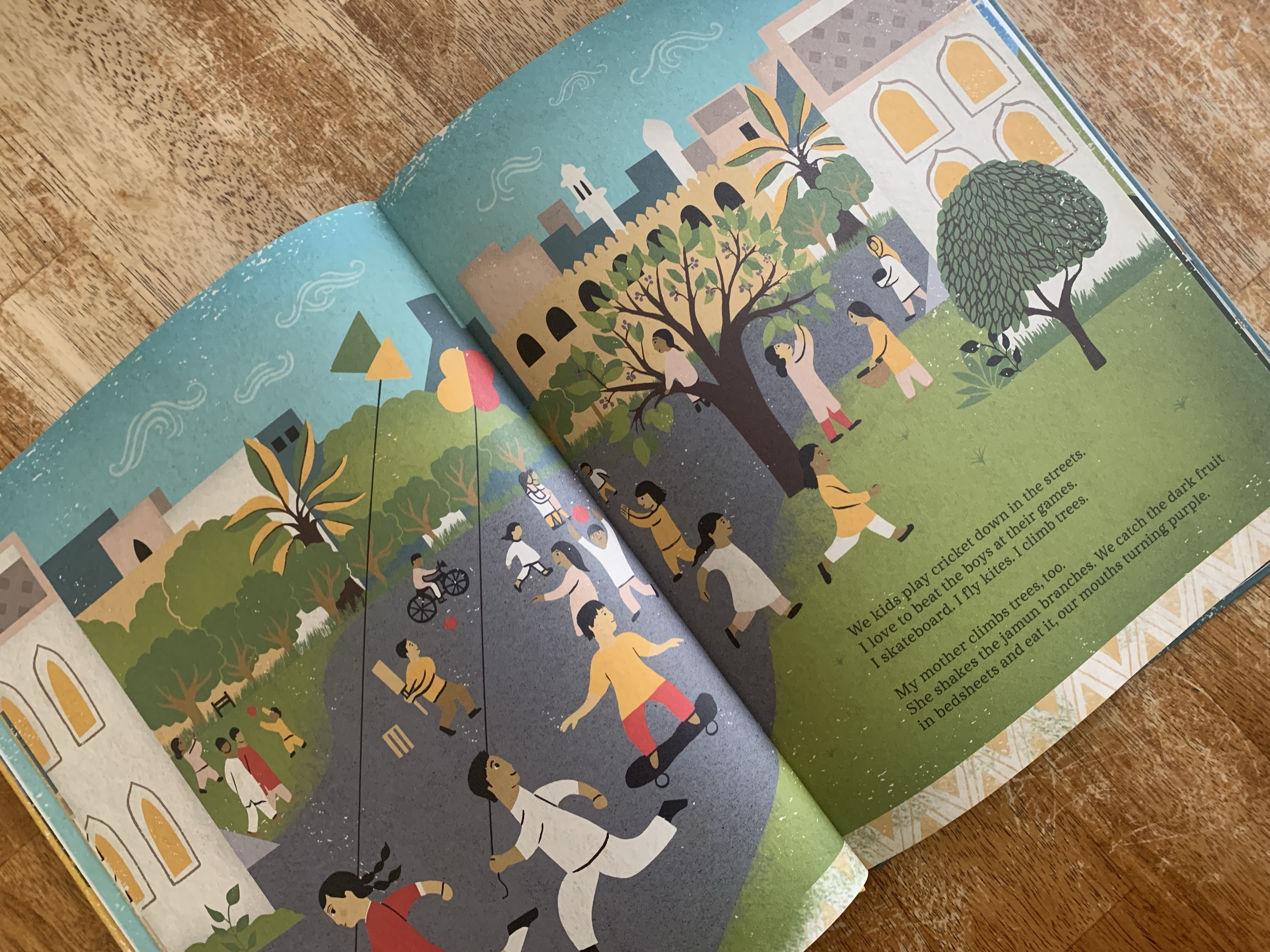
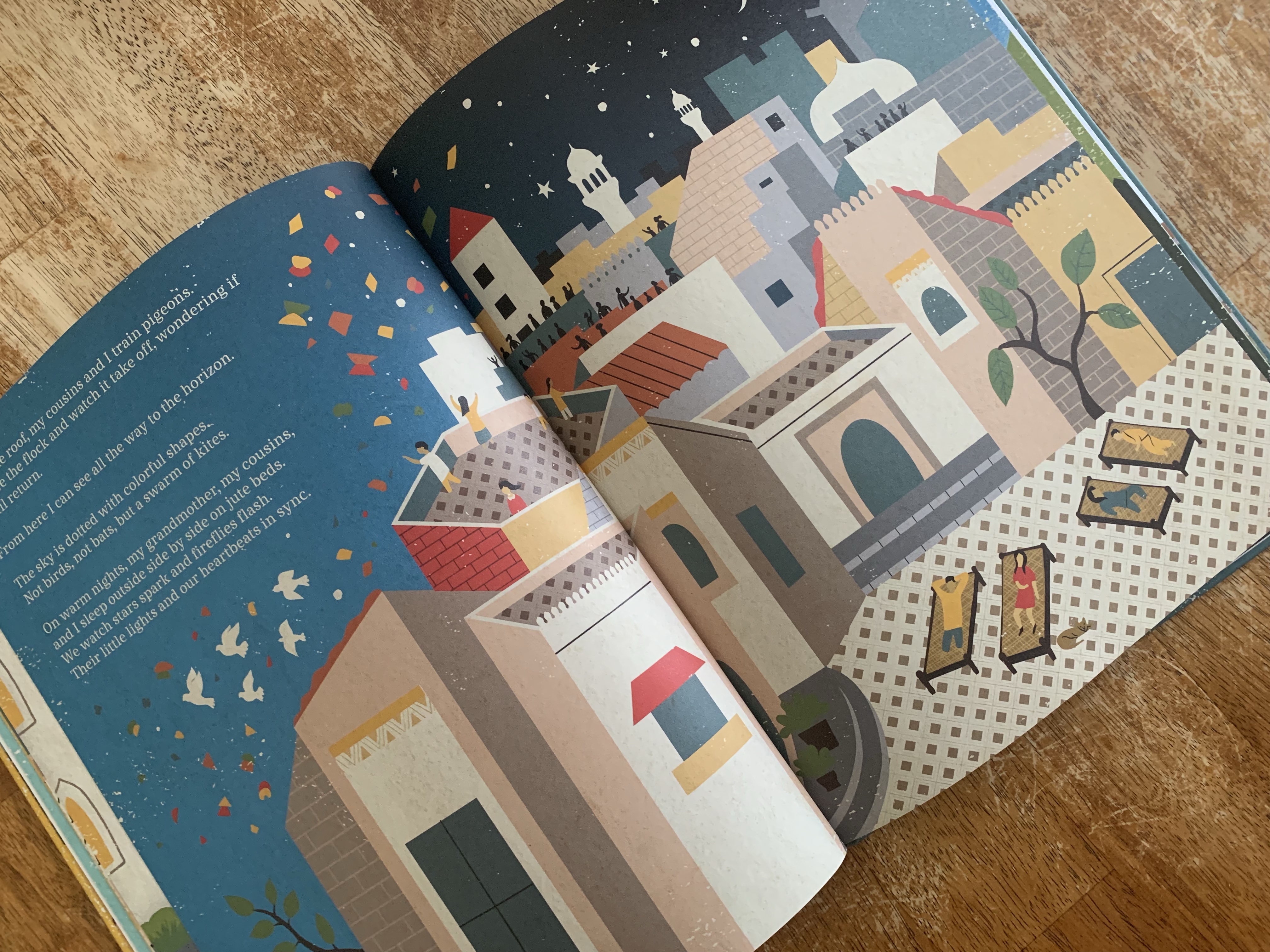
Outside is the city of Lahore, in Pakistan, streets rich in smell and color and sound exist: orange jalebi and strings of jasmine, sounds of Qawwalis and pop music, the melodic call to prayer from the minarets.  As a child she plays cricket and climbs trees and flies kites.  Up on the roof she trains pigeons and looks out at the horizon.  

img_1697

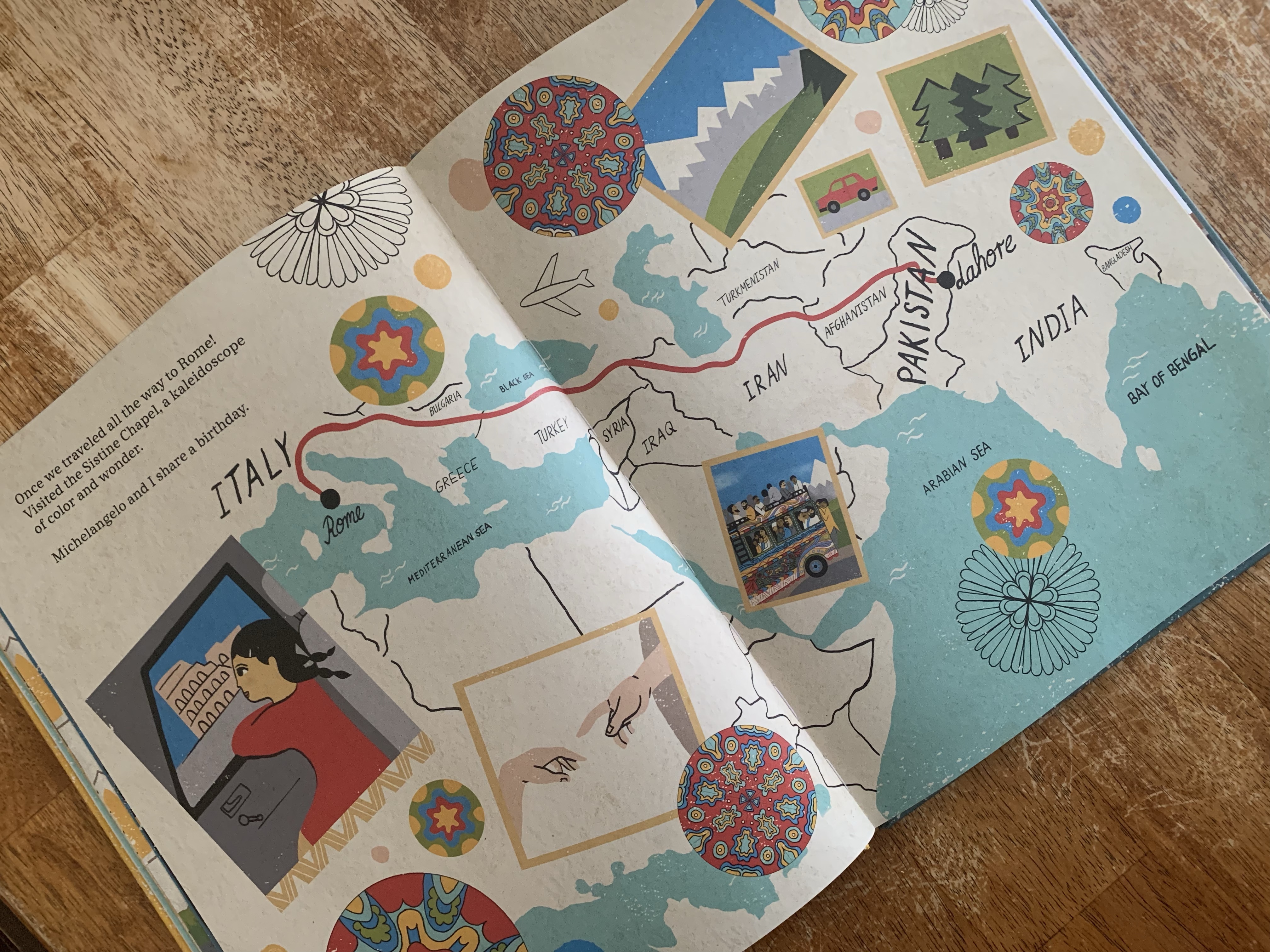
When it gets hot, her family heads north.  They once traveled all the way to Rome.  She visited the Sistine chapel, her and Michelangelo share a birthday.

img_1699

At school she is shy. She loves math, as it is a tool to understand the world.  She finds she is also good at drawing birds, and people.  She studies miniatures with a magnifying glass.  Eventually training in miniature painting with a master.  Art becomes her ticket to new worlds.

img_1698

She heads off for America, taking her roots with her, but once she arrives she cannot leave.  Her passport is the wrong, color.  She lives in New York and cannot return to Pakistan for nine years.  Now she can travel and soar and share her work with the world.

img_1701

There is a glossary at the end and more information about Shahzia and her paintings.


Ruby in the Sky by Jeanne Zulick Ferruolo

Standard
Ruby in the Sky by Jeanne Zulick Ferruolo

ruby

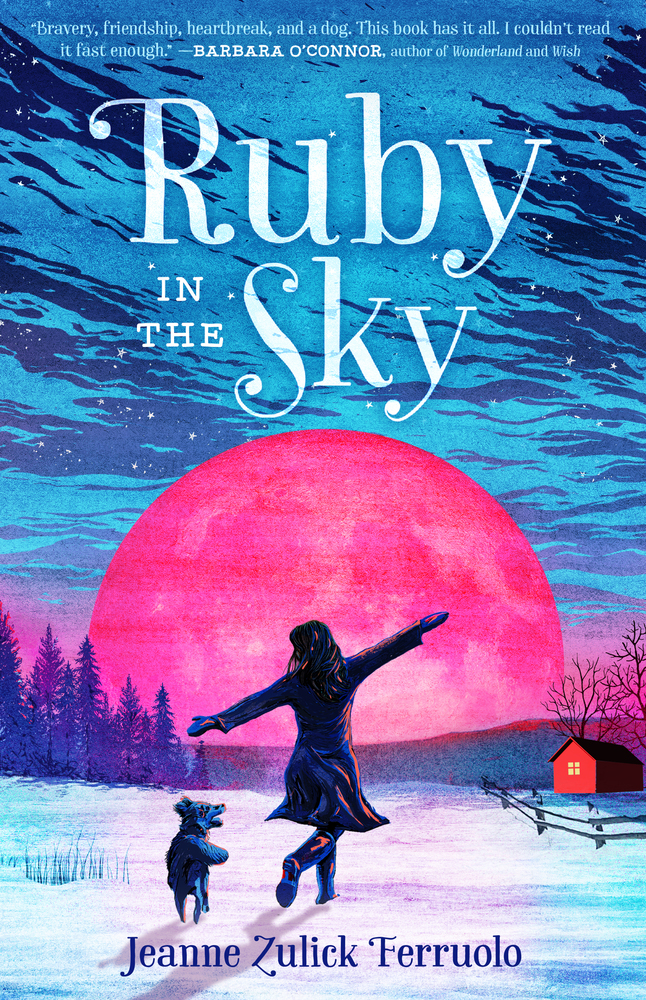
The author of this wonderful middle grades novel reached out to me after I reviewed her book A Galaxy of Sea Stars, to let me know that this book too has a Muslim character.  As we exchanged emails back and fourth I learned more about her work with Integrated Refugee and Immigrant Services in New Haven Connecticut (IRIS), and the impact the people she has met there have on her and her writing (the new paperback version of Galaxy has bonus content that reflects this).  Allies and advocates are gifts for Muslims and for our fictional representation.  The details and warmth of her Muslim character, Ahmad, a Syrian refugee, is seamless and accurate, and while this is not his story, his support of the main character helps normalize Muslims as friends and in daily life.  He takes time out for his five daily prayers, he refuses to shake a female’s hand, and he uses the word inshaAllah.  The story is Ruby’s though, and her journey pulls you in from the first chapter and leaves you cheering for her long after you close the book.  Over 295 pages (AR 4.1) you witness Ruby find her voice, dare to not be invisible, accept friendship, and help others.   
SYNOPSIS:

Ruby has just moved to frozen Vermont from their last “forever home” in Florida.  Originally from D.C., Ruby and her mom have been moving to places they have vacationed to try and find joy.  Since Ruby’s father, a police officer, died, the two of them have been broken and barely surviving.  The only constant is a cousin, Cecy, who helps them out and convinces Ruby’s mom to come back to her childhood town of Fortin, and to be closer to her.  The winter is bitter, the house is freezing, and even with Cecy arranging for Ruby’s mom to have a job, it only takes a day for Ruby’s mom to be arrested, fired, and for Ruby to be on her own.  With only a garbage bag full of belongings, and some thrift store finds for warmth, Ruby’s plan is the same as it has been in every other town they have landed in: keep her head down and be invisible.  Ruby’s dog, Bob, though has other plans, and when he takes off into a neighbor’s yard filled with ‘No Trespassing’ signs a meeting with Abigail takes place that will change Ruby.

Abigail Jacobs is known in Fortin as the “Bird Lady.”  She has a home, but lives in a shed on her property, dresses in layers of scraps and scarves, feeds the birds, and keeps to herself.  The rumor is that she killed her husband and daughter, everyone knows it, it could just never be proven.  There are also stories that she has a moon rock.  When Ruby meets her she is angry and cold, but the way she interacts with the animals and her knowledge of the moon, keeps her intrigued and even though Ruby’s mom forbids her from visiting Abigail, Ruby and her develop a friendship of sorts.

At school Ruby’s plan to go unnoticed is challenged by Ahmad Saleem, a refugee who lives with his uncle a grocery store owner and is teased by a few classmates for his accent and disappearances at lunch time when he goes to pray.  He is kind and and determined to help Ruby and immediately declares her his friend.  Ruby tries to avoid him, but eventually he starts to win her over.  With the upcoming wax museum, a Fortin favorite, drawing near, Ruby tries to explain to her teacher that they will be leaving back to D.C. before the final presentation, but Mr. Andrews isn’t letting her off and somehow she finds herself researching Michael Collins, the astronaut that stayed on the space shuttle alone to circle the dark side of the moon while Neil Armstrong and Buzz Aldrin took their historic walk. 

With the mayor singling out Abigail with his new ordinances, Ruby’s mom deciding not to take the plea deal and fight her case at trail, the short cold days, the desire to return to D.C., the wax museum approaching, and Ruby needing answers, Ruby at some point will have to stand up and speak out.

WHY I LIKE IT:

I love that the story unfolds in layers.  You don’t know where it is going, but the slow peeling away shows the complexity of people and situations.  The book doesn’t shy away from confronting stereotypes and looking beyond appearances.  I like that there is some discussion of Islamophobia, when Ahmad is overheard speaking Arabic for example, but the character that needs the most standing-up for is an elderly white woman.  The small pivot allows the book to avoid a familiar theme and shows the reader a Muslim shop owner helping the tattered woman that the town fears and resents. I enjoyed the strong reminder of how women and science and their careers have not been widely accepted until recently.  I think many readers will be surprised that much of Abigail’s rumors stem from her being a brilliant educated woman that society struggled to respect then and now.  I absolutely love the science and space aspects that bring Ruby Moon, her neighbor, and her class project together.

I wish there was a little bit more about her mom and her relationship at the end.  The disconnect in their relationship warranted the sparse information in the majority of the story, but I needed some hope for the two of them.  Same for the relationship with Cecy.  I get that Ruby doesn’t have a good relationship with her mom’s cousin, but as Ruby grew in so many ways, I wish that her appreciation of what Cecy has done for her and her mom would have also been realized in some capacity.

FLAGS:

Ruby being dishonest. Death, injury of a pet, physical assault, bullying, teasing, Islamophobia.  

TOOLS FOR LEADING THE DISCUSSION:

I probably wouldn’t focus an entire book club on this book, but I think it would be a great addition to a summer reading list.  The insight into a character trying to find herself within her own family and experiences with connections to history and science would be a benefit to any child to read and reflect upon.

The Girl Who Stole an Elephant by Nizrana Farook

Standard
The Girl Who Stole an Elephant by Nizrana Farook

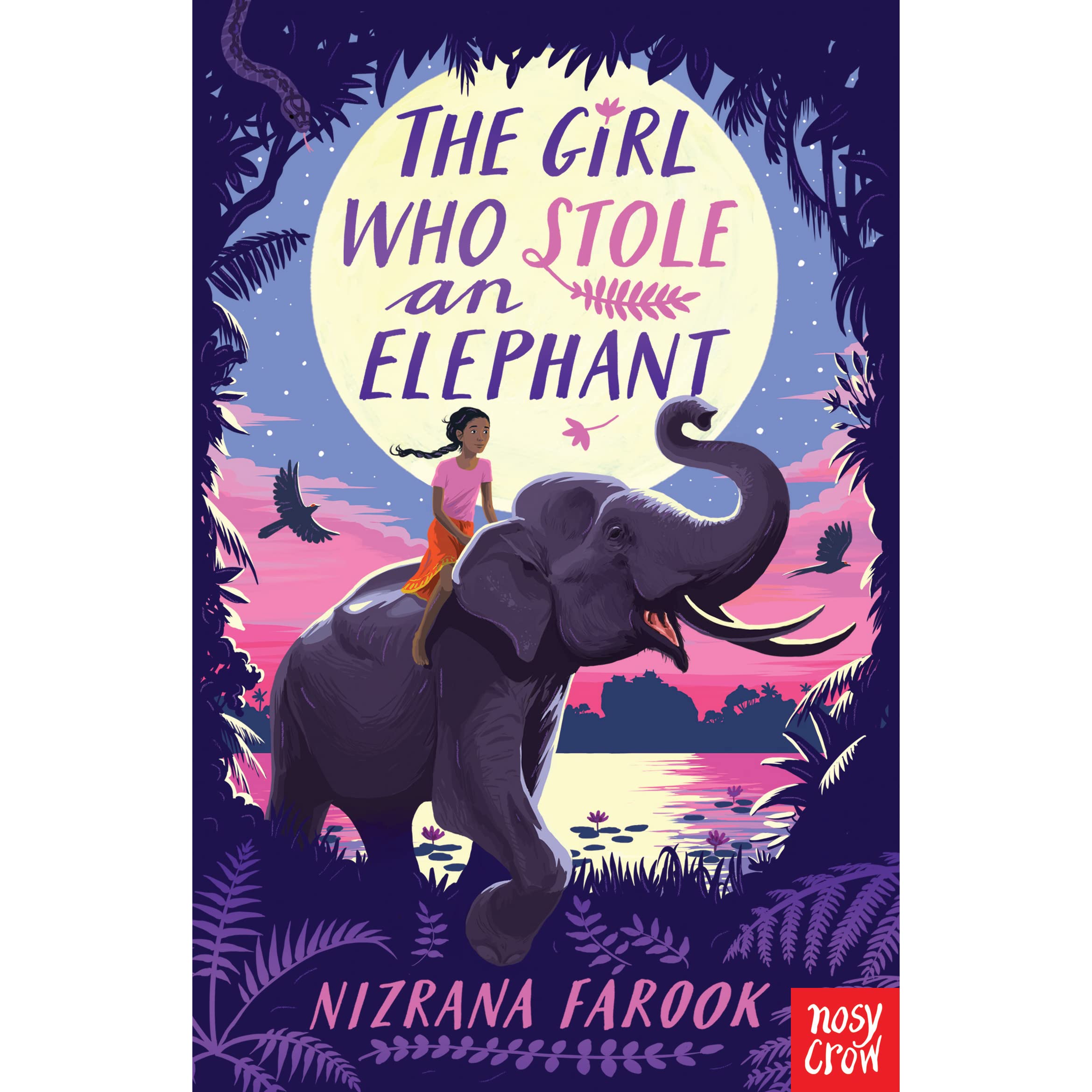
elephantI have to admit this 240 page middle grade OWN voice book had me invested and glued to the pages.  I was swept away to Sri Lanka and in disbelief at the boldness, cleverness, and spunkiness of the Robin Hood-esque 12-year-old protagonist.  I could not put it down as my head worked over time to figure out how this trio of children, one being a Muslim girl, was going to get out of the heap of trouble they had caused.  Yes, admittedly it wraps up a bit too quickly and simply, the main character Chaya doesn’t learn her lesson and is a terrible friend, and there isn’t a good moral of lying and stealing being bad.  But all that aside, the book is a fun adventure that while written pretty straightforward and clearly, is rich in adventure, culture, and excitement for second to fourth grade readers (and 40 year old moms that love strong girls).

SYNOPSIS:

Chaya is the daughter of a tribal representative, whose mother has passed away.  She goes to school, attends the temple once a week to learn Sanskrit, and at dawn is known to steal things to give to those in need.  At night time, people are on guard, expecting trouble, but dawn seems to be the perfect time to take what she needs from people that won’t even notice.  The book starts out with her stealing jewels from the Queen with the hopes of helping a friend who was bitten by a crocodile get medical help in the next town over.  The people in Sarendib have an unjust king, and stealing from his wife to help take care of people that need assistant is a job Chaya takes seriously.  Her heart is in the right place, but when a guard sees her she stops to visit a friend who works in a wood shop to hide the jewels until the heat dies down.  The box they hide the stolen goods in is purchased by a young Muslim girl, and now Chaya has to steal them back from her to get them to people that are in need.

The chain of events is just getting started, and when the jewels are discovered the wood working Neel takes the blame and is imprisoned, and the new girl in town, Nour, is determined to help free Neel from prison and save the villagers from being tormented by the royal guards.  Chaya devises a plan to free Neel from the palace dungeons, but nothing ever quite goes to plan and all the prisoners are freed.   As she runs to escape her own doom, she steals an elephant to get away, the king’s elephant.

The entire story is a series of follies and at each turn the children have really good intentions, they just keep snowballing into situations beyond their control with the stakes constantly multiplying.  I really don’t want to give it away, but they might just bring down a monarchy as they tromp through the jungle on an elephant, accidentally burn down villages, and find that even though Nour is a wealthy meat eater, they can in fact be friends.

WHY I LIKE IT:

I love that the story is outrageous, yet grounded.  I was sucked in from the first few short chapters and didn’t look back.  Chaya is oh so plucky and her fallibility and flaws make her so endearing.  She is a bit of a mean girl to Nour, but I think she shows growth.  The slight raised eyebrow regarding her, is that she didn’t learn some grand lesson, and in fact is possibly emboldened by her thieving and getting away with it.  There probably should have been some humbling at the end, but she is bold and outspoken, and not one for regrets.  I absolutely love the letter she left her father owning up to her role in the whole hullaballoo, and as an afterthought acknowledging that she skipped two days of school.  She is a cheeky one, but her heart is huge and she has her own sense of integrity that is unwavering.

I like that Nour is acknowledged as being Muslim, eating meat, and going to mosques before she moved.  It doesn’t articulate that Chaya doesn’t like her for her faith, but it isn’t helping the two girls befriend each other either.  I love the elephant, and the plants, and fruits, and animals that bring the story to life.

FLAGS:

Lying and stealing. Some destruction of property.

TOOLS FOR LEADING THE DISCUSSION:

I can’t see me doing this as a book club selection, it is just too young of a target audience, but it would be a blast to read aloud to a second or third grade class, or to assign in a classroom setting.  The chapters are really short that early chapter readers will feel accomplished when they complete the book, and the subject matter will compel them to keep turning the pages to find out what happens next.

City of the Plague Gods (Rick Riordan Presents) by Sarwat Chadda

Standard
City of the Plague Gods (Rick Riordan Presents) by Sarwat Chadda

I was excited to hear that another Rick Riordan/ Rick Riordan Presents books featured a Muslim character and was anxious to see how the multi god genre would account for Islamic tenants.  But I was completely giddy (that’s putting it mildly), when I found out that Sarwat Chadda is aka Joshua Khan, author of the Shadow Magic Series and that this book has practicing Muslim Characters front and center.  In his own words, “it has taken be twelve years and eleven books to get around to writing a Muslim tale.” That isn’t to say that it is Islamic fiction, there is gay romance that is there if you want to see it and has been confirmed by the author outside of the book, there are  numerous fake gods in Mesopotamian mythologies, there is death and violence, but it is fun, oh so fun.  It has salat, and going to the mosque, and an imam, and saying surahs and discussing jihad an nafs, and sadaqa and it says the shahada in Arabic and English, it presents Muslims authentically in their words and actions, and it isn’t just the characters’ backstories it is who they are and how they see the world.  The book is an AR 4.5 with 383 pages and like all Rick Riordan books, full of humor, sentiment, family, growth, and ancient mythology.

SYNOPSIS:

Sikander “Sik” Aziz is 13 and when not at school is at his family’s NYC deli working away.  The son of Iraqi immigrants, he is dedicated to helping his family especially since his older brother Muhammed, Mo, has passed away.  Mo’s lifelong friend Daoud has moved in to Mo’s old room and helps out in the deli, but is really an aspiring actor who does anything to get out of work.  When the book opens, Sik and Mo are closing up when the deli is attacked by rat faced men demanding to know where it is.  Sik has no idea what they are talking about and the two demons tear apart the family restaurant until a mysterious girl appears and sends them and their stream of insects, disease and destruction from the deli.

The next day at school Sik’s injuries are healing remarkably quick and he and the new girl, Belet, find themselves getting sent to the principal’s office together.  When he learns that Belet’s mom is Ishtar, goddess of love and war, or rather passion, and was the girl at the deli, he can no longer deny that the tales Mo used to tell him about Gilgamesh, Enkido, Nergal, Kasusu, and Mesopotamian mythology are very real.  

As Sik, Belet, Ishtar, Daoud, and an army of cats, Lamassu, learn that the plague god Nergal is behind what is going on and that he plans to destroy Manhattan, it is up to them to stop the destruction, save Sik’s parents who are in the hospital, and ultimately the world.

WHY I LIKE IT:

The book was written before Covid 19 and the idea of a plague or pandemic was not yet on everyone’s mind, but when it was published in 2021 it sure become that much more relatable and close to home.  I love that some of the reactions of the characters and community to being around infected people and the backlash was so accurate to what we have all seen since 2020.  

The way that the oneness of Allah swt and the multi fake gods is reconciled is that the Mesopotamian cast are old and powerful, but not ALL-powerful, as Ishtar tells Sik, someone had to create us.  She also says that today people might call them something else.  It seems to leave open the idea that they have abilities and because of their abilities people worshipped them and the name stuck, not that they are creators or even claim to be. The concept of being between alive and dead is explored when Sik visits Kurnugi, he asks where Muhammad Ali is and Mo tells him he isn’t there, he went straight to Jannah.  It might not be a clear explanation, but it at least hints that Muslims in real life have a different view than the mythological one being explored.

I love the snark, and the humor, it flows so well and incorporates pop culture with ancient references very smoothly. I love that they say InshaAllah and AllahuAkbar and when Sik is presumed dead at one point and awakens he can’t go to the mosque because they are having his janaza and it would be awkward.  I love that there is a glossary that denotes if words are Arabic, Islamic, or Mesopotamian.  Muslim kids reading this will feel so seen and proud to be openly Muslim and inspired that they too can be heroes.

FLAGS:

Mythology, fighting, death, the use of the term badass.  Daoud and Mo’s relationship.  Daoud and Mo became friends in 5th grade and when Sik sees some photos of his brother that Daoud had taken, he says that he sees love.  When Sik and Mo are reunited in Kurnugi, Mo hints that there is more to the friendship, it is subtle.  In online interviews Chadda says they were in a romantic relationship.  It is not explored or heavily detailed.  The only other romance mentioned is that Gilgamesh in his prime refused Ishtar.

I think fans of Rick Riordan already know that there is going to mythological characters, creatures, battles and violence and a character or two that are LGBTQ+, some possible romantic angst between main characters, death, and unfaithful flirty gods.  This book is much “cleaner” than most, so 4th graders and up that are fans, will be fine reading this.  

TOOLS FOR LEADING THE DISCUSSION:

I don’t know if I could do this as a book club selection.  The romance is minor, but once you sense it and know it is there, it is a factor.  I don’t know if it would have to be discussed and how an Islamic school would want me to handle it, because both Mo and Daoud are practicing Muslims.  I think the book does a sufficient job of not committing shirk and shirk like messages with the mythology, but as always with these types of books it is a judgement call if the children (and their parents) can understand where the lines of fiction are and where they stand.

Fandom: https://riordan.fandom.com/wiki/City_of_the_Plague_God

The Unicorn Rescue Society: The Secret of the Himalayas by Adam Gidwitz and Hena Khan illustrated by Hatem Aly

Standard
The Unicorn Rescue Society: The Secret of the Himalayas by Adam Gidwitz and Hena Khan illustrated by Hatem Aly

unicorn

This middle grades 208 page book is part of a series, but this particular installment is co-authored by Hena Khan, takes place in Pakistan, and features Muslim side characters in the quest to find and protect the mythical, magical, and illusive unicorns.  The adventure is quick, the cultural and religious references sincere and appreciated, the characters quirky and fun, and the writing smooth and enjoyable.  I can’t speak for the whole series, but I think second to fourth grade readers will enjoy the eccentric teacher, the clever kids, and the knowledge about animals, culture, and geography that is woven in to the story to keep it engaging.  I don’t think you need to read the books in order, but I would encourage it.

img_0785

SYNOPSIS:

Elliot and Uchenna are elementary aged students and also members of the secret, Unicorn Rescue Society.  When a classmate starts a newspaper and interviews local businessman, the kids teacher, Professor Mito Fauna spots what he thinks is a unicorn horn in an accompanying picture and is determined to go and protect, once found, the imaginative creatures.  He enlists the kids and Jersey, a creature with a blue body, red wings, a goat face, clawed front legs and hooved hindlegs, to set off in his single propeller plane for the Himalaya mountains of Pakistan.

They arrive in Torghar, Pakistan and make a rough landing that nearly kills a local boy.  Alhumdulillah, Waleed is fine, and in true Pakistani and Islamic tradition the boy takes the visitors to his grandmothers home to be fed and welcomed.  Waleed agrees to help the Americans find a man known only as the “Watcher,” to see what he knows about unicorns and the hunters that come to poach for sport.

Hiking the mountains and getting short of breath makes each act that much more difficult, but alas the kids find the Watcher, aka Asim Sahib, but sadly *SPOILER* don’t find unicorns.  Rather a species of mountain goats, markhors, that have two long twisted magical looking horns. The wealthy businessman brothers also show up in their helicopter to capture, not kill the markhors.
The rescue society follows them and learn that the sinister brother are testing out the magical properties of a bezoar on pit viper bites.  Needless to say it doesn’t work and the rescue society must rescue the dying butler, and captured markhors.  All is not lost, even if they didn’t find any unicorns, at least they made new friends, and know that if they haven’t found the unicorns yet, hopefully no one else has either.

img_0778

WHY I LIKE IT:

I love that there is praying, and thikr, and ayats from the Quran quoted and explained in the book regarding saving animals, caring for each other and trusting Allah swt.  There is culture regarding taking gifts, welcoming guests, drinking tea and even breaking stereotypes of what a boy from Lahore visiting his family in the mountains knows and doesn’t know.  It isn’t preachy on any accounts, but the messages relayed in their silly way are very well woven in and leave a wonderfully represented impression of Islam, Muslims, and Pakistan.

The diversity featured in the book is nice, even within the main characters: one is an African American girl, one a Jewish boy, and the teacher is Hispanic.  The story at the end, A History of The Secret Order of the Unicorns, takes place during the reign of Charlemagne at a monastery, and features a boy named Khaled and his little sister Lubna. It is clearly intentional and a reflection of the author and illustrator.

img_0776

FLAGS:

There are some possibly gross moments featuring the goats licking urine, tea being made from the markhors’ saliva and the near death of a man requiring venom to be sucked from his leg.

img_0777

TOOLS FOR LEADING THE DISCUSSION:

The book is definitely below a middle school book club level, but I think younger elementary teachers and parents would see students get hooked on the series and would benefit from having the books around.

img_0780

Rumaysa: A Fairytale by Radiya Hafiza illustrated by Rhaida El Touny

Standard
Rumaysa: A Fairytale by Radiya Hafiza illustrated by Rhaida El Touny

rumaysa

This middle grades retelling of the classic fairytales: Rapunzel, Cinderella, and Sleeping Beauty, replaces white characters with diverse Desi characters, reclaims female characters’ empowerment, and weaves the stories together with Rumaysa first freeing herself, and then using a magic necklace that takes her to those in need  (Cinderayla and Sleeping Sara) in her quest to find her long lost parents.  After a few chapters, I started writing a list of gaping-huge-ginormous plot holes, they are frequent and laughable, then I took a deep breath and recalled the similar eye-rolling inconsistencies that plague perhaps all fairy tales, but specifically Disney-esque ones. Once I let go of trying to understand why Rumaysa is wearing hijab while locked in an isolated tower, or how the witch can’t remember her name, but Rumaysa knows the name her parents gave her when she was kidnapped on the day of her birth, or that she knows she was kidnapped and her whole backstory, just to name a few, the book was much more enjoyable.  I still have major issues with some of the forced Islamization and cultural tweaks, but not because they existed, but rather because they weren’t strong enough.  Why have an Eid ball for all the fair maidens in the land.  It was awkward to read all the young people showing up to pair off, and then people asking the prince to dance, and him saying he didn’t know if he could.  Why not just make it an over the top Desi wedding with families, where dancing and moms working to pair their kids off is the norm. Having it be a ball for the maidens in the land, just seemed like it was afraid to commit to the premise of twisting the fairytales completely.  There are a few inconsistencies, however, that I cannot overlook.  This is a mainstream published books and there is at least one spelling error and grammar mistake.  I could be wrong, as it is British, and I am by no means competent in even American English, but I expect better.  Even content wise, Prince Harun for example, is wearing a mask, but the text comments on his blushing cheeks, eyes, eyelashes, and smile, not a typical mask perhaps? And don’t get me started on the  illustrations, the same awkward ball has Ayla leaving, and in the picture not wearing a mask concealing her face as the text states.  Overall, the inside illustrations are not well done.  The cover, by artist Areeba Siddique is beautiful with the shimmery leafing on the edges, that would have brought the inside pages a lot more depth and intrigue than the ones it contains.  Despite all the aforementioned glimpses of my critiques to follow, I didn’t hate the book and quite enjoyed the light handed morals and feminism that was interwoven with clever remarks and snark. The first story has Rumaysa wearing hijab, finding a book about salat and praying.  The second story takes place on Eid and Ayla eats samosas, discusses Layla and Majnun, and has a duputta. The third story I don’t recall any culture or religious tidbits other than keeping with the consistency of cultural names.  There is mention of romance between an owl who has a crush on a Raven, but the heroines themselves are learning to be self sufficient from errors of their parents/guardians and are not looking for any males to save them.  Other than that the book really needs an editor and new illustrations, I can see fairytale loving middle grade kids reading the book and finding it enjoyable, or even younger children having it read aloud to them a few chapters at a time, and being drawn in to the stories and eager to see what happens next. It would work for that demographic, but perhaps no one else.

img_0394

SYNOPSIS: (spoilers)

Rumaysa’s parents steal vegetables from a magical garden when there is no food or work to be found, as a result when Rumaysa is born, the owner of the garden, an evil witch, takes Rumaysa and places her in a tower protected by an enchanted forest and a poisonous river.  No one can get in, and Rumaysa cannot get out.  In the tower Rumaysa reads, no idea how she learned, and spins straw in to gold as she sings a song that channels the magic she consumed in utero from the stolen garden.  With only rations of oats to eat, a friendly owl named Zabina frequents Rumays daily and brings her berries and news .  When he brings her a new hijab, Rumaysa has the idea to lengthen the hijab with bits of gold over time, so that she might escape.  When she finally gets her chance, she is met by a boy on a magic carpet named Suleiman, and is both shocked and annoyed that someone got close to the tower, and only after she saved herself.  The two however, and Zabina, are caught by the witch and must escape her as well.  When that is all said and done, Suleiman gives Zabina a necklace that takes one to someone in need of help.  His parents want him to save a princess, he wants to study in his room, so he hands off the necklace hoping it will help Rumaysa find her parents, and he heads off on his flying carpet.

The necklace doesn’t transport Rumaysa to her parents, however, it takes her to a street where a girl is throwing rocks in desperation having been denied attending an Eid ball after her dress was torn to shreds.  The story starts with Ayla’s back story before Rumaysa arrives, but the two girls befriend each other, Rumaysa uses her magic gold weaving abilities to conjure up a new and beautiful dress and golden shoes and the girls head to the ball.  When Ayla heads off to get samosas she meets the prince, but doesn’t know he is the prince.  They argue about the play Layla and Majnun and when her stepmother asks about the dress, Rumaysa and Ayla make a run for it.  A shoe is lost, the stepmother comes to know, the guards search for the missing girl, and all is well.  Except Harun is incredibly shallow and superficial and only interested in Ayla’s clothes and status, so she rejects him and points out that she is much too young for marriage.  She instead reclaims her home, fixes her relationship with her stepsisters and begs Rumaysa to stay.  Rumaysa makes her excuses and is whisked away to a land that is being ruled by a man and his dragons.

Originally the land of Farisia is ruled by King Emad and Queen Shiva, but they have become unjust and disconnected from their people.  When Azra gets a chance to steal Princess Sara and take the kingdom, he does.  Rumaysa arrives to free a sleeping Sara from the dragon and restore apologetic and reformed leaders to the thrown.

img_0397

WHY I LIKE IT:

I do like the spinning of familiar stories and either updating them, or twisting them, or fracturing them, so I am glad to see an Islamic cultural tinge available.  I feel like the first story was the strongest conceptually even if the details and morals weren’t well established.  The second story was strong in the messaging that Ayla, and any girl, is more than just a pretty dress, but the premise was a little shaky and not that different from the original.  The third story was a little lacking developmentally for me and all three I felt could have gone stronger in to the religion and culture without alienating readers or becoming heavy.  There are characters illustrated in hijab, some in saris, some in flowing robes. Princess Sara is noted to be a larger body type and I appreciated that in elevating the heroines, other’s weren’t put down.  Even within the book, there is diversity which is wonderful.  

img_0398

FLAGS:

There is lying and stealing with consequences.  “Shut up” is said.  There is magic, death, destruction, and a brief mention of an avian crush.

img_0395

TOOLS FOR LEADING THE DISCUSSION:

I could see this being used in a classroom for a writing assignment to urge students to write their own tales.  I think it is fourth or fifth grade that children read fairytales from different points of view: think the three little pigs from the wolf’s perspective or the Stinky Cheese Man and Other Fairly Stupid Tales, and this book would lend itself easily to that lesson as well.