Category Archives: History

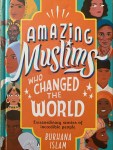
Amazing Muslims Who Changed the World: Extraordinary Stories of Incredible People by Burhana Islam illustrated by Reya Ahmed, Deema Alawa, Nabi H. Ali, Saffa Khan, Aaliya Jaleel and Aghnia Mardiyah

Standard
Amazing Muslims Who Changed the World: Extraordinary Stories of Incredible People by Burhana Islam illustrated by Reya Ahmed, Deema Alawa, Nabi H. Ali, Saffa Khan, Aaliya Jaleel and Aghnia Mardiyah

img_8359

The 30 stories presented over 197 pages are inspiring, and this compilation so desperately overdue. The book is not chronological it is completely random, and at first I was confused, but as I made my way through the book, I actually grew to love not knowing who I would be reading about next.  Yes, there is a table of contents, but the point being that you don’t have to be born into royalty, or be a warrior, or have lived a long time ago to be amazing, you just have to follow your passion.  I learned so much about people I thought I knew about, and was tickled to learn about people I have never heard of: bakers, athletes, actors, educated slaves, architects, spies, singers, scientists and politicians.

img_8360

At the end of each six page illustrated blurb is an “Interesting Fact” and at the end of the entire book are some activities in the “Amazing Extras” section.  Readers can crack a code like Noor Inayat Khan who helped the Allies decode and send secret messages from France to Britain or write a poem like Rumi, a song like Yusuf Islam (Cat Stevens), draw a superhero like G. Willow Wilson, make a camera following the science of Hasan Ibn Al-Haytham, or color a picture of Muhammad Al-Idrisi.

img_8361

My favorite biographies were those that I knew little or nothing about before hand.  If I had to pick two favorite among all of those sections, I’d pick Khawlah bint Al-Azwar and Ayuba Suleiman Diallo.

img_8362

In 600 CE Arabia, Khawah, the masked knight, learned how to fight along side her brother and eventually served with Khalid ibn Waleed in battle.  It is said that she killed the Byzantine leader that captured her and then asked for her hand in marriage.

img_8365

Ayuba Suleiman Diallo in the 1700s in modern day Senegal was a highly educated man who was captured and forced in to slavery in Maryland, USA, interacted with James Oglethorpe, found himself being sent to England and with the help of a Thomas Bluett was able to be freed and eventually return home a free man. SubhanAllah!

img_8363

This book has it all: famous Muslim men, famous Muslim women, Black Muslims, Arab Muslims, European Muslims, American Muslims, Asian Muslims, African Muslims, Muslims who lived a long time ago, Muslims who are still alive all jumbled up and beautifully presented by a Muslim author and a handful of Muslim illustrators. This book is wonderful for 3rd graders to adults and would be a benefit on any book shelf.  It is worth noting there are no sources given, and doesn’t explain how the people were chosen to be included in the book.

The Awakening of Malcolm X: A Novel by Ilyasah Shabazz and Tiffany D. Jackson

Standard
The Awakening of Malcolm X: A Novel by Ilyasah Shabazz and Tiffany D. Jackson

img_8312This historical fiction piece about Malcolm X follows him through incarceration with flashbacks to his childhood and teenage years.  Written by his daughter it is hard to know where this 336 page book is factual and where it takes artistic freedom with filling in the blanks. A few creative liberties are mentioned in the author’s note at the end, but some sources in the back would help clarify, as she was a toddler when her father was killed. The time frame of Malcolm X’s life and a large portion of the book covers his introduction and conversion to The Nation of Islam, but it never mentions even in the timeline at the end that he left it, or that they were responsible for his assassination.  The book is beautiful and heartbreaking at the same time, it is also so very humbling and empowering. I just don’t know that younger middle school readers (the stated intended audience is 12-18), will really grasp the content, his condition, and his searching, while trying to keep all the characters, time frame references, and slang straight.  With the mention of his girlfriend who he is/was sleeping with, as well as the drugs, the alcohol, and the abuses occurring in prison, older teens might be able to handle the book better, and be tempted after to dig deeper to learn about him going for Hajj, becoming Sunni, changing some of his views, and ultimately being gunned down in front of his family.

SYNOPSIS:

Malcolm Little is living between Roxbury and Harlem and going by the nickname Detroit Red.  When the story opens, Malcolm and his friend Shorty are about to tried for stealing a watch, a crime that he acknowledges he committed, but undoubtedly doesn’t deserve 8-10  years in prison for at age 20.  Nearly every chapter starts with a flashback to an earlier time and then concludes with the atrocities of prison life at hand.  As the narrative flips back and forth Malcolm’s story and awakening emerges.

Born in Omaha the Little family’s home is burned down by the Ku Klux Klan, they move a few times as the growing family grows closer together and establish themselves as followers of Marcus Garvey in advocating for Blacks.  Malcolm’s preacher father is killed when Malcolm is six years old and his mother institutionalized when he is 13, for refusing to feed her children pork amongst other things, and thus leaving the family grasping as they know she isn’t crazy, yet cannot get her released.  Malcolm is incredibly bright and attends a nearly all white prep school, but even after being class president, a teacher discourages him from pursuing his dreams of being a lawyer, and Malcolm drops out of school and ends up being a hustler.  His white girlfriend, a married woman in Boston and her friends convince him to rob some wealthy white neighborhoods and when he later takes a stolen watch to be fixed he is arrested and found guilty of grand larceny, breaking and entering, possession and more.  He is sentenced to Charlestown State Prison and day-to-day life is rough.

The guards at the overcrowded prison are aggressive, the food un consumable, and being put in the hole as punishment is beyond inhuman.  Malcolm is filled with anger and rage and is still trying to hustle people.  He learns his family has become followers of The Nation of Islam and he doesn’t want to hear it, he doesn’t want to hear about his prison mates preaching the Bible and he doesn’t want to hear about God.  He feels betrayed by God and feels guilty for not being a man his father would be proud of, the refrain: up, up, you mighty race! echoes throughout.

Throughout it all his family’s love is felt in visits, letters, and warm memories of life before his incarceration.  His flashbacks to events in his childhood that defined him, inspired him, molded him, show what a beautiful family he had and how racism in large part destroyed it.  His parents valued education and discipline and his elder siblings carry that torch and pass it on to the younger children, they are a large family and their love is palpable for each other and for the liberation of Blacks in America.

Little’s sisters write letters and eventually get Malcolm transferred to a much nicer prison, Norfolk, where he really channels his rage into reform, determined not to leave the same man he entered as.  He has access to a full library, he joins the debate team, he takes classes, converts to The Nation of Islam and then refuses to get a polio shot and is sent back to Charleston for the remainder of his sentence.

The book concludes with his release, and teases that members of his family are becoming uneasy with the Honorable Elijah Muhammad.  At the very very end, he meets Betty, the lady who will be his wife.

WHY I LIKE IT:

I love that this chunk of Malcolm X’s life shows the transformation of his thinking, how outside influences forced him to dig in to himself and reflect in such a profound way.  The book is as timely as ever as the systemic racism that is determined to see people of color fail is still running and growing.  There is a little mention of how veterans are treated better in other countries on the front lines than they are at home when they return that I wish was explored more, but there are so many characters that flit in and out of Malcolm’s prison world, it is hard to tell them apart as it is Malcolm’s story and his development that is being told.

Not surprisingly, I wish there was more about him converting to Sunni and going for Hajj.  The book stops before then and I am sure that most readers, will not understand the difference between The Nation, the Ahmadis mentioned, and Sunni Muslims.  This concerns me as the acceptance of Elijah Muhammad as a Prophet is hard to read.  I think some conversation with readers would be necessary as the book offers little if any to differentiate.

I like that each chapter starts with a direct quote of Malcolm X and the the fact that the relevance of his words in today’s world don’t need any explanations or context is devastatingly powerful.  I also appreciate how engaging and smooth the writing is.  You really feel the layers of Malcolm X the character, being pealed back and him coming into the proud confident leader that he is known to be.

FLAGS:

There is profanity, mention of him sleeping around, memories of kissing his girlfriend, alcohol consumption, cigarettes, drug use, violence, beatings, abuse.

TOOLS FOR LEADING THE DISCUSSION:

I don’t think I would do this as a book club for middle school.  Possibly if I was a high school teacher I would offer it as outside reading or extra credit when reading about the Civil Rights Era, or if I was teaching the Alex Haley, Auto Biography of Malcolm X.
Float Like A Butterfly by Ntozake Shange illustrated by Edel Rodriguez

Standard

img_8250

This 40 page biography beautifully presents major events of the famous boxer’s life without going in to much explanation. While it is an AR 4.7, it is still a picture book, and might work better for younger kids with some conversation and context, than for middle grade readers looking for anything in-depth about the beloved hero. While following his life, the reader sees him as a child growing up before he becomes famous, and sees that even after he retires, he is so much more than just a boxer, he is a compassionate leader, icon, and humanitarian.

img_8251

Born in Louisville, Kentucky in the Pre-Civil Rights South as Cassius Clay, he struggled to understand why there was only a white superman, and questioned if heaven was divided up by color and income like Smoketown.

img_8252

Cassius loved the power of words and would help his father make rhymes as a sign painter. When his bike gets stolen he is motivated to learn to fight so that nothing else is ever taken from him and his. He may not be the colored superman, but he is determined to be lightening fast and have fists that fly.

img_8253

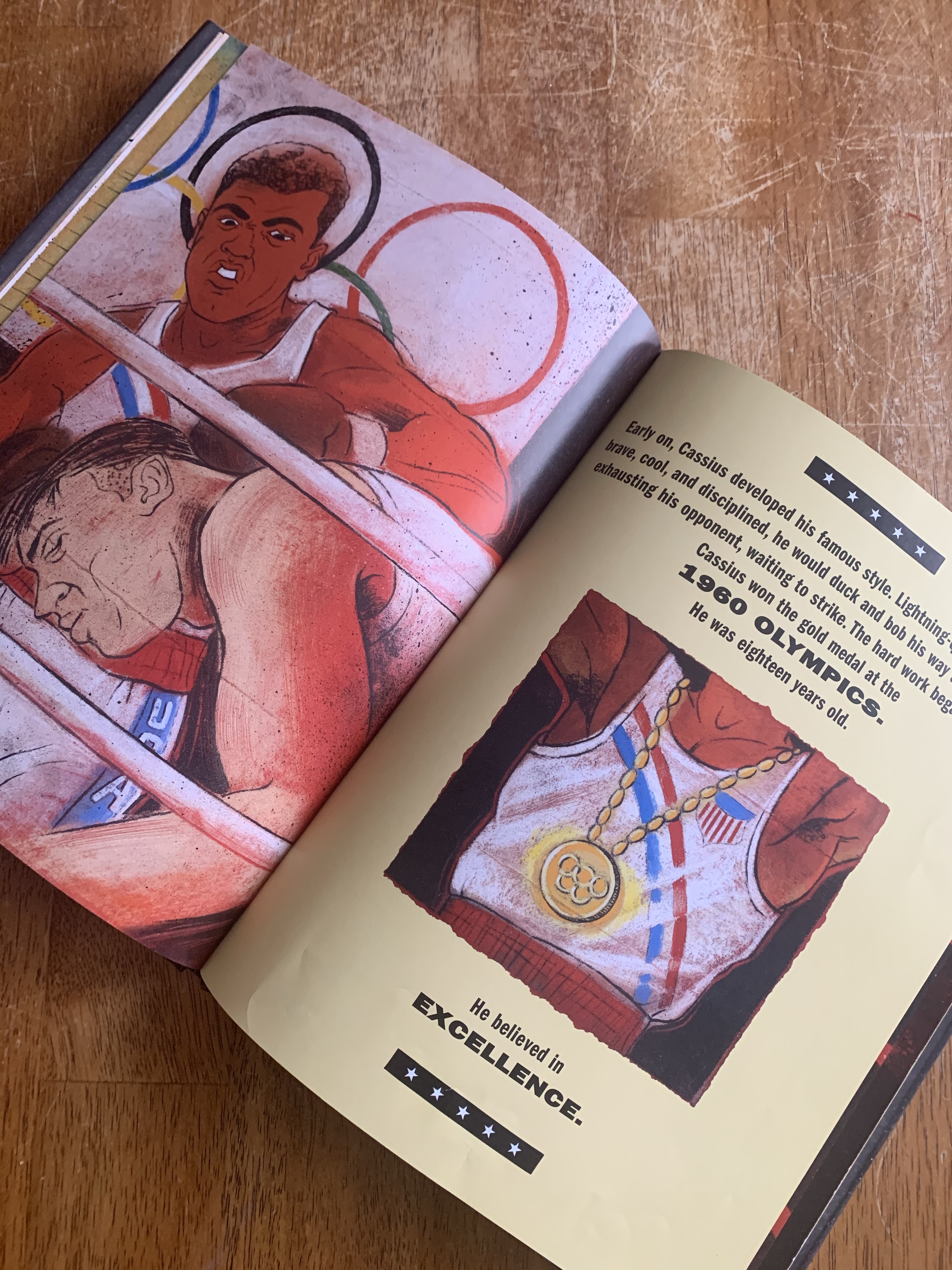
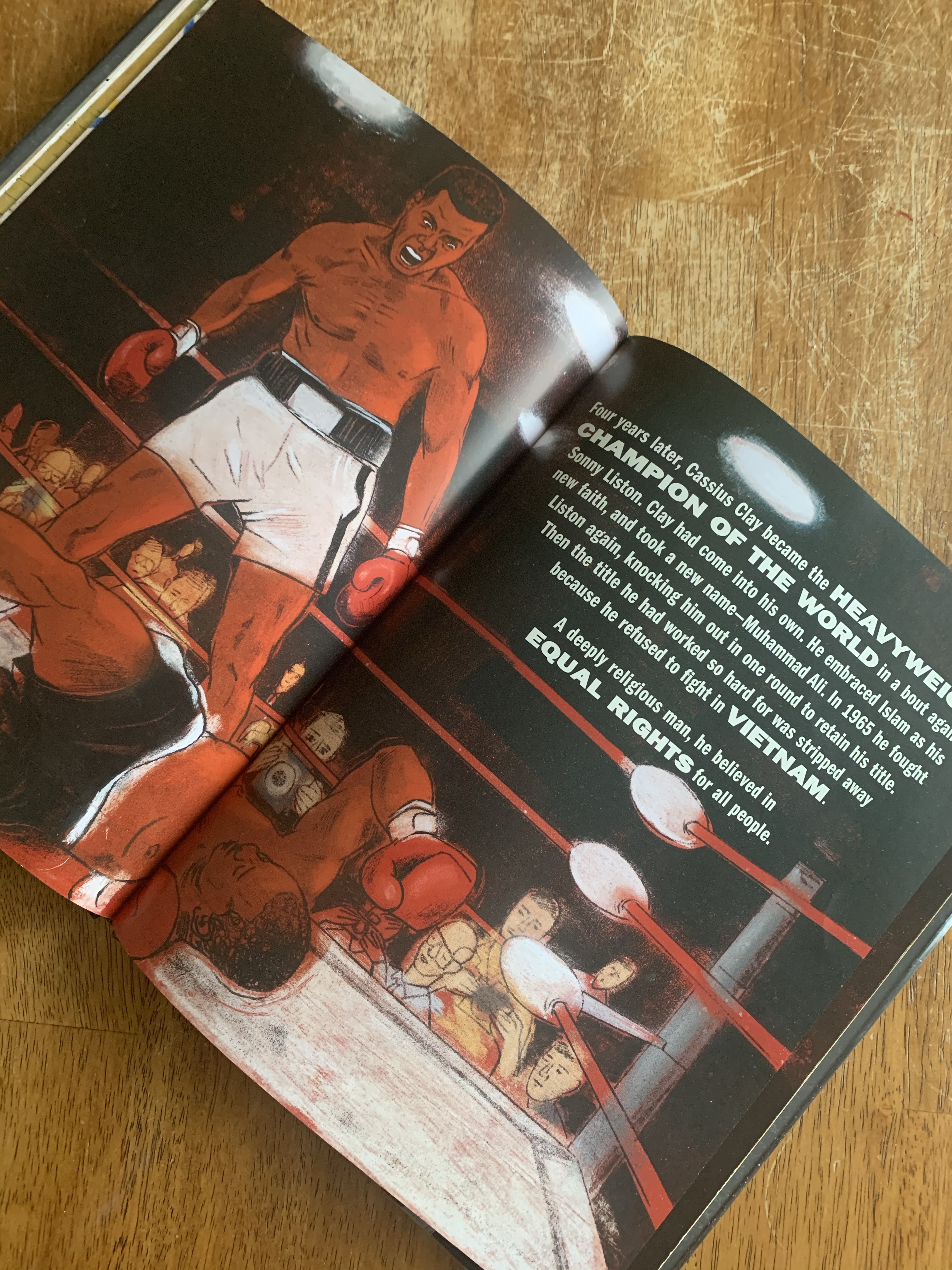
In 1960 at age 18 he won Olympic Gold. In 1964 he converted/reverted to Islam and changed his name to Muhammad Ali days after becoming the Heavyweight Champion of the World. His titles were stripped from him, however, when he refused to fight in Vietnam.

img_8254

Years later in 1971, the Supreme Court reversed his convictions for not fighting and in 1974 he reclaimed his title by beating George Foreman in “The Rumble in the Jungle.” In 1981 after winning, keeping and losing the title, Muhammad Ali retired from boxing for good.

img_8255

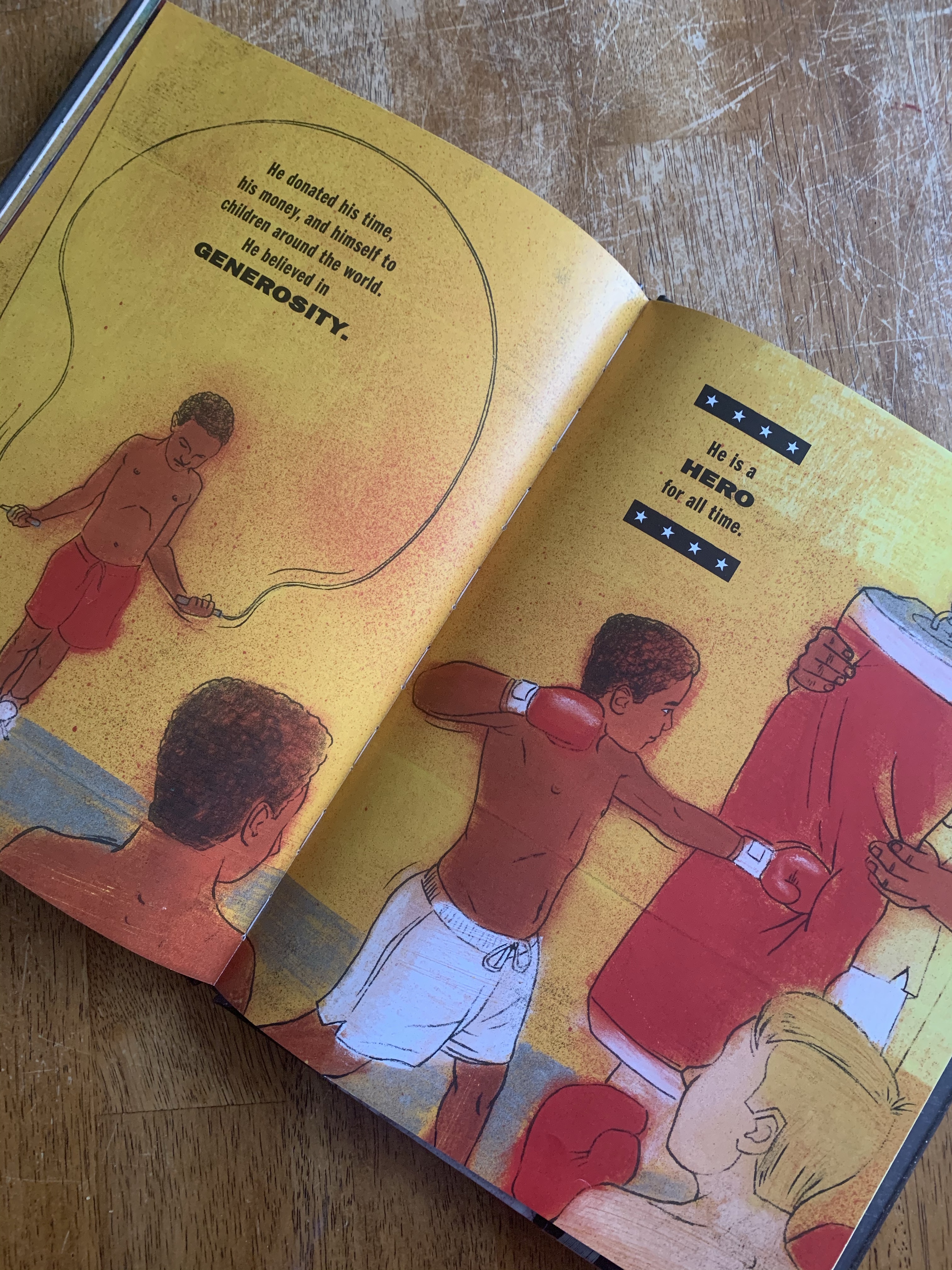
Muhammad Ali suffered from Parkinson’s disease but still donated his time, his money and himself. He believed in perseverance, and equality, and fought for what he believed in. He passed away in 2016 at the age of 74.

img_8256

This is an updated edition from the 2002 originally published book, it now includes his death. I wish it was more than a fleshed out timeline and showed him as a person, or what it was like to lose everything when standing up for something you believe in, or explained what some of his catch phrases meant, or really just as a more high energy celebration of his life.

img_8257

Fatima Al-Fihri by Aaliyah Tar Mahomed illustrated by Winda Lee

Standard
Fatima Al-Fihri by Aaliyah Tar Mahomed illustrated by Winda Lee

img_7927

This adorable simple nonfiction highlight of the founder of the world’s first university still existing, The University of Al-Qarawiyyin, is perfect for preschool/kindergarteners and up.  The brightly illustrated, large minimal text passages spread out over 16 glossy pages breathes life in to a remarkable character and celebrates an accomplishment that every one should be familiar with and inspired by, inshaAllah.

img_7928

The story starts by establishing little Fatima’s love of learning.  She learns from books, her family and from the people in her city.  When her family moves from Tunisia to Fez in Morocco, Fatima is excited to learn new things.

img_7929

Every day she goes to the mosque to read and meet new people. Her father supports her, and when he passes away she is left with his wealth.  She decides to use the money to rebuild the mosque.

img_7930

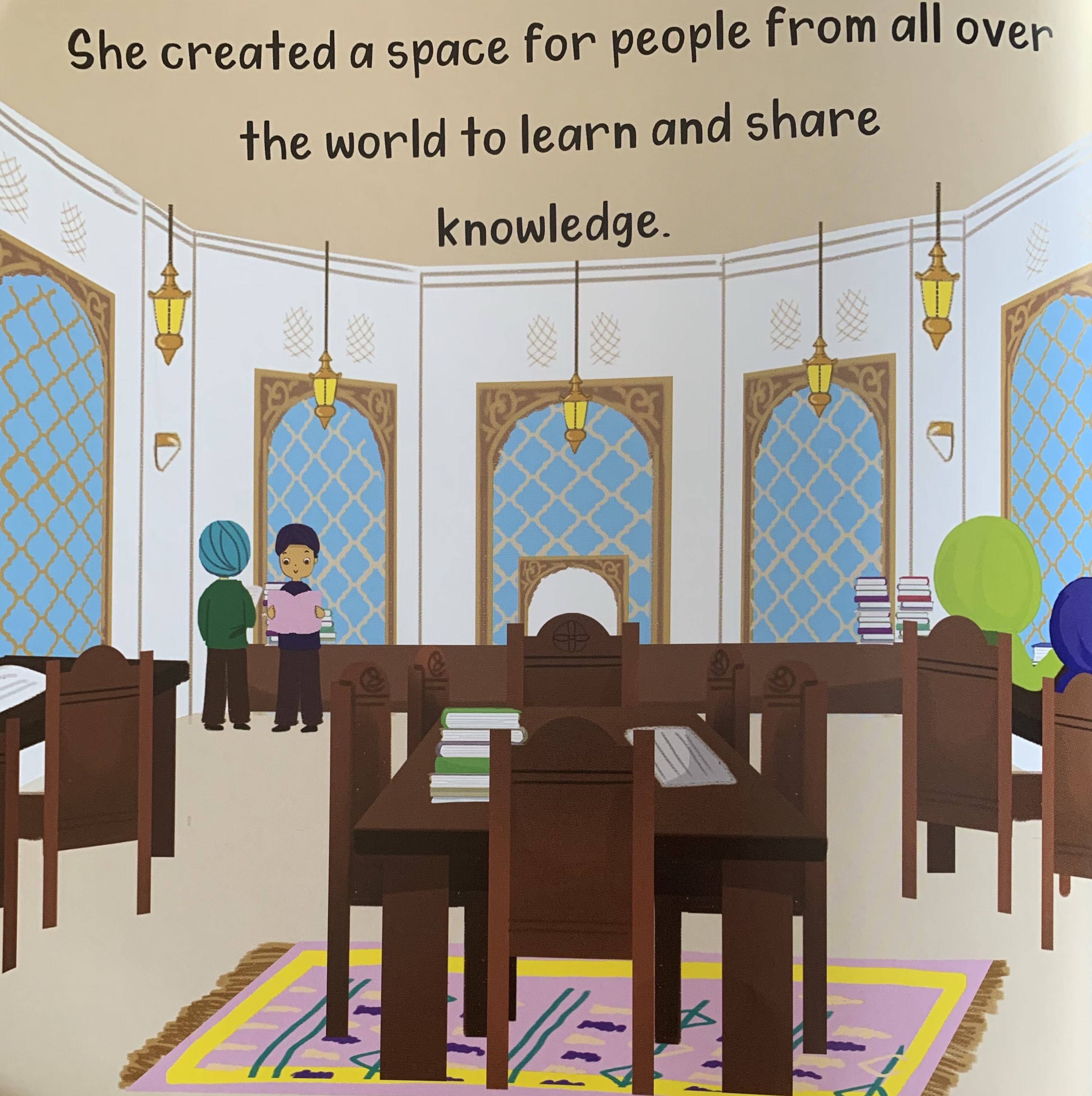
She recalls that ‘iqra’ is not just about gaining knowledge, but is also sharing what you have learned with others.  She purchases the land around the mosque and builds a university.   It is documented as being the first institution to issue educational degrees.

img_7931

I wish the story was slightly more fleshed out with detailing more about her family and her influences, about her overcoming some obstacles and even how long she lived for.  I know the target audience has a short attention span, but a few details even little ones can relate to will connect them to such an important figure and inspire the readers to dream big and make a difference.

img_7932

This book is the first in the WomanKind series.   A new series to tell stories about Muslim women who made history.

img_7933

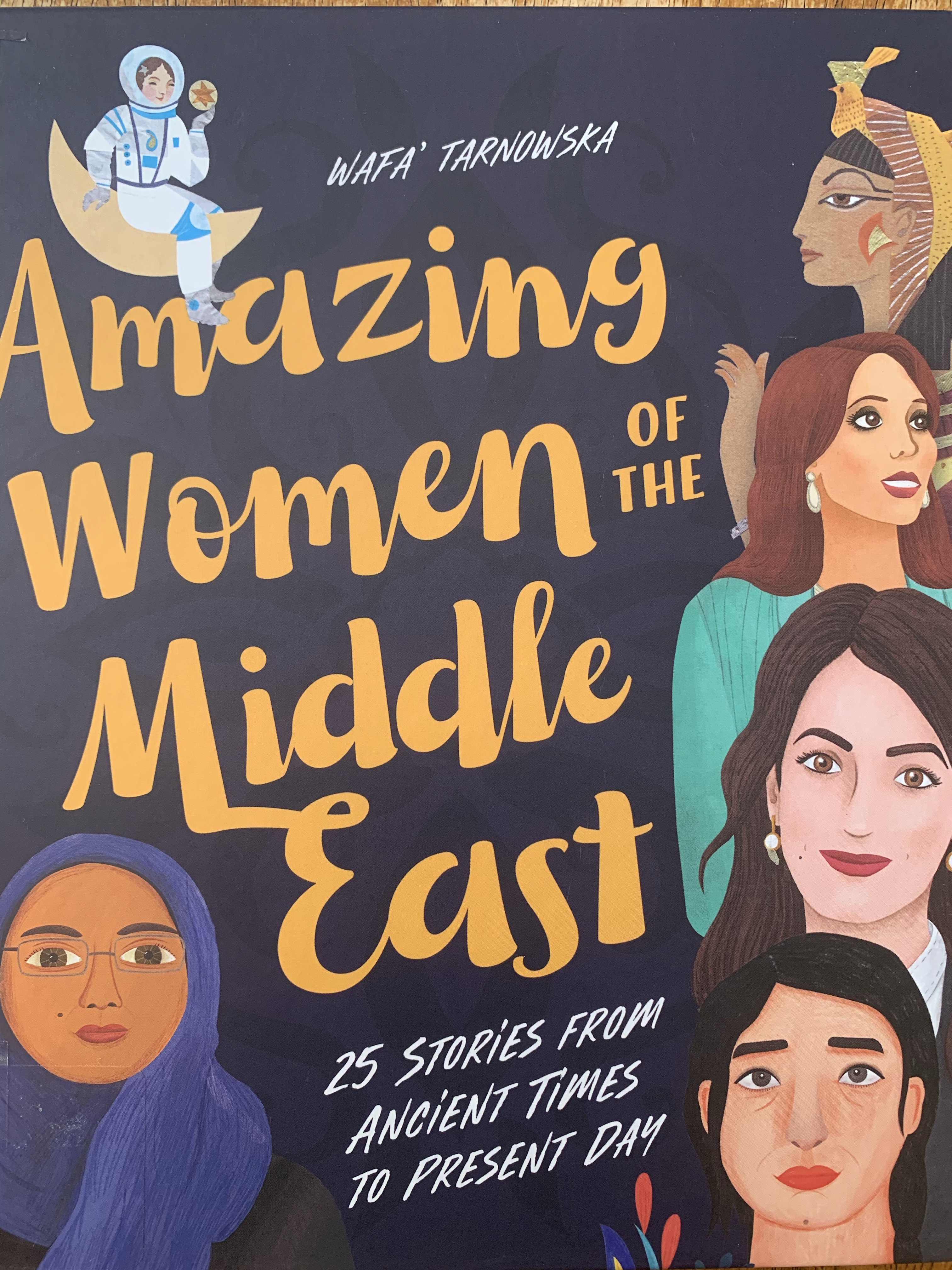
Amazing Women of the Middle East: 25 Stories from Ancient Times to Present Day by Wafa’ Tarnowska

Standard
Amazing Women of the Middle East: 25 Stories from Ancient Times to Present Day by Wafa’ Tarnowska

img_7464A nonfiction picture book for teens that features amazing women from ancient times to the present day.  Many of the women featured are Muslim and each entry receives a teasing summation page with a full page portrait from one of five international artists before a two page, more in-depth biography is presented.  The 112 pages feature an introduction, and a map to start the book off, and acknowledgements and a glossary at the end.  There are large time gaps that I wish would have been commented on, the geographical pool includes India which surprised me, and in one of the entries the way hijab is discussed seemed judgmental to me, but other than that the stories are absolutely remarkable.  There are amazing women in every culture and throughout all time periods, but to see one that highlights a region that is stereotypically oppressive to women is a sight for sore eyes.  I learned so much and marveled at the intellect, bravery and determination shown from being rulers of empires to intellectuals to scientists and artists everything in between.

The book starts with Nefertiti born in 1370 BCE and concludes with Zahra Lari, a hijab wearing ice skater from the United Arab Emirates born in 1995.  There are “celebrities” such as Amal Clooney, Fairuz, Cleopatra, Sheherazade and many that might not be as well known.

I particularly enjoyed learning about Zenobia the 3rd century warrior queen who conquered a third of the Roman empire in just five years.  Sufi mystic and poet Rabi’a al Adawiyya and her devotion to Allah swt.  Eqyptian Shajarat al-Durr who was nicknamed Queen of the Muslims in the 13th century.  And Hurrem Sultan from the Ottoman Empire.

Not every one featured was a ruler or married to one, and not are so far in the past, which in many ways gives the collection it’s charm.  Somayya Jabarti was the first female editor-in-chief in Saudi Arabia in 2014 and  Maha al Balushi is the first Omani woman to fly professionally for her country’s airline in 2010, examples of two women presented that cracked the glass ceiling by following their own dreams.

It is great to learn about the strength of the women from the past and see how to add to the legacy.  The book is a great reference, as well as a source of inspiration for people of all backgrounds to enjoy and appreciate.  I found the book at my local public library in the YA/Teen nonfiction women section.

Baba, What Does My Name Mean? A Journey to Palestine by Rifk Ebeid illustrated by Lamaa Jawhari

Standard
Baba, What Does My Name Mean? A Journey to Palestine by Rifk Ebeid illustrated by Lamaa Jawhari

img_7233

This lyrical journey through Palestine’s major cities, shares historical facts, geographical information, cultural richness, and love for a homeland that will inspire and educate all readers. There is a lot of information pressed in to 32 pages and at times the rhyming text, illustrations, and maps are powerful, and at other times overwhelming. The 8.5 x 11 horizontal paperback bound book needs to be bigger to hold all that the pages contain, and hard back to hold up to the details that need to be poured over to be appreciated. The content about the names and places in Palestine is priceless and well done, but I really wanted to love the book a bit more than I ended up feeling for it. I think trying to make it all rhyme was just a bit too much for my liking, but I would buy this book again in a heartbeat to share with my children. Even though we are not Palestinian, I think all Muslims have a piece of Palestine in our hearts and feel a deep need to celebrate the culture, fight for their freedom, and demand a quality of life that they are brutally being denied by their oppressors.

img_7234

The book starts out at bedtime with a little girl, Saamideh asking her baba what her name means. He explains to her that it means “one who is patient, persistent and one who perseveres.” She is named this because she is Palestinian, he explains and then he shows her the key to their ancestral home in Palestine. He asks her to close her eyes and imagine a white dove, named Salam, taking her on tonight’s journey.

img_7235

Salam and Samamidah prepare to journey across Palestine’s mountains, hills, deserts, and plains. They start in Areeha, one of the oldest cities in the world, and one one of the lowest points on Earth.

img_7236

They journey next to Al-Quds, the capital. They see the old city, Al-Aqsa, and more, before heading off to Nablus, Yafa, Haifa and the Akka. Learning about the cities, the food, and the history of each.

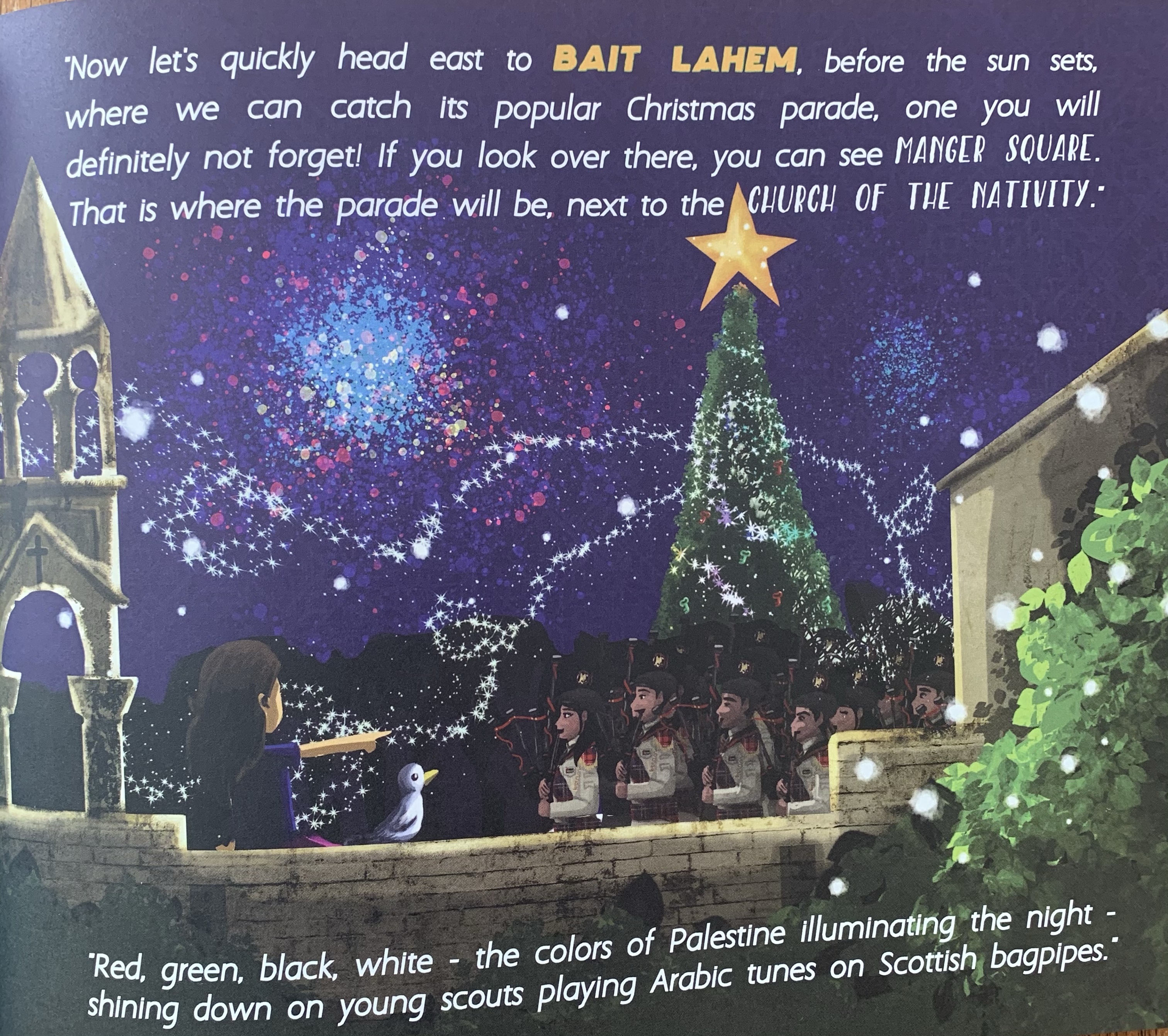
They learn about the dabkah, and the weaving in Gaza and head to Bait Lahem too. They learn about glass blowing in Al-Khalil at the Ibrabhimi Mosque, and finally they conclude their journey with the little girl dreaming of flying around the world to use her key and open people’s hearts and minds.

img_7239

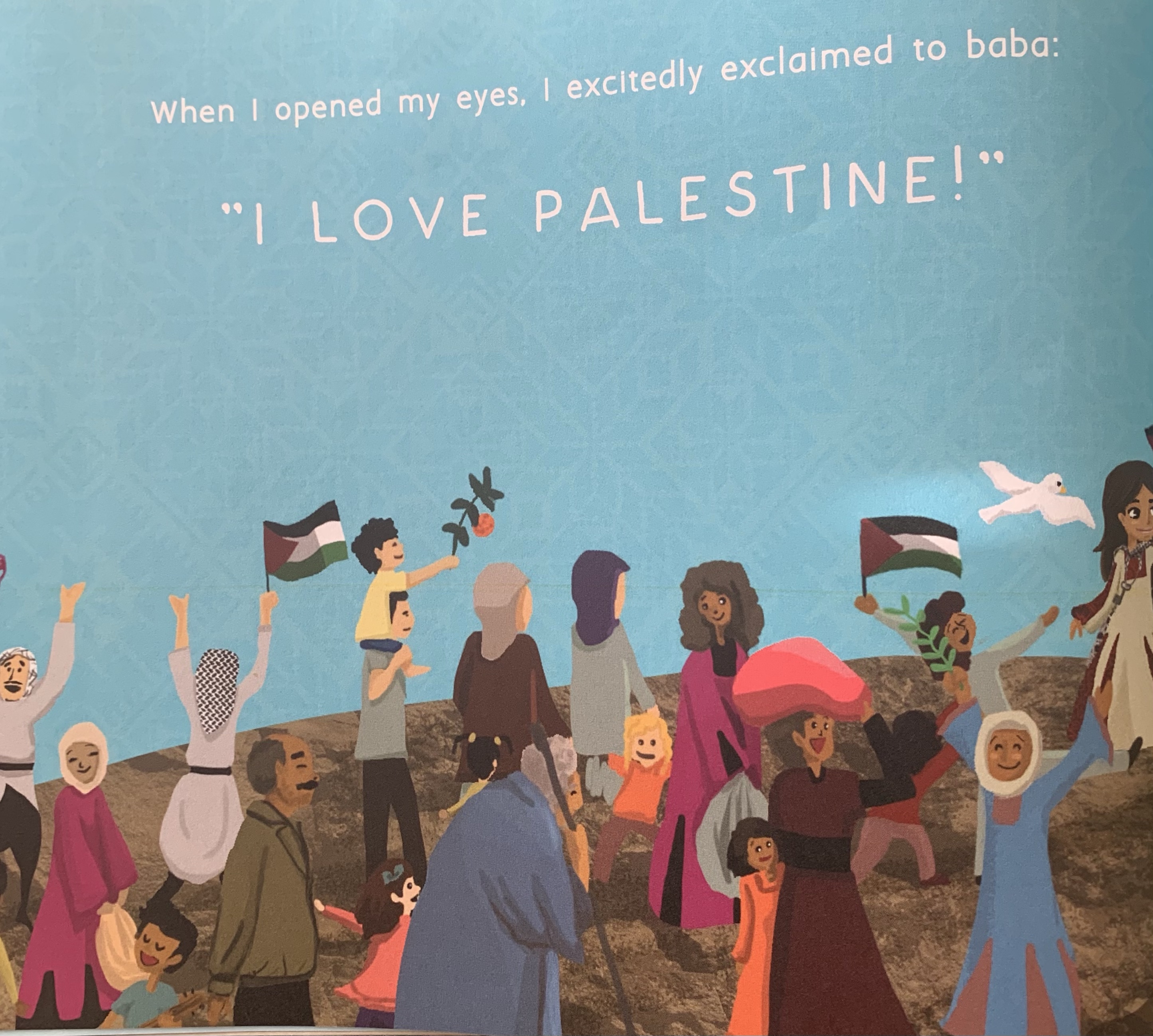
She proudly exclaims her love of Palestine and her and her baba pray that one day they will be able to return. Saamidah then asks her baba why they are refugees, and he promises to save that conversation for tomorrow’s beditme story.

img_7240

The book concludes with a list of the city names in Arabic, trasliterated in English, and then the English names. It then has discussion questions at the end.

The book is not outwardly political, nor critical. It is a celebration of a people, a culture, and land. Happy Reading!

Alia’s Mission: Saving the Books of Iraq by Mark Alan Stamaty

Standard
Alia’s Mission: Saving the Books of Iraq by Mark Alan Stamaty

alia

Based on the true story of Alia Muhammed Baker, the Basra librarian who saved 30,000 books in 2003 from the destruction during the Iraq War, this 32 page graphic novel, is an AR 3.9 and while it isn’t a chapter book and isn’t just a picture book, it works well for 2nd through 4th grade readers that will enjoy a bit of history, a lot of excitement, and detailed panels that make the story come to life.  The story, as it is based on fact, is very similar to The Librarian of Basra, but with it’s different presentation style, might appeal to a larger audience to appreciate and celebrate what she did to save such precious books, naturally, I’m a huge fan!

5532A37C-C4DF-46FA-8334-5F4AA3A06AB5

SYNOPSIS:

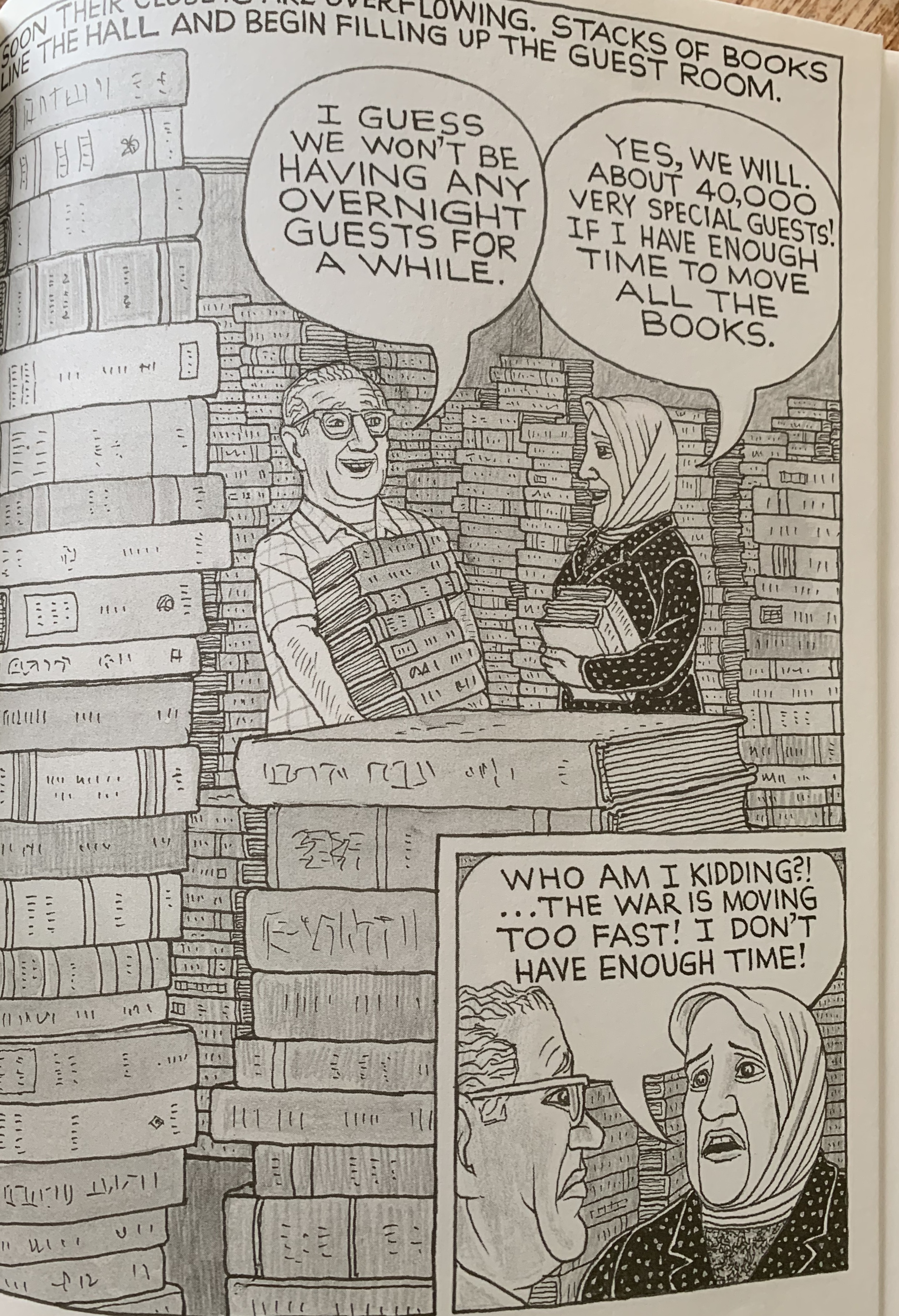
Alia is the Chief Librarian of Basra Central Library and has always loved books and learning.  As war draws closer, she tells her husband she is worried that the library could be bombed or set ablaze.  She goes to the government to voice her concerns and ask that the books are relocated, but her request is denied.  So she takes matters in to her own hands, and starts smuggling books under her shawl and in to her car, and stacks them in her home.  Every day she does this for a week, soon closets are over flowing and she starts stacking the books in her guest room.  Worried that she isn’t making fast enough progress, she gets the restaurant owner next door to help her when looters start taking the pencil sharpeners and furniture from the library.  She has a plan to have everyone possible come together to move the books, and many people come to help.

Eventually the library is set on fire, the news gives Alia a stroke.  When she recovers she learns she saved 30,000 books, and up next for this real life super hero? Building a new library, inshaAllah.

A3A17616-7940-4E80-8CA1-9798A8BA4FC8

WHY I LIKE IT:

I love that it shows the value of libraries and books, the determination of one person, and the support of a community.  People are awful during a war, yet, sometimes they are pretty amazing too.  The illustrations are detailed and varied, with inviting text and clear concise language.  It really is well done.

B0FB5A2A-7376-4F20-BCD1-6D64956B77C6

FLAGS:

Destruction of property, sneaking, looting.

TOOLS FOR LEADING THE DISCUSSION:

I think it would be great to have kids read this story and the librarian of Basra and discuss


Nowhere Boy by Katherine Marsh

Standard
Nowhere Boy by Katherine Marsh

boy

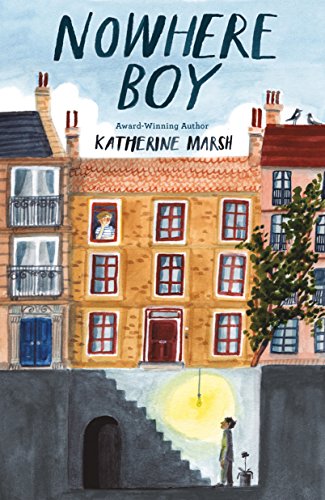
I was not expecting to be so absorbed by this 362 page AR 5.4 book.  I knew it was about a Syrian refugee in Brussels and his friendship with an American kid living in Europe for a year, so I knew that Islamaphobia and immigration would all be factors.  I also knew that as a middle grade book it would be optimistic, and a bit of a stretch at times,  but when I had to pause in the first chapter to wipe the tears off my cheek, I knew that while it could be billed as, another refugee story, it really was going to be a poignant story about humanity and friendship and family and making a difference, so I settled in and was swept off to Belgium and the adventure of two determined kids.

SYNOPSIS:

The book opens with 14-year-old Ahmed on a boat with his father hoping to reach Greece from Turkey, when the boat stalls, his father and two other men, the only other people on the dinghy that know how to swim, jump into the sea to drag the boat.  When a storm swell hits them, his father is lost and Ahmed, who left Syria when an explosion killed his mom and sisters, is all alone.

Max is 13 and his parents and sister have just arrived in Belgium for a year.  Not a great student, Max learns that he will be going to a local school where French is spoken, and will be repeating 6th grade.  Less than thrilled with the news, he is additionally hurt that his parents didn’t tell him first.

The two stories start off separate with Max trying to find his footing in school and scouts where he understands very little, and has no desire to learn, and is also getting picked on by a kid named Oscar.  He learns about the history of his street and house during World War II from his after school tutor and a police officer that used to live in the house they are renting and makes regular checks on how it is being maintained.  

 Ahmed has been staying with Ibrahim and his family, another man that tried to drag the boat in the sea, but with news that they are probably going to be forced to return to Iraq, suggests that Ahmed register in as an unaccompanied minor so that he could find a place to stay.  Ahmed knows that if he registers in Beligium he will never make it to England, he hires a smuggler for 300 Euros to get him there.  When the smuggler steals his money and his phone, Ahmed worries his organs could be next, and jumps out of the moving car,  

Ahmed runs through a neighborhood looking for shelter and safety and some warmth from the frigid air.  Ahmed finds the basement of a house unlocked, he then finds a wine cellar room that is empty and decides to stay for the night as he figures out his next step. One day turns in to two and before he knows it, he has a routine of finding food upstairs during the night, which he records so that he can repay the family one day, caring for the family’s discarded orchids, and working on his English.  Then one day Max goes downstairs and discovers Ahmed living there.

Deciding he isn’t a terrorist, Max decides not to turn Ahmed in nor tell his parents, and the two become friends.  The two enlist Farah, a nice Muslim girl at school to help, and they get Oscar too, to forge papers to get Ahmed in to school.  While the biggest problem should be keeping a kid hidden in the basement, and keeping him fed and entertained, the situation is compounded as terrorist attacks by Muslim extremist plague the city and Europe, making everyone on high alert.  The police keep checking in and anti immigrant sentiment rises.  When Ahmed gets accused of being a bomb maker his secret is out, but can his knowledge of how a jewish boy was hidden in the neighborhood during the war keep him free? Nope, I’m not going to spoil it, you have to read it, trust me, you’ll thank me for it!

WHY I LIKE IT:

I love, love, love, the history parallel, and the truth in the story of Albert Jonnart and Ralph Mayer that is woven into this modern fictional story.  I love that Max so plainly says that the stories are the same and that laws that aren’t right shouldn’t be followed, yes! The book reads a lot like Refugee by Alan Gratz crossed with The Boy at the Back of the Class by Onjali Q. Rauf with the kids being so heroic and determined and awesome, throw in a dash of The Diary of Anne Frank, switching out a boy for a girl, a Muslim for a Jew, the basement for the attic, and a diary for a fictional story, and you have this book.

I love that the adventure and excitement shows how resourceful kids can be even when they don’t share common language.  Max speaks English and is learning French, he is helping Ahmed learn better English and some French, when they talk to Farah who speaks Moroccan Arabic /Berber, they often have to go through Oscar who speaks French and English.  Yay, for American television and kids who’s hearts are bigger than the obstacles they are taking on.  Additionally, when the kids hit a dead end, they reach out to Jews in America for help, knowing that the two religions have more in common than politicians and the media would like to think.  Seriously, kids should rule the world.

Ahmed is a religious boy that prays, refuses meat even when hungry to ensure it is halal, and makes sure that Max knows in Islam kindness and charity are the norm and commands, not the violence that people are doing in the name of his religion.  A lot of the moms of the kids at school where hijab, and the author gets the Islam right and believable.  It doesn’t get preachy, but a fair amount of information about Islam is shared.

FLAGS:

A lot of lying. Some violence, death, hate speech. There is mention of smoking and the adults I think drink wine at one point.

TOOLS FOR LEADING THE DISCUSSION:

I’m hoping to do this as a middle school book club selection, because it really is so good.

Author’s website: https://katherinemarsh.com/books/nowhere-boy/

Teaching: https://www.teachingbooks.net/tb.cgi?tid=60364


Mae Among the Stars by Roda Ahmed illustrated by Stasia Burrington

Standard
Mae Among the Stars by Roda Ahmed illustrated by Stasia Burrington

mae

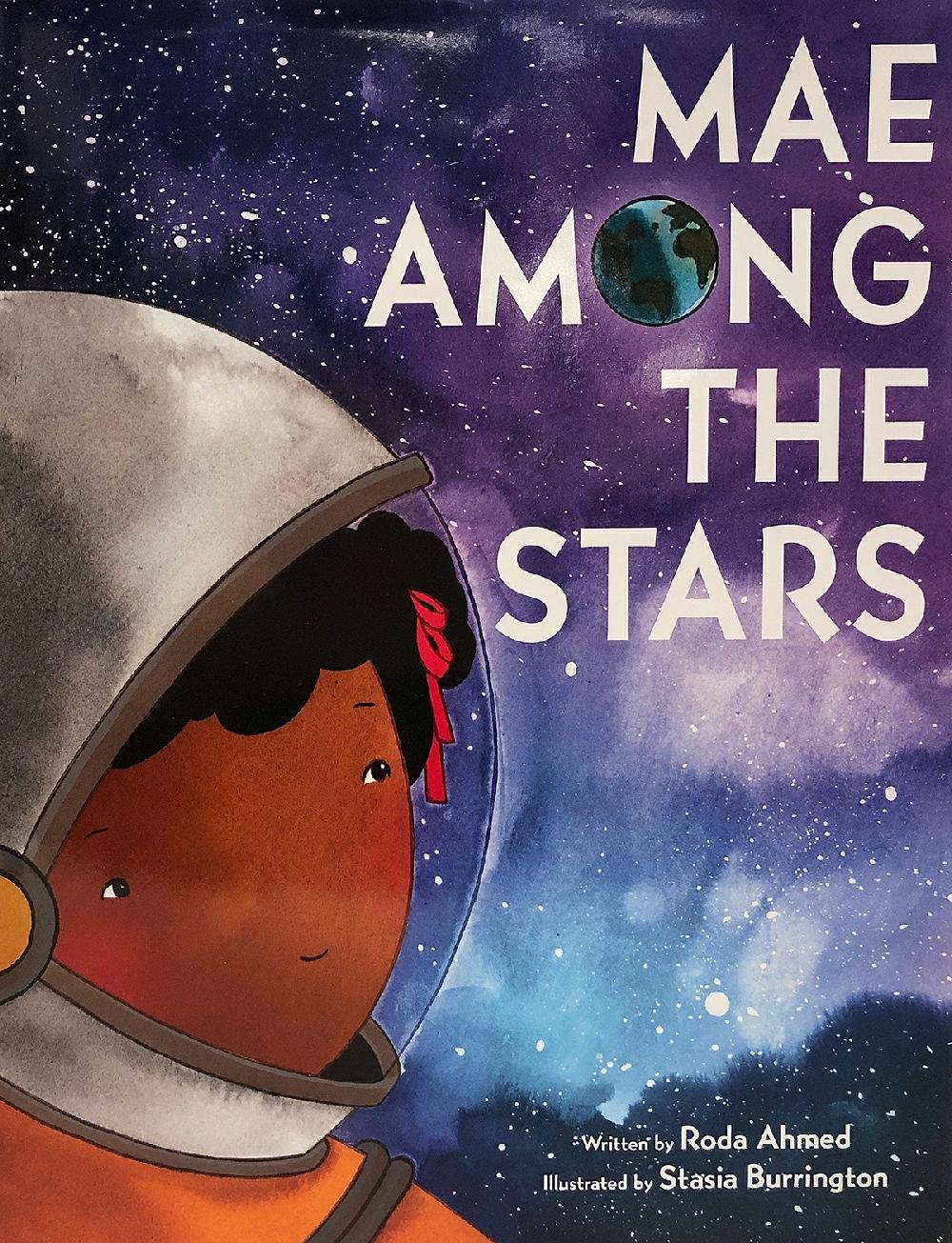
Inspired by the early life story of astronaut Mae Jemison this 36 page AR 3.0 children’s picture book is inspiring and encouraging.  It is not a biography of the first African American woman in space for children, infact with the exception of the note at the end, there really are very few specifics about how she went from being discouraged by a teacher to flying in outer space.  That isn’t to say the book isn’t beautiful and impressive, because it is, and it shows how no one should limit your dreams or your success.  The book radiates warmth and determination and for children, preschool to third grade, if desired, offers a way to start a discussion about racism and sexism all while celebrating the amazing accomplishments of Mae Jemison.

9291EB01-47EA-42C7-AE9A-2E2601245176

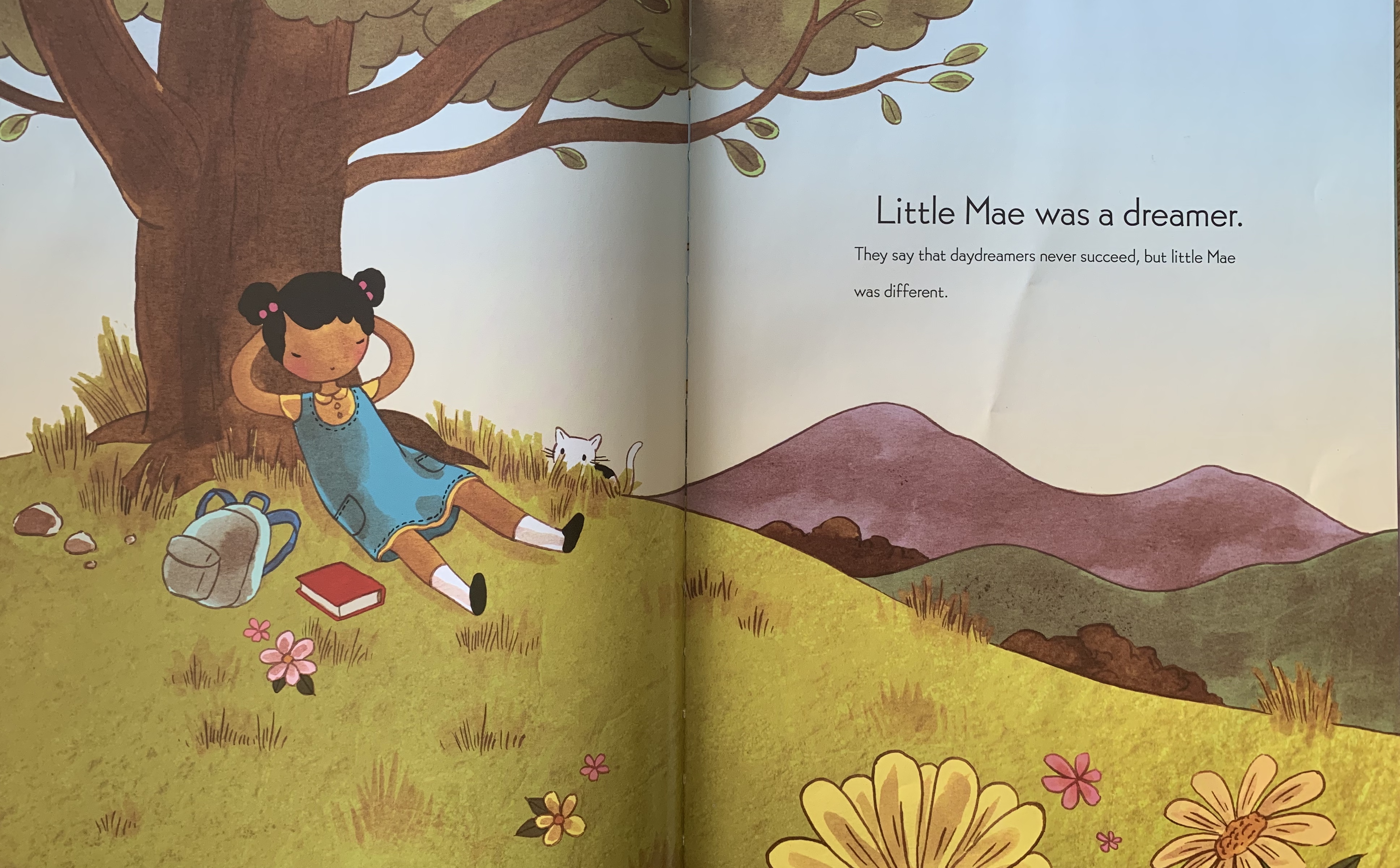
Mae is a dreamer and her homework one day asks her what she wants to be when she grows up, she tells her family she wants to see the Earth from up there, pointing to the sky.  Her mom tells her that she will have to be an astronaut to do that.  Nervous that it might be too lofty of a goal, her family reassures her that if she can dream it and believe it and work hard for it, that anything is possible.

ACD1927E-46F4-4525-84D9-4D1D4479B261

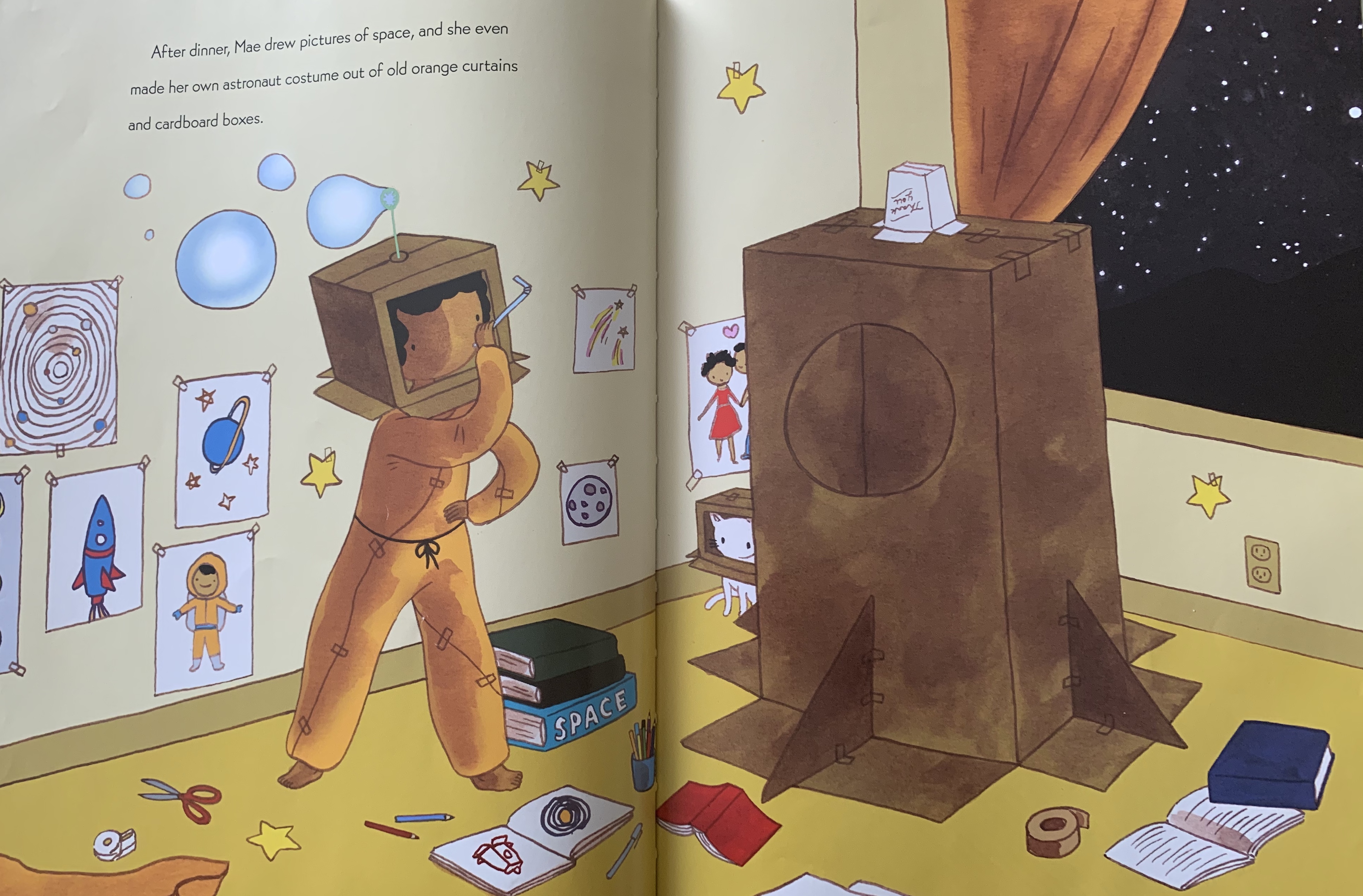
From then on, Mae reads books about space from the library, plays pretend, and makes herself a space suit from old curtains and a cardboard box.  She dreams about being in space and looking back at Earth, and she tells everyone she can about her dream to be an astronaut.

869AD060-D37E-4B8A-AB1A-C77F1E92A68C

At school when the teacher asks what everyone wants to do and be in the future, Mae’s answer gets her laughed at.  Ms. Bell tries to encourage her to be a nurse instead.  Once home, Mae breaks in to tears that her teacher didn’t believe in her.  Mae’s mom tells her that her teacher was wrong and that she hoped Mae didn’t believe her.  She told Mae that no one could stop her from pursuing her dreams.

EC432DA0-0032-45F8-B22D-9017DD033DAE

With her family’s unwavering support and a lot of hard work, Mae goes to space. The book ends with her keeping her promise of waving to her parents and looking down on Earth.

958EA75A-98CD-4FD0-9AA0-5091A9E06B65

The book touches on a lot of powerful issues that I really hope adults will point out and discuss with their children.  Why her teacher didn’t think she could be an astronaut, not as a belittling of the nursing profession, but as a woman of color what would make her teacher think that was her best option.  When and how should we handle when teachers, or people in authority,  do or say something that we disagree with. I also hope that the note at the end that tells more about Dr. Jemison’s accomplishments is poured over again and again and again and appreciated.  Truly she is a hero!

4532F757-FC28-41E8-AB6B-D548B60DB1BB

There is nothing Islamic in the book, I’m assuming the author is Muslim, but honestly I didn’t find anything in my Google searches that would indicate that she is or isn’t.  It is really just my assumption about the name and my wanting to share this inspiring story with beautiful illustrations with the people who frequent my blog.  Enjoy!

The Story of the Holy Prophet Muhammad (peace and blessings of Allah be on him): Ramadan Classics: 30 Stories for 30 Nights by Humera Malik

Standard
The Story of the Holy Prophet Muhammad (peace and blessings of Allah be on him): Ramadan Classics: 30 Stories for 30 Nights by Humera Malik

the story of prophet muhammad

I debated posting about this book for so long that Ramadan is more than half over.  But as a reference for years to come, I thought I should go ahead and throw my late support toward this Ramadan tradition and a book deserving of space on your shelf for children 4th grade and up.  I’ve seen people praising it for a few years, and finally I ordered it this year, however, I wanted to not only read it, but also test it out first: reading a story a day, discussing and asking the correlating questions with my own children, before reporting back.  I cannot and thus won’t comment on the accuracy of authenticity of the book, nothing stood out as erroneous to me and there is a bibliography at the back, but there is a reason I try and steer clear of non fiction, I’m just not qualified to comment.

SYNOPSIS:

The book starts with the birth of Prophet Muhammad (saw) and ends with the selection of Abu Bakr (ra) as the first Khalifah.  Each chapter is between one-and-a-half to two-and-a-half pages and the 30 chapters plus one Eid day chapter (so a total of 31), covers 103 pages in all.  There are a few pictures of where the Battle of Badr took place, the Cave of Hira, not many.  There are three questions at the back of the book for each of the chapters, but no answers.  The book is pretty linear, just the second chapter bounces back to Prophet Abraham (as) and Hagar and the story of Zamzam and then the rebuilding of the Ka’bah.  It is a glorified timeline, which in this case is a good thing.  It doesn’t go off on tangents or provide a ton of outside references, it is concise and general, but hits the key parts: marriage to Khadijah, first revelation, migration to Abyssinia, Taif, Hijrah, treatment of slaves, year of sorrow, Battle of Badr, Battle of Uhud, Treaty of Hudaibiyah, it talks of tensions with various tribes, coming to an agreement about the Khalifah, and more.

I think younger children might possibly be able to have the short chapters read to them and then explained, but really, it would be a lot to process.  The words are simplified and the gist of situations are conveyed, but topics aren’t necessarily shied away from.  It discusses that Prophet Muhammad (saw) had more than one wife, and that there were slaves, and there were tensions with the Jews, and Bilal was tortured, all things that picture books might skip over.

WHY I LIKE IT:

I like that even my young teen could read and involve herself without feeling like the exercise was childish.  Many of the answers are open ended in nature and require more than just a one word answer.  It allows for children to add other facts that they know about RasulAllah to the dialogue and make connections to our history with our current life very easily.  Even children that know the story of Prophet Muhammad (saw) will find the book engaging and smooth enough to read through again (and hopefully again each Ramadan) and learn new tidbits, understand concepts more clearly and be reminded about the beauty of our Prophet.

FLAGS:

Nothing

TOOLS FOR LEADING THE DISCUSSION:

If I was a teacher, I would definitely start each morning reading a chapter and doing the Q and A, whether it was Ramadan or not.  I think we need to be more connected to our Prophet and grow our love and appreciation for him, so books like this are such a great tool in accomplishing that goal.