Category Archives: 4th grade and up

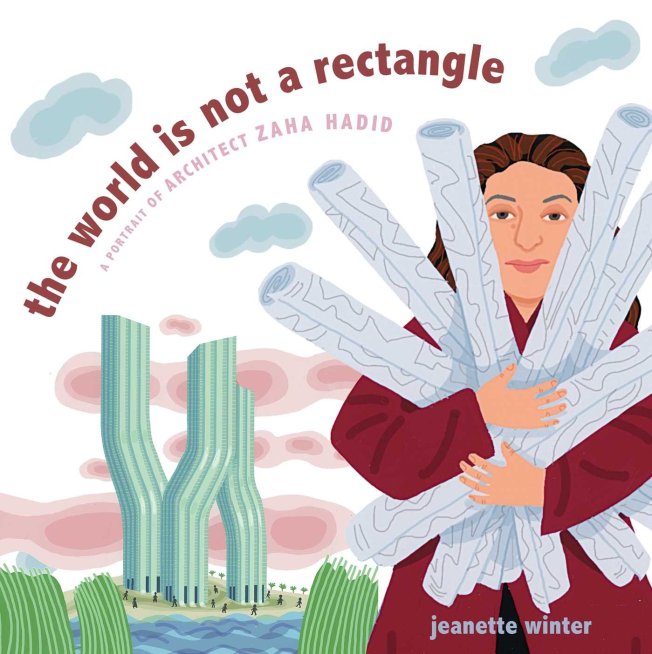
The World is Not a Rectangle: A Portrait of Architect Zaha Hadid by Jeanette Winter

Standard
The World is Not a Rectangle: A Portrait of Architect Zaha Hadid by Jeanette Winter

rectangle

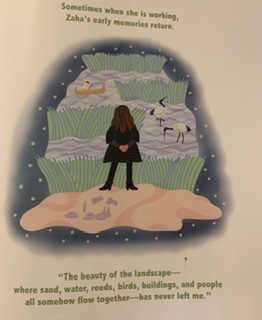
This non fiction book spread over 56 pages on an AR 4.0 level is the biography of the famed Iraqi architect’s inspiration, triumph over obstacles and accomplishments.  It doesn’t go in to great detail of her life, but gives enough information for children to become familiar with her and be inspired by all that she accomplished not only as an Arab, Muslim woman, but as an architect and trail blazer of design and structure.  The pages are beautifully illustrated and the simple text flows and dances around the pages like her buildings in real life.

0BE54CFC-BBDB-4507-9DDA-FDA54576B014

Born in Iraq where rivers flow, wind swoops across sand dunes, and cities existed thousands of years ago, Zaha finds designs and shapes throughout her home and the city of Baghdad.  She has ideas about arrangements of furniture and designs of clothing, she loves that dunes and rivers and marshes don’t have corners.

CEE97AF8-91A3-46AC-A63E-E3484F1790B1

She is a Muslim that attends Catholic school and loves math.  She goes to London for college to study to be an architect. She is relentless in her passion and fills notebooks with plans, paintings with what she sees in her mind and graduates with honors.

94EC3F0A-2584-4786-9FF8-9FE173CB04A5

She opens her own office and with a few friends, she designs buildings that swoosh and zoom and flow and fly.  The world is not a rectangle, but unfortunately no one wants to build her designs.  She keeps entering competitions, and winning, but they refuse to build her buildings.

FE2B9584-E1C6-4B19-94B8-9684A9F6BC0C

She designs buildings that come from her memory of grasses swaying, and wind blowing over dunes, and shells being cradled.  She designs an opera house like a pebble in the water, with the singer the pearl.  A ski jump that reaches the sky like a mountain.

91BAFF18-340B-4334-B856-5984A4CF1060

One by one, Zaha’s designs become buildings all over the world.  She has over 400 employees and designs buildings, shoes, doll houses, furniture, she does what she likes and urges others to do so as well.  Zaha passed away in 2016, but her visions are still carried out.


The Girl and the Ghost by Hanna Alkaf

Standard
The Girl and the Ghost by Hanna Alkaf

ghost

A book meant for middle grades, 8-12 year olds, that has depth and layers and culture and strength is not something you find very often.  Over 275 pages, the book is at times dark and haunting, but what is truly remarkable is that it doesn’t talk down to young readers and with its pop cultural references and relate-ability,  the book is not dreary.  In fact, the true “haunting” occurs after the book is finished and the concepts of friendship, being alive, and forgiveness stick around and require thought and consideration.  The book is based on a Malyasian folktale, how much is a fleshing out, or simply a starting point, I do not know, but I do know that the characters are memorable, the concept thought provoking, the writing flawless, and the intertwining of Malay culture, Muslim characters and the supernatural, a combination that makes for an enjoyable read.

SYNOPSIS:

When an old witch dies, her pelesit, her ghostly demon, is passed on to her granddaughter Suraya.  Suraya lives with her mother, a teacher, and is lonely and emotionally neglected.  An adventurous girl, the pelesit, keeps the small girl safe, but waits to reveal himself to her in the form of a grasshopper when she is older.  When he does reveal himself to her, she asks him his name, and he doesn’t know it, so she names him Pink.

Suraya and Pink become best friends, and he provides company for her as she receives very little from her mother and has no friends.  Suraya had no knowledge of her grandmother and Pink modifies the stories to leave out how evil, cruel and vindictive she was through him.  As an evil being with no heart these acts never bothered him, although he stopped enjoying them long before she died.  With Suraya however, he feels things.  He is sad that she is unloved by her mother, teased by the other children, and that she doesn’t have the things other kids have.  Suraya is kind, and forgiving, and tries so hard not to let things bother her.  Pink however, with a twitch of his antenna can make things happen.  Bad things.  Things that might at first seem like a part of life, but when Suraya catches on, she scolds Pink.  She makes him promise never to use his magic to hurt people, ever.  He reluctantly agrees, she is his master after all.  Unfortunately he doesn’t keep his promise.

On Pink’s prodding, Suraya makes friends with a new girl at school, Jing, and their friendship makes Pink jealous.  He harms Jing and Suraya decides she no longer wants to be his master.  As a result Pink is determined to make Suraya’s life miserable.  As desperation mounts, Suraya tells her mom about Pink and a pawang is called in to separate the spirit from Suraya.  Something seems off about the pawang, and when Suraya investigates, she realizes that she must save Pink from him.  Together with Jing, Pink and Suraya are off on an adventure against the pawang and might just learn more than Pink’s backstory in their efforts along the way.

WHY I LIKE IT:

I love that Suraya and her family are Muslim and that Jing is not and they are best friends.  Suraya and her family pray, celebrate Eid, give salams when at the graveyard, but obviously also believe in magic and ghosts, and somehow in the story it doesn’t seem to be contradictory or odd.  I love Suraya’s strength.  None of the relationships in her life are good.  Yet, she is good, and she forgives and fights to make those close to her better.  Pink is manipulative and controlling and abusive, but she still fights for him to be treated better and that says more about her, than whatever he is.  Suraya’s mom is distant and neglectful, but yet, there is still realistic hope that their future can be and will be better.  I love that all these layers are there and yet are subtle too.  Kids are smart and they will bring their own experiences, understanding, and expectations to decipher these relationships, and that is amazing.  I love that the characters in the story may be so different than the typical western reader, but they will still see themselves in this poor Malay girl from a small village, in her best friend Jing who lives and breathes Star Wars, or even in the religions pawang who is a power hungry charlatan; toxic friendships and family secrets make the book universal.

FLAGS:

Pink makes it look like blood is on a girls back side, implying a girls fear of leaking, but it isn’t explicit or named.  There is death and dying and supernatural and lying.

TOOLS FOR LEADING THE DISCUSSION:

I am thinking strongly about using this as a book club book, as the discussion would be delicious and varied among the participants.

Interview with the author: https://thequietpond.com/2020/08/20/our-friend-is-here-an-interview-with-hanna-alkaf-author-of-the-girl-and-the-ghost-on-writing-friendship-malaysian-childhoods-being-true-to-your-stories/


The Battle by Karuna Riazi

Standard
The Battle by Karuna Riazi

the battle

This claims to be a companion book to The Gauntlet, but it does rely heavily on details from the first to make sense of who some of the characters are as this book does little to explain them and advance their story.  In reality the book is very similar to the first book, but sadly not as fun.  I was disappointed in the 295 page AR 5.2 book, but my fourth and fifth grade boys enjoyed it as they had few expectations and the fast pace kept the book fun.

SYNOPSIS:

It has been four years since Bengali American Ahmad Mirza has left the game world, Paheli, with his sister Farah and her friends.  The old board game has been destroyed and the reboot focuses on a new video game setup.  This time around Ahmad is the main character and with his ADHD he finds himself getting in trouble a lot in school and desperate for a friend.  When a mysterious package holding a video game shows up and Winnie sticks up for him, things are possibly looking up. When all of New York freezes at the insertion of the game, however it clearly is not.  Winnie and Ahmed are off to battle the Architect and MasterMind to unfreeze their beloved city and escape Paheli.

Different battles and characters inch the duo closer to winning, but facing their fears and  being sidetracked by remnants of the last game trying to return make everything complicated.  Ahmed’s uncle returns to the game, giant mice try and help, crazy monkeys distract, and flying rickshaws populate the eastern inspired world filled with Bengali, and Arab references.

WHY I LIKE IT:

I love that it is a Muslim kid with some struggles at the helm, but there is really so very little character building that it ultimately doesn’t count for much in the long run.  Just like the first book, the characters are taken from the “real” world and transported to a game world and they must win the game to return home.  The book is fast paced and fantastical, but I constantly felt confused.  The challenges were disjointed, there wasn’t a clear objective, Ahmed didn’t recall being there before or that Vijay bhai had somehow come back with them, the mice help and then they are absent, and there wasn’t really a big reveal or explanation resolving any of it.  It felt all over the place and with little world building I didn’t feel like I could even picture what Paheli looked like, so forget feeling what the characters felt or imaging the intensity that that the game was running on.  It seemed like an updated version of the first book, but not done as well at all.

FLAGS:

Pretty clean, some intensity, some fighting/battling, death, nothing detailed nor grotesque.

TOOLS FOR LEADING THE DISCUSSION:

I think the book is great to have in a classroom or on a home book shelf especially if the Gauntlet was enjoyed, but I wouldn’t use it as a book club book because it doesn’t offer much to talk about.  There isn’t a cathartic release or even an under current of family and friendship and loyalty, it really is just surface level story telling.

Leila and the Sands of Time by Shirin Shamsi

Standard
Leila and the Sands of Time by Shirin Shamsi

shirin shamsi

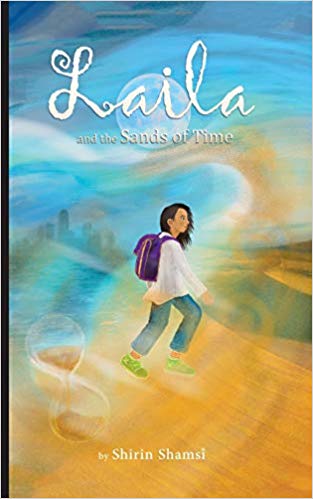
This 127 page book has a lot of potential, but ultimately didn’t win me over.  It is one of those that needs a good editor to encourage the author to flesh out the characters, take advantage of a potentially cathartic resolution, and fill the gaping holes in the story.  Meant for ages 8-12 the tiny font, and tight spacing, make the book really dense and intimidating to look at and read.  The book, as written, should be well over 200 pages, if spaced appropriately for the target audience.  Once you accept the presentation and get in to the story, it isn’t an awful read, it just could have and should have been so much more.  I hope the author revisits it and polishes it up- the time travel, the science DNA component, and the death of the protagonist’s parents, offer a lot for Muslim and non Muslim readers to sink their teeth in and be swept away by, but ultimately, I don’t know that most readers will be motivated to finish the book, and those that do, won’t remember anything about it.

SYNOPSIS:

Laila’s dad has recently died, and with her mother having died years earlier, Laila is now 13 and an orphan living with her stepmom and baby sister.  Feeling resentful that her dad remarried and had a child that took time away from her in his final span of life, doesn’t make Laila a very kind person at home.  Her best friend Beth, even points out how cold she is to her family.  With school vacations approaching, Laila is headed for Umrah with her dad’s brother, her uncle, and his wife.  While making tawaf, Laila loses her aunt and uncle in the crowd and finds herself transported to 7th century Arabia.  She hears a baby crying and learns that the baby’s life is in danger.  To save her, she must get the baby, the baby’s mom and baby’s sister from Makkah to Yathrib.  The only way to do that is to join a caravan, and they can only join a caravan if they have a male escort.  So Laila chops off her hair, acts like a boy, and gets them in the caravan.  They meet bandits along the way, but nothing too scary, they arrive in Medina and right before they meet RasulAllah, Laila finds herself back in the present.  She is in a hospital, but the doctors do not know what is wrong with her so they release her.  She returns to the US, relays the story to Beth, and decides that at an upcoming field trip to study DNA, she is going to submit the baby’s hair that she still has for dating.  The results show it is from 1400 years ago and a family heirloom of her step moms reveals that the baby is a great great great great… grandmother of her’s.  Resolved to open her heart to her family, Laila is a changed person, alhumdulillah.

WHY I LIKE IT:

I love the premise, it is like Sophia’s Journal and When Wings Expand  thrown together and scrambled.  Laila is struggling with her faith and is trying to find it, while also finding a way to move forward after losing her father.  There are just a lot of things that aren’t answered, are contradictory, or don’t make sense.  It says she learned Arabic because her mother spoke it, her dad is desi, but really no hiccups speaking in 7th century Arabia other than forgetting the word for scissors?  She at one point said she was a cousin from the north, but while on the caravan mentioned that she had never travelled through the desert.  There really should have been more action with the thieves and the regrouping when the men came back.  Similarly, her gender reveal should have been a bigger deal than it was.  I was hoping there would be a mention of if her hair was long or short when she awoke in the hospital, I don’t think I missed it, but maybe, or maybe it wasn’t there.  Once back home, there really needed to be a reunion scene with Laila and her stepmom and half sister, I mean the whole point of the time travel was to save a baby. Really? Nothing? I was disappointed that it was glossed over and mentioned as a retelling to Beth and pushed aside.  The second climax is when the DNA testing is being questioned, but I didn’t get the need for the babysitter and everything to be rearranged for a two second conversation with the principal accusing Laila of theft, a phone call should have sufficed, plus when Laila and Beth mention it to the scientist, it seems everyone was questioned, but Beth wasn’t, something wasn’t consistent there either.  Overall, the book needed more action for a book that involves time travel and more emotional attachment and character connection for a book that involves a newly orphaned young teen girl.

I like the conveying of Islamic facts and information and history in a fairly smooth way.  At the beginning, Umrah being explained was a little text bookish, but it smoothed out as the book progressed.  I love the little flashbacks at the beginning of each chapter, I wish there would have been some information about the remarriage of her father and her emotions on the matter at that time.  It is one thing to be grieving, but really she is a brat to her step mom, and if the uncle and aunt live right there, not sure where they live, someone should really be working on getting them all some family therapy, not a quality situation for anyone.

FLAGS:

none

TOOLS FOR LEADING THE DISCUSSION:

I wouldn’t use the book as a book club selection, nor would I think it would get read if on a classroom shelf.  I might use the premise of going back in time to meet Prophet Muhammad, as a writing prompt though.  Would be a good assignment with factual and Islamic references to get kids stretching their imagination to make it all come together and work.


Diana and the Island of No Return by Aisha Saeed

Standard
Diana and the Island of No Return by Aisha Saeed

dianaThis Wonder Woman story of Princess Diana as a young girl is not noteworthy because of its groundbreaking storytelling, but more for the fact that the series and story is by a Pakistani-American Muslim author.  I am not sure how authors are assigned or chosen to  write these reimagined character series, but I think it is a great compliment to her writing and a great mainstream representation of diversity that we should celebrate.  Even more exciting is the subtle addition of Diana’s best friend, Princess Sakina, daughter of Queen Khadijah to the story, and that while they are citizens of fictitious world of Greek gods, they seem to spout Islamic wisdom on occasion, and be equally strong and important to the adventure at hand.  The book is meant for middle grades and at 288 pages is a fun light read for girls and boys of all ages.

SYNOPSIS:

Young Diana is anxiously waiting for the start of the yearly Chara Festival, when strong women from all over the world come to her island home of Themyscira to celebrate their different cultures and strengths.  Most of all Diana is waiting to spend the week with her best friend Sakina.  Frustrated that her mother is not allowing her to train with the other Amazonian women, Sakina listens to her and they hope to persuade Queen Hippolyta that this is the year.

As the women are arriving and gathering in the palace, Diana discovers a boy near the ships, Augustus.  Boys are not allowed on Themyscira.  There is no exception, but when all the women in the palace are drugged to sleep, her and Sakina are forced to trust him to try and save their loved ones.

Augustus confesses that a demon has hypnotized everyone on his island home, and that he was told to break the spell he needed to bring Princess Diana to the demon.  With no options and determined to prove her self, Diana and Sakina and her trusty bird fly off on a chariot to another world.

With tests around every corner, literally, the trio has to work together, to stay alive, gather the ingredients to make a potion to save the people on both islands, and push themselves to be brave.

WHY I LIKE IT:

So the story is ok, it is fun, I’m sure most kids that like superheroes and even many that don’t will enjoy the quick paced plot of the story.  There are definitely little nuggets of inspiration and motivation that make the book a positive influence on the reader.  The trio discuss bravery and how being scared doesn’t make you less brave, they encourage one another to push themselves and they forgive each other when they make mistakes.

Sakina and her people are scholars and on occasion says deep thoughts.  She says at one point, “My mother always says we are supposed to enjoin the right and forbid the wrong.” Which is a general principal, but the word choice sounds a lot like Surah 3 verse 110 “enjoining what is right, forbidding what is wrong,”

FLAGS:

There is talk of Zeus and the other gods.  There is lying.

TOOLS FOR LEADING THE DISCUSSION:

I probably wouldn’t do this as a book club book, but I would definitely encourage kids to read it.  I think muslim kids will get a kick out of seeing the names Sakina and Khadijah in the book and feel like its a bit of a shoutout, which I think is awesome.  It seems like it is book one in a three part series, so I hope to have my kids read them all and make sure the 3rd-5th grade teachers at their school have them as well.


When Stars are Scattered by Victoria Jamieson and Omar Mohamed

Standard
When Stars are Scattered by Victoria Jamieson and Omar Mohamed

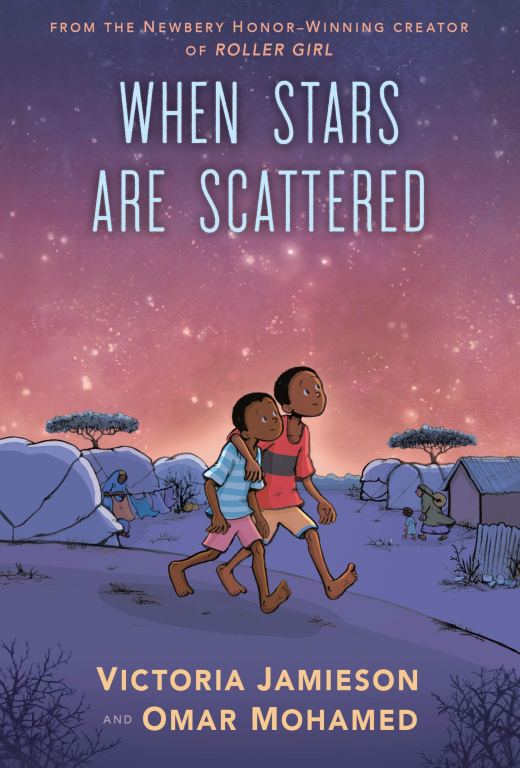
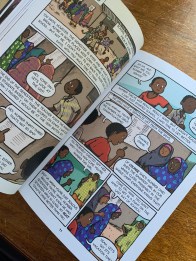
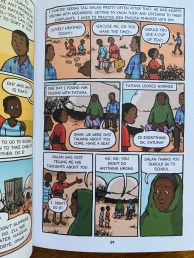
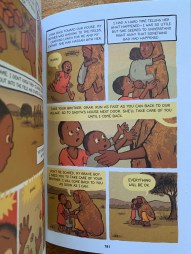
starsThis graphic novel swept me off my feet and left me in tears, not because of the hard life and sadness that life in a refugee camp entails, I had braced myself for that, but because of the hope and humanity and beauty that is so powerfully expressed and conveyed in this 264 page book.  Meant for 3rd graders and up, I think kids through middle school should be encouraged to read it.  The illustrations and colors are incredibly well done and the story is based on a true story that needs to be told and shared.  It is definitely in the top 10 books I’ve read this year and I keep catching my 11 year old re-reading this book repeatedly (like 5 or 6 times).

52BE6C8B-4246-4A92-BA66-004378A21862

SYNOPSIS:

Omar Mohamed lives in Dadaab refugee camp in Kenya.  His father was killed in the Somali war and his mother has not been seen after she sent Omar and his younger brother Hassan to run with the neighbors to escape the violence.  Hasan suffers from seizures and doesn’t speak, save one word, Hooyo, mother in Somali.  The two boys have an adopted mom Fatuma, who looks after the boys in the camp as if they were her own.  Unable to go to school, Omar spends his days looking after his brother, playing soccer with plastic bags, and waiting in lines for water, food, and news of a better opportunity.

When Omar gets the chance to go to school (5th grade) he has to make the difficult decision of pursuing his own opportunities, with the hope of helping Hassan later, or living day to day and taking care of his younger brother.  He is finally convinced that education will help them both, and that if the girls can find a way to do their chores and attend class, he can too.

Each transition from primary, to middle to secondary school requires testing, and only the top get to continue.  Determined to stay in school, Omar studies while dealing with life’s many challenges and the daily additional challenges of living with little food and resources.

When Omar and Hassan’s names finally appear on a UN interview lists for resettlement, hope seeps in, but the wait and the uncertainty prove to be yet another test.  Along the way there are side characters from the United Nations that show compassion, other families that show how generous and loving humans can be, female classmates show him how to take advantage of his privilege and friendships that move friends to family.

D74285FB-CBDC-4C4A-BD7B-070439BB08EF

WHY I LIKE IT:

The book is gripping and has heart.  I don’t know what I expected, but I truly could not put it down.  The character’s stresses are felt and emotions are conveyed so powerfully, that I don’t know that you can read the book and forget it.  The most emotional part for me was his honesty in dealing with his brother, the strength of his friends, particularly female, and the bond to Fatuma.  Truly their living arrangements and loss of family is gut wrenching, but it was the little things that touched me the most.  The honesty of Omar having to decide if he was tempted to not go to school because he was scared. Was he using his brother as an excuse to stay with something he knew.  The emotional tipping point of no return for me was when he realized Fatuma would not be able to go to the second interview with the UN and would not be a part of what came after.  Of course I knew that, but by that point I was so connected to the character, that when Omar realized it, I broke for him.  To feel that connection in a graphic novel was new for me, perhaps a first, and alhumdulillah I am better for it.

The characters are Muslim and behave traditionally with praying and Ramadan and Eid.

F9E64F9D-1722-4CBD-B905-BE754BCE6C77

FLAGS:

There is talk of khat, something the men chew on the side of the road to forget things.  There is some violence, bullying, a young girl getting married before 6th grade and having a baby.

CDD12698-52CE-4FFD-9444-29A666980797

TOOLS FOR LEADING THE DISCUSSION:

Yes! I am hoping if and when we resume school I am starting with this book inshaAllah, for my middle school book club.  There is so much to talk about and understand and empathize with.

Stuck in the Middle by Sumayyah Hussein illustrated by Diana Silkina

Standard
Stuck in the Middle by Sumayyah Hussein illustrated by Diana Silkina

middle

At 122 pages this early chapter book with frequent illustrations is a great book to share with 2nd-5th graders.  It is has a great message and lesson with lots for children to relate to with regards to life with siblings, getting frustrated, making mistakes and recovering.  The lesson is strong, but doesn’t become preachy as the protagonists voice rings true to her age.  Mistakes are made by many characters and situations are fleshed out so the reader can understand why things are done.   By showing that there isn’t one side to a story, and that knee jerk reactions are common, readers will get that ultimately we are still responsible for how we act, and learning from our transgressions is part of growing up.

5343F790-E06E-47DB-96D9-A85A7EAEFA9E

SYNOPSIS:

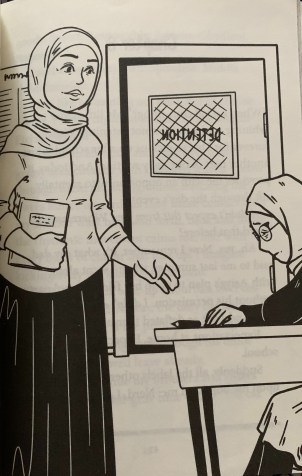
Salma is the middle child in a busy family, and very little is in her control.  When her frustration over her brother stealing a chocolate bar, causes her to lose her cool, and then she is forced to run errands with her family, homework doesn’t get done in time and she finds her self in detention.  Normally a very good student, teachers and other students are shocked that Salma is in trouble.  Things don’t improve when her brother steals her carrot cake the next day, and in a plot to get even, Salma ruins her brothers brand new PS4 controller.  She also turns a blind eye at school when she sees someone picking on him.

Doing her best to avoid being discovered as the culprit, or being in a position to see her brother being bullied, her guilt starts to get to her.  When an ambulance has to come to the school for a kid that got pushed and needs stitches, she realizes she has to make things right, even if that means getting in trouble.

7E60CD43-7DCB-41AE-BFF8-6CA415A5BDA2

WHY I LIKE IT:

I love that it is so relatable, honestly switch Salma with my middle son Haroon, and the 13 year old boy that doesn’t want to go out with the family, with my 13 year old daughter that doesn’t want to go out and we are looking in a mirror, haha.  The family is Muslim and they practice and let the religion shape their view of the world and how to function within it.  The girls wear hijab and use the hadith premise that they have to fix a bad deed with a good deed to provide the solution to the mistakes made earlier in the story.

AE60B7D6-48FA-4A46-A4E7-4F0BB40351AD

FLAGS:

None

46612FC3-B196-4A59-9BB8-AA54F7ADBD3F

TOOLS FOR LEADING THE DISCUSSION:

I already made my middle child read the book, and because of the length it wouldn’t lend itself to a book club, but I can see teachers having kids read it and then discussing, just like I am doing in my family.  It is sweet and well done and a great addition to your bookshelf.


Running Overload by Jake Maddox illustrated by Tina Francisco

Standard
Running Overload by Jake Maddox illustrated by Tina Francisco

5870B613-F406-493B-8203-FAB9869DE555

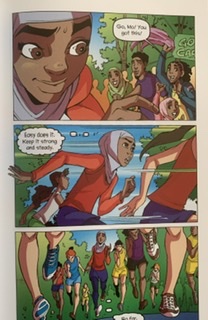
This 72  page graphic novel features a female Muslim protagonist trying to balance her desire to be a great cross country runner and the rest of her life.  Meant for 3rd graders, the lessons are applicable and relevant for readers in middle school as well.

6B290892-6842-45D4-88FE-7FE4D82BAEC6

SYNOPSIS:

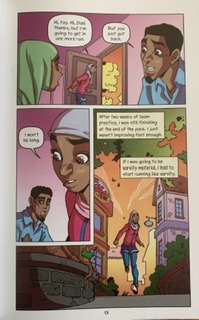
Nimo Mohamed has made the varsity track team, and is determined to keep up with the older girls.  She is training too hard which her coaches and parents warn her against, but she doesn’t listen.  As a result she is lying to her family about what she is doing, her grades are suffering, and her body is exhausted to say the least.  After coming dead last in a meet, getting a D on an English test, and injuring her knee, the truth comes out and her dad has her quit the team.  Can she convince him to give her one more chance? Can she learn to pace herself?

253551C1-18E4-4A86-8BD2-315C79A685DA

WHY I LIKE IT:

There is nothing Islamic in the book except for the main character’s family.  The women wear hijab when out, not at home and they have Islamic sounding names.  I like that she is modestly dressed when she runs and that no one seems to care that she is Muslim.  This story is not about her faith, it is a universal story of balance, and the character highlighting the moral is Muslim.  Her parents are divorced, but are on the same page regarding her running and school balancing act, and they come together to support her.  I also like that the book is a sports book and has a female girl of color as the lead.  There is a lot of very intentional diversity in the book and it is refreshing to see.

There are questions at the end, and running vocabulary and tips for running as well.

B555F927-C2E0-433B-8F6B-ED1E58486CD3

FLAGS:

None

F050C711-00AF-4581-93AB-C0E440C1FDD8

TOOLS FOR LEADING THE DISCUSSION:

The book wouldn’t lend itself well to a book club, but would definitely provide one-on-one discussion opportunities.  The short linear story is all about imparting teachable moments on the reader, which isn’t a bad thing, but I think the real strength is that the book is one of a larger series that should really be in every classroom and library to show how balance and integrity and strength and diversity are values that we need to hear over and over, not just in one running book, but from a lot of different sources.


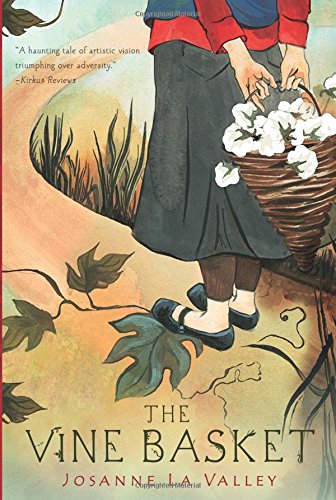
The Vine Basket by Josanne La Valley

Standard
The Vine Basket by Josanne La Valley

vine basket

While in the midst of moving from Knoxville to Birmingham nearly 4 years ago, a lady reached out to me telling me that a colleague of hers, also an author, was a follower and fan of my blog and had recently passed away, she asked if she could send me a copy of her friend’s books.  I agreed, not knowing what type of books the lady had written and didn’t think much of it.  In the chaos that is moving, I received the books and boxed them up and then unboxed them and vaguely remembered that they were about Muslims in China.  I put them in the to be read pile and just never got to them.  Then as the plight of the Uyghurs started to be known here in the US, something tickled my brain, but nothing came of it, until recently when I realized, a lady, a non Muslim years ago was trying to tell the Uyghur’s story, and had reached out to me, and I didn’t get it, and still wasn’t getting it.  So alas, I have now read the Vine Basket, and while it might not present Islam the way we are used to seeing it in life and in print, the characters do identify as Muslim and this middle grade book is a simply woven, beautiful story that gives voice to a population that is horrifically being silenced.  The AR 5.0, 252 page book is a quiet book that will stay with me: the drunken father, the threat of being sent to a factory, the loss of tradition;  I am so glad I read the book, and only wish I could reach out to the author to hear more about her knowledge of the region, of the people, of the culture that is being erased.

SYNOPSIS:

Mehrigul is 14, and since her older brother left, she has been forced to leave school to help her father sell goods in the marketplace.  More often than not though, it is solely Mehrigul’s responsibility as her father drinks and gambles away the meager earnings the family makes. Her mother, ashamed of the poverty the family endures along with some presumed mental illness and headaches, seeps further and further away from the reality of life and the chores that need to be done to ensure food and survival of the family.  Her younger sister is the only spark in a dreary and difficult life, and Mehrigul is determined that she should stay in school and be shielded from the darkness hanging over the family.

One day while in the market, an American woman approaches Mehrigul and asks to purchase a frivolous grape vine basket Mehrigul had made and hung to decorate the cart.  She offers her 100 yuan, more money than Mehrigul has ever seen, and asks her to make more baskets, and that she will be back in a month to purchase them. The basket serves no purpose like the willow baskets her grandfather weaves and despite the money, Mehrigul’s father is not happy.

Mehrigul is forbidden from making the baskets for the American, and the fact that she will even return is dismissed.  Her father grows increasingly cruel toward Mehrigul and keeps her busy to prevent her from making more.  Mehrigul seeks solace in her elderly infirm grandfather who tries to help her find inspiration and time to make her baskets as he sees in her a gift that has value in their old culture.  At one point as her father steals her baskets to take on a “religious” pilgrimage to the mountains.  And her planting crops in the fields leaves her hands cut and swollen, unable to make more with just days left before the American lady is due to return.

WHY I LIKE IT:

At first I was really uncomfortable with the idea of a white American savior coming to a dying oppressed culture to offer hope, until I read the afterwards and understood that much of the story was inspired by the author’s own experience and that she worked with Uyghur’s to get the story right.  The book reads like historical fiction which makes the day to day life of this modern book all the more heart breaking, it isn’t about the past it is the present, and life in East Turkestan is bleak.  I like the character of the father, he is an abusive mess, yet somehow it isn’t that easy to write him off, he has his own struggles and the depth of character I found in him, in a middle grades book, is haunting.  I also really like how Mehrigul’s story is so foreign to us here in America, yet her emotions and insights are universal and thus relatable.  She wants to find her place, and excel, and help her family, and she is scared, doesn’t know who to trust, and takes on more than most children any where should, but often are forced to do.

The characters identify as Muslim and as a people the Uyghurs are Muslim.  They say salam in the story, but only to the grandfather, and the girls all cover their hair with scarves.  The father obviously drinks and gambles, two practices, not permitted in Islam.  Mehrigul fastens a talisman and connects her prayers to it as a form of worship which I would imagine is cultural perhaps, and when things go awry she remarks she should have prayed to Allah swt.  The father goes on a pilgrimage to a mountain shrine, which again seems off from traditional Islam, but is presented in the book instead as odd because the father is not normally religious.  Islam is not a big part of the book, so it is hard to know if the representation of it are isolated to who the author met, or a larger norm of the community.  Considering how isolated and oppressed the Uyghurs are, I tried really hard to suspend judgement, or offer my privileged limited critique of the people.

FLAGS:

Drinking, gambling, abusive father, anger, lying, deception.

TOOLS FOR LEADING THE DISCUSSION:

I would consider this for a middle grades or even middle school book club, there is so much going on in China and in the erasing of Islam there that this book would supplement the news and few stories we are hearing.  It opens up the culture and gives it a face that is not political, but personal.  The faults of the father are not glorified at all, and the discussion about his desire to hold on to culture and fear about his daughter surpassing him would be fascinating to hear from people the protagonists age.

The Story of the Holy Prophet Muhammad (peace and blessings of Allah be on him): Ramadan Classics: 30 Stories for 30 Nights by Humera Malik

Standard
The Story of the Holy Prophet Muhammad (peace and blessings of Allah be on him): Ramadan Classics: 30 Stories for 30 Nights by Humera Malik

the story of prophet muhammad

I debated posting about this book for so long that Ramadan is more than half over.  But as a reference for years to come, I thought I should go ahead and throw my late support toward this Ramadan tradition and a book deserving of space on your shelf for children 4th grade and up.  I’ve seen people praising it for a few years, and finally I ordered it this year, however, I wanted to not only read it, but also test it out first: reading a story a day, discussing and asking the correlating questions with my own children, before reporting back.  I cannot and thus won’t comment on the accuracy of authenticity of the book, nothing stood out as erroneous to me and there is a bibliography at the back, but there is a reason I try and steer clear of non fiction, I’m just not qualified to comment.

SYNOPSIS:

The book starts with the birth of Prophet Muhammad (saw) and ends with the selection of Abu Bakr (ra) as the first Khalifah.  Each chapter is between one-and-a-half to two-and-a-half pages and the 30 chapters plus one Eid day chapter (so a total of 31), covers 103 pages in all.  There are a few pictures of where the Battle of Badr took place, the Cave of Hira, not many.  There are three questions at the back of the book for each of the chapters, but no answers.  The book is pretty linear, just the second chapter bounces back to Prophet Abraham (as) and Hagar and the story of Zamzam and then the rebuilding of the Ka’bah.  It is a glorified timeline, which in this case is a good thing.  It doesn’t go off on tangents or provide a ton of outside references, it is concise and general, but hits the key parts: marriage to Khadijah, first revelation, migration to Abyssinia, Taif, Hijrah, treatment of slaves, year of sorrow, Battle of Badr, Battle of Uhud, Treaty of Hudaibiyah, it talks of tensions with various tribes, coming to an agreement about the Khalifah, and more.

I think younger children might possibly be able to have the short chapters read to them and then explained, but really, it would be a lot to process.  The words are simplified and the gist of situations are conveyed, but topics aren’t necessarily shied away from.  It discusses that Prophet Muhammad (saw) had more than one wife, and that there were slaves, and there were tensions with the Jews, and Bilal was tortured, all things that picture books might skip over.

WHY I LIKE IT:

I like that even my young teen could read and involve herself without feeling like the exercise was childish.  Many of the answers are open ended in nature and require more than just a one word answer.  It allows for children to add other facts that they know about RasulAllah to the dialogue and make connections to our history with our current life very easily.  Even children that know the story of Prophet Muhammad (saw) will find the book engaging and smooth enough to read through again (and hopefully again each Ramadan) and learn new tidbits, understand concepts more clearly and be reminded about the beauty of our Prophet.

FLAGS:

Nothing

TOOLS FOR LEADING THE DISCUSSION:

If I was a teacher, I would definitely start each morning reading a chapter and doing the Q and A, whether it was Ramadan or not.  I think we need to be more connected to our Prophet and grow our love and appreciation for him, so books like this are such a great tool in accomplishing that goal.