Tag Archives: Picture book

Until You Find the Sun by Maryam Hassan illustrated by Anna Wilson

Standard
Until You Find the Sun by Maryam Hassan illustrated by Anna Wilson

I don’t know that this book is particularly unique or mind blowing, but I read a digital copy a few weeks ago and was surprised when some tears fell, I read it when I got the physical copy to my kids and my throat caught again, and here I am writing this review and feeling all vulnerable.  It is as if I too am a little girl in a new place missing her grandfather on the other side of the world, which clearly I’m not.  The book is sweet, and moving, and I find myself emotionally invested every time I read through the 32 pages and get lost in the large sweeping illustrations.  The book is not Islamic, there are a few hijabis in the background and text that articulates friends saying salaam before the girl moves.  Additionally, the main character’s name is Aminah, and the author is of Pakistani decent, and has a Muslim sounding name.  The story though, at its core is universal, heartfelt, reassuring, hopeful, and lovely to share in all spaces. It begs to be read aloud and holds the attention of toddlers to early elementary aged children.

The book starts with a happy little Aminah in a bright sparkly environment of sunshine, mangoes, and salaams.  Every night she listens to Da’s stories of adventure as she snuggles next to her grandfather.  One day she finds out they are moving, going on an adventure.  Only Da won’t be joining them and Aminah is devastated.

The new home is gray, and cold, and no adventure at all.  She wants to go back, but Da reassures her during their nightly conversations that things will get better.  And sure enough, with a bit of bright yellow inspiration, she starts to discover the adventures awaiting in her new home.

Kids will find the end hopeful and resolved, but I somehow found it a little bittersweet.  Da loves his grand daughter and wants her happy, but the adult me, realizes their relationship will never be the same, and Da will miss her in many ways, alone, as she embarks on her own life.  I know I’m projecting, but the ability to see both perspectives adds a nice layer to the book.

The book is available here from Amazon and will be in local libraries in June 2024.

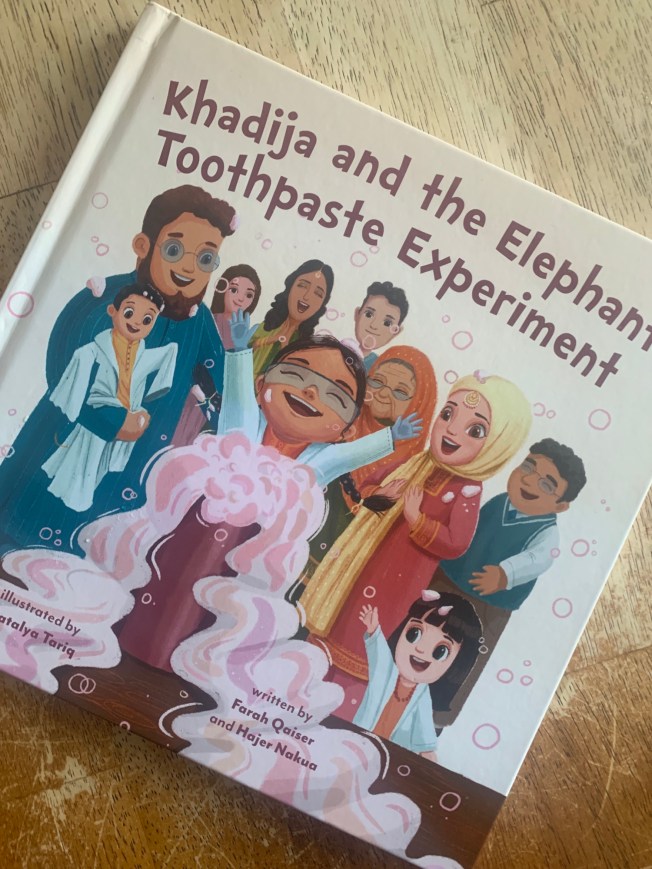
Khadija and the Elephant Toothpaste Experiment by Farah Qaiser and Hajer Nakua illustrated by Natalya Tariq

Standard
Khadija and the Elephant Toothpaste Experiment by Farah Qaiser and Hajer Nakua illustrated by Natalya Tariq

img_3251-1

This 26 page book is set on Eid, it does not specify Eid al-Fitr or Eid al-Adha, but it isn’t overly impactful on the story outside of the framing, so really it is a non issue.  The book shows a Muslim family and is a benefit for appealing to women and girls in science, unfortunately it has some plot holes though.  A big point of the book is the girl, Khadija, wondering if she can be a scientist who wears hijab because she doesn’t see any scientists at the fair wearing one. When she voices this concern to her parents, her father reassures her saying, “Anyone can be a scientist.  Scientists can wear a hijab like Amma, or glasses like me.”  First of all, I don’t like it equating hijab to glasses, hijab is a religious practice, not a tool to help you see or an accessory.  I’m well aware not every book has to have Islam centered, but I do worry that if hijab is relegated to an article of clothing, and Khadija doesn’t wear hijab, that readers might just be confused and not be able to connect the dots.  With weak writing, a confusing premise, and a climax of doing an experiment, that is not included for the readers to do at home, included in the book; I am struggling to recommend this for every bookshelf.  It isn’t a bad read, it just should be better.  I love the joyful engaging illustrations, I like the female Muslim science representation even. I just ultimately think the weak writing drags the book down and will have some kids confused why she is worried about a scarf she doesn’t wear impeding on a career she doesn’t have, and be unable to see that as a Muslima she will want to wear hijab as an act of worship when she grows up.

img_3252-1

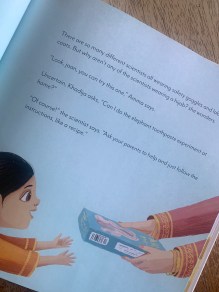
The book starts with Khadija and her family heading to her school for the science fair after Eid salah.  She sees lots of scientists, but notices none wearing hijab.  She gets a science kit to do at home and then the family starts to prepare for guests coming over for dinner.

img_3253-1

Khadija can’t wait to do her experiment so she quietly gathers up supplies, and heads to the bathroom to make elephant toothpaste. It works, a little too well, but then it is everywhere and mom and dad show up to help her clean.  Khadija wonders if she is not cut out to be a scientist.  Mom and dad console her, the people arrive for an Eid party, and her parents and her do the experiment for all to see.

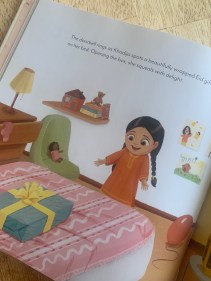
The story is pretty straightforward, but I sure have a lot of questions: why is the “big day” the science fair and not Eid.  It is at her school but the science fair is not students sharing projects, but professional scientists? And does she purchase a science kit, why does her mom give it to her at the fair, but then she asks the scientist is she can do it at home? What else did she see or learn at the science fair, she just went saw scientists in lab coats, got the kit and left?  How was it still morning when she got home after the fair, after Eid salah?  There is a whole page of her getting an Eid gift and squealing with delight, but never shares what the gift is.  I also really, really wish it had the experiment in the book. I want to know what it is and why it is called, “elephant toothpaste.” I truly do not know why this book has no backmatter.  Information about women in science, how to do the experiment, maybe something about hijab or Eid. A link or scannable QR code to see the experiment would have even added something to increase knowledge and excitement for science, representation, and dreaming big.

img_3256-1

Celebrations and Festivals: Ramadan and Eid al-Fitr by Sara Khan illustrated by Nadiyah Suyatna

Standard
Celebrations and Festivals: Ramadan and Eid al-Fitr by Sara Khan illustrated by Nadiyah Suyatna

img_3101-1

This 48 page, informational based book is told through a little girl explaining her Ramadan and Eid days in a fictionalized story format. The information is not new, nor is the framing, and it has my pet peeve  line of “Ramadan is the ninth month in the lunar calendar,” but aside from that, the book does a good job of showing the joy, the activities, the faith, and the importance without self-othering, unrealistic cluelessness, or watering down. For whatever predictability the story has, the back matter is excellent. The additional information about Islam, the crafts, and even the quiz, make this book a standout in a crowded category. The book does not talk down to readers and thus works for Muslim and non Muslims alike. It also is unapologetic and informative making it a good book to share with non Muslim classrooms wanting to learn about Ramadan without crossing into “preaching.” The illustrations are warm and joyful bringing the lengthy book to life.

The story starts with Raya introducing Ramadan and then herself to the reader. She then details her Ramadan day. From sighting the moon to doing the good deed suggestions on the countdown calendar. It explains Allah swt and that adults are required to fast but kids are not. Raya spends time exploring how hard it is to skip snacks, but remains hopeful that when she is ready to fast she will be able. Her father also reminds her about other aspects of Ramadan and being on your best behavior as Raya helps set the table, donates to charity, and reads Quran. Throughout it all, informative details about Muslims are threaded through. Focusing on Raya herself also breaks some stereotypes as she discusses the joy found in a wide variety of foods from many cultures, Eid prep, looking for the moon, having henna put on, and heading out for Eid prayers and festivities. There are numerous details universal to all Muslims presented, as well as unique highlights specifics to Raya’s family such as showing the family bowling and reflecting on mini golf last year, activities that even her grandparents can participate in.

img_3104-1

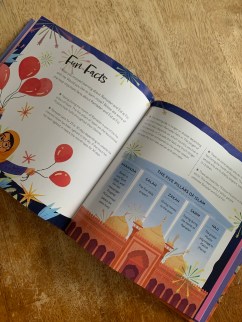
The robust back matter starts with Fun Facts about Islam, stats about Muslims, details about the five pillars, etc.. The next two page spread is about the lunar calendar and has a pullout bubble explaining the use of the phrase “peace be upon him.” Then there are directions for a pop-up Ramadan card, Then information about the month of Mercy, Laylat al-Qadr, paradise, a recipe for Ramadan Cookies, info about Masjids, and finally a quiz, with answers.

img_3105-1

I like that the book balances showing joy through Raya’s personal experience, with facts about Ramadan, Eid, and Islam. I also like that Raya knows all this, my hatred of the formulaic child waking up and wondering why her family is up so early eating breakfast or a child wanting to fast and the family not supporting them is not widely realistic, and I appreciate that this book feels very reflective of what our kids feel, experience, and know about the blessed month. I also like that it features food, but does not dwell on it, and yes there are presents for Eid, but again it doesn’t make it the central factor in the joy she is feeling of being with her family.

The Ramadan Drummer by Sahtinay Abaza illustrated by Dinara Mirtalipova

Standard
The Ramadan Drummer by Sahtinay Abaza illustrated by Dinara Mirtalipova

img_3025-1

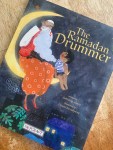
This book reads very much like an early work in progress.  It doesn’t seem to know if it wants to be a book about foods and hunger in Ramadan, or about a Ramadan drummer waking people up for suhoor, or being a fantasy where you can hear people’s thoughts in your dreams and when you awaken you can get blessings for being kind.  Sure maybe it could be all of the above, unfortunately as written, it falls short in being much of a cohesive story at all.  Many of the details have no baring on the plot, the transitions from food, and fasting and pants feeling tight to dreaming about the Ramadan drummer that he heard about once in passing, is very abrupt and none of the children I read it to ages four to eight could sit through it. With no Islamic centering it is never clear other than to “think of the poor,” why this small child is fasting, and who is going to be doing the rewarding for kindness in Ramadan.  For Muslim and non Muslim kids alike, this book will not make much sense, I’m afraid, nor be memorable, even if they can get through it. The idea of a Ramadan Drummer appears in a lot of books, and perhaps this fantasy reinterpretation could have been fun, but with the lack of Islamic content, a clear story line, and the focus being on hunger, the book doesn’t do much for me.

img_3026-1

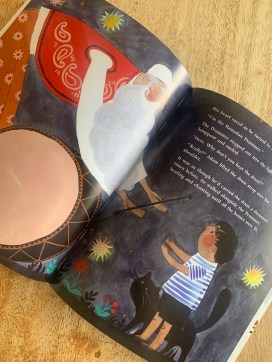
The book starts out with Adam being hungry, his stomach is a wild beast, roaring and grumbling for food.  He is told fasting helps people think of the poor, but he can’t “think on an angry stomach.”  The next two pages are about food, then his aunt and uncle come over, wishing everyone a “blessed Ramadan,” and then they break their fast. No Salams are given, iftar is not named, but they mention a Ramadan drummer. Adam is eating so much his pants are tight, they then pull out dessert.  That night he can hardly fall asleep because he ate more cookies than he should.  The lack of self control is an odd thing to stress without any insight into moderation, especially in Ramadan when controlling the nafs is such a present test.

img_3027-1

That night he dreams he meets the Ramadan drummer, they listen to the wants and thoughts of the neighbors, he wakes up in the morning to pancakes and then he responds to what he learned in his dream.  It is sweet that he spreads kindness to the neighbors, with the Ramadan drummer only having to tell him, “during Ramadan, every act of kindness is reward tenfold.”  I have no idea if Adam is already kind and this was just extra motivation, it never says who will be doing the rewarding, I wish it shared what was being chanted to wake people up, and I wondered if this is going to be an every night occurrence, but alas there are no answers.

img_3028-1

The book ends with Adam still hungry, but his heart being full whereas his stomach is not.  There is then a lengthy Author’s Note that mentions “Muslims will not eat or drink from sunrise to sunset,” clearly getting the start time wrong.  Throughout the text it says “before sunrise” leaving the time a bit vague, but not wrong.  The Illustrator’s Note calls a Mullah, a Muslim priest, which struck me as odd.

It seems so odd to have a Ramadan book void of even basic religious mentions. Why would you stress about getting up, let alone getting up on time, if there are no rules and requirements to your fast. The whole reason for the fast is an act of worship, how the worship is done matters. By removing religion: the lack of salams, prayer, duas, connection to Allah, etc., it makes fasting seem like an act in isolation and it makes it just about food, which shortchanges the month of Mercy. Ramadan is joyful, it is so much more than a month of just being hungry.

A Ramadan to Remember by Marzieh A. Ali illustrated by Najwa Awatiff

Standard
A Ramadan to Remember by Marzieh A. Ali illustrated by Najwa Awatiff

img_2876-1

A problem solving kid that loves his faith, finds himself in a new neighborhood at the beginning of Ramadan without a mosque or a Muslim community.  I appreciate that this 32 page book actually has a bit of a plot, not just the overly done fictional story crafted around basic Ramadan facts of a child’s first fast.  Sure, it mentions most of the expected concepts in a similar manner, but it also centers acts of ibaada, shows more than tells, is brightly illustrated, and is unapologetic. The kid is a doer, a problem solver, and isn’t unsure about who he is, which is refreshing. That isn’t to say that it gets everything right, it still attributes fasting to feeling compassion for the poor.  Even when a side character challenges the notion, the character doubles down that it makes us more appreciative, which inshaAllah it does, but it isn’t WHY we fast.  Overall though, I think the book still is a benefit in Muslim and non Muslim spaces. The story and illustrations make it appealing at story times and bed times, and the backmatter is equally engaging.

img_2877-1

The book starts with Zain getting excited for his favorite time of year, Ramadan.  Only this year the decorations are still in boxes, Mama and Baba are busy with their new jobs, and there is no mosque or Muslims in the neighborhood.  Zain knows, he rides around looking for clues, has even checked the newspaper, and had his dad look on his phone.  It is a big change from the Islamic school he used to go to, and the busy mosque he used to volunteer at.

img_2879-1

Then Zain gets an idea, to build a mosque with all the moving boxes.  Neighbor kids come and ask questions, and Zain is happy to explain as they join in the building.  One night while praying outside under the stars in the cardboard mosque, a friend joins the family, and this Ramadan just might turn out to be pretty wonderful after all.

img_2878-1

I love that Zain doesn’t wait around for his parents to figure everything out, he is motivated. I also really like that he knows who he is, is comfortable sharing his faith and beliefs, and that the neighbor kids find connections to him, not the other way around.  I wish he would find a place to volunteer at, our charity isn’t restricted to helping only Muslims, though I might be the only one to pick up on that unresolved thread.  I also get that the kid that joins the salat for story purposes, is seen after prayer, but he didn’t join the prayer right and my older kids were sure to point that out.

The backmatter has a glossary, but in a more engaging format that I think kids will actually stick around for, and the Ramadan essentials and crafts make for a nice extension for those wanting to add a craft to the story time activity.

img_2882-1

The book is traditionally published and widely available.  You can find it here at Amazon, or here at my favorite store Crescent Moon.  It is also available in public libraries and would be a great addition to classroom and school library shelves.

Aliya’s Secret: A Story of Ramadan by Farida Zaman

Standard
Aliya’s Secret: A Story of Ramadan by Farida Zaman

img_2838-1

Books like this are honestly a disservice to Muslims. I know the industry means well by having a token holiday book, by an OWN voice writer, ensuring it is joyful and illustrated in a warm way, but when the information is erroneous, it really just perpetuates misinformation. This book will be on shelves everywhere and shared at story times in classrooms and libraries and non Muslims will think they are being inclusive, and Muslim kids will also learn erroneously or doubt if they are in the wrong, or best case scenario (?) have even more to explain to those around them. The book is adorable, yet the information about when we fast and why we fast is wrong, repeated throughout, even in the backmatter.  The book is for young children and pivots around lying, the character lies repeatedly with no consequences…in Ramadan no less.  Sigh, our kids deserve better.

created by photogrid

The book states multiple times, four in fact, that Muslims fast from sunrise until sunset, this is incorrect, Muslim fast from dawn to sunset. Sahoor is not eaten at sunrise, it is eaten before dawn. This is not me being picky, this is wrong. The dad perhaps has his own reasons for fasting, but Islamically we do not fast to feel what those who are hungry feel or to be grateful, those hopefully are results of fasting, but in fact we fast as commanded by Allah swt. Children are required to fast when they hit puberty, not at the age of 13 specific. Many kids fast full and partial days before puberty, and I don’t agree that their growth is stunted as suggested by the book.

created by photogrid

The set up of the story is nice, albeit another first fast book, in that at least the character and her classmates and friends know what Ramadan is and thus there is no othering. It talks about charity and praying and shows the Muslim family living their life unapologetically which on the one hand is great, but then makes the lying seem weird. Why would Aliya keep fasting a secret from her friends at school even if she is keeping it from her parents? Why would she lie about it, why would she lie and have it articulated as lying and there be no repercussions for it, in a picture book? She doesn’t even just do it once, she lies THREE TIMES.  When you do good things from a place of faith and worship, it seems off to me to have it framed in deceit with no other commentary.

Sure to some the time when fasting starts might be a small thing, but seriously is it that hard to get correct? I wish the editorial/publishing/marketing team would have hired beta/sensitivity readers, not all Muslims know Islam, and not checking the facts really is just sloppy.

Insha’Allah, No, Maybe So by Rhonda Roumani, Nadia Roumani illustrated by Olivia Aserr

Standard
Insha’Allah, No, Maybe So by Rhonda Roumani, Nadia Roumani illustrated by Olivia Aserr

img_2711-1

Not every funny thing a child says can be copied and pasted into a children’s book.  And while I have no doubt that this book was edited and revised numerous times, it sure feels like a conversation or 20 that I’ve had as a mom, a teacher and a librarian over the years.  Well, I take that back, the mom in this book, is very articulate, and not nearly as exasperated as I’m sure I always am.  It is so on point that it makes me truly wonder, are you even a Muslim parent if you haven’t been asked what Insha’Allah means? The backmatter articulates that Muslims and Arabs of all faiths use Insha’Allah. The text and illustrations themselves are not Islam specific, but the authors are Muslim, and the term always on the tip of our tongues. It is very relatable and impossible to read without smiling, I can’t wait to share it, insha’Allah. (See what I did there? ya.)

img_2715-1

The book starts simple enough, a little girl asks her mom if they can go to the park as they walk near one, and mom says, “Insha’Allah,” and keeps on walking.  Ranya gets upset asking why she said no, and the mom explains that insha’Allah doesn’t mean no, it means God willing.

img_2712-1

Ranya doesn’t just accept the answer and move on, she tells her mom it always feels like no, until her mother explains that we can want something to happen, but sometimes Allah has other plans.  Ranya presses her mother a little more trying to understand if insha’Allah means, maybe.  A few more examples are shared, and the definition is expanded to also mean, hopes and dreams.

img_2713-1

Ranya wants to pin down her mom on some of the insha’Allahs, making cookies, a sleepover, a trip to Disneyland.  Mom does her best, but Ranya is spunky and makes sure she gets the last word in.

I love the note at the end that ties it all together and shows the universal appeal of the word.

You can preorder your copy here

img_2714-1

Tipu’s Roar: A Freedom Fighter’s Tale by Subia J. Ali illustrated by Gabriel Sorondo

Standard
Tipu’s Roar: A Freedom Fighter’s Tale by Subia J. Ali illustrated by Gabriel Sorondo

This large (9×11) hardback book is for the most part gorgeously illustrated in sepia tones, but the story is only 11 pages long; a pretty steep price point for 11 pages.  A story nestled with in a story, the premise of bringing to light a not well-known historical figure is admirable, but with no sourcing, it is hard to know what is real, and what is legend.  The concept and angle of being a freedom fighter and resisting colonization is timely, sadly it lacks the inspiration that I feel the author set out to convey.  I read the book a few times, and still had to Google a map of Mysore, Tipu Sultan and the role of the French in the subcontinent in the 1700s.  It would seem a book dedicated to the children of Palestine, defining words of freedom fighter, colonization, and imperialism before the book even begins, would answer the basic questions about the hero at hand.  

The book starts with an old man feeling gentlemanly wearing a bush shirt, chatting with his grand daughter who is being corrected to call him Dada Jaan instead of Grandpa. He then gets lost in thought and begins to tell his grand daughter the power of names to emphasize his point.  Tipu Sultan, known as the Tiger of Mysore, he tells her, “fought the British, who had come to colonize the Indian subcontinent.”

He doesn’t so much as convey the information in an entertaining way, as he lists off details and then pulls out to make sure she is still listening.  He tells her about the British East India Company draining the wealth of the subcontinent by taking tea, cotton, gems and spices.  He tells how Tipu “studied Islam, spoke many languages, and was a pioneer in rocket artillery.”  He credits Tipu’s rockets as revolutionizing warfare all around the world, and connects India, France and America as fighting off their Imperial colonizers, with the French being close allies in India’s struggle against the British.

Once her Dada Jaan’s retelling is through, and Tipu has lost, and Mysore falls, the little girls ponders over the story and years later appreciates her Dada Jaan in his traditional tunic rather than his bush shirt from before.

The book is in many ways needs to be fleshed out, sourced, and the messages articulated for today’s readers. 

Dear Muslim Child by Rahma Rodaah illustrated by Aya Ghanameh

Standard
Dear Muslim Child by Rahma Rodaah illustrated by Aya Ghanameh

img_2280-1

The flow, poignancy, and lyrical verses force you to slow down, take a deep breath, and immerse yourself in the concepts and ideas so beautifully presented in the text, and illustrated on the pages.  Whether you are reading it alone, snuggled up with a little one, or in a boisterous story time, this book pulls you in as it speak directly to the reader (or listener), burrowing inside and inspiring reassurance and confidence.  The tone of the text melds with the illustrations making the book appeal to those looking to understand, be seen, or to be empowered.  The short stanzas with the opening refrain of, “Dear Muslim child,” are a delight to read and share again and again, alhumdulillah.

The book does not have a story or a plot, but has an organization that keeps the pace moving in a poetic way. It starts by mentioning that we were meant to be, even “before Allah spoke the universe into existence.”  It then tells us about Islam, nur, names, the power of words, purifying our hearts (with wudu), listening to the adhan, and praying.  It talks of the beauty of hijab, and community, and purpose and mattering.

img_2282-1

The centering of Allah (swt) is not shied away from, yet the book is not preachy or overly religious.  For example wudu is shown, but not named; adhan is named but not defined.  If you wish to discuss each page, there is a lot to unfold, but if you want to just read the surface it is beautiful just the same.  The book is traditionally published, and a true accomplishment of the author, and the authors that have come before that this book, this type of book, is widely available for us all to enjoy.

img_2284-1

Gates and Tales by Sally Zaki illustrated by Arwa Ali

Standard
Gates and Tales by Sally Zaki illustrated by Arwa Ali

This 34 page picture book is adorably illustrated as it focuses on the gates leading to Masjid Al-Aqsa and sprinkles in culture, sights, and history about Palestine along the way.  I love the concept, it is unique, and I love that there are maps throughout of the masjid compound.  I truly learned a lot even though it is for early readers, naturally I wish there was a scannable QR code to learn more, but as an adult, with my kids, or in a classroom it would not be hard to search up Bab Al-Amud, Qubbat Al-Sakhra, Bab Al-Sahira, Salah Al-Din, Masjid Al-Qibli, Bab Al-Khalil, Al-Quds Citadel, Qaitbay’s Fountain, Bab Al-Asbat, or Qubbat Al-Silsilah.  Islam is also woven in, not just in the architecture or history, but also in mentioning the sunnah of fasting on Thursdays, quoting an ayat from the Quran in the text, and the kids meeting up to pray.  The writing isn’t super great,  it breaks down the fourth wall regularly, calling the readers “friends” and asking them to find things in the illustrations, their missing friends, and about foods and the flags of their country.  I’m not sure why the book hopes the readers are “from countries surrounding Palestine,” I found that a little off putting, and I’m not sure why we are supposed to memories the “gates by heart,” or how at the end we are now “victorious heroes.”  Even the defined words at the end, are a bit haphazard: za’atar, falafel and sido, being the only words highlighted, in a book with many Arabic words present. Presumably the reader found all the friends so they did reunite, it seemed to kind of falter, I thought they would show something they all love, or share some snacks, but the book, just kind of ended.  I like that the book is joyful and upbeat, I do appreciate that the last lines do mention that “Palestine is occupied today.  One day, insha’Allah, it’ll be free,” inshaAllah, inshaAllah, inshaAllah.

The book starts with Nidal introducing himself to the reader and letting you know he is going to take you on a special journey through four different gates.  He then asks the reader if they know where we are, before showing us Palestine on the globe.  He is going to “meet his pals at Masjid Al-Aqsa nestled east of the Old City of Al-Quds and includes the entire area inside the wall surrounding the Masjid.”  I love that it explains the area within the walls and the map on the opposite page is helpful.  

His mom has prepared him some snacks to share with his pals, and he puts on his Palestinian flag backpack before heading off.  He goes through Victory Gate.  Then his friend Aisha takes over and tells what gate she is entering through, shares details about the flower carved at Bab Al-Shira, and that her Sido would tell her about Salah Al-Din when they walked down Salah Al-Din street together to get to Masjid Al-Qibli, with its gray dome. Khaled and Jihad follow the same format and the book ends with the kids sitting in front of the Dome of the Rock asking what gate the reader will come through.  

I purchased my copy from Crescent Moon Bookstore here and if you use code ISL at checkout you will save 10%.