Tag Archives: Palestine

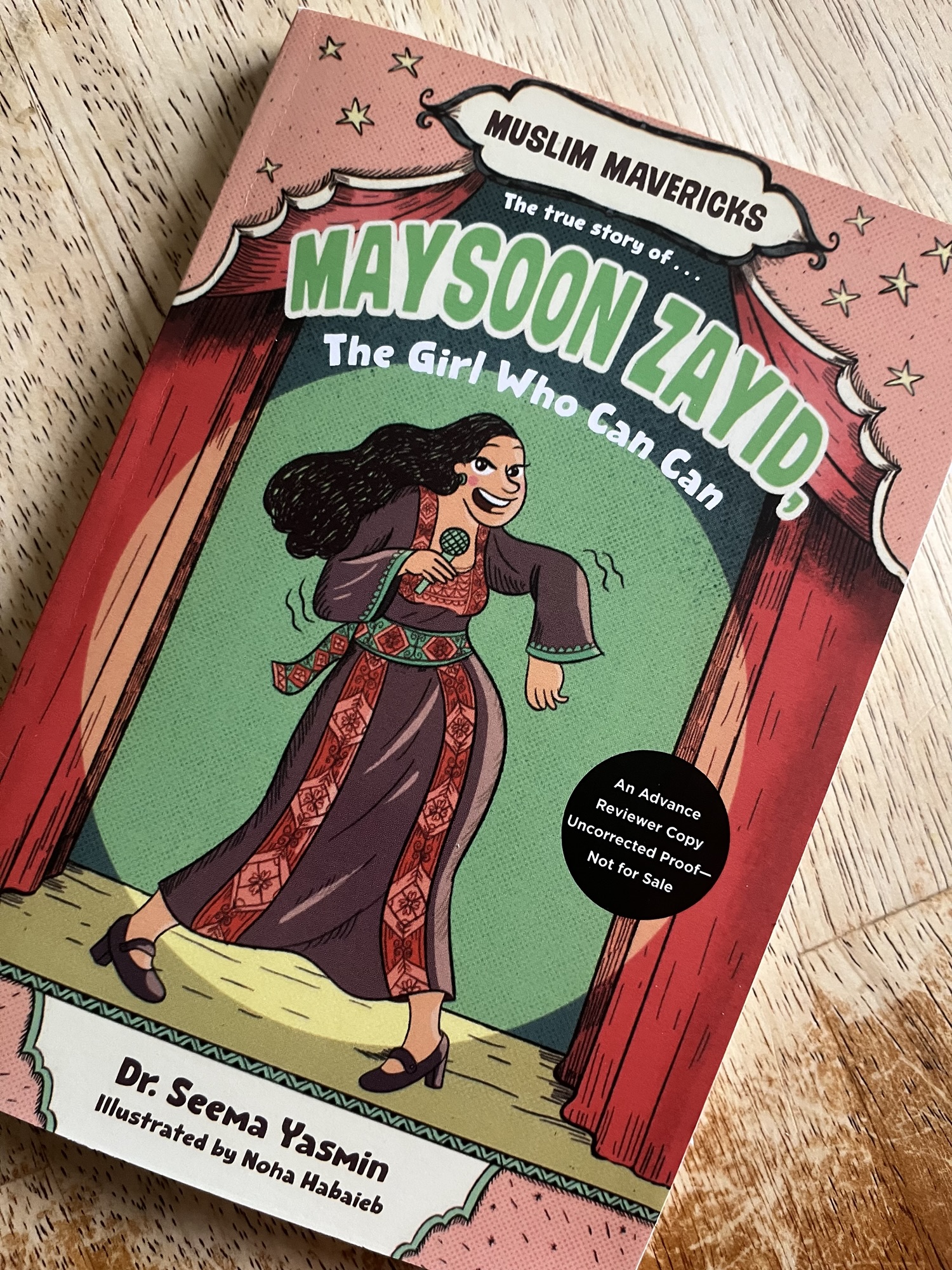
Muslim Mavericks: The True Story of Maysoon Zayid, The Girl Who Can Can by Dr Seema Yasmin illustrated by Noha Habaieb

Standard
Muslim Mavericks: The True Story of Maysoon Zayid, The Girl Who Can Can by Dr Seema Yasmin illustrated by Noha Habaieb

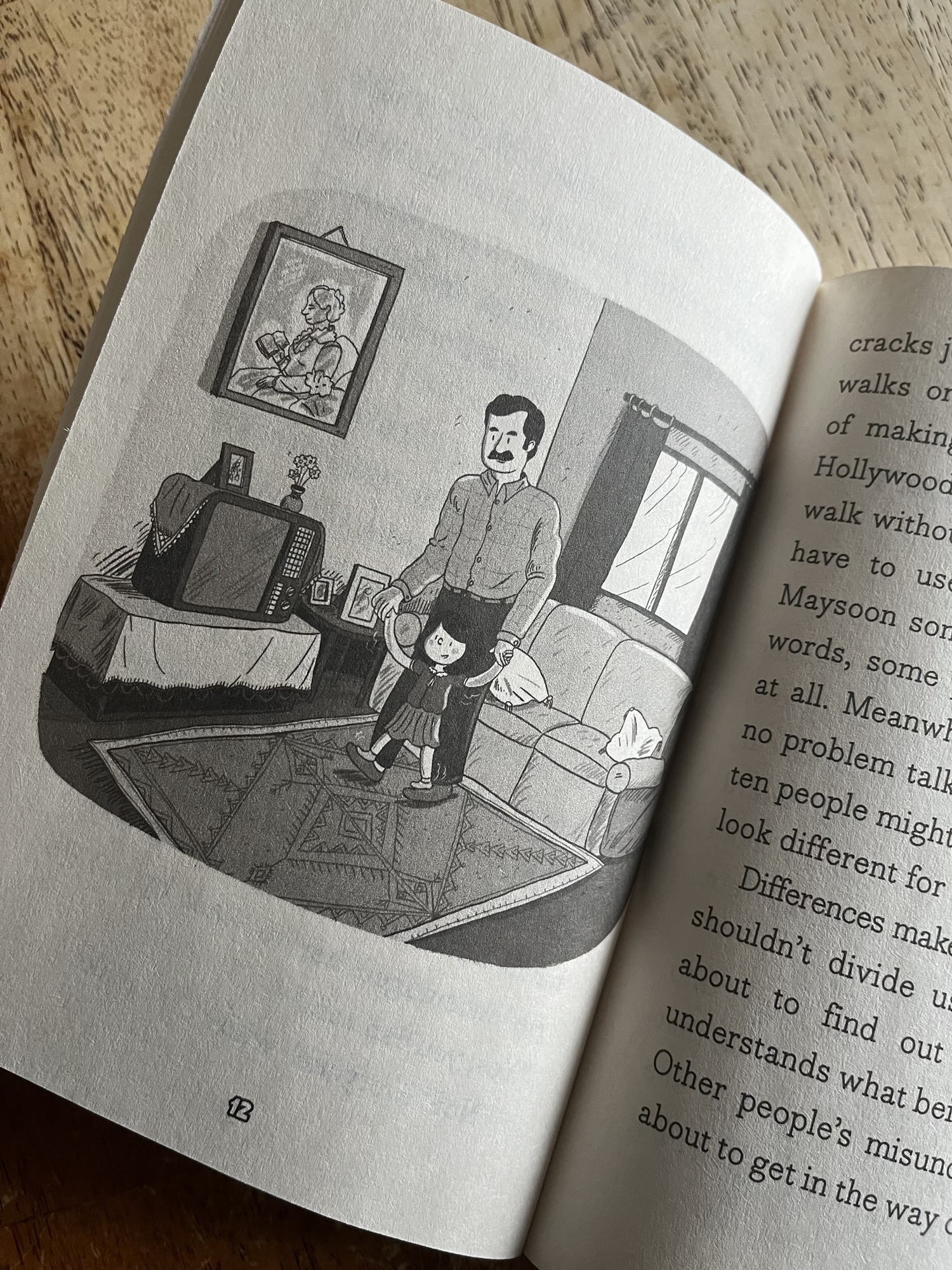
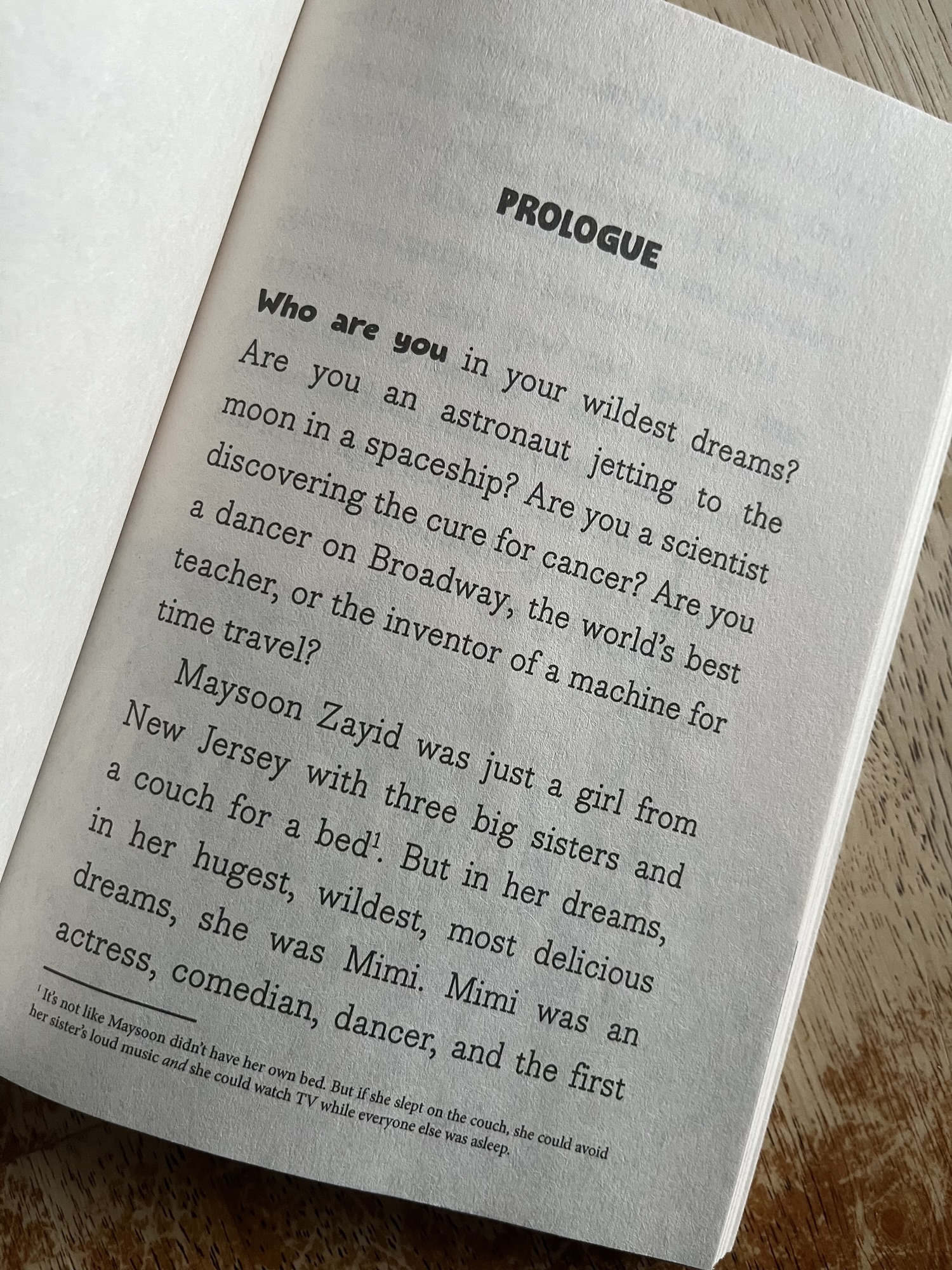
This 73 page, first book in the Muslim Mavericks series for early elementary readers is an informative biography on the actress/dancer/comedian/entertainer who happens to have cerebral palsy, three sisters, be born in New Jersey of Palestinian decent, and be Muslim. I could not find what other biographies the series plans to include, which is a bit disappointing, and I mention it because it is published by Salaam Reads, a Muslim imprint of Simon and Schuster, the author seems to identify as Muslim, and Maysoon Zayid is Muslim.  Yet, a side from Muslim being included when she lists off all her perceived labels, there is nothing Islamic in the book, so I’m curious what the line up or plans are for the series.  I get that it isn’t meant to be some Islamic resource guide, but in this book, in particular, it seems blaringly absent when all of the other self identifying labels are factored in to Maysoon’s dreams, her obstacles, her bag of tools to overcome her challenges….EXCEPT ISLAM.
SYNOPSIS:
The book follows Maysoon looking up to her sisters on the cusp of her first day of school, where she finds out the school will not accept her, all the way to her starring on General Hospital as an adult.  With her fighting battles to be included, finding her voice, and pivoting her dreams, readers learn about cerebral palsy, determination of Palestinians, and refusing to settle.  From her goals of being an actress, comedian, dancer, winner of the EGOT, the reader sees how having a dream and determination is often not enough, but refusing to let others define you is something that you should always fight.

WHY I LIKE IT:
I particularly love the determination and dedication Maysoon’s dad has to her care and health. Their relationship is shown to be constant and I think as a result pushes back on numerous stereotypes. I also like that glimpses of Palestine, both historical and her own time their with family is shown and credited with her strength and determination.  I just can’t figure out why nothing showing her practicing Islam, or seeing her obstacles through an Islamic lens is included, and if it is because she doesn’t, then why the repetitive use of the “Muslim” label and the flagship book in a Muslim centered series by a Muslim imprint? sigh.

The Slightest Green by Sahar Mustafah

Standard
The Slightest Green by Sahar Mustafah

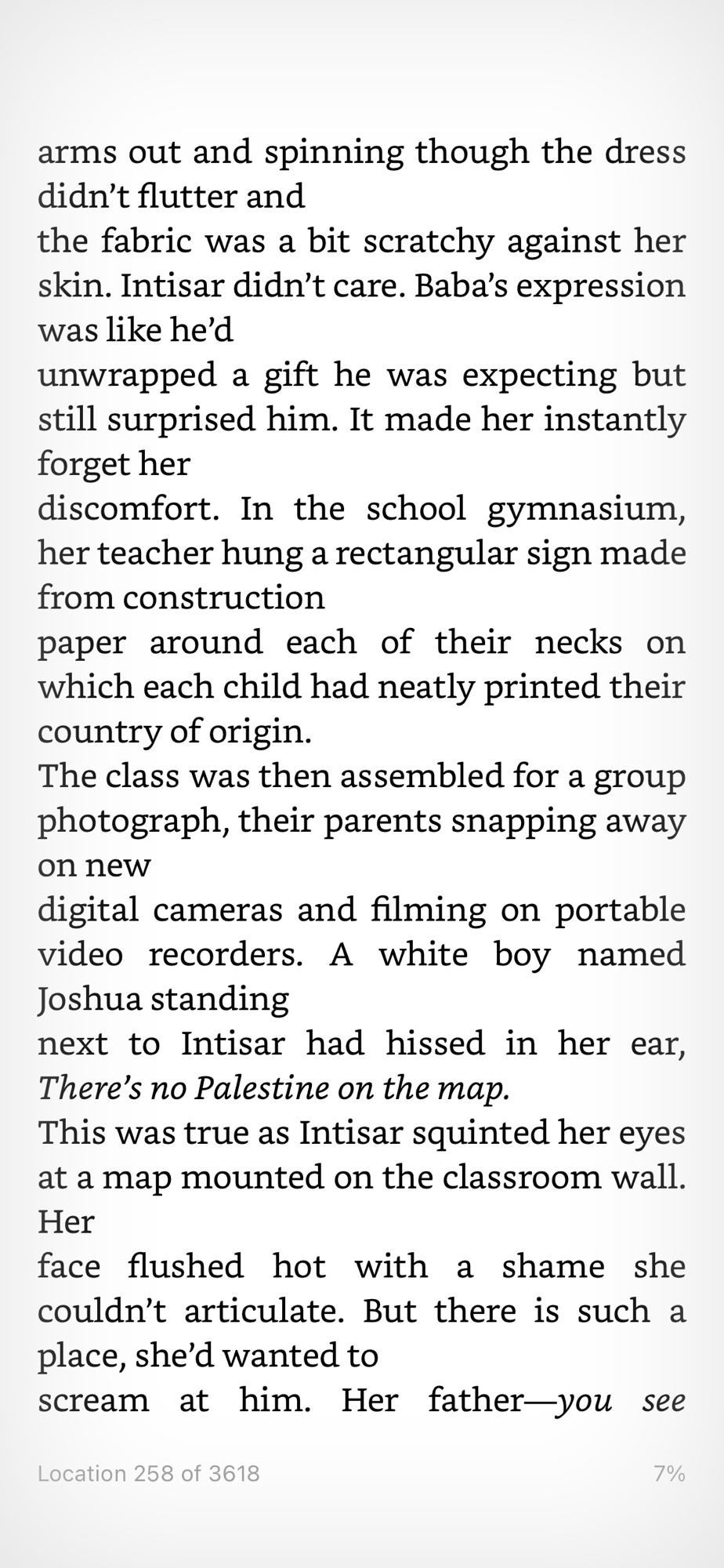
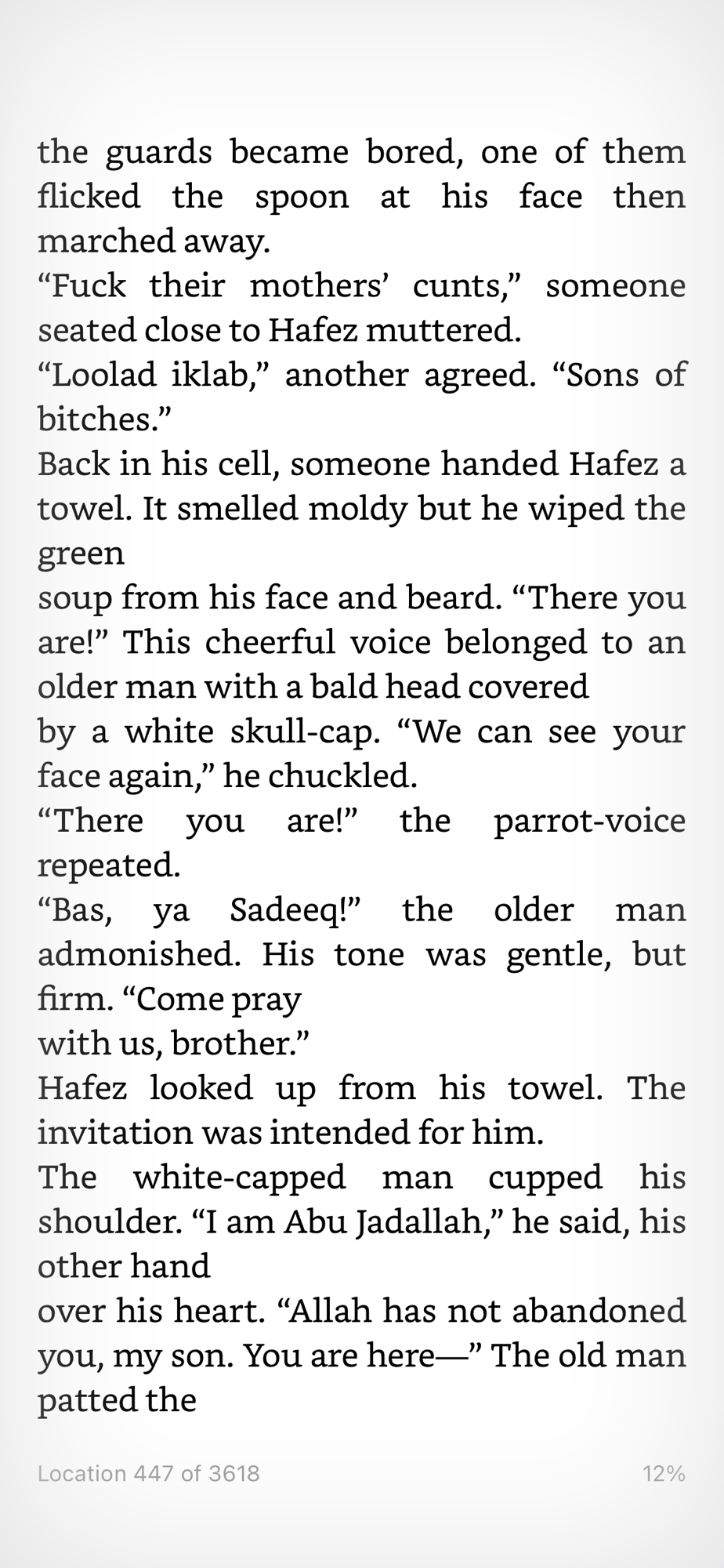
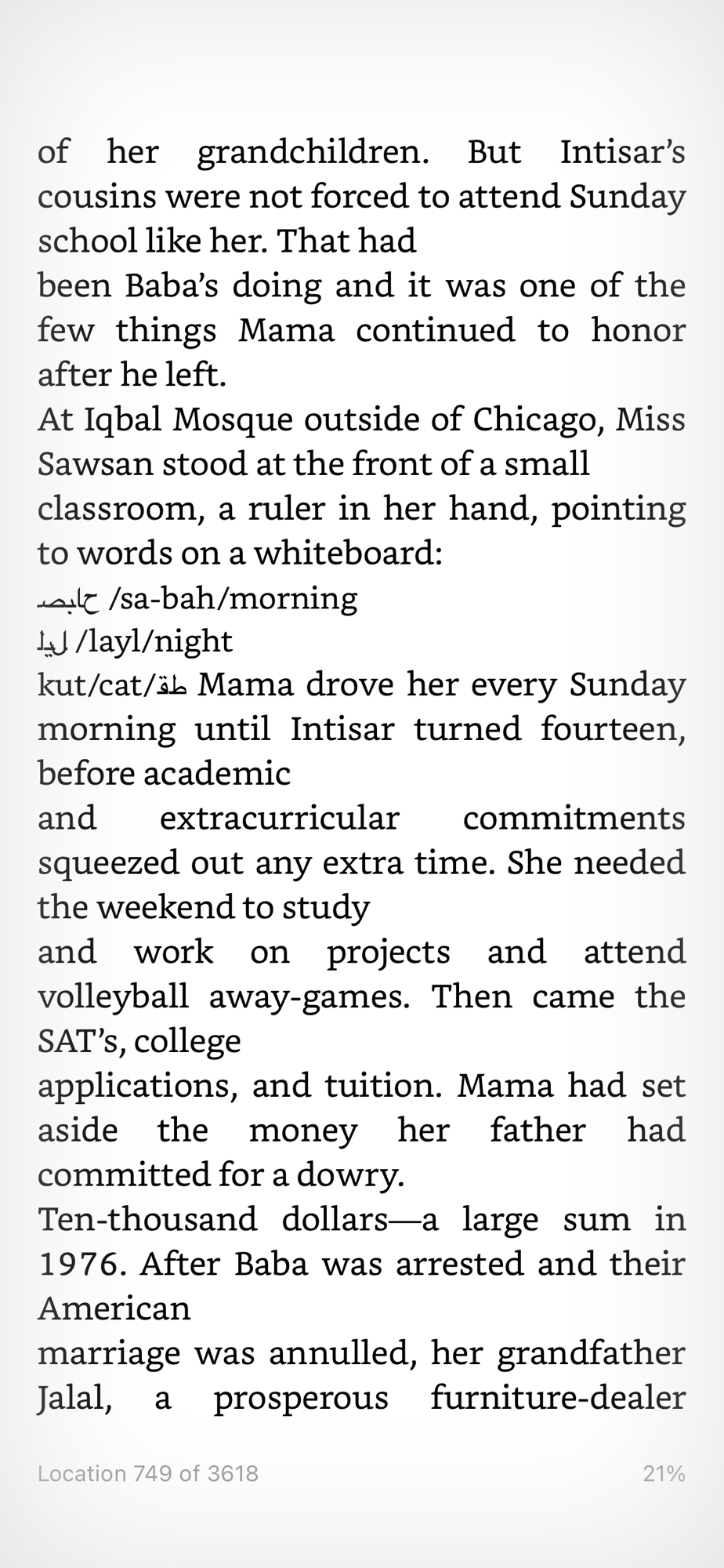
This adult multi generational novel weaves a narrative that will stay with the readers for the warmth and depth it explores of a fictional family that over the course of 248 pages becomes very real, and in many ways familiar through its personal focus. The book is deliberately slow as it glides through different members of the family, their backstories and different points in time. The prose highlights the plight of Palestinians but not in a didactic or call to action sort of way. The characters and their stories, and their trauma and dreams are very tied to Palestine and the occupation, but the focus on the individual and the ripple effects is what will linger. I do not know when the book was written, (it is published in November 2025) as I read a digital arc which had very minimal backmatter, but this book is set before the recent genocide and is all the more important for today’s readers in pushing back against attempted erasure of Palestinian voice, culture, and history.

Intisar is a nurse in Chicago, the only daughter of divorced parents. She lives with her mother and has not seen her father in over 20 years. Not since he left the family to return to his home in Palestine, join the resistance and after a fateful mission is forced to serve a life sentence in Gahana Prison. When he is released to live his final days before he succumbs to cancer, Intisar heads overseas to see him one last time. Her grandmother Sundus additionally needs Intisar, the only heir, to fight for her to keep her land and home, a task that Intisar is not willing to pursue. As family history is shared, daily atrocities witnessed, Intisar starts to see herself differently, and considers if she could feel at home in her father’s homeland.

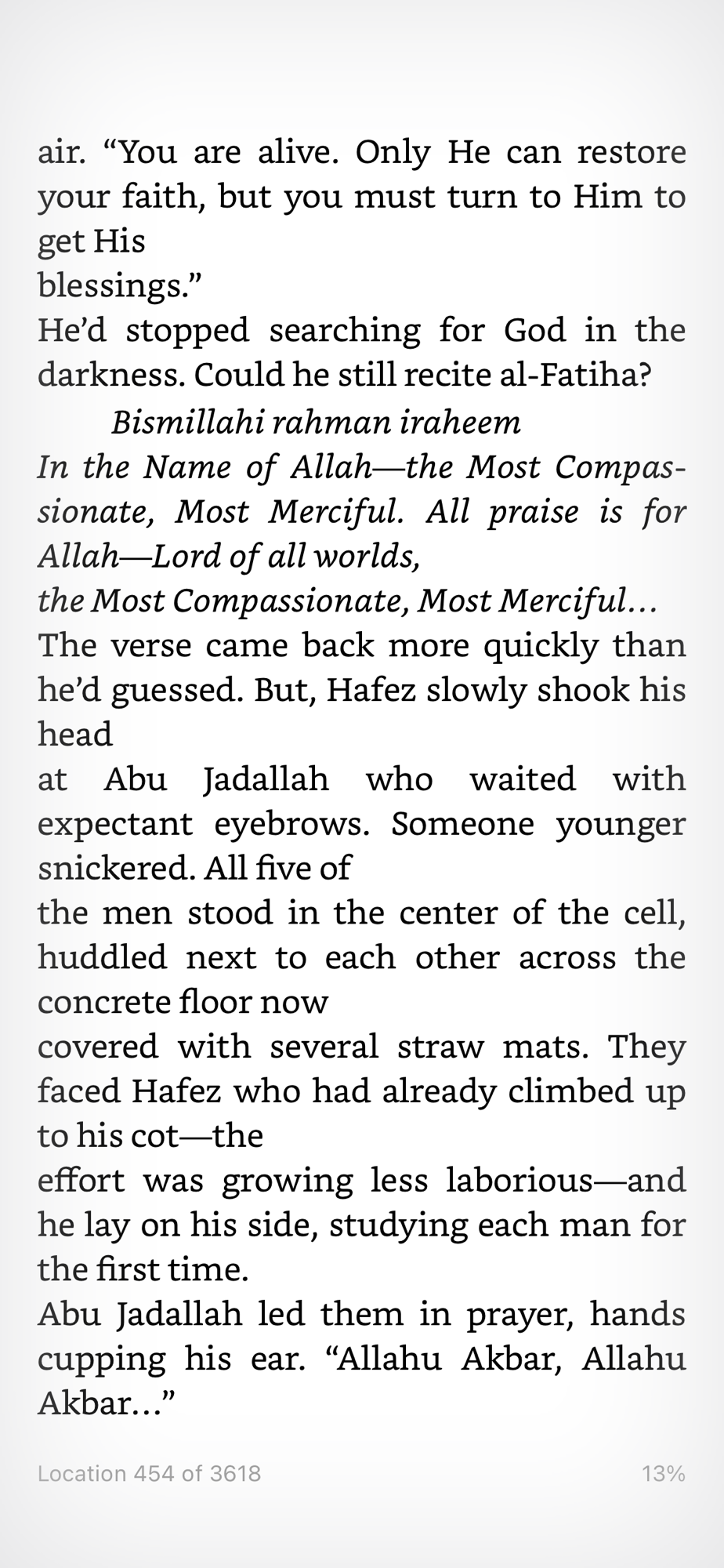
Again I read an arc, but there are a few sentences that really have me hoping line edits will still occur before the final version. The book is adult, it has a Muslim drinking and serving alcohol, there is assault, sexual and physical mentioned, and yet I didn’t feel like it was sensationalized, actually felt that the author was deliberately holding back to keep the story about the family and not the larger issues. Their is quite a bit of Islam, not from every character, but it is woven in and not an identity issue. Actually one line used frequently is my only real gripe with the book. “Pray to the Prophet,” is regularly said by a few characters, so I though perhaps it is something unique to them, up until about the midpoint, where many characters start to say it and I don’t like it. It makes it clear other places that Allah swt is One and who we pray to, it has the shahada in English and verses from the Quran, so I’m guessing it is a colloquialism perhaps, or maybe a poor translation, I honestly don’t know, but it bothered me, so I am sharing.

The Land of La La La by Sana Saghafi illustrated by Azam Vazehimogadam

Standard
The Land of La La La by Sana Saghafi illustrated by Azam Vazehimogadam

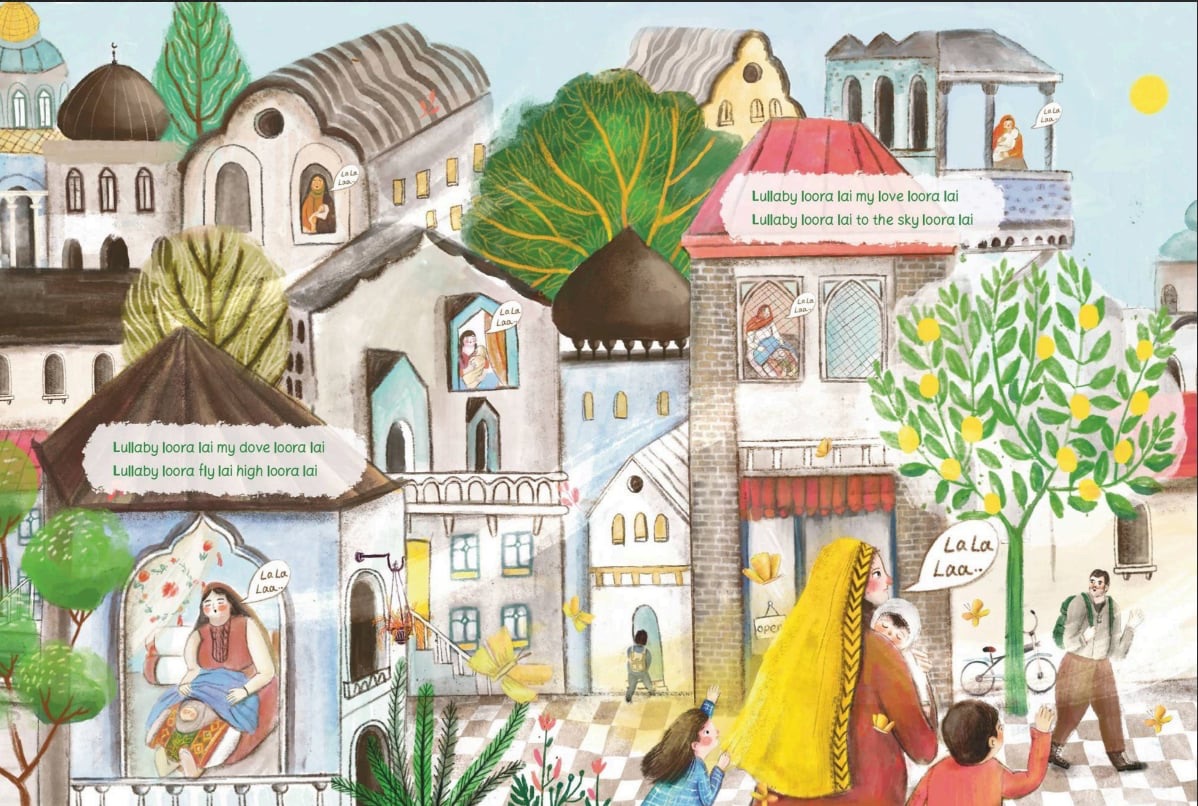
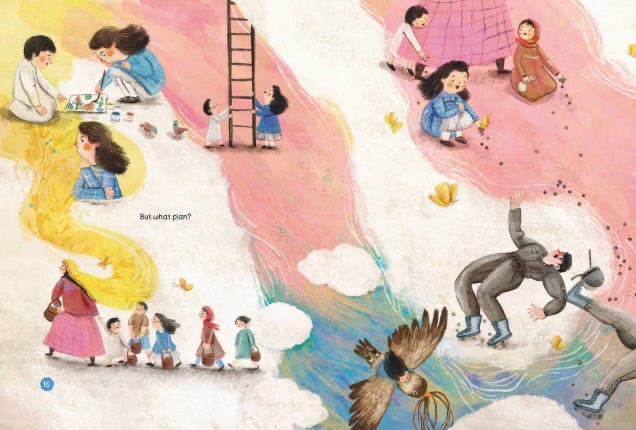
This gorgeous and powerful 36 page picture book goes back in time to a Palestine where the struggles of today are still found, along with the resilience of the people, determination of the women, ingenuity of the children, love and hope.  The book is so strongly unapologetic in its portrayal of marbles representing strategy of kids to battle the giants aka soldiers, of children being imprisoned, of the occupiers being outsmarted by the people, and the joy that persists despite the attempts of erasure. The story within a story…within a story(?), doesn’t name Palestine until the very end, after the stories at hand have wrapped up, and doesn’t disclose that it is based on a true story, except for in the blurb.  It is also worth highlighting that the book is not OWN voice or sourced.  I still am sharing though because it is positioned as happening long ago, and thus hopefully not further erasing a Palestinian voice, but rather sharing a story to prevent it from being lost.  I do not know the author, illustrator, or publishers’ intent, this is simply my view and I am happy to be corrected if I have arrogantly overstepped.  


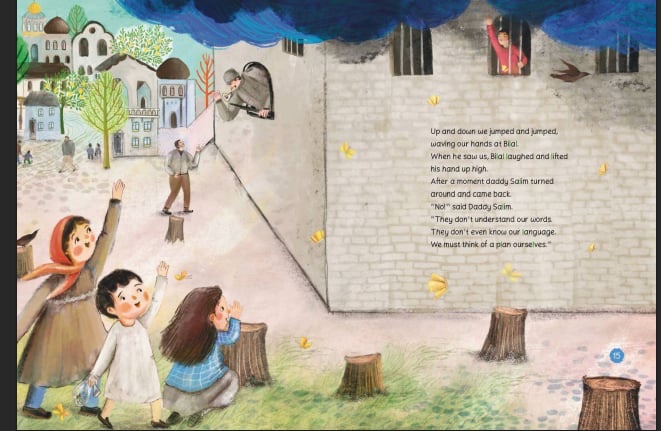
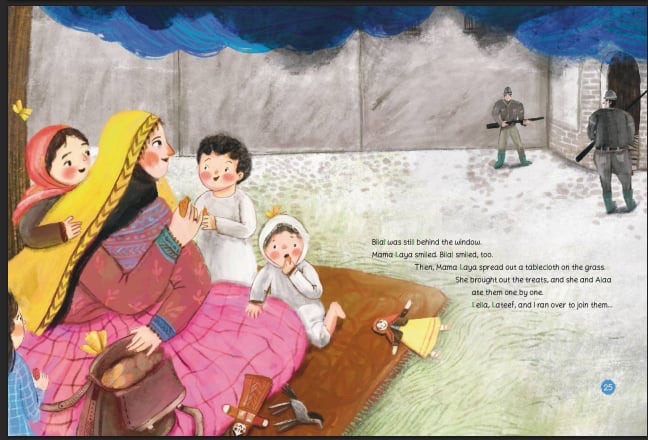
The book starts with a lullaby lilting through the air, the la la las, connecting the women caring for their children. Mama Laya is busy so Big Brother Bilal is playing with the children, marking which soldiers have been defeated on the paper that matches the marble game in the lane. When the giants take him away the children run to find Daddy Salim.

The searching children and family find Bilal in prison, and the giants don’t speak the language of the people to be reasoned with, so they must figure out a way to free him on their own.  Mama and the children have a picnic outside the prison and secret filled lullaby conveys the plan right under the giants’ noses. With Bilal free, the women gather to teach each other a secret way to communicate, to resist, to hope, in the lullabies that they sing.

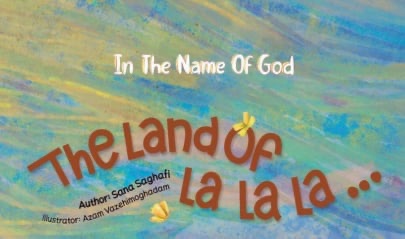
There is no religion mentioned, but the title page begins, “In the Name of God,” and numerous characters are depicted wearing hijab.  I read a digital arc and I hope the printed version has backmatter to highlight that the author is not Palestinian, when this would have taken place, and if it is accurate.  Authenticity and accuracy are important, and I hope the book clarifies what is real, what is imagined, an where the information came from.


Your Friend From Palestine by Nabila Adani

Standard
Your Friend From Palestine by Nabila Adani

This book is absolutely gorgeous, from the raised text on the cover, the sweeping illustrations with tangible details, the Islamic threads, and the heart, but…yeah you knew something critical was coming, the rhyme is not consistent, and the biggest hurdle for me, is that there is no backmatter.  I can’t say that I’m “bringing this up again,” because I don’t know that the debate ever dies down: can you write a book about something personal that you have not lived through? In this case can a non Palestinian write a book from a Palestinian perspective? As a former journalist and long time reader, I still maintain that you can, but backmatter detailing your own limitations, what efforts were made to have the book verified by those with OWN voice experience, and background information on why this is pertinent and relevant are mandatory. And this book does not offer them.  Nothing feels off about the contents, and anyone with a heart, has seen and felt everything on the pages about our brothers and sisters living under occupation and through genocide. So is it a good book, yes. Do I think it has value, yes. But, is it authentic? Is it accurate? Is it enough? Does the focus on hardship and destruction open eyes or diminish Palestinian joy? Why wasn’t a Palestinian brought in to cowrite the book with the author illustrator? Was it sensitivity read? I am not able to answer these questions, I simply bring up my concerns for you to decide for you and your children. While the book ends on hope for a free Palestine, and a safe Gaza, the oppressor is unnamed.

The book starts with children on a beach playing when they find a message in a bottle.  The message is from Khalid, a child in Gaza telling the finder about his life and asking about theirs. He likes to play football, but sometimes it isn’t safe, he likes to read stories but often can’t because there are no lights, and he dreams of swimming in a swimming pool, because they often don’t even have water to drink.

Khalid then tells the finders of the bottle, and thus the readers, to not lose hope, “to hold on to your imaan.” And it highlights what we can all do to help.  “You can pray for us! Send charity! Spread the news!” and tell people about Palestine. So that one day we can meet at the Dome of the Rock, pray at Masjid Al-Aqsa, and be together in a free Palestine, inshaAllah.

The illustrations are beautiful and the framing effective in connecting with readers, and highlighting the similarities before revealing the obstacles. Again why I wish there was backmatter, so that it didn’t feel simplistic, but rather bringing it down to a younger audience level.  With dialogue, explanation, and context, the book can be powerful, but on its own, I feel the lacking authenticity, transparency, and details about Palestine, make the book in need of an update before future reprintings.

Everything Grows in Jiddo’s Garden by Jenan A. Matari illustrated by Aya Ghanameh

Standard
Everything Grows in Jiddo’s Garden by Jenan A. Matari illustrated by Aya Ghanameh

This sweetly illustrated 32 page rhyming book starts off introducing a little girl living in one place, and having a home in Palestine that she has never been to, but loves.  The book then becomes pretty universal with her and her grandfather talking about what grows, his “green thumb superpowers,” and the magic of planting small trees that change and produce. The pages then add in more Arabic words of what is grown, and then when Jiddo is drying his eyes recounting why he had to flee his home and his roots, I too, found I was emotionally invested in light of everything current and past, and the simple words weaving a heartfelt story of family, connection, and home. I do wish that there was some Islam in the text or illustrations: a dua, a plea to Allah swt, a hijab on a main character not just on background memories, but there is not. There is also nothing overtly political or named in the text. The backmatter does discuss the Nakba without naming names and highlights the author’s inspiration, but inshaAllah nothing that will get the book banned or kept off shelves. The rhyme and cadence are pretty good, it doesn’t feel overly forced, but when reading aloud in a group, as always, I suggest practicing a few times to make the flow consistent.

The book starts with a beautiful spread of a mother and daughter looking through a photo album, and imaging going to Palestine one day, the subsequent pages show how Jiddo’s garden helps bring Palestine to them. The “sour green janarek plums,” “crunchy green khiyar,” and “plump red bandora.” Mama makes warak enab and Teta sings for more.

One day the little girl wonders how her Jiddo learned to grow everything and he shares that he learned from his father how to care for the land.  She then wants to know why they left Palestine, and he says, “our land was taken from us…and our family had to flee.” The hope is to return, the illustrations show the key to their occupied home being held on to, and reinforces the symbolism that Palestinians are like seeds that will flourish wherever they are, reaching toward the light.

The book contains a glossary with words written in English and in Arabic script, and an author’s note in the backmatter with presumably personal photographs of the author and her family.  I read a digital ARC and look forward to release day for my preorder to arrive.

The Donkey who Carried the War on her Back by Hooda Al Shawa illustrated by Sienny Septibella

Standard
The Donkey who Carried the War on her Back by Hooda Al Shawa illustrated by Sienny Septibella

This 44 page story told from Zahra’s perspective, a donkey in Gaza, juxtaposes her life and what she sees before the bombardment of Gaza with after, and the determination and hope that drives her and her owner Sami to help. I love that it shows the daily joy, beauty and the resilience in the face of attempted erasure. By using the donkey as the protagonist, the book is able to explain and show realities in a manner that remains simplified, removed, apolitical, but informative none-the-less, for young children. The book was created with the collaboration of the Tamer Institute for Community Education who’s vision is, “Towards a Free and Safe Palestinian Learning Society,” so, I’m not sure that my opinion counts for anything, but I do worry that the “telling” comes with the words the donkey hears of “sanctions, closures, embargoes, blockade,” but the “showing” comes when “one day, a war came to my city.” It feels like it could be interpreted that life was fine and then one day it wasn’t, and yes, the backmatter defines the words, but it doesn’t “show” the donkey at checkpoints, or show any previous destruction, or struggles.  Presumably the book wants to show the joy and beauty of Gaza to humanize a population that the global media is endlessly working to dehumanize, but the framing and the memorability paints a picture that to my acknowledged outsider, non Palestinian heart, feels dismissive of years of oppression, and aligns with the erroneous narrative that it started in October 2023. That isn’t to say the story is not important,  I think that with guided conversation and contemplation, the book will show children what Gaza looked like before the attacks by the occupation, the importance of pack animals such as donkeys, and why the people of Gaza dream of freedom.

The book starts with Zahra the donkey standing on green grass with buildings and the ocean in the background, acknowledging that Gaza is not an “ordinary city.”  She hears words in the market place that the greengrocers call out “sanctions,” “closures” “embargoes, “blockade,” and hears that the people cannot travel or leave, “that life is difficult and RESTRICTED!” But despite that, she enjoys carrying things in her wooden cart as she makes deliveries, food, solar panels, strawberries, stopping with Sami to get ice cream.

Then when the war hits, the city is turned to rubble, and people must live in tents. Zahra and Sami’s daily routine changes, they transport ration supplies, serve as an ambulance, transporting families to refugee camps, and the border with Egypt to try and leave. The sounds of crying are devastating, but she also hears laughter, and music, and stories from the hakawati.

I like that what they deliver is defined to explain what she is carrying “mahshi kousa,” although it seems like a translation error perhaps and should be “kousa mahshi” with the noun coming first, but again, what do I know. It appears the author is Palestinian Kuwaiti, but there is no mention in the text of the book about any religion, or indication online of the author or illustrator’s faith identity,  I share this not for its Islamic rep, but for solidarity and awareness.  There are visible Muslims in the illustrations.

Mariam’s Dream: The Story of Mariam Al-Shaar and her Food Truck of Hope by Leila Boukarim illustrated by Sona Avedikian

Standard
Mariam’s Dream: The Story of Mariam Al-Shaar and her Food Truck of Hope by Leila Boukarim illustrated by Sona Avedikian

This 44 page biographical picture book set in the Palestinian refugee camp, Bourj Al-Barajneh in Lebanon, centers the story of Mariam Al-Shaar and her determination to start a restaurant and food truck despite the restrictions of refugees and women. Her drive and persistence leads to the creation of Soufra, the home of not just good food, but also community, hope, dreams, and change. the The illustrations, the heart of the story, the backmatter, are all well done, yet for some reason, the emotional impact seemed lacking for me.  I didn’t “feel” inspired, or moved.  I didn’t feel her pain, her grit, her joy when it all came to fruition. For a biography, I didn’t feel like I got to know Mariam, or why this was her dream.  The book explains being a refugee, and not having full rights, but it doesn’t show the reader. We are told Mariam wants to do “something,” but the “something” she finds, is what other women want. “We want to cook,” they tell her.  “We are good at it.” The reader though never is shown, why they want to cook, or what is stopping them from cooking, and even if Mariam wants to cook too.  It is clear the struggles Mariam faces when she wants to branch out and start taking the food to those outside of the refugee camp by way of a food truck, but lines such as “They tell her not to risk it,” fall flat when the reader doesn’t know what is at risk.  The absent context makes it hard to cheerlead and understand why this is so revolutionary.  Ultimately, it is a lot of telling, not showing. The story is fine on the surface, but I don’t think it will linger and illuminate refugee struggles, Palestinian struggles, or women’s struggles beyond the page because we are not show what those are, and how inspiring it is that Mariam Al-Shaaar overcame them.

The book starts with prose that describes that Palestinian refugees “live between worlds.”  The camp is not just physical walls, but also walls that keep her from living her dreams. She decides to do something about it, but doesn’t have to do it alone, she reaches out to others and “Soufra is born! A feast.  A table full of food.”  It is a way for women to come together to cook, earn a living, and be among friends.

People around the camp flock to Soufra and the women “have changed.  Their children have changed. Mariam has changed.” Mariam wants to take Soufra beyond the camp, and is determined to buy a truck, learn how to drive, and share their food.  More walls can’t keep Mariam down, after two years, the food truck is a reality. 

The book concludes with an Author’s Note about the author interviewing Mariam Al-Shaar, a beautiful Food Glossary, details about Refugees and Refugee Camps, and a Selected Bibliography.  The author is not Muslim, but Mariam is and she and many of the illustrated women wear hijab and are visibly Muslim. 


Kamal’s Key by Rifk Ebeid illustrated by Sophia Soliman

Standard
Kamal’s Key by Rifk Ebeid illustrated by Sophia Soliman

This 44 page hardback book gently, yet powerfully, focuses on the Palestinian resistance symbol of the key, by sharing a multi generational tale of new beginnings, heartache, hope, and resilience. The writing is moving, and flows with simple lines, beautiful illustrations, and maintaining a focus on a singular theme. So often well meaning books about oppression, war, politics, try and include numerous details that the picture book suffers in its appeal to younger audiences, the opposite is often true with books being so generalized that it isn’t clear exactly where refugees are from or what turmoil is being discussed. This book strikes a beautiful balance of calling the incoming occupiers a dark cloud and not giving them space or attention, while focusing on Palestinian experiences through a lens of hope, joy, and love.

The book starts with the key. It is a beginning to Kamal’s home. It is on his belt at his wedding, it is the beginning of his and Huda’s new life starting together, a symbol of their home when their son is born. It is the beginning of Jalal’s imaginative play of using it as a dhulfiqar. It is secured around Huda’s neck when they are forced to leave their home, and find refuge in tents. It is hung when the tents become walls.

One day Jalal takes it down, when the hurt in his father’s eyes is too much for him to witness. When Jalal becomes a father though to Salma, the key becomes her toy, her microphone, her connection. When Kamal gifts the key to his granddaughter it becomes her art, her poetry, her necklace, a symbol of her hope and a people’s right to return.

I’ve read this story a few times to myself, as well as with my children, and I only wish it was a little larger in size. It works well one-on-one or with a few, but it is a story that needs to be shared in large story time groups, and the 9 x 9 inch size makes it a bit difficult.

img_8454-1

The book concludes with an author’s note, an illustrator’s note and a glossary, not just of terms, but traditions, concepts, and information about the song. I purchased my copy from Crescent Moon Store.

My Olive Tree by Hazar Elbayya

Standard
My Olive Tree by Hazar Elbayya

img_7154-1

I love that this author illustrator traditionally published book shows the ways that olive trees and their fruit connect people.  The little girl, Salam, can’t wait to grow her very own tree, but it takes a while, and when it finally sprouts, it is trampled by soldiers.  Heartbroken to lose her plant, her community shows her how they are like their beloved olive trees: their roots are deep, and they are a part of the land.  The tender illustrations, the poignant symbolism, and the love and unity that radiates through, makes this book an important read for children and adults of all ages and backgrounds.  There are no countries mentioned in the text (Palestine appears only in the author’s note), nor any religion, there are visible Muslims in the illustrations, even the soldiers are unnamed, but the setting is clear.  Picture books take years to be published and that it released at this point in history, shows how long the struggle for freedom has been taking place, and how strong and resilient Palestinians are.  This book that will be read over and over, shows even in the sadness, the feeling of hope abounds.

The book starts with Salam noting how old her grandpa is, and that only the olive trees are older than Sido.  Sido then explains to his granddaughter how the olive trees connect them all: farmed, picked, pressed, oil used to cook, olives sold to eat, added to dishes, and made into soap.  Salam goes to plant her seed and be part of the connection. She waters it and waits, but it doesn’t seem to be growing.

Finally a spout, and then a little plant, and then the soldiers march into their lands and destroy everything in their path, even Salam’s olive tree.  Sido reassures her that she will plant more olive trees in her lifetime, but Sido also wants to show her that she is not alone.  Friends, family, and neighbors, come together to show her, “just like the olive trees, when they try to break us, we grow back stronger.”

A truly beautiful hopeful book, subhanAllah.

img_7144-1


Hilwa’s Gift by Safa Suleiman illustrated by Anait Semirdzhyan

Standard
Hilwa’s Gift by Safa Suleiman illustrated by Anait Semirdzhyan

img_6526-1

I’ve read a few children’s picture books about harvesting olives, and even some about Palestine’s olives, but this one really stands out because it is just so very joyful.  There is information about picking the fruit, processing, and making soap and oil with olives, but the book’s take away is just sore cheeks from smiling, and a full heart from feeling the importance, love, and tradition of olives, family, and being together.  The text and illustrations combine beautifully allowing the story of Hilwa, the olive tree, Ali and his Seedo to say a lot without having to spell it all out. And that it is traditionally published at such a critical time, is truly a gift.  There is nothing religious in the text, there are a few #Muslimsintheillustrations, and the author is Muslim. Additionally there is nothing about the current situation, the politics, the upheaval, or the occupation. The book follows Ali as he arrives after a long journey to his Grandparent’s home, it is harvesting season and  he is about to see all of the gifts that come from olives with the guidance of his grandfather, the cheering of his cousins, and the offerings of his beloved Hilwa.

The book starts with Ali and his parents arriving exhausted after their long flight to Palestine.  Greeted by Seedo, when Ali sees Hilwa, the olive tree his grandfather planted with his grandfather, the tiredness disappears.  When he hears Sitty whacking the trees and his cousins singing, “Zaytoon, ya zaytoon.”  He is ready to help harvest.  But, he doesn’t want to hurt Hilwa and decides to pick the olives one by one.  After his arms are tired and the basket is empty, he gently tries the traditional method and makes the zaytoon rain down with his grandparents and cousins cheering him on.

Hilwa has many gifts, and the next day they load up the olives to be taken to the press, they then prepare and enjoy the olives being pressed in to oil.  They bring the oil home to cook with, eat, turn in to soap, and the pulp is used to build the fire.  The best gift of all however, is the family, friends, and neighbors gathering to share and be together.

I read an early copy, and hope that the beginning will be smoothed out a bit.  It actually read as if a page was missing.  If the family had just arrived from overseas, and the grandfather was so excited, why wouldn’t the grandmother and cousins also leave what they are doing to great the just arrived family? It seemed a bit off, but once the story recovered, the text and story flowed without incident, so perhaps the disjointedness has been resolved.

img_6527-1

It is so important to show the richness of cultures to those that might be unaware, for a culture that is relentlessly villainized, even more so.  This 40 page picture book is great for ages 3 and up, and while it doesn’t detail Palestinian culture, it highlights a central component and shows the vibrancy and warmth of a people and their relationship to the land and the importance of olives and olive trees.  There is a glossary at the end with words in English and written in Arabic scripts as well as an Author’s Note.