Tag Archives: Muslim Family

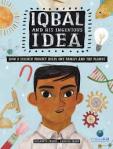
Iqbal and His Ingenious Idea: How a Science Project Helps One Family and the Planet by Elizabeth Suneby and Rebecca Green

Standard
Iqbal and His Ingenious Idea: How a Science Project Helps One Family and the Planet by Elizabeth Suneby and Rebecca Green

iqbal

It is a bit odd that this story is fiction, when it reads so much like a piece of nonfiction.  It is a picture book, but has an AR level of 4th grade 4th month.  So, while the story is great and highlights a country and culture, Bangladesh, not often seen, I don’t know that this book would appeal to many kids.  The kids that it does appeal to though and that can find it in a library or bookstore (not sure where it would be shelved), I think will not just like it, but possibly find it both inspiring and worth reading again and again.

IMG_2086

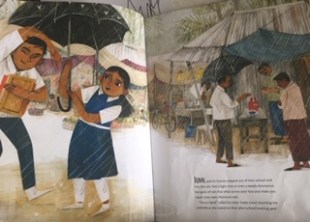
It is monsoon season in Bangladesh and the rains make Iqbal’s mom have to cook indoors.  As a result, she and the baby, Rupa are constantly coughing from breathing all the smoke from the woodburning stove.  Iqbal’s father mentions a propane stove he saw in the market, but the family cannot afford it, despite wishing that they could. 

Iqbal’s school has just announced the School Science Fair and the winners get cash prizes, if Iqbal can win, maybe he can buy his family the new stove.  His little sister Sadia offers her services to help him win and be his assistant.

IMG_2087

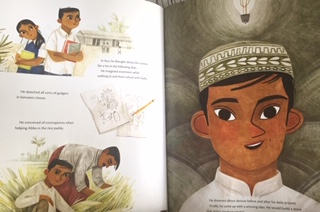
After a lot of thinking, pondering, and dreaming, Iqbal decides on the perfect project: a stove that didn’t produce smoke.

With the help of his teacher at school to find ideas and articles and plans on the internet, Iqbal and his sister build a solar cooker with foil and an old umbrella. 

IMG_2088

The science fair is a success, Iqbal wins, the family buys the stove and propane with the winnings, and when it isn’t raining, the family is able to use the solar stove Iqbal and Sadia built.

The book draws on ideas of sustainability, pollution, economic viability, problem solving, and education.  The culture provides the backdrop making all of these issues relevant and real, and mentioning Ramadan, Eid, and prayer provides some depth to the characters and adds to their culture.

IMG_2089

A lot of reviews online criticize that the mom is cooking and that the kids test an egg on the solar cooker and call her to eat it if it is supposed to be Ramadan, but I personally promise you, during Ramadan, we are always cooking.  And if she is nursing the baby, the mom wouldn’t be required to fast, there’s a lot of other reason she couldn’t/wouldn’t be fasting, but really, it is such a small portion mentioned in passing, no detail needs to be given, and it didn’t bother me at all.

Another complaint about the book is that if money is so tight the kids wouldn’t be at a school where they can just make copies, and buy eggs on their own.  I think there is some truth to this, but maybe a wealthy doner funds the school.  I think you could argue it either way.  I don’t know that the family is poor, it is the overall society, so kids could have pocket money, a propane stove is probably imported at least from a larger city so the expense would be more, similarily the infustruction of electricity and gas lines could hint more at why they cook the way they do.  Needless to say the family is smiling in the pictures, they have food, and they seem to be doing ok.  So the fact that the school printed a few articles and the kids bought some eggs without asking permission, didn’t bother me greatly.

IMG_2090

The illustrations are expressive and show the family connections and emotions.  I like that they bring to life a country many wouldn’t know, even if I wish it weren’t a work of fiction, but based on some child actually there.  

The end of the book has information about clean cookstoves, how to build one yourself, and a glossary.  The large 9×12 hardbound book would hold up well to multiple readings, and the amount of text on the pages would work well as a read-a-loud to younger kids who would find the subject matter interesting.  

IMG_2091


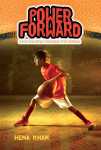
Power Forward: Zayd Saleem, Chasing the Dream by Hena Khan illustrated by Sally Wern Comport

Standard
Power Forward: Zayd Saleem, Chasing the Dream by Hena Khan illustrated by Sally Wern Comport

power forward

I enjoy Hena Khan’s books, I love basketball, and I love that this three book series is written for 3rd-5th graders.  I didn’t love the cover, however, which I attribute to the reason I waited so long to start reading the book, I know, lame.  But luckily the books were in the public library and I had a few hours on my hands and was able to consume the first two books, and look into ways to get the third one ASAP!  Written on an AR 3.8 level the 126 pages fly by, the second book On Point is 130 pages and an AR 4.0, and the third book in the series, Bounce Back comes out in October.

SYNOPSIS:

Zayd Saleem is in 4th grade and is desperately trying to move from the D squad basketball team to the Gold team with his best friend Adam.  The only problem is he is a pretty scrawny kid, and he has committed a lot of his day to practicing violin.  His desperation forces him to be less than honest and the consequences that follow may strip him of the chance to even try out for the team at all.  The basketball story is intertwined with a rich cultural Pakistani-American backdrop and familial characters that are relatable and fairly fleshed out.  Zayd’s mamoo, maternal uncle, has agreed to meet someone to consider marriage, which brings out some humor as the whole family, including grandma and grandpa, have big roles to play.  Zayd also has to figure out why he gets such stomach aches as he makes regular notes in his food diary, and has to balance the universal themes of friends, school, and homework, as well.

WHY I LIKE IT:

The font and spacing is wonderful for the target demographic, sprinkle in the illustrations and the book is not intimidating in length or size.  The book is very real and relatable, kids of all backgrounds will relate to the basketball storyline and the video games and players mentioned.  I loved the cultural environment.  My kids absolutely loved the mentioning of the Pakistani food that they eat, and customs they participate in, and dynamics they know all too well.  I don’t know that a non Desi (someone from the Indian subcontinent) will get it, love it, and not be turned off by it.  The books are published through Salaam Reads and I would imagine the author and publisher know what they are doing, and the library has numerous copies, so clearly, I’m over thinking it, but I really want to get feedback on the cultural aspect, because it is done really well and I think it would show promise for future books.  

I love that the book is about a boy and basketball, but it isn’t limited to being a boy book or a sports book.  The story moves seamlessly through all facets of the characters life that makes it pretty memorable for what could have just been a sports story with a moral.  The “life lessons” are clear and obvious, but not overly elevated.  The little mistakes that Zayd makes are a part of his life, as are the consequences, but his family helps him through them, and help him learn.

There isn’t anything preachy or blatant about Islam in the book, but the characters are Muslim and it mentions that the parents are heading to the mosque at one point to help with a fundraiser.  

FLAGS:

There is lying, but that is kind of the lesson being worked through.

TOOLS FOR LEADING THE DISCUSSION:

I recently agreed to help a teacher with her “Lunch Bunch.”  Once a week students can opt to eat lunch in the library and have a book read to them.  They must commit for the duration of the book and I think for a 4th and 5th grade group this book would be a lot of fun.  It would probably only take two sessions to read and with the diverse class I can see if they get the cultural stuff or if it just bogs down the story to them.

Author’s website: https://www.henakhan.com/power-forward/


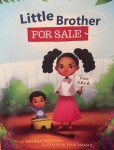
Little Brother for Sale by Rahma Rodaah illustrated by Fuuji Takashi

Standard
Little Brother for Sale by Rahma Rodaah illustrated by Fuuji Takashi

IMG_1867.jpg

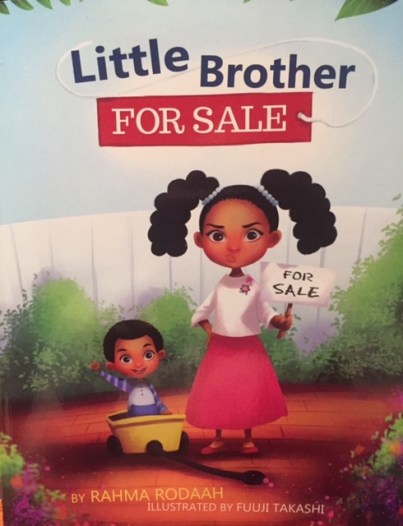
Oh how I love to read sweet books and repeatedly thumb through warm engaging illustrations.  This book is beautiful, fun, and (possibly) very relatable.

IMG_1860

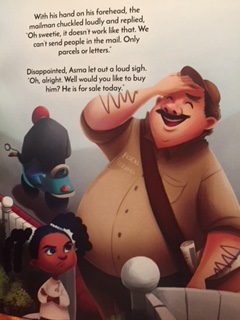
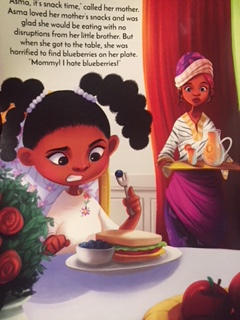
A big sister, Asma, is ready to get rid of her little brother, Hamza, so that she can enjoy all her parent’s attention.  But when the mailman won’t let her ship him to grandma, and neither the lady walking down the street nor the neighbor next door want to buy him, she is determined to find someone to take him off her hands.  Alas though, it is Hamza’s nap time and while mom makes salat Asma finally gets some time to herself.

IMG_1862

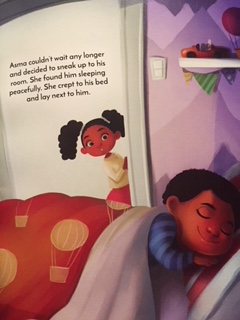
Except she misses having someone sharpen her crayons, or eat the blueberries she doesn’t like, and there is no one to dance with her around the living room.  She decides that maybe she does like her little brother, and lays down next to him with promises of loving and protecting him forever.  Ahhh…..

IMG_1866

Yeah, the book is pretty predictable, but the details make it charming.  I love the diverse characters and the love and warmth they all exude.  I love that when she drags her brother out in the wagon and holds up the for sale sign, mom is peeking out from the kitchen.  I reassured myself that she was there, so it was ok for Asma to be talking to the mail man, a potential stranger, and the lady walking down the street, muslimah or not. 

IMG_1861 

The only slight hiccup to me was what one-year-old, he was seemingly taking his first steps in the first picture, can sharpen crayons? Maybe I just failed to prepare my children, but other than that, the book is smooth, and well done.

IMG_1864

The binding quality, the font, the amount of text on the 26 pages, is definitely preschool to first or second grade, and the illustrations will mesmerize even toddlers who won’t understand why the book is so silly. 

IMG_1863

The book has been floating around my house and I’ve seen my 11 year old pick it up and read it on her own, and then read it to the three year old mutltiple times.  She possibly was getting ideas, but maybe it also reminds us that siblings really can be both annoying and lovely as well.

IMG_1865

Snatched Asmaa Hussein illustrated by Svaitoslav Diachyk

Standard
Snatched Asmaa Hussein illustrated by Svaitoslav Diachyk

snatched

The premise is simple, Omar ate something that didn’t belong to him, and the guilt is weighing on him heavily.  The beauty of the book is how, with his mom’s help and his own determination, he makes things right.  

snatched3

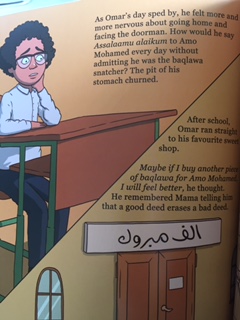
Set in Egypt, Omar eats the doorman’s baqlawa, and while he knows he shouldn’t have, he doesn’t know what to do about it.  The doorman, Amo Mohamed, blames the cat and Omar tries to move past the theft.  But the guilt builds up and he even dreams about baqlawa, eventually telling his mom so he can start to fix things.  

snatched1

After isha prayer, the two of them make some new baqlawa.  I love that the mom doesn’t get mad, but she is firm that while, “we made the baqlawa together,”  she tells him, “you have to talk to Amo Mohamed on your own.”  

Omar confesses his crime to the door man and apologizes, Amo Mohamed in turn apologizes to the cat, and all enjoy a piece of baqlawa together with smiles.

snatched4

The last page in the 38 page book is a glossary and is headed by a hadith by Prophet Muhammad, “Be conscious of God wherever you are.  Follow the bad deed with a good one to erase it, and engage others with beautiful character.”

The illustrations aren’t amazing, but they are sufficient and help walk the reader through the story.  I like that the mom covers when out and about, but not in the home.  The story is great for ages 4 and up, but the amount of text on the page and book length might make independent reading more geared to second and third graders. 

snatched2

The book would work for muslim and non-muslim children a like and does a good job of showing a universal situation in a culturally rich environment.


Muhiima’s Quest by Rahma Rodaah illustrated by Daria Horb

Standard
Muhiima’s Quest by Rahma Rodaah illustrated by Daria Horb

IMG_0976

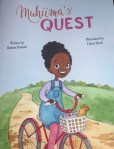
This picture book for ages 7 and up, reads incredibly smooth for the amount of text on each page, and the pictures are warm and expressive in this large (8.5 x 11) 32 page book.  Clearly the author is talented in writing and passionate about empowering her character to hold on to her culture and faith, however it seems overly forced at times.  

muhima

The premise is that it is Muhiima’s birthday, but that she doesn’t celebrate birthdays, her family only celebrates both Eids.  So when her mom hands her a surprise on the morning of her birthday and Muhiima asks if it is a birthday gift and her mom says, “kinda” it seems a bit like she is walking back from the premise. The tie-ins throughout the book as she journeys from location to location on her quest as a result seem forced.

muhima1

The map first leads her to her father’s book store to get wisdom and love and a gift that she can’t open until the end.  She also journeys to her Grandparent’s house, her Uncle’s basketball game, her Aunt’s beauty salon, and oddly her Masjid Quran Class, which apparently she is skipping, but stops to get the wisdom and gift from her teacher at, none-the-less.  Oddly enough, but at least noted, she reaches home to find everyone on her quest already there.

muhima3

On her way home, she sees her non-muslim friend Rosie celebrating her birthday and wishes she could have a birthday gathering with gifts and family too.  When she opens the door to her own home, she gets just that.  The passages detailing why it is hard to be different are incredibly relatable and poignant, but to then have Muhiima get the same thing with a different name, again seems like the author is walking back on her premise.

muhima2

The wisdom and advice the family gives to Muhiima is wonderful and powerful. I love that the character is a strong girl of color, and that her family is supportive and consistent.  They say Salaam, they pray, they go to the mosque.  Some of the little details were jarring, like why it didn’t specify what prayer, why it was her class that she visited at the mosque, how all the people got to her house before her, etc.  This minor glitches with the forced premise of relating the quest to her birthday, make the book overall a bit awkward.  This is so unfortunate because the advice and the quest are so endearing, while not being judgementat or preachy.  I don’t know how to fix it, I just hope, like really really really hope, that the author keeps writing and that her next book is a little more revised and editted.


Mikaeel and Malaika: The Quest for Love

Standard
Mikaeel and Malaika: The Quest for Love

mikaeel.jpg

The beautiful hardback book is pricey, but fun.  I didn’t have any expectations when I read it, but now that I’ve read it three times and had my children read it, and my mom a reading specialist/teacher of 45 years read it, I feel pretty confident in saying, its a well-done book.  I think it can get a bit cumbersome when reading aloud, because some lines rhyme and some don’t, but on the third read through I read it to six kids ages two to nine and all throughly enjoyed it.

maandm

The sibling superhero duo are on a quest to find out how to have a pure heart.  They try praying aloud, praying quietly, then they go and talk to the Big Boss, their dad, who speaks in rhyming clues.  The play on words might make the book utterly confusing to children younger than five, or kids of all ages if full attention isn’t being given when read aloud.  For independent readers, they will delight in the words that sound the same yet have completely independent meanings.

mandm2

Eventually their quest also takes them to Agent M.O.M who loves them more than anyone else they can imagine, but the big reveal is that Allah (swt) loves us even more.  I don’t know that it is crystal clear that getting a pure heart involves loving the one who loves us most. But, I think by the end, the readers are just entertained that they figured out Allah loves them more than anyone else in the world and is the creator of us all.  The last page has an ayat from Surah Rehman, ” So which of the favors of your Lord would you deny?” Which again adds one more thing to the story about being grateful for all that Allah has given us, keeping it from being a completely streamlined story, but adding to the overall love and appreciation for Allah.

mandm1

The illustrations are absolutely beautiful and engaging, the amount of text and the font is perfect for ages 6-8 and the messages is fun and educational.  I hope that there are more in the series, alhumdulillah.


My Own Special Way by Mithaa Alkhayyat retold by Vivian French translation by Fatimah Sharafeddini illustrated by Maya Fidawi

Standard

FullSizeRender (83).jpg

A mainstream Early Reader book with a cute little muhajaba on the cover and a premise that she’ll be a big girl when she wears hijab seemed like a book I should adore.  And while it isn’t bad, and I’m glad it was in the library,  really I’m not sure how I feel about it.

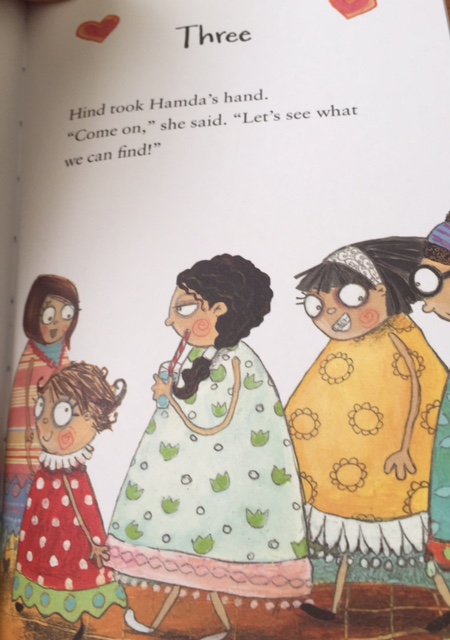
In someways, I’m just confused.  Why would you pick one of the characters to be named Hind, in a book urging readers away from picture books and into chapter books, it isn’t going to be pronounced with a short i sound, it is going to be pronounced like a “be-hind,” umm not so good for the age demographic you are trying to show another culture to, there will just be giggles and jokes.  Also, many of the illustrations are cute, but what is wrong with the dad and with Jamila’s sleepy eyes, they kind of border on creepy. And not the creepy, in a cool way, more like creepy in an awkward way.  And finally, with an author, a retold by, and a translator, and presumably a ton of editors and proofers at Orion Children’s Books, I found veil to be a very formal word to use throughout.  It does say it is a scarf at one point, but the word of choice throughout is veil, and I think to be culturally accurate, hijab would have been a better choice.  Even for English readers, scarf would have been a better fit.

The book is 62 pages, there is no glossary and it is not AR, but is a transition early reader book for kindergartener and first graders.

SYNOPSIS:

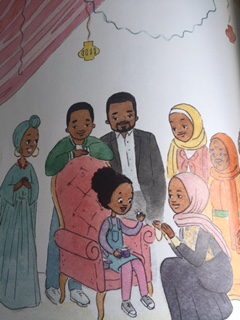
Little Hamda wants to spend time with her four big sisters, but they all say she is little and have other plans.  When her mom reminds her that they were small at one time too, she realizes that when they were small they didn’t wear hijab, or in this book, a veil, and now they are big and where one when they go out.  So, in her mind, once she starts wearing one, she too will be big, and thus the challenge of finding a way to wear it comfortably begins.  She is helped and supported by all her family and finally she finds her own special way to wear her veil.

I like that it is a mainstream book trying to include some diversity.  The family is relatable and the themes universal even if portrayed in a minority muslim framework.

FullSizeRender (80)

WHAT I LIKE ABOUT IT:

I love the premise of the book and that it is very clearly Hamda’s idea to wear a veil, no one is forcing her.  The text and illustrations align to show the girls cover when they go out, not in the home.  The dad needs help at one point finding his shoes to go to the mosque.  However, it doesn’t tell what a mosque is, or explain that the family is Muslim and wearing hijab is an Islamic act, which might be a comprehension block for young readers.

I really go back and forth on the illustrations.  On the first reading I thought they were creepy, when I went back to write the review they were kind of cute.  When I asked my kids, two said they were fine, and one said they were ugly and was positive I am the only one to have ever checked out the book.  Yeah.

FLAGS:

Fine, and Islamically nothing erroneous.

TOOLS FOR LEADING THE DISCUSSION:

Obviously not a book club level book, but I would be very interested to have some first and maybe even second graders read it and give me feedback, like I said I’m on the fence with this one.  Check to see if your library has it, read it, have your kids read it, and let me know.

FullSizeRender (82)

The Swirling Hijaab by Na’ima bint Robert illustrated by Nilesh Mistry

Standard

81fjfxOGmNL

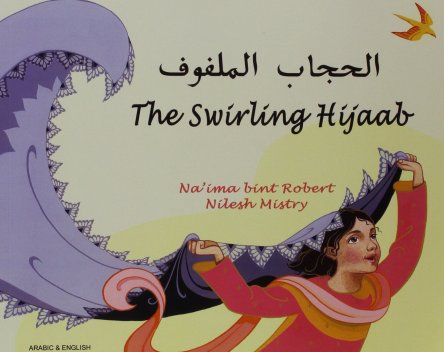
Written in 2002 I’m not sure why this book isn’t in libraries or easy to find, it is wonderful.  We all got so excited when Mommy’s Khimar came out, and for good reason, it is great, but I feel like this book is very similar and somehow not appreciated.  The book is written in verse, with just one line on each page, there are 20 languages that this book appears dual language in, and the author is incredibly well known (Ramadan Moon, From Somalia With Love, Boy Vs. Girl, Going to Mecca, She Wore Red Trainers).

The large pictures show a small girl using her mom’s hijaab to play pretend with as a fort, a boat’s sails, a cloth for her tea party, a comfort when mom isn’t there, and most of all as a covering as a part of one’s faith.  The book shows the little girl as a desi bride, an African warrior queen, a beduin, and a relatable little girl having fun.

The book works well for little ones, with its simple text and large pictures, and is perfect for story time and bedtime alike.  The pictures aren’t bold and vibrant, but are colorful in their muted state and engaging as the swirling hijaab transforms into so much more than a piece of cloth.

It doesn’t mention Islam or Muslims, but just that the hijaab is worn as a sign of faith.  It depicts the girl praying, but doesn’t offer and text regarding it.


Zaydo Potato: A Muslim Superhero by Randa Taftaf and Maz Galini illustrated by Lovyaa Garg

Standard
Zaydo Potato: A Muslim Superhero by Randa Taftaf and Maz Galini illustrated by Lovyaa Garg

img_0531.jpg

This is the second review of a Zaydo Potato book on the blog, and much like the first book this one caters to toddler and early elementary aged children who will enjoy the large colorful pages, the silliness of finding a potato on each page, and who can benefit from the repetition of events to understand a concept.  In this 32 page book the concept being conveyed is taking care of each other, as established by the hadith at the beginning of the book.

zayd

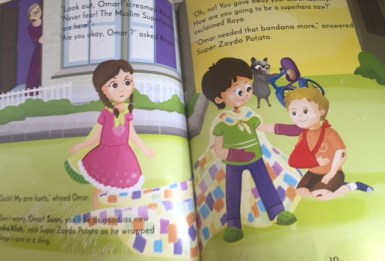
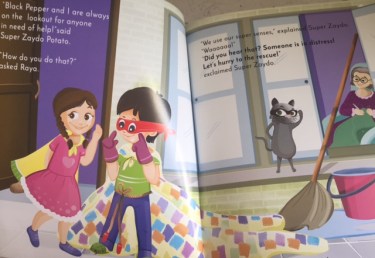
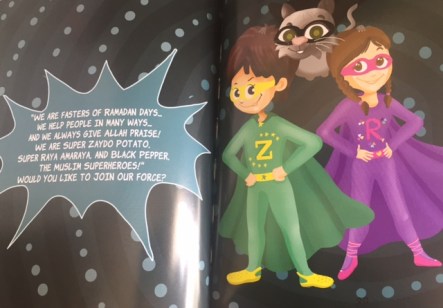
Zaydo and Raya dress up as superheroes, but find their power in saving the day involves using their capes, and masks, and belts, and gloves, to help those around them who can benefit more. They use a bandana to sling a hurt arm, a towel cape to cover a spill, and silly gloves to make a baby stop crying.   They call themselves Muslim Superheroes and after showing the reader that it is good to help one another, praise Allah, and do what is right, they ask if you want to join their force.

zayd2

I read the book to my own children and then to a group of about 25 kids under the age of 6 and it went over pretty well.  The amount of text on a page is sufficient to convey the repetitive scenarios.  Honestly, I don’t really understand why the book takes place in Ramadan.  Other than the first page saying that they are the fasters of Ramadan days, and the last page repeating it, there is nothing Ramadan specific about the story.  In fact the Grandma is drinking tea on the first page, so yes maybe she is excused, but it is a bit confusing to have the Ramadan element in there when it is not a facet of the story at all. 

zayd1

The word ‘super’ is used a lot, and if reading it aloud can get your tongue a bit tied.  I also don’t understand why Raya has a last name or second part to her name, Raya Amaraya, maybe to go with the rhyming of Zaydo Potato? Either way by adding super, before their names, and the rhyming second name, I felt like a lot of the book was just saying names. The only other critique of an other wise solid book about teaching kids how to truly be super in a practical way, is that the Grandma is in a lot of the pictures in the background sewing so that when she surprises them with real costumes, the kids can enjoy going back and see she was working on them the whole time.  Except I thought, my kids thought, and the story time kids all thought she was knitting, and the costumes don’t look knitted, so it is a bit jarring.  On closer inspection there is just one needle, not two, but it is really large, almost crochet hook size, so a sewing machine illustration would have been a much better choice.

zayd3

The activities and lessons at the end and the founding premise of the book really make the book an important one to share with your little ones.  The binding and glossy pictures of smiling children having fun will entertain and educate them at the same time.  My critiques are small, but I feel like a few test readings by the authors, and the minor quirks could have been eliminated all together.  

zayd4


Hassan and Aneesa Celebrate Eid by Yasmeen Rahim illustrated by Omar Burgess

Standard
Hassan and Aneesa Celebrate Eid by Yasmeen Rahim illustrated by Omar Burgess

hassan.jpeg

So, cute, mashaAllah, I remember last year when I read about these two siblings celebrating Ramadan how pleasantly surprised I was by their relatable sweet story, and once again, I am thrilled that such a little book packs so much information in a fictionalized story to smile at.  Really its size is my only criticism, the book is tiny in size at 7 inches by 8.  The length of 24 pages is fine, its just hard to read it to a group, and really is only ideal for bedtime (not that I won’t read it to a group of kids, its just hard).  Even the price is fabulous, alhumdulillah, and also available in the public library.  Overall, the book is pretty sweet.

handa

Hassan and Aneesa are getting ready for Eid after a month of fasting.  Their parents are having a party so there is a lot to do to get ready, cleaning, cooking, sampling food, and wrapping gifts. The morning of eid is chaos with everyone running around (so relatable)!  They finally are out the door and heading to the park to pray outside, following Prophet Muhammad’s example.  They listen to the imam give a speech about sharing food and then its off to hug everyone and wish one another an Eid Mubarak.

handa1

When everyone heads to the siblings home, you see kids having fun, dad cooking, and presents being exchanged.  After everyone leaves, they take food to the neighbors, as the imam reminded and the fictional family concludes a wonderful eid that they don’t want to end.

anda2

There is a glossary at the back and the pictures are colorful, bright, and expressive.  While there isn’t a plot or any character development, the situations the kids find themselves are relatable.  The joking that Aneesa will help her mom by sampling the food, and the picture at the end of the kids playing in a messy room with the parents passed out from exhaustion on the couch is pretty fun. 

handa4

There are a few books out there that timeline an eid day, but this one does it well. Kids two and up will enjoy the excitement and feel ready to celebrate eid themselves.  It shows the holiday as fun and desirable and something to look forward to.  Because the kids are in a handful of books, it also does create some identity confidence, as kids see themselves in the various situations that Aneesa and Hassan explore.