Tag Archives: Muslim Author

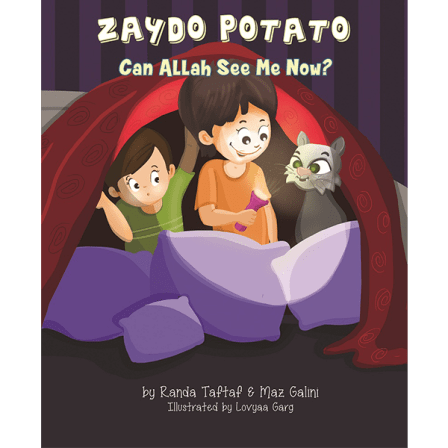
Zaydo Potato: Can Allah See Me Now? by Randa Taftaf and Maz Galini illustrated by Lovyaa Garg

Standard
Zaydo Potato: Can Allah See Me Now? by Randa Taftaf and Maz Galini illustrated by Lovyaa Garg

zaydo

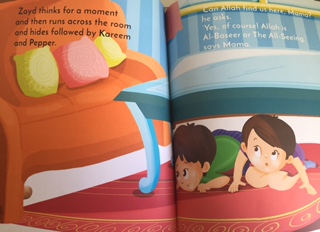
The book starts off simple enough with a little boy, Zayd playing hide-and-seek with his friend (or maybe cousin), Kareem, and his cat Pepper, when the challenge of hiding where they can’t be found, spawns a lesson in how Allah (swt) is always watching and watching over us.  As the kids hide in different places, the mom uses the names of Allah (swt) to emphasize the point.  The story presents the names of Al-Baseer, the All-seeing, Al Aleem, the All-knowing, Al-Khabeer, the All-aware, Al-Raqeeb, the Watchful, and Al-Shaheed, the Witness.

FullSizeRender (53)

The book is 32 pages, with the story taking up 24 of those pages. An ayat from the Quran, surah Hadid verse 4, starts the story and there is a glossary of the names of Allah at the end.  There is also some suggested activities for the book.  Hidden on each page is Pepper the cat and a potato.  There are other activities of finding shapes, counting blocks, finding different animals, etcetera,  that encourage children to go back to the book to engage in the pictures, and inshaAllah the message presented.

FullSizeRender (52)

There are two books thus far in the series and one E-book, the order doesn’t matter, as each is a standalone book.  The husband and wife authoring team also have a publishing company, Rummana Publishing Inc, and based on their website seem to have plans for more in the future.  This book came out about six months ago, and with its Glossy cover and large colorful pages, children will enjoy the story and activites.  The pictures are warm and engaging, and overall they are very well done.  The sentences are short, and the amont of words on the page is appropriate for the target audience.  There seems to be some arrant spacing on new text lines, but I doubt anyone would notice, and a few sentences are awkward either in their wording or lacking commas, but again, it is minor.

FullSizeRender (54)

A good story premise, easily conveyed to younger Muslims, makes the book an asset for Muslim children establishing a foundation and building a relationship with Allah swt.


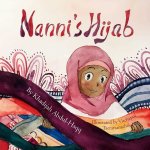
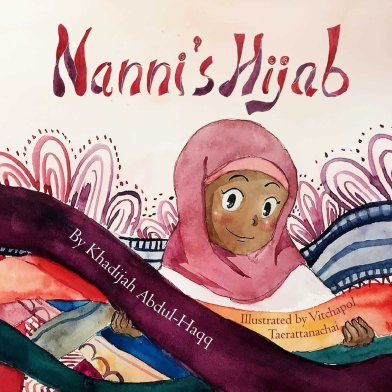
Nanni’s Hijab by Khadijah Abdul-Haqq illustrated by Vitchapol Taerattanachai

Standard
Nanni’s Hijab by Khadijah Abdul-Haqq illustrated by Vitchapol Taerattanachai

Nanni's Hijab

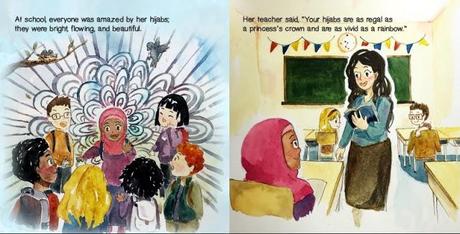
MashaAllah, there are so many things to like about this 36 page, brightly illustrated, elementary aged story.  Nanni, the main character, is spunky.  Not only is she strong enough to wear hijab to school, but she also is brave enough to confidently handle a bully on her own.  Surrounded by a supportive teacher, friends, classmates, and her mom, Nanni’s creativity and understanding that Allah swt will help her find a way to handle her predicament results in a happy ending, and many empowering messages.

nannis-hijab-childrens-book-review-L-Yo6YBS

The book would work for most children, but I think second grade and up would get the most out of it.  The girl might be young to be wearing hijab, but it seems like she wears it because she wants too.  I like that the illustrations have her and her mom uncovered at home, and that there is a glossary at the back, opening up the book to muslim and non muslim kids alike.

DVBz_rcVwAILbLM

I also really like the larger messages of acceptance, trying new things, and doing better when you know better.  The supporting cast in the book resonates with muslims who go to schools where they are the minority, but have support and encouragement to practice their faith none-the-less.  Nanni’s teacher remarks that her “hijabs are as regal as a princess’s crown,” and the other students like seeing what color or design she is wearing each day.  Although a children’s book, the author does very clearly explain that the hijab is part of Nanni’s faith, although not mentioned by name, and that it is an act of worship. Nanni wants to handle the problem on her own, and for as bad as she wants to punch Leslie, she knows it isn’t the right thing to do.  As she wrestles with what is the best approach, she puts her trust in Allah, swt, which perhaps is the greatest lesson for us all in the book, alhumdulillah.

Ayesha Dean: The Istanbul Intrigue by Melati Lum

Standard
Ayesha Dean: The Istanbul Intrigue by Melati Lum

ayesha dean.png

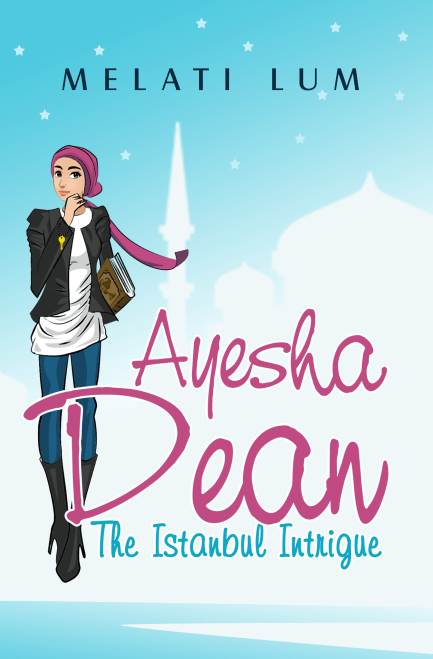
I’ve tried numerous times to get my preteen daughter to read a Nancy Drew book with little success, yet she devoured this mystery and is eagerly waiting for more.  The protagonist is relevant, resourceful, fun, and a practicing Muslimah too.  At 240 pages, the spacing and large font make the book easily accessible, and tempting to dive in to.  The pacing is pretty good, and while there are a few hiccups with storytelling style, the book overall is worth adding to yours and your child’s reading list.

SYNOPSIS:

Ayesha’s parents are deceased, but her Uncle Dave has raised her as a Muslim following her parent’s wishes.  Having graduated high school she is off on a celebratory trip with her two closes friends: Jess and Sara, her uncle and her friend’s dad to Istanbul, Turkey.  The adults have a business conference and the girls are hoping to explore and enjoy all the sights of the Turkish Bazar, the Hagia Sophia, the Blue Mosque and more.  While looking for a book to gift Uncle Dave, Ayesha and her friends discover a secret message sewn into an old book of maps and set off to collect clues and solve a 100-year-old ibn-Arabi mystery.  Obviously, I don’t want to give too much away but there are villains, and shady characters, and dear friends, and lots of yummy food.

WHY I LIKE IT:

I love that the heroine is a hijab wearing, salat praying, Tae Kwon Do trained, fashionable, kind, young lady.  She has integrity and resourcefulness, that make the reader want to cheer her on.  Her friends are significantly less developed, I really couldn’t tell you much about them, and honestly had to look back to recall their names.  I understand why they are in the story for Ayesha to play off of, but I’m hoping that they will have a bit more substance in future novels.  Other side characters had more depth than Sara and Jess did, and even getting them out of the way for the climax seemed to further diminish their roles and importance.

I loved learning about Turkey through the characters, the history, architecture, the food.  The author really shined when talking about Islamic history as well.  When Ayesha and Emre explore the Sultan’s Privy Chambers at the Topkapi Palace, and look at Prophet Muhamad’s (saw) sword and bow, the excitement and reflection is palpable.  In other places however, I felt like the narrator’s voice was completely jarring and distracting to the engaging story at hand.  In the midst of pursuing a lead, the story comes to an almost standstill to say, “the friends chatted amiably as they walked, admiring the city as they went (69).”  The majority of the descriptions are so vivid that the few places where they cease are noticeable and awkward.

I also loved the diversity of the friends, even Ayesha’s own personal makeup adds some depth and appreciation that she has chosen to practice Islam.  Ayesha prays and tries to make sure she is not alone with a boy, she is conscious of her hijab and notes the Islamic elements in her own life and in her environment.  Obviously the book takes place in Turkey and she is unraveling an Islamic mystery of sorts, but I think the book works well for Muslim and non Muslim middle schoolers alike.  The book is not preachy, and the translations of prayers and poetry are framed in a historical or inspiring, not doctrine manner.  Similarily, I think you might be able to get boys to read it too.  It inspires girls who perhaps can identify with the main character, but I think even boys will be impressed with what Ayesha can accomplish.

FLAGS:

The book is fairly clean, there is some intense moments with kidnapping and having guns drawn, but nothing too haunting.  Ayesha obviously makes a good “friend” but nothing happens or is even detailed as wanting to happen between her and Emre.  Just Emre’s dad regularly teasing them as he looks for a wife for his son.  The only real flag for me was the exploring of the harem at the palace and the mention of concubines, and eunuchs.  A lot of detail is not given just that the women must have felt trapped, but it is a heads up if your child asks you about it, to be ready to answer.

TOOLS FOR LEADING THE DISCUSSION:

I think this would be a fun book club book to explore deeper some of the sites and history of Turkey.  I would have to explain the harem before hand I think, but I think it can be done factually to avoid to much over thinking for the young readers.  I think to track the clues and “map” out the trail in a group completely with pictures of the real places would really bring the story to reality.

Interview with the author: http://mvslim.com/meet-melati-lum-criminal-lawyer-who-also-has-a-passion-for-writing/

Why we need more heroines like Ayesha Dean: http://www.muslimkidsguide.com/why-do-we-need-more-muslim-heroines-like-ayesha-dean/


It Must Have Been You! by Zanib Mian illustrated by Fatima Mian

Standard
It Must Have Been You! by Zanib Mian illustrated by Fatima Mian

it must have been you.jpg

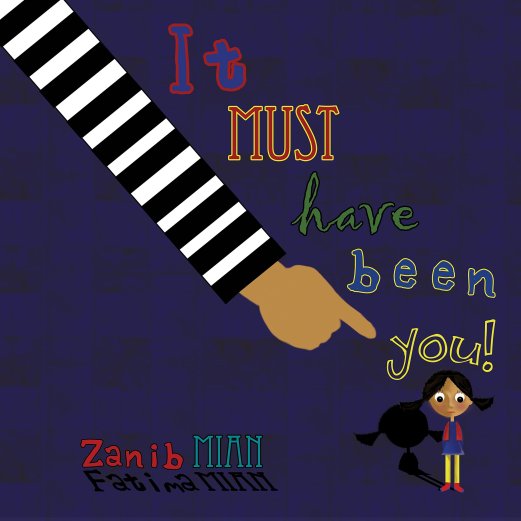
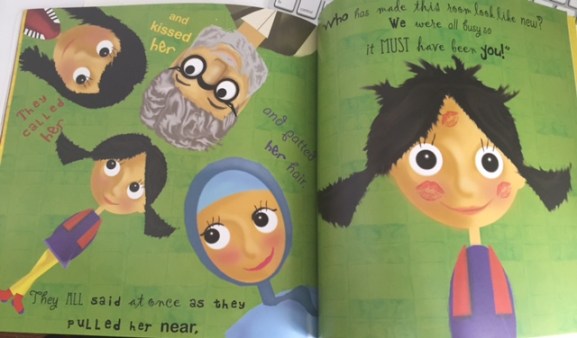
This rhyming 32 page book follows around a small girl, “about the same age as you,” who seems to make a mess every where she goes.  She never lies or even responds to the accusations of her unintentional messes, as she gets caught each time by someone in her family who points their finger and identifies the clues that led them to their answer. Luckily, she uses this pattern to her advantage as she cleans up and makes her family a card resulting in hugs, kisses, and love.

FullSizeRender (34)

Written for younger kids (4-6), the book is bright and colorful and very well done.  Even two and three year olds will enjoy the sing-song rhythm and chunky engaging illustrations.  The pages are thick and the binding solid, especially for a soft back book.  The 10 x 10 square size works well for story time and bedtime alike.  However, because the text is incorporated into the illustrations, if you are reading to a group, you will want to read it a few times before you present.  Looking at it straight on, the word order is much more clear and if you are reading it with emerging readers, I would recommend pointing to the words as you read, so as to help guide your listeners.  The fonts get a little crazy, which is part of the fun, but again may require some assistance to help the younger readers decipher the words.  Older independent readers (up to age 7 perhaps) might like the slight challenge of figuring out what word comes next, so that the story makes sense.

FullSizeRender (33)

The mom wears hijab and that is the only islamic reference or overt implication.  A fun book that thus far with multiple readings has yet to get monotonous and boring, yay!

FullSizeRender (32)

Salam Alaikum: A Message of Peace by Harris J illustrated by Ward Jenkins

Standard
Salam Alaikum: A Message of Peace by Harris J illustrated by Ward Jenkins

salam alaikum.jpg

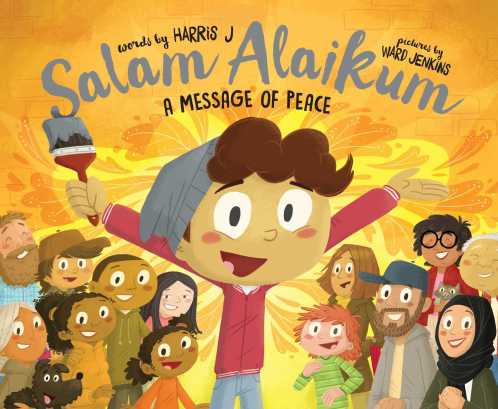
Harris J’s song by the same name gets stuck in my head because it seems like “Salam Alaikum,” is the only words in the song, so when I heard that he had written a book based on the lyrics, I was a little skeptical. But, total credit to the illustrator, the book is adorable, and the lyrics aren’t too bad either.

salam1

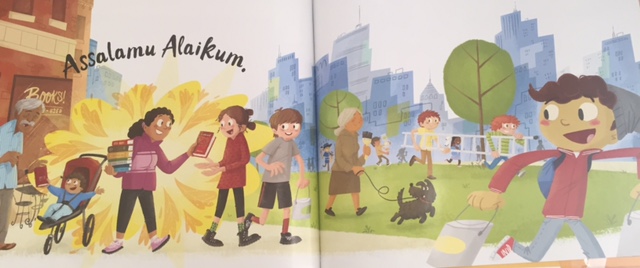
Thirty big pages, that radiate with light and happy faces and a big clear font that celebrates peace, love, and coming together.  The words “Salam Alaikum”  is a Muslim greeting, but there is nothing overtly religious. There is one muhajaba that appears on a few pages, but with the content matter, there is a lot of diversity in the book.  A variety of skin tones, ages, clothing, genders, sizes, all come together to hold hands and work for peace.

salam2

The content isn’t ground breaking, but the number of words on the page are good for 3-6 year olds.  And it does introduce that the world is more fun when we all work together and are kind.  Kids will like the illustrations and return for them undoubtedly.  It is hard to know if the books these days are truly better, or are just done better.  But, while I checked this one out from the library, I think I just might want a copy of my own.

salam3


Yo Soy Muslim: A Father’s Letter to His Daughter by Mark Gonzales illustrated by Mehrdokht Amini

Standard
Yo Soy Muslim: A Father’s Letter to His Daughter by Mark Gonzales illustrated by Mehrdokht Amini

yo soy muslim

I feel like I preordered this book years ago, I have been so anxious to see what all the hype was about. When it arrived I tore open the box and read it on the short walk from the mailbox to the house, read it again standing in the kitchen, left it for a few days, and reread it now to write the review. SubhanAllah, it didn’t disappoint.

yousoy4

It reads, as intended, as a powerful letter to a child.  There aren’t long winded morals or overly fancy words. It is direct in its many ways of telling you, that you matter, where you come from matters, that your foundation matters. That you are strong, and beautiful, always, even when the world may not think so. That you are Muslim, that you are from Allah, that you speak in Arabic and Spanish and dreams.  The verses become poetry that dance on the page with the illustrations telling the story as powerfully as the words.  The words in turn float and lilt around images as old as time and as innocent as dancing in the wind.

soy

The 32 pages fly by that you can’t help but read it again, slowly, savoring all the harnessed power and hope of a multi culture world, a multi cultural faith, that is truly beautiful.  Recognizing the humanity that we all share, yet feeling pride in your own unique skin is a balancing act that doesn’t need to be apologized for, and should be celebrated.

yo soy2

I love that this book exists.  That it is available on Amazon.  That it is bold and colorful and hardbound, and so well done.  There is diversity in Islam.  There is diversity of belief in Indigenous populations, that there is so much inspiration in the world around us and in our past.  Are all messages that come through even for the youngest readers.

yosoy3

yo soy1


Zaahir & Jamel The Camel: At the Mosque by Amatullah AlMarwani illustrated by Sudha Choudhary

Standard
Zaahir & Jamel The Camel: At the Mosque by Amatullah AlMarwani illustrated by Sudha Choudhary

zahir and jamel

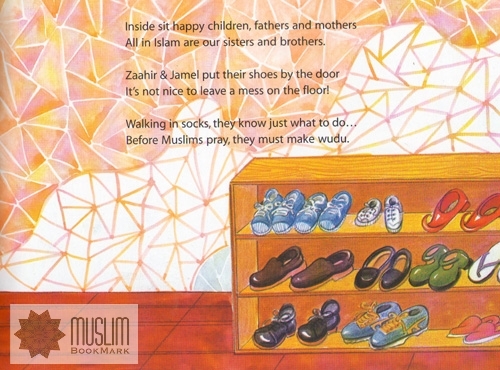
Another book in the Zaahir and Jamel the Camel series, this book explains to children how to behave at the mosque.  The pictures are colorful and busy, engaging children 2 and a half and up.  Younger children can enjoy the bolder aspects, and older children will enjoy the details.  Some of the text seems to hide behind the geometric shapes, but I would imagine the story is usually read aloud and not independently, so it isn’t too much of a problem.

zaahir 1

Just like when Zaahir and Jamel went for Hajj, the short rhyming sentences go step by step on what to expect as the story follows Zaahir and Jamel through the process: they take off their shoes, they make wudu, they stand for salat, they make du’aa, they stay quiet and respectful.

zaahir2

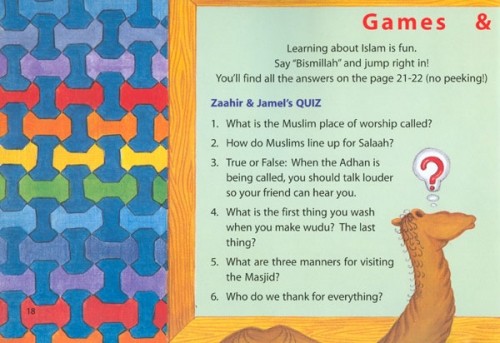
The book is 23 pages, but the story is really only 17 pages.  The story is followed by Games and Activities including a quiz and a crossword puzzle, and then a Glossary.  The quiz is great when reading aloud to a group or even just at bed time to make sure the children understood the key points.

zaahir3

The book is small and rectangular, which makes it work better in smaller groups (6.6 x 9.5), but for a book that cost less than a dollar online, it really should be in every child’s library.  Its a great review for little ones before Jumaah or just as a gentle reminder that praying in the mosque is something that all Muslims have in common.  It also works well for parents of non muslim kids that might be coming to the mosque and want to know what to expect, and how to act.

zaahir4


Alana’s Bananas by Mariam Hussein illustrated by Saima Riaz

Standard
Alana’s Bananas by Mariam Hussein illustrated by Saima Riaz

alanabanana

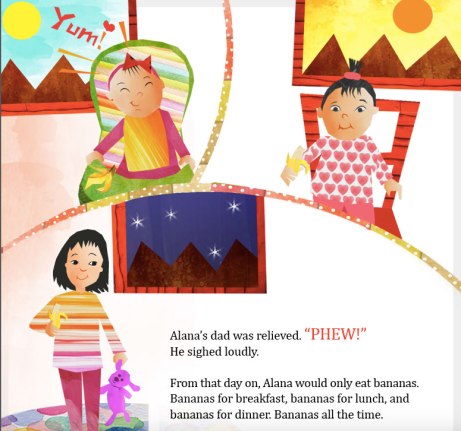
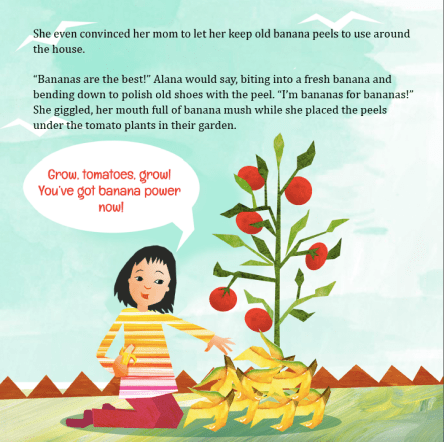
A silly, silly book about a girl’s love of bananas and her despair when a storm wipes out the banana crops in Costa Rica.  The moral of the story is to try new foods, and in 36 pages I think the reader will grasp just how over the top Alana’s obsession with bananas truly is and the lesson will be learned.

alana3

My only stumbling block is I’m not sure what age the book is for.  The bright silly pictures work well for ages 3 and up.  The theme works well for ages 4 and up.  The amount of text on the page, however, is more 6 or 7 and up, and the concepts of where banana’s come from, multiple uses for banana peels is about the same.  The character in the book, Alana, is eight and goes to the library and reads cook books and cooks independently, but the way her parents trick her into eating other foods is to hide eggs, peanut butter, rice, avocados and anything else they could find in banana peels, which keeps with the silliness of it all, but seems a bit off for 8 years old. Also talk about very patient parents allowing their 8 year old to only eat bananas for so long, and then not being upset when they have to resort to extreme levels of trickery.

alana1

There is nothing islamic in the text, and the only islamic elements are the author, illustrator, and the family based on the illustrations.  The mom wears hijab, but it is neither mentioned or referenced and no islamic vocabulary or phrases are in the story. In a scene at school, the girl sitting next to Alana is wearing hijab.

alana2

The book is about 10×10 and sturdy in its construction.  The back cover has a recipe for Alana’s Banana Breakfast Muffins. Enjoy!

Blackout! by Sumayyah Hussein illustrated by Majd Massijeh

Standard
Blackout! by Sumayyah Hussein illustrated by Majd Massijeh

blackout.png

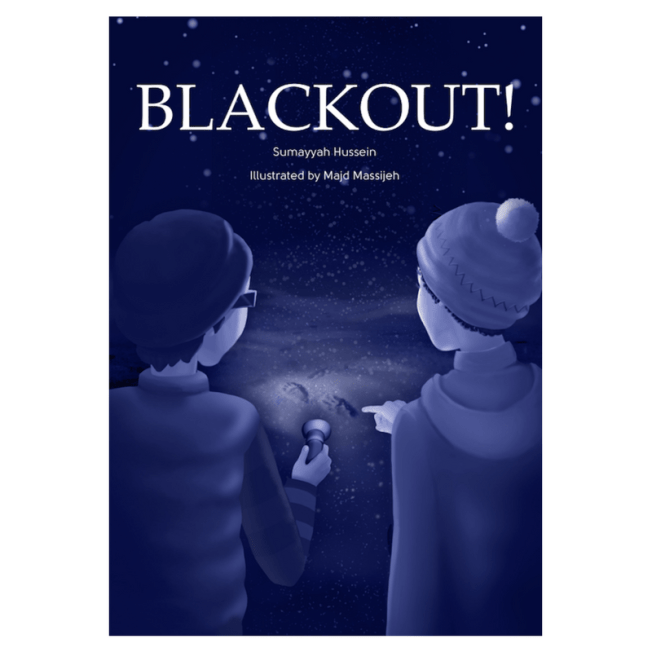
Presenting the stories of refugees to young children often involves a balancing act of fact, emotion, and restraint, all while finding the common ground to create empathy in the reader.  Increasingly on bookshelves are successful picture books that use illustrations to build bridges of understanding and bright colors to convey hope.  For older children there are books that can devote time to explain issues or offer first hand accounts along with political back stories and historical events.  For elementary age children 2nd and 3rd grade particularly, chapter books on refugees are not very common.  Children this age seem to relish in silly outlandish characters with a few font happy sentence and pictures on each page or stick to series that are easily predictable as they present tidbits of history or simple mysteries.  All reasons to encourage your child to read Blackout! and break the monotony and gain some empathy.  As delicate as the subject matter is, the book manages to resonate with most children how good they have it and how fortunate they are, without getting preachy or pretentious.

SYNOPSIS:

Yusuf, a 12-year-old Canadian boy is anxiously waiting the arrival of his cousin Ahmed from Syria.  Ahmed recently lost his father when their makeshift boat capsized, and while coming to Canada is a blessing, he is still haunted in his dreams and memories by all that he has seen and endured.  This idea that being safe now, doesn’t erase all the pain and fears experienced, is a concept most adults understand, but I was surprised that my children had to talk it out a bit.  They understood that he would be sad, but hadn’t really thought how hearing loud noises would immediately remind him of the explosions he heard in Syria and of his home and buildings crumbling down.
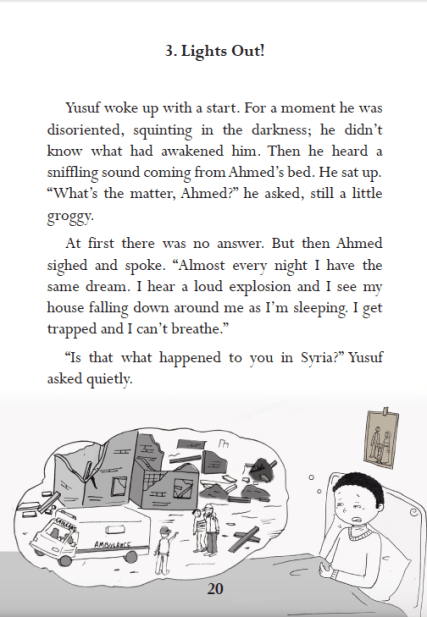
blackout inside

The story’s focus is the present however, and follows Yusuf.   The backstory of Syria and Ahmed’s escape is juxtaposed with an ice storm turning Toronto powerless and cold.  As Yusuf deals with the annoyance of a few days without electricity he learns a bit of compassion for others in the world, who endure a similar situation indefinitely.  In a beautiful way, Ahmed’s enduring optimism changes Yusuf as they find reasons to smile at the raccoon rummaging through their food put outside to stay cold, or playing in the snow to pass the time.  The characters have a lot of heart, for a short book, and you really feel like you get to know them and feel for them.  Yes, Yusuf whines, but he is a kid who’s winter vacation plans have gone awry and is frustrated and bored.  Ahmed, while a survivor, still struggles, but maintains a personality much more than just victim.  The other family members are background, but they aren’t flat, they have warmth and humor and pain in equal parts, implying if the book was longer, we’d get to know more about them too, and probably like them as well.

Despite the refugee story line, and the blackout, the crux of the story is actually helping one another and being neighborly.  Ahmed at one point is telling a story of how he began helping someone in a refugee camp and that it gave him purpose.  This reminds Yusuf that they have an elderly neighbor and the radio alerts had encouraged people to check on one another.  The boys rush over to find Mr. Caldwell, suffering from carbon monoxide poisoning brought on by his kerosene heater. Luckily an ambulance is able to get there just in the nick or time. On the third day of the blackout, the Imam speaks about helping one another and making this obstacle into something positive.   Ahmed tells Yusuf how the neighbors in Syria would gather in the winter to share what food they had.  This brilliant idea gets the support of Yusuf’s dad, the Imam and the whole congregation as they rush home to invite the neighbors to a neighborhood BBQ.  The perishable food needs to be consumed, so what better way to enjoy it, than to share it.

When the power comes back on, Yusuf is not the same kid, he has grown in compassion, and patience, and inshaAllah the reader will be similarly affected for the better.

WHY I LIKE IT:

I love that the book addresses a hard topic on a kid level.  It does not overwhelm the reader or frighten them.  MashaAllah, it balances what they can understand, with something bigger.  The illustrations keep it light in their doodle like appearance and the font, spacing, chapter length and presentation are perfect for the target audience.

blacout2

The women wear hijab, they pray, they go to the mosque, yet they don’t quote hadith or Quran or say a lot of mashaAllah and Alhumdulillah, making the book work easier for non Muslims.  The coming together of community is nice.  No one asks or worries what religion, race, or ethnicity anyone in the neighborhood is, they just come together to share a meal and welcome Ahmed and his mom to Canada.  The Imam is relatable and the dad is involved and generous, the mom is competent and respected, all normal behaviors that reinforce community and normalize diversity and acceptance.

FLAGS:

The violence of war may affect young children differently.  Nothing is sensationalized or graphic, but Ahmed does get stuck in the rubble when his house is destroyed, and his father’s drowning is discussed.  Nothing is talked about in depth, but the ideas are presented.

TOOLS FOR LEADING THE DISCUSSION:

This book would be perfect for a young book club.  I’m looking forward to reading it with my six-year-old son and my eight-year-old niece so that I can see how what they get from the book.  There is a brief explanation on refugees at the back of the book, and I think current events would naturally make a book club discussion easy to facilitate.  I think gathering items and meeting refugees after, would also be a wonderful way to turn the fictional story into real action.  It is also worth noting 100% of profits from this book will be going to the Syrian Canadian Foundation‘s mental health and wellness initiative for Syrian newcomers.

blackout1

Yippee! Ramadan is over, It’s Eid by Farjana Khan

Standard
Yippee! Ramadan is over, It’s Eid by Farjana Khan

yipee

A friend loaned me this book from the local public library, so I was not only excited that a book about Eid was readily available, but also hopeful that it was good quality.  Then I saw the title.  I mean I get that the “Yippee!” is a title part of a series of books on the different holidays Muslim’s celebrate, but for as excited as Muslims are for Eid, they are usually very sad that Ramadan is over.

Nevertheless, I opened it up and hoped to be swept away.  The list of Eid activities and rituals however, were very dry and anticlimactic.  The characters are not named, the pages are meant for pre-schoolers I would imagine, but the lack of excitement in the language is disappointing.

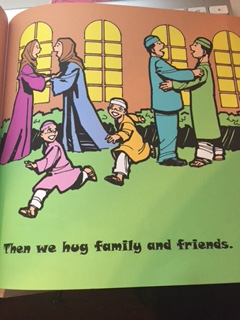
yippi hugThere are 19 pages of text, and the first few pages start off pretty well with a little boy seeing the Eid moon.  Then the family goes to the mosque and learn that Eid marks the end of fasting and the month of the Quran.  The boys father then gives money to the mosque, it doesn’t say that it is charity, but if one is familiar with Eid, one could assume. However, the book seems to be for those unfamiliar with Eid, so for me, this is where the book started to be lacking.  The next page also is where the list seems to start, and some of the items on the list are a bit of a stretch.  “We hug family and friends,”  followed a few pages later by a whole page dedicated to “My mother sets the table.”

yippi table

The book is also obviously desi as they eat parathas and firni.  At one point the kids play a game, not sure what game, it only says what sister’s favorite game is, and then a page is dedicated to the fact that “sister’s team wins.”

yippi fries

Perhaps I am too harsh, as the book is colorful and shows family and friends happily interacting.  There are women covered, not covered and with niqab, and there isn’t anything erroneous in what is written.  I just would hope for more.  The book is small in size, 8.5 x 8.5, and could have been fleshed out a lot more.  It reads like a child’s rough draft, each page or so, being a topic sentence, without the details.
I really don’t know what one would learn or get out of this book, that they wouldn’t get out of a fictionalized account or even a character driven story at Eid time.  Online prices don’t convince me the book is a stand out either.  There are much more fun, engaging, and memorable Eid books out there, not sure why the library chose to invest in this one, but alhumdulillah, I suppose it is better than nothing.