Tag Archives: hijab

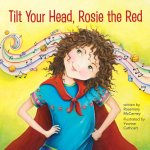
Tilt Your Head, Rosie the Red by Rosemary McCarney illustrated by Yvonne Cathcart

Standard
Tilt Your Head, Rosie the Red by Rosemary McCarney illustrated by Yvonne Cathcart

rosie.jpg

This book is nearly the mirror of Nanni’s Hijab, just told from a different perspective and swapping out the heroine.  Written in 2015 this book definitely came out first, and while the 24 page book is targeted for  4-8 year olds, if your teaching point of view, this book and Nanni’s hijab could be used for older kids to make for a great lesson.  

IMG_1753

I love that this book is written by a non Muslim and the main character is non Muslim.  The binding the pictures, the size, all make this a wonderful addition to any library in showing that differences can and should be celebrated.

IMG_1752

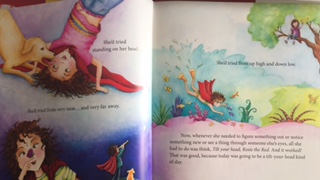
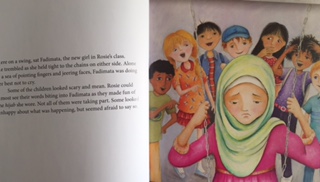
Rosie loves wearing her red cape, and she loves looking at things from all angles and perspectives.  One day at school she arrives at school to see kids making fun of the new girl, Fadimata and her hijab.  

Unable to stop the kids she reaches out to Fadimata, and transforms her cape into a hijab in solidarity.  After the teacher also talks to the class about being kind, the next day is a surprise for Rosie, when many of the girls are wearing scarves and hijabs in a variety of manners to show acceptance and celebrate differences.

IMG_1751

This is the first book in a Rosie the Red Series, and I kinda really love that in the second book, Being Me, about volunteering at a food pantry and helping a friend, Fadimata is minor character.  She is now one of Rosie’s best friends and is both mentioned by name and illustrated.  This is awesome to me, because while books about Muslims are great, having us be in books as supporting characters solving other problems, learning lessons, and going on adventures, makes us more mainstream and inshaAllah part of the accepted landscape.

rosie1

*Side note, if you look at this book on Amazon, and read the comments you can see how truly upset many people are by this book calling it “indoctrination” and criticizing it for not encouraging assimilation.  If you read the book and like it, and like the tone and message it promotes, maybe write a review, and make the world a little warmer.

Magnus Chase and the Gods of Asgard: The Sword of Summer by Rick Riordan

Standard
Magnus Chase and the Gods of Asgard: The Sword of Summer by Rick Riordan

The_Sword_of_Summer.jpg

Yes, that is a Rick Riordan book cover you see.  Yes, it is about Norse mythology.  Yes, the whole book is about fake gods and fictional demigods.  Yes, you are on the correct blog. 

Brace yourself, if you haven’t heard about Magnus Chase, son of the god Frey, whose series is now on book three, it is ok, Rick Riordan has brought a lot of mythology back to pop culture in a fairly short amount of time.  But this series stands out because get this, the Norse god Loki, (yeah the one featured in popular Marvel Avengers movies), in this series, has a daughter…named Samirah Al-Abbas…who wears hijab…and is a valkyrie…and is an Iraqi immigrant, and is a main character, and is really awesome.

The book is 497 pages and is also a pretty fun audio book.  It is an AR 4.8.

SYNOPSIS:

So, the basic plot is much like Percy Jackson, in that a young boy, in this case a homeless orphan, Magnus Chase, finds out that he is demigod and has to basically find some friends and save the world while learning about the given mythology that they belong to.  For Magnus, he learns about his father, Frey, the god of spring and summer, when he dies and is taken to Valhalla, a paradise for warriors in the service to Odin.  The whole book is about Magnus, who is now an einherjar, a member of Odin’s eternal army , trying to prevent ragnarok from happening.  Among his group of friends are Jack, the sword, Blitzen, a dwarf, Hearthstone, an alf, and Samirah (Sam).

WHY I LIKE IT:

By and large, Sam is pretty well developed as a practicing Muslima.  She is being raised by her grandparents and feels bad sneaking out to perform her valkyrie duties.  She is not at all comfortable being alone with males one-on-one, nor being seen with males as she has an arranged marriage to Amir Fadlan, her second cousin, when she gets older.  She wears a green hijab that doubles as a camouflage cloak, and she mentions going to the mosque with her grandma.  (In later books, according to my daughter, she also talks about fasting, how she is a practicing Muslimah and the daughter of Loki who handles all that Norse mythology throws at her.)  She is proud and strong, and really the only thing that makes no sense to me is why she takes off her hijab so freely when not in life threatening scenarios, I get when she uses the camouflage to hide in emergencies.  She apparently explains later that she considers the einherjar her extended family, but that wouldn’t make them her mehram, so it is still a bit sketchy.

Here is an interview question from Entertainment Weekly to Author Rick Riordan about Sam, and his answer: (http://ew.com/article/2015/10/14/rick-riordan-magnus-chase-interview/)

Speaking of Loki, one of my favorite characters in the book is Sam, or Samirah Al-Abbas. I think she’s a great example of a diverse character — not a white man, not a woman who’s there to be a love interest. She’s also seamlessly woven into the history of this myth. Can you talk about the conception of her character?

The idea for her started with the primary sources. The story that Sam tells in The Sword of Summer about an ambassador from the Caliph of Baghdad visiting the Vikings in Russia – that’s true. It really is one of our best sources because the Arabs of the time were reading and writing when nobody else was. That connection back then – that the world was a whole lot more connected even back then than we think of, that these cultures did not exist in these hermetically-sealed little bags, they were blending together all the time – that fascinated me. I thought, what would it be like to have a modern Muslim-American character who still had that connection to the Viking world like the Caliph of Baghdad did all those years ago?

And then again I started pulling on stories from students I’ve had in the past. One very powerful memory I have was being in my American history classroom on 9/11 and one of my students was a Muslim-American girl. She burst into tears when she heard the news, because she knew that her world, her life, had just changed, and had been defined for her in a way that she did not want and could only do so much to control. That really was powerful for me, and it inspired me to learn a lot about Islam and what the tradition actually was, as compared to what we hear about in the media and how it’s often distorted, and to honor her experience. Samirah kind of came out of that confluence of things.

FLAGS:

Obviously the whole story features multiple fake gods.  I don’t think it is celebrated though, they are beyond ridiculous, but if your kids can’t understand the idea of mythology or you think it is beyond the scope of fiction, that is your call. 

There is a ton of violence, as they prepare for ragnarok and just killing in general, some is gruesome. The book is not dark at all, however, it is in fact laugh out loud funny.  

There are some giants that get drunk, mention of mead, some jokes about Hel in reference to Helheim and the goddess of Helheim, Hel.  There are some “damns” scattered in as well. 

The stories of some of the gods is a bit scandalous, but for the most part the book doesn’t give much detail.  It does discuss Freya marrying dwarves for a day for their jewels and having kids with them.  There is flirting and mention of kissing.  There is also some mention of males being moms and animals and monsters being born of human parents, it is all very confusing.  But it is there. Also, my source, my 11 year old daughter, mentions that the rest of the series does have a gender fluid character named Alex.

TOOLS FOR LEADING THE DISCUSSION:

I doubt I’d do this as a book club book, but as any teacher or librarian knows, Rick Riordan fans are committed and enthusiastic.  I still keep in touch with many kids that weren’t big readers until the read Percy Jackson, and once they read the series multiple times, they then jumped to his other series.  So, while I wouldn’t use this as a book club book, there is a ton of kids that would love to discuss it with you, so read it, the bonding as a result will be well worth it.

Hats of Faith by Medeia Cohan illustrated by Sarah Walsh

Standard
Hats of Faith by Medeia Cohan illustrated by Sarah Walsh

Hats_of_Faith_Sm_1024x1024

How fun to find similarities between groups that on the surface might seem so very different.  This 7×7, 14 page board book, keeps it simple and perfect for toddlers starting to notice people all the way through to early elementary children making connections around them.

Each page shows a portrait style illustration with a warm smiling face and the repetitive text of identifying what the name of the “hat” is followed by who wears it.

The opening page states that ” Many religious people share the custom of covering their heads to show their love for God.” And concludes by saying that “Learning about each other makes it easy to be more understanding.  Being understanding helps us spread love and peace.”

hats_of_faith_deensquare_04.jpg

Muslims are mentioned and depicted on the hijab page, the topi page, and on the head wrap page.  The book shows Muslims, Sikhs, Rastafarian, Jewish, and African Christians, it shows both men and women and offers phonetical pronunciations when necessary.


My Own Special Way by Mithaa Alkhayyat retold by Vivian French translation by Fatimah Sharafeddini illustrated by Maya Fidawi

Standard

FullSizeRender (83).jpg

A mainstream Early Reader book with a cute little muhajaba on the cover and a premise that she’ll be a big girl when she wears hijab seemed like a book I should adore.  And while it isn’t bad, and I’m glad it was in the library,  really I’m not sure how I feel about it.

In someways, I’m just confused.  Why would you pick one of the characters to be named Hind, in a book urging readers away from picture books and into chapter books, it isn’t going to be pronounced with a short i sound, it is going to be pronounced like a “be-hind,” umm not so good for the age demographic you are trying to show another culture to, there will just be giggles and jokes.  Also, many of the illustrations are cute, but what is wrong with the dad and with Jamila’s sleepy eyes, they kind of border on creepy. And not the creepy, in a cool way, more like creepy in an awkward way.  And finally, with an author, a retold by, and a translator, and presumably a ton of editors and proofers at Orion Children’s Books, I found veil to be a very formal word to use throughout.  It does say it is a scarf at one point, but the word of choice throughout is veil, and I think to be culturally accurate, hijab would have been a better choice.  Even for English readers, scarf would have been a better fit.

The book is 62 pages, there is no glossary and it is not AR, but is a transition early reader book for kindergartener and first graders.

SYNOPSIS:

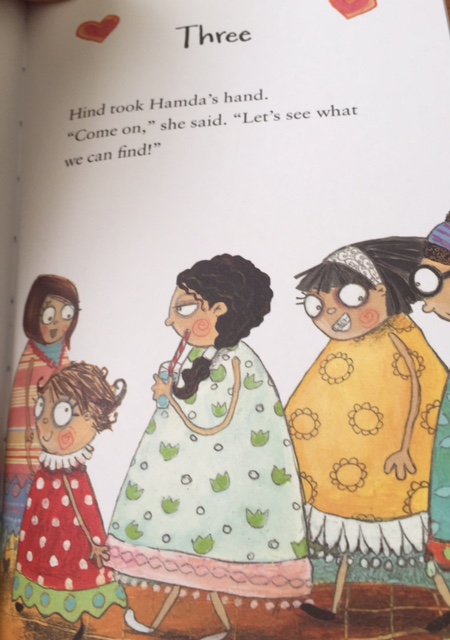
Little Hamda wants to spend time with her four big sisters, but they all say she is little and have other plans.  When her mom reminds her that they were small at one time too, she realizes that when they were small they didn’t wear hijab, or in this book, a veil, and now they are big and where one when they go out.  So, in her mind, once she starts wearing one, she too will be big, and thus the challenge of finding a way to wear it comfortably begins.  She is helped and supported by all her family and finally she finds her own special way to wear her veil.

I like that it is a mainstream book trying to include some diversity.  The family is relatable and the themes universal even if portrayed in a minority muslim framework.

FullSizeRender (80)

WHAT I LIKE ABOUT IT:

I love the premise of the book and that it is very clearly Hamda’s idea to wear a veil, no one is forcing her.  The text and illustrations align to show the girls cover when they go out, not in the home.  The dad needs help at one point finding his shoes to go to the mosque.  However, it doesn’t tell what a mosque is, or explain that the family is Muslim and wearing hijab is an Islamic act, which might be a comprehension block for young readers.

I really go back and forth on the illustrations.  On the first reading I thought they were creepy, when I went back to write the review they were kind of cute.  When I asked my kids, two said they were fine, and one said they were ugly and was positive I am the only one to have ever checked out the book.  Yeah.

FLAGS:

Fine, and Islamically nothing erroneous.

TOOLS FOR LEADING THE DISCUSSION:

Obviously not a book club level book, but I would be very interested to have some first and maybe even second graders read it and give me feedback, like I said I’m on the fence with this one.  Check to see if your library has it, read it, have your kids read it, and let me know.

FullSizeRender (82)

The Swirling Hijaab by Na’ima bint Robert illustrated by Nilesh Mistry

Standard

81fjfxOGmNL

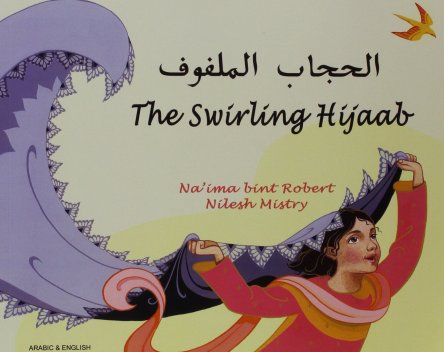
Written in 2002 I’m not sure why this book isn’t in libraries or easy to find, it is wonderful.  We all got so excited when Mommy’s Khimar came out, and for good reason, it is great, but I feel like this book is very similar and somehow not appreciated.  The book is written in verse, with just one line on each page, there are 20 languages that this book appears dual language in, and the author is incredibly well known (Ramadan Moon, From Somalia With Love, Boy Vs. Girl, Going to Mecca, She Wore Red Trainers).

The large pictures show a small girl using her mom’s hijaab to play pretend with as a fort, a boat’s sails, a cloth for her tea party, a comfort when mom isn’t there, and most of all as a covering as a part of one’s faith.  The book shows the little girl as a desi bride, an African warrior queen, a beduin, and a relatable little girl having fun.

The book works well for little ones, with its simple text and large pictures, and is perfect for story time and bedtime alike.  The pictures aren’t bold and vibrant, but are colorful in their muted state and engaging as the swirling hijaab transforms into so much more than a piece of cloth.

It doesn’t mention Islam or Muslims, but just that the hijaab is worn as a sign of faith.  It depicts the girl praying, but doesn’t offer and text regarding it.


Captain Lilly and the New Girl by Brenda Bellingham illustrated by Clarke MacDonald

Standard
Captain Lilly and the New Girl by Brenda Bellingham illustrated by Clarke MacDonald

lilly.jpg

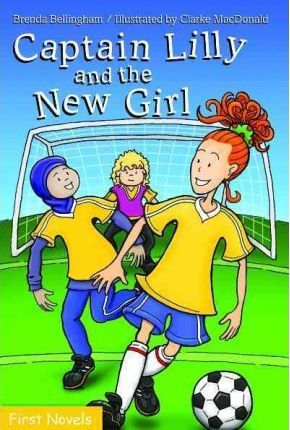
This book is part of First Novels, a collection of books in Canada that focuses on easy to read early chapter books that encourage kids to transition from leveled readers, while getting to know a single character in a realistic contemporary world.  There are a lot of Lilly books, but this one caught my attention because of the hijab wearing girl on the front, presumably the “new girl.”  At an AR 2.8 this 64 page book is great on so many levels, and really does meet the First Novel goal of presenting a simple theme and showing the main character grow.

SYNOPSIS:

Lilly is changing soccer teams, and only finds solace when many of her school friends will also be joining.  While each of the girls has different opinions and levels of enthusiasm about the team, they all are committed to one another as the “Wolves” stick together in a pack.  This loyalty is tested when a new girl is brought in to fill in for an injured wolf.  The foreigner, from America, wears a scarf, and just like with soccer, there are a lot of differing thoughts on the matter.  The reader see what Lilly feels as it is told from her perspective, which makes the issue not so much about the hijab itself, but about how a 9 or 10-year-old thinks and processes new concepts.  Ultimately, the Wolves as individuals and a team, have to decide what to do when an opposing team says that Sara has to take off her hijab if she wants to play.  

WHY I LIKE IT:

I love that the book is real, with strong independent girls.  The side characters aren’t cookie cutters of each other, they all have personalities and quirks, and I love that they don’t all agree, yet they all can make it work.  The book’s catalyst is the hijab, but it isn’t preachy and it is presented and understood through a non-muslim elementary-age character.   I don’t think Islam or Muslim is even mentioned, nor any culture, she is American, and the book takes place in Canada.  It addresses safety regarding the hijab, comfort in wearing sweats and not shorts, and being hot in a long sleeve shirt, issues that any reader can understand and ponder about.  The book isn’t gripping, but for the age group and the intent, it is spot on.  The font, spacing, size of the book, and simple illustrations, urge kids to read a “chapter book” and think about something they may not have ever thought about before.

FLAGS:

Clean, it does say words like “suck,” but it isn’t disrespectful.

TOOLS FOR LEADING THE DISCUSSION:

I wouldn’t use this as a Book Club book, because the kids can read it fairly quick, but I would probably read it aloud to kids and have them discuss, or have them somehow read it in groups and discuss.  There are a few websites that can help facilitate the discussion, but kids would definitely have opinions on how the situation was handed, how they might handle it, and what they think of the team’s sponsor.  

https://www.teachingbooks.net/tb.cgi?a=1&tid=40533

Click to access FirstNovels_Series_ActivityGuide.pdf

http://www.formac.ca/firstnovels


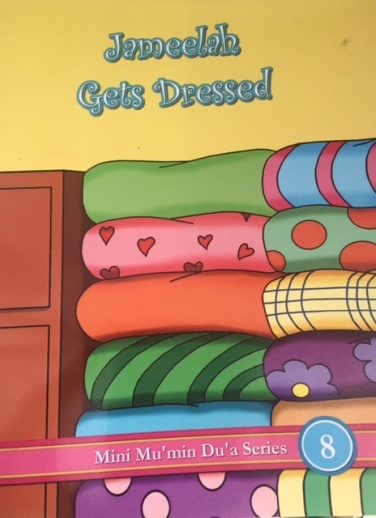
Jameelah Gets Dressed by

Standard
Jameelah Gets Dressed by

FullSizeRender (62)

These books in the Mini Mu’min Dua Series are a great way to introduce familiar concepts in an Islamic framework to preschoolers and teach them the accompanying duas for them.  I previously reviewed Sajaad is Sick, which pleasantly surprised me, and this book proved that the series has consistency and value.

FullSizeRender (63)

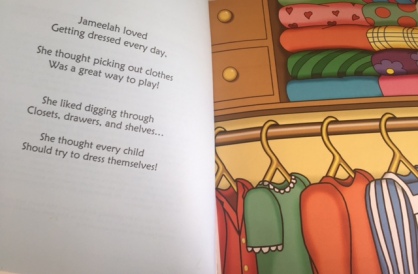
The pictures are colorful, but basic, there are no faces or people included.  The text rhymes, yet has a nice cadence that doesn’t seem overly forced throughout the 38 pages.  The book is large, 8×10, with a glossary cover, and decent weight and binding.

This book includes a few footnotes: defining hijab, giving the ayats for the commandment to draw your veil over your bodies, the hadith about starting with your right, etc.  There are four duas included, the one for getting dressed, the one for wearing something new, the dua for when someone else wears something new, and the dua for getting undressed.

FullSizeRender (64)


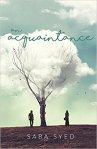
An Acquaintance by Saba Syed

Standard
An Acquaintance by Saba Syed

acquaintance.jpg

A young adult Islamic fiction romance novel, yes its a genre, albeit small one. I braced myself for stereotypes, cheesiness, over simplifications, sweeping condemnation, and preachy reprimands.  They never came.  I think this book is different, because from what I felt while reading it, and from what I’ve read the author say, this book is written for us: Muslim females, raised in the west, devout, strong, involved, and vulnerable.  It isn’t trying to convince anyone of Islam, or prove our place in America.  It isn’t trying to justify relationships or make us hide in our houses, rather it is taking us up to the line, showing us our strengths and weaknesses, and leaving us there to think.  In 282 pages, I saw myself crystal clear in the protagonist, the vilifying community, the determined best friend, and the steady parent.  It is easy to judge, but this book gets the nuances, the temptation, the justification, the internal battles, and it does it all without resorting to extremes that would make it inappropriate for upper middle and high schoolers. Yay!

SYNOPSIS:

Sarah Ali has grown up in small town Wickley, Pennsylvania, her whole life.  Her dad owns the local hangout, she is well known and well liked ,and very involved at school and in the masjid that her father helped start.  She has a best friend who is Muslim and although her mother has passed away, her home life with her dad and older brother is solid and supportive.  Senior year, however, is where the book takes place, and with Islamaphobes protesting and a new boy, Jason, in town coming to her rescue, the stage is set for her to have to decide how much their “friendship” crosses her internal boundaries of right and wrong, and when feelings are on the table, what choices she will make.

Throughout the book, there are numerous supporting characters that have their own roles in shining light on the situation from the outside and adding context to the world that Sarah lives in.  But this is ultimately Sarah’s story, told from her perspective, and the internal conflicts are believable because they are hers, the reader can see a mile a way what is going on and what will happen, but to see it unfold within her is at times a little naive, but considering her age, plausible.  It is her denial and acceptance of the situation at hand and what her role and hopes are that make the story very hard to put down.

The book in many ways is subtle, I don’t want to give to much of the plot away because it is obvious, it is a love story between two teenagers that can’t have a future based on the fact that she is Muslim and not willing to compromise that.  But that doesn’t mean there aren’t real feelings involved and real consequences to the choices that are made.  Throw in the gossip mongers at the masjid, an older brother who is concerned, an ever patient father, and a handful of others and the book feels incredibly real. 

WHY I LIKE IT:

Things are never black and white in real life, nor does reality prevent emotions and desires from breaking out.  There is no shaming in their tale (other than by the judgemental aunties), but there are consequences that are also given their time and spotlight.  From a parenting perspective it shows how a few questionable decisions can really get you in a heap of trouble and heartache, even if on the outside you can argue you did nothing wrong.  Even in the book Sarah remarks that they didn’t do anything, but yet, they did so much, this understanding is really powerful, and so needed for the teenage demographic. The book does not celebrate Sarah and Jason’s relationship, although I must admit I did kind of cheer for them at some points (I know, haram).  It shows that they are good people, but that there is a bigger picture.  It also shows there is life and hope, and forgiveness after, in the healing.

I love that Sarah’s dad is awesome and that his ultimate weapon is dua.  Not the stereotypical immigrant father trope, he is awesome.  I also love that Sarah’s best friend, Jasmine, is a person of color, so diversity gets a bit of a shout out.  The masjid politics is spot on, and the hypocritical aunties are as annoying in the book as they are in real life.  Yes, there are times where the dialogue is a little syrupy and long-winded, but overall, this book is calm and reflective and so, so important for high school and college girls to read.

Islam is the religion practiced, from praying, to how they talk, to how they dress, the subtlties there are brilliant as well.  You can tell the author is Muslim because it is natural and real, not researched and blotched.  The message is ultimately that Allah knows all, and that we do things for His sake alone.

FLAGS:

Truly the most Jason and Sarah do is hold hands, but the masjid ladies constrew that they do a lot more, and that Sarah ends up pregnant and gets an abortion. All untrue, but this revelation, that this is the gossip going around, is explored at the end of the book.

TOOLS FOR LEADING THE DISCUSSION:

Oh how great would this book be as a book club for high school or even college age girls.  But, alas I’m not involved in anything like that so I will have to just recommend this book to anyone that meets that criteria looking for a good book. 

Having said that, part of me really thinks this book doesn’t need to be discussed.  Saints and Misfits was a book that needs to be read and discussed with our youth, this book, I kind of like it to stir and fester within each reader.  The lessons are there, and are clear, and some days I could see a girl really feeling one way and switching another.  Like the father in the book, our kids, inshaAllah, have been taught right and wrong, we have to see what they do when tested.  And this book can really speak to them, and offer them a bit of conciousness when faced with a seemingly small decision that could have big consequences.  This book will stay with a reader, and that’s a good thing.  I just don’t know if it will manifest the same with everyone, and I think that is a great thing.


Book trailer: https://www.youtube.com/watch?v=fraVJZI1xNU

From the Author: https://muslimmatters.org/2017/11/10/an-acquaintance-a-young-adult-novel/
 

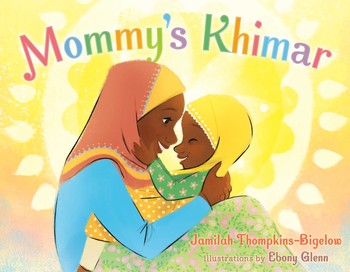
Mommy’s Khimar by Jamilah Thompkins-Bigelow illustrated by Ebony Glenn

Standard
Mommy’s Khimar by Jamilah Thompkins-Bigelow illustrated by Ebony Glenn

mommys-khimar-9781534400597_lg

Children playing dress-up with their mother’s clothes is a universal activity, that most can relate to.  Playing dress-up in your mother’s khimar is what makes this book both familiar and stereotype breaking in a way that is actually pretty powerful.

mommy3_grande.jpg


In this 40 page hardback book targeting 4-8 year olds, Salaam Reads, once again brings Muslim characters to the masses, without alienating or talking down to either Muslim or non Muslims readers.

mommy2_grande.jpg

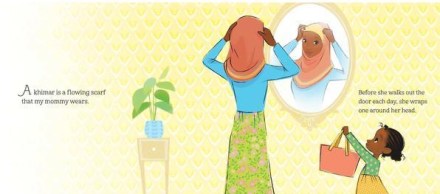
The story starts off with a little girl explaining that “A khimar is a flowing scarf that my mommy wears.  Before she walks out the door each day, she wraps one around her head.”  She then marvels at the variety of scarves her mother has, commenting on the colors, and prints, and designs, that by the time she is ready to use them as her favorite make-believe accessory, readers will be wishing they too could have such an assortment.

download

From using a khimar to be a queen with a golden train, to being a shooting star, the reader also along the way learns that she loves the connection the khimars offer her of her mother, when she isn’t near.  The ladies at the masjid are also part of that connection so that when she dreams of all the fantastical pretend things she can be, she also knows they too are with her.  Even her grandma, Mom-Mom, who exclaims “Sweet Jesus” when she sees her in her yellow khimar, and loves her although she doesn’t go to the mosque like the little girl does, is a part of the love and support the little girl feels by those around her when she is wrapped up in her mother’s khimar.  download (1)I love that it stresses even though her grandma is not Muslim they love each other because they are family.  Muslims and Islam are never mentioned outright, just the mosque and the ladies saying Assalamu alaikum, hint at the khimar being worn for religious reasons.
download (2)

Perhaps the best part is the pictures.  The illustrations with their yellowish hues radiate warmth and the faces and smiles are good for the soul.  You can feel the love the little girl both receives and gives to those around her through the pictures that perfectly compliment the simple text.

The diversity of the book in the main character being a girl, a child of color, and a Muslim, is such a beautiful thing to see.  Stories like this are powerful tools when children see themselves in books with positive messages, and remind us all how much more diversity it needed in literature to both highlight our differences, and celebrate our similarities.


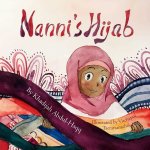
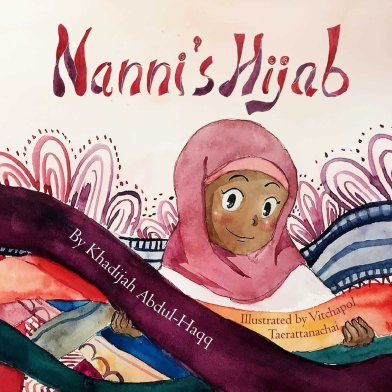
Nanni’s Hijab by Khadijah Abdul-Haqq illustrated by Vitchapol Taerattanachai

Standard
Nanni’s Hijab by Khadijah Abdul-Haqq illustrated by Vitchapol Taerattanachai

Nanni's Hijab

MashaAllah, there are so many things to like about this 36 page, brightly illustrated, elementary aged story.  Nanni, the main character, is spunky.  Not only is she strong enough to wear hijab to school, but she also is brave enough to confidently handle a bully on her own.  Surrounded by a supportive teacher, friends, classmates, and her mom, Nanni’s creativity and understanding that Allah swt will help her find a way to handle her predicament results in a happy ending, and many empowering messages.

nannis-hijab-childrens-book-review-L-Yo6YBS

The book would work for most children, but I think second grade and up would get the most out of it.  The girl might be young to be wearing hijab, but it seems like she wears it because she wants too.  I like that the illustrations have her and her mom uncovered at home, and that there is a glossary at the back, opening up the book to muslim and non muslim kids alike.

DVBz_rcVwAILbLM

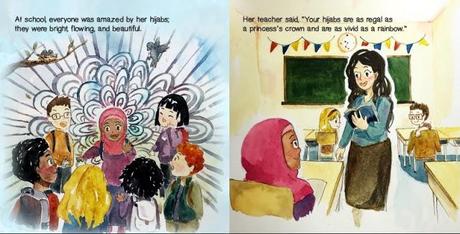
I also really like the larger messages of acceptance, trying new things, and doing better when you know better.  The supporting cast in the book resonates with muslims who go to schools where they are the minority, but have support and encouragement to practice their faith none-the-less.  Nanni’s teacher remarks that her “hijabs are as regal as a princess’s crown,” and the other students like seeing what color or design she is wearing each day.  Although a children’s book, the author does very clearly explain that the hijab is part of Nanni’s faith, although not mentioned by name, and that it is an act of worship. Nanni wants to handle the problem on her own, and for as bad as she wants to punch Leslie, she knows it isn’t the right thing to do.  As she wrestles with what is the best approach, she puts her trust in Allah, swt, which perhaps is the greatest lesson for us all in the book, alhumdulillah.