Tag Archives: gentle

Steet Puppy, Masjid Cat by Moniza Hossain illustrated by Wastana Haikal

Standard
Steet Puppy, Masjid Cat by Moniza Hossain illustrated by Wastana Haikal

I was a little nervous opening the book, I didn’t know if it was going to be a “Lady and the Tramp” type retelling, and I was unsure how dogs would be presented, but I sure was not prepared for the absolute adorableness that unfolded.  The simple rhyming lines contrasting the street puppy’s life to that of the pampered cat in the masjid, to their meeting, and the sweet imam leading with kindness warmed my heart.  The real chef’s kiss is the backmatter that doesn’t source, but references the sunnah of “acts of charity to every beast alive,” and notes that dogs, unlike cats, are not allowed in the mosque for religious reasons.  I love that “masjid” is in the title, that the author’s note and glossary explain adhan, imam, and the Quran, and ultimately that friendship amongst differences is the takeaway for all readers.  I don’t love that the adhan in the text is described as ringing and the imam as singing, but I acknowledge my pickiness.  And while I love that Prophet Muhammad saw is mentioned in the author’s note, I do wish salutations were given afterward.  The illustrations on every one of the 32 pages are delightful, and I love that the image on the jacket is different than the one on the book itself.  For ages 3 and up, and even emerging readers, this book has a lot of heart, and my 6 year old has read it aloud so many times, I just might have it memorized.

The book starts with simple rhyming lines showing the contrasting life of the cat and the dog, from their daily activities, to how other’s treat them.  When they meet, the cat is not too welcoming, but the imam shows the puppy kindness and the cat follows suit.  As simple as sharing and giving each other a chance, creates a friendship between the two animals, and a beautiful conclusion even the littlest children will understand.

The book is not didactic, and the role of the imam and setting of the masjid, for Muslim kids will be such a spark of joy, but in no way will it limit non Muslim children from connecting with the story.  The benefit for all is seeing a masjid environment and a Muslim in action, normalizing both, and inshaAllah reminding us all to be a little kinder to our animal friends.

Hilwa’s Gift by Safa Suleiman illustrated by Anait Semirdzhyan

Standard
Hilwa’s Gift by Safa Suleiman illustrated by Anait Semirdzhyan

img_6526-1

I’ve read a few children’s picture books about harvesting olives, and even some about Palestine’s olives, but this one really stands out because it is just so very joyful.  There is information about picking the fruit, processing, and making soap and oil with olives, but the book’s take away is just sore cheeks from smiling, and a full heart from feeling the importance, love, and tradition of olives, family, and being together.  The text and illustrations combine beautifully allowing the story of Hilwa, the olive tree, Ali and his Seedo to say a lot without having to spell it all out. And that it is traditionally published at such a critical time, is truly a gift.  There is nothing religious in the text, there are a few #Muslimsintheillustrations, and the author is Muslim. Additionally there is nothing about the current situation, the politics, the upheaval, or the occupation. The book follows Ali as he arrives after a long journey to his Grandparent’s home, it is harvesting season and  he is about to see all of the gifts that come from olives with the guidance of his grandfather, the cheering of his cousins, and the offerings of his beloved Hilwa.

The book starts with Ali and his parents arriving exhausted after their long flight to Palestine.  Greeted by Seedo, when Ali sees Hilwa, the olive tree his grandfather planted with his grandfather, the tiredness disappears.  When he hears Sitty whacking the trees and his cousins singing, “Zaytoon, ya zaytoon.”  He is ready to help harvest.  But, he doesn’t want to hurt Hilwa and decides to pick the olives one by one.  After his arms are tired and the basket is empty, he gently tries the traditional method and makes the zaytoon rain down with his grandparents and cousins cheering him on.

Hilwa has many gifts, and the next day they load up the olives to be taken to the press, they then prepare and enjoy the olives being pressed in to oil.  They bring the oil home to cook with, eat, turn in to soap, and the pulp is used to build the fire.  The best gift of all however, is the family, friends, and neighbors gathering to share and be together.

I read an early copy, and hope that the beginning will be smoothed out a bit.  It actually read as if a page was missing.  If the family had just arrived from overseas, and the grandfather was so excited, why wouldn’t the grandmother and cousins also leave what they are doing to great the just arrived family? It seemed a bit off, but once the story recovered, the text and story flowed without incident, so perhaps the disjointedness has been resolved.

img_6527-1

It is so important to show the richness of cultures to those that might be unaware, for a culture that is relentlessly villainized, even more so.  This 40 page picture book is great for ages 3 and up, and while it doesn’t detail Palestinian culture, it highlights a central component and shows the vibrancy and warmth of a people and their relationship to the land and the importance of olives and olive trees.  There is a glossary at the end with words in English and written in Arabic scripts as well as an Author’s Note.

Yusuf and Yusra’s Merry Dilemma by A. Dawood

Standard
Yusuf and Yusra’s Merry Dilemma by A. Dawood

img_8876

We need more books like this. Books that don’t dismiss the pressures of celebrating holidays that don’t belong to us and that facilitate conversation. Is this 36 page early chapter book incredible literature, no it is not, but it is important. And I strongly suggest reading this book with your children and discussing the contents sooner rather than later. Not the first week of December, when holiday music and decorations are already in full force, but when in fact, they are not. Talk to your kids before it is an emotional defensive assertion of power. Talk to them when calm thoughtful conversation can occur without being in response to an invitation to a party, or a school/community event. Equip your children and guide them where they are in their understanding. Yes, that means that you the parent will have to read this book first, and then ask your child to read it, or read it with them. It is not long, it is not deep, or a complex story, it is a relatable scenario of a a practicing Muslim kid who weighs his options, makes a choice, gets caught, and is gently talked to by his father. There is openness, their is dialogue, and yeah, it gets a bit preachy at the end, but that is kind of the point. The book does not come out for a few more months, but I hope you will preorder it, and I hope the author may consider releasing it before October. I’m the daughter of a convert, born and raised in America. We need to talk to our kids about holidays, not just demand avoidance or give in to peer pressure and imitate. It isn’t simply saying they have Christmas we have Eid, it needs to be understood, we are Muslim and we do what we do to please Allah swt. In some ways I wish the book was stronger, but every family is different, and this book gives space for you to tailor the conversation for your family about Islam, in relation to both the religious aspects and commercialization of the Christmas holiday.

SYNOPSIS:
Yusuf and his friends love video games, the book opens with them playing at a friend’s house when the conversation turns to the new Nintendo MAAX that will be out for the holidays. It is on all the boys’ wish list, Yusuf doesn’t celebrate Christmas, and the friends know that, but he feels left out thinking he will have to wait six more months until Eid. When his mom picks him up early to take him to the mall to get boots with his sister Yusra, he see’s a raffle for the gaming station and enters. There is just one catch, you have to take a picture with Santa. Yusuf knows Prophet Isa is important in Islam, and is not the son of God (astugfirallah), he also knows that Santa is a fictious character. He hesitates, but then complies, when his sister sees the proof hanging out of his pocket after he makes wudu, their dad decides to talk to them as they walk to the masjid for maghrib.

WHY I LIKE IT:
I like that the kid and his friends know that he doesn’t celebrate Christmas, that the internal debate is coming from a kid who knows his faith, it is not an identity crisis. He knows what is right and wrong, but yet the debate as to whether a picture with Santa crosses the line or not is still had. I’m sure a lot of Muslims would be fine with it, but a lot wouldn’t, and the conversation about preserving our imaan and imitating others and doing something that stems from a belief we do not share, I think is important to have with kids. Is it ok to do a gift exchange for Christmas if we are Muslim? This family says no, and dad explains it to Yusra and acknowledges that it made her sad to miss out on it. I think these are questions that families wrestle with and often instead of discussing we just ignore. We know gift giving is important and kindness is important, but when it is tied to celebration of God having a child, is that ok? The book does not give fatwas or hadith or get heavy handed, it is a gentle discussion from the father with his young children that is presented in the book and can easily be continued in real life afterward. There isn’t judgement or othering of Muslims and non Muslims, the tone allows for you to think about the concepts both in the fictious scenario, and inshaAllah also in your real life. I think whether you are strong in keeping away from Christmas activities or a little more lenient, you will find this book a benefit and not be offended or annoyed. While I wish the book was a little longer and a bit more polished on the literary side, I appreciate that the book will resonate with families facing similar situations, and that it does so for early elementary kids that are starting to have to make their own decisions when they are at school, with friends, and in front of Allah swt.

I do with the pictures were better and maybe the font a little bigger.

FLAGS:
Christmas and posing with Santa, secrets

TOOLS FOR LEADING THE DISCUSSION:
The book is for younger kids, but I think a weekend school teacher could read it aloud and lead a discussion just as well as a parent doing it at bedtime. Again though, I would present it before December, start the dialogue early so it can be referenced with situations arise.

Preorder/Order here https://amzn.to/3Jrzlsi

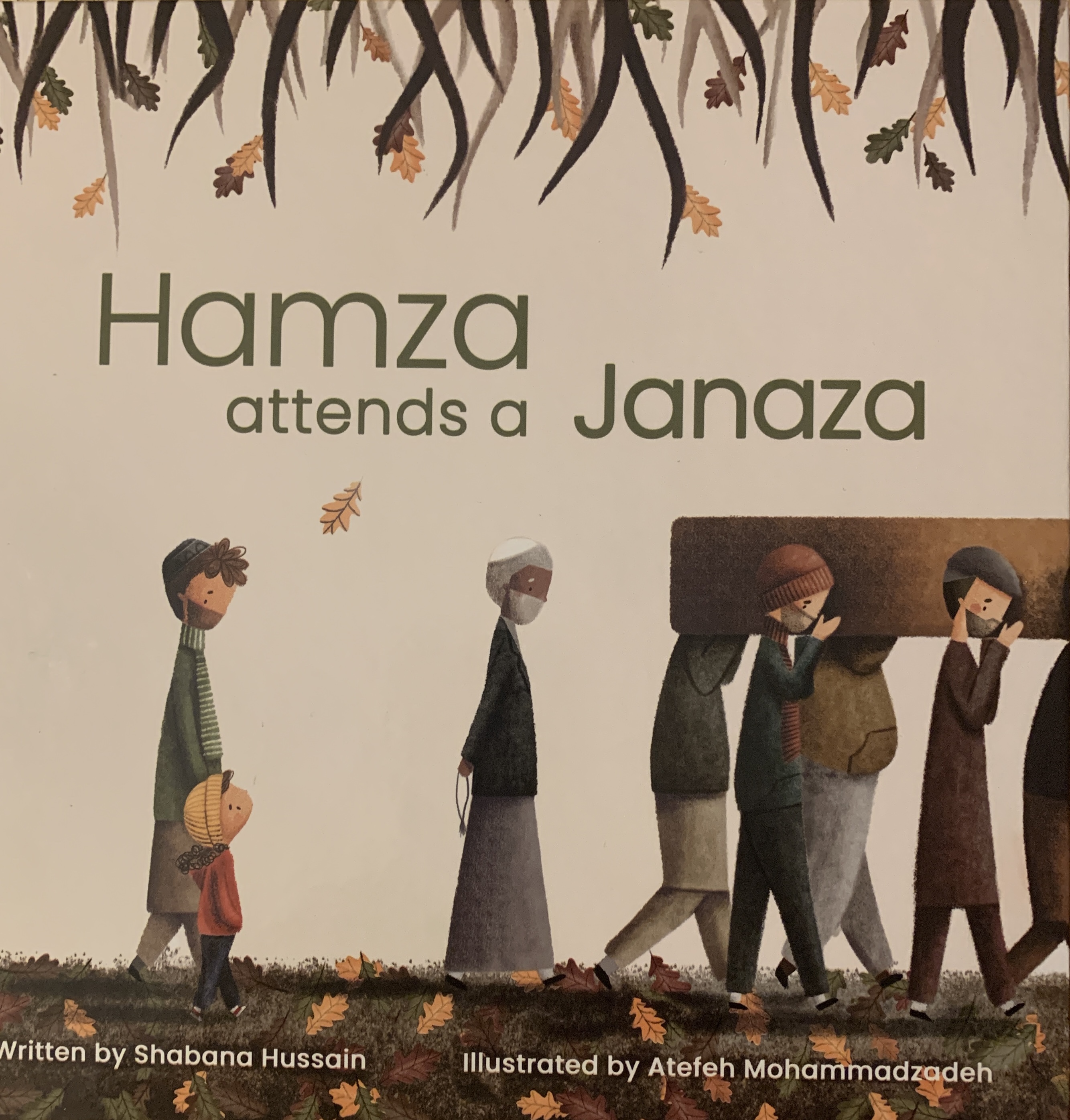
Hamza Attends a Janaza by Shabana Hussain illustrated by Atefeh Mohammadzadeh

Standard
Hamza Attends a Janaza by Shabana Hussain illustrated by Atefeh Mohammadzadeh

img_5141

For years it has been noted how few children’s Islamic books about grief and loss are available, and while numerous titles have come out in the last few years, it wasn’t until I saw this new book, did I realize how desperately we were in need of a book on janaza.  I love that the author establishes on the first page that this book is not focused on grief, but rather about death, the burial, and preparing to meet Allah (saw) in the hereafter with our deeds.  The beauty is that while the topic is critical and needed, the story is also well done.  It may not focus on emotion, but it has a lot of heart and tenderness, thus making it a wonderful addition to all book shelves for children preschool and up as a brief introduction to how Islam views death, the rituals of burial, and the worship that surrounds it. Packaged with clear text, robust backmatter and absolutely adorable illustrations, I am very happily impressed with this book.

img_5142

The book starts with Hamza telling about his favorite day of the week, Saturday, the day he spends with his Nano-ji and cousins, but one day all that changes when his mom gets a phone call about the loss of a community Uncle.  Mom says, inna lillahi wa inna illahi rajioon quietly in to the phone and Hamza knows something is wrong, but doesn’t quite understand why the passing of Uncle Sameer, the owner of the local sweet shop, means he has to attend a janaza instead of going to his grandfather’s house.

Hamza’s parents explain the reward of going, and remind him that we all have to leave this world one day. They recall Uncle Sameer helping bandage his knee when he got hurt and gave him a lollipop.  Once in the car, Hamza wants to know what is going to happen.  His parents explain the ghusl and the body being wrapped in the kafan and the body being put in the ground.

img_5144

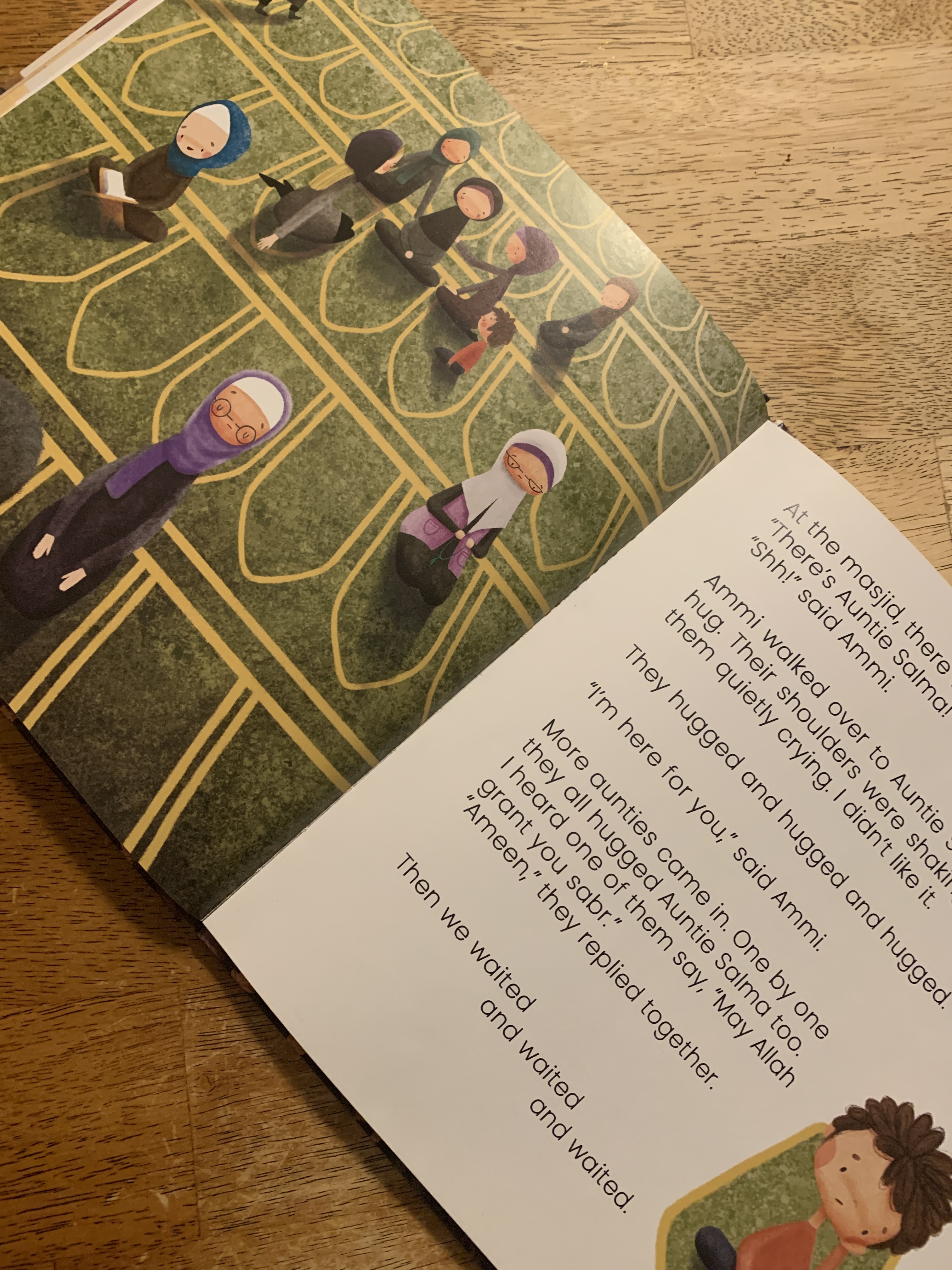
When they get to the masjid there are a lot of aunties on the women’s side, including Auntie Salma who everyone is hugging and reassuring.  After dhuhr the janaza begins, but it is a standing up namaz, and is very short, and Hamza is confused. Later outside the long box is loaded into the car, duas are made, and the body taken to the cemetery.

At the graveside, more duas are made, and Hamza worries that Uncle will be lonely.  When his father explains that his good deeds will keep him company, Hamza remembers the kindness Uncle Sameer has shown him and makes duas.

img_5146

The backmatter contains hadith about what still benefits those that have died, reward for attending a janaza, a glossary, discussion points, suggested activities, and duas.  The book is a great starting point to introducing death, rituals, and answering questions any child might have in a gentle manner.  

I bought the book from Crescent Moon Store