Tag Archives: Eid Al Fitr

The Best Eid Ever by Sufiya Ahmed illustrated by Hazem Asif

Standard
The Best Eid Ever by Sufiya Ahmed illustrated by Hazem Asif

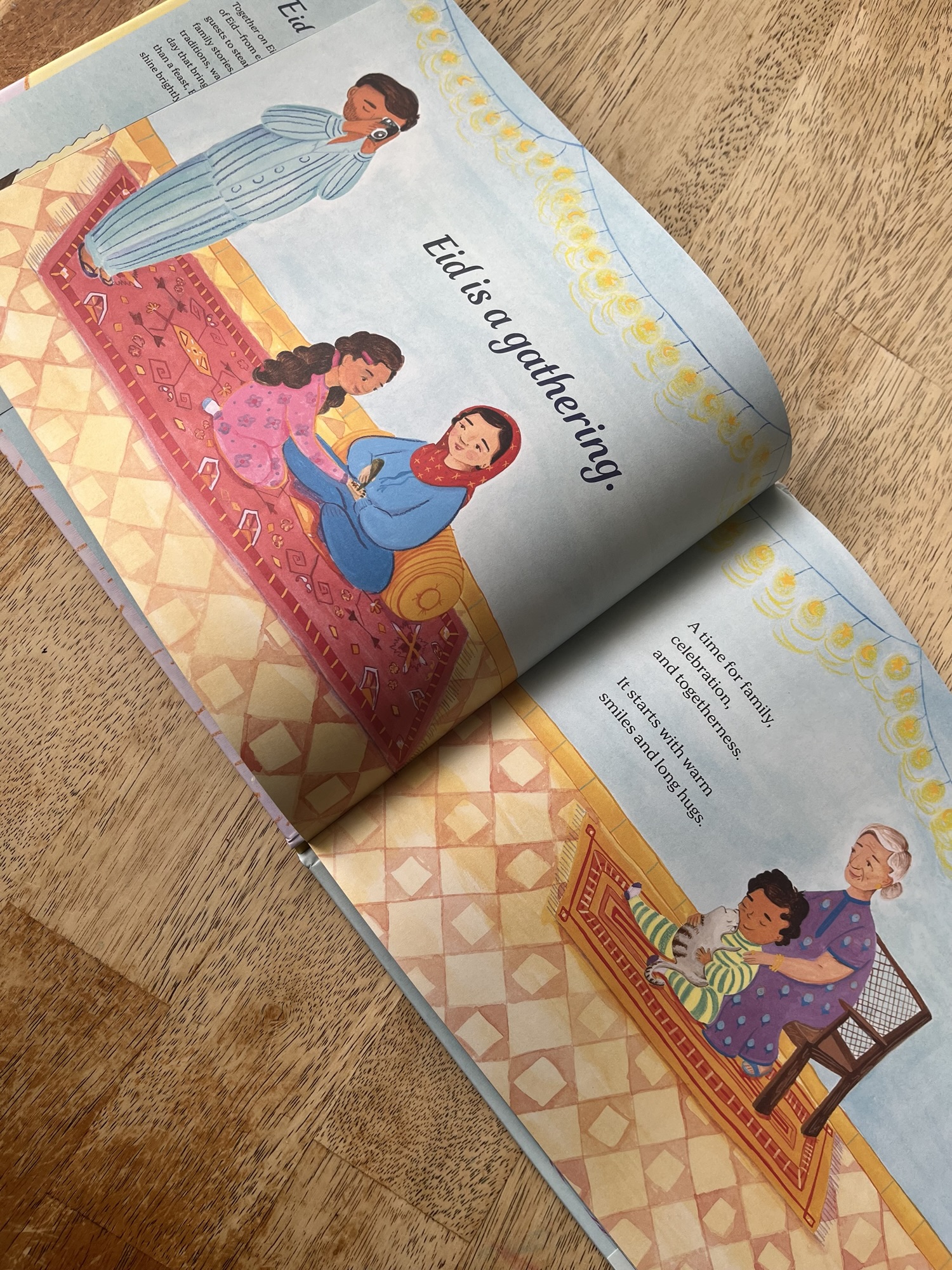
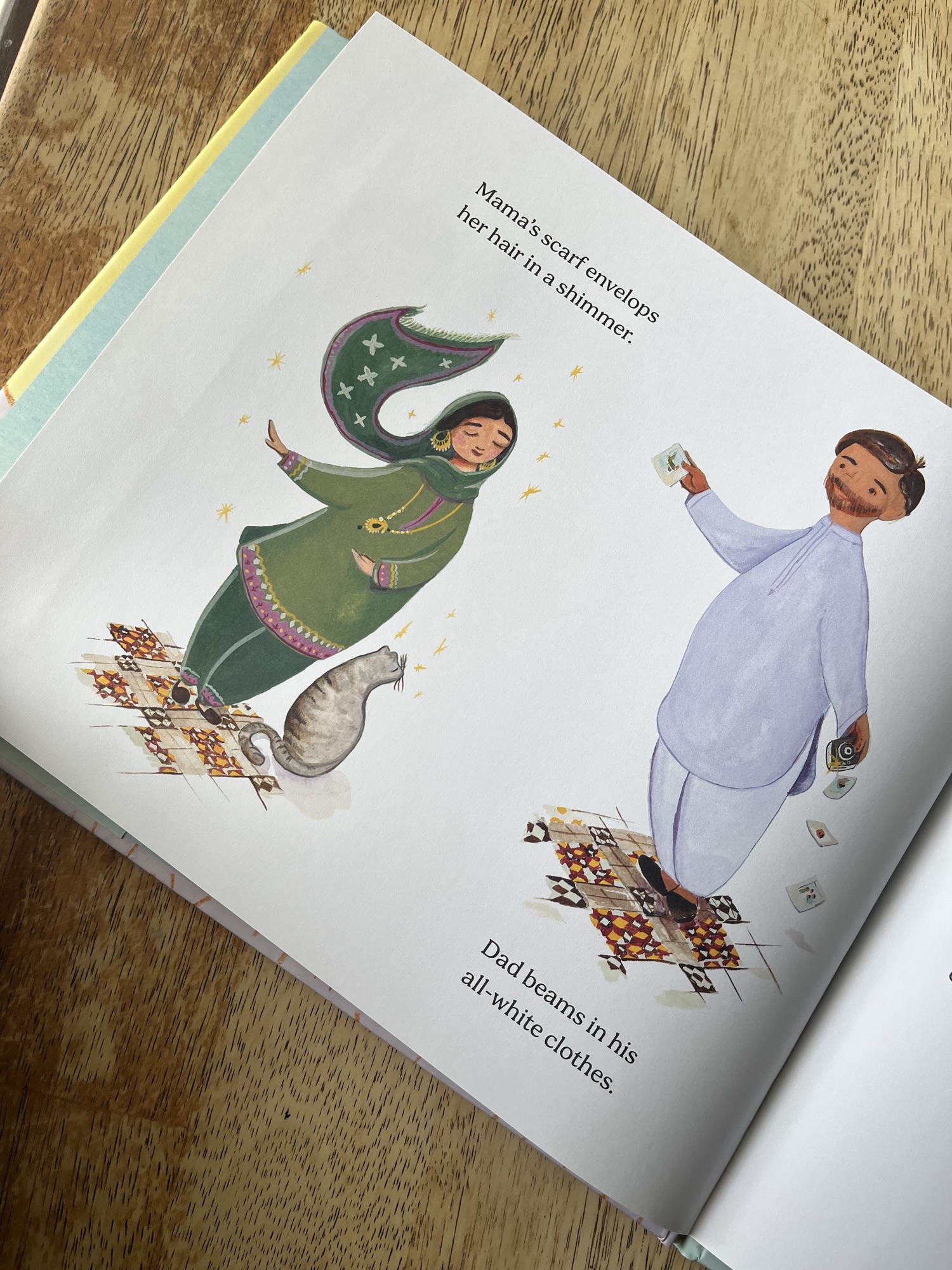
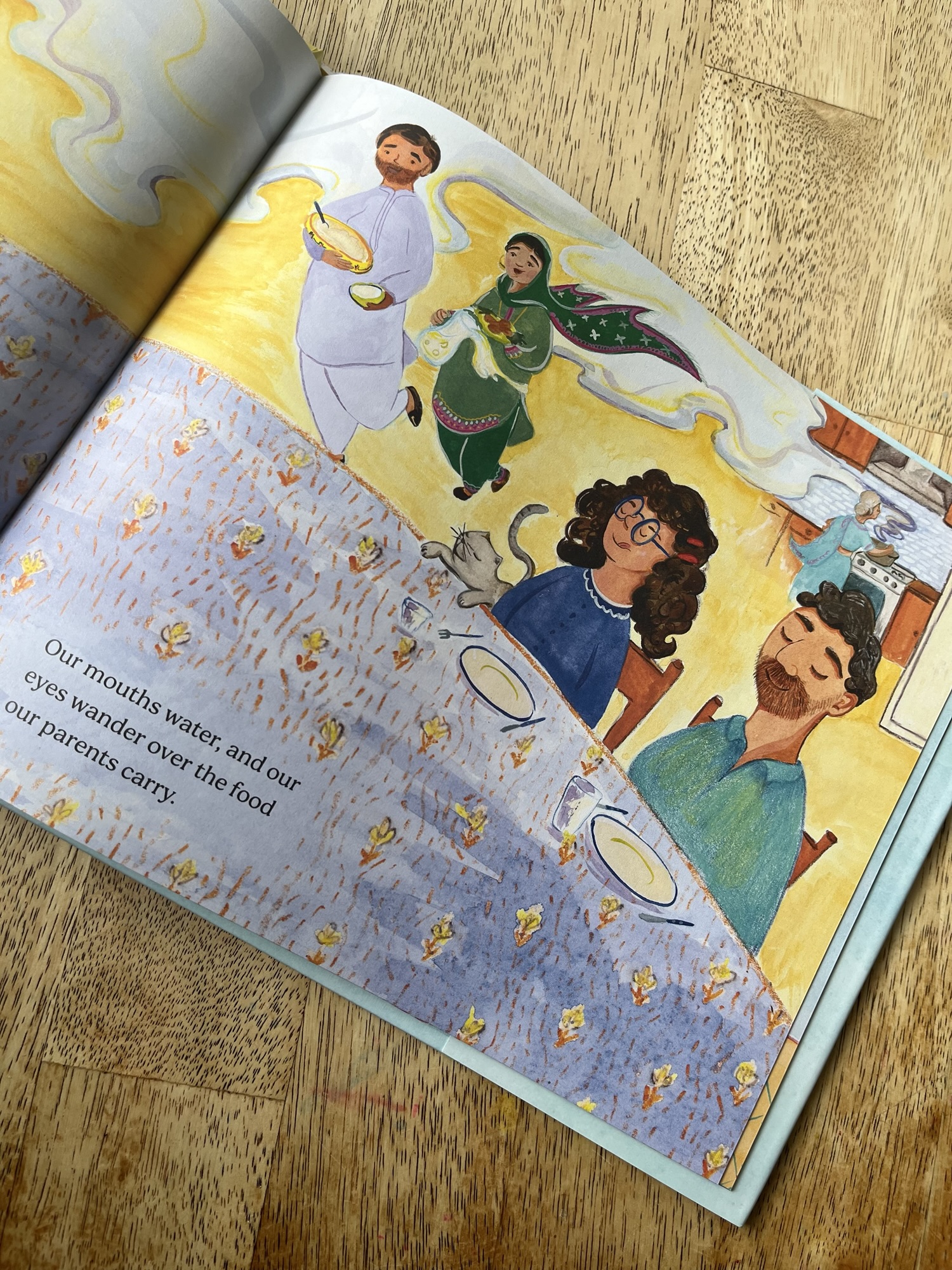
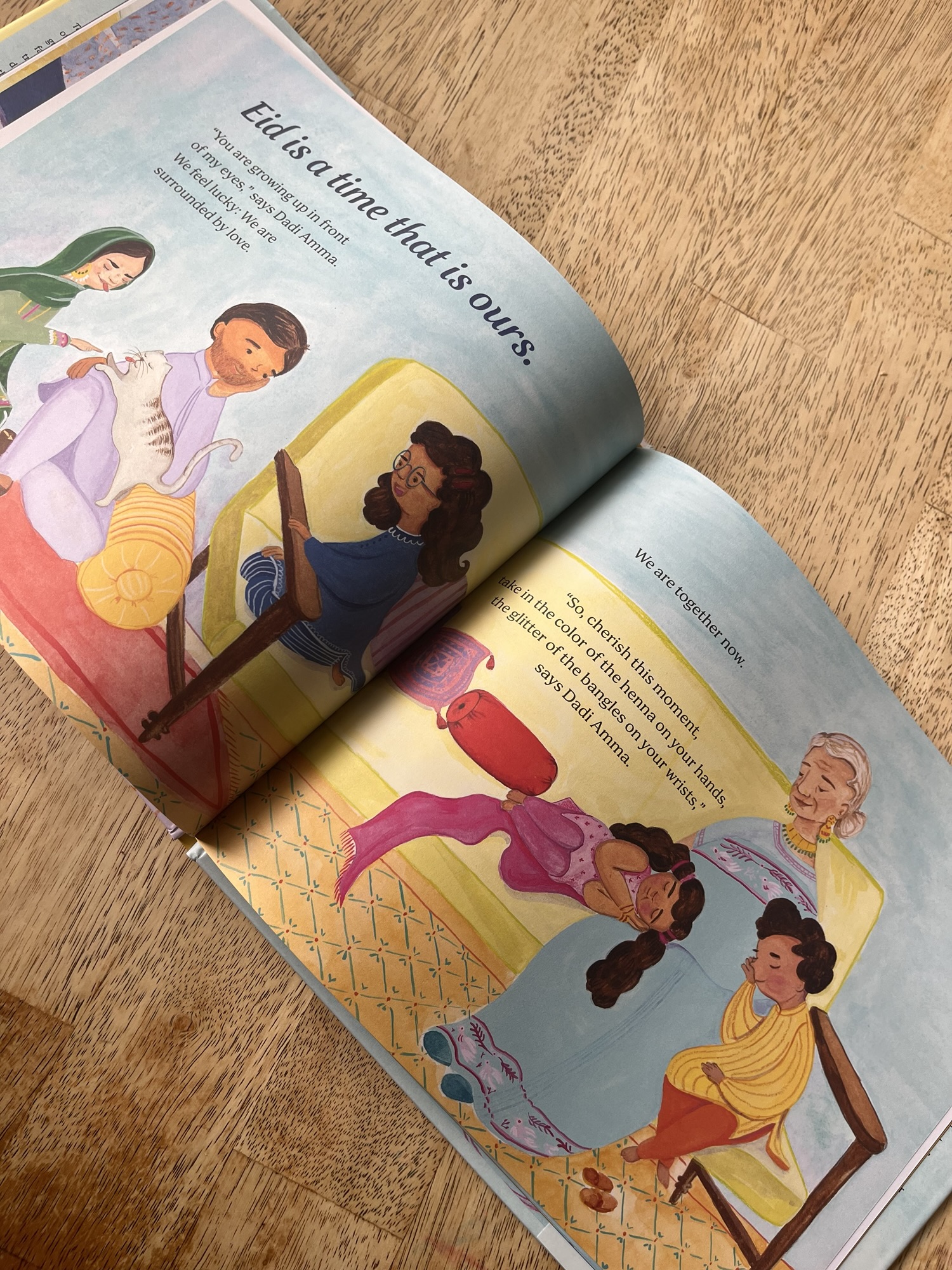
This book blends some facts about Ramadan and Eid with cultural practices, showing a day in the life of a family celebrating, and a sprinkling of a story line to keep elementary aged kids invested. The back of the book labels it as an introduction to Ramadan and Eid and I think that is a pretty solid summary.  Aisha is eight, and apparently too young to fast from sunrise to sunset.  I wonder if she is old enough to fast from dawn to sunset as Islamically prescribed? Yes, I’m petty, but it is wrong to say sunrise to sunset, and I’m not backing down. This year her aunt, Chachi Amal has made a scavenger hunt for her and her brother to find their Eid presents, but first there is henna to apply, decorations to hang up, Eid prayers to attend, desserts to be shared with neighbors, and lunch to be had, before the three question scavenger hunt can commence, and presents can be located.  The backmatter has information about Ramadan, Muslims, Eid, and a glossary.  The book would work well for a generic class or library story time. I don’t imagine Muslim kids will find it particularly memorable and ask for it more than once.  It is a Desi family, with the Chachi being Libyan and sharing desserts. hinting at the diversity of Muslims, and I can see kids wanting parents to hide their gifts and make a scavenger hunt, which is sweet and a nice idea to build on.

The book starts with Aisha looking outside to see if the moon can be spotted and Eid determined.  Samir and Dad come in and say that the mosque has declared Eid tomorrow.  Eid is Aisha’s favorite festival, she loves Ramadan, eating iftar with her fasting family, and she loves dates. This year her Chachi has hidden their gifts and made a scavenger hunt for the kids to follow.

Aisha can’t wait, but her Mom says they have other traditions first, and Aisha has henna painted on her hands.  They have to dry for at least two hours, so she watches a show while Dad and Samir decorate.  Then it is time for bed, and the scavenger hunt will have to wait.

Early in the morning is no time for a scavenger hunt, Mom is in the kitchen and they have to get to Eid prayers. After salat, and wishing everyone Eid Mubarak, Aisha is ready for the clues, but her and Samir are sent to deliver sweets to the neighbors.  When they return home, they can’t get to presents because it is lunch time. Finally, the scavenger hunt begins, the clues are solved, the presents found, and the day “the Best Eid Ever.”

I purchased this book from Crescent Moon Store, code ISL will save you 10%.

First Festivals: Ramadan: A Lift the Flap Book illustrated by Junissa Bianda

Standard
First Festivals: Ramadan: A Lift the Flap Book illustrated by Junissa Bianda

I was pleasantly surprised by the cuteness of this little (7.5 x 7.5) 12 page lift the flap Ramadan board book I got at the library. Written by committee (Ladybird Books) and part of a series, I didn’t really expect much, but the illustrations are adorable, and the salat flap made me smile. The text is simple and informative, fitting for the target demographic covering that Ramadan is a special time for Muslims to grow closer to Allah, do more good deeds, fast, fast, pray, and celebrate after prayers at the mosque with a feast.  It is positioned to teach non Muslims about Islam, so the “Muslims do, or say, or believe” framing, can inherently feel a bit othering, but being the tone of the book is to educate, I think it can easily be reworded for Muslim homes to benefit and enjoy.

The book starts with a two page spread of a family in a living room and text that identifies that “a new moon has appeared” and Ramadan is here.  The flap lifts the curtain to reveal a crescent.  It states that Ramadan is a special time for Muslims and that we grow closer to God, articulating that we call God, Allah (swt).

The remaining spreads feature diverse characters, various colors, mobility, hijab wearing and not, and cover fasting, suhoor, iftar, eating dates, praying tarawih and then celebrating Eid at the end of the month.  Flaps lift to show inside a mosque, praying and making dua, opening gifts, visiting neighbors, and eating.  The book concludes with Ramadan over and Muslims remembering what the special month taught them. Overall it does a good job of balancing, fasting, praying, and being together, not over emphasizing food, or commercializing the holy month at the expense of showing faith practices.

Maymoona’s Moon: A Special Eid Story by Razeena Omar Gutta illustrated by Zayneb Haleem

Standard
Maymoona’s Moon: A Special Eid Story by Razeena Omar Gutta illustrated by Zayneb Haleem

I love the illustrations of this book and have been trying to get it since it released in Australia to no avail, it finally is being released here in America and the 32 page hardback book is so cute to look through.  The story is, well, sigh.  It isn’t bad or wrong, but for a religious centered book, it has no Islam, no Eid feels, no faithful reliance.  Rather than using religion to bring the sighting of the moon to little Muslims and non Muslims, and blending it with the protagonists desire to be an astronaut as the framing of the story, it just focuses on the celestial intrigue.  “Cosmic compasses,” “galactic goggles,” and a cheering squad are needed for “Operation Galaxy Gaze,” there are no “Bismillahs” or “Alhumdulillahs” when looking for the moon, and ultimately seeing it.  Again, it isn’t wrong, it just seems a little unfortunate.  This book will be read in Islamic and public schools, libraries, and everywhere else children, preschool to early elementary, gather with hopes of hearing a Ramadan or Eid story.  I’m just fairly confident, none will leave knowing what Eid is, or why it is important to Muslims.  They will get that Maymoona loves the stars, there is an “inshaAllah” when she dreams of being an astronaut some day, but even the backmatter entitled, “Why is Seeing the Moon so Important for Eid?” focuses on just that, the seeing of the moon, not the month of Ramadan ending and Eid joy prevailing.  I know I’m harsh when it comes to Islamic rep, this one just skirted the line of telling us about searching for the moon, leaving Ramadan behind, and the excitement of Eid, when it so easily could have shown us, and left a lasting impression long after the book closed.

The book starts with the sights and sounds of Eid approaching. There is only one thing left to do and that is something Maymoona takes very seriously, looking for the moon.  It is the most exciting part of Eid for her, as she dreams of being a future astronaut.  She assembles her team to plot and plan, her gear to give her the best chance of success, and she squashes her nerves and makes her ascent to the best vantage point.  And then she waits, patiently to see if the wind will move the clouds, if her dreams of landing on the moon will come to fruition, if tomorrow will be Eid.

The large 8.5 x 11 pages with a matte finish make this book easy to share in small groups or at bedtime, and really let the pictures charm the audience on each and every spread.

Eid for Nylah by Nizrana Farook illustrated by Zelma Firdauzia

Standard
Eid for Nylah by Nizrana Farook illustrated by Zelma Firdauzia

I have read this book dozens of times and I honestly don’t know how I feel about it. If you remove the title and second to last page and just READ the words, the book could be about any holiday that you might clean and decorate for, that would involve giving gifts, putting on henna, wearing new clothes, praying, and sharing food at. The illustrations imply that it is a Muslim holiday with about half the women in the pictures wearing hijab, and a few decor items that say Eid Mubarak in English and Arabic, but readers that are unaware or unfamiliar might not grasp that it is faith based at all, and the Author’s Note mentions, but doesn’t detail much about the religious significance either. During one reading, I felt it also could almost seem like a mystery, that the title just happens to ruin. The cat Nylah goes to different houses on the street seeing and hearing the tidying and banner hanging and gift wrapping occurring, but doesn’t know why no one has time for her, until the big reveal that it is Eid. I think for little non reading kids that actually might be my approach, to share the book without the title and back blurb and see if they can figure out why everyone is too busy to play with Nylah.  I don’t know that it is tokenism, or that Islam is left out to make the book palatable for the Western gaze, I could be wrong though, I really just think this is the author’s style.  Having read her chapter books that always center animals, feature community, and include Muslim names, I think this is just an extension of her lyrical writing in her debut picture book. The book would work for either Eid, but the backmatter is the author’s reflection on Ramadan and Eid al Fitr.  I know I’m the minority that struggles with Islamic holiday books that leave out the Islam, so for those of you that do not find it disappointing, the book is sweet.  Nylah is a cat that is welcome and known to the entire neighborhood, to come and go as she pleases, the age engaging illustrations complimented by the cadence and rhythm of the structure, lines, and diction are easy to read aloud to groups of all sizes, and hold the attention of 3 year old children and up.

The book starts with a family “wiping and scrubbing, tidying and sorting, everything in sight.”  When no one has time to play with Nylah, she heads outside under the crescent moon, and goes next door to Bilal’s house, where he and his family are decorating.  When she tries to play with the ribbon, she is once again told they are too busy to play, so she slips into Reem’s house where they are doing henna.  This continues from one house to another until the next morning when her family all dressed wakes her up to go to the park with them for prayers and Nylah realizes it is Eid.  Now the children are not too busy and everyone plays with Nylah.

Yeah, I know, taking a cat to Eid prayers sounds wild to me too, kids love imagining though what chaos might ensue.  There is enough hinted at that Muslim families can find the clues and make the book more religious or holiday centered, but I wish it showed the cat seeing praying or reading Quran, hearing the athan or thikr, or something that would ground the book in Islam, but alas, it does not.

The book concludes with an Author’s Note and scanable QR Code for a free audio reading.

The Eidi Bag by Shazia Afzal illustrated by Shiva Delsooz

Standard
The Eidi Bag by Shazia Afzal illustrated by Shiva Delsooz

This adorable 32 page picture book, is not just a story about celebrating Eid al fitr, it weaves in themes of culture, faith, anticipation, disappointment, change, and appreciation.  It is Sarah’s first Eid in a new country and she has made herself a new Eidi bag just for the occasion, to collect the money she will receive from friends and family to celebrate the holiday, and then use to buy treats to share.  Except other than her parents and grandfather, no one gives her Eidi.  She longs for Pakistan and the traditions that she is used to, when slowly she sees that new and different traditions can also be fun and filled with love and joy.  The slow realization and protagonist point of view are skillfully done in keeping the story engaging, the arc smooth, and the lessons nuanced.  The beautiful illustrations, tug at your heart and bring the story to life making me confident that it will be a highly sought after addition to any book shelf for story time, bedtime or independent readers, Muslim and non Muslim alike.

The book starts with Sarah running into the kitchen on Eid morning to show her Mama her Eidi bag and ask for her Eidi. Her Mama lovingly gives in and reminds her that it isn’t polite to ask for Eidi.  Sarah repeats the requests when Baba and Dada ji enter, and Mama rolls her eyes.  The family is then off to the masjid to pray, listen to the khutba and give donations.  At each turn of greeting friends, Sarah shows off her bag, and yet no one offers her Eidi, much to her confusion.  On the way home Sarah is missing Pakistan and recalling how full her bag would be if she were there.

Once home, Mama is busy in the kitchen getting ready for guests to come by. Sarah notices that they will be coming at a certain time, not in and out all day long like before.  When the guests, Muslim and non Muslim, start to arrive they each bring a gift, baklava, flowers, candies, a little plant, and even a set of 40 markers just for Sarah, that she can store in her Eidi bag.

I love that even though it could very easily come across as whiney, or with money being discussed, greedy, it doesn’t.  The book is very tender, and you feel the emotions of Sarah in a new place adjusting to what her expectations are to the reality, and adapting. Being kind of dismissed at Eid also was very reflective as children everywhere get a bit jostle with all the hugging and greetings flying around above their heads. I also love that the neighbors come, including a friend named Jessica, modeling for non Muslims what they too can expect if invited to an Eid party. Someone brings baklava, not a traditional Pakistani dish, also showing the diversity within Islam, subtly adding an additional beautiful layer to the story.

The book concludes with an Author’s note and a glossary.  A great book that will work for both Eid al Fitr and Eid al Adha.

Join Us for Ramadan by Sana A. Faqir illustrated by Amna Asif

Standard
Join Us for Ramadan by Sana A. Faqir illustrated by Amna Asif

This 18 page chunky board book is about 7.5 x 7.5 inches and a little over an inch thick.  Each spread features interactive touch, feel, lift, slide, and rotate features that keep little toddler hands engaged, while the text shares Ramadan basics. Interestingly enough though, the back says it is not for 0-3 year olds, presumably because parts could tear and be choking hazards, but making it unusable for the demographic(?).

It starts with a slider that reveals the Ramadan moon and encourages readers to find the moon in the sky. The next spread has you lifting a cover to see what Mummy has made for suhoor.  The prayer mat is then pulled out, The Qur’an opened, Sadaqah collected, dates and chocolate rotated, masjid doors opened, and once again the moon slides into view to know it is time for Eid.  

The illustrations are cute, the manipulatives are clever and not repetitive, but the flaps on any of the lift the flap reveals are incredibly thin, and the outer strip that holds the entire book is similarly skimpy and I don’t know how long it will hold up with regular use considering the thickness of the actual pages.  

Almost Sunset by Wahab Algarmi

Standard
Almost Sunset by Wahab Algarmi

At 224 pages, this middle grade graphic novel has a whole lot of heart. Seventh grade is not easy for anyone, and Hassan is balancing school, grades, soccer, fasting, and taraweeh every night, while dealing with friends, video games, cousins, and falling asleep in class. I love that this OWN voice book really centers Islam. It doesn’t shy away from showing the stresses that the character and presumably the readers of immigrant kids in public schools might encounter, right alongside stresses with Muslim cousins and friends at the masjid trying to pressure you to do something you don’t want to do.  And as in any coming of age story, young Hassan does not want any special treatment or parents to get involved. SPOILER: Hassan does hide his faith and that he is fasting for Ramadan at school, he also does make mistakes, notably among them is when he breaks his fast in what he is told is a loophole of sorts, but by the end he grows and trusts and realizes he doesn’t have to do it all, all the time, and that he isn’t alone. The book is not heavy, but it has layers that serve as relatable mirrors and windows for kids who are going to thoroughly enjoy this richly illustrated book.

SYNOPSIS:

The story starts with seventh grader, Hassan dreaming about food, drooling on his arm, and then being woken up by his teacher, again.  It is Ramadan and Hassan is fasting, going to taraweeh at night, trying to keep up with school and soccer, and on top of it all, he doesn’t want anyone to know.  He also doesn’t have the latest version of the popular video game that all his friends have, and he has to explain to his childhood friend Rosie why it is no longer appropriate for them to hang out together.  Nights and weekends with family and at the masjid should be a reprieve, but somehow even there he is the odd one out, opting to pray instead of play, and being unsure if closing your eyes while sneaking food really prevents Allah swt from seeing you eating like his cousins claim.  Threaded through it all are soccer practices, games, and falling grades that are going to get him tossed off the team, making this a Ramadan to remember.

WHY I LOVE IT:

Wahoo, some Yemeni representation, I loved the flashback/dream longing for Yemen.  I like that Hassan isn’t expecting adults or others to speak for him, and his heart is really in the right place.  I did feel a bit of a disconnect though when his friends knew he fasted the previous year, why he wouldn’t just explain it was time again for him to do so. Increasingly even the most isolated western cities are aware of Ramadan, so I didn’t feel that hesitation for Hassan to own it, even when a friend explicitly asks.  SPOILER, On a similar thread, his soccer coach is Muslim and their isn’t a huge sigh of relief and immediate kinship when the information is revealed.  If Hassan really feels he is shouldering it alone, why wouldn’t this empower him to step into himself so to speak.  I also didn’t understand why the end of the season pizza party wouldn’t have just been at iftar time. The book really had a chance to model how others can support their Muslim friends, and moving a food based celebration a few hours is an easy accommodation, but the Muslim coach didn’t even do it, so why would non Muslims.  

When Hassan does sneak food during his fast, he gets away with it, but it doesn’t sit right with him and I think it is powerfully done, him coming clean also is not punished as it really is something between Hassan and Allah swt and I love how it is left to that.  Regardless of if you feel it is required of a 7th grade boy or not, the ownership of faith I feel is more important than the getting in trouble by your parents in this case.

FLAGS:

Lying, failing grades, sneaks food during fasting, boy girl friendship, hints at internalized Islamophobia.

TOOLS FOR LEADING THE DISCUSSION:

I wouldn’t do this as a book club, but would absolutely have it on shelves for kids to easily access, and I would absolutely discuss with them, what their takeaways were.

Busy Eid illustrated by Campbell Books illustrated by Debby Rahmalia

Standard
Busy Eid illustrated by Campbell Books illustrated by Debby Rahmalia

img_5008-1

I put this book on hold at the library during Ramadan, but there was a waiting list and I just got it.  No worries though, the 8 page board book with moveable parts can be fun for babies and toddlers all year long, and if you skip over the welcoming of the new moon on the first page, the rest of the book will work for Eid al Adha just the same.  The book doesn’t have an author, it seems to be written by committee by Campbell Books or Macmillan which is fine, since their are only eight rhyming lines. The speaking bubbles that ask the reader to do something however, are about off.  For example asking what color the domes on the mosque are, to which my overthinking brain can’t discern, are they gold…en? tan…ish? on the first page it wants you to move the moon, then asks you to point to the stars and moon, but then on a later spread wants you to guess what’s in the present before you slide the scene to reveal it, with only four spreads, at the very least there should be consistency.  As for the illustrations though, they are lovely and inclusive.  There are smiling warm faces of all colors, shapes, sizes, cats a plenty, a blind gentleman, old young, different styles of hijabis, some non hijabis too.

img_5009-1

The book starts as they all seem to, with the sighting of the new moon, there is cheering, wearing one’s best clothes, and going to pray, gift giving, and food, and pullouts, pushups, and slides on each spread to engage little hands.

img_5011-1

The book is sweet, I’m glad we have representation in toddler board books for Eid joy.  There is nothing religious, or educational.  A Muslim family will perhaps see some of their Eid activities mirrored in the pages, but there is no real grounding or insight for those unfamiliar with Eid to understand why Eid is special, what it is celebrating, or who celebrates the holiday.

img_5010-1

I got my book at the library, but it is available here on Amazon or here at Crescent Moon where my initials ISL at checkout will save you 10%.

Baby Touch: Happy Eid! by Lemon Ribbon Studio

Standard
Baby Touch: Happy Eid! by Lemon Ribbon Studio

img_3516-1

This 12 word, 10 page, touch and feel board book is nothing special, yet for some reason it does make me smile.  It could be better, and absolutely, “star” has nothing to do with Eid, but that it is in our public library, that it is full of joy for our littlest humans, and that it has mosque and prayer rug, and charity, and community, and family, and feast, is really quite sweet. It would work for either Eid and the bright uniform pictures are clear and simple to engage babies and toddlers alike.

img_3517-1

Each page spread has a singular image and a word below it.  The pictures on the right have some sort of touch and feel element, from a bumpy minaret, to raised smooth coins in the charity jar.  I wish the rice on the feast plate would have been raised and that a plush prayer rug would have been offered, but until publishers seek out beta readers, this is probably as good as it is going to get.

img_3518-1

Some of the words might be too advanced, but I think the singularity allows for discussion if the child wants, if not, it is still nice to see elements of Eid illustrated for a baby to connect to in a joyous presentation.  The 7x 7 book is not overly padded, but the corners are rounded and easy for little hands to carry.

I found mine at my library, but it is also available here on Amazon.

Looking for the Eid Moon by Sahtinay Abaza illustrated by Sandra Eide

Standard
Looking for the Eid Moon by Sahtinay Abaza illustrated by Sandra Eide

The illustrations and sister bonding in this story are sweet, but it isn’t exciting, and doesn’t feel very Ramadan or Islamic rep or even very purposeful.  I was really surprised that there wasn’t a craft activity or science tie in at the end, it seemed to be heading in that direction seeing as Eid joy, iftar, and anything religious are all completely absent. The plot really is just the title, “looking for the Eid moon.” The text feels abrupt, it doesn’t flow, and feels othering.  “For years, the moon marked important Muslim holidays and dates. And Eid wouldn’t begin until the crescent moon was spotted.” Numerous communities still rely on local sighting and have hilal committees marking all moon phases and months.   This framing of it being an antiquated practice, feels off.  The sisters are young, but Sara is old enough “to know the crescent moon is faint and hard to see,” yet she doesn’t even acknowledge iftar time, they don’t pray maghrib.  The complete removal of Islam makes looking for the Eid moon seem like they could just be looking for Mars or a comet.  It says they are excited for an Eid party, but clearly not enough to be excited it is Eid the next day, they are simply sad that they didn’t see the moon.  I’ve read the book a few times, and I truly can’t make it make sense, and I don’t understand how silver paint glows, shouldn’t it be glow in the dark paint? Sigh.

The book starts with Sara looking at her Eid dress saying she is excited for the Eid party, but first she has something to do.  She packs her flashlight and binoculars and grabs her little sister Lulu and the head out to spot the Eid moon. On their way out they pass mom hanging decorations, and she wishes them well.

In the backyard the girls watch the sky change colors and the sky is cloudy.  As it gets darker, the girls get a little scared, but mom finds them and tells them the moon has been spotted elsewhere.  The girls are sad and Sara comes up with a way to cheer up Lulu.  SPOILER she paints a ball silver, fills it with coins, and writes a note that it is from the Eid Moon, claiming this is a moon rock.  Lulu proclaims it the “best Eid ever.”

The Author’s note tells of the family’s tradition to hide and find moon rooks with coins in them, in what sounds akin to an Easter egg hunt.  It also erroneously says that Eid al Fitr is a three day holiday.  I don’t get the connection to the moon being brave and a source of light to refugees in the book, if that was the author’s intent, to show the moon as hope “when times are bleak and dark,” I’m sorry but the message was not conveyed.