Tag Archives: business

Academy Story by Naim Hammami

Standard
Academy Story by Naim Hammami

I dnfed this elementary aged book a few months ago, and pulled it back out feeling obligated that the publisher sent it to me and, I ought to read it.  So, I did, and it is not well-written, but since I read it, I’m writing a review, and hopefully sparing y’all the same frustration.  The cover is pretty cool, so is the idea, and the Islam is centralized and prioritized, but the story reads like an introduction, yes a 152 page introduction.  It repeats itself so often, it contradicts itself within the repeated ideas, and then moves forward at a snails place before ending.  I think it wanted to end on a cliff hanger, but because so little is accomplished up until that point, it feels like it doesn’t end at a climax, but rather the start of the action, which is irritating.  It feels like the author started telling a story orally about a family in a kingdom that when they finish primary school either continue to secondary school or find themselves in a secret academy, and no one knows how they are chosen, or what the academy is like; someone heard that much and told the author to write a book, and they did.  There is no character development, drawing the reader in, suspense, imaginative language, or refinement, it reads rough and I don’t know if it is because it is translated, or because there was never much to work with, but if you have seen this book, and were excited to see an Islam centered adventure story, sadly I’d say pass, it misses the mark.

SYNOPSIS:

The book starts with centralizing three siblings, Fatima, Suhayl, and Harun.  Fatima is the oldest and is a second mother serving her family, cooking, and apparently enjoys reading, she was not chosen for the Academy and is still bothered by it.  Suhayl is the protagonist who hates school, and Harun is the little brother who is still in primary school.  The first few chapters are the repetitive circling of anticipation and excitement for finding out who gets in to the Academy at home and talking about what little is known about the Academy, and why it is important as today is the day Suhayl will find out.  Why they had no idea about the Academy before breakfast on the day he is going to find out, is beyond me, the world building was an info dump, repeated in the following chapter when Suhayl is now at school.  His friends all discuss that they are going to find out about the Academy, only then to contradict that whole build up and wonder IF they will find out about the Academy today.  We meet the friends, find out some of them have parents that went to the Academy, but do not talk about, as they are not allowed.  The reader is not told what the benefits of having gone to the academy are either, outside of knowing all educators have been trained there.  The book then says how Suhayl doesn’t have friends and proceeds to discuss how close he and his friends are.  When the assembly starts the class learns there is no Academy announcement and no end of the year field trip, instead they will have to come up with a challenge, that is optional, to do over the school holidays.  After rounds of voting and a weird power flex, a business challenge with rules is established and the winner gets to leave school if they want. Suhayl is determined to win, he and his buddy, Yusuf, decide to make fans using the Venturi Effect to sell at their stall and try and make the most profit and win.

WHY I LIKE IT:

I like the premise, the artwork, the Muslim characters, I even like the business, life-lessons and science explanation of the fan.  I don’t understand how it makes Suhayl’s fan more effective than a regular fan, but the book has bigger problems. I know for many author’s writing is figuring it out or making it up as you go, so I realize the ridiculousness of saying that this book feels like the book is being made up on the spot. It is writing quality that allows readers to get lost in a story, enjoy the words, and connect to the characters knowing that the author has control of a story and taken care of the required elements of a completed book.  The rules of the challenge and how they were to finalize the idea, seemed so scattered, that combined with the weak writing, and repetitive premise building, made the intrigue of a whispered about Academy seem like a completely separate story.

Additionally, I don’t understand the stressing of the three siblings, The book is only about one, Suhayl, and his friends, yet each have a “character profile sheet,” but they are not all together at the start, or even the end.  One profile sheet is at the end of chapter 2, one at the end of chapter 4, and then the third at the end of chapter 6.  If the point is that as the series progresses you will see the sibling more, and it is meant to garner interest, the choice assumed that readers will stick around for a series, and I don’t think the book at hand, will pull readers in to see how the series pans out.

FLAGS:
Secrets, business deception

TOOLS FOR LEADING THE DISCUSSION:

If the book were donated I would shelve it, but I would not seek it out to shelve.

Amir and the Jinn Princess by M.T. Khan

Standard
Amir and the Jinn Princess by M.T. Khan

amir

This 304 page middle grade fantasy book is a quick fun read.  There is no religion in this Muslim authored book, jinn are not portrayed as creatures from Islamic doctrine, and with the exception of Quranic decorations hanging in a room and Zam Zam water being mentioned, once each, in passing, there is nothing hinting or signaling religion.  Even the jinn come across as characters who just happen to be jinn, who have control over fire and live in an alternate world, the book uses their fantasy elements to create an added layer, but the heart of the story is making choices, doing what’s right, being a good friend, and changing injustice when you can. This is a companion book to Nura and the Immortal Palace, and even with the lacking religion, I think I enjoyed this book more.  The plot is clearer, the characters are relatable, the thread of the missing mother is emotional, and the commentary on corporations and labor practices are awesome to see in a middle grade book.  

SYNOPSIS:
Amir is wealthy, really wealthy, and arrogant, and unlikeable, and yet, the over the top framing of him being all these things, makes even the target audience reader realize, that he is also a 12-year-old little boy who is grieving his missing mother, longing for friends, wanting to be seen in his competitive family, and ultimately smarter and more emotionally intelligent than he will ever force himself to admit.  Until, a cat, or rather a jinn princess in the shape of a cat, shakes up his world, by convincing him to come to hers.

Shamsa strikes a deal with Amir, she will help him look for his mother, if he helps her battle against her siblings to be the next heir of the Kagra Kingdom.  Amir knows she is a trickster, it is her nature, but he wants, no needs, to find his mother, so he is willing to pose as her slave and do her bidding.  There are three tasks to test the future heirs physicality, artistry, and diplomacy, and the irony that Amir does not want to be heir to his own fortune, while helping Shamsa claim hers, is not lost on him and will in fact force him to make choices about who he wants to be and what he wants to stand for.

WHY I LIKE IT:
I like that the book discusses monopolies and business and corporations and systemic gatekeeping.  It stays on level and articulates the points it wants the reader to explore with Amir, but does so without taking away from the story.  Also the ability to see all that Amir has, because he is wealthy, also allows the reader to see what he is also missing, and this is done with a little more subtly, some self-awareness, and some quality writing which results in making Amir a little more relatable.

I do wish there was some Islam, jinn are Islamic based and to not have any signaling seems a bit lacking.  Perhaps it kept it so that accuracy or rep was not a factor, I don’t know, but when Amir says that he thought only the uneducated believe in such creatures, it rubbed me the wrong way, just like when he makes a comment that, “those are the kinds of games God like to play with me.” The lines are minor, but when that is the only religion mentioned and it is done in a negative trivial, dismissive way, they carry more weight than perhaps intended.

I like that the characters and plot are solid.  It doesn’t feel like Amir is free-falling through a crazy chaotic world, there is direction and purpose.  There really isn’t a lot of world building or even Pakistani culture, it really is about the characters and their arc of growth and coming in to their own.

FLAGS:

Fantasy, jinn, lying, sneaking, death, abuse, manipulation, plotting, casinos, fears of water, abandonment, abuse.

TOOLS FOR LEADING THE DISCUSSION:
Probably wouldn’t do it as a book club, there are teachable moments and concepts that would be fun to discuss perhaps with economic or business tie-ins, but I don’t know that there is that much to discuss outside of what the book offers.  I do plan to shelve this though, so my own kids have easy access to pick it up and read and hope teachers, librarians, and parents will as well.


Leena Mo, CEO by Deena Shakir illustrated by Nez Riaz

Standard
Leena Mo, CEO by Deena Shakir illustrated by Nez Riaz

img_5445-1

For ages four to eight this 40 page picture book really introduces great concepts of leadership, business, support systems, and dreaming big.  Before Leena Mo, leads a company though, she thinks up ideas to solve a problem, she turns her ideas into a plan, tests her hypothesis with her prototype, and takes her invention to the next step when demand grows.  Investors, employees, storage, sales, Leena Mo has not only created a product and a company, but she is leading a business, and inspiring others, even back in her Mama’s home in Iraq. With a Mama wearing hijab, a singular mashallah in the text, and the Arabic word for “my dream” Helmy being what she names her snow clearing robot, children everywhere will be inspired and encouraged to think a little bigger than they may have done before.

I love that this business concept is brought down to an early elementary age (and even younger), in a way that they not only will understand, but also be inspired by.  Younger kids might not get the steps, but the fun engaging illustrations, and simple text builds to show that the idea is also growing, and even four and five year olds will grasp that this is exciting.  There are books about science, inventions, even increasingly more about financial literacy, so this is in many ways a next step, that touches on those concepts, but really focuses on the investors, growth and leadership.  The story and concepts weave together, and that culture finds a place as well, is a testament to the quality of this solid, joyful OWN voice read.

The book starts with Leena playing outside in the snow with her friends, when her Mama asks her to shovel before it gets dark.  Leena hates shoveling.  She finds it worse than raking leaves, doing the dishes, and even taking out the garbage.  Instead of complaining though, she starts to dream up an idea of something that would make clearing the snow easier.  She decides on a robot, and gets to work designing and building and testing.

Once it works, a neighbor, Miss Irma, asks to borrow Helmy, and when she returns it, the rest of the neighborhood wants to know where they can purchase one of their own.  When Miss Irma invests in Leena and her team, the next phase begins and as parts turn into products, and equations determine cost, the team of Leena, Olivia, and Lily starts rolling out Helmies.

The sweet ending of inspiring others, will also hopefully inspire readers to think bigger, dream bigger, and recognize the role support,  teamwork, and leadership all play in bringing ideas to life.

The book can be preordered and soon ordered anywhere and everywhere books are sold.

The Big Yard Sale: David Learns How to Treat Customers by Tariq Touré illustrated by Anika Sabree

Standard
The Big Yard Sale: David Learns How to Treat Customers by Tariq Touré illustrated by Anika Sabree

img_9753

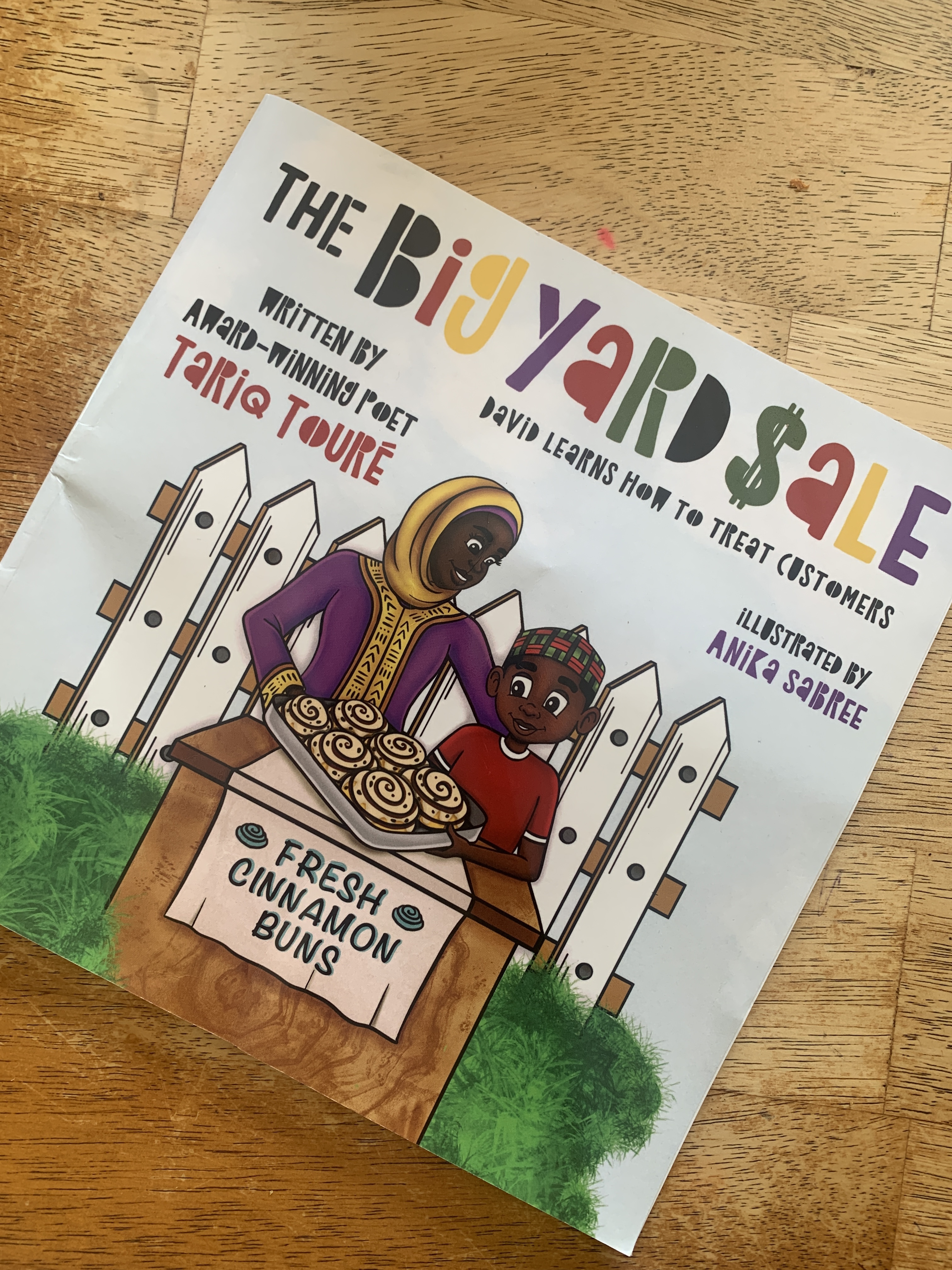
David Kareem is back and learning how to treat customers at his neighborhood yard sale.  The 26 page rhyming poem, turned children’s book (note there is little punctuation) is brightly illustrated as it follows David on his selling journey.   With Mommy’s baking and guidance on how to treat customers, his Saturday morning offers lots of lessons, mistakes, learning, and entrepreneurship for David and the reader alike.  There is a hint about a smile being charity, an Imam stops by, and David puts on a kufi.  It has good lessons and the same community vibe as the first book David’s Dollar, with visible Muslims in the illustrations and with Muslim names in the text throughout. But there was a page with two typos which disappointed me, a changing number of cinnamon rolls, and when the copy arrived it was pretty damaged and bent (probably/possibly not the fault of the author, but it cost $25 through the preorder Launchgood, so disappointing none-the-less, alhumdulillah you can now purchase it here from Amazon for $12).

David wakes up and hears commotion outside, he thinks he left a toy on, but soon realizes the neighbors have their stuff on tables and are selling things.  David wants in on the action, but can’t figure out what to sell.  He seems to gather up some toys and household items in the early illustrations, but ultimately it is about him selling his mother’s cinnamon rolls.  She is a baker, and is testing them out, but he says he only needs five and is off to peddle his wares.

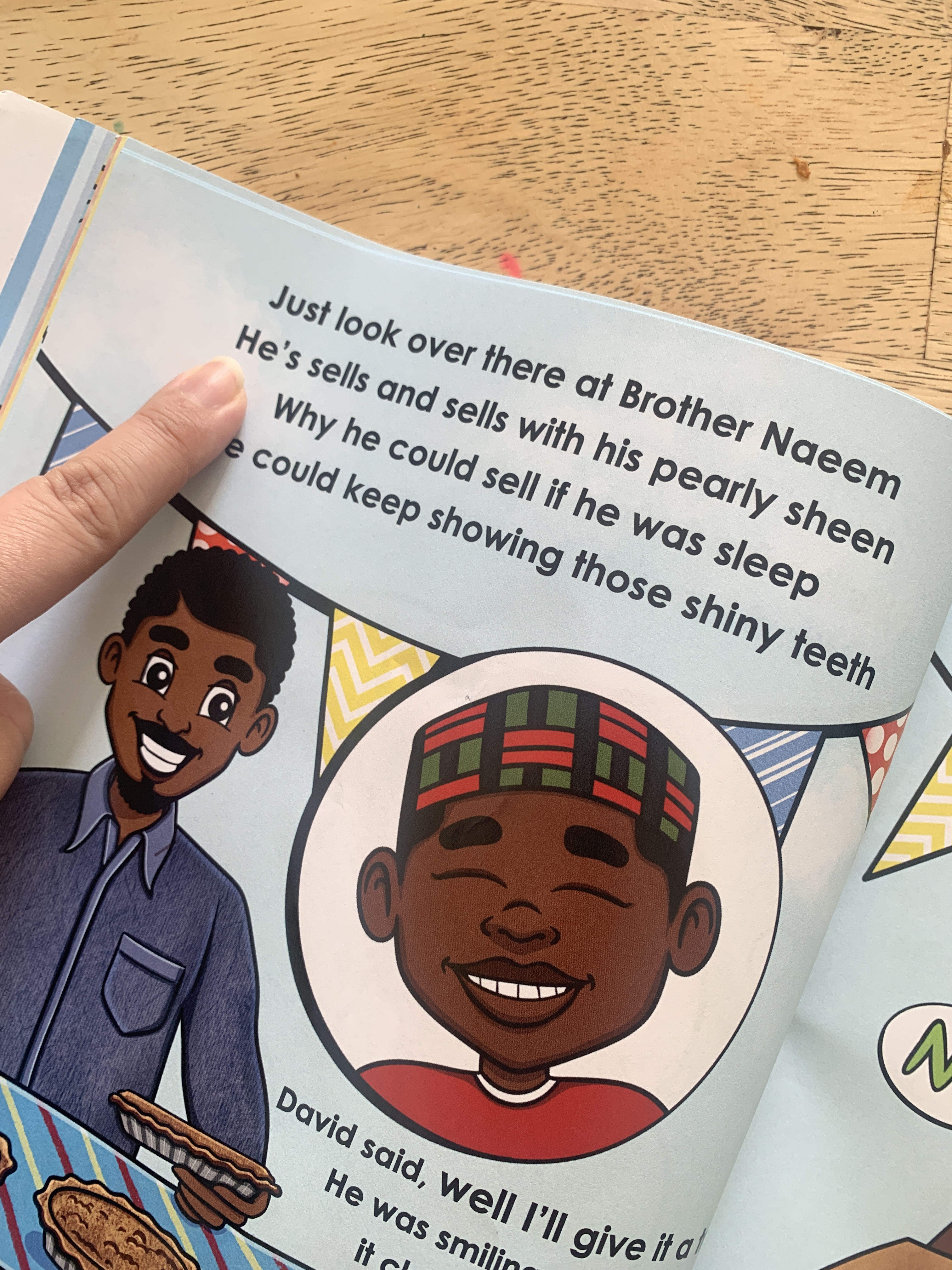
The first costumer comes, and leaves, he asks his mom what he did wrong, and she advises him to adjust his attitude by smiling.  They look at Brother Naeem as an example. The next costumer comes, but asks if he can warm up the now six cinnamon rolls in the illustrations.  David says no, and once again he turns to his mom to find out why.  She tells him that “the customer is always right” heads off to get a heat lamp, and uses Sister Khadijah selling beads for reference.  When Imam Musa comes, David completes the sale, but Mommy says he needs to learn gratitude.

img_9757

One page has “He’s” when it should be “He,” and “sleep” when it should be “asleep.”  I get the lack of punctuation is stylistic, but I don’t feel like these two on the same page are intentional, they just seem erroneous, and being that they are on the same page, makes it seem like the page was just missed perhaps in editing.

Overall I enjoyed the presentation, representation and content of this book and am glad I preordered it months ago. I wish it had a smidgen more Islam in it, but I think this book would be great in an early elementary story time with recently traditionally published books about business for a similar demographic, including the author’s earlier book, David’s Dollar. Teaching kids about entrepreneurship, ethics, gratitude and doing it with Muslim characters is incredible to see and important to share.

The Great Labne Trade by Eman Saleh illustrated by Eilnaz Barmayeh

Standard
The Great Labne Trade by Eman Saleh illustrated by Eilnaz Barmayeh

labne

My friend Noura, owner of Crescent Moon Store, said this book was good, so when I saw the amazing illustrations on the cover, I didn’t even look into what the book was about, I bought it and waited impatiently for it to arrive.  When it came I started reading it and thought ok, ok another book about lunch food that is perceived as “other” and the bullying that ensues with having a “smelly” lunch.  But the bullying never really came, and the book was suddenly not about being different, it was about entrepreneurship, and a mother’s love and support, and appreciating good food, and sharing culture, and raging against an oppressive system. Ok, so there was no raging, the book ended with determination and a following of the “rules,” in a very kid appropriate manner, but it was fun and a nice change from the typical storyline in rhyming children’s books.  There is no “Islam” aside from a boy named Ahmed and his sweet hijab wearing mother, but this book will result in smiles for kids preschool to early elementary and encourage business creativity and thinking outside the box.

img_5127

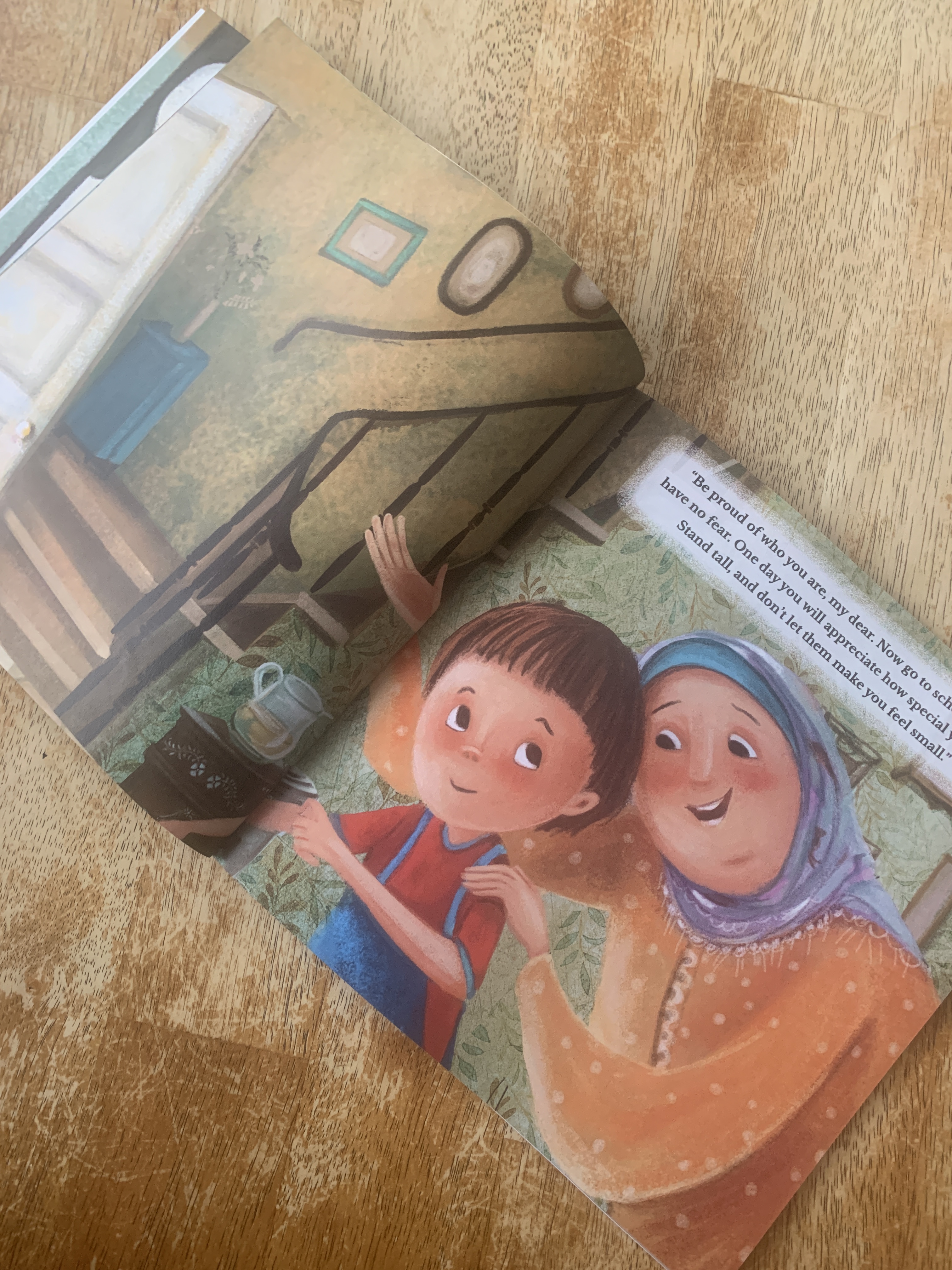
Ahmed is not thrilled to be taking a labne sandwich to school and would rather have a pb&j like everyone else. His mom encourages him to “be proud of who you are, appreciate how special you are, stand tall, don’t let other’s make you feel small,” and sends him out the door.  At lunch when the kids start to turn up their noses, Ahmed gets them to try the sandwich, and they love it.

img_5128

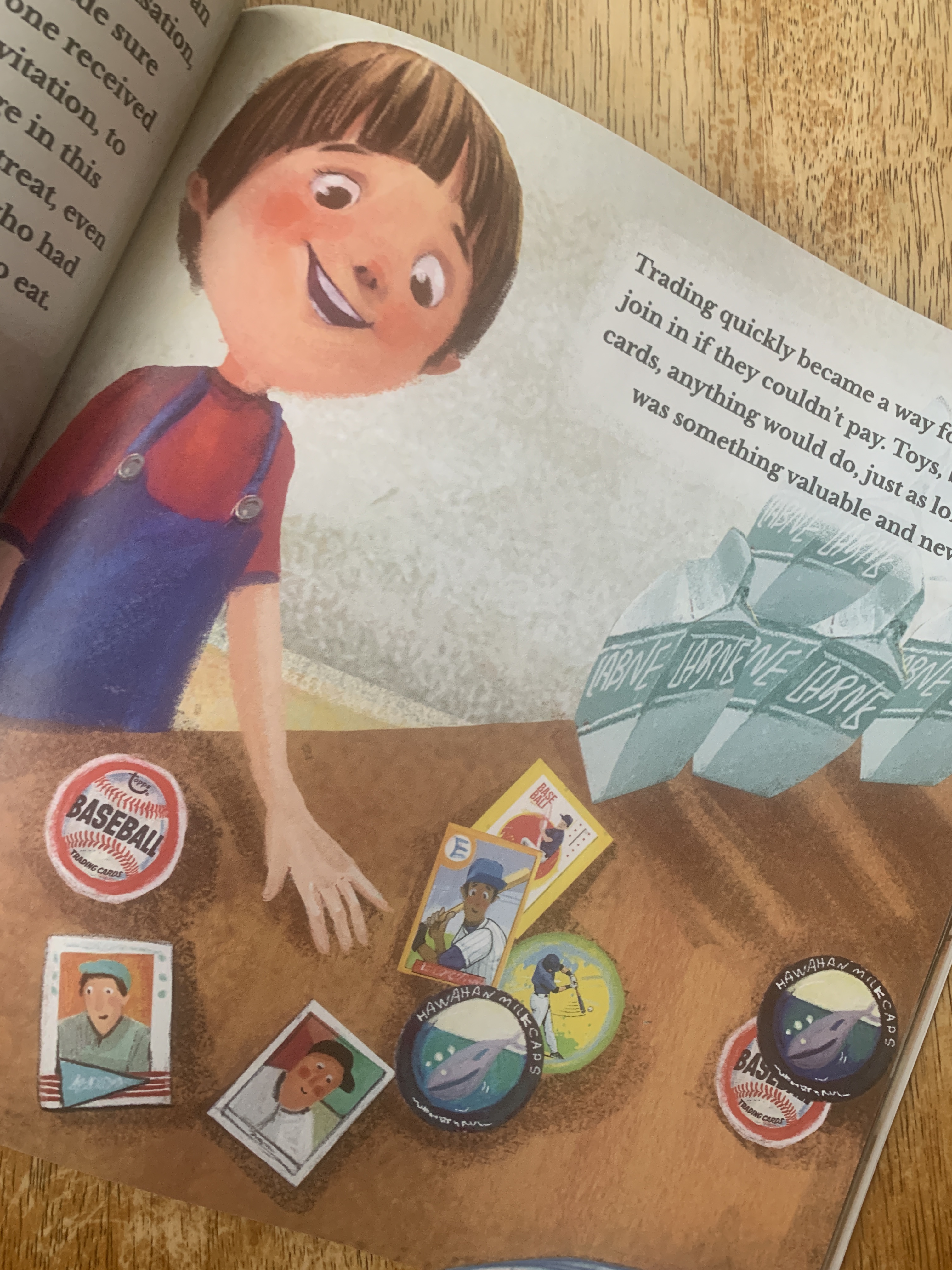
Ahmed gets an idea, maybe he can sell labne sandwiches to his classmates. Mama stays up late making them and Ahmed sets up shop in the cafeteria. He sets his price, and they sell out, so he increases the charge, and they are still selling. He also is open to trades for those that can’t pay.  Before you know it he is adding dishes to the menu.  Things are going well for entrepreneur Ahmed, until the lunch ladies have had enough and take matters to the principal.

img_5130

The 58 page book is not text heavy and the rhyme is fairly good, it is hit and miss at times, but the story is not hindered by it. I did feel like the book took a few pages to set the stage and get into the story. The initial timeline and the “smelly” lunch could be cleaned up a little, but once the business storyline presents it is smooth and enjoyable. And the illustrations, they are perfect for the story and for keeping Ahmed and his dream in your heart.

The book is available here at Crescent Moon or on Amazon.

img_5129