Tag Archives: Beautiful Illustrations

The Home We Make by by Maham Khwaja illustrated by Daby Zainab Faidhi

Standard
The Home We Make by by Maham Khwaja illustrated by Daby Zainab Faidhi

img_5134-1

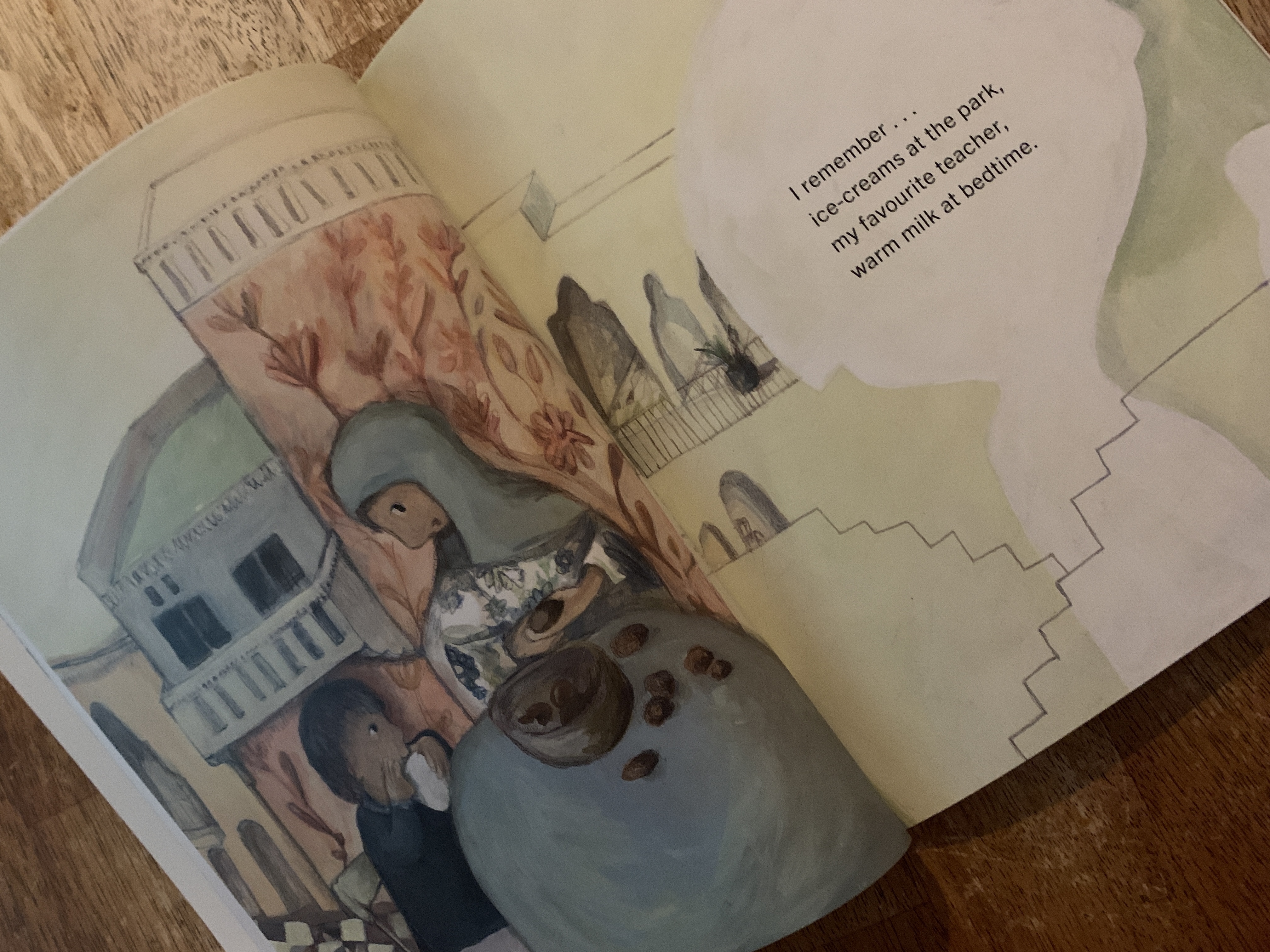
This 48 page picture book follows a family as they leave their home under siege and journey to America.  Through the eyes of the young girl the thread of what is home, where is home, and is it a place or a feeling weave through the emotional unknown that the family faces throughout.  Even once settled the feeling of security at home is threatened, and the family must persevere.  The little girl’s joy and hope that whatever comes will be faced together with her parents, keeps the book hopeful and at times even joyful.  The lyrical writing is occasionally makes the book feel text heavy, but because the reflection of memories and inclusion of emotions is used in conjunction with the story moving forward, I think elementary aged children with guidance will benefit from reading and discussing the book. As a former journalist, I truly believe one can research a topic and write an accurate story or an article presenting what they learned for others to benefit from.  At the same time as a lover of fiction, I enjoy OWN voice and the authenticity that it brings to the experience.  So, when I read the Author’s Note at the end, and found the author is not a refugee, and that there is no named sources of the author’s friends who are refugees, in fact there are no references whatsoever, I felt deflated.  It in some ways makes me uncomfortable that what looks much like a Syrian refugee story on the pages, is perhaps so mainstream, that a fictionalized account can be shared and accepted without authenticating it.  No country is named in the book, the author is an immigrant so there undoubtedly is a level of OWN voice, and she disclosed she is not a refugee- truly nothing “wrong” has been done, but nonetheless I feel like I should share that here for you to decide how you feel about it before reading the book.

The book starts with rockets falling outside a family’s home while they pack essentials in the red glow.  They then leave their home, and the house key behind as they start their journey. They begin walking past destroyed buildings, the girl’s school, branches that seem to not want to let them leave.  They arrive at the docks, spread the same blanket they once took to the beach during happier times, and wait for the boats.

There are not enough lifejackets, but her parents make sure she gets one.  As the boat bobs along, the young girl imagines astronauts in space and wonders if they too miss home.  The angels in blue vests get them from the boats to the camp, where they stay and wait, while they complete paperwork and dream of finding a new home. When that day comes, the goodbye is hard, but they board a plane to America with hopes and dreams.

img_5139-1

In America there is an apartment, help to learn the language, and reminders that they are lucky they have made it this far.  But, there are also people who do not want them here, that make them feel unsafe in their new home, and the family will have to work hard to find their place and make the puzzle pieces fit.

img_5140-1

The full illustrations bring the book to life, and compliment the text, establishing a tone that is seamless in conveying both fear and happiness on a kid appropriate level. 


Sajjadati and the Power of Dua by Ayesha N. Rahmaan illustrated by Laila Ramadhani Ritonga

Standard
Sajjadati and the Power of Dua by Ayesha N. Rahmaan illustrated by Laila Ramadhani Ritonga

img_7520

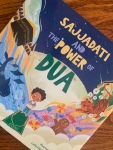
This 38 page large hard back picture book is absolutely beautiful: the illustrations, the tone, the thickness of the pages, all come together to create a child’s wonderment about the power of salah and dua with grounding in the actual parts of prayer.  On my first reading the imaginative “magical” aspects of the prayer rug, “Sajjadati,” was sweet and endearing, but as I thought about the story and then reread it, I had some concerns.  I know the book is meant for children, I know I am a reviewer and thus am over analyzing it, so I point the following out as a “heads up” so to speak, and for you to make your own decisions if the literal text will be misleading or if the overall mood of the book will be taken as loving dua and the closeness prayer brings one to Allah swt.

img_7521

The book starts with a little boy recalling when he got his green prayer rug from his grandma, that has his name on the corner (in the illustration it is centered on the top, not in the corner) and him naming the prayer rug, “Sajjadati.” The following page, same spread, then says,  “When I have Sajjadati with me, I can pray anywhere.  And when I pray on Sajjadati, I can go anywhere.” These lines give me pause, because even if the prayer rug is lost or not with him as he grows up, he is still going to need to pray. The importance of the prayer rug seems over elevated, albeit sweet, religiously a little unsettling.  The second of the two lines, about going anywhere, is also a bit of a gateway to the rest of the book and almost encouraging one’s mind to wander during salah.

img_7522

The next page gets back on track saying that starting to pray and saying “Allahu Akbar” leaves this world behind, the little boy says surahs he has memorized, and knows Allah swt is watching him.  He asks Allah for what he wants, and his imagination takes him on adventures after each salah. He imagines flying, and being a superhero.

img_7524

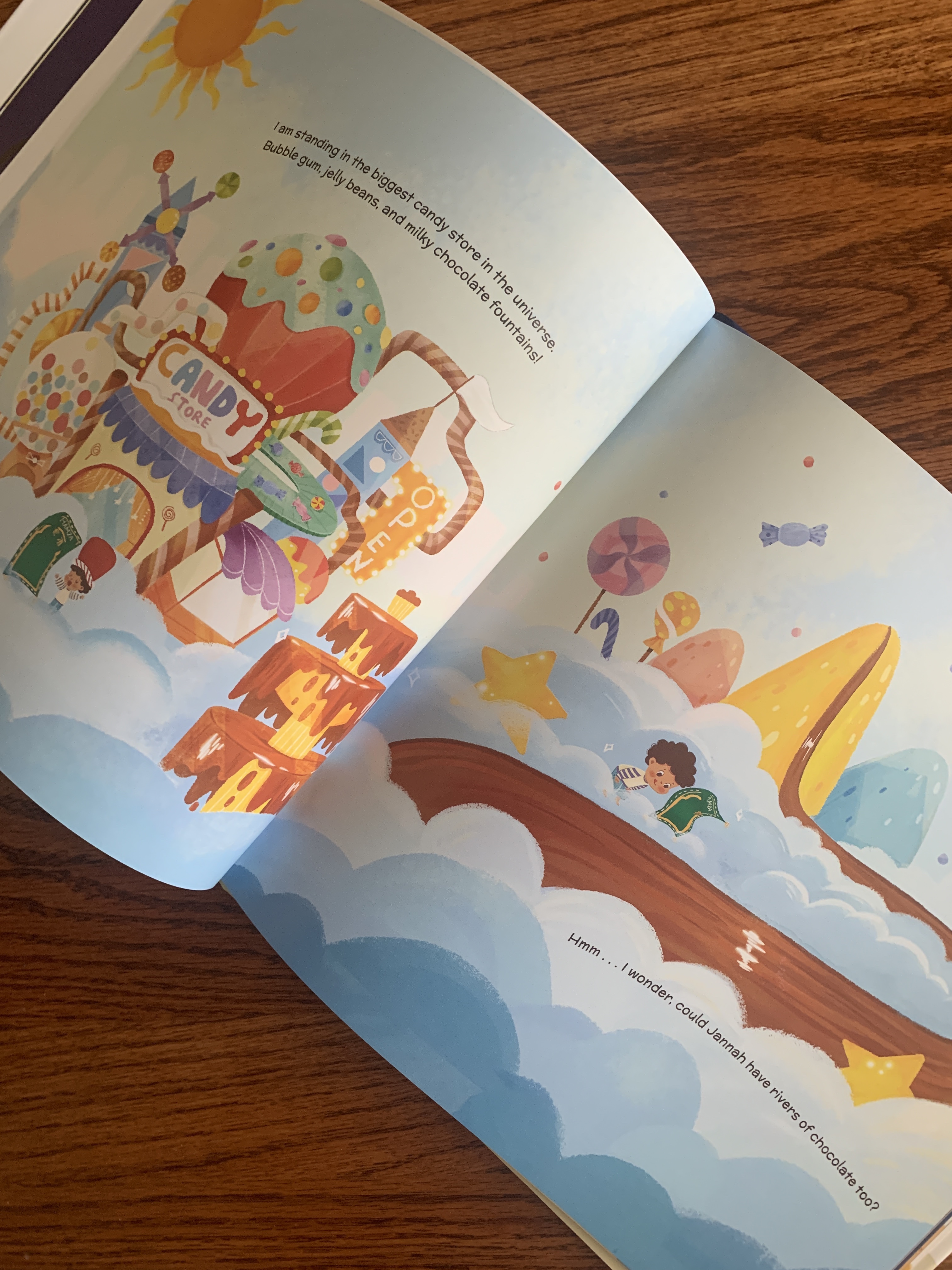
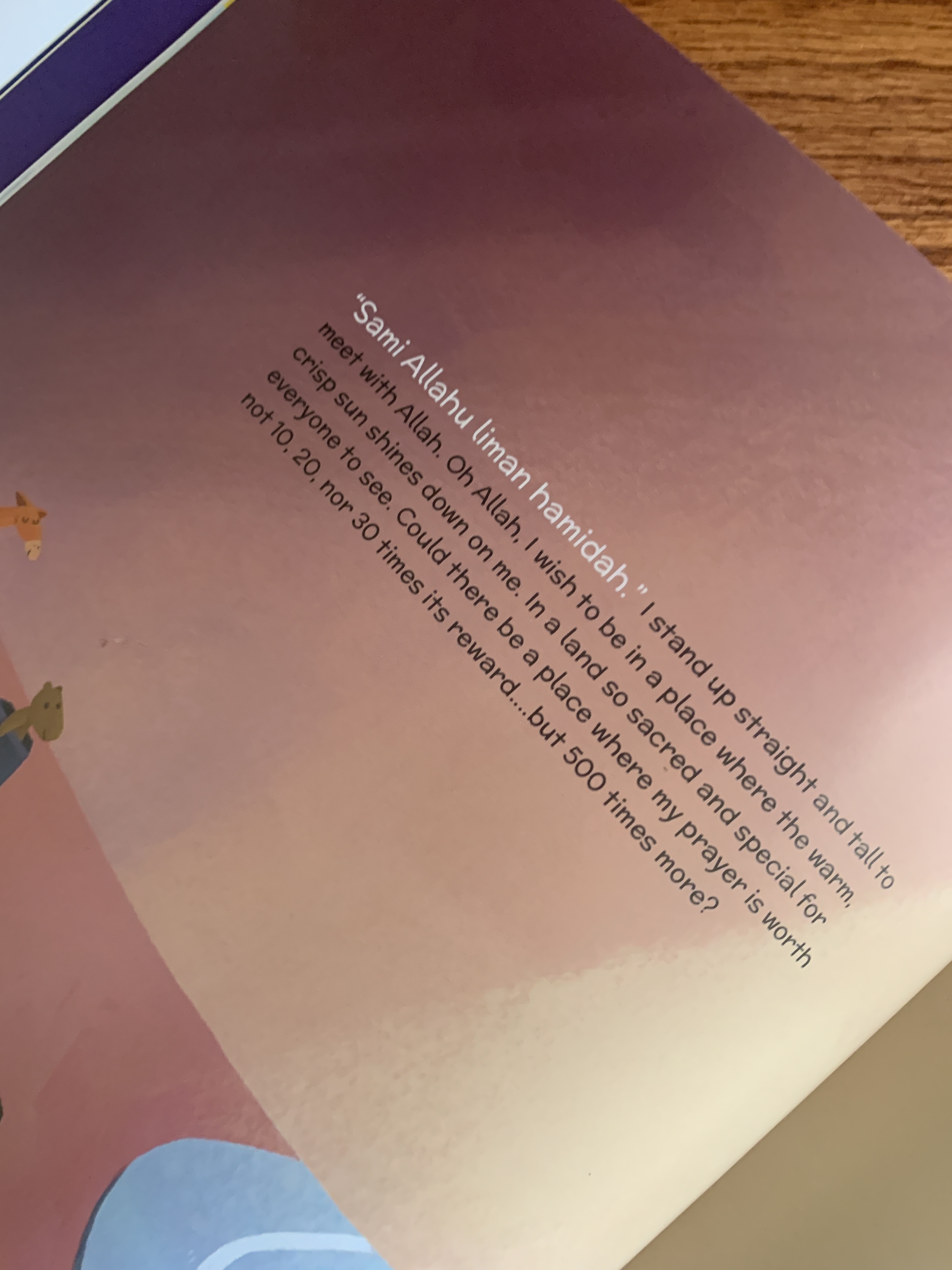
The story then returns to being in prayer, not after, and going in to ruku.  The text has him imagining he is in the “biggest candy store in the universe” wondering if Jannah has rivers of chocolate before standing up straight again saying “Sami Allahu liman hamidah,” and contemplating if there is a place where his prayers would be worth more and Sajjadati taking him to al-Aqsa.

img_7523

In sujud Sajjadati tickles his nose, but he doesn’t mind because he is closest to Allah swt in this position, and while he won’t let his “annoying little sister,” bother him, his mind does drift to being on a boat in the sea with seagulls squawking, “salaam.”

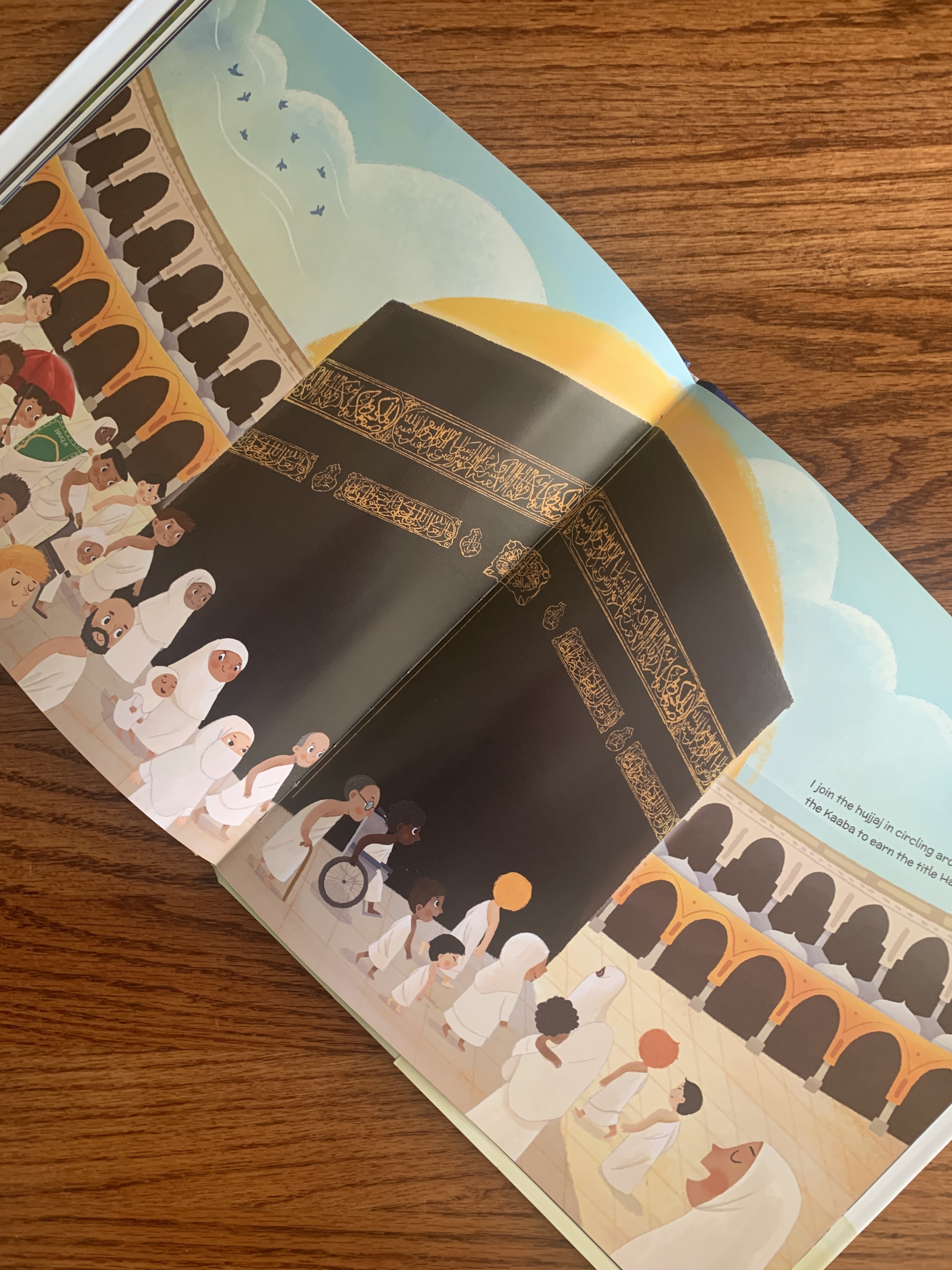
Hamza is then making dua for those suffering.  Since nothing is impossible when making dua, he is also asking for pets from the savanna, but knowing that Allah swt will provide what is best.  He makes duas to go for hajj and concludes his salah by folding up Sajjadati and finding peace in Allah swt being al-Mujeeb.

img_7525

I love the heartfelt framing of salah and the interweaving of both real and whimsical wants, as well as the sprinkling of facts about prayer into the story, but I honestly struggled a bit with the juxtaposition of the parts of prayer with the day dreaming elements.  I also struggled with the tenses, and find myself constantly rewording this review to reflect the book’s timeline.  Hamza is with his family, for example, hearing the current event news, while the next set of pages has him back making dua at the end of the prayer he started at the beginning of the book.  And the hearing the news and the praying for people is all being conveyed in the present tense, not clear if he recalled hearing about strife in the world and then made dua, or paused heard and resumed his prayer, it all seemingly happening at once, but that doesn’t really make sense. The title also says dua, not salah, and so much of the book is about prayer, that I feel like the two get conflated erroneously, and dreaming big during dua is different than having your mind wander during your salah.

img_7526

The book starts with an ayat from the Quran in Arabic text and meaning of the translation in English and concludes with a glossary and space to complete a Dua List.

If this book seems like a good fit for your young child, I ordered mine from Crescent Moon Store and you if you use my initials ISL (Islamic School Librarian) at checkout you’ll save 10%.

Salih by Inda Ahmad Zahri illustrated by Anne Ryan

Standard
Salih by Inda Ahmad Zahri illustrated by Anne Ryan

salih

This is an example of a picture book that should not be categorized as being only for children.  The passages of short simple text and the expansive illustrations that pull the reader in, combine to set a powerfully moving tone that holds you in it’s grips until the final page.  The names and hijab clad women could make this book a refugee tale with #muslimsintheillustrations, but because the author is Muslim, and the book so beautiful, I wanted to do a full review.  Some of the vocabulary is a bit advanced for younger children, so I think the best application of this book is not to hand it to a small child to read independently, but rather to read it to a child and let the words tickle their hearts while they immerse themselves in the pictures.  I look forward to sharing this book at story time to kindergarten through third grade.  I think the imagery, concepts, and emotion will resonate and open minds and hearts.

img_2168

Salih is like a turtle, he carries his home on his back. He and others are heading to the sea.  He tries to remember when things were better, and forget the bad times.

An old man shows him how to paint.  Salih shares this creativity with others.  Then he slips all the paintings into bottles and when he is on the rough sea, the bottles float away.

The storm rages, but then it calms, and land is seen, and hopes and dreams return.

We, collectively, have become numb, apathetic even, to the plight of refugees.  I have been trying for a while to get this book from Australia, and even though I am over a year late since its publication, it is still timely.  It will always be timely.

img_2170

We cannot be so arrogant to dismiss the plights and challenges faced by those in our world.  That is why I say, yes it is a children’s book, but people of all ages, need to be reminded.  It isn’t the worst of the worst incidents that need to only be shared, or the over the top happy stories.  We need to not let our hearts grow so hard. And this gentle book, with a sweet boy and turtle shell imagery has a lot of potential to remind us of the human element of global conflict.

Available to purchase in the USA here

img_2172

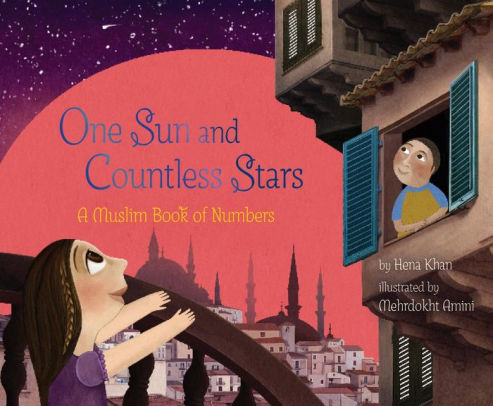
One Sun and Countless Stars by Hena Khan illustrated by Mehrdokht Amini

Standard
One Sun and Countless Stars by Hena Khan illustrated by Mehrdokht Amini

one sun

I don’t think that Hena Khan is necessarily a controversial figure, but some days her work feels very polarizing as some praise her ability to share OWN voice desi American Muslim stories while others feel like she waters down the very stories she is sharing to appease the majority.  Irregardless of our nuanced views, many of us first were made aware of her when we we were swept away in 2012 by the mainstream book, Golden Domes and Silver Lanterns.  Since then she also has published a book about shapes in the same format, and now this counting book that reminds me how beautiful and powerful it is to see Islam so unapologetically presented to all children.

Screen Shot 2021-11-10 at 10.25.04 PM

The author’s note at the end is important:

There are many significant numbers in Islam.  They include one for God, five for the pillars of the religion and daily prayers, seven for the circles pilgrims and visitors walk around the Ka’aba during hajj and more.

Mathematics and astronomy were among the intellectual pursuits of early Muslims.  They helped to develop algebra and used geometry to create the elaborate patterns found in Islamic art.

For this book, I chose concrete and illustratable terms rather than abstract concepts.  The representations for each number focus on things we can count in the world around us.

The book counts the diverse and global parts of a practiced faith.  The unique and the mundane, all beautifully illustrated and richly conveyed.  From cups of tea and shoes taken off for prayer to two hands making dua and four lines of a surah being memorized.  The book counts up to nine and then marvels at the countless stars that we see each night.

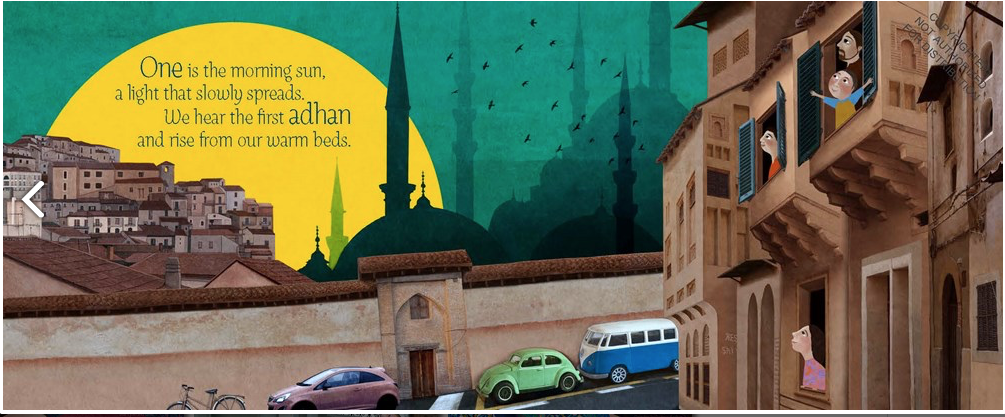
The first page is possibly a bit problematic in accuracy.  The tone and framing of starting the day with the sun rising and the sound of the adhan is warm and beautiful, but the adhan is not called at sunrise for the first prayer of the day, fajr.  Fajr begins at dawn.  There are only 21 words on the first page, so I’m inferring a lot about the correlation of the sun and athan that may or may not be present.  It is something frequently misrepresented, so it catches my attention. And yes, the seven tawafs mentioned in the author’s note would also apply to umrah, not just hajj.

Overall, the book is lovely and will remind many of us what made us all celebrate Hena Khan and her stories so many years ago.

Mustafa by Marie-Louise Gay

Standard
Mustafa by Marie-Louise Gay

mustafa book.jpg

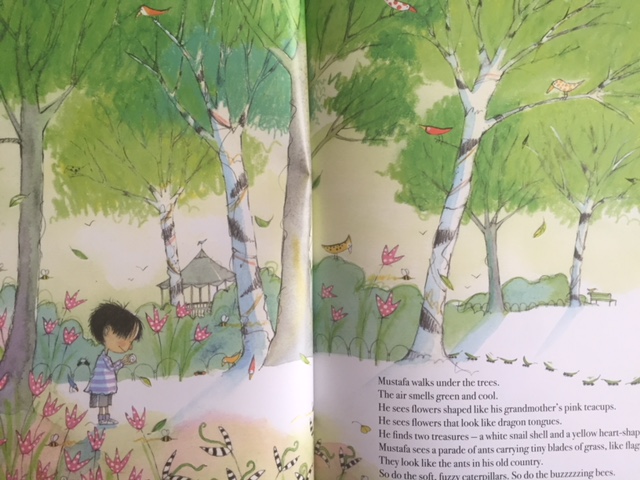
This 40 page book caught my attention because I have a son named Mustafa, and the illustrations looked endearing and fun.  The author/illustrator was inspired to write the story when she visited Croatia and saw the resilience of the children.  She also remarks on her website, that children in new places can all relate to the nuanced uneasiness and gradual fitting in process that takes place universally (http://marielouisegay.com/blog/).

IMG_1816

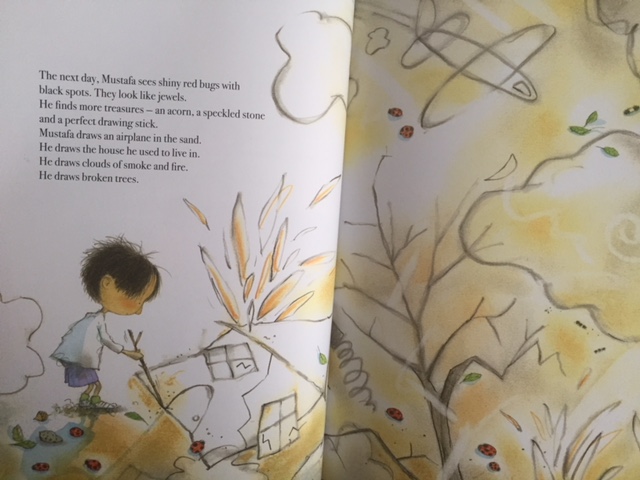
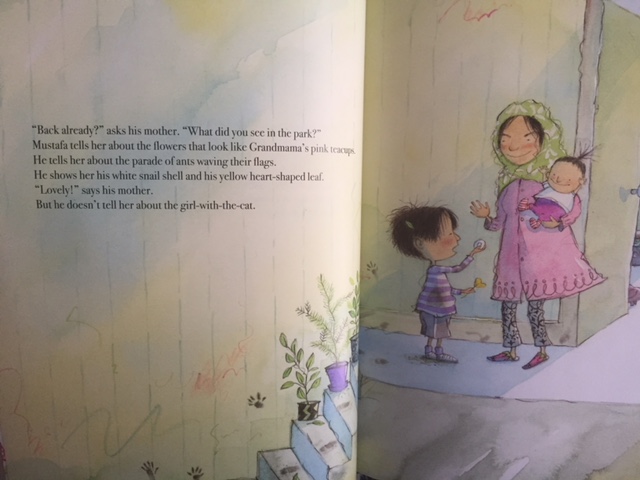
The text is prose-like as young Mustafa ventures from his apartment each day to the park nearby.  He notices things he has never seen before and compares them to the destruction he recalls of his homeland.  He also finds things that remind him of home and things that look familiar. From little ladybugs and a heart-shaped leaf, to the changing leaf colors and kids dressed up in costumes, there is so much to take in and understand.

IMG_1818

As the days go on, he begins to wonder if he is invisible.  Finally, a little girl with a cat makes a small beckoning gesture to him that doesn’t need language to be understood, and just like that, the world gets a little more welcoming.  This gentle story shows what being new can feel like, and reminds us that sometimes all it takes is a simple act of kindness to change so much.

IMG_1820

The book mentions that Mustafa came on a long journey, but does not specify where he has come from.  He draws his house being bombed in the dirt with a stick and mentions loud noises and fire.  The mother wears hijab, and obviously his name would identify them as Muslims, but other than that there is no reference or mention of religion.

IMG_1817

Overall, the book would be great for ages 4-8.  The passages are a little long, but with the illustrations and relatable concepts, I think children will reflect on what the author is trying to convey, and be able to process what Mustafa has been through, and how hard even the littlest things can be in a new place.

Yo Soy Muslim: A Father’s Letter to His Daughter by Mark Gonzales illustrated by Mehrdokht Amini

Standard
Yo Soy Muslim: A Father’s Letter to His Daughter by Mark Gonzales illustrated by Mehrdokht Amini

yo soy muslim

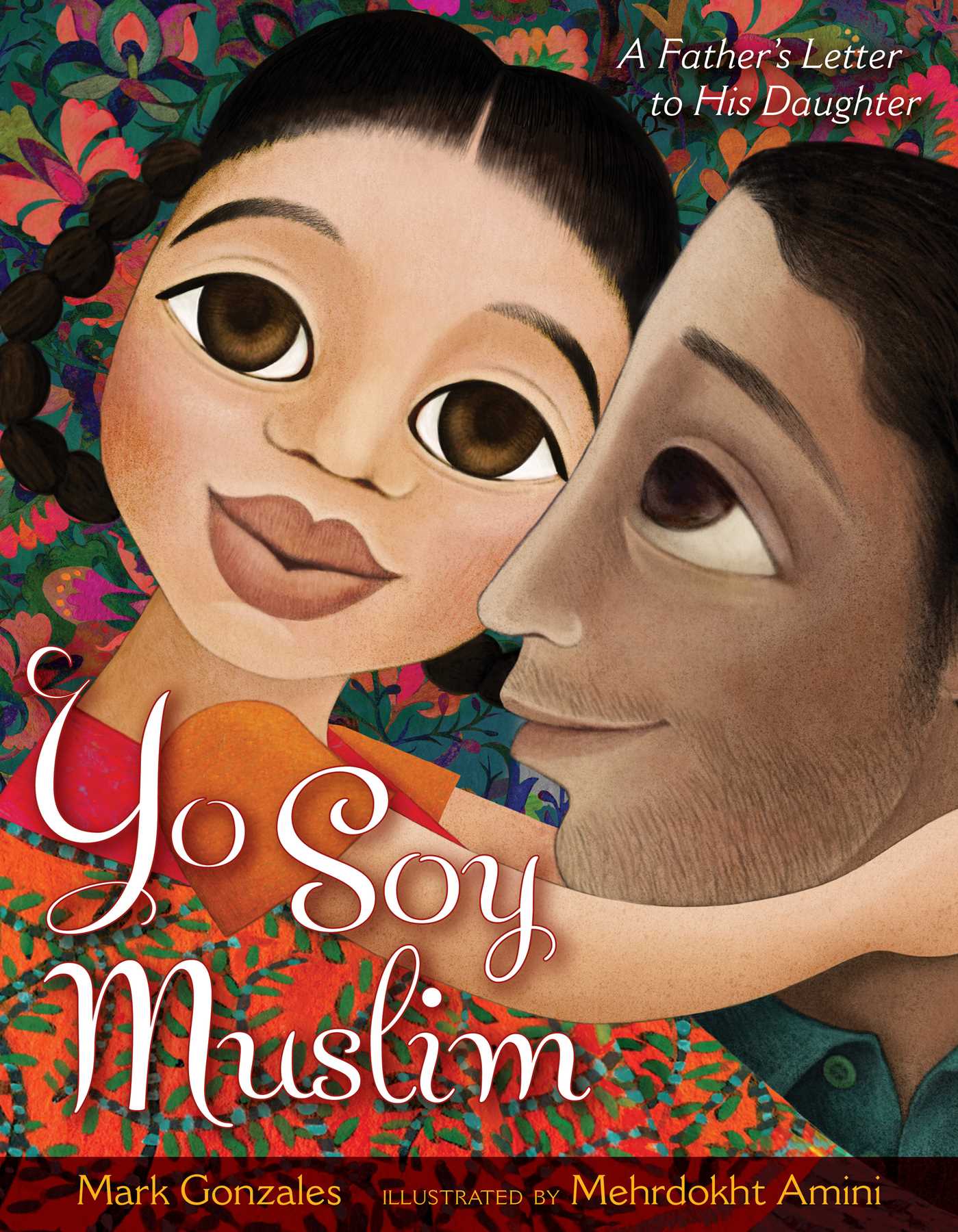
I feel like I preordered this book years ago, I have been so anxious to see what all the hype was about. When it arrived I tore open the box and read it on the short walk from the mailbox to the house, read it again standing in the kitchen, left it for a few days, and reread it now to write the review. SubhanAllah, it didn’t disappoint.

yousoy4

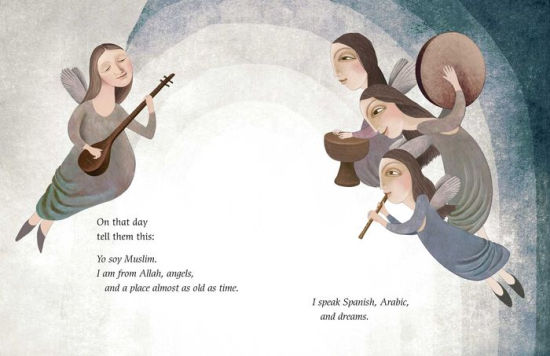
It reads, as intended, as a powerful letter to a child.  There aren’t long winded morals or overly fancy words. It is direct in its many ways of telling you, that you matter, where you come from matters, that your foundation matters. That you are strong, and beautiful, always, even when the world may not think so. That you are Muslim, that you are from Allah, that you speak in Arabic and Spanish and dreams.  The verses become poetry that dance on the page with the illustrations telling the story as powerfully as the words.  The words in turn float and lilt around images as old as time and as innocent as dancing in the wind.

soy

The 32 pages fly by that you can’t help but read it again, slowly, savoring all the harnessed power and hope of a multi culture world, a multi cultural faith, that is truly beautiful.  Recognizing the humanity that we all share, yet feeling pride in your own unique skin is a balancing act that doesn’t need to be apologized for, and should be celebrated.
yo soy2

I love that this book exists.  That it is available on Amazon.  That it is bold and colorful and hardbound, and so well done.  There is diversity in Islam.  There is diversity of belief in Indigenous populations, that there is so much inspiration in the world around us and in our past.  Are all messages that come through even for the youngest readers.

yosoy3

yo soy1


Allah Created Everything by C. Alta

Standard
Allah Created Everything by C. Alta

allah created everything

The version I have is called Allah Created Everything, but it seems that the more common edition is God Created Everything, regardless the book is beautiful, timeless, and a perfect book for story time with the little ones.  The simple words and beautiful illustrations are the perfect level for Daycare through Kindergarten students.  They can gaze at the pictures and absorb the simple text, and even participate in a powerful conversation after about how Allah/God created us all, and everything around us.

The Blades of Grass,
The Oceans and Seas ,
The Rocks-
The Soil-
The Beautiful Trees,
The Majestic Mountains That We See,
Allah Created Everything.
The Dog-
The Cow-
The Whales-
The Birds, The Spiders and Bees,
The Wild-
The Tame-
Allah Created Everything.
The Sun,
The Moon,
The Rainbow-
The Clouds, Tornadoes, Volcanoes,
Lightning Shattering the Skies.
People of the World,
Shapes-
And Colors We See,
Allah Created Them
Just like You and Me.