Category Archives: ramadan

Boy vs Girl by Na’ima B. Robert

Standard
Boy vs Girl by Na’ima B. Robert

9781847801500.jpg

I read this book a few years ago and was blown away that Islamic fiction could explore these topics compellingly in a YA package.  I remember loaning out the book to a mom with middle school kids to see if she could tell me how accurate the storylines were.  Yeah, I never got the book back, and never got the feedback, and the book slipped my mind and thus I never wrote a review on it.  Fast forward to last month and I’m trying to find a middle school book club selection and I can’t believe that I don’t have a blog entry of this book to look back on.  Clearly, this shows why 1- I don’t loan out books anymore and 2-Why I have a blog, cause I remember nothing about the flags, relevance or appropriateness of the book, thus I bought another copy, read it, and am now documenting my thoughts.

The book is 260 pages and an AR 5.3, but the drug use and violence I’d say would warrant an older reader, 9th grade and up perhaps.  And while by the end, the book leaves a pleasant taste in your mouth and you would place it back on the shelf in a contented manner, I would be misleading if I didn’t confess that it took much self motivation to pick the book up and keep reading more than once, that it honestly took me a month to read.  The last third was hard to put down, but you have to get through a fair amount of frustration, stereotypes, and extremes to get there.

SYNOPSIS:

Sixteen year old twins Farhana and her brother Faraz live in London and are incredibly different from one another.  Farhana goes to a school where she excels both academically and socially.  She is queen bee, beautiful, and articulate.  Faraz on the other hand, goes to a different school and doesn’t really fit in anywhere, but in the art studio.  One thing that unites them, however, is their determination to grow and learn about Islam this Ramadan, and their home environment of a large extended Pakistani family that places culture above religion.

Both twins are close with the “black sheep” of the family, their Aunty Najma, a niqabi rebel set on marrying a white convert.  But, both twins have their own stresses as well.  Farhana has recently called it off with a boy named Malik, but isn’t really over him and Faraz has gotten himself involved in a street gang to find a place to belong, but the stakes are getting higher.  Both twins on the eve of Ramadan and with the coaching of their Aunt are determined to get their lives straightened out, fast properly, reconnect with their faith, and with each other.  They do, alhumdulillah, however, the spiritual high only lasts so long, as earlier decisions come back to haunt them.

Farhana makes the bold decision to start wearing hijab, but once the novelty wears off, she starts to question her choice.  It isn’t helped by her mom who is very, very against the need to veil and makes it difficult for her daughter.  Faraz meets some street artists at the masjid and while it looks like he could find a place to excel, his alliance with a gang, also comes with enemies from rival crews.  Physical fights and drug runs have him out at all hours of the night and the priority of fasting and praying fade as the the pressures of not getting killed or caught prevail.

As each kid has their ups and downs, and the parents prove to be out of touch with the lives of those in their homes, tidbits of Islam come through, but unfortunately so does a lot of cultural dogma that isn’t always clarified or pushed back on, making there a lot going on in this book, and making me wish it was a just a bit longer and more fine tuned.

WHY I LIKE IT:

The book, I could argue set the foundation for the amazing pieces of literature currently available.  Published in 2010, the book really was a first of its kind.  Written by a Muslim, unapologetically written for Muslim and non-Muslims, and available in the mainstream.  The book tackles real issues, but seems to fall into stereotypes too.  That Farhana covers and is so beautiful, she looks like Aishwariya Rai, the Bollywood actress, why would she cover.  Malik decides to figure things out and wait for her, ahhh, so sweet.  There’s the rebel Asian girl who gets a lot of page space early on for her incredibly minor role, going on about Asian Girl Bachelor Parties and hooking up with everyone and anyone. There is the best friend who is religious and the Imam’s daughter and is also chubby.  The nice brother at the masjid who saves the protagonist.  I don’t know, they all seem predictable.  What I like about fiction is it allows Muslims to be seen in shades of gray not just black and white, and while this book tries to do it, I feel like only the main characters are allowed to grow and change, the minor characters hold on to their positions so resolutely that, they kind of seem dry.

I like that the tables on hijab are switched up, it isn’t the parents that want the girl to cover, but rather the girl her self, and some of the conversations about hijab and Farhana’s choice to do it compared to her friend who is forced allow for some powerful moments.  I also like, that she has doubts soon after opting to wear it.  I wish some religious reasonings were brought in to her understanding of hijab, but the aspects of choice and how to wear it, are present.  I’m grateful that Faraz’s storyline takes most of the action, so that it isn’t a romance novel, with Farhana pining relentlessly for Malik.  I had hoped for a little growth from the gang head, Skrooz, especially after Aunty Naj sheds some light on him, but his criminal act at the end after showing Faraz his cousin or maybe it was his brother seemed a bit off.  Again, it was only to benefit the protagonist, not to show that we all have our own battles.

The parents and extended family are irritating to say the least. To the extent of delaying iftar to get the food to the grandmas house and then serving the men first, like really? I don’t think so.  There is nothing that says the women have to eat after serving everyone else in religion and that is never challenged.  Yes, Farhana challenges her mom’s notion of women not going to the mosque, but the food bugged me.  I am Pakistani American, and the culture has its flaws, but the presentation in the book, is one big wide stripe of female oppression, which isn’t fair either.  Absolutely, their are families that the women cook all day and then eat in a corner, but I feel like the staging of this book as “authentic” either needs to show variation, or account that this is how one family views it, not that it is universal.

FLAGS:

There is talk of casual sex, physical violence with knives and fists, details about drugs: cocaine and heroin.  None of it is celebrated, but it is present and very much the norm in how it is presented.

TOOLS FOR LEADING THE DISCUSSION:

I still sway back and forth on if this could be done as a book club selection, and in the end I would opt that no it can’t.  Not for the drug use, or boy girl relationships, but ultimately for how the backwards and closed minded the Pakistani culture is presented as being.  If the group was high school Pakistani heritage kids maybe, but I think Arabs and non Muslims in general will not think very highly of the culture after reading this book, and I think that is a disservice to be promoting in a book club selection.  


A Moon for Moe and Mo by Jane Breskin Zalben Illustrated by Mehrdokht Amini

Standard
A Moon for Moe and Mo by Jane Breskin Zalben Illustrated by Mehrdokht Amini

IMG_1514Based on the release date of this book (August), I preordered it in the Spring with the Peg+Cat book thinking they were both about Eid al-Adha.  Oops.  As someone who reads a lot, I really need to learn how to read.  This book is not about Eid al-Adha, it actually mentions Ramadan, but just as a context point, so rather than wait til next Ramadan to post the review, I though, lets do it now and celebrate how much we all have in common and build bridges of friendship across religious lines during this blessed month of Thul Hija.
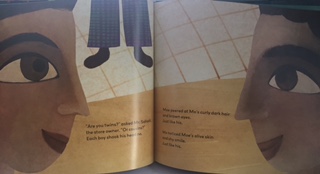
Set in Brooklyn, New York, Moses and Mohammed live on opposite ends of the same street.  One day they accompany their moms to a store in the middle of the street, and when the boys start touching things they shouldn’t their mothers’ reprimands reveal their shared nickname, Mo/Moe.  

IMG_1520

The boys then pause to look at each other and notice the same dark hair, brown eyes, olive skin, and shy smile.  Add in to the mix that one of them has a bouncy ball, and the boys become quick friends, while their mothers shop.

IMG_1519

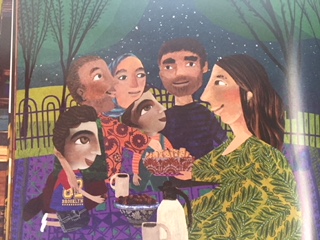
The boys hope to see each other again, but don’t.  Weeks pass, and the Feldman family is busy getting ready for Rosh Hashanah and the Hassan family is preparing for Ramadan.  Another chance meeting happens at the park, and the boys are thrilled.  The mom’s are seen chatting and then, the boys are missing, and the moms are panicked.  They are found playing in the dirt, but the relief from the moms, bonds the families who plan an evening picnic together.

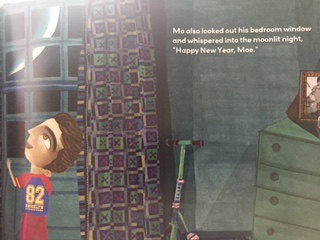
The book concludes with the boys in their own homes looking at the same moon and wishing each other a blessed Ramadan and Happy New Year to themselves.

IMG_1516

The book reminds me a lot of Yaffa and Fatimah, Shalom, Salaam, in the way the two characters, one of Jewish faith, and one of Muslim, occupy the same environment and come to know and appreciate one another as friends.

IMG_1517

The illustrations are by the same artist that illustrated Hena Khan’s color and shape books, and they are vivid and fun.  I’ve read the book a few times, and flipped through it a few more times just to marvel at the pictures and the world of these two sweet families.

A great book, that I hope to use in an interfaith story time when the opportunity arises!

IMG_1518

Sidenote, the shop keeper is the nicest one ever, he gives the boys taffy, and warm falafel, and doesn’t scold them.  The book mentions a few foods and at the end of the book there is a factual paragraph about the holiday and a recipe to try.  There is also an Author Note and Illustrator Note at the end of the 48  page book.  The book would be perfect for 5-8 year olds, but younger kids and older kids will enjoy the book as well.


Zaydo Potato: A Muslim Superhero by Randa Taftaf and Maz Galini illustrated by Lovyaa Garg

Standard
Zaydo Potato: A Muslim Superhero by Randa Taftaf and Maz Galini illustrated by Lovyaa Garg

img_0531.jpg

This is the second review of a Zaydo Potato book on the blog, and much like the first book this one caters to toddler and early elementary aged children who will enjoy the large colorful pages, the silliness of finding a potato on each page, and who can benefit from the repetition of events to understand a concept.  In this 32 page book the concept being conveyed is taking care of each other, as established by the hadith at the beginning of the book.

zayd

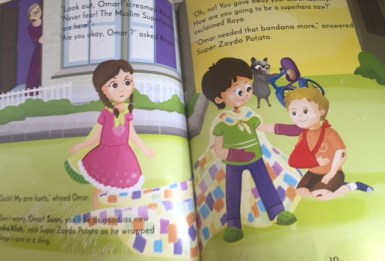
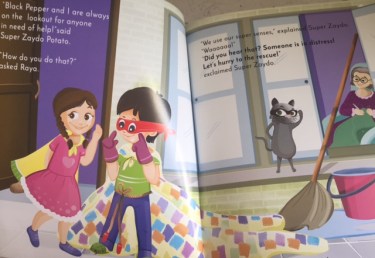
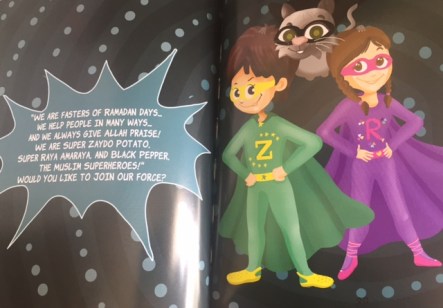
Zaydo and Raya dress up as superheroes, but find their power in saving the day involves using their capes, and masks, and belts, and gloves, to help those around them who can benefit more. They use a bandana to sling a hurt arm, a towel cape to cover a spill, and silly gloves to make a baby stop crying.   They call themselves Muslim Superheroes and after showing the reader that it is good to help one another, praise Allah, and do what is right, they ask if you want to join their force.

zayd2

I read the book to my own children and then to a group of about 25 kids under the age of 6 and it went over pretty well.  The amount of text on a page is sufficient to convey the repetitive scenarios.  Honestly, I don’t really understand why the book takes place in Ramadan.  Other than the first page saying that they are the fasters of Ramadan days, and the last page repeating it, there is nothing Ramadan specific about the story.  In fact the Grandma is drinking tea on the first page, so yes maybe she is excused, but it is a bit confusing to have the Ramadan element in there when it is not a facet of the story at all. 

zayd1

The word ‘super’ is used a lot, and if reading it aloud can get your tongue a bit tied.  I also don’t understand why Raya has a last name or second part to her name, Raya Amaraya, maybe to go with the rhyming of Zaydo Potato? Either way by adding super, before their names, and the rhyming second name, I felt like a lot of the book was just saying names. The only other critique of an other wise solid book about teaching kids how to truly be super in a practical way, is that the Grandma is in a lot of the pictures in the background sewing so that when she surprises them with real costumes, the kids can enjoy going back and see she was working on them the whole time.  Except I thought, my kids thought, and the story time kids all thought she was knitting, and the costumes don’t look knitted, so it is a bit jarring.  On closer inspection there is just one needle, not two, but it is really large, almost crochet hook size, so a sewing machine illustration would have been a much better choice.
zayd3

The activities and lessons at the end and the founding premise of the book really make the book an important one to share with your little ones.  The binding and glossy pictures of smiling children having fun will entertain and educate them at the same time.  My critiques are small, but I feel like a few test readings by the authors, and the minor quirks could have been eliminated all together.  

zayd4


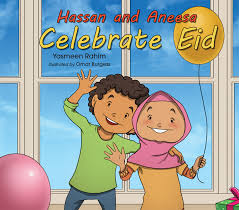
Hassan and Aneesa Celebrate Eid by Yasmeen Rahim illustrated by Omar Burgess

Standard
Hassan and Aneesa Celebrate Eid by Yasmeen Rahim illustrated by Omar Burgess

hassan.jpeg

So, cute, mashaAllah, I remember last year when I read about these two siblings celebrating Ramadan how pleasantly surprised I was by their relatable sweet story, and once again, I am thrilled that such a little book packs so much information in a fictionalized story to smile at.  Really its size is my only criticism, the book is tiny in size at 7 inches by 8.  The length of 24 pages is fine, its just hard to read it to a group, and really is only ideal for bedtime (not that I won’t read it to a group of kids, its just hard).  Even the price is fabulous, alhumdulillah, and also available in the public library.  Overall, the book is pretty sweet.

handa

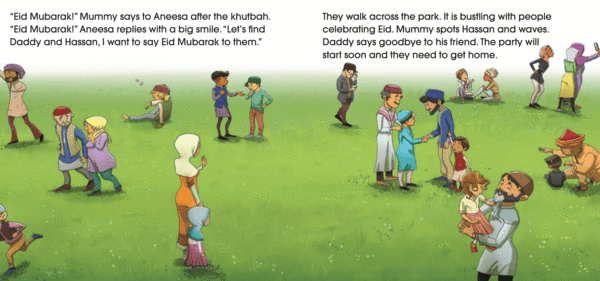
Hassan and Aneesa are getting ready for Eid after a month of fasting.  Their parents are having a party so there is a lot to do to get ready, cleaning, cooking, sampling food, and wrapping gifts. The morning of eid is chaos with everyone running around (so relatable)!  They finally are out the door and heading to the park to pray outside, following Prophet Muhammad’s example.  They listen to the imam give a speech about sharing food and then its off to hug everyone and wish one another an Eid Mubarak.

handa1

When everyone heads to the siblings home, you see kids having fun, dad cooking, and presents being exchanged.  After everyone leaves, they take food to the neighbors, as the imam reminded and the fictional family concludes a wonderful eid that they don’t want to end.

anda2

There is a glossary at the back and the pictures are colorful, bright, and expressive.  While there isn’t a plot or any character development, the situations the kids find themselves are relatable.  The joking that Aneesa will help her mom by sampling the food, and the picture at the end of the kids playing in a messy room with the parents passed out from exhaustion on the couch is pretty fun. 

handa4

There are a few books out there that timeline an eid day, but this one does it well. Kids two and up will enjoy the excitement and feel ready to celebrate eid themselves.  It shows the holiday as fun and desirable and something to look forward to.  Because the kids are in a handful of books, it also does create some identity confidence, as kids see themselves in the various situations that Aneesa and Hassan explore.

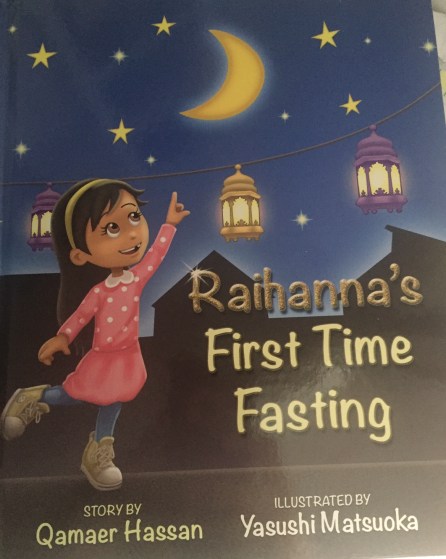
Raihanna’s First Time Fasting by Qamaer Hassan illustrated by Yasushi Matsuoka

Standard
Raihanna’s First Time Fasting by Qamaer Hassan illustrated by Yasushi Matsuoka

FullSizeRender (94)

By this time in Ramadan I’ve read a lot of very similar books that all seem to have slightly different takes on presenting the basics with various degrees of turning them into a fictionalized story.  Each have their own flavor and approach and this story in many ways is for mature little kids and works to bring a slightly deeper understanding to Ramadan and helping the less fortunate.  At 36 pages long, most of the pages are heavy on text, but not overly preachy or dense.  Dialogue and emotion fill the paragraphs, and the book works to establish Raihanna as an actual character, not just a foil to move from one Ramadan fact to another. This is also apparent, as a new Riahanna book has just come out, Raihanna’a Jennah, in making her the lead in a series.

FullSizeRender (95)

Raihanna is excited to be fasting this year, after establishing that the crescent must be sighted and that suhoor is the meal to start the fast, Raihanna puts on her hijab to pray.  She asks for forgiveness for being deceitful to get another cookie and asks Allah to make her and her friend able to go ice skating.  At bedtime it also mentions that she says her three kuls before going to sleep.  

FullSizeRender (98)

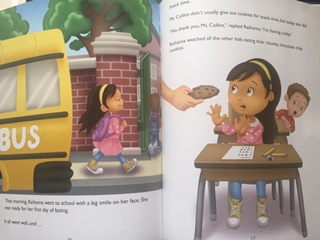
All her excitement starts to falter at school, however, when the teacher hands out chocolate chip cookies for snack and Raihanna has to explain she is fasting.  By the time she gets home from school she is not sure she even knows why she is fasting as her stomach rumbles and her mood is pretty sour.  Mom jumps in to action and takes her to a soup kitchen where the two of them, along with others, serve food to the homeless. 

FullSizeRender (97)

At iftaar time Raihanna understands how blessed she is to be surrounded by family and food, and makes a more heartfelt dua.  The book ends with letting the reader know that Raihanna spends the next 29 days loving Ramadan and being appreciative.

I love that it really picks one specific aspect of Ramadan and focuses on it in a tangible way, the poor and hungry.  Yes, she prays and recites Quran and all, but establishes that she probably does that every day out side of Ramadan as well.  I like that the author also shows that it is ok that Ramadan is hard.  There is a bit more insight and understanding in this book than just the typical list of facts.  I think ages kindergarten through 2nd grade, kids that are starting to fast will get the most of it, and relate the most to Raihanna.  It could work for non Muslims, with a bit of context of belief or just read a different Ramadan book first, but the target audience is Muslim kids.

FullSizeRender (96)

The beautiful cartoonish pictures are bright and engaging.  I have no idea why it bothered me that the characters wore the same clothes everyday, or at least the two days that the story covers, but it kind of did. I like that the dad sets the table and helps in the food prep and parenting.  The list of family members and all the dishes seems unnecessary, but with the glossary at the back it does offer a bit of culture to be conveyed.  There is also a little reader response at the end.   

Ramadan Around The World by Ndaa Hassan illustrated by Azra Momin

Standard
Ramadan Around The World by Ndaa Hassan illustrated by Azra Momin

IMG_0251

I started this blog because I know the value fiction can have in empowering and exciting people when they see themselves reflected in story lines.  As Muslims, it is a needed tool both for our own children and for teaching other children about us.  So, imagine my surprise when I felt my back straighten up and a smile stain my face for a long while after I finished reading this beautiful book about Ramadan traditions all over the world.  Not because it showed so many beautiful Muslims from rich colorful backgrounds sharing the common bond of loving Allah in Ramadan, that was expected.  Nor was it for the diversity of skin tones, and cultures, and ages, and head coverings, throughout.  No, it was because there are characters with autism, and one that is hearing impaired, one in a wheel chair, and a little girl with diabetes who cannot eat all the candy, just a few.  I didn’t realize how strong that notion hit me.  Me, an adult, a type 1 diabetic since I was 11, there in print, in a book about Muslims.  Yes, I may have had tears, I might still as I write this review.  It is powerful people, to see yourself in a fictional character, at any age.  May Allah swt reward all the authors out there writing books for our children to feel proud of who they are, one beautiful page at a time. You are making a difference.

FullSizeRender (90)

Emotions aside, this book is wonderful in and of itself.  It starts with the moon telling a bit about how Ramadan is fasting from sunrise to sunset, doing good deeds, being kind, and how it is celebrated all over the world.  The moon then takes us on a journey to twelve countries: The US, Turkey, Mexico, Brazil, Australia, Scotland, Malaysia, Egypt, Morocco, Madinah, Palestine, and Senegal.  Each location gets a two-page spread of text and gorgeous illustrations that tell about a Ramadan celebration, or tradition, and stress something about the month in general such as iftar, or sadaqah, going to the mosque, helping orphans, the adhaan, saying salaam.  The book concludes with Ramadan ending and the moon signing off.  There is a glossary followed by more information about Ramadan. 
FullSizeRender (89)

In all the book is 40 pages, hardbound, and large enough to make it perfect for story time and bedtime alike.  In small bursts the book would work for 4 year olds and up and first graders and up will understand how universal Islam is and relish at the diversity in celebrating “the most wonderful time of the year.”

FullSizeRender (92)

My hope is to read this book at a Masjid Ramadan Storytime and to have a few of the countries set up as “stations” for the children to visit.  I can’t wait to try it out and see if we can remind ourselves how blessed we are to be united all around the world as Muslims, alhumdulillah.  For non Muslims this book is not preachy, it shows how a holiday is celebrated in different places, and would do a great job of showing the joy Ramadan contains for Muslims with universal core principals, but how culture and traditions of celebration make it a diverse experience.  

FullSizeRender (91)


Ilyas and Duck: Ramadan Joy by Omar S. Khawaja illustrated by Leo Antolini

Standard
Ilyas and Duck: Ramadan Joy by Omar S. Khawaja illustrated by Leo Antolini

FullSizeRender (88).jpg

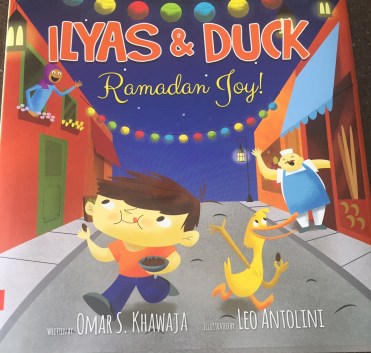
The fourth book in the popular Ilyas & Duck series is perfect for instilling joy about Ramadan, and excitement in overcoming Mr. Mean.  But first readers along with Ilyas and Duck, will have to understand what fasting means, realize that it is hard and not all fun, learn some Arabic words and concepts such as compassion, empathy, and gratitude, before they can save the neighborhood from a menacing villain wanting to destroy the blessings of Ramadan.

FullSizeRender (87)

As always, with Ilyas and Duck, the rhyming book asks questions that kids think about and is silly in a way that they can relate to.  The illustrations are bright and engaging and the hardback book is 38 pages of fun and information, perfect for ages 5 and up. 

FullSizeRender (86)

The book starts with the ayat from the Qur’an that says, “O you who have believed, decreed upon you is fasting as it was decreed upon those before you that you may become righteous” (chapter 2, verse 283).  The book concludes with a mock newspaper spread of the Current Times, full of tidbits about the crescent moon, benefits of fasting, Ilyas and Duck Ramadan cards, a crossword puzzle, and a classified add for Eid Goodie Bags posted by an anonymous, Mr. “M.”

FullSizeRender (85)

The book cleverly conveys how a day of Ramadan is practiced without getting preachy.  It shows Ilyas and Duck, praying and eating dates and decorating and getting excited.  the women wear hijab, but nothing about singling out that this is a part of Islam or Muslims is really mentioned.  The reader just is going along with Ilyas and his pal Duck.  It does remark that Allah is the provider and fasting helps build your relationship with Allah, but not to the point that it would seem preachy or alienating to non Muslim children.  Meaning I think you could read this book to your child’s public school class, or scout troop and not have any problems, while similarly giving a Muslim child an awesome story to identify with.

FullSizeRender (84)

A lot of the behavior details of what one should and shouldn’t do in Ramadan actually come from Mr. Mean, as he like all villains, lays out his evil plan.  He is hoping to spray a poison that will make kids play instead of pray, and he is leaving cookies around to tempt kids to break their fast.  He is also planning to spread rumors, and encourage gossip, and get kids to make promises they cannot keep.  Alhumdulillah, Sheriff Ilyas and Deputy Duck run him out of town because “there’s no room for meanness, only goodness in Ramadan.”

Owl & Cat Ramadan Is. . . by Emma Apple

Standard
Owl & Cat Ramadan Is. . . by Emma Apple

owl and cat ramadan.jpg

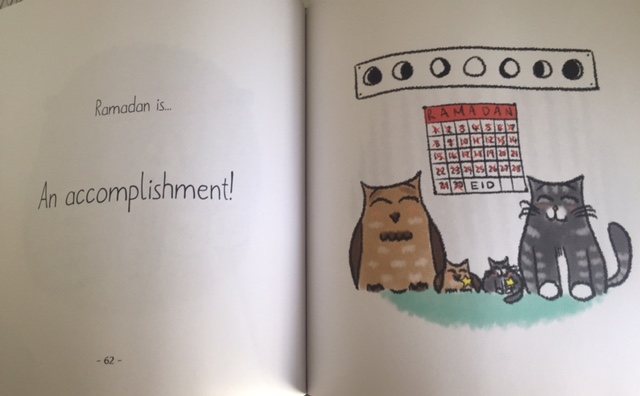
Seventy-four pages, with about that many words, conveying what Ramadan is, and how it is practiced to the youngest of listeners. Emma Apple once again in her simple, yet colorful drawings of Owl and Cat holds toddlers’ interest as she effectively conveys the feeling of what Ramadan is like to muslim and non muslim children.  With so many factual based books about Ramadan and how it is practiced, this nice change of pace shows a lot of the feels and activities in an incredibly streamlined way.

FullSizeRender (75)

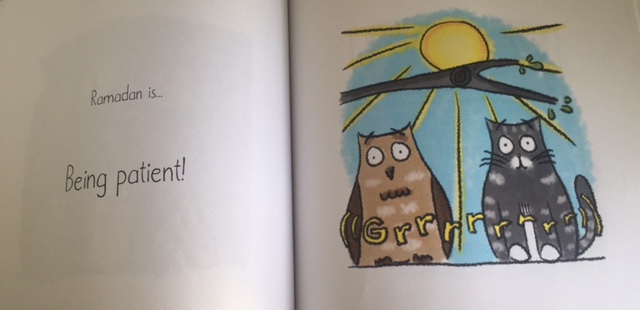
The book starts with an opening page that tells about Ramadan before establishing the rhythm of each page starting with “Ramadan is…” and then concluding the sentence with one, two or four words to describe the blessed month.

FullSizeRender (77)

The illustrations show the two characters doing the things mentioned with their little owl and cat friends, praying, eating, learning, taking naps, etc.. The book is heartfelt, funny, and informative with its sparse wording and simplicity.

FullSizeRender (78)

I was thrilled to find it in the public library, and glad to know that there are now more books in the series, alhumdulillah, as well as a workbook to accompany this one.

FullSizeRender (76)


Ramadan by Hannah Eliot illustrated by Rashin

Standard
Ramadan by Hannah Eliot illustrated by Rashin

ramadan.jpg

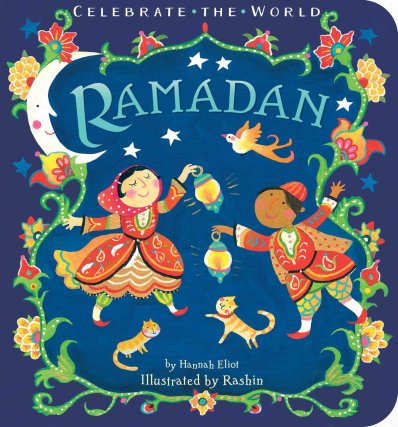
A beautifully illustrated board book about Ramadan came out in April just in time for Ramadan.  The 24 pages tell basic facts about Ramadan, introduce readers to Arabic vocabulary of suhoor, iftar and Eid al Fitr, and conveys concepts about fasting.  It explains that Ramadan is praying, and family, and helping others.  It never strays from appealing to toddlers and preschoolers, which makes the book a great choice for little ones.

ramadan 1

I wish that it included something about Allah, or the Quran, but it doesn’t and as its a Simon and Schuster published book it is probably intentional as to keep it open to both Muslim and non Muslim children.  The month is referred to as a special month, but doesn’t tell why it is special other than it being a time to fast.  It says we fast to know how the poor feel and to appreciate what we have.  There is nothing about religion mentioned out right, the words Islam and M  cccuslims don’t even appear in the book.

FullSizeRender (72)

I love that it mentions that while we are fasting we still go to work and school.  And I love that it mentions Eid as a time of gifts and sweets and praying.  The main take-a-ways of the book are that Ramadan is a special time of year of praying, loving our family, and giving back to others, while it explains going without food and drink, it doesn’t overly dwell on it.

FullSizeRender (73)

The pictures are busy and colorful and detailed and wonderful.  They show diversity of color, age, ethnicity, body shape and are full of smiling warm faces.  There are animals in nearly every picture and they really are whimsical yet bold enough, to hold readers’ attention over and over and over again.

FullSizeRender (74)

Mr. Ramadhan Moon by S.R.M. illustrated by Haleema Tahir Gul

Standard
Mr. Ramadhan Moon by S.R.M. illustrated by Haleema Tahir Gul

mr moon.jpg

This little 26 page paperback book is not a lot to look at, and it really isn’t substantial in your hands either….but it comes with this little guy, who is Awesome!
IMG_0077.JPG

And once Mr. Ramadhan Moon smiling at you, and you open the book, the only real complaint you’ll have is how can we support this book so that the book can become hardback, the pages bigger, and the font spaced out more.  Yeah, it is fun, really fun.

FullSizeRender (70)

Told from Mr. Moon’s perspective the story covers the basics about Ramadan, fasting, charity, praying, and Eid, but also incorporates the searching of the moon in both the Ramadan month sense, and in the hiding of the toy and finding it around your house activity gimmick. Much like the Christmas game of “Elf on the Shelf,” Mr. Ramadhan Moon wants to be found each day of Ramadan, and can also be found on each page of the book.

FullSizeRender (69)

The book is written in rhyme, which often is forced, but its ambition is appreciated as a lot of information is conveyed.  There is even a glossary of terms in the back.

FullSizeRender (71)

The book is ordered through Etsy and I think will be a blast for kids toddler to 3rd grade.  I’m planning to hide him daily this Ramadan and I’ve already read the book to my children who can’t wait to start a new Ramadan tradition.