Category Archives: Non Fiction

Hind’s Hands: A Story about Autism by Umm Jawayriyah and Juwayriyah Ayed illustrated by Emma Apple

Standard
Hind’s Hands: A Story about Autism by Umm Jawayriyah and Juwayriyah Ayed illustrated by Emma Apple

hind

This is an important book to show representation of an underrepresented group, not just those with autism, but also those that love them and live with them.  It is also important to spread awareness so that those that do not have first hand experience can show compassion and patience for the individual and those around them as well.

This 16 page book, only 9 pages of text, is written by a mother and daughter about another daughter.  It is told from the perspective of 9 year old Juwayriyah and how she sees and helps her younger sister Hind.

IMG_2406

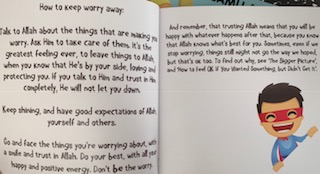
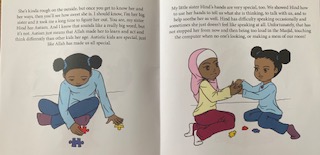
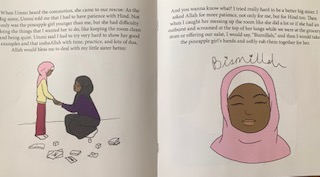
I love that it makes it super clear that children with autism are created this way by Allah swt and made special just as all of us are unique and special. I also like that Juwayriyah has had to learn to slow down and say bismillah before often dealing with Hind.  It also shows that it is a work in progress and there are good days and bad days.  It isn’t smooth sailing, and it isn’t something that needs to be fixed, it is what it is and we must adapt.

IMG_2407

The book is wonderful, for what it does and what it represents, however, in terms of story, it is kind of dry.  It very much is a nine year old, optimistically talking about her sister and how rubbing her hands has proved a coping skills when she is overwhelmed, but you don’t get to know any of the characters.  You don’t feel a bond, or understand what life is like for Hind, or why sometimes she has outbursts or what her triggers are.  I don’t know that kids will even understand concretely what autims is other than that it means people with it learn and act and think differently, as no real examples are given.  

IMG_2408

There is a lot of text on the pages.  I think if you know someone with autism or have maybe seen a child having a melt down, children younger kids will enjoy the explanation and fact giving the book provides.  Otherwise I think 2nd to 4th graders will get the most out of this book as they start to notice different behaviors and other’s reactions to them.

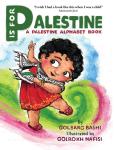
P is for Palestine: A Palestine Alphabet Book by Golbarg Bashi illustrated by Golrokh Nafisi

Standard
P is for Palestine: A Palestine Alphabet Book by Golbarg Bashi illustrated by Golrokh Nafisi

p for pale

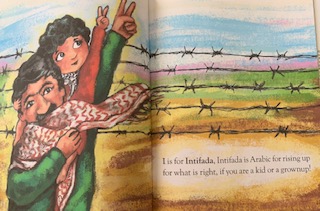
I first heard about this book maybe a year ago when it was making waves for including such passages as “I is for Intifada, Intifada is Arabic for rising up for what is right, if you are a kid or a grownup!” The book was in limited supply however and hard to find.  Recently a 2nd edition came out and is widely available in major outlets. 

IMG_2401

The book follows the well established genre of giving each letter in the alphabet a page to depict in picture and words details about a given subject.  The form usually rhymes and appeals to little kids learning about something specific, and adults, who enjoy the topic at hand.  

IMG_2399

While this book is fabulous because it exists, and praiseworthy because it celebrates Palestine, Christmas and Eid and the birthplace of Jesus and Lebneh and Quds and olives and grape leaves and everything else that makes Palestine so close to one’s heart, the stanzas themselves are really forced and inconsistent in rhyme and meter.

IMG_2400

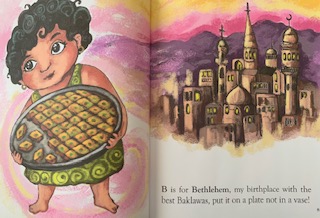
Granted, one doesn’t buy or even pick up a book like this for its literary merits, but the text is really a bit all over the place.  “Can we sing the ABC anywhere? With a woolly bear or in thin air? L is for Labneh is like yogurt.  I eat it for lunch, wearing my loafer! B is for Bethlehem, my birthplace with the best Baklawas, put it on a plate not in a vase! K is for Kuffiya, the best kind you can hang on a hook in Hebron souk! E is for Eid, it means Festival, like the Muslim Eid al-Fitr when we eat enticing eats, get excited over gifts, and enjoy seeing out extended families. J is for jesus, Jesus was born in my hometown (Bethlehem), not Jamestown!”

IMG_2403

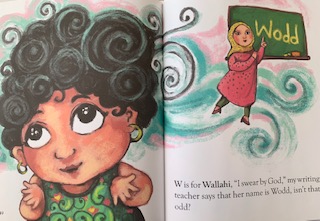
I of course overlooked some of the awkwardness because the illustrations are lively and beautiful and the parts I thought needed explaining, I chalked up to me not being Palestine, nor having visited there.  

Many of the passages are touching and memorable and make the book so important.  M is for Miftah, Key of Return…Mama’s Mama, and my Jiddah’s Mama’s, for which I yearn! T is for Thob, a traditional dress wtih tatreez (embroidered pieces).  Takes time to make, with thousands of tiny threads, if you please!

IMG_2405

There is an Appendix in the back, giving a tad more information on the main idea mentioned for each letter.  There is also a Publisher’s note.  While there was some controversy that the book is anti Semitic or spreading propaganda, I think the book comes from a place of love and culture.  There is Christian and Muslim concepts and a character named David making grape leaves.  It does not mention Israel or Zionism blatantly, which I think shows that Palestine has its own culture and isn’t solely defined  by the crimes committed against them.  Interestingly, the author is from Iran.


The House of Wisdom by Florence Parry Heide and Judith Heide Gilliland illustrated by Mary Grandpre’

Standard
The House of Wisdom by Florence Parry Heide and Judith Heide Gilliland illustrated by Mary Grandpre’

house of wisdom

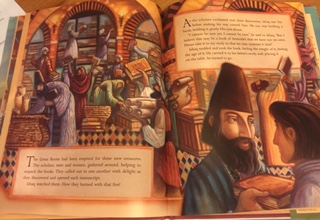
This 37 page, non fiction book written on a AR 5.1 is a beautiful telling of 9th century Baghdad and the quest, collection, and love of knowledge.  It follows the true story of Ishaq, a young boy who’s father translates books and documents in the House of Wisdom, the intellectual center of everything.

FullSizeRender

Ishaq has a lot to learn from his father and the books in this majestic place, before he can lead one of the Caliph’s expeditions to search for books.  However, while he acquires his knowledge or Aristotle, Galen, Plato, and Hippocrates, and more, he doesn’t feel the fire, so to speak, of a powerful burning to seek knowledge.

FullSizeRender (1)

He finally gets his chance to lead an expedition and he travels the wold for three years, learning, collecting, and experiencing things.  Walking the streets of the great teachers of long ago and readying himself to be a scholar upon his return to Baghdad.
Upon his return, Ishaq’s father presents him with a book by Aristotle and when he opens it he finds the flame consume him.  Ultimately, history will credit Ishaq with translating the entire known works of Aristotle and he and his father Hunayn, and the Caliph al-Ma’mum, with carrying the torch of civilization to the rest of the world.

The book does not mention religion or Islam, but Muslim children at least should recognize names, and words like caliph, and geography enough to know that this is indeed their history.  Non-Muslim children probably will not make the connection, and in some ways, possibly selfish ones, I find that unfortunate.

The illustrations are beautiful and rich in both texture and detail.  They compliment the text wonderfully and really bring the grandness of the story to life.

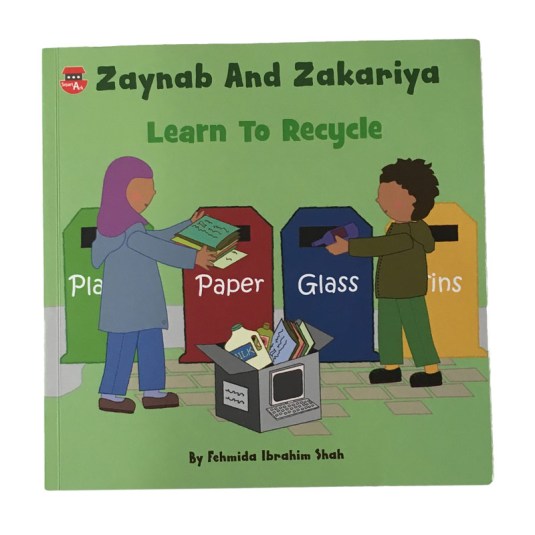
Zaynab and Zakariya Learn to Recycle by Fehmida Ibrahim Shah

Standard
Zaynab and Zakariya Learn to Recycle by Fehmida Ibrahim Shah

ZAYNAB-AND-ZAKARIYA.jpg

I’ve seen a few other environmentally inclined children’s books in Islamic School libraries over the years, but this one is one of the better ones in terms of its comprehensive thoroughness, proactive nature and presentation. 

Zaynab and Zakariya help each other learn about recycling paper, tin, glass, and then reach out to their parents at the library to learn exactly how recycling works, what happens to trash, and how they can do their part to help the Earth.  I like that the kids, don’t just drop a few items in a bin, flip off a light, and turn off the water, they actually help their mom start to compost, they seek out items made from recycled materials at a store to purchase, and learn about catching rainwater with their father.  The text is a bit heavy and is probably more suited for at least 1st grade and up if read in a group setting, younger kids would enjoy it in bits and pieces, and would absolutely benefit if some hands on activities could be incorporated.  

The book is 28 pages, sturdily bound and has a glossary of terms in the back.  The book is small, about 9×9 and the pictures feature no faces.  The story line is framed in an Islamic context and Quranic verses are highlighted and mentioned in the story.


The Prophet’s Faithful Friend: The Story of the Great Hijrah by RS Khan illustrated by A Saha

Standard
The Prophet’s Faithful Friend: The Story of the Great Hijrah by RS Khan illustrated by A Saha

prophets faithful friend.jpg

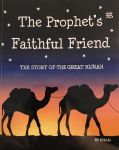
This book is written in verse, and while some of the 32 pages are overly heavy in text, it does for the most part stick to appealing to younger children, 4 years old and up.  I had hoped the book would be more about Abu Bakr as Sadeeq, but it really is just a simplified retelling of a part of the Hijrah.  There is nothing wrong with that, I just had hoped for more about their friendship.

FullSizeRender (58)

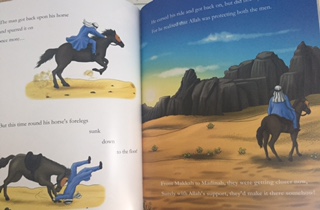
The only real specifics of the Hijrah are that of Suraaqah, and the inability he and his horse faced while trying to get close to the Prophet and his friend.

FullSizeRender (61)

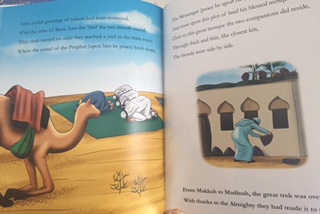
The book is meant for Muslim children as it shows some of the fears that RasulAllah faced, ways Allah swt protected him, and gets children excited as the two reach Madinah safely.  There are Islamic and Arabic words sprinkled through out, without a glossary and children might night some help understanding Quraysh, migration, hastened, suspense, and companion.

FullSizeRender (59)

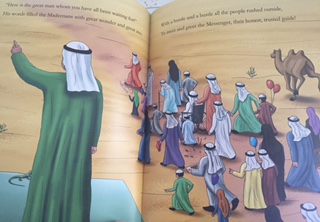
The pictures are bright and the book is printed on thick glossy paper.  There are no faces detailed, and Prophet Muhammad  and Abu Bakr are not pictured.  The pictures seem to get a little ahead of themselves as they show people holding balloons and in wheelchairs, not sure that they were invented or common yet, but perhaps.

FullSizeRender (60)

I know I have mentioned it before that there are surprisingly few stand alone books about Prophet Muhammad (AS) for younger children, so while this book isn’t the greatest book ever, it is pretty good amongst few other options.

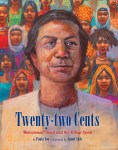
Twenty-Two Cents: Muhammad Yunus and the Village Bank by Paula Yoo illustrated by Jamel Akib

Standard
Twenty-Two Cents: Muhammad Yunus and the Village Bank by Paula Yoo illustrated by Jamel Akib

22CentsCover

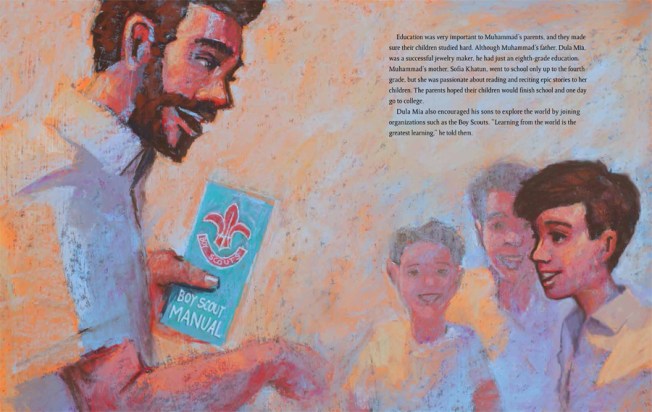
This 40 page biography written on an AR 6.5 level, tells the story of Nobel Prize winner Muhammad Yunus and his microcredit banking initiative.  The book topic is inspiring and for the most part the author does a good job of bringing it down to a middle school level. You can tell the author tries to flesh out Muhammad Yunus by starting the book with him as a boy, and relaying how he was raised and how his parents and boy scouts shaped him.  Despite her efforts however, at times it reads more like a resume, not a children’s picture book.

22_cents_3

Other than his accomplishments, and work history, I didn’t learn anything about him that made him relatable as a person, nor did I learn much about Bangladesh, or Islam.  And yes, I know it is a biography, but it felt like it was a void that needed filling.   I did learn about the program he started, a few of the obstacles that had to be overcome and I particularly liked that those receiving the microloans also had to learn about money, finance, and banking to pass a test before getting approved  And that 94% of those receiving the help have been women.  Grameen Bank is now a global bank, and the help he has given to so many is truly inspiring and something our youth should understand through humanitarian, economic, and compassionate lenses.

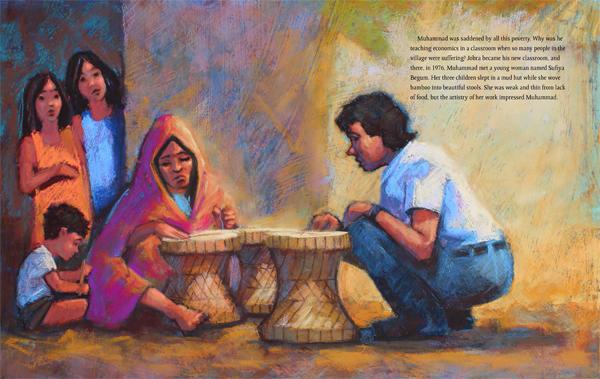
The title comes from the incident that brought Muhammad Yunus’ desire to help to fruition. He saw a woman weaving a beautiful basket, and learned that she could not afford the supplies to weave the basket, to sell in the market and as a result needed a loan.  Banks would not loan the equivilant of 22 cents because it was too small, and money lenders would charge so much interest, that after the basket sold, and the money lender repaid, there was scarce enough funds to purchase enough food for the family, let alone enough to buy new supplies, and thus the cycle was unbreakable.  He wanted to make her and those like her independent, not needing charity or the kindness of others to get her ahead, and thus the seven day course, test, and microcredit system evolved.

22 inside

The illustrations I think are both rich and well done.  The effect of the watercolors flesh out the text heavy pages with detail, but don’t create a distraction from the concepts and accomplishments being presented.  Following the story is a two page afterward telling additional awards and continuing the story of Muhammad Yunus with two real life photographs.


Khadijah: Mother of History’s Greatest Nation by Fatima Barkatulla

Standard

khadijah.jpg

I depart from the Islamic Fiction that I enthusiastically seek out and read, to share and review a work of non-fiction that swept me off my feet.  Perfect for children eight and up, and particularly ideal for girls, this book is absolutely physically beautiful and the content is as well.  This 176 page book flows like a story not a history book, and at times a love story between Khadijah (RA) and our beloved Prophet (SAW).  The font and spacing invites young readers to absorb each word without feeling rushed or overwhelmed.  

SYNOPSIS:

The book is a biography of our mother, Khadijah bint Khuwaylid.  It starts just before she is made aware of Muhammad and ends with her death, followed by a few reflections of RasulAllah missing her.  For the most part the story keeps her at the focus and for the age group the slips into seerah are no problem.  But I wanted more about her.  I learned that she was married twice before she wed Prophet Muhammed, but I wanted to know more of her children with these other men.  I wanted to know if they ever accepted Islam.  I wanted to know of Khadijah’s childhood and her parents, and her tribe.  I wanted to know more about her sister who sounded like her, and if she had any other siblings.  It scratched the surface, and even my 10-year-old daughter wanted more, in a good way.

It covers their marriage, and it reads like a sweet fairy tale that is absolutely full of noor and love.  It shares how she supported the Prophet at every turn and the hardships of the boycott.  It drops names and places, but not in an over burdening way. In many places I actually wanted more detail as to how they all fit together in time and place. As she has children and grows ill and time passes, the story comes to an end.  Almost too quickly, as her day-to-day life as a mother and wife are missing, and I was hoping there would be more.  Yes the  growth of Islam and the plots of the Quraysh are so important, but I wanted more Khadijah, in a book claiming to teach us about our “legendary mother.”

WHY I LIKE IT:

Obviously the story is great, and really the way it is presented is how our kids need to know our history: with love and compassion and enthusiasm.  You feel the love between Khadijah (RA) and Prophet Muhammad (SAW) you see how patient and devoted she is in a very emotional way.  Truly the author has given life to a story many of us know, and filled us with a connection and relationship that is very personal and inspiring in nature.  When you finish the book, you feel like Khadijah is a friend, an amazing friend, but someone you know intimately and proudly, not just as a historical figure.

innerpages2_1024x1024

FLAGS:

None

TOOLS FOR LEADING THE DISCUSSION:

I would absolutely do this for like a 4th -6th grade book club.  I think it should be mandatory reading.  I would probably invite someone well versed in the seerah and Khadijah to answer the children’s questions.  How wonderous it would be to hear the kids discussing her life and offering parallels, lessons, and inspiration to one another from their new found knowledge of Khadijah (RA).


Lost and Found Cat: The True Story of Kunkush’s Incredible Journey by Doug Kuntz and Amy Shrodes illustrated by Sue Cornelison

Standard
Lost and Found Cat: The True Story of Kunkush’s Incredible Journey by Doug Kuntz and Amy Shrodes illustrated by Sue Cornelison

kunkush

Often children’s stories of refugees fleeing war are hopeful in a forced way that seems to want to protect them from the reality of what is going on in the world.  As adults we often cling to the ones with happy endings for our children and for ourselves, because the tragic ones are too numerous and overwhelming to comprehend.  This book marvelously does a great job for those older children in the middle that are beginning to understand the world around them, while not bombarding them with the severity of how cruel we can be to one another.  This true story instead focuses on a beloved cat and all the humans of different backgrounds, all over the world that help reunite her with her family.  Giving hope, but also showing the difficulty in the world, and the effects even one person can have in making a difference.

cat

Kunkush’s family goes to great pains to get themselves (all 6 of them) out of Mosul, and away from the war.  That the fact they sneak their beloved cat with them, shows just how much a member of the family he is. They drive through the night, and walk for days over a mountain, they reach a Kurdish village where they sneak the cat on a bus to Turkey, they then have to cross the Aegean Sea to Greece, only to land in Lesbos and have Kunkush disappear.  The family searches as long as they can, but alas have to move on to their new home.  From here the story switches from following the family to following the cat and all the people determined to reunite him with his family.  Unfortunately, they don’t know where the family is.  Amy, a volunteer, takes the cat to the vet to get cleaned up, and then creates an internet campaign to try and find his family.  People from all over the world donate to his care, and his travel expenses.  Eventually, Amy takes the cat to Germany, where many refugees have resettled and continues her search.  Finally, word gets to the family in Norway, and Doug, a photographer, arranges to fly the cat to her new home. Alhumdulillah.

img_3838.jpgOne could argue that countless people are misplaced each day due to war, and we overlook it because it is easier than dealing with it, so why care about a cat.  And to that I challenge the skeptic, animal lover or not, to read this book and not have your heart-strings tugged.

IMG_3839The book is done beautifully.  The pictures are warm and endearing and are the only proof that the family is Muslim, by their hijabs.  The love the family has for their pet is expressed in the illustrations, and even more so by the real photographs at the end of the book following the Note from Doug and Amy.  At 48 pages the book works really well for 3rd grade and up (it isn’t AR) who can marvel at the cat’s journey.  I particularly think this book is a great way to show children another aspect of refugees.  There are a fair amount of books that talk about the refugee experience or show refugees getting adjusted to a new home.  But, this is a great way to show that refugees are not just defined by a word.  They are vibrant individual people just like everyone else.  By focusing on the cat and his journey, the reader sees what a refugee goes through, particularly this family, and hopefully will stop and think about it.   But it doesn’t just show the family in that capacity, it shows them as a vibrant family who loves and desperately misses their cat- something more children may be able to relate to.

kunkush (1)

What Does a Muslim Look Like? by Mohamed Abdel-Kader illustrated by Abdullah Badawy

Standard
What Does a Muslim Look Like? by Mohamed Abdel-Kader illustrated by Abdullah Badawy

what does a muslim look like.jpeg This 22 page, simplistic book written in rhyming couplets, is such a timely and necessary book.  Much like Owl and Cat: What Islam Is… this book has value that extends far beyond its audience level (not AR but, I’d say three years and up), as the content breaks down stereotypes while being framed in a positive, non condescending way.

IMG_3160

A brother and sister pair, Jack and Jane, go about their day when at dinner Jack remarks that he learned that two of his classmates are Muslim and they look like them.  Thus arises the question, what do Muslims look like?  The book then goes on to break down stereotypes and broaden views in the same rhyming manner that keeps the book light and child friendly.  The conclusion is that like people of other faiths, everyone is different, and that no one should be judged on what is on the outside.

IMG_3161

The book appears to have been started on Kickstarter in 2012 and Alhumdulillah it got the needed funding to get published.  I got my copy through the public library system, and I am beyond thrilled that I found it where hopefully a lot of people can get their hands on it.  Reading the author’s campaign on where the concept came from, he would have had no idea how much more timely the book is now, then when it was first published.  I get asked quite regularly from old school friends, how they can introduce Islam or get the ball rolling  to talk to their kids about Muslims, and this book would be a great start.  Told from non Muslim kids perspectives, with very hip parents, the book does not discuss any tenants of faith or belief, it just identifies the many shapes and sizes and colors that Muslims come in.  It would work well to show that Muslims are everywhere not just in the news, without overwhelming even the youngest of readers.

IMG_3162

The pictures in the book are absolutely perfect in complimenting the story. They are not only silly, but also diverse as the book’s text would require.  Interestingly there are ladies with hijab and those without, and scarves are not mentioned in the text, and also noteworthy is there are no bearded men in the pictures.  Overall, a wonderful book that I would love to have on my shelf with extras to hand out.