Category Archives: Middle School

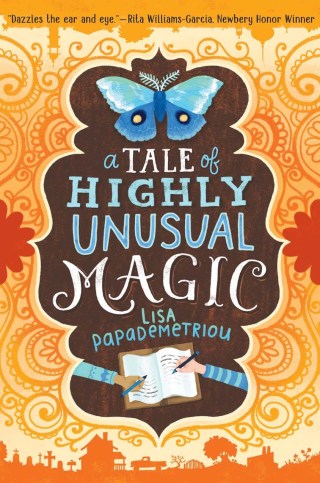
A Tale of Highly Unusual Magic by Lisa Papademetriou

Standard
A Tale of Highly Unusual Magic by Lisa Papademetriou

a-tale-of-highly-unusual-magic-L.jpg

For a book about magic, featuring a girl who admittedly knows very little about Islam, a surprising number of tidbits sneak through and work to introduce Islam and Pakistani culture to those unfamiliar, while similarly exciting Muslims readers who can see a major climax point a mile away and get to feel “in” on the unavoidable “aha” moment.  Written on a 4.9 level this 297 page book, is clean and engaging, a rare combination, especially for advanced readers who are having a hard time finding books that are content appropriate.  I’m fairly confident that anyone, of any age, who reads this will learn something, whether it be about lepidopterology, violins, occupation and partition of the subcontinent, Rudyard Kipling, caskets, friendship, Islam, and finding a place to belong.

SYNOPSIS:

There are three main storylines in the book, Leila’s, Kai’s and The Exquisite Corpses’.  Leila is a Pakistani-American girl growing up in America who decides to visit her Pakistani dad’s family in Lahore for the summer.  Unfamiliar with the language and customs, she has a good attitude of learning as much as she can, and absorbing new things.  Her dad’s family speaks English, is not very religious, is wealthy, and pretty modern.  They have servants, and drivers, and while she gets to go to museums and landmarks, the lifestyle is partially simplified for reader understanding, and partially to not take away from the real point of the story: Leila moving out of her sister’s shadow, and finding comfort in her own multi-cultural skin.  

Kai is spending her summer with a great paternal Aunt in Texas that she has never met.  Her father passed away and her mom has recently lost her job, so a change of scene is what she is presented with.  Her Aunt is a character in and of herself, but by and large leaves Kai to her own devices and supports her adventures from a distance.  The real story for Kai is a budding friendship with the neighbor girl, Doodle who is determined to find and save a rare moth no longer found in the area.  Nervous to make friends Kai learns sometimes the value of things isn’t in the winning, or being the best, but in doing something because you enjoy it and it is the right thing to do.

The two girls story is tied together by them finding two parts of a magic book, The Exquisite Corpse.  The old book tells the story of Ralph T. Flabbergast and Edwina Pickle, in bits prompted by the girls’ own writings.  Like the game of writing a few sentences, folding over the page and having the next person add to the story, the book connects the girls and the readers in a tale that is as much about the two long ago sweethearts, as it is about families, overcoming obstacles, and believing in happy endings.

WHY I LIKE IT:

I like that it is told from various voices, and as much as the story is plot driven, I truly felt connected to the main characters.  The only magic is the book, so the realism is very critical to gaining the readers interest and thankfully once you read about 70 pages or so I feel like the book does suck you in and take you for a fun ride.  The first few chapters are a bit confusing and I wasn’t sure where the story was going, Finally, at my 11-year-old daughter’s prompting I had to just barrel through without asking and wondering too much.  You don’t find out about Kai’s mom and dad or how Rudyard Kipling and “Kim” tie in to it all, almost until the end.  I like that the author doesn’t talk down to the reader, and as a result I learned a bit about so many things.  The twists and interweaving of stories and characters, and things as random as moths and music and saurkraut, remind me of well written adult novels that often aren’t found in books for fourth graders.  

Their isn’t much religion in a doctrine or even practicing sense, but through culture some is learned and shared, and I like that it isn’t completely washed out or removed.  The main character’s father says that he wasn’t religious in Pakistan so when he came to America he wasn’t about to start.  Leila mentions that her mom wants him to take the girls to the mosque or to see Eid, but again, they don’t, but do celebrate Christmas.  So, when she is in Pakistan and sees masjids, and fakirs, and people feeding birds as a sadaqa it is a nice inclusion.  Especially because the vocabulary is used and explained.  She mentions that her extended family goes for Jummah, yet doesn’t pray five times a day, she also touches on Ramadan as being a time of fasting but doesn’t know that there are two Eids.  As she learns, the reader does too.  It definitely isn’t how any practicing Muslim would want Islam portrayed, but it isn’t disrespectful and it is realistic.  Again, because the author doesn’t seem to talk down through her characters, there doesn’t seem much judgement and thus, hopefully also shows most readers some diveresity to the Pakistani stereotypes in the media.

FLAGS:

None, the book is clean, the love story between Ralph and Edwina, is just that they love each other. Nothing more than a sweet sentiment.

TOOLS FOR LEADING THE DISCUSSION:

I would definitely use this book as a Book Club selection because I think there is so much to connect to and discuss.  It would be fun to do as an interfaith book club with kids for the same reason.  While the main characters are girls, I think boys would enjoy it as well, there is some spying, sleuthing, action, and a whole goat debacle, that I think would be a blast to explore with students.

I don’t see any online reading guides, but there is so much to discuss it won’t be a problem.  Enjoy!

Ticket to India by N.H. Senzai

Standard

In terms of plot and and believability, this 274 page 6.3 reading level book has moments of unrealistic twists, but the historical flashbacks and context make up for it as it delves into Pakistan, India partition without getting overly bogged down in politics and bitterness.  You can tell that the author writes from a place of love and warmth, as she talks about all sides involved: Pakistan, India, Great Britain.   The stories, fictional and historical, that weave through the novel make it informative and entertaining irregardless of one’s prior knowledge.

SYNOPSIS:

Maya is 12, and a little shy, especially compared to her older sister Zara.  The book starts with her writing a journal entry about her visit to Pakistan in an airplane somewhere over the ocean.  Maya, her older sister Zara, and their mother are heading to Karachi from America because of the death of Maya’s beloved grandfather.  Frequent visitors to Pakistan, Maya is familiar with the sights, traditions, and language.  As other family members arrive, Maya and Zara overhear their elderly grandmother planning to runaway to India to retrieve family heirlooms that were left during partition.  The plan had been in the works for the whole family to go, visas were already obtained, but with the unexpected death, the urgency is amplified.  Grandma wants to find a ring to bury with her husband.  In Islamic custom burials happen very very quickly, often the same day, so the delay and sending the body to America, is something you just have to go with as the reader.  Rather than convince Grandma to stay, the girls threaten to tell their mother if she doesn’t take them along, and the next thing you know the trio are off to India and on a treasure hunt.  There is a map at the beginning of the book, which is very helpful.  However, the adventure isn’t straightforward, not only in the trio’s adventures, but in that grandma ends up in the hospital, Zara and Maya decide to pursue the lost items on their own, and then Zara and Maya get separated.  Twelve-year-old Maya then is forced out of her shell as she is kidnapped, and running for her life, trying to keep her promises, and also in desperately trying to save her family from having to pay a ransom to save her.  A lot happens, and the intensity amplifies as it starts out as a elementary aged family story and turns into a middle school adventure.  A long the way are beautiful passages about the scenery, amazingly simplified, but factually and emotionally accurate explanations about partition and ultimately, through Maya, about finding your voice. 

WHY I LIKE IT:

The framing of the fictional story and the historical context is wonderful.  Partition, is such a pivotal moment for those that lived through it, but has less and less relevance to today’s generation that lives abroad.  So, to find a book that makes the gist of the events come through, is why I love using fiction to connect people and ideas.  I am making my daughter read this tomorrow, no question. She needs to know what her own grandmother endured, what decisions her family had to wrestle with, and this book allows us to have those discussions in an informed way.  I’m sure many would disagree and say that the reader should know about partition before reading the book, but I think the tidbits and delicate way the author convey the horrors, the agony, the manipulation, and the struggles in todays time, is far better than I could do to a sixth grader. 

Maya’s abilities seem to grow overnight, so while she was an ok protagonist, she might annoy some.  I actually had to google in the middle of reading how old Maya is, at times she seems like she is eight or nine and at other times like she is 15.  I do like that Maya constantly remarks how alike India and Pakistan are, a reality that today’s generation definitely agrees with, but is often afraid to voice to their parents.  I also like that there are good and bad everywhere, a theme that doesn’t get old, especially in books that deal with cultural and religious elements as presented to a wide audience.

There isn’t much religion in the book, the characters don’t stop and pray or wear hijab, but the setting does allow for mention of masjids, and a kind Imam back in California, the characters identify as Muslim and they discuss Muslims as a minority and political entity regularly.  One of the treasures the grandma is looking to retrieve is an old Qur’an with the family tree drawn within.  The book talks about how intertwined the two countries and many religions of India are, and Maya’s name articulates many of these crossroads.  In the end, perhaps the best lesson from the book, is how much alike we all really are.

There is a wonderful Author’s note in the back, along with a glossary.

FLAGS:

The book has some violent images as it discusses trains coming from India to Pakistan with only a few living aboard and vice versa.  The intensity as Maya is robbed, and then kidnapped, and then held hostage, could also be jarring for some younger readers. 

TOOLS FOR LEADING THE DISCUSSION:

Like all her other books, I would absolutely include this in a Book Club, there is a lot to discuss, lots to understand, and lots to enjoy.

Author’s website: http://www.nhsenzai.com/ticket-to-india/

Reading Group Guide: http://www.nhsenzai.com/wp-content/uploads/2017/09/Ticket-to-India_ReadingGuidePDF.pdf

YouTube book trailer:

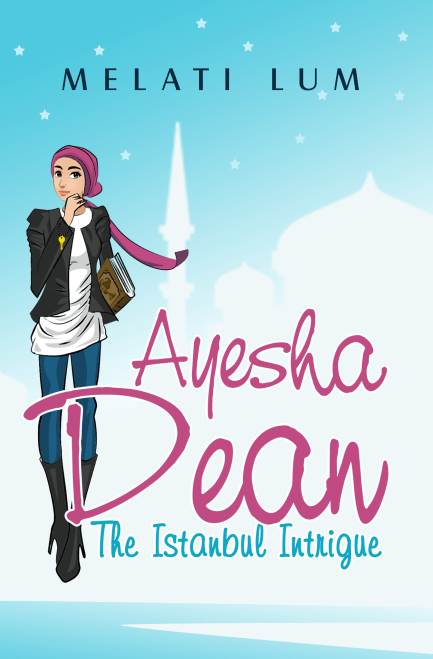
Ayesha Dean: The Istanbul Intrigue by Melati Lum

Standard
Ayesha Dean: The Istanbul Intrigue by Melati Lum

ayesha dean.png

I’ve tried numerous times to get my preteen daughter to read a Nancy Drew book with little success, yet she devoured this mystery and is eagerly waiting for more.  The protagonist is relevant, resourceful, fun, and a practicing Muslimah too.  At 240 pages, the spacing and large font make the book easily accessible, and tempting to dive in to.  The pacing is pretty good, and while there are a few hiccups with storytelling style, the book overall is worth adding to yours and your child’s reading list.

SYNOPSIS:

Ayesha’s parents are deceased, but her Uncle Dave has raised her as a Muslim following her parent’s wishes.  Having graduated high school she is off on a celebratory trip with her two closes friends: Jess and Sara, her uncle and her friend’s dad to Istanbul, Turkey.  The adults have a business conference and the girls are hoping to explore and enjoy all the sights of the Turkish Bazar, the Hagia Sophia, the Blue Mosque and more.  While looking for a book to gift Uncle Dave, Ayesha and her friends discover a secret message sewn into an old book of maps and set off to collect clues and solve a 100-year-old ibn-Arabi mystery.  Obviously, I don’t want to give too much away but there are villains, and shady characters, and dear friends, and lots of yummy food.

WHY I LIKE IT:

I love that the heroine is a hijab wearing, salat praying, Tae Kwon Do trained, fashionable, kind, young lady.  She has integrity and resourcefulness, that make the reader want to cheer her on.  Her friends are significantly less developed, I really couldn’t tell you much about them, and honestly had to look back to recall their names.  I understand why they are in the story for Ayesha to play off of, but I’m hoping that they will have a bit more substance in future novels.  Other side characters had more depth than Sara and Jess did, and even getting them out of the way for the climax seemed to further diminish their roles and importance.

I loved learning about Turkey through the characters, the history, architecture, the food.  The author really shined when talking about Islamic history as well.  When Ayesha and Emre explore the Sultan’s Privy Chambers at the Topkapi Palace, and look at Prophet Muhamad’s (saw) sword and bow, the excitement and reflection is palpable.  In other places however, I felt like the narrator’s voice was completely jarring and distracting to the engaging story at hand.  In the midst of pursuing a lead, the story comes to an almost standstill to say, “the friends chatted amiably as they walked, admiring the city as they went (69).”  The majority of the descriptions are so vivid that the few places where they cease are noticeable and awkward.

I also loved the diversity of the friends, even Ayesha’s own personal makeup adds some depth and appreciation that she has chosen to practice Islam.  Ayesha prays and tries to make sure she is not alone with a boy, she is conscious of her hijab and notes the Islamic elements in her own life and in her environment.  Obviously the book takes place in Turkey and she is unraveling an Islamic mystery of sorts, but I think the book works well for Muslim and non Muslim middle schoolers alike.  The book is not preachy, and the translations of prayers and poetry are framed in a historical or inspiring, not doctrine manner.  Similarily, I think you might be able to get boys to read it too.  It inspires girls who perhaps can identify with the main character, but I think even boys will be impressed with what Ayesha can accomplish.

FLAGS:

The book is fairly clean, there is some intense moments with kidnapping and having guns drawn, but nothing too haunting.  Ayesha obviously makes a good “friend” but nothing happens or is even detailed as wanting to happen between her and Emre.  Just Emre’s dad regularly teasing them as he looks for a wife for his son.  The only real flag for me was the exploring of the harem at the palace and the mention of concubines, and eunuchs.  A lot of detail is not given just that the women must have felt trapped, but it is a heads up if your child asks you about it, to be ready to answer.

TOOLS FOR LEADING THE DISCUSSION:

I think this would be a fun book club book to explore deeper some of the sites and history of Turkey.  I would have to explain the harem before hand I think, but I think it can be done factually to avoid to much over thinking for the young readers.  I think to track the clues and “map” out the trail in a group completely with pictures of the real places would really bring the story to reality.

Interview with the author: http://mvslim.com/meet-melati-lum-criminal-lawyer-who-also-has-a-passion-for-writing/

Why we need more heroines like Ayesha Dean: http://www.muslimkidsguide.com/why-do-we-need-more-muslim-heroines-like-ayesha-dean/


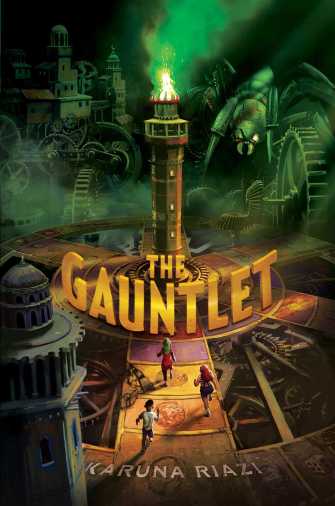
The Gauntlet by Karuna Riazi

Standard
The Gauntlet by Karuna Riazi

the gauntlet

Take Jumanji, turn it into a chapter book, flavor it with steam punk, set it in a Middle Eastern inspired marketplace, and have the protagonist be a Bengali-American, hijab wearing Muslim on a quest to save her little brother with her two BFFs from New York. Bam, you now have a 298 page AR 5.4 reading level booked called The Gauntlet.  

Published by Salaam Reads (Amina’s Voice) this book is written for all kids, the main character’s religion and culture just add depth and a connection to the game they have fallen in to.  I found this book on Scholastic, and when I got it, I handed it to my daughter to screen for me.  I asked her once she finished if it had any Muslims in it and how were they presented, to which she gaped at me and said, “umm mom the whole thing is about a Muslim girl and it is awesome!” So naturally I moved it higher up in the “to be read pile” and while I agree with her assessment, the book is more plot than character driven, and there isn’t a lot of theology in it, just a race against time to get out of the game alive.

SYNOPSIS:

It is Farah Mirza’s 12th birthday and while she should be downstairs visiting with her guests from her new school, she is holed up in her bedroom with her little brother Ahmad and her best friends from the old neighborhood, Essie and Alex, playing board games, the Mirza family’s favorite pastime .  When Aunt Zohra tries to coax them from the room she mentions a gift for the birthday girl is in her room, and the kids sneak off to get it.  Only it isn’t the book she brought to give Farah that they find, it is a bewitched game called the Gauntlet of Blood and Sand that lures kids in, and keeps them if they cannot out play the Architect.  When Ahmed falls in, the trio has no choice but to follow him in to try and rescue him and escape, before time runs out.

Once inside the game, they are in a city called Paheli. It resembles an old Middle Eastern city with large souks, market places, even a small masjid, surrounded by sand and levels absolutely breathtaking in both their beauty and in their threat to the children.  The inhabitants are those that played the game and lost. The challenges the kids must face range from a life size game of mancala to a taste test of Bengali/Indian sweets.  As they rush from challenge to challenge they meet a kind tea shop owner, giant lizards, spies and police of the architect and see fairly detailed descriptions of different parts of Paheli. The gamemaker/designer known only as the Architect senses that the kids will win, so he starts to cheat, and then feels bad and arranges to meet the players.  When the children meet him, and hear his story, they feel some sympathy for him, but not for the Jinn that holds the ultimate power over the game.  Obviously they do escape, but I won’t spoil the fun the process is, nor the sweet surprise of the reunion.  

WHY I LIKE IT:

I like that at the core, the story is driven by love for a sibling and requires the teamwork and cooperation of friends.  The rest is just frills from this central and clear message that is woven throughout the book.  While it is idealistic, there are hints that it isn’t overly so.  Yes Ahmad with his ADHD is a lot to handle at times, and the friends do have their squabbles, but ultimately both friends and family are worth risking it all.  I love that Farah is Bengali, many of the foods are Indian, and they are set in the Middle East, but yet somehow it seems interchangeable, this made me laugh, and while in other instances might have annoyed me, I liked how connected it made everyone seem, more alike than different.  Essie and Alex know some of the foods and cultural lexicon from growing up in New York.  They don’t find things different, they had lots of kids in school that wore hijab. Readers unfamiliar with some of the words and names found in the subcontinent and Islamic history might be put off a bit by the regular use of these words and the lacking glossary, but if you identify with any of it, you will celebrate seeing yourself in this book, just as Farah relished in seeing something of familiarity in Paheli.  

The book is fast paced and the detail given to the setting and cultural aspects are fun, but I really don’t feel like I connected much with the characters as a result.  There is very little character development and I actually had to look back in the book for some of the names to write this review.  There also isn’t much religion in terms of belief or practice.  The buildings and the food and the tone all hint at Islam, but I would have loved to hear an athan, or even her pausing to pray.  Not even that is there.  She wears hijab and that is about it in terms of religion.  

Ultimately I love that it is a mainstream book, with a strong storyline that is action packed and fun for older elementary and early middle schoolers that is clean and familiarizes and thus normalizes a culture not often seen in young adult fiction.  

FLAGS:

None, it is clean, at times possibly a bit scary with human bones, but not anything overly haunting.

TOOLS FOR LEADING THE DISCUSSION:

This would be an amazing book for a book club, and I would play the games that they play in the gauntlet at the meeting.  There isn’t a ton to discuss in terms of introspection and growth, but there is enough, and it is fun.  Plus, there aren’t a lot of books like this for Muslim kids to see themselves in, that I think it would be a blast for them to read, and enjoyable for the adults to watch them get swept away.

Interview with the Author: http://ew.com/books/2017/03/27/karuna-riazi-gauntlet-jumanji/


Twenty-Two Cents: Muhammad Yunus and the Village Bank by Paula Yoo illustrated by Jamel Akib

Standard
Twenty-Two Cents: Muhammad Yunus and the Village Bank by Paula Yoo illustrated by Jamel Akib

22CentsCover

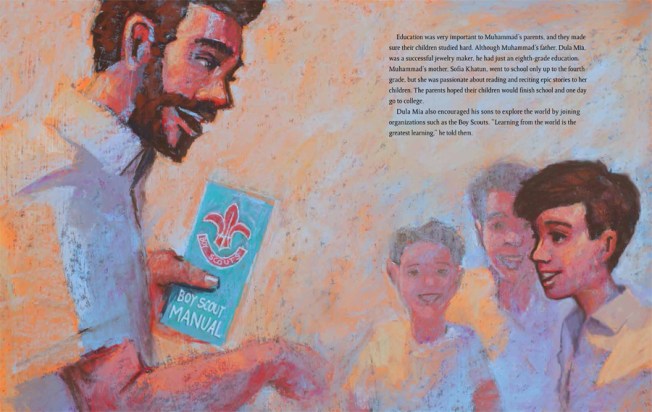
This 40 page biography written on an AR 6.5 level, tells the story of Nobel Prize winner Muhammad Yunus and his microcredit banking initiative.  The book topic is inspiring and for the most part the author does a good job of bringing it down to a middle school level. You can tell the author tries to flesh out Muhammad Yunus by starting the book with him as a boy, and relaying how he was raised and how his parents and boy scouts shaped him.  Despite her efforts however, at times it reads more like a resume, not a children’s picture book.

22_cents_3

Other than his accomplishments, and work history, I didn’t learn anything about him that made him relatable as a person, nor did I learn much about Bangladesh, or Islam.  And yes, I know it is a biography, but it felt like it was a void that needed filling.   I did learn about the program he started, a few of the obstacles that had to be overcome and I particularly liked that those receiving the microloans also had to learn about money, finance, and banking to pass a test before getting approved  And that 94% of those receiving the help have been women.  Grameen Bank is now a global bank, and the help he has given to so many is truly inspiring and something our youth should understand through humanitarian, economic, and compassionate lenses.

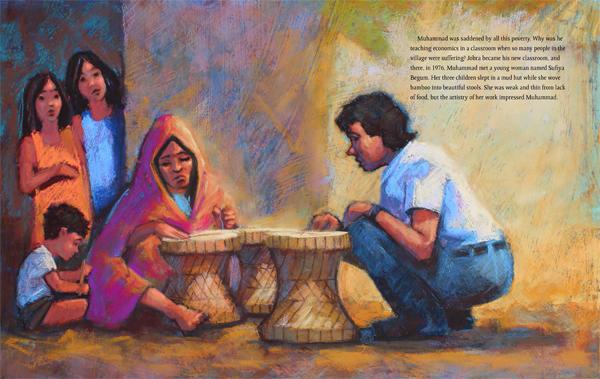
The title comes from the incident that brought Muhammad Yunus’ desire to help to fruition. He saw a woman weaving a beautiful basket, and learned that she could not afford the supplies to weave the basket, to sell in the market and as a result needed a loan.  Banks would not loan the equivilant of 22 cents because it was too small, and money lenders would charge so much interest, that after the basket sold, and the money lender repaid, there was scarce enough funds to purchase enough food for the family, let alone enough to buy new supplies, and thus the cycle was unbreakable.  He wanted to make her and those like her independent, not needing charity or the kindness of others to get her ahead, and thus the seven day course, test, and microcredit system evolved.

22 inside

The illustrations I think are both rich and well done.  The effect of the watercolors flesh out the text heavy pages with detail, but don’t create a distraction from the concepts and accomplishments being presented.  Following the story is a two page afterward telling additional awards and continuing the story of Muhammad Yunus with two real life photographs.


nine, ten: A September 11 Story by Nora Raleigh Baskin

Standard
nine, ten: A September 11 Story by Nora Raleigh Baskin

nine, ten.jpg

I still struggle with the fact that 9/11/2001 is taught as history, it seems so current and fresh in my mind, that I really struggle with how works of fiction (and non fiction too) try to tell me about the pulse and the mood and the impact of something that I lived through and recall so clearly.  I suppose this isn’t a unique predicament, but because of the magnitude, one that I still wrestle with.  The author of nine, ten glosses over the big picture and in a lot of ways, the events of 9/11, but instead tries to show the paradigm shift that occurred and the division drawn as life before and life after.  She attempts to do this on an AR 4.8 and in 197 pages.  No easy feat, but one that definitely has some hits, and for me at least,  a few misses too.

SYNOPSIS:

Told from four different perspectives that intersect at the opening and at the close, the reader meets the characters two days leading up to 9/11, spends some of September 11 with them, and then peeks in on them again a year later.  The characters all cross paths at Chicago’s O’Hare Airport.

The first character is Will.  A middle school boy struggling to come to terms with how his father died helping someone on the side of the road.  Often more responsible and mature for his age as he helps his mom with his younger siblings, he lives in Shanksville, Pennsylvania and finds healing with helping those affected by the plane that goes down there.

Next we meet Aimee, who has just moved to California and is starting a new school.  Her daily drama is more missing her mom who travels a lot to New York for business, but is relatable as she tries to make new friends, fit in, and find her place in a new environment.  Her mom is in New York during the duration of the book, and has a meeting in one of the Twin Towers on the 11th.

Sergio lives in Brooklyn, New York and is a math wiz who gets a special award and recognition for his achievements.  He lives with his loving grandma, but it is the stressful encounter with his deadbeat father that sets him on a fateful subway trip that introduces him to Gideon, a New York fire fighter.

Naheed is the fourth character, and is an Iranian American Muslim girl, who is struggling to handle friends, and new questions about the hijab she wears.  Her friend drama consumes her, until 9/11 happens and she has to now prove her love of America at every turn.

The characters each take chapters divided by dates and while short, they do form a connection in their snapshots.  You feel like you get to know the characters and you do feel a tinge of stress knowing how they are all related geographical to what will transpire on the 11th. But in the afterward, the author explains why she intentionally keeps the carnage at bay to show how connected we all are, especially children, at the forefront of her fictionally retelling, and to show how much we all were affected that day.

WHY I LIKE IT:

I like that breaking up of the story, it adds some dimension to the book.  I know some reviews feel it is over done, but I think it is deliberate, and highlights how we all are inter connected and for late elementary, early middle school readers, I think the choppiness it allows, keeps the book on their level.  I like that each character has their own struggles, it isn’t that life was rosy and then 9/11 ruined everything, these kids have their own issues and stresses and realistic personalities before and after.  I also like that the Muslim character is not from the Middle East, it further shows how groups get lumped together for different reasons giving the book a bit more for readers to consider.

There are however, some real issues in how they present Naheed, which seems odd, since the book is so politically correct, and given the topic, you’d think the author and editors would work overtime to get the islamic parts correct.  But alas at one point Naheed’s visiting Uncle wants to know why Naheed doesn’t pray the mid day prayer, thuhr, at school, to which the mom replies, “she makes up her prayers at third prayer.” What? Yes I laughed out loud, no one calls the prayers by their numbers! I have never used numbers to describe our prayers, they have names, and we use their timings to describe them to others, not numbers. At one point, Naheed is making wudu, ablution, and the author gets it wrong. “And lastly, feet.  Right foot with right hand. Left foot with left.  Toes to ankles.” Left hand for both feet.  I also take some issue with Naheed having to wear hijab at age nine.  Hijab becomes required at puberty, so yes it could have been when it became required of her, but it seems a little young for her, and it seemed a bit forced.

In terms of plot, I would have liked a day or two after 9/11 to juxtapose the differences in priorities and the lens of how we got to a year later, or two years later, or 15.  Also, how they all went to New York on the anniversary to tie the story together made for a nice ending, but why they all went was a bit of a stretch, ok a big stretch.

FLAGS:

For a book about 9/11 there is relatively no violence.  The only death is in talking about Will’s father and the only blood is when Sergio helps a man on the subway.  There is some hate speech at the end, but even that is minimal.  Will does kiss a girl he likes. And both Will and Sergio skip school.  Aimee worries if her mom is having an affair (implied) and if her parents are getting divorced, but it isn’t explicit.

TOOLS FOR LEADING THE DISCUSSION:

I think this would be a good book for a younger book club.  With its overt commitment to political correctness and breaking down stereotypes, it reinforces how similar we all are through strengthening bonds of humanity, rather than being divided by our skin color, or religion.  I think it would also lead so easily into faccilitating discussion of today’s kids putting themselves in the story.  What in their lives wouldn’t matter any more or what would matter more. There is a Reading Group Guide at the end of the book, along with an Author’s Note and Acknowledgement, that easily lend themselves to more discussion ideas.

Curriculum Guide: http://www.norabaskin.com/nine-ten-curriculum-guide/


Brave by Svetlana Chmakova

Standard
Brave by Svetlana Chmakova

bravecover.jpg

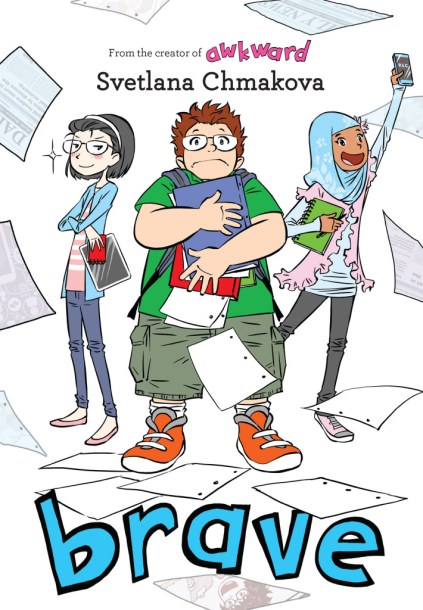
Often these days, minority groups are feeling more and more marginalized in a blaring world that is increasingly divisive and polarized.  So to see a book in my child’s Scholastic Magazine with a muhajaba on the cover, and not a main character, in a book about bullying, where she isn’t the instigator or recipient, made my minority heart swell with hope.  This 238 page graphic novel (AR 2.8) is a quick, quick read for middle schoolers, and one with a good message, that is more self empowering than preachy.  A companion book to Awkward (which I haven’t read, but hope to soon), the author takes us into Middle School through the eyes of Jensen, a kid who is struggling to find his place and escapes into his daydreams to conquer every day stresses.


SYNOPSIS:

Jensen wants to be a NASA scientist, but he isn’t good at math.  He loves to draw, but the Art Club is consumed with an upcoming event he knows nothing about, he is harassed by two bullies every chance they get, and occasionally he is asked by the newspaper staff to do menial work.  Yet, somehow despite having no friends, and a constant barrage of things going against him, he doesn’t see himself as a victim or as the recipient of bullying.  Rather, he falls into regular day dreams where he is the main character in a video game and all these battles have to be overcome to reach the end.  The surrounding characters have their own little stories, and you get to know a bit about them through Jensen, but the author doesn’t let any of them be painted with a singular stroke.  You see the athletes, being kind and sticking up for kids getting picked on, one being a math wiz.  The journalism staff of Jenny, Akila, and Felipe, run the school, but have their own stresses and internal struggles.  The circle of activity comes to a head when a student is expelled over the dress code, and all the various groups in Jensen’s world have to come together to make change.  In the process he realizes that he is being bullied, and that something needs to be done.  He also realizes nobody has it all together and he has a part to do to help others as well.

WHY I LIKE IT:

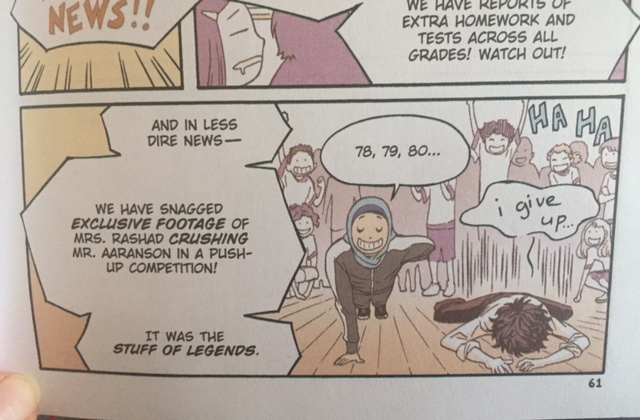
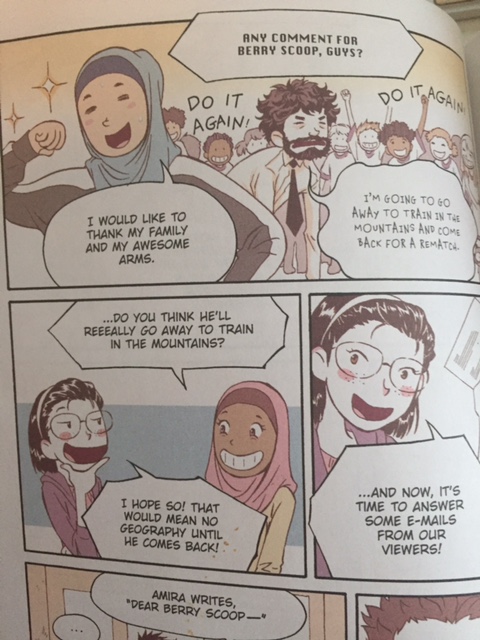
First I like it because there are Muslims in the book, that are just characters in the book.  They don’t represent all Muslims, they aren’t “different” or “other.”  Akila wants to be a journalist and she is smart, and she is kind, but she fights with her best friend, the bossy Jenny, and it is Jensen that has to help them see their errors.  I also like that the P.E. teacher, Mrs. Rashad, is a hijab wearing Muslim, that beats the social studies teacher in push-ups. I mean what an amazing way to break a hundred stereotypes, by not mentioning them, and just showing them as normal. A muslim woman, working, being physical fabulous, and being modest, ya we need more of this. There is no mention of their religion, their clothing, their hijabs, nothing.

FullSizeRender (27)FullSizeRender (28)

I also like that the students in some cases didn’t realize that they were bullying.  I think this happens a lot, where maybe someone won’t let you sit by them because they are saving a seat for someone else, but the second or third time it happens, the recipient feels alienated, where the aggressor may not even be aware.  The book explores lots of ways of bullying, but because it is filtered through the character, it leaves a lot of room for discussion about how people treat us, and how we treat others, and where a lot of pain can come from the misinterpretation on both ends.

There is a lot of diversity in the book, boys, girls, skin tones, body sizes, physical abilities, handicaps, intelligence, etc. that come up to varying degrees, but do at least offer the readers real ways to see themselves in the pages.  The book has a very tidy, happily ever after feel, which is ok I think for middle school. The book has a specific audience. Elementary will just find everyone mean, high schoolers will find it childish, but as social relationships get more challenging in middle school, I think this demographic will often have to find the courage to be brave to get through unscathed.

FLAGS:

None. One character has a boyfriend, maybe. But it is clean with pretty much everything, it even says for All Ages ont he back.

TOOLS FOR LEADING THE DISCUSSION:

I would love to do this as a book club book.  I don’t think it would need any prompting or guides. My 6th grade daughter said it was “ok” yet has brought it up at least ten times since she read it, and has come and sat by me to watch me read it.  I think, she has had some similar issues and to be able to talk about them through the characters, has been liberating for her, and furthered my conviction that fiction has power.

The Author’s website: https://svetlania.com/


Amina’s Voice by Hena Khan

Standard
Amina’s Voice by Hena Khan

amina voice

This book really marked a shift in Islamic fiction for me and the genre.  First of all I was waiting for the book to come out.  I didn’t stumble upon it or hear about it from someone else.  I knew when it was going to be released, and I knew I wanted to read it. Additionally it was the first books published by Salaam Reads, an imprint of Simon and Schuster. Which according to their website was “founded in 2016, Salaam Reads is an imprint that aims to introduce readers of all faiths and backgrounds to a wide variety of Muslim children and families, and offer Muslim kids an opportunity to see themselves reflected positively in published works.”  This is big, huge in fact.  The bar has been raised, and a platform has been given, no more excuses.

Alhumdulillah, Amina’s Voice is a beautiful 197 page book for children ages 8-12.  The book is not AR, but probably will be in a few weeks.  I think it is spot on for 3rd through 5th grade in terms of content, message, and appeal.  The book caters to females and Muslims, but naturally is not limited to those two demographics exclusively.  There are characters of a variety of ethnic and religious backgrounds in the novel that play significant roles in saving the day and keeping the book powerfully optimistic and inspiring.

SYNOPSIS:

Amina is starting middle school and everything is changing for Amina. Her friends are acting different, her older brother is skirting with trouble and her religious uncle is coming to visit from Pakistan.  Internally, she doesn’t like the spotlight but desperately wants to get out from behind the piano to sing.  All of this combines in a climax that pivots around the destruction of the mosque she attends and her having to find her voice, and use it to take center stage in her own life.

WHY I LIKE IT:

There is a lot going on in the book, but it doesn’t get over whelming with Amina’s voice keeping the reader focused on her and her view of the events around her.  The author does a good job of getting inside a 12 year-old girls head without being condescending or heartless.  The reader feels her stress that she is losing her best friend, Soojin to Emily, a girl who used to torment the two “ethnic” girls, without belittling her concerns.  You also feel her love of Islam and struggle to understand if music and singing is permissible within Islamic rules.  The book is realistic fiction with school, friendships, and family guiding the story.  Everything from the ups and downs of group projects, inside jokes between siblings, and trying to pronounce the big HAA in Arabic.  The macro of middle elementary years combined with the micro facets of culture, religion, and current events, and you speak to a section of readers that will connect with Amina and what she goes through in a very authentic, relatable story.

The only points that gave me pause is the premise and music in the book.  It is a point of disagreement amongst nearly every group of Muslims, so to have the Imam sitting and listening to her play the piano, is a bit hard for me to accept as the norm, no matter how cool Imam Malik is.  Additionally, I wish that Amina’s mom had some depth, and the relationship between Amina and her uncle, Thaya Jaan, was fleshed out just a tad more.  In both cases I felt something was lacking, and I wanted more.

FLAGS:

Nothing major, but a few minor issues, that a parent may want to be aware of for younger readers.  Mustafa, Amina’s brother, is seeing skipping Sunday school class and reeking of cigarette smoke.  He denies it, and the issue is definitely not glorified.  There is also crushes discussed amongst Amina’s friends and when Amina spills a secret, she has to own up to it and work it out to maintain her friendships.  The destruction of the mosque could also be upsetting to younger readers.  It isn’t graphic, but her emotional response and the intensity of it, is the climax, and a very real part of our world sadly. For parents, this fictional vandalization could possibly be a great place to start a discussion from if your children are somehow unaware of the current status of Islam in the west.  It also shows that people are good, as the whole larger community, comes together to show unity, love, and respect are values to us all, alhumdulillah.

TOOLS FOR LEADING THE DISCUSSION:

This book would be perfect for a 3rd through 5th book club.  If I was starting a new book club I would start with this book.  It has it all. It has real issues, religious issues, universal issues, and heart.  All while staying on age level and all in a realistic fiction safe space to have an opinion about objectively.  The discussions after the book is read will flow naturally, but just in case:

Reading Group Guide:  http://www.simonandschuster.com/books/Aminas-Voice/Hena-Khan/9781481492065/reading_group_guide

Author’s Page: https://www.henakhan.com/


Just a Drop of Water by Kerry O’Malley Cerra

Standard
Just a Drop of Water by Kerry O’Malley Cerra

just-a-drop-of-water-cover

Thankfully the adult in me won out as I resolved to read a book whose cover and title did nothing to tempt me.  I know, I know, never judge a book by its cover, but seriously a kid running on the American flag with major Muslim characters, written by a non-Muslim about September 11th? I was hesitant and nervous to know what messages would be spread in the 304 pages to children on an AR 4.0 grade level.  But alas, I was  nervous for nothing.  The book is wonderful, and I want to read it again with my 5th grade daughter so we can discuss it.  It is hard to believe 9/11 is now taught as history, but as someone who lived through the tragedy as a college student, this book hit on so many of the defining moments of that horrific morning and the days that followed.  The book isn’t overly political, or judgemental, or preachy, and in retrospect, most people on September 11th and the days immediately following, weren’t either.  We were confused, scared, and unsure, a tone the book reflects and magically presents on an elementary level without getting  overwhelming with the enormity of it all .   The book was published two years ago, and I’m very tempted to contact the author or editor and urge them to reconsider a cover and title change because truly the story deserves it.

SYNOPSIS:

Jake and Sam have been friends their whole lives.  They bonded in the sandbox with their little green army men and have been planning battles and missions together ever since.  Told from Jake’s perspective the reader sees what life is like for these two 8th grade boys.  They push each other in cross-country, their parent’s come together for Jake’s 13th birthday, neighborhood boys swing by for pizza and front yard football games.  But there are stresses too: siblings, busy parents, not getting named captain of the team, friends that play dirty.  Then September 11th happens and worlds are shattered.  The boys learn that one of the hijackers, Mohammed Atta, was from their town, and although Sam has only been to the Mosque a few times with his grandparents, and his parents are culturally American not Saudi, the school bully Bobby is determined to get rid of Sam.  Jake makes it his mission to defend his friend with his fists and his words, but when his parents urge him to stay away from Sam, the stakes are raised.  President Bush says, you are either with us or against us.  But what is Jake to do?  Secrets about Sam’s dad come out and the FBI takes him away for questioning.  The town is gripped in fear and 8th grade boys on both side are determined to change the world, to be the drop of water creating ripples of change.  As Sam and Jake pull away from each other, Sam starts going to the mosque to learn about what he is being accused of being and begins to identify as Muslim.  Jake’s frustration with his parents continues to grow as does his impatience with Sam, but when Jake overhears Bobby plotting something serious, Jake will have to decide where he stands and how strong he is.

WHY I LIKE IT:

I like that the author crafts a story that is complex, but not overwhelming.  She sticks to focusing on getting inside Jake’s head and succeeds.  He is frustrated and confused and determined, but alas he is only a kid and can’t foresee his actions or articulate them the way an adult can.  He is likeable and fallible and she doesn’t belittle him, thus making his plight tangible and relatable.  I was a little disheartened when about a quarter of the way in it was made clear that Sam knows nothing of Islam or his culture, but it works so well in the story to show that he was pushed to go learn about his roots, since others were treating him as if he represented Arabs and Muslims.  This is so real, I knew so many non practicing Muslims that suddenly started coming to the mosque or reading books on Islam because they realized they should know where they come from.  Many resumed a secular life over time, but many also became more practicing, a phenomenon, the US media and politicians have seemingly failed to acknowledge as Islamaphobia is rampant and so many people pick up a Quran to see how a religion painted so negatively, can simultaneously be one of the fastest growing religions in the world.  The author doesn’t even touch on what Muslim’s believe, but she does include that they abhor violence and disavow the attacks.  The Sheikh is presented as nice enough and there is no negative judgement or tone from the author, aside from the xenophobic characters.

The title of the book comes from a song that Jake’s grandma likes and she often tells Jake, “just a drop of water.” Jake takes it to mean that something is insignificant, but she has him listen to the song and explains that it makes ripples that grow.  The imagery is great, and the line becomes powerful, I guess I just felt it wasn’t devolved or woven in enough to make a strong, clear statement to be the title of the book.  I’m sure many would disagree with me, but as I stated earlier the title along with the cover photo didn’t pull me in.  The book appeals to both girls and boys as both are presented very positively.  There are a handful of side stories that add depth to the characters and narrative that I haven’t touched on, but they are all charming in their own way.  There is a Boo Radley type character, there is a whole tangent about Jake’s grandfather and the details surrounding his grandfather’s death, and the overall messages about friendship, and doing what’s right that make the book relevant to a wide spectrum of readers of all ages.

FLAGS:

The book is remarkably clean considering it is about an act of terror followed by bigotry.  There is some hate speech and violence, and some lying and cheating, and mention of getting pantsed.  But, overall clean and no concerns for 4th grade and up.

TOOLS FOR LEADING THE DISCUSSION:

There are a lot of resources online and it doesn’t surprise me.  This book would do great as a novel study, as it is historical fiction.  It would also work well as a book club selection for any elementary or middle schoolers, not just those in an Islamic school.

Core Connections: achievethecore.org/file/1602


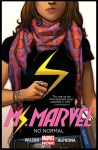
Ms. Marvel No Normal & Generation Why by G. Willow Wilson illustrated byAdrian Alphona & Jacob Wyatt

Standard
Ms. Marvel No Normal & Generation Why by G. Willow Wilson illustrated byAdrian Alphona & Jacob Wyatt

I have to be completely honest these are the first comic books I’ve ever read from cover to cover.  So, while I’m in no position to review the art work, or historical role of the original Ms. Marvel or even have a valid opinion on the superhero story lines, I do want to cover the Islamic elements because even as someone as outside the comic book world as I am, I knew that Marvel’s new Ms. Marvel is a Pakistani-American Muslim girl from Jersey and that’s pretty big.

I was intimidated to read No Normal, I ordered it from Scholastic and have had it on my shelf for a while, I was excited, but nervous. But then I ordered the second one, which is also a collection of 5 comic books, and thought, let’s do this.  Both collections are easy reads, and the text and what to read first in each story frame is clear.  As with comics and graphic novels the pictures convey much of the story so there isn’t a lot of “explanation,” but the story is compelling enough, that even a novice like me didn’t get too hung up on what was going on and how it could be possible.   While it may tempt younger children, I would hold off until the reader is a teen, especially if the reader is Muslim.  There is a bit of drug use and alcohol in No Normal and obviously violence, but at it’s core it is a story of a girl trying to discover who she is and there is some angsty teenage stuff that someone who hasn’t gone through the emotions, might take as attacks on Islam, parents, and culture.

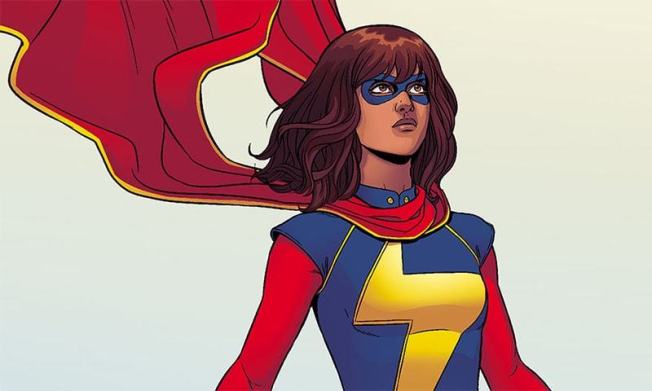
Kamala Khan is a high school student in Jersey City, New Jersey.  She has a Muslim friend, Nakia, who wears hijab, and non Muslim friends of both genders that seem to support her faith and culture, almost more than she does.  The story opens with her sniffing bacon and her friends humoring her oddness.  Having grown up with the same group of friends around her, they understand her quirks and nerdiness and she seems to fit in.  As with most teens though, she feels on the “outside” and Kamala right away tries to seem cool with the more popular crowd.  She  is struggling to find herself within her Pakistani culture, her American life, her Islamic beliefs and teenage friends, information all presented in the first few pages while at the local convenience store hangout.  A lot for Kamala to balance and she hasn’t even discovered her “powers” yet.

Kamala’s parents initially seem more “cultural” than religious as her father chastises Kamala’s brother Aamir for being too religious, yet is constantly on Kamala, presumably because she is a girl.  In a fit of defiance against her parents strict curfew, Kamala sneaks out of the house to attend a party, accidentally drinks alcohol (she spits it out) and gets caught in some “fog” that gives her morphing, stretching, embiggening, and quick healing powers.

As Kamala tests how her powers work, and what they mean, there are a few funny asides that appeal to Muslim readers: she attempts to use her Burkini as a base for her super hero disguise, and her mother threatens to send her to the Sheikh if she gets caught sneaking out again.  Her parents start to grow on you though, the mom is a very stereotypical immigrant mother who cares for her daughter in a worrying nagging way, the dad actually tries to communicate with Kamala and comes across a little more genuine toward the end of the first collection.  Her brother seems to be level headed, but a minor influence.  He sticks up for her and tries to help, but it doesn’t seem like they are that close.   The final scene in No Normal left a little bit of a bitter taste in my mouth and I was glad that I already had Generation Why to dive right into and not let the conclusion of the first one fester in my head.  Kamala shows up to a wedding late, complete in Shalwar Kameez (Pakistani clothing) and gets in an argument with her mom.  Kamala says, “You and Baba want me to be a perfect little Muslim Girl–straight A’s, med school, no boys, no booze, then some hand picked rich husband from Karachi and a billion babies.”  The mom says, “Your father and I want the best for our only daughter our expectations are high so that your successes will be many.”  It goes back and fourth then the mom says she is grounded and the book ends with Kamala retorting, “wanna bet…?”  While I’m sure most every Muslim American teen has felt this way, I don’t think I’d want my 9 year-old-daughter thinking that is how narrow success is defined, or that being the best you can be is a punishment. It’s probably a realistic gripe, but to have it be the last impression, naturally brought out my defensive instincts.

A lot of the awkwardness and stage setting in No Normal is resolved by Generation Why and I found I enjoyed it a lot more than I thought I would.  I might even be anxiously waiting to see what happens next.  Kamala is sent to the Sheikh and while she is intentionally vague about telling him what is going on with her, she does suffice it to say she is trying to help people and he responds by telling her to do it with as much honor and skill as she can. I love that he wasn’t putting her down, but rather trying to mentor her spiritually to find her self and do so honorably.  Really the only other religious/cultural scene is when Lockjaw a giant dog with transporting abilities shows up to help Kamala and her parents say he can stay, but outside because he isn’t clean.  I don’t know if non-Muslims will fully understand why, but it made me chuckle.  It also made me like her family a bit more.  They are strict, but not unreasonable.  They didn’t say, “no” they found a compromise.

Generation Why contains more action than back story.  I’m not entirely sure why Wolverine shows up, I have no idea who the lady in charge of stuff is with Captain America, and I’m not sure why no one finds it odd that the Inventor is a bird man, but hey it is fun.  And it definitely had me cheering on Ms. Marvel as she empowers her generation and learns that being American Muslim might be the easiest of her identity issues when she learns she is inhuman.  It gets a little cheesy, but the foundation of comic books being good against evil, lends itself to that right?

Overall, I think I would recommend both collections are read together, as it gives a better picture of what Ms. Marvel is and can be.  I think thus far the author has done a good job of showing that she is Muslim and that her faith adds depth to the character.  Her tenacity, persistence, determination, compassion for animals, her humor, her nerdiness, all make her very like-able and admirable.  I probably wouldn’t do it as a Book Club selection, because our school only goes to 8th grade and being an Islamic School I don’t know that most of the students feel the identity crisis until possibly much later if at all.  But I think the books would work well for discussion with older kids.  Topics of what youth can do, their role in preserving the planet, discovering your sense of self and purposes are all there in comic book, super hero, action packed form!

Kamala Khan