Category Archives: islamic fiction

Mimi & Unicorn Get to Know Allah by Zanib Mian illustrated by Laila Ramadhani

Standard
Mimi & Unicorn Get to Know Allah by Zanib Mian illustrated by Laila Ramadhani

img_3480-1

Creating understanding and love of Allah swt is perhaps the most important type of Islamic fiction book available for young children, so I love that we have options to choose from. The framing of this book is nothing new, a child asking various people about Allah swt to learn about Him, is found in numerous books.  But, this 32 page book is particularly engaging because of the large brightly illustrated pages, and the author’s signature style of conveying facts in a simple relatable manner.  The comic relief of the unicorn and the adorable protagonist are great, and the added layer of it being checked by two named scholars really make this one of the best in a very populated category.

The book starts with Mimi wondering about Allah swt after hearing people say things such as, “Allah will take care of it,” and “Allah knows.”  She asks her imaginary friend, Unicorn, but she doesn’t know either, so they head off to ask different family members.

img_3484-1

Summaya, Mimi’s big sister tells her that  “if you know Allah, you love Him, and He loves you.” It is followed up with details that Allah swt knows us, because he made us. From Nana, Mimi and Unicorn learn that Allah swt is One, and he explains why we don’t know what he looks like.  From Nani we learn that “Allah swt has no beginning and no ending.” Baba explains that we turn to Allah swt when we need help, Unicorn wonders if we need a phone or Imam to do that. Finally she talks to her Mama who explains trusting Allah’s plan.

Each stop is beautifully articulated and examples are given, resulting in a Mimi who’s heart becomes light and warm, and who works to know more about Allah swt every single day.

The backmatter includes notes from the author and illustrator and various bookish people sharing their early understanding of Allah swt and his attributes.

img_3487-1

The book is available from muslimchildrensbooks.co.uk in the UK and here from Crescent Moon Store in the USA (she ships globally)
The Monkey, The Cow, and the Wolf (The Song Book) by Zain Bhikha illustrated by Amir Al-Zubi and Azra Momin

Standard
The Monkey, The Cow, and the Wolf (The Song Book) by Zain Bhikha illustrated by Amir Al-Zubi and Azra Momin

I was wondering when the book version of this song was going to be released.  It is a beloved at our house, and when the book arrived, I don’t know if the 4 year old or 13 year old was more excited.  Either way, none of us were able to read the book, we all, by about page two, were singing at full volume the story of the monkey, the cow, and the wolf.  If upon seeing this cover you didn’t immediately start humming the beloved kid’s song, then you are in for a treat with this book as three stories about animals teaching timeless lessons are shared.  The book is simply the lyrics of the song, so a parent might need to explain a bit, but the fun illustrations, and rhyming lines will make it a favorite for toddlers and preschoolers to sing and flip pages to, alhumdulillah.

The song/book is organized with a statement, a chorus highlighting the moral after each story and then repeating the opening framing statement.  The first story is about a business man who would cheat his customers, Allah swt sent him a monkey, and the monkey purified his wealth by disposing of half of it in the sea. The moral being that “Allah hates cheating, Allah hates lies, so give what’s due and receive what’s right.”

The next story is about a farmer and his cow.  The farmer works his animals way too hard, so Allah allows the cow to speak and tell his owner not to abuse him or the other animals.  The moral being that “Allah made animals, Allah made man, to all living creatures be kind and fair.”

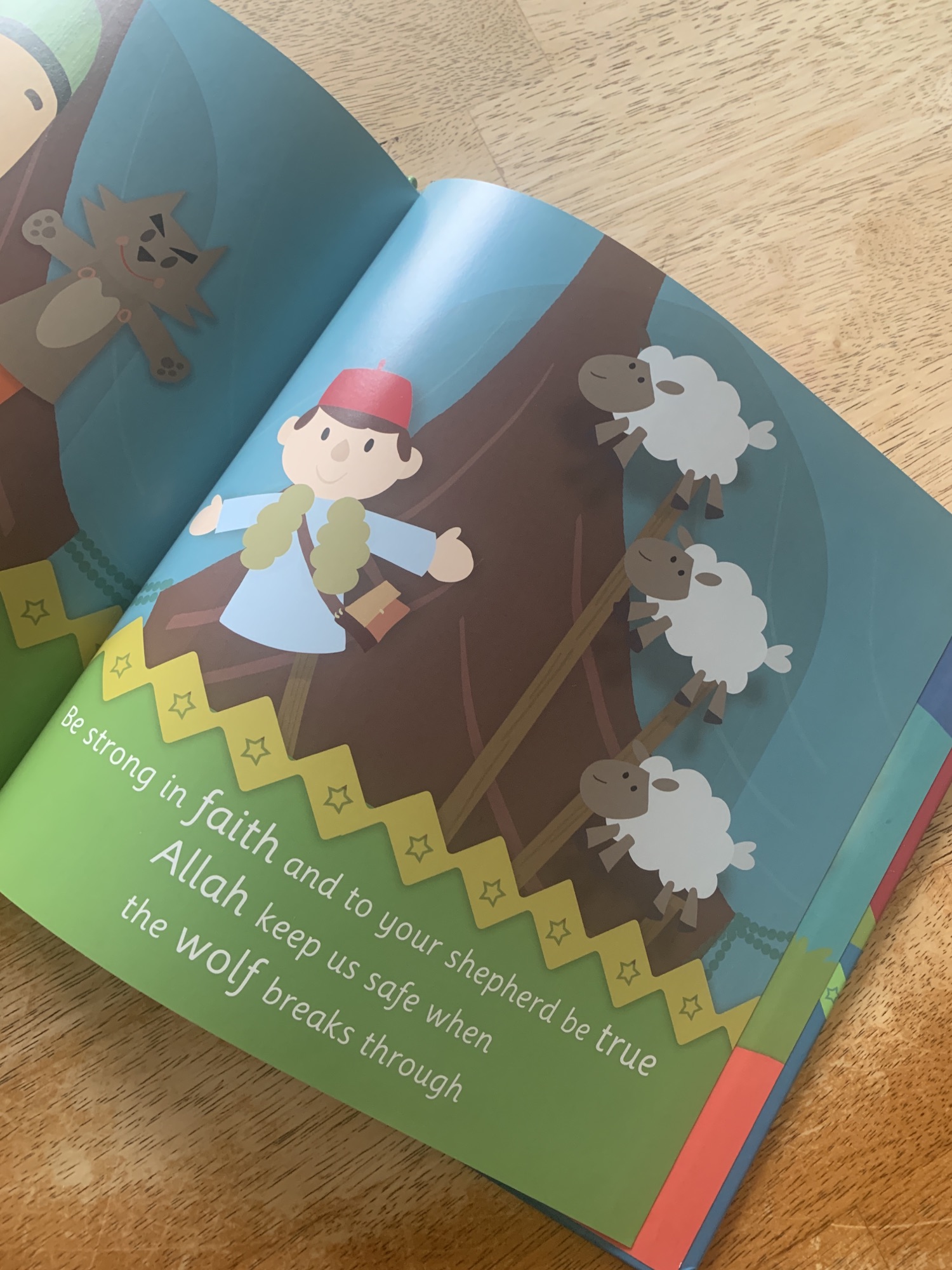
The final story is about the wolf trying to steal the sheep and the shepherd protecting them.  The warning is that the sheep must be strong in faith for the wolf will always be trying to take you.

The book and song are catchy and fun, and provide stories and morals to discuss with kids at story time and bedtime.  The only slightly odd thing about the book is that the last page is the inside back cover.  I’m sure it was a binding decision but it seems it could have balanced the title pages at the beginning to make it feel symmetrical.

Available to order HERE

An Eid Story: Husna and the Eid Party by Fawzia Gilani-Williams illustrated by Kulthum Burgess

Standard
An Eid Story: Husna and the Eid Party by Fawzia Gilani-Williams illustrated by Kulthum Burgess

img_3309-1

This 27 page book is old, published in 2007, and one that I kept an eye out for on occasion since reviewing a similar early chapter book by the same author, The Lost Ring, that I found in a public library in 2016.  Somehow it found its way to me in 2024, and I’m reviewing it because it has been a while since I’ve indulged in older books that shaped the foundation of Muslim literary representation so many years ago.  It is the epitome of Islamic fiction and what Islamic fiction looked like when I started teaching.  It has a Muslim protagonist, with a universal stress, framed in Islamic acts, perspectives, information, and morals.  It is unapologetic, it is at time preachy, and while the writing isn’t remarkable, an engaging story is laid out with numerous lessons along the way.  You may not want to rush out and purchase this book, but if you have it on your shelf, it would be worth pulling out, dusting off, and sharing with a child. At times the details feel a little dated, but there is a timelessness to stresses with friends, being left out, assuming the worst, and wanting to be included.  This book will offer a chance to be seen in the text and illustrations as Husna waits to be invited to her friend’s Eid party.  The book does not specify if it is Eid al-Fitr of Eid al-Adha, but it really isn’t impactful on the story, as it simply sets the time, mood, and draws all the threads together.

SYNOPSIS:
It is the week after Eid and students are back at their Islamic school, Husna has lots of friends, but Maryam is her favorite.  While on the playground, someone asks Maryam where the party is going to be, and she responds, “probably at the house.”  Excited Husna waits for her invitation, that unfortunately never comes.

WHY I LIKE IT:
Even though the book has a happy ending and is based on a misunderstanding, the feelings are very real.  I remember feeling left out, I’ve seen my own kids and students feel it, and that the book is a snapshot of that feeling from a Muslim perspective, really makes it hit home.  Husna makes dua in sujud at Maghrib and Fajr that she will be invited, conversations begin with As-Salamu ‘Alaikum and end with Barak Allahfi-ki, homework is learning Hadith and memorizing ayats, jumah is prayed, and every page is filled with Islam.

FLAGS:

None

TOOLS FOR LEADING THE DISCUSSION:
The book is an early reader, a text heavy one at that, but none-the-less meant for ages seven and up. I can see it being read today in small groups in an Islamic school or if you have a young one who is perhaps feeling something similar.  You might have to explain invitations in the mail, or calling on a house phone, but it still has relevance.

Ilyas & Duck: Spectacular Salah by Omar S. Khawaja illustrated by Mattia Cerato

Standard
Ilyas & Duck: Spectacular Salah by Omar S. Khawaja illustrated by Mattia Cerato

img_3321-1

It has been a minute since we have had a new Ilyas & Duck book to read and share with our kids, and this one focusing on prayer is informative, fun, and was well worth the wait.  It is also long, 48 pages long to be exact.  There is a lot of information and works best for ages six or seven and up.  The clever rhyme and engaging illustrations tell about wudu, the times of the five daily prayers, Surah Al Fatiha, facing the Kabah, having the right intention, connecting with Allah, and not being distracted. I love the framing that salah is not just an obligation, but is an opportunity to talk to Allah swt and should be spectacular.  The author reads his books aloud a lot to kids, so if you have ever seen one of his readings, I highly recommend channeling the voices and energy, to hold the audiences attention if using the book at story time.  If reading at bedtime, or if handing to an independent reader, take the opportunity to discuss the points, check understanding, and reflect upon what Duck is learning.  As always the banter between Duck and Ilyas keeps the kids laughing, the story moving, and the information flowing, alhumdulillah.

The book starts with two verses from the Quran and the hashtag #freepalestine, before entering the world of Ilyas and Duck one summer afternoon,.  An alarm goes off and Ilyas heads off to make wudu and pray.  Duck couldn’t get up though, he prayed earlier, so he thought he was done.  Ilyas explains that there are five prayers in the day, and Duck is seriously worried that Fajr, Dhuhr, Asr, Maghrib, and Isha are going to cut in to his game time, snack time, and movie time.

When Ilyas tells Duck that prayers don’t take long and it is when you speak to Allah swt, Duck in his enthusiastic way is determined to make each and every prayer spectacular. He drafts a plan, learns the steps and what to say, finds the direction, makes his intention, says Allahu Akbar and starts training. 

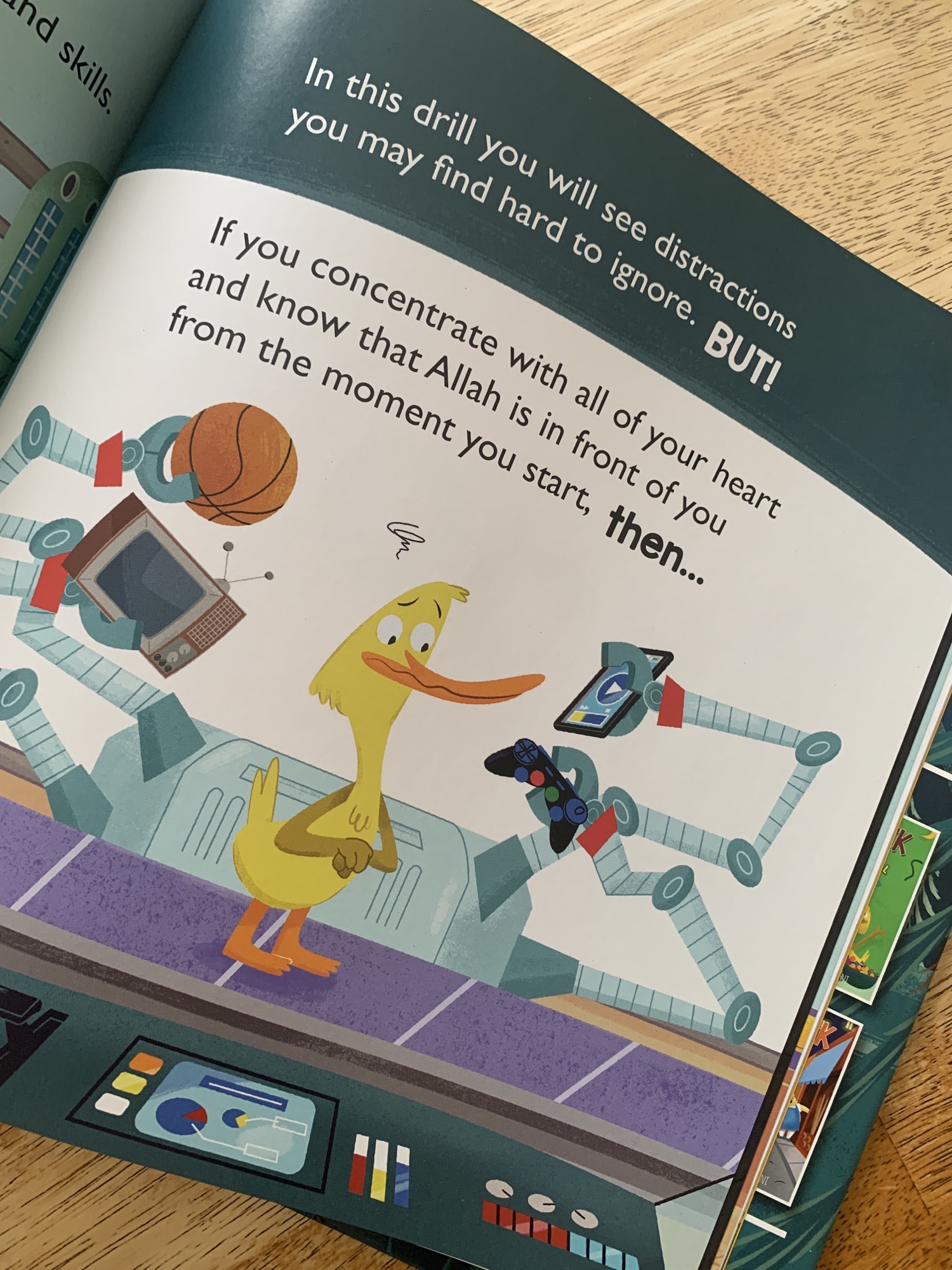
He is praying all over the Earth whenever the time comes, but then he learns he can do more and goes to visit the Professor.  He learns about connection and closeness to Allah.  He also learns about using his heart and staying focused, before rushing back to tell Ilyas all that he has learned.

The book covers a lot of ground, and gets kids excited to pray.  I like that the information is a mix of highly detailed specifics, general knowledge, and humor.  The way the salah times are described and the emphasis on connecting with Allah swt and making your prayers heartfelt is not often seen in books for this age group, and I think it gives the book a wider lasting appeal.  My 8 year old did point out after reading it independently and laughing, that if Duck prayed Fajr didn’t he know a little bit about prayer already?  Also, given the length of the book, a line clarifying that infact not all places on Earth are ok to pray upon, would have been nice. 

img_3327-1

I hope this book signals more books in the series are heading our way.  I notice that the illustrator is not the same, but the pictures are similar enough I doubt most kids will notice. The book is widely available and can be purchased from Amazon here or from Crescent Moon here

Made from the Same Dough by Laura El Alam illustrated by Passant Ablal

Standard
Made from the Same Dough by Laura El Alam illustrated by Passant Ablal

img_3052-1

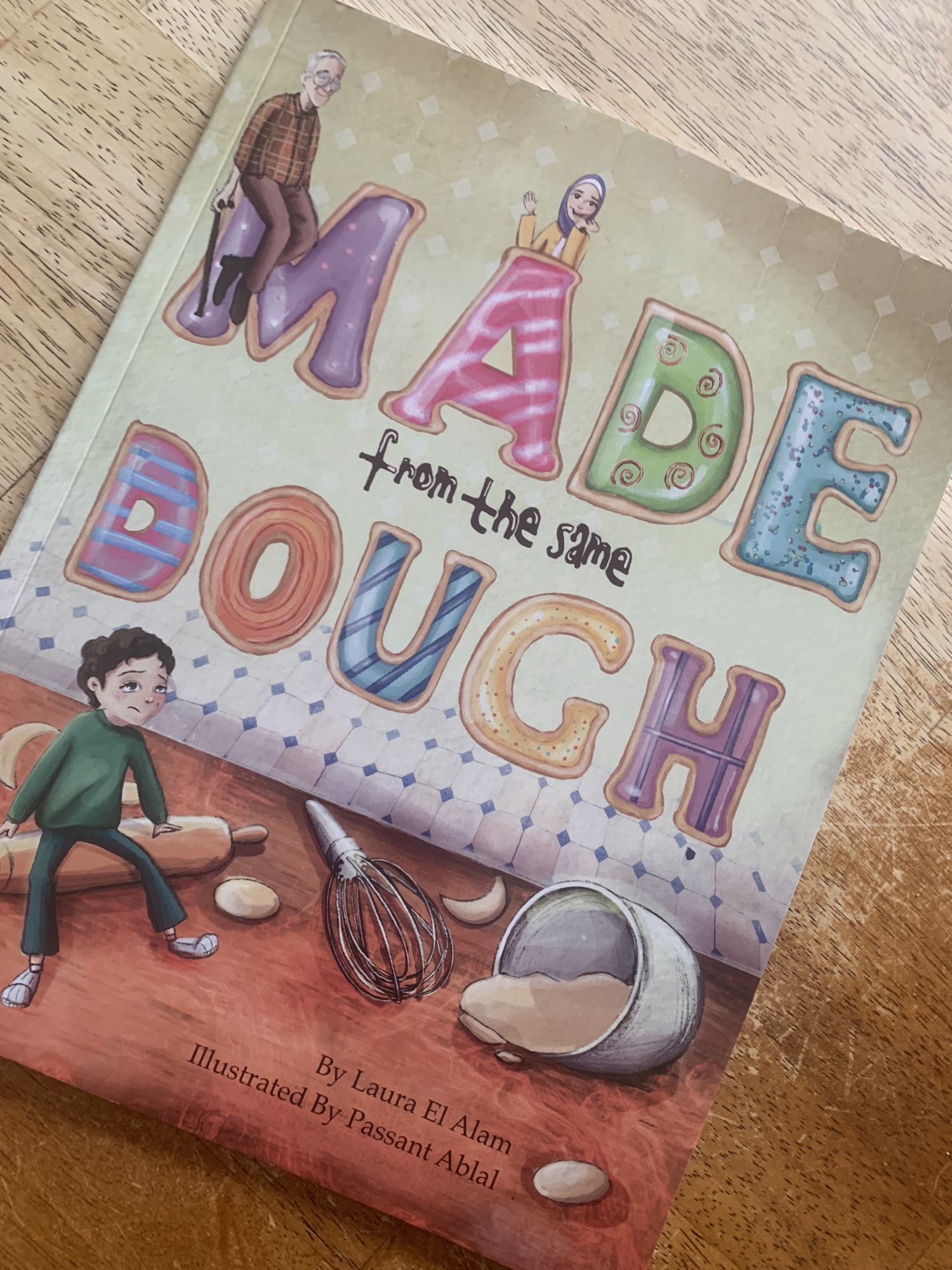
Not all books about Ramadan have to be lists of facts. It is ok to show Ramadan and Islamic elements in stories that have their own plots, character arcs, conflicts and resolutions that are not just about abstaining from food and water, or losing your temper.  This book set in Ramadan is a story about a  Muslim boy and his Christian grandfather, and a whole lot of heart.  As a child of a convert, this book spoke to me, and I saw myself in that relationship, not only as a child, but even as an adult bringing my grandparents to my kids Islamic schools, friends’ lunches, and asking them to wait on the side while we pray.  I absolutely love the perspective of the protagonist, that he is worried about what Muslims will think of his grandfather not fasting or praying, as opposed to the often shown character worrying about what non Muslims think about us. The paradigm shift is subtle, but empowering to Muslim readers to see that they are not “other” in any environment.  The authenticity and how it all comes together in the clear text of the book is beautiful, but I must say, I really struggle with the illustrations.  I know art is subjective, and I am no artist, but yikes, I feel like the pictures actually distract from the story unfortunately.

The book starts with Papa coming over to his daughter’s family home and smelling something cinnamon-y delicious.  He dives in to the harira soup and recalls the cinnamon Christmas cookies they used to make.  Rayan wonders if Papa even remembers that the rest of them are all fasting.

Mama invites him to join the family at Auntie Hana’s for iftar the next night, and Rayan worries what Papa will do when they all pray, or if his friends will wonder why he came to iftaar if he is not fasting.

img_3054-1

Papa agrees and offers to make cinnamon cookies to share.  Rayan doesn’t like the idea of Christmas cookies at iftar and tells grandpa that Santa won’t be there.  The next day when Grandpa comes over to bake, Rayan refuses to help. Part scared, part frustrated, part anxious, Rayan hears everyone having fun, but stays in his room.

When they arrive at the iftaar potluck, Rayan reminds Papa to take of his shoes and then devises a plan to keep the Christmas cookies from causing any embarrassment. Only his sister Aliya foils his plan and Rayan will have to face his own feelings and make things right.

I’ve read this book easily close to twenty times, since ordering it, evaluating it for the Muslim Book Awards 2023, (it won the Holiday category), writing this review, and reading it to my littles at bed time, and it still hits close to the heart every time.  It reminds me of my own grandpa, who has been gone almost exactly a year, who may not have always understood our actions as Muslims no matter how often we tried to explain them to him, but never loved us any less.

img_3056-1

You can purchase your copy here at Crescent Moon

Eliyas Explians Ramadan by Zanib Mian illustrated by Daniel Hills

Standard
Eliyas Explians Ramadan by Zanib Mian illustrated by Daniel Hills

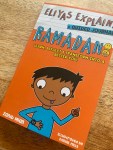
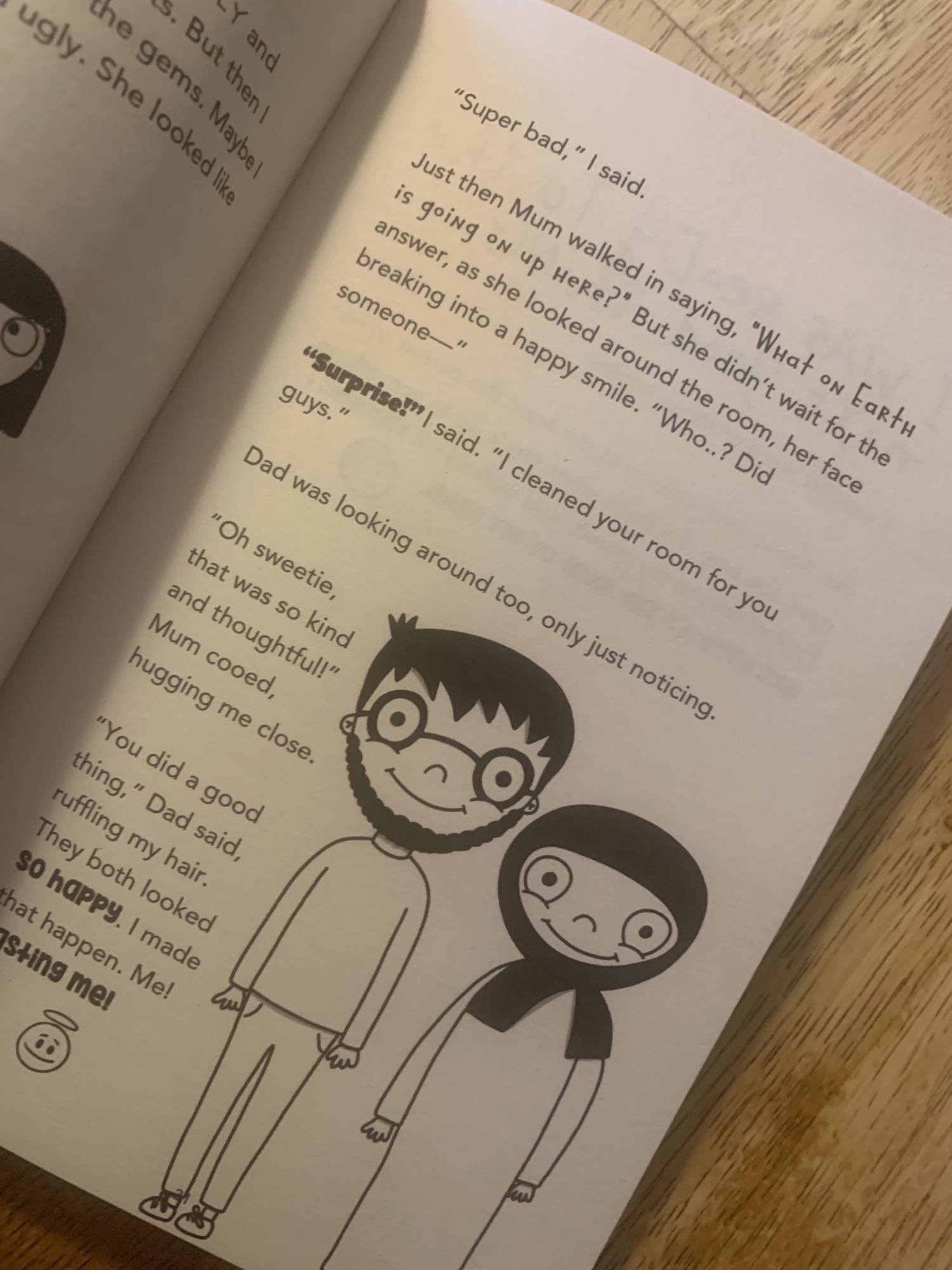
This is the fifth book in the Eliyas Explains series, and it really is what you would expect and hope, a book about Ramadan from Zanib Mian would be.  Eliyas’s voice is funny, relatable, engaging, and yet somehow manages to find a clear way to inform too.  The framing is fictional, but the book is meant to be lesson, moral, and information filled.  The voice did seem to break when Eliya’s didn’t know what “Ramadan Mubarak” meant, but it is clear that the book is meant to teach and remind middle grade kids about Ramadan from moon sighting to Eid, so I don’t think anyone other than an old reviewer would notice.  Parents might notice though that Eliyas loses his cool at one point and starts to presumably call his sister stupid, it stops at “st,” but then says he “started to cuss” which in America would be taken to mean a profanity much stronger than stupid, so just be aware, so you don’t panic if your child asks.  Overall the book is great, it is a solid 80 pages before the guided journaling begins and concludes at 115 pages.  The illustrations, changing font, and humor really make it perfect for the age group.  I gave it to my eight year old to read and I could hear him laughing, saying a few dua’as aloud, and he even came and asked me a few questions making sure he understood new information correctly.  This book would work as an independent read, a read aloud, or even an elementary reading assignment in an Islamic or weekend school.  The book is remarkable for the simple fact that it starts by naming the scholar that proofed the book, truly this is revolutionary, please can we normalize sourcing already.

The book is divided into chapters, with chapter one reintroducing Eliyas and his family to the reader. They are out on a bike ride and Eliya’s wants to know why everyone is so excited for Ramadan and giving up food and water.  Mom and dad explain taqwa and good deeds being multiplied and prayers being answered and big shaytans being locked up and Eliyas is excited (to put it mildly) to get closer to Allah swt and be a better version of himself.

Chapter two explains the moon, making intention, and waking up for suhoor.  With nine chapters before the journaling, the book discusses doing good deeds, fighting, forgiveness, shaytan being locked up, taraweeh, Laylatul Qader, and Eid.

The journaling guides readers through forgiveness, ibadah, goals, duas, kindness, feelings, connecting with Allah swt and more.  The beauty of this book is that it does pack a lot of information, but it shows a lot too, and gives kids a way to see Ramadan in action.

You can order your copy here at Crescent Moon store 

Aliya’s Secret: A Story of Ramadan by Farida Zaman

Standard
Aliya’s Secret: A Story of Ramadan by Farida Zaman

img_2838-1

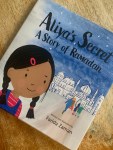
Books like this are honestly a disservice to Muslims. I know the industry means well by having a token holiday book, by an OWN voice writer, ensuring it is joyful and illustrated in a warm way, but when the information is erroneous, it really just perpetuates misinformation. This book will be on shelves everywhere and shared at story times in classrooms and libraries and non Muslims will think they are being inclusive, and Muslim kids will also learn erroneously or doubt if they are in the wrong, or best case scenario (?) have even more to explain to those around them. The book is adorable, yet the information about when we fast and why we fast is wrong, repeated throughout, even in the backmatter.  The book is for young children and pivots around lying, the character lies repeatedly with no consequences…in Ramadan no less.  Sigh, our kids deserve better.

created by photogrid

The book states multiple times, four in fact, that Muslims fast from sunrise until sunset, this is incorrect, Muslim fast from dawn to sunset. Sahoor is not eaten at sunrise, it is eaten before dawn. This is not me being picky, this is wrong. The dad perhaps has his own reasons for fasting, but Islamically we do not fast to feel what those who are hungry feel or to be grateful, those hopefully are results of fasting, but in fact we fast as commanded by Allah swt. Children are required to fast when they hit puberty, not at the age of 13 specific. Many kids fast full and partial days before puberty, and I don’t agree that their growth is stunted as suggested by the book.

created by photogrid

The set up of the story is nice, albeit another first fast book, in that at least the character and her classmates and friends know what Ramadan is and thus there is no othering. It talks about charity and praying and shows the Muslim family living their life unapologetically which on the one hand is great, but then makes the lying seem weird. Why would Aliya keep fasting a secret from her friends at school even if she is keeping it from her parents? Why would she lie about it, why would she lie and have it articulated as lying and there be no repercussions for it, in a picture book? She doesn’t even just do it once, she lies THREE TIMES.  When you do good things from a place of faith and worship, it seems off to me to have it framed in deceit with no other commentary.

Sure to some the time when fasting starts might be a small thing, but seriously is it that hard to get correct? I wish the editorial/publishing/marketing team would have hired beta/sensitivity readers, not all Muslims know Islam, and not checking the facts really is just sloppy.

Dear Muslim Child by Rahma Rodaah illustrated by Aya Ghanameh

Standard
Dear Muslim Child by Rahma Rodaah illustrated by Aya Ghanameh

img_2280-1

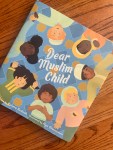
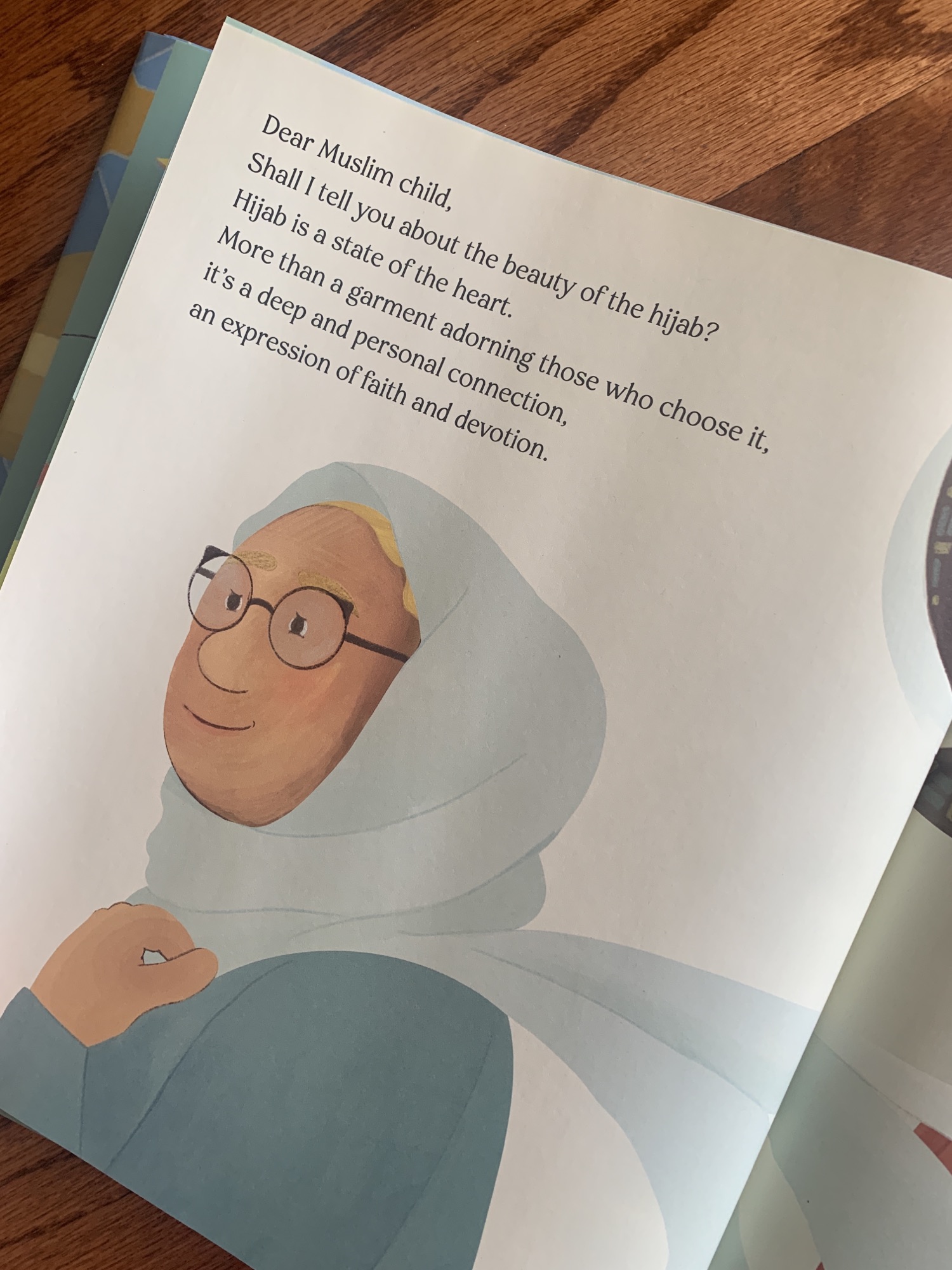
The flow, poignancy, and lyrical verses force you to slow down, take a deep breath, and immerse yourself in the concepts and ideas so beautifully presented in the text, and illustrated on the pages.  Whether you are reading it alone, snuggled up with a little one, or in a boisterous story time, this book pulls you in as it speak directly to the reader (or listener), burrowing inside and inspiring reassurance and confidence.  The tone of the text melds with the illustrations making the book appeal to those looking to understand, be seen, or to be empowered.  The short stanzas with the opening refrain of, “Dear Muslim child,” are a delight to read and share again and again, alhumdulillah.

The book does not have a story or a plot, but has an organization that keeps the pace moving in a poetic way. It starts by mentioning that we were meant to be, even “before Allah spoke the universe into existence.”  It then tells us about Islam, nur, names, the power of words, purifying our hearts (with wudu), listening to the adhan, and praying.  It talks of the beauty of hijab, and community, and purpose and mattering.

img_2282-1

The centering of Allah (swt) is not shied away from, yet the book is not preachy or overly religious.  For example wudu is shown, but not named; adhan is named but not defined.  If you wish to discuss each page, there is a lot to unfold, but if you want to just read the surface it is beautiful just the same.  The book is traditionally published, and a true accomplishment of the author, and the authors that have come before that this book, this type of book, is widely available for us all to enjoy.

img_2284-1

Gates and Tales by Sally Zaki illustrated by Arwa Ali

Standard
Gates and Tales by Sally Zaki illustrated by Arwa Ali

This 34 page picture book is adorably illustrated as it focuses on the gates leading to Masjid Al-Aqsa and sprinkles in culture, sights, and history about Palestine along the way.  I love the concept, it is unique, and I love that there are maps throughout of the masjid compound.  I truly learned a lot even though it is for early readers, naturally I wish there was a scannable QR code to learn more, but as an adult, with my kids, or in a classroom it would not be hard to search up Bab Al-Amud, Qubbat Al-Sakhra, Bab Al-Sahira, Salah Al-Din, Masjid Al-Qibli, Bab Al-Khalil, Al-Quds Citadel, Qaitbay’s Fountain, Bab Al-Asbat, or Qubbat Al-Silsilah.  Islam is also woven in, not just in the architecture or history, but also in mentioning the sunnah of fasting on Thursdays, quoting an ayat from the Quran in the text, and the kids meeting up to pray.  The writing isn’t super great,  it breaks down the fourth wall regularly, calling the readers “friends” and asking them to find things in the illustrations, their missing friends, and about foods and the flags of their country.  I’m not sure why the book hopes the readers are “from countries surrounding Palestine,” I found that a little off putting, and I’m not sure why we are supposed to memories the “gates by heart,” or how at the end we are now “victorious heroes.”  Even the defined words at the end, are a bit haphazard: za’atar, falafel and sido, being the only words highlighted, in a book with many Arabic words present. Presumably the reader found all the friends so they did reunite, it seemed to kind of falter, I thought they would show something they all love, or share some snacks, but the book, just kind of ended.  I like that the book is joyful and upbeat, I do appreciate that the last lines do mention that “Palestine is occupied today.  One day, insha’Allah, it’ll be free,” inshaAllah, inshaAllah, inshaAllah.

The book starts with Nidal introducing himself to the reader and letting you know he is going to take you on a special journey through four different gates.  He then asks the reader if they know where we are, before showing us Palestine on the globe.  He is going to “meet his pals at Masjid Al-Aqsa nestled east of the Old City of Al-Quds and includes the entire area inside the wall surrounding the Masjid.”  I love that it explains the area within the walls and the map on the opposite page is helpful.  

His mom has prepared him some snacks to share with his pals, and he puts on his Palestinian flag backpack before heading off.  He goes through Victory Gate.  Then his friend Aisha takes over and tells what gate she is entering through, shares details about the flower carved at Bab Al-Shira, and that her Sido would tell her about Salah Al-Din when they walked down Salah Al-Din street together to get to Masjid Al-Qibli, with its gray dome. Khaled and Jihad follow the same format and the book ends with the kids sitting in front of the Dome of the Rock asking what gate the reader will come through.  

I purchased my copy from Crescent Moon Bookstore here and if you use code ISL at checkout you will save 10%.

We Know What to Say: Phrases Commonly Used by Muslims by Sabria Chao

Standard
We Know What to Say: Phrases Commonly Used by Muslims by Sabria Chao

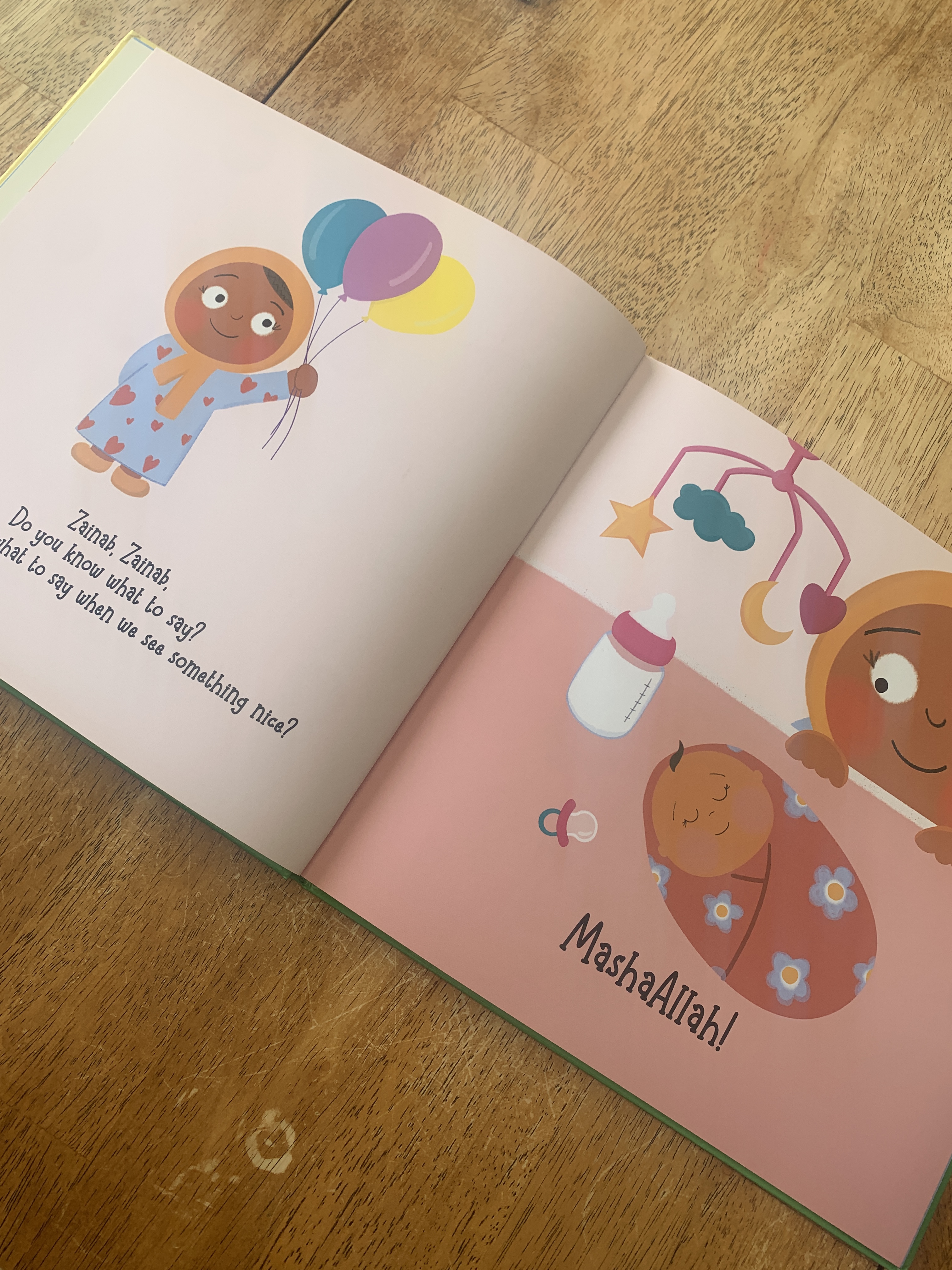
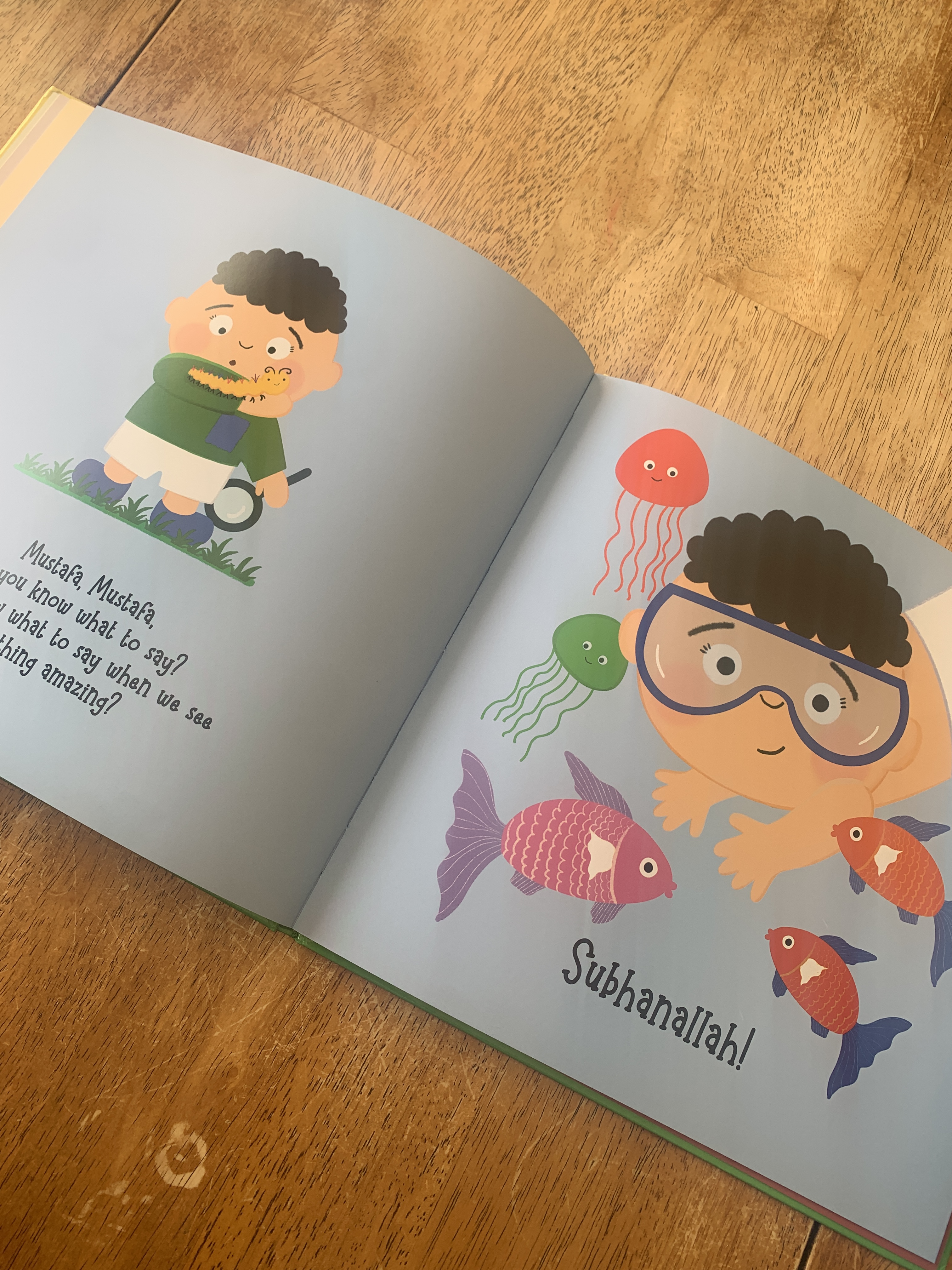
The concept behind this 42 book is really nothing new, but the presentation is wonderful.  The large hardback size, the clear inviting illustrations, and the repetition allow the book to be a delight at story time and bedtime alike.  Each Islamic term is introduced by a diverse character with a common Muslim name being asked if they know what to say in a situation.  The child gives the word, the following two-page spread restates the term and when to use it. All the terms are shown at the end in a two page spread along with a glossary and a Note to Parents.

I love the relatable scenarios: zoom calls, rain, getting sick, etc..  I also like the rhythm of the book, it reminds me a little bit of Brown Bear, Brown Bear.  The bright colors, the simple engaging illustrations and the big size make me ecstatic to share this at story time.  So many of the books that focus on Islamic terms for toddler to preschool level are small board books.  They serve a purpose, but we have long needed a large clear book for groups of children to learn, practice, and review together.

This book was nominated for the 2023 Muslim Bookstagram Awards, but you can purchase a copy here