Category Archives: islamic fiction

Spell it Like S-A-M-A-R by Shifa Saltagi Safadi illustrated by Saliha Caliskan

Standard
Spell it Like S-A-M-A-R by Shifa Saltagi Safadi illustrated by Saliha Caliskan

img_7225

This 36 page book for kindergarten and up shows the role perseverance, confidence, and believing in yourself can play in conquering bullies, carving out a space for yourself and finding success.  While the book is a little predictable on the surface, older kids will understand that by winning the spelling bee, Samar didn’t just benefit by standing up to the bully, but in proving to herself what she is capable of and ultimately being more confident of her place in a new country.  The book is presented on large 8.5 by 11 full color glossy pages and features discussion questions at the end.

img_7227

Samar is in 3rd grade after recently moving to America from Syria, where she was the best student in her class.  ESL wasn’t difficult, but mainstream class is proving to be a challenge, mostly because of Jenna, the class bully.

img_7228

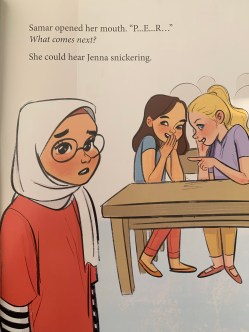
Jenna, snickers when it is Samar’s turn to spell words in front of the class, she teased her about her jump rope songs not being in English, and she makes fun of her for her accent.  With the help of a kind friend, Angela, the two girls decide the school spelling bee will be the best chance to prove how smart Samar is, by winning.

img_7229

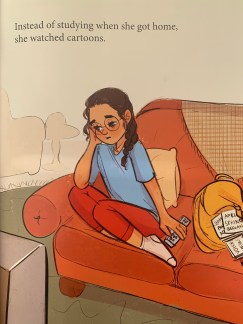
The first step Samar must do is convince her teacher, Ms. Bryan to help her study.  To  show her commitment she offers to give up her recess to study.  The teacher agrees, but on the way home Jenna teases her saying she’ll never win when she can’t even speak English properly.  Deflated, when Samar gets home, she doesn’t study the flashcards and opts to watch cartoons instead.

img_7230

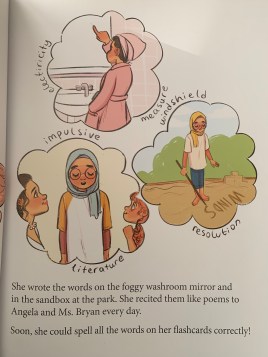
When later in the week her teacher quizzes her, Samar admits she didn’t study.  Ms. Bryan encourages her by sharing her own story of coming to America and having to learn English.  When Samar gets home she sees her mother, a former dentist in Syria, studying for the exams to be a dentist in America. This is the spark she needs and she studies hard, everywhere, and with anyone who will help.

On the day of the bee, Samar spells word after words correctly and after saying bismillah before spelling the final word, wins the competition and beats Jenna. The audience cheers and the next day Samar and Angela are jumping rope and Samar is singing in Arabic.

img_7231

I love that Samar and her mom wear hijab while out, but not at home, that they speaks Arabic, and Samar says bismillah.   Samar’s mom is clearly highly educated and determined and mom and dad are supportive.  I love that Samar’s drive, however, comes from her own determination, no one forces her or guilts her, it is her leading the way and understanding what her mother is going through and her teacher has gone through, and using that as inspiration.  I love that at the end she doesn’t rub it in Jenna’s face that she won, and the symbolism of Jenna just disappearing from the story makes this clear as Samar steps in to her own.  I truly love that for every Jenna in the wold there is also an Angela.  Be kind, be supportive, be a good friend!

I got this book from http://www.Ruqayasbookshelf.com and it can also be found at my favorite book store http://www.crescentmoonstore.com as well.  Happy Reading!

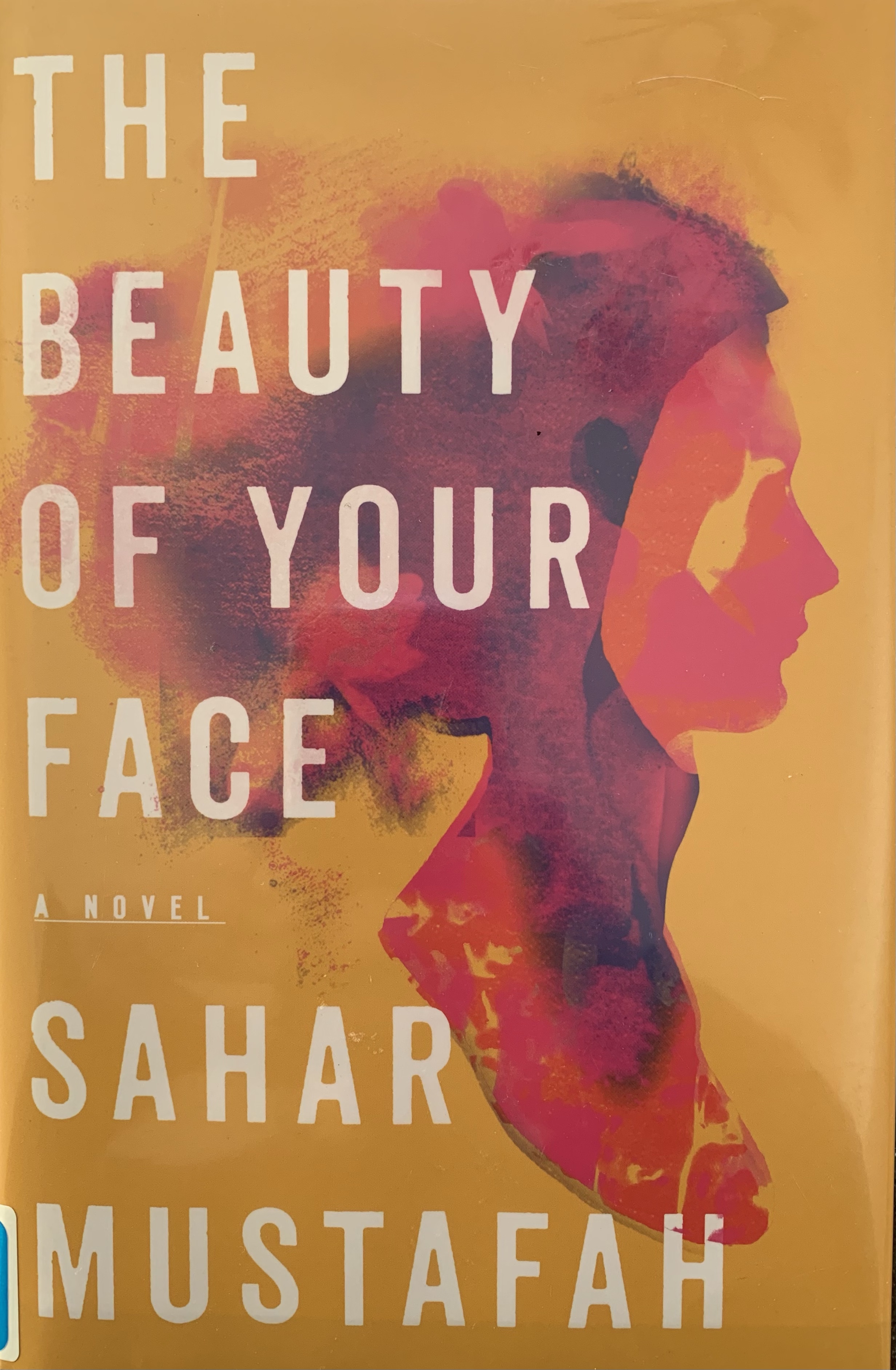
The Beauty of Your Face by Sahar Mustafah

Standard
The Beauty of Your Face by Sahar Mustafah

img_7145

I had debated picking up this book knowing that it isn’t labeled YA and I’m painfully behind on a stack of books I want to review, but after reading @muslimmommyblog’s review I opened the first page: that was 24 hours ago, I couldn’t put it down.  I’ve seen a lot of comments about this book being more YA than adult fiction because it tidies everything up so precisely at the end.  I’ve also seen critiques from non Muslims that it is overly preachy at times.  Many Muslims are so swept away by the rawness and presence in Islam in the book that they are making their teens read it.  So I wanted to read it and review it to determine if it is appropriate from my perspective for teens, and offer my take on it.  Ultimately I think while much of the Palestinian-American protagonist’s life story in the book occurs as a child and young adult coming of age, that the “flags” are so critical to the story and so numerous, that no matter how deftly and non specific she handles these issues and moments, that the book really is meant for more mature readers. I’ll detail it more below in the FLAGS section but to highlight a few mature spots mentioned in the book to varying degrees:  extra marital affair, alcohol, making out, groping, nudity, sex, voyeurism, killing, shooting, physical abuse, profanity, suicide attempt, bigotry, etc.  The writing is absolutely superb, and it isn’t sensationalized, but it is there and provides understanding as to why the characters often are as they are to a point that you need to understand them with a certain clarity.  I would think this 298 page book would most appeal to early college age readers where one is hopefully open minded enough to understand the characters relationship with religion whether they are Muslim or not, old enough to have some of their own life to reflect upon, and on the cusp of a new chapter that they realize the role their choices can make as they move forward.

SYNOPSIS:

Afaf’s life story unfolds out of order and with occasional interruptions from an outside point of view.  It opens with her at work, as a principal of an Islamic girls high school in Chicago as we see her dealing with parents upset with things taught at the school and the balance she tries to achieve in guiding her girls to be strong, confident, well-informed Muslims in a diverse America.  It then flips back to 1976 and begins the tale of Afaf’s life with her parents, immigrants from Palestine, her older sister and younger brother.  Not ever feeling like she fits in at school, she loses any sense of normalcy at home when her 17 year old sister Nada goes missing.   There were problems at home before: her mother never being happy, Afaf never feeling her mother’s affection, her father having having an ongoing relationship with another woman, but as days and months go by, and no clues can find Nada, it will be the event that seemingly tore the family apart.  Afaf’s mother has a mental breakdown, Afaf’s father takes to drinking, and thus Afaf and her younger brother Majeed have to navigate much of their life on their own.  In high school Majeed finds baseball and becomes the ideal student and son.  Afaf lets white boys feel her up and has a reputation for being easy.  She doesn’t cross the line, but her reputation and name on the back of bathroom stalls is fairly accurate.  When their father is involved in a car accident, he finds Islam.  The family is very cultural, but not religious at all.  Eventually Afaf and her brother accompany their father, much to their mother’s protests to the Islamic Center and while Majeed has no interest in religion let alone Islam and never returns, Afaf feels an instant peace and the opportunity to redefine herself and continues to go and study Islam.

The book jumps regularly in sections, not every other chapter, and at some point it shows Afaf as an elementary school teacher making the commitment to wear hijab and preparing to wed a Bosnian man with a broken war filled past.  It jumps and has her brother home from law school visiting and her mother attempting suicide by drinking drano and being found laying naked in a bath tub.  After recovering, her mother returns to Palestine and never returns.  In yet another vignette, it has Afaf and her husband and father preparing to go for Hajj, where her father passes away, and has her returning to find she is expecting her third child a little girl.  There are other surprises that I’ll not reveal, but some of these jumps are interrupted by a voice of a radical alt right mant who walks into the girls school and starts shooting, finding himself face to face with the principal, Afaf.

WHY I LIKE IT:

I am seriously blown away at the quality of writing, and the interweaving of religion and culture.  It is a main stream book and it has a lot of religion in it.  It isn’t so much long passages of preaching, the father would like it to be that way, but the other characters keep him in check.  But the quiet transformation of Afaf and having Islam save her from a life she was not content with.  I love that it has joy and happiness despite all the tests and obstacles.  The book could have been really heavy and drag, but it wasnt, it was compelling and hard to put down.  The characters will be with me a while and I can see myself rereading the book just to visit them again.  

I was a little confused with Afaf’s limited Arabic and her mom’s limited English.  How did they communicate? I get that perhaps it was symbolic of their broken relationship, but seriously when Afaf is seven and not understanding Arabic and her mom is not understanding the police and neighbor in basic English, something is a bit off.  I like that insight is given as to why Afaf is fooling around with any boy that wants her and that it shows it isn’t about the acts themselves.  I also like how it showed her conflicts in reporting an Arab child in her class being abused at home by her father and how the response was so sad by the community.  While Islam saves her and holds her to a higher standard, it doesn’t appeal to her brother, it doesn’t remove the hypocrisy of people who are Muslim: abuse, owning liquor stores, and it doesn’t make everything better for her.  She has to suffer consequences of her choices, she just feels that Islam gives her the tools to persevere and understand and have hope.  

I love the food, oh man, hearing all the dishes being cooked and served and cleaned up after, really made me very hungry.  The cultural elements of the music and songs and oud really ground the book and make the OWN voice value ring so true and strong.  The racism and bigotry feels very real as well.  The author is the daughter of Palestinian immigrants and the way that she articulates such pointed examples of not being given the chance to move up in the elementary reading group, side comments the high school coach makes to her, and the general stereotypes thrust upon her, are very powerful.

FLAGS:

So there is a lot, as stated in the intro, but I want to articulate a bit of why I maintain older teens for the book even though it isn’t overtly sensationalized. I’ll walk through some of the major flag themes.:

Take the drinking. The father is an alcoholic, but the mother and children hate it, Majeed drinks beer with his friends, but isn’t Muslim, yet the Khalti is somewhat religious and they pour amber drinks at Thanksgiving. So there is some moral lesson, which I think you could argue is fine in YA or even middle grades.

Relationships/sex/body: The father is having an affair with a much younger woman, they refer to her as sharmoota and everyone knows about it, no other details are given. Afaf lets boys touch her naked body, but draws the line at intercourse, she says she on some level doesn’t want to do that to her parents or something of that nature. Right before proposing marraige, her and Bilal do kiss. Once they are married it mentions them making love in the mornings. It mentions masterbating and blow jobs. The shooter and his girl friend have sex, the shooter watches an Indian neighbor nurse her baby through the door and sees her exposed breast with some detail and then goes home and masterbates. When the mother is pulled out from the tub after attempting suicide it doesn’t just mention she was naked, it comments on her pubic hair.

Violence: An Arab Muslim male classmate, drives Afaf away from her bike and the slaps her telling her basically that she should not be such a slut. Afaf punches another girl in a fight at school. A child in Afaf’s class is being hit by her father. Mother lashes out at Afaf, she ends up burned. The climax is a mass shooting where 14 students and a teacher are gunned down and killed. Self harm: car crash while drunk, suicide attempt with drano.

Minor: Yeah there is music, and Halloween,

TOOLS FOR LEADING THE DISCUSSION:

This would make a great book club selection for those in their early 20s and up. It is well done, just not for younger readers. The book is very popular and numerous author interviews can be found with a quick Google search.

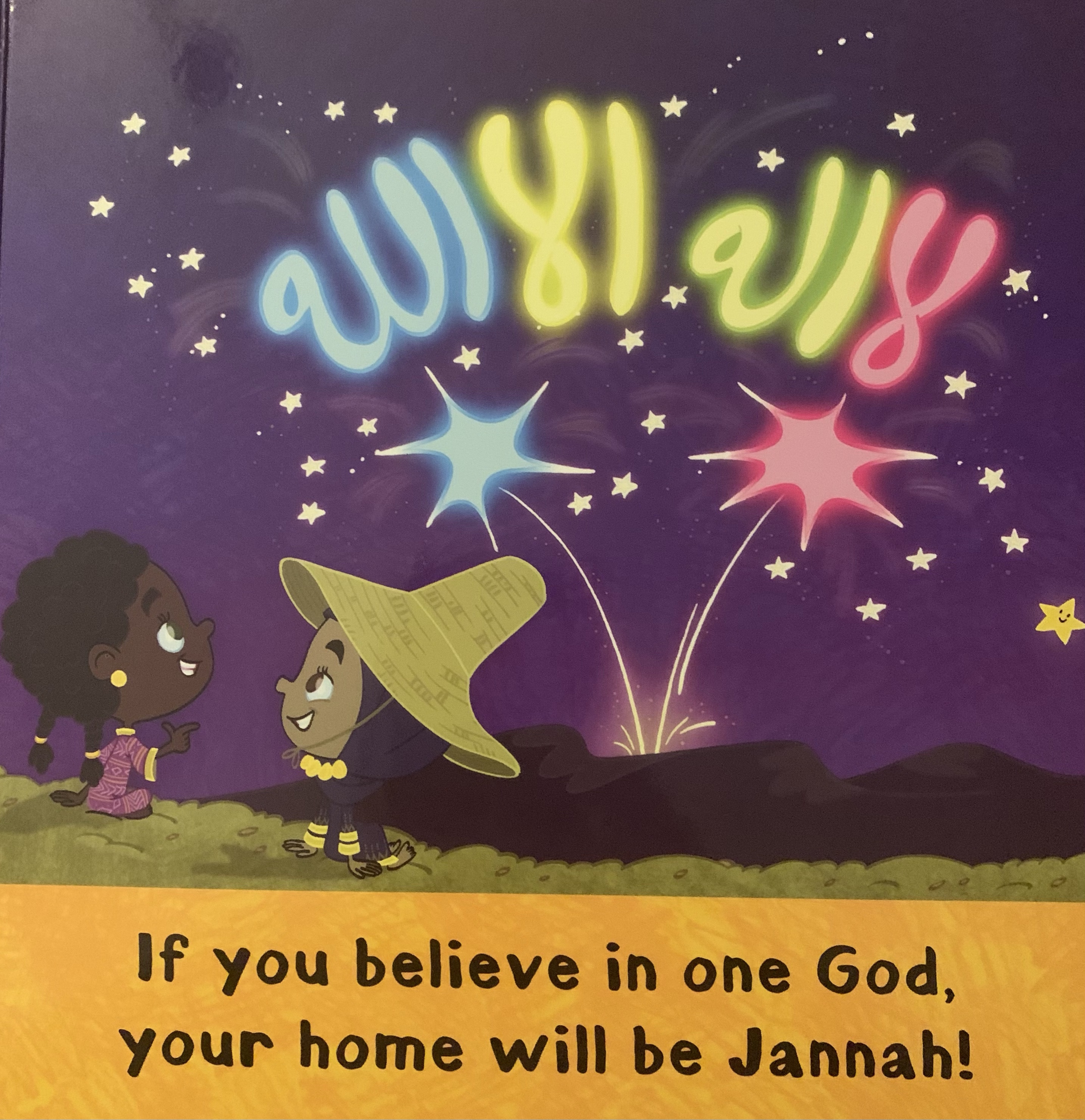
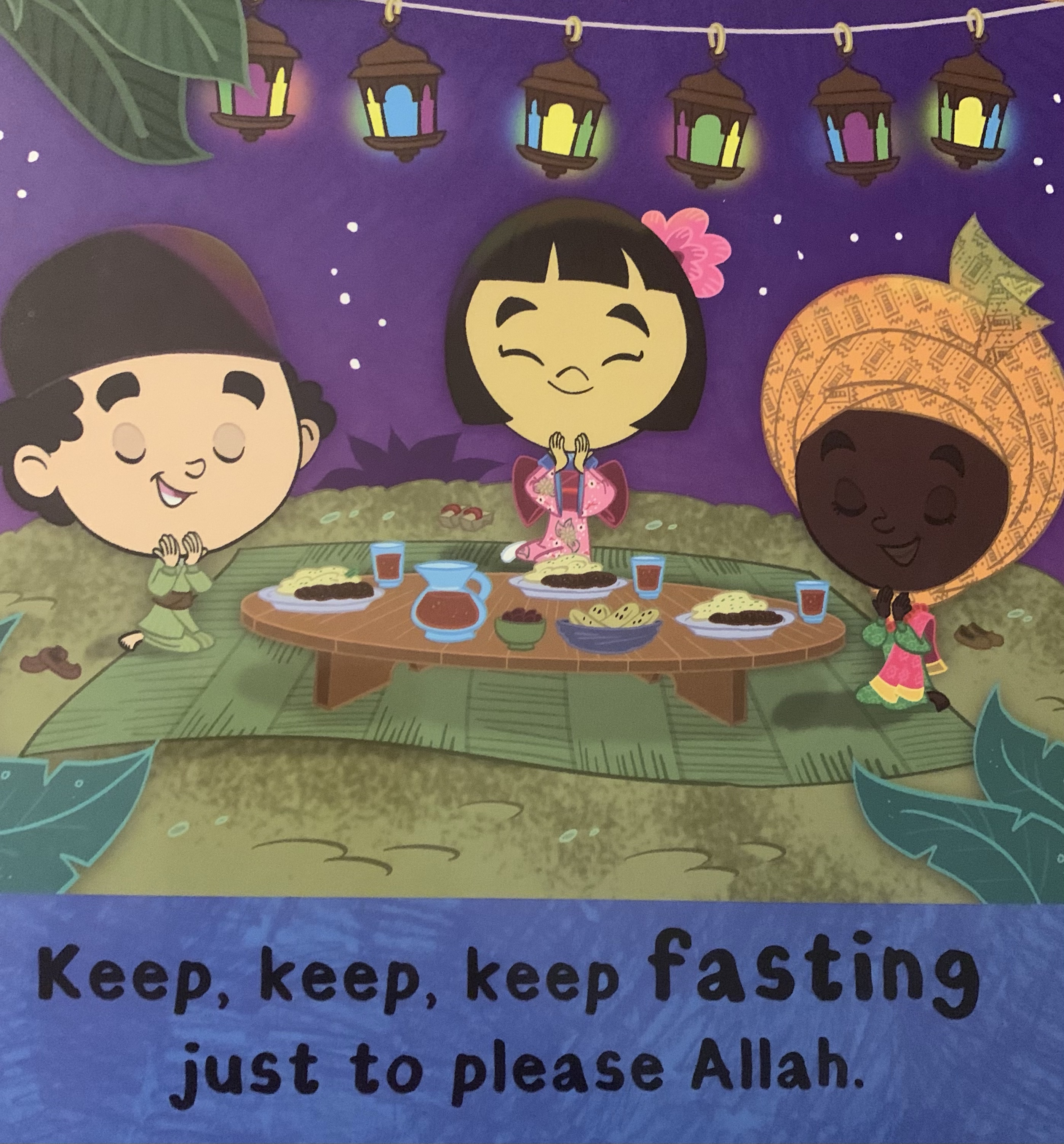
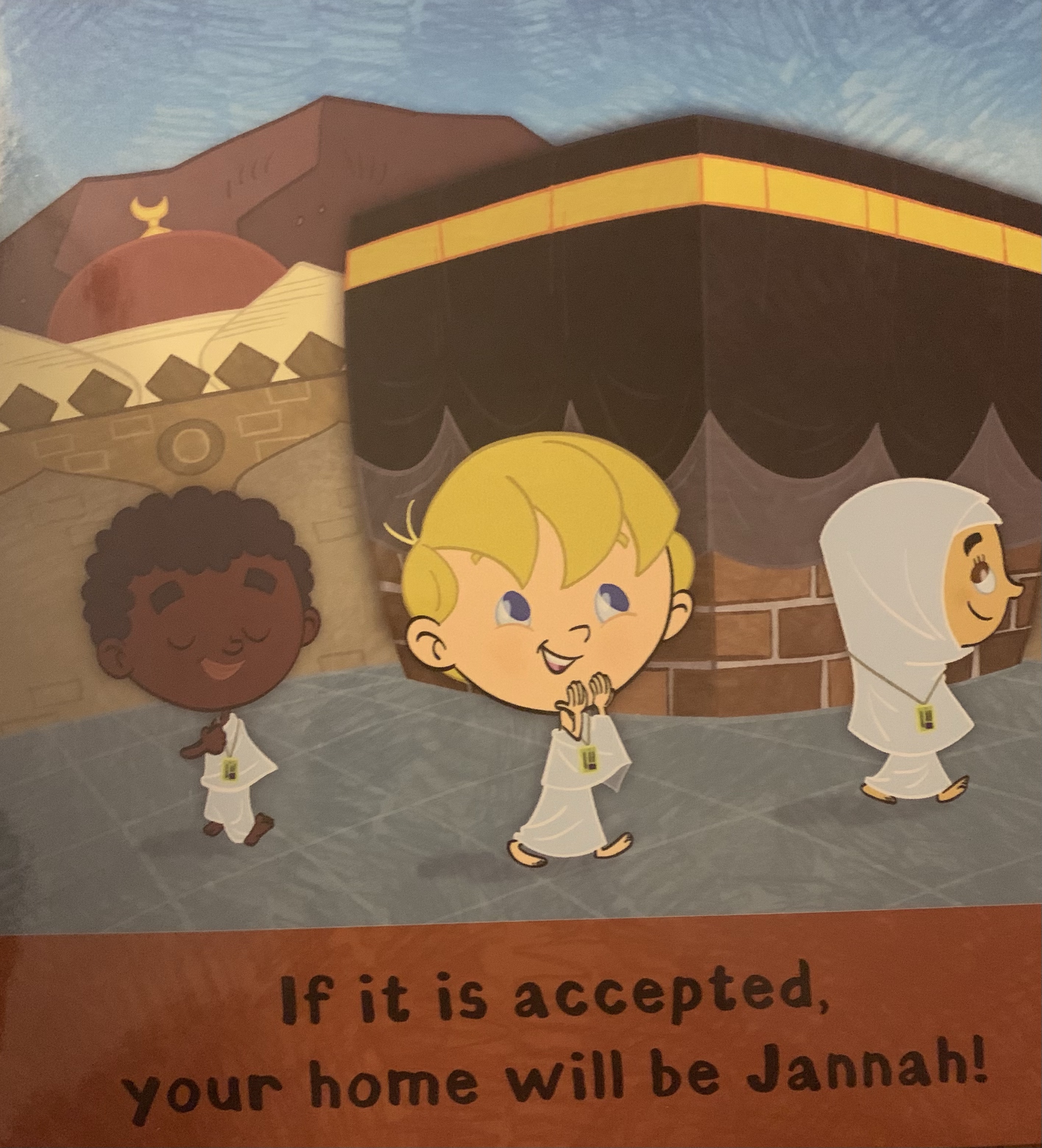
Five Pillars Just to Please Allah by Rabia Bashir and Amir Al-Zubi

Standard
Five Pillars Just to Please Allah by Rabia Bashir and Amir Al-Zubi

img_7055

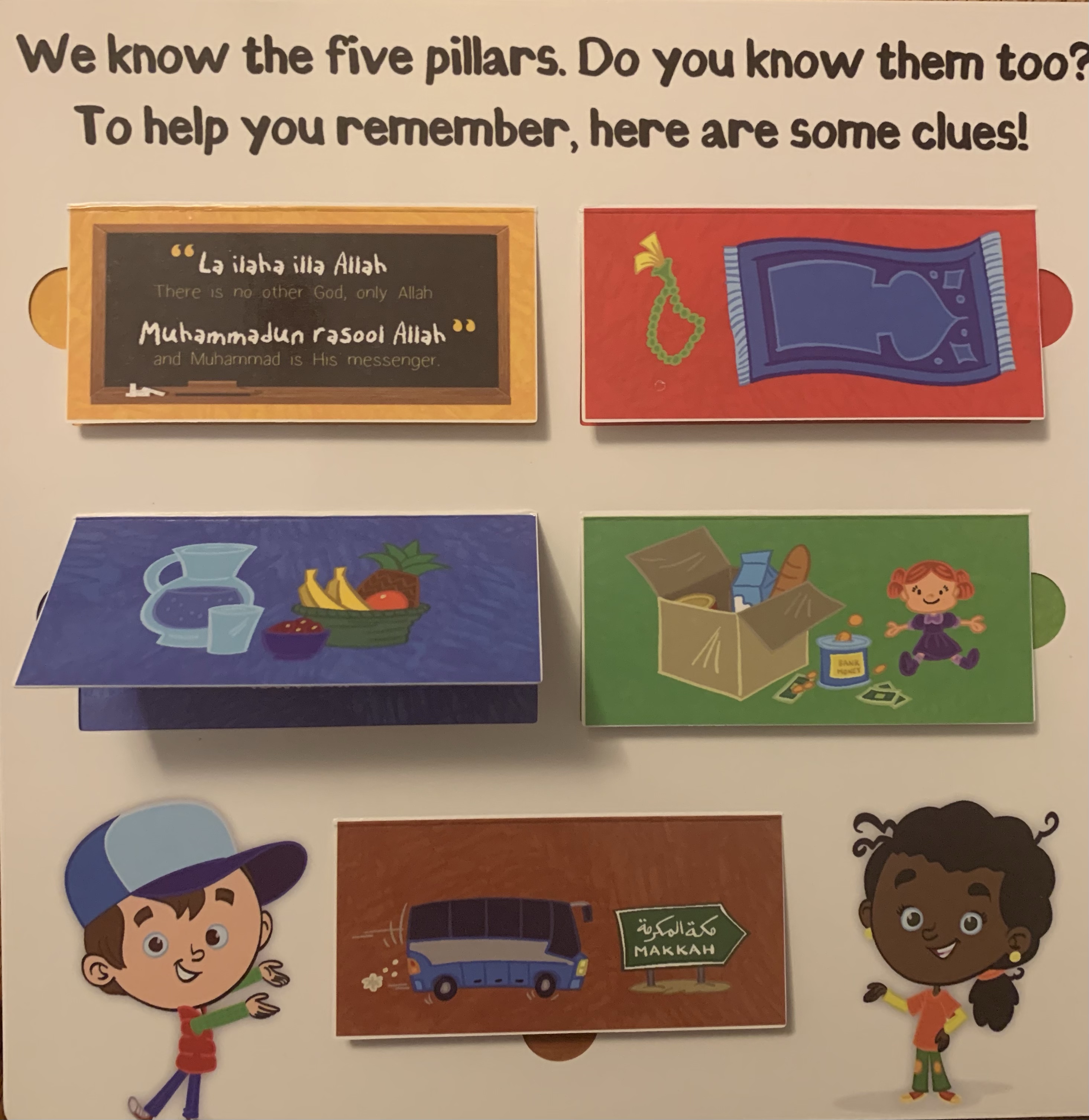
This adorable 8×8 board book for little Muslims is perfect for toddlers to Kindergarteners.  My one year old loves toting it around and looking at the pictures, while my 5 year old likes reading the book independently and lifting the flaps at the end to quiz himself.  I’m normally really against liftable flaps in board books, but thus far my little one hasn’t ripped them all off, so I’ll spare y’all my repetitive rant.

img_7051

The 10 pages of text are perfect to identify the five pillars to the tune of “Row, row, row, your boat” and get little ones familiar with the terms.  The illustrations give older kids something to discuss as they show diversity, the pillars in action and are bright, glossy, and engaging.

img_7052

The publisher’s website seems to have changed, it was preciousbees.com but now seems to be bismillahbees.com and song of the book can be found here: https://youtu.be/F2hHvDFSVz8

img_7050

I got my copy from Crescent Moon Store and can’t speak highly enough of their great customer service and selection.  

img_7053


The flaps at the end are fairly small which inshaAllah will extend their life.

img_7054

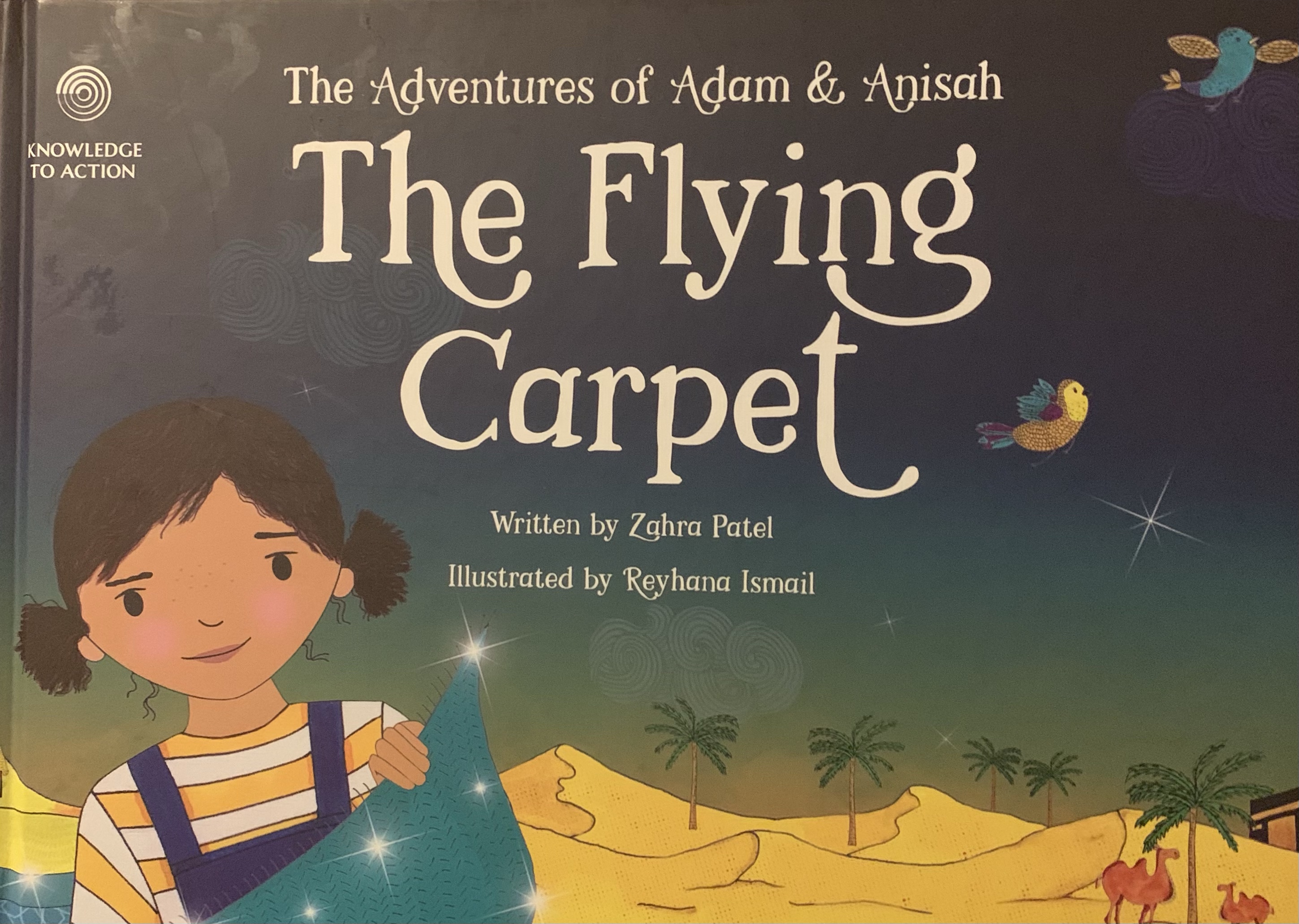
The Adventures of Adam and Anisah: The Flying Carpet by Zahra Patel illustrated by Reyhana Ismail

Standard
The Adventures of Adam and Anisah: The Flying Carpet by Zahra Patel illustrated by Reyhana Ismail


img_6995I am confident that every Muslim child has imagined their prayer rug at one time or another to be a flying carpet, so how absolutely heart filling as an adult to find a book that embraces this idea, roots it in Islamic fact and presents it so beautifully for our littlest Muslim believers.

img_6996

The occasionally rhyming and constantly cadence filled picture book features a big brother preparing for and performing salat as his enamored little sister puts imagination and celebration to the act of worship.

img_6997

I absolutely love the admiration that Anisah has for her big brother and am delighted how prayer is presented not as an obligation but as an opportunity to soar and marvel in amazement.

img_7002

The book concludes with a section that provides context to the story, questions to discuss, and ways to extend the learning.  The hardback binding, 8.5 x 13 horizontal orientation and high glossy illustrations make the book a joy in small groups and at bedtime.

img_6998

This book is really, really well done in its simplicity, and I need to order the other book in the series, My Brother’s Shield from Crescent Moon Book Store, as soon as possible.  

Be Sure to Pray, Zain! By Humera Malik illustrated by Gonmuki

Standard
Be Sure to Pray, Zain! By Humera Malik illustrated by Gonmuki

1636FC1C-82AA-48FD-9904-10616FD9CB55

A very relatable 31 page early elementary chapter book about not only establishing salat, but doing it for the right reasons.  The book is not preachy or reprimanding, and even with a moral purpose, Zain manages to connect with readers and be funny and likable along the way.  Told from the view of the young narrator, realization is achieved, confessions made, understanding gained, and inshaAllah regular prayer established.  A great book to share with your own children when salat integrity is in question, and a great reminder of the power of salat that kids will enjoy reading even when it is not, alhumdulillah.

3FE2BB19-9372-4292-A0AE-B091D66B8F1D

SYNOPSIS:

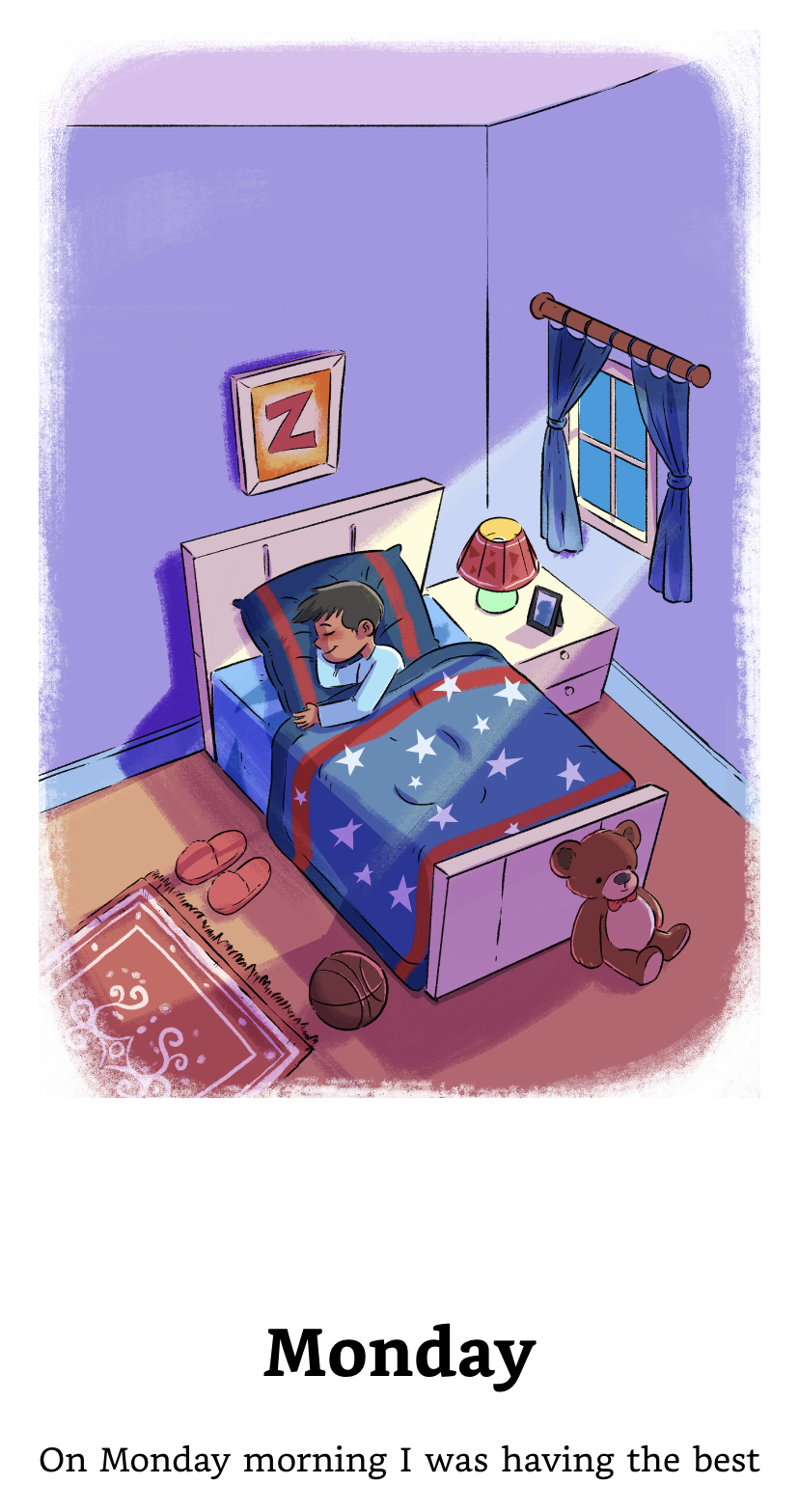
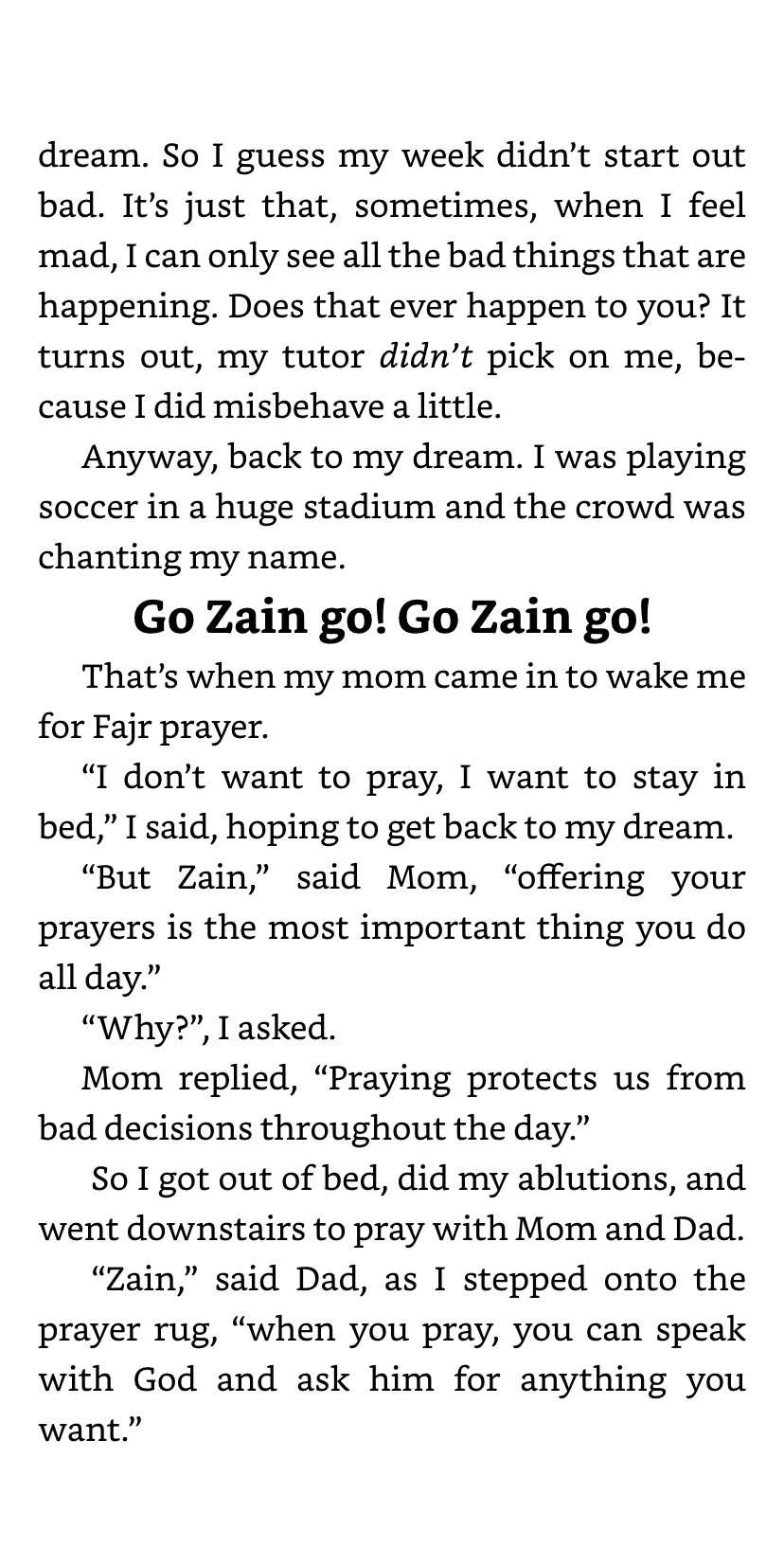
Zain starts off by introducing himself as a kid who lives with his parents and is having an  awful week.  He rewinds and begins with recapping Monday.  Right away he acknowledges that Monday actually started out ok as he was having an awesome dream, but that sometimes when he is mad he only sees and remembers the bad things.  Because of his awesome dream he didn’t want wake up and pray Fajr, but his parents reminded him that when you pray you can ask anything you want from God and that praying protects us from bad decisions.  He drags himself up to pray and asks God to help him on his spelling test.  Later that day he took his test, said Bismillah, and aced it.  So he concludes that maybe Monday wasn’t so bad, and Tuesday wasn’t either.

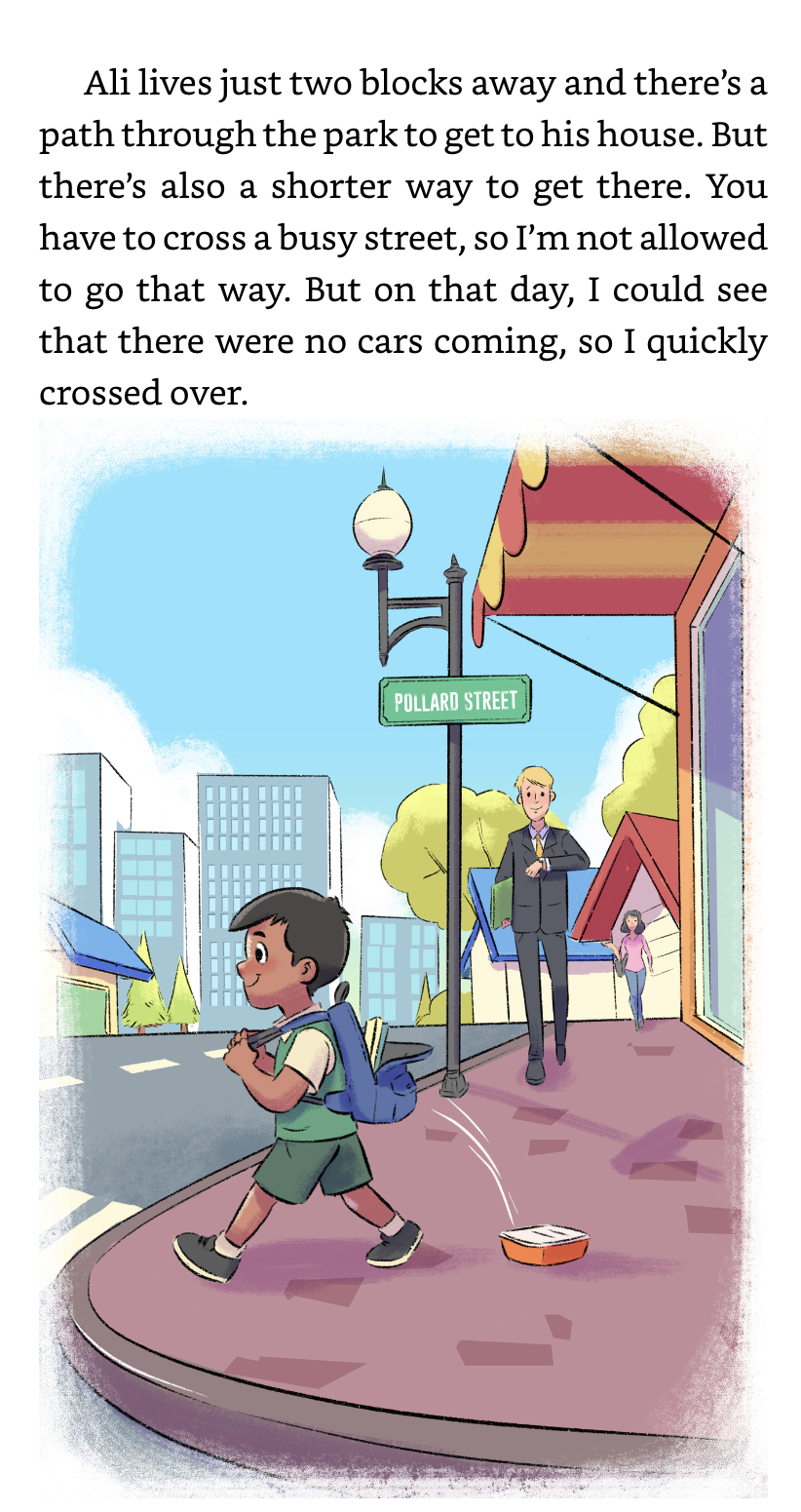
On Tuesday, Zain sticks up for his neighbor Joey who is being picked on by some older bullies.  Later that night Joey’s parents come over to thank him and take him out for ice cream in appreciation.  Wednesday, starts out great at school, and after school he gets to bake blueberry muffins with his mom.  When the muffins are done he was suppose to pray Asr and then take the muffins to his friend Ali’s house.  His mom reminds him to take the safe way and not cross the busy street.  But, Zain forgot to pray Asr and sees no cars coming and chooses to take the short cut across the road.  When he gets to Ali’s house his backpack is open and the muffins are missing.

The rest of the week continues with highs and lows.  Many of the lows coming when he doesn’t pray.  At one point a friend comes to tell him to come to the park to play soccer, and he knows his mom is going to ask him to wait a so they can pray together, so he pretends not to hear and rushes out the door.  Another day he chooses to not miss the end of a show he is watching to pray and heads off to tutoring without praying at all.

When the book rejoins Zain in the present he is feeling bad about kicking a friend playing soccer, cheating on a math test, and not getting to taste his muffins.  He unloads everything that has happened over the week, and his parents calmly and patiently ask him if he has been praying.  When Zain realizes he has been neglectful his mom likens prayer to bricks in a wall that help keep bad things out.  His parents tell him that when we miss our prayers, we end up with holes in our wall and bad ideas can sneak in.  Resolved to stay strong, Zain wakes up the next morning to pray Fajr and have a good day, inshaAllah.

31F4B3A3-12AE-493B-80DA-E93FC0F75AEB

WHY I LIKE IT:

I love that it stays with a young kids perspective and doesn’t get weighed down with hadith and ayats and lectures.  The parents let him learn from his mistakes and he comes to his own realization, not through their reprimanding or catching him in his deceitfulness.  The book is a great way to remind kids that it is their responsibility to pray and that Allah swt knows everything, so that connection has to be made between the person and their creator, it isn’t something you do only when someone is watching or telling you to do it.  I do wish that when he did resolve to pray that there would have been a bit of an outpouring to Allah.  I love that he had tears in his eyes when he told his parents everything, but I think it would have been really powerful to see Zain ask Allah to forgive him and to help him keep his wall strong.

The book reads smoothly, and the illustrations are well done and inviting.  Early chapter book readers will enjoy the font and format and knowing where the story is going with the days of the week chapters.  On one occasion I wish the word “wudu” would have been used instead of ablution, and I’m not sure what Zain has against carrots, but nothing too major will keep kids from enjoying the story and understanding it.

4AE0291F-2915-4F34-BA1C-D625DC0B97D6

FLAGS:

none.

EA28C866-45A0-47D6-B446-AF196504321E

TOOLS FOR LEADING THE DISCUSSION:

This book is for children learning to pray and realizing how important salat is.  So while it won’t work for a book club, I really hope teachers in Islamic Schools and Sunday Schools will read the book aloud or assign it to their students.  It is a great teaching tool, a great reminder, and a fun story too.


The ABC of Allah Loves Me by Learning Roots

Standard
The ABC of Allah Loves Me by Learning Roots

abs-of-allah-loves-me.jpg

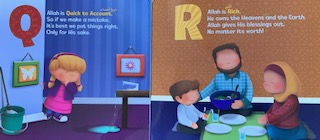
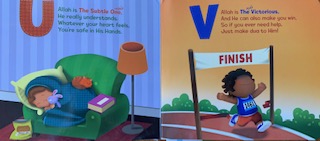
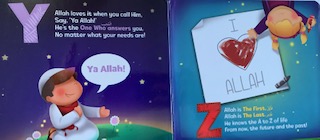
You really wouldn’t think there is much to review in an alphabet board book, but this particular one tries to do more than just pluck a random Islamic word or concept for each of the 26 English letters.  It attempts to give each of the letters one of Allah (swt)’s beautiful names explained in English, but written in Arabic too.

IMG_8773

Each 5 x 10 page features a four line description in a rhyming format to flesh out the highlighted word or phrase.

IMG_8774

Some letter to corresponding Asma al Husna are spot on, but some are a little more of a stretch and some don’t even seem to try.  Overall though it is well-done and delightful.

IMG_8778

The people illustrated don’t have visible eyes, but many have smiles, noses, or closed eyes.  They are bright and warm and engaging.  The binding and thickness of the pages is sturdy.

IMG_8777

Perhaps my favorite part of the book is that the while the rhyming is forced, as is nearly always the case in these type of books, the diction stays on level.  Little kids will understand the words used and emerging readers will be able to sound out and read many on their own as well.

IMG_8776

A great book for your toddler to preschool collection and a reasonably priced book from Crescent Moon Store http://www.crescentmoonstore.com.

Ilyas & Duck and the Fantastic Festival of Eid-al-Fitr by Omar S. Khawaja illustrated by Leo Antolini

Standard
Ilyas & Duck and the Fantastic Festival of Eid-al-Fitr by Omar S. Khawaja illustrated by Leo Antolini

Ilyas & Duck and the Fantastic Festival of Eid-al-Fitr


In the world of Islamic fiction, there are a lot of Eid books out there for children, but this one is definitely more fun than most, especially for the younger crowd.  The presentation of a big, bright, hardback book is aimed at 3 to 6 year olds, and reads well out loud, however, the book is very, very inviting, and older kids with happily pick it up and thumb through the 32 pages of rhyming lines as well.

The book starts with Ilyas watching the sky to see if Ramadan is over and if Eid is here.  Duck in all his silliness doesn’t know what Eid is and rushes out to get decorations to celebrate.  he returns with a Christmas tree and ornaments.  Ilyas non judgmentally explains that those are for our Chrisitian neighbors for their holiday.  Duck then runs out again and returns with a menorah and dreidel and once again Ilyas explains that those are for our Jewish friends celebrating Hanukkah.  Ilyas and Duck then fly away in their hot air balloon to the Masjid to learn about Eid.

Ilyas and Duck2Ilayas and duck

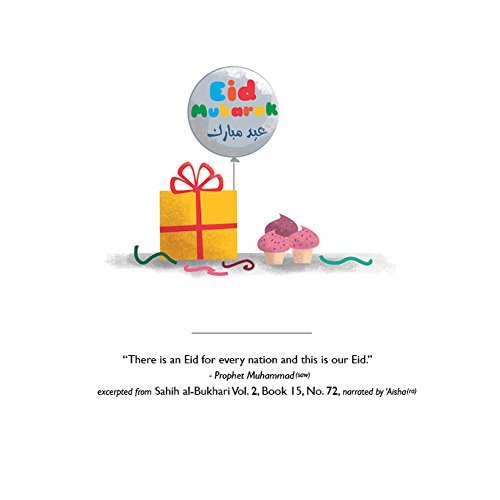
The book works for Muslim children to understand what others celebrate and works for non Muslims to see what we celebrate.  It is all done in a matter of fact way of celebration, not of doctrine.  It is built on the idea that, “There is an Eid for every nation ant his is our Eid.”ilyas and duck eid

Much like the first Ilyas and Duck book, this one is great to have around and read again and again!

Bismillah Soup by Asmaa Hussein illustrated by Amina Khan

Standard
Bismillah Soup by Asmaa Hussein illustrated by Amina Khan

Bismillah Soup

It is always a cause of giddiness to find a good book, but to have one recommended by a mutual friend of the author, makes it all the better. Bismillah Soup is a spin-off of the Stone Soup folktale, but without the “trickery” of the classic.  Hasan, wants to surprise his mom with a feast, but money is tight and when Hasan is sent to ask the local Imam for some rice, a plan: Bismillah Soup, forms that brings the entire community together.  The story takes place in Somalia and the cultural words that are peppered in to the story add detail and talking points to have with the kids.  As each community member shares something small, the enormous feast that is created is a wonderful example of what can be achieved when we each give our best to help others.  The book is 40 pages with a glossary at the back and is definitely one that can be read over and over to kids of all ages.  Even the littlest ones are able to grasp the beauty of coming together through the colorful and playful pictures.

soup-gallery-img1 (1)The real treat of the book however, is how it all comes together: the words, pictures, sentence structure, font, size, and diction all compliment each other on the same level.  I read a lot of books aloud as a children’s librarian, and while the rhyming ones are great for the littlest listeners, there is often a void of read-out-loud stories for the kindergarten and first grade levels.  And I am talking about all books, not just Islamic ones.  Most picture books in my experience are written on a third grade level, with longer blocks of texts, smaller fonts, a wider range of vocabulary and longer sentences.  These books are often beautiful and very tempting, however when I read them during story time I end up “summarizing” them, and telling the story rather than reading it.  Similarly, early readers often find them frustrating and too difficult to read independently. Bismillah Soup strikes a wonderful balance, mashaAllah.
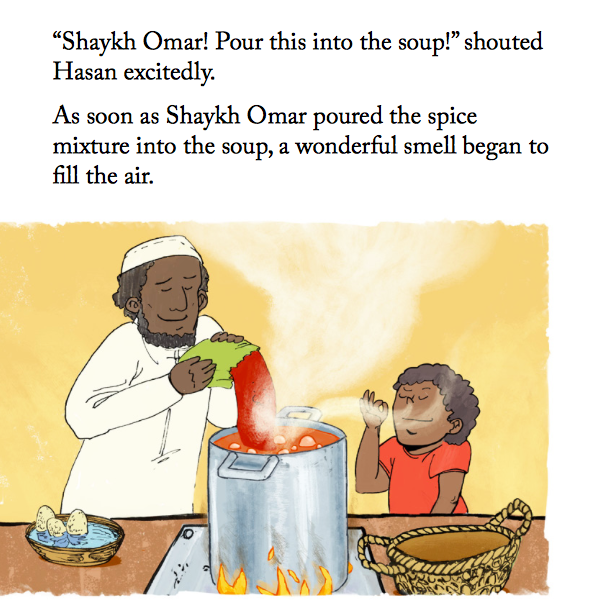
I read the story to my own children who enjoyed it and have found my first grader reading it independently twice this week.  Each time beaming with excitement to tell me something new he has gained from the book.  When I read it aloud to them, my kids marveled at how having a good intention and being so generous could benefit everyone. The first time my son read it independently he was in deep thought about how grateful Hasan was even though they didn’t have much food and how he was a determined problem solver.  The second time I found him reading it, he was so very impressed at the kindness of Shaykh Omar.  He really started to understand the subtle beauty of the character not just in helping Hasan’s family with food, but also supporting and working with the young boy to make the feast happen, alhumdulillah.  Screen-Shot-2015-08-29-at-12.06.00-AM

I highly recommend the book and I can’t wait to read it to my students at school next week, inshaAllah.  For more about the book, the author, and her other work you can go to the author’s website  http://www.ruqayasbookshelf.com

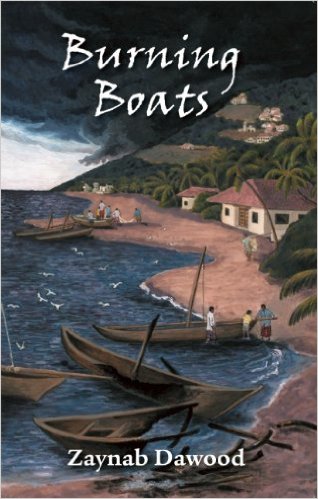
Burning Boats by Zaynab Dawood

Standard
Burning Boats by Zaynab Dawood

burning boats

This book came highly recommended from a friend that read it aloud to her Kindergartener and I ordered a class set based on her raving review.  After trying to get into the book on three separate occasions I concluded that yet again I should have waited and read the book myself before ordering it.  So I handed it over to my avid reading eight-year-old who read it in a day and said it was pretty good, asked a few questions, and continued on her way confused as to why I couldn’t finish it.  So, I started it again determined to get through it and with Ramadan quickly approaching I thought I could motivate myself to do so.  However, I could not, and it sat on the shelf for the entire month with a book mark only a few chapters in.  At the prodding of my guilty conscious to return the book to my friend, I continued reading from where I left off, rather than starting over, again, and found that by dismissing completely who any of the characters are and how they are related, the story does get off the ground and I was able to finish it.  That being said, I think the story might have appeal if read aloud one chapter at a time. To read it in one setting did not help the story that can’t seem to decide it if wants to be character driven or action driven.  The sheer number of characters is completely over the top, there are at least 20 characters mentioned by name and the book is only 137 pages.  And honestly I never bonded with any of them.  There is action in the book, but the details seem misplaced.  The author details characters all saying salam and walaikumasalam to one another and giving moral reproaches based on Quran and Sunah, but I never felt I understood why the main characters were leaving, why the villain was so bad, or how (spoiler alert) a pivotal character in the book died. I guess by never connecting to the characters or feeling an emotional tie, positive or reproachful, the book didn’t live up to it’s potential.  The book is recommended for ages 12 and up, but I think younger children could read it and even younger could listen to it being read to them without any major concerns.  With guidance the book is by no means a waste of time, but if you recommend it to a child and they struggle to get into it, you might just have to let them find something else to read.

SUMMARY:

A small fishing village is being harassed by a corrupt businessman’s attempts to take over the entire industry in Tobay.  The principal of the school and a few close friends are trying to stop him, but have decide they cannot and thus are planning to move elsewhere.  The children are forbidden to go to the harbor as boats are being burned and crimes committed to persuade the local fisherman to abandon their solo endeavors.  With few places to play, the loss of the harbor affects the children greatly as well.  A tropical storm complicates matters as it tears through the village destroying the poor inhabitants meager dwellings as well as the damaging the school and the mosque.  With friends taking in homeless neighbors and the main family planning to leave the children plan one last game that turns dangerous when all the boats in the harbor are set a blaze.

WHY I LIKE IT:

There are some definite good qualities in the book, despite the holes.  It opened up a good discussion between my daughter and I about preparing a body for ghusl and Janaza.  It does show that people can change and that when people are sincerely apologetic and are striving to correct their behaviors, those around them should offer forgiveness in not just their words, but in their actions as well.  It also shows that good kids can make bad choices, and that the consequences can also be very real.  Similarly it shows that adults also don’t always know what to do, and that they can be forced to reconsider as well.

FLAGS:

There is violence in the book and death.  Nothing too graphic, but one might have to explain to younger, more sheltered reader,  that just because someone has a Muslim name doesn’t mean they are practicing Islam and are good people.

TOOLS FOR LEADING THE DISCUSSION:

There aren’t any online tools, but I would suggest having the readers keep a character journal.  Every time a new name appears, write down who they are, (and who they are related to), so later they can look back on it if they become confused.

Because of the “holes” in the story I would probably ask the students to give their thoughts as to what happened or why the characters decided to do what they did and then turn it back on them and ask them what they would do.

Why was Ibrahim leaving? Would you have left? What made Nasser change? Would you have forgiven him? How do you think Ayesha died? Etc.