Author Archives: islamicschoollibrarian

Home is Not a Country by Safia Elhillo

Standard
Home is Not a Country by Safia Elhillo

home is not a country

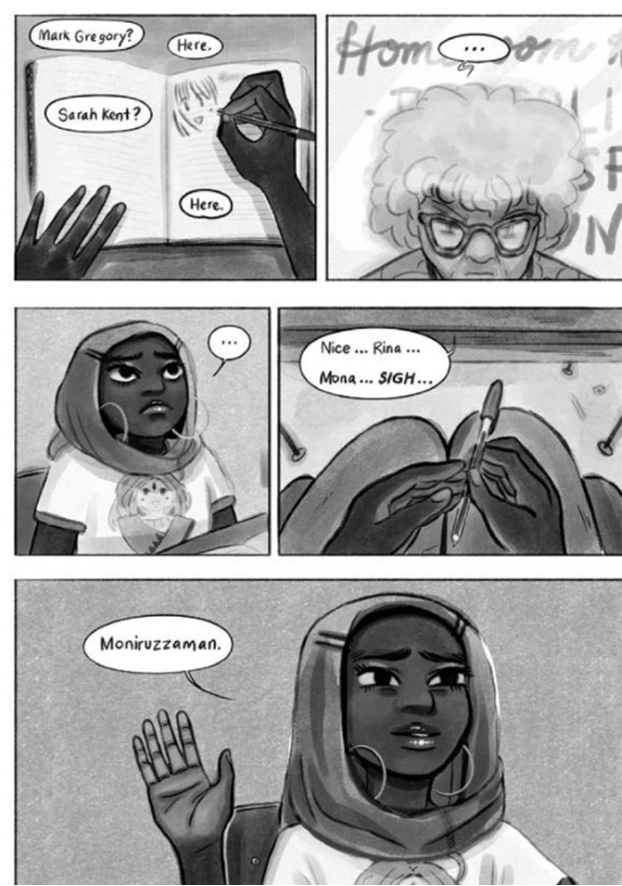
This upper middle school/high school 224 page novel told in verse touches on familiar themes of finding yourself and wondering about what could have been, but is anything but predictable.  Through magical realism, religion, culture, and phenomenal imagery, this book is haunting and powerful as it sweeps you into the possible alternate reality of a young 14 year-old-girl yearning to be someone else, consumed by a life that could have been, desperate for the other half of her mirrored existence, and for a home that she does not know, but so desperately longs for.  As a Muslim child of an immigrant, the daughter of a single mother, and nearly invisible at school, readers will feel her story, more than know it, and find themselves in her own awakening.

SYNOPSIS:

Nima feels like she exists in pieces.  No one understands her and she doesn’t feel comfortable in her own skin.  At school she is invisible, she is foreign and teased for it.  She has one friend, Haitham who is always there for her at home, but just a familiar wave in public.  At home Nima enjoys old Arabic songs and movies, hobbies she is teased for at weekend Arabic school, her hardworking mother is graceful and beautiful, Nima is neither.  Her world is the aunties and family in her building, but her Arabic is weak and she doesn’t fit in anywhere.  Her father passed away before she was born in a country she has never known.  Her twin sister died before birth, one for each parent in each world.  Nima imagines if she wasn’t Nima, but Yasmeen instead.  If she was bright and loud and loved and confident. The name she was nearly given, an alternate life she has become obsessed with.

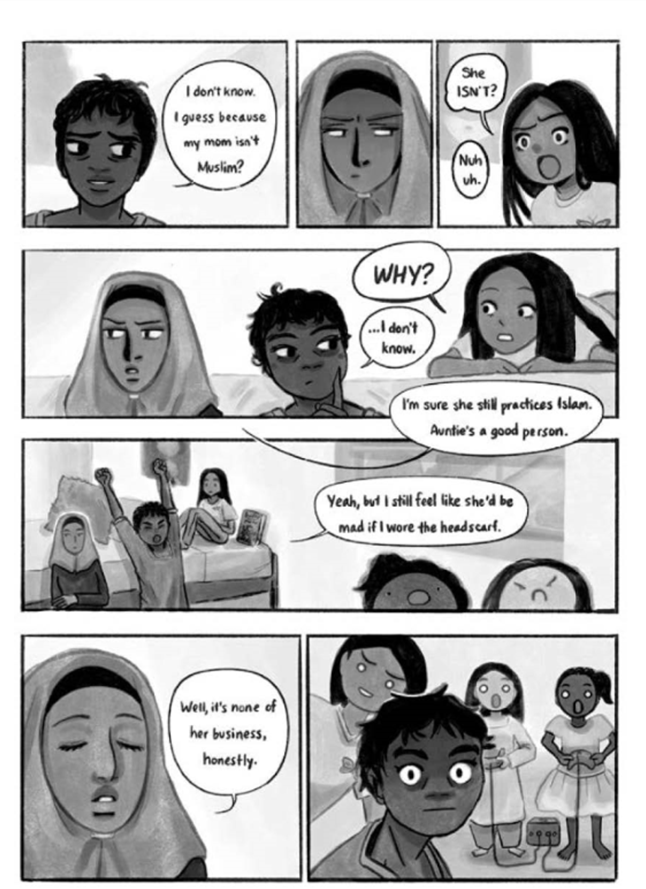
When Haitham and her get in a fight, when her mother removes her headscarf and the bullying intensifies, Haitham ends up in the hospital, assaulted, barely hanging on and Yasmeen appears to help a floundering Nima escape a meal she can’t afford, a man that intends to assault her, and a world where she might find answers. The two girls travel to the homeland in the photographs to understand their parents, to understand why their mother left and Nima to the realization that only one of the girls can truly exist.  

WHY I LIKE IT:

I love that I had no idea where the story was going and how much would be spelled out and how much would be left for the reader to interpret.  It affected me in a way that I wasn’t expecting and reminded me of the blurred lines of reality from books like Beloved (Toni Morrison) and Her Fearful Symmetry (Audrey Niffenegger).  I love that the Arabic script is present and often not translated.  The unapologetic connection to the character and author is powerful and beautiful to see in a deeply introspective book.  I enjoyed that the “country” wasn’t named as it added to the concept of not knowing you home, it was frustrating, but for all the right reasons.

There isn’t a lot of practiced Islam mentioned, she doesn’t talk about praying, but does talk about the athan and longing for it.  Her mother wears hijab, but takes it off and wears a hat instead. The daily life of living in two worlds is taken to mean something very literal and the journey to both worlds is remarkable and memorable.

FLAGS:
There is physical assault, theft, lying.  Nima has to escape a man that intends to rape her, his intention isn’t detailed, but Yasmeen helps her escape when he brings her to a hotel.  Haitham’s dad has an affair with his mom and she is pregnant with him when the story flips back to the past and the couple are not married.  There is singing and music and dancing throughout. I think 14 and 15 year olds will be able to grasp the intensity of such situations while also not being shocked by them.

TOOLS FOR LEADING THE DISCUSSION:

I am on the fence if I could do this as a middle school book club, I might suggest it to the high school advisor.  There is so much to unwrap in the lyrical text that will draw the students in and force them to reflect on their own impressions to understand Nima’s reality.  I think there would be so many conflicting thoughts that the discussion would be amazing.  

Here is a better synopsis than mine: https://www.npr.org/2021/03/04/973389493/home-is-not-a-country-imagines-the-lives-we-could-have-led

Q and A with the Author: https://thenerddaily.com/safia-elhillo-author-interview/


https://www.npr.org/2021/03/04/973389493/home-is-not-a-country-imagines-the-lives-we-could-have-led

Islamaphobia deal with it in the name of peace by Safia Saleh illustrated by Hana Shafi

Standard
Islamaphobia deal with it in the name of peace by Safia Saleh illustrated by Hana Shafi

img_9893

This nonfiction book has given me pause.  The information, the approach, the presentation, the importance, is all really well done, I just can’t really grasp how to use the book.  It is broken up in to four sections:  Islamophobia 101, The Believer, The Intolerant, and The Bystander. In each sections it has scenarios, comic strips, quizzes, infographics, advice columns and so much more spread out over 32 pages.  After it explains what Islamophobia is, it offers believers (Muslims) ways to see if what they are facing is classified as Islamophobia.  It has quizzes and questions and advice for people that are intolerant, and then if you are just around Muslims and intolerant folk what you can and should be aware of and do.  I think in a classroom all sections could be gone over, but I’m not sure in which grade and in what context.  In an Islamic youth group I think it could be really thought provoking to look at different sides and encourage the members to share their personal experiences, but I don’t know.  If you are a bully, would some quizzes and graphics be enough for you to recognize your own bias, could it make you change your attitude? I’d love to hear from others that have read this book, I checked mine out from the library.  It says it is for ages nine and up and other books in the series cover topics such as: consent, homophobia, transphobia, anxiey, racism, and freedom of expression.

img_9897

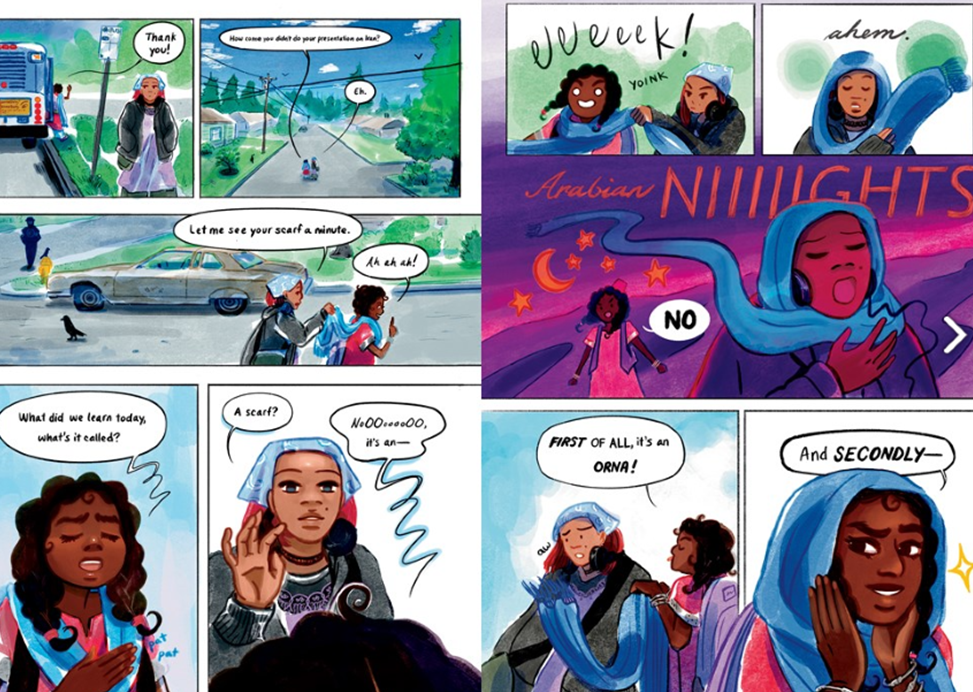
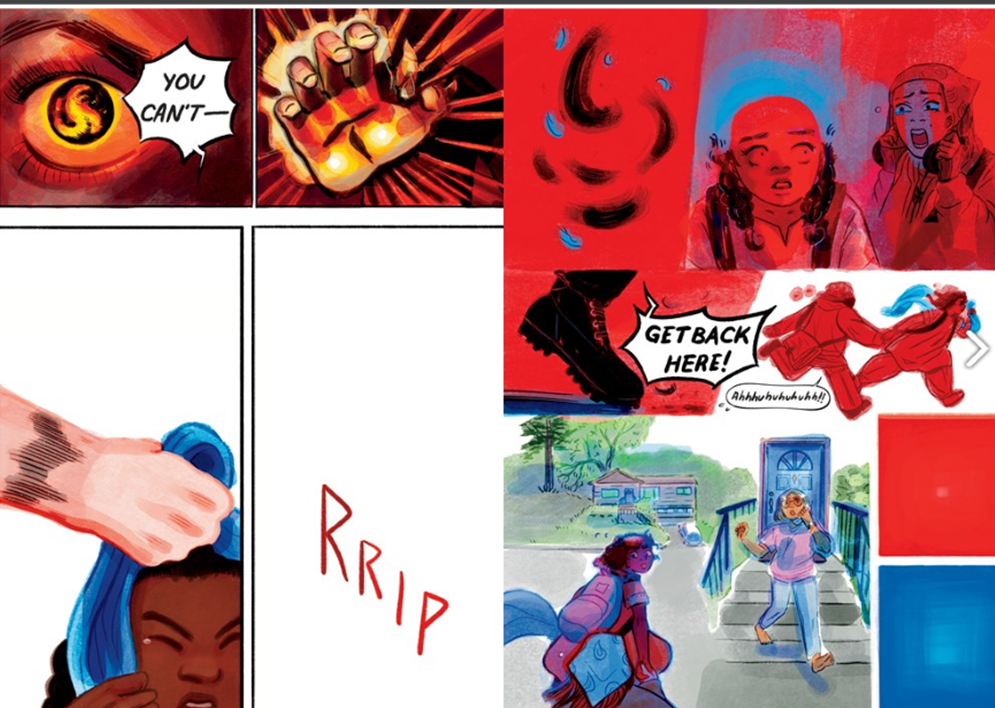
The first section: Islamophobia 101 starts off with a scenario of a girls first day of school after the summer and her first day wearing hijab.  No one really says anything, but there are whispers, her best friend asks if everything is ok at home.  It defines Islamophobia as “a kind of intolerance, or a refusal to accept and respect ideas and views that are different from your own.  It is the belief that Muslims, or people who follow the religion of Islam, are a group to be fearful of.”  It goes on to explain in examples what Islamophobia is while giving facts about Islam and things to think about. There are graphic comic type scenarios showing what Islamophobia can look like based on ignorance, stereotypes, then assumptions, and finally fear.  The section then offers a 10 question quiz, followed by questions and answers to a fictitious counselor in an advice column format. Finally there are myths and a Did You Know Section.

img_9899

The next section: The Believer, starts with a scenario of a Muslim holding their breath while watching the news.  Of being proud of your family and faith, but being tired of convincing people you are a Muslim and a good person.  An advice column about handling halal food, terrorism, hijab and sports is next followed by tips to not feel alone and an infographic on dos and don’ts to not be overwhelmed by your experiences.
img_9901

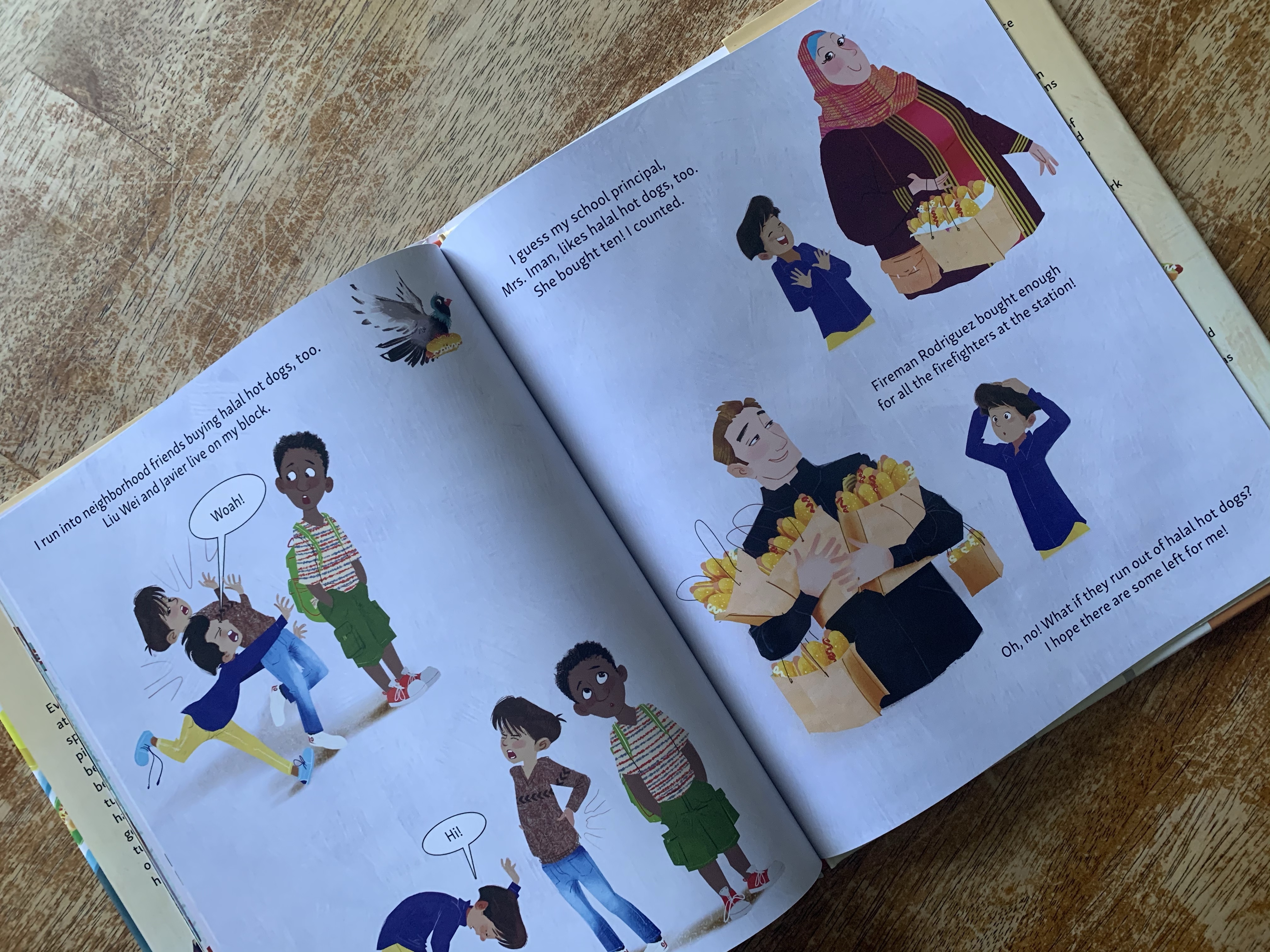
The third section is The Intolerant which asks if other people’s religions bother you, or if you question why religion has to be part of daily life and not kept personal.  There is a a 30 question true and false quiz, then a challenge to be part of the problem or part of the solution, with information on what you can do.  There is a sidebar about the role of social media as well as some highlights of current Muslim sports figures.

img_9900

The Bystander section asks if you’ve seen someone bullied or harassed for being Muslim, if it bothers you to hear people talk about immigrants and refugees as a threat, and what you can do to speak up. There are dos and don’ts a 10 question quiz, some more Islam facts and some direction to get more information.

img_9902

Overall the book is well done, and I had my kids look through it to see a way to facilitate anything they experience and how to articulate how they are treated and might treat others.  

img_9896

In My Mosque by M.O. Yuksel illustrated by Hatem Aly

Standard
In My Mosque by M.O. Yuksel illustrated by Hatem Aly

I know I am a little late to the review party of this highly anticipated beautiful book, but for good cause: I wanted to test it out in a virtual storytime for preschool to third graders before I chimed in with my opinion of this 40 page picture book ideally for four to eight year olds, but wonderful for all ages. The hardback binding, the glossy pages, the AMAZING illustrations and the factual information at the end, make this one of my favorite books ever for Muslim and non Muslim readers alike. If you can, gift this book to your child, your child’s teacher, their friends, your friends, and ask your library to shelf it. It is unapologetically Muslim, and has the power to mirror our own love of our masajids as well as encourage others to stop in and visit if they are curious about what a mosque is like. After reading it aloud, my only critiques are the very thing pages that make it hard to turn when reading to a group, and the small font which is appreciated so that the illustrations can be enjoyed, but hard to read when the gloss causes a glare and the thin pages bow. The only words in the text that gave me pause is when the “imam tells us stories…” to explain the khutba and speech, and when it says after salat “I whisper heartfelt wishes.” I understand the intent, but feel like the word “stories,” isn’t the correct word for ayats and hadith, nor is “wishes” the right framing of duaa or longings. I also wanted there to be a page number in the references section referring back to the pages in the book that link the inspired illustration of mosques to the real ones detailed at the end. Undoubtedly minor stuff for a book that came with a lot of expectation and yet still managed to blow me away, alhumdulillah.

The book shows diversity of tones, body shapes, and mobility as it welcomes and invites you in to a mosque. The shoes are lined up like beads as you enter and you let your toes sink in to the carpet. We wear our best clothes and get hugs from aunties because we are loved. Grandfathers do thikr on tasbihs and its ok to snuggle up with your dad while he is praying. Grandmas are reading Quran and little kids help put out prayer rugs. The imam gives speeches about unity and that we are all from the same creator. The muezzin calls us all to prayer and we stand in lines linked together with friends like a long chain. Hijabs flow and sometimes we get distracted. We say greetings to the angels on our shoulders and whisper our wishes. We learn to help others, we play in the courtyard and gaze up at the domes. We feel safe and joyful like our friends of other faiths in their places of worship and all are welcome in the mosque.

The book does not shy away from Islamic words in Arabic, nor from faith references such as the “most High,” and “subhanAllah.” The glossary at the end covers their meaning and the text flows in a way that you can stop or review afterward with relative ease. The imagery in the text of the shoes like beads, and standing in salat like a chain, are warm and relatable, and the illustrations, they are magical. The expressions on the children’s faces as they try and pray and stay still, but alas are children and they are silly and sweet and not chided, but loved, is so refreshing in both the text and pictures. The different masajids that are referenced, and the detail make repeated visits to the book heartwarming and joyous.

I love the lists and details about mosques around the world at the end, and the successful portrayal of genuine love and connection Muslims feel to the mosque as a place of coming together, or worship, or friendship, of play, of charity, of community, and of openness.

Ayesha Dean- The Lisbon Lawbreaker by Melati Lum

Standard
Ayesha Dean- The Lisbon Lawbreaker by Melati Lum

img_8735

In this third Ayesha Dean book, that can be read as a stand alone, the Australian teen sleuth finds herself on the other side of the law in the beautiful city of Lisbon in Portugal.  Over 333 pages, she must understand what she is being accused of and figure out how to clear her name, all while marveling at the beautiful historic sites, diving into the delicious food, and looking fabulous while she does it all.  Middle grade to early middle school readers will enjoy the fast pace mystery that has history, crime, adventure, and friendship.  There, as always, is a twinge of romance, but it all stays halal as Ayesha is a proud and practicing strong Muslim young woman.

SYNOPSIS:

Ayesha Dean is now 18 and has just arrived in Lisbon for three months as part of an internship program to help little kids with their english.  This is her first international trip without her beloved Uncle Day and her two closest friends Jess and Sara.  Not to worry, there are a lot of young people participating in the internship program and she will be rooming with two girls, Mara and Aveline. Things start of routine enough as Ayesha gets to know the handsome and kind Raimy from America and tries to figure out why Aveline doesn’t seem to like her.  But on her way to the school she will be working at, she finds a wallet filled with money and no identification, just a phone number.  When she calls the number and a meeting is setup, the stage is set for a series of events that will include telling Raimy off for mansplaining things to her, a man murdered, a chase scene, a necklace stolen, no memory of it all, and Ayesha being arrested.

Knowing only a few people in the city, and having just met them at that, Ayesha makes bail by getting help from her friend’s Aunt in Spain who comes to provide Ayesha a place to stay as well. She has some time before her formal hearing, and Ayesha is determined to figure out what she is being accused of and how to clear her name.  With the help of Mara, Raimy, a young girl in the elementary school Ayesha was working at, and some chance encounters, Ayesha finds herself risking her own safety in an underground environmental gang ring. I won’t spoil all the ups and downs and ultimate ending, but Ayesha Dean’s tae kwon do, faith, and wits will all be used and the last page will definitely leave you wanting more.

WHY I LIKE IT:

I feel like the writing has finally found the perfect balance between description and action, the first chapter was a bit choppy, but once it hit its stride it was smooth.  I was intrigued by the historical detail that was all new to me, and am pondering how to convince the author to lead a tour group through all these places that Ayesha visits.  As always the descriptions of food and architecture and fashion are all so spot on that you feel like you are there.  I absolutely love that religion is so genuinely a part of Ayesha, but it is for her, she doesn’t do it for any one else.  She prays, she wears hijab, she doesn’t drink, she clarifies to Raimy what she can do, she acknowledges possible stereotypes and discrimination, but chooses to move forward and not get bogged down by it.  She is physically and mentally strong, but doesn’t come off as arrogant or judgmental or unrealistic.

I like the diverse characters in this book, and in all of them.  The multi ethnic protagonist has friends from all sorts of backgrounds and it is really refreshing and natural.

FLAGS:

There is murder, assault, crime, drinking and alcohol.  Nothing is glamorized or anything a third grader couldn’t probably handle.  There is a hint of possible romance, but nothing that crosses any lines or standards.

TOOLS FOR LEADING THE DISCUSSION:

I would consider this for a middle school book club if the majority of the participants are 6th graders as it would not have the same appeal to older 8th graders.  I think they would benefit the most and enjoy the strength and cleverness of such an inspiring lead.  Of the three books in the series, I think this one would work the best for insightful discussion and empathy.  It would great to hear them imagine themselves in her shoes: a foreign country, no family, no longtime friends, minimal language skills and accused of a serious crime. Oh I can’t wait to share this book with my reading friends!

Maryam’s Magic: The Story of Mathematician Maryam Mirzakhani by Megan Reid illustrated by Aaliya Jaleel

Standard
Maryam’s Magic: The Story of Mathematician Maryam Mirzakhani by Megan Reid illustrated by Aaliya Jaleel

img_8776

This 40 page nonfiction biography is beautifully illustrated and informative.  I had never heard of Maryam Mirzakhani the Iranian born, first female winner of the Fields Medal.  Her life from loving stories and not liking math, to becoming a student and later a professor in the United States is remarkable and inspiring.  Second through fourth grade readers that both love and struggle with math will be drawn in to her unique way of looking at the world, and the math she found to serve as her magic wand in explaining it.  I don’t know if she identified as Muslim, while in Iran she was forced to cover, but when she left, she no longer did.  The illustrator is Muslim and religion aside, I am thrilled that a book like this exists, and that such a brilliant woman and her accomplishments can be presented to young readers.

img_8778

Maryam loves stories.  She reads them to her sister, her best friend Roya and her browse bookstores and dream themselves into plots of their favorite stories.  On the weekends she spreads long rolls of paper on the floor to draw and color her imaginary worlds.  She wanted to be an author when she grew up and knew how lucky her generation was to attend school after the war that tore her country apart.

img_8779

Math made her head spin, she would rather be doodling, but when she was 12 her teacher introduced her class to geometry.  It was different, the numbers held stories and the shapes were pictures. She made stories about the problems and wondered about them as if they were characters.

img_8781

In high school, Maryam and Roya entered the International Mathematical Olympiad.  The first year they received participation medals, but the next year, Maryam won the grand prize with a perfect score. She finished her schooling in Iran devoting her life to the stories that numbers told and left Iran to start graduate school at Harvard in the United States.

img_8782

When she had a hard time solving problems she would spread large rolls of paper on the floor and solve them.  Her daughter would tell people she was a painter.  She wanted to stretch the mind and how people went about solving equations.  She became a professor and a lecturer and one of her discoveries became known as “the magic wand theorem.”

In 2017 she passed away from breast cancer and the world lost a remarkable storyteller, mathematician and human.  The book concludes with an author’s note, important dates, and books to reference to learn more about Maryam Mirzakhani.

img_8780

Elisha the Eid Fairy by Daisy Meadows (Rainbow Magic)

Standard
Elisha the Eid Fairy by Daisy Meadows (Rainbow Magic)

img_9867

If you are familiar with the Rainbow Magic fairy books, you know they are never ending, there are currently 228 titles in the collection that cover beginning readers, early chapter books, and longer solo chapter books.  They cover seasons, colors, flowers, jewels, musical instruments, pets, friends, holidays, etc., and now festivals.  They may not be the most intellectually stimulating, but they serve a purpose in getting young readers confident and engaged.  My daughter loved them in first and second grade and when this book was delivered a few days ago, she was so excited to see a Muslim fairy.  She is 14.  Representation will always matter, even when the story is a bit hokey and random, to see yourself in a beloved series, has power.  Yes, the story is predictable in the 80 drawing filled pages, but for first and second graders it is fun.  Elisha wears western clothes with her hijab, has a magical Pelita lamp that brings Eid joy to the human world, and hosts feasts with international foods.  Yes, the fairy is Muslim and Eid joy after Ramadan comes from an oil lamp apparently, it is a stretch, and if you are not comfortable with this imaginative representation of Eid joy coming from a magical creature’s enchanted item, then please don’t waste your time.  If your kids already read books about fairies, this book might be of great delight to them, and be a great conversation starter for you to have about what really makes Eid a joyous time.

img_9869

SYNOPSIS:

Jack Frost is still determined in this the third book in the four part festival series, to cancel Eid, Diwali, Hanukkah and Buddha Day to create his own Frost Day.  With the sighting of the new moon, in this book Eid is under attack.  Humans Rachel and Kirsty are summoned to help find Elisha the Eid Fairy’s magical Pelita lamp.  But, Elisha goes missing and the girls arrive on Festival Island to find goblins destroying the Eid decorations.  The fairyies divide up and Rachel and Kirsty in their fairy form are off to find Elisha, while the other fairies handle the goblins.  They find her in a tower surrounded by a hail storm, the can’t get her out unless they find her wand.  Once they find her wand they have to find her magical item.  The goblins have it and are trying to teach it to make Frost Day treats instead of the kleichas and baklava and turkish delight that it keeps creating.  With quick thinking, and an impromptu dance lesson, the lamp is recovered, Eid joy is saved, and the girls return to the human world, knowing that one more festival will need saving in the near future.

img_9870

WHY I LIKE IT:

First of all, I didn’t know what a pelita lamp or kleichas were, so I did learn something once I Googled it, but I’m not entirely convinced that a pelita lamp (sometimes it is capitalized and sometimes it isn’t) is critical to the celebration of Eid.  Aside from the religious uncomfortableness of attributing Eid joy to a magical creature and her enchanted item, the concept of the lamp seems a bit weak.  I like that information about Ramadan is included and Eid Mubarak is mentioned a few times, but a little bit more about a lamp or lantern perhaps as a cultural relic, would have really made more sense even in this fragile framework.  

I like that multiple cultures are represented in the concept of Eid and Elisha, she isn’t boxed in to one culture, she is universal.  The themes of team work and friendship are always present in these books which is a great way to show respect for multiple religions and festivals.  Jack Frost at times seems to be a good villain, but more in theory than in reality.  His spell that the fairies are trying to break:  “Ignore Eid and Buddha Day, Make Diwali go away.  Scrap Hanukkah and make them see- They should be celebrating me!  I’ll steal ideas and spoil their fun. My Frost Day plans have just begun.  Bring gifts and sweets to celebrate The many reasons I’m so great!” spells out his plans and make him the right amount of scary for early readers.

img_9874

FLAGS:

The premise of where Eid joy comes from.  The goblins say “shut up” at one point.

img_9871

TOOLS FOR LEADING THE DISCUSSION:

It is a little young for a book club selection, but if you have Rainbow Magic books on your shelf, you should definitely have this one too.


Too Small Tola by Atinuke illustrated by Onyinye Iwu

Standard
Too Small Tola by Atinuke illustrated by Onyinye Iwu

9781536211276

This AR 3.6, 89 page early chapter book features three stories set in Lagos, Nigeria.  The main character and her family are Christian, but many of the neighbors are Muslim, and the third story is set in Ramadan with Easter and Eid falling at the same time.  The sense of community throughout the book, the OWN voice detail and charm make this book silly, warm, and delightful for first through third grade readers.

img_9777

SYNOPSIS:

In the first story Tola heads to the market with her Grandmommy.  Not the fancy mall, but the muddy market further away.  Her older brother Dapo is too busy playing soccer to help, her older sister Moji is busy with homework, that leaves little Tola to carry the items on her head with her tough as nails little grandmother.  Everyone says she is too small, but Grandmommy knows she can do it.  As they purchase the items, and neighbors call to have them pick up items for them too, the duo have to take lots of breaks on their way home, but Too Small Tola does it and proves to herself and others that she might be small, but she is strong.

The second story once again focuses on life in Lagos and the one bedroom apartment the family shares.  One morning both the power and the water are out and the jerry bottles need to be filled at the pump.  When some bullies trip Tola and the water spills, an elderly neighbor lady patiently waits for the right time to get her revenge on Tola’s behalf, and when the bully challenges the woman, the entire line stands together.  Tola may be small, but she stood for something and made a difference.

The final story involves the neighbor, Mr. Abdul, the tailor who lives downstairs, coming to measure Tola and her family for their new Easter clothes.  He let Tola measure everyone last year and praises her as the best measurer in Lagos, and Tola is eager to take the measurements this year.  When the tailor breaks his leg, he is worried he will not be able to ride his bicycle to his clients and will not be able to prepare the Eid feast and pay rent.  Tola knows they have been fasting all Ramadan and between her, Grandmommy, and Dapo they come up with a plan to help.  Dapo will peddle the bike and take Tola to measure everyone for their orders.  Tola may be small, but she can save the day for the Abdul family.

WHY I LIKE IT:

I love little Tola and her sassy grandma.  The book would lend itself so wonderfully to be read aloud as it bursts with personality and dialogue.  I love the sense of community in such a day-to-day life that would seem to stark and hard to most western readers.  Tola’s draws on those around her to find her strength, from her Grandmommy, to her neighbors, they may tease her that she is too little, but they also build her back up and stand with her.  I love the diversity in Tola’s world.  She seems so excited that Eid and Easter will be aligned and that after her services they will be joining the Abdul’s feast, such a great lesson of tolerance and respect without being preachy about tolerance and respect.  Young readers will enjoy Tola and the insight into Nigeria.

FLAGS:

Grandmommy lies when a neighbor calls her in the market to ask her to pick up his TV, she pretends the battery dies as she and Tola laugh at how ridiculous them carrying a TV would be in addition to everything else they are carrying.  There is bullying when Tola is tripped and then when Mrs. Shaky-Shaky trips the bully.

img_9781

TOOLS FOR LEADING THE DISCUSSION:

This wouldn’t work for a book club, but would be ideal in small groups, or to be read aloud.  There would be a lot to discuss as children would relate to Tola and find themselves cheering her on.

Misfits in Love by S.K. Ali

Standard
Misfits in Love by S.K. Ali

misfit

I reread my review of Saints and Misfits before diving in to this sequel that can also work as a stand alone, and imagine my absolute delight when all the things I wanted more of: Muhammed and Sarah, the mom, Jeremy, etc., were explored in this wonderful high school and up, 320 page, romantic comedy story.  The romance stays halal and the comedy light, but seamlessly interwoven into a weekend wedding are very serious notions of racism and prejudice within the Muslim community.  The writing is flawless as I tried to tell the summary to my daughter I realized just how many characters there are in the book, yet while reading, I never once was confused about who someone was or how they fit in to the family, it really is quite remarkable how real and personal the characters all become.  In many ways the story is uniquely an American-Muslim (arguably) one with characters that are half this culture, a quarter that, wearing cultural clothes to coordinate with friends, mutli lingual, multi ethnic, and yet all coming together as friends and family.  We, nor are the characters perfect, but that our weakness is explored in fiction so that we all might benefit in reality, is truly remarkable.  I honestly couldn’t put it down, and my teen and tween children may or may not have had to figure out their own meals, as I hid in the corner to devour this book in a single day. I regret nothing.

SYNOPSIS:

Janna Yusuf has just graduated high school and has been spending the last few weeks at her father’s sprawling house on a lake to help with wedding preparations for her beloved older brother.  What started out with plans to be a small nikkah between Muhammad and Sara, has quickly snowballed into a “wedding” with a few hundred guests and an ever evolving color scheme.  With extended family and friends pouring in over the three days, Janna is anxious to see Nuah and finally tell him that she is ready to return his feelings, reunite with her mom after being apart for weeks, and see who her best friend Tats is bringing as her plus one.  But, Nuah is acting weird, her mom seems to be considering remarrying, and her father is revealing himself to be racist.  There is a lot going on, and in between wedding preparations, possible crushes, family drama, prejudice overtones, and a curious ice cream man, Janna is having an unforgettable weekend.

Janna and Muhammad are close, they are the children of an Indian American non practicing father and an Egyptian American religious mother.  Their parents have been divorced for a while, and their dad and his Greek wife Linda have two little boys and are hosting everyone and the wedding.  The heart of the story is Janna as she thinks she is ready to pursue something halal with Nuah, but is slightly intrigued by Sara’s cousin Haytham and very perplexed by her mother’s potential future new husband’s nephew Layth. Being it is a wedding, and many people are staying at her father’s house and many more at the hotel in town with their own families.  Jana is trying to figure stuff out about Nuah while hanging out with Nuah’s older pregnant sister.  She is constantly thrown together with Layth as she meets his Uncle Bilal, her mom’s college friend that has proposed to her, and who’s own daughters are friends of Sarahs.  Yeah, there is a lot of overlap, a lot.  It’s like real life. As attractions wax and wane in such a short time, it is the relationship Janna has with her own family and the contentment she must find within herself that ultimately matter most.

WHY I LIKE IT:

I love how authentic the story and its characters are.  I come from a small family, but a very close friend has a huge family, and this just reminded me of going to her family events and finding how interconnected and small the world really is.  I absolutely love Janna, she is Muslim by choice through-and-through and is genuine in her understanding and actions that, while the book is meant for Muslims and nonMuslims, she really sets the standard of how fictitious characters can positively affect their readers.  The only slightly forced thread for me was Janna suddenly loving animals and being ready to head to Peru.  I get that she was crushing, but it seemed a little too over the top for an otherwise very plausible plot.

The best part of the book, in my opinion is that it isn’t all fluff and fun, there are some very real issues that get spotlighted.  Like in Saints and Misfits where Janna is sexually assaulted by a seemingly devout, religious, well liked male, this story addresses racism and prejudice within the Islamic community.  Janna’s dad always felt treated as less than by Janna’s mom’s family for not being Arab.  He flat out warns Janna about her feelings for Nuah because he is Black.  Sarah’s Aunt is offended that the mendhi is more Desi than Arab.  The issues aren’t just pointed out, they require active acknowledgement and action.  The author’s note at the end, even discusses the significance and weight of such views at the end.

FLAGS:

There are mentions of the sexual assault that happened to Janna in the first book.  There is mention of periods, a possible affair, racism, and a character who drove while drunk and killed his son as a result.

TOOLS FOR LEADING THE DISCUSSION:

I don’t know that this book would be a great fit for a school book club, but I think a group of high school or college aged girls would thoroughly enjoy reading this and discussing it, and I would totally invite myself to their gathering to do so.

It’s Ramadan and Eid al-Fitr! by Richard Sebra

Standard
It’s Ramadan and Eid al-Fitr! by Richard Sebra

img_9007

Sigh, another erroneous children’s nonfiction book from a holiday book series targeting classrooms.  This 24 page book is meant for pre-school to first grade and in addition to being vague and repetitive, states that Muslims have a holy book that was written in Ramadan.  It never states the Quran by name, and clearly it wasn’t written, it was revealed in Ramadan.  It later also states that Eid al-Fitr is the last day of Ramadan, failing to acknowledge that it falls on the first of Shawwal, when Ramadan is over.  The table of Ramadan dates at the end spanning from 2016-2022 is also problematic if you are trying to explain that we often don’t know until the night before when Ramadan and Eid will be because we need to sight the moon.  These errors may appear minor, but when they seem to fill every recently published children’s nonfiction book, it really makes the correction of such assumed facts that much harder to overcome.  If our non-fiction books are so consistently flawed, our sense of reality is being shaped erroneously, and imagine what else we have consumed as fact that isn’t accurate over the years.  Please speak out when you come across these errors, in Islamic books and all non-fiction works.

img_9008

The book is filled with simple short sentence and often repeats the same basic information on multiple pages.  The two page spreads contain the text on one side and a realistic photograph on the other with critical thinking prompts to consider.

img_9009

It starts off by establishing that Muslims have a calendar based on the moon, that Ramadan is the ninth month and it is a holy month.  The next page again reasserts that Ramadan is not one day, but a whole month before introducing the idea that families get together to pray.  The erroneous page about the Islamic holy book follows and then the concept of fasting: not eating or drinking during the day is presented.  The critical thinking point asks readers to consider how fasting might change your day.

img_9010

There is then a page about prayer which includes that we kneel on rugs, pray everyday, but pray more in Ramadan.  I’m not sure why this page didn’t follow the page that first mentioned prayer, especially since the next page goes back to talking about food which probably should have followed the page on fasting.

img_9011

The page about Eid being on the last day of Ramadan is then followed by more sentences over a few pages about Eid being a festival, there being food, and gifts. There is a table of Ramadan dates at the end, as well as an index and books to further read.  There isn’t a proper glossary because there really isn’t any vocabulary presented  in the vague descriptions, but there is a picture glossary with words such as celebrate, dates, gifts, and prayers.

img_9012

The Prayer to the Merciful for Little Ones by Saniyasnain Khan illustrated by Bindia Thapar

Standard
The Prayer to the Merciful for Little Ones by Saniyasnain Khan illustrated by Bindia Thapar

img_8938

This 14 page board book is a prayer based on Surah Fatiha and explores the first few ayats with reflective and thoughtful duas.  It has soft muted illustrations of birds and nature on small 5 by 5 pages.  The idea of the book is sweet and soft that I can imagine reading it with a child in your lap after salat, or perhaps whispering into them at bedtime, but it really is a prayer for the parents to read.  Children might understand from the text that everything is from Allah swt and He is always with us and helps us, but because it doesn’t repeat those notions, I don’t think the message will stick. The vocabulary is not reflective of toddlers understanding, and really the comfort comes from them listening to a loved one’s voice not the text or pictures.  I have five kids, this book was purchased when I was pregnant with the first one, I don’t think it has ever willingly been picked up by any of them or sat through in the idyllic picturesque manner that a person with no children would imagine spawning from such a heartfelt book.  I hope I’m in the minority and other families have loved and appreciated this book as it was undoubtedly intended.

07F4AB67-2FEB-44B0-A5FF-994F9A884FDE

The book starts with a complete english translation of Surah al Fatiha.  The next two page spread is entitled “Praise be to Allah” which is explored in the text of praising Allah for the blessing given and knowledge of Allah being close. The theme isn’t entirely on point, but follows the rhythm of duas: praising Allah swt and glorifying him mixed in with making your requests.

6377C9F1-53DD-4C0A-84D4-66AD00FB9725

“Lord of the Universe” is the next heading, followed by “The Compassionate, the Merciful,” “Master of the Day of Judgement,” “You alone we worship and to You alone we turn for help.”  The final section is “Guide us to the straight path.”

40595865-EF04-42DC-9A71-B4F09DECE81E

The book came out in 2003, and I was ecstatic to see it available, however, there are now just better and more varied options available, that this one will once again be lost on my shelves.

80351529-FA74-444A-A8CA-7F23A6E3EB4C