Tag Archives: Muslim Friends

Peg + Cat: The Eid al-Adha Adventure by Jennifer Oxley and Billy Aronson

Standard
Peg + Cat: The Eid al-Adha Adventure by Jennifer Oxley and Billy Aronson

peg.jpg

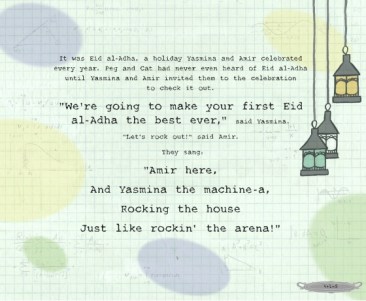
Easily the most anticipated Eid al-Adha book to come out this year, the book does not disappoint.  Following the episode, the book, is 32 pages and while ok for ages 3 and up, like the show, it really is geared to children able to grasp the math concepts presented.

The book’s story is that it is Eid al-Adha, and Peg and Cat are learning about it with their friends Yasmina and Amir. The holiday facts don’t seem forced and words like hijab. oud, and Eid Mubarak, are integrated naturally.  The concept of giving charity, giving to those with LESS, becomes the set-up for learning about more than, and less than. 

peg4

A few pages later the tradition of dividing meat into three parts: one to keep, one for friends, and one for the poor, sets up a lesson on fractions and using a pan balance.  The really big problem, involves moving crates.  They count down from seven to calm down, and then use all their lessons learned to solve the problem and help a neighbor.

peg5.jpg

The illustrations are straight from the show in all their adorable glory, I’m not sure why Yasmina has some strange tree branch looking loose hairs poking out of the top of her scarf.  I love that the page numbers are math problems (2 +1=3 for the 3rd page).  And the hardback with slip cover workpages on the underneath side, are a nice treat.  I was especially greatful the picture on the slip cover is the same as on the book, so the cover can be discarded, as will ultimately occur with multiple readings.

peg2

Books like this are great ways to introduce an Islamic tradition to non Muslims in a non preachy, non threatening way.  By seeing beloved characters with Muslim friends helps shape perceptions and increase understanding, inshaAllah everyone wins, alhumdulillah.

No Ordinary Day by George Green

Standard
No Ordinary Day by George Green

no ordinary day.jpg

I was really, really excited to get this book in my hands.  An early chapter book, about Islam and sports, with diverse characters, that seemed to be the start of a series featuring the “Childhood Champions,” seemed to have the potential to fill a gaping void in Islamic fiction.  And while the book shows promise and has a lot going for it, it falls short of what it could be, and perhaps with the ever growing book options, what it should be. 

To be clear the Islamic lessons and values are on point as are the pictures, it is the holes in the story, the random text layout inside and the lack of depth that keep this book from reaching its full potential.

SYNOPSIS:

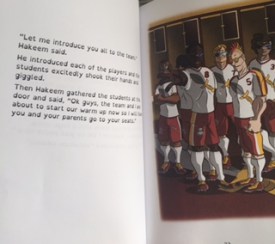
Ibrahim normally needs help to get up for school on Mondays, but not on this day. On this day they were promised a surprise at school and Ibrahim can’t wait to see what it is.  When the 8-year-old gets to school he and his friends are delighted to meet Hakeem Muhammad a soccer star on the California Spartan’s Team in town to play against the local Harlem Knights.  To win one of the five tickets that he is giving away the students have to recite some ayats from Juz Amma and tell why it is important that they study the Quran.  Ibrahim goes first, and we don’t know what he recites, but he says that studying Quran makes him feel happy and inspired.  Which to me didn’t really meet the criteria of the competition.  The next student is also a member of the “Childhood Champions,” but we know nothing about Jannah, other than the one page bio at the beginning of the book.  Jannah recites some mystery ayats and says that knowing the meaning helps her with reciting, a bit more of an appropriate answer, but still kind of not fulfilling the question in my opinion.

ordinary1

All five kids in the crew win tickets for them and their families for the game that night.  A limo picks them up and they get to meet Hakeem in the locker room.  When they arrive  he is praying, so they wait, say salam, chat, and then are shown to the VIP box.  The game is close, Hakeem scores the winning goal for the Spartans and the kids go home happy. No real problem or solution, the climax is just the game.

WHY I LIKE IT:

I love that the font was chosen to help kids with dyslexia and the full color internal pictures are a nice plus.  I don’t understand how it was determined how much text is on a page, as it is so varied and inconsistent, that it seems like a draft rather than a final copy.

I love that this book is about Muslims and for Muslims, the star athlete prays, and connects with Allah swt, and is proud of it.  His praying before the game is not weird to his teammates, which is awesome for kids to see.  The conversation after his salat with the kids is also pretty powerful, but the setup is incredibly awkward. Yasin won a ticket for reciting Quran, so why the answer about why he is praying before the game started with explaining that he prays five times a day, seems jarring to the flow of the book and story.  I liked the insight about praying and being grateful whether they win or lose, but the catalyst for the exchange was really forced.   Loved that Hakeem made sajood when he scored and that Ibrahim was asking Allah for help.

I wish the ayats the kids recited would have been shared.  I think the book is for muslim kids, so it would have helped if they really inspired something tangible that the readers could relate to.  The book is very bland and it could be much more memorable.  I’ve read the book three times, and couldn’t tell you any of the students names.  I had to look back to write this review.


I’m not a soccer expert, but I think the winning goal would have been called back for offsides, I’m hoping I’m mistaken.  The breaking a world record for loudest fans seemed a stretch, but kids 6-8 probably would be bothered by it or find it out of place.  The book says it is for ages 6-12, but I can’t see kids 12 years old getting much out of this 40 page book.  

FLAGS:

None the book is completely clean.

TOOLS FOR LEADING THE DISCUSSION:

The book wouldn’t work for a book club selection, but I would probably have it in a school library for kids transitioning to chapter books, and in a classroom for excitement and novelty.  There isn’t anything “wrong” with the book, it just needs a good editor and a little more.  It really is almost there.

https://www.launchgood.com/project/childhood_champions__no_ordinary_day_a_book_for_muslim_children#!/


Zaydo Potato: A Muslim Superhero by Randa Taftaf and Maz Galini illustrated by Lovyaa Garg

Standard
Zaydo Potato: A Muslim Superhero by Randa Taftaf and Maz Galini illustrated by Lovyaa Garg

img_0531.jpg

This is the second review of a Zaydo Potato book on the blog, and much like the first book this one caters to toddler and early elementary aged children who will enjoy the large colorful pages, the silliness of finding a potato on each page, and who can benefit from the repetition of events to understand a concept.  In this 32 page book the concept being conveyed is taking care of each other, as established by the hadith at the beginning of the book.

zayd

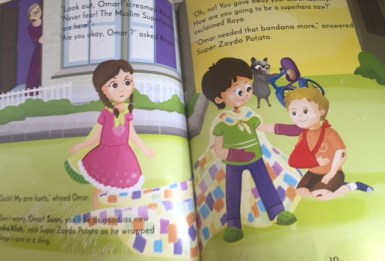
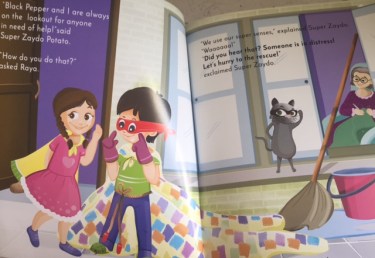
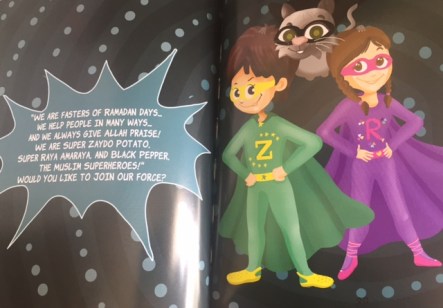
Zaydo and Raya dress up as superheroes, but find their power in saving the day involves using their capes, and masks, and belts, and gloves, to help those around them who can benefit more. They use a bandana to sling a hurt arm, a towel cape to cover a spill, and silly gloves to make a baby stop crying.   They call themselves Muslim Superheroes and after showing the reader that it is good to help one another, praise Allah, and do what is right, they ask if you want to join their force.

zayd2

I read the book to my own children and then to a group of about 25 kids under the age of 6 and it went over pretty well.  The amount of text on a page is sufficient to convey the repetitive scenarios.  Honestly, I don’t really understand why the book takes place in Ramadan.  Other than the first page saying that they are the fasters of Ramadan days, and the last page repeating it, there is nothing Ramadan specific about the story.  In fact the Grandma is drinking tea on the first page, so yes maybe she is excused, but it is a bit confusing to have the Ramadan element in there when it is not a facet of the story at all. 

zayd1

The word ‘super’ is used a lot, and if reading it aloud can get your tongue a bit tied.  I also don’t understand why Raya has a last name or second part to her name, Raya Amaraya, maybe to go with the rhyming of Zaydo Potato? Either way by adding super, before their names, and the rhyming second name, I felt like a lot of the book was just saying names. The only other critique of an other wise solid book about teaching kids how to truly be super in a practical way, is that the Grandma is in a lot of the pictures in the background sewing so that when she surprises them with real costumes, the kids can enjoy going back and see she was working on them the whole time.  Except I thought, my kids thought, and the story time kids all thought she was knitting, and the costumes don’t look knitted, so it is a bit jarring.  On closer inspection there is just one needle, not two, but it is really large, almost crochet hook size, so a sewing machine illustration would have been a much better choice.

zayd3

The activities and lessons at the end and the founding premise of the book really make the book an important one to share with your little ones.  The binding and glossy pictures of smiling children having fun will entertain and educate them at the same time.  My critiques are small, but I feel like a few test readings by the authors, and the minor quirks could have been eliminated all together.  

zayd4


Zaydo Potato: Can Allah See Me Now? by Randa Taftaf and Maz Galini illustrated by Lovyaa Garg

Standard
Zaydo Potato: Can Allah See Me Now? by Randa Taftaf and Maz Galini illustrated by Lovyaa Garg

zaydo

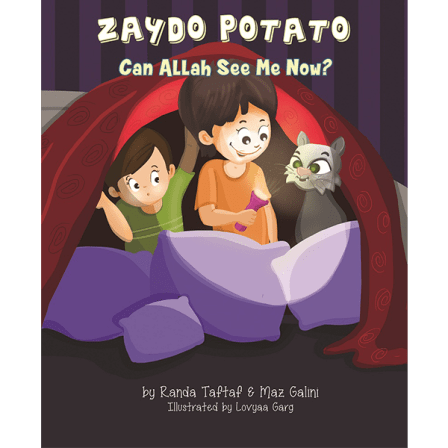
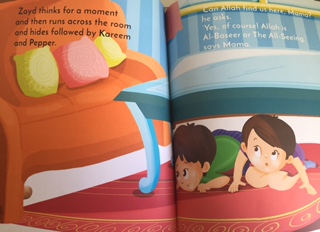
The book starts off simple enough with a little boy, Zayd playing hide-and-seek with his friend (or maybe cousin), Kareem, and his cat Pepper, when the challenge of hiding where they can’t be found, spawns a lesson in how Allah (swt) is always watching and watching over us.  As the kids hide in different places, the mom uses the names of Allah (swt) to emphasize the point.  The story presents the names of Al-Baseer, the All-seeing, Al Aleem, the All-knowing, Al-Khabeer, the All-aware, Al-Raqeeb, the Watchful, and Al-Shaheed, the Witness.

FullSizeRender (53)

The book is 32 pages, with the story taking up 24 of those pages. An ayat from the Quran, surah Hadid verse 4, starts the story and there is a glossary of the names of Allah at the end.  There is also some suggested activities for the book.  Hidden on each page is Pepper the cat and a potato.  There are other activities of finding shapes, counting blocks, finding different animals, etcetera,  that encourage children to go back to the book to engage in the pictures, and inshaAllah the message presented.

FullSizeRender (52)

There are two books thus far in the series and one E-book, the order doesn’t matter, as each is a standalone book.  The husband and wife authoring team also have a publishing company, Rummana Publishing Inc, and based on their website seem to have plans for more in the future.  This book came out about six months ago, and with its Glossy cover and large colorful pages, children will enjoy the story and activites.  The pictures are warm and engaging, and overall they are very well done.  The sentences are short, and the amont of words on the page is appropriate for the target audience.  There seems to be some arrant spacing on new text lines, but I doubt anyone would notice, and a few sentences are awkward either in their wording or lacking commas, but again, it is minor.

FullSizeRender (54)

A good story premise, easily conveyed to younger Muslims, makes the book an asset for Muslim children establishing a foundation and building a relationship with Allah swt.


Zaahir & Jamel The Camel: At the Mosque by Amatullah AlMarwani illustrated by Sudha Choudhary

Standard
Zaahir & Jamel The Camel: At the Mosque by Amatullah AlMarwani illustrated by Sudha Choudhary

zahir and jamel

Another book in the Zaahir and Jamel the Camel series, this book explains to children how to behave at the mosque.  The pictures are colorful and busy, engaging children 2 and a half and up.  Younger children can enjoy the bolder aspects, and older children will enjoy the details.  Some of the text seems to hide behind the geometric shapes, but I would imagine the story is usually read aloud and not independently, so it isn’t too much of a problem.

zaahir 1

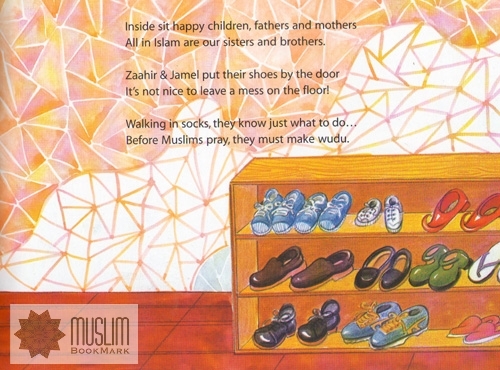
Just like when Zaahir and Jamel went for Hajj, the short rhyming sentences go step by step on what to expect as the story follows Zaahir and Jamel through the process: they take off their shoes, they make wudu, they stand for salat, they make du’aa, they stay quiet and respectful.

zaahir2

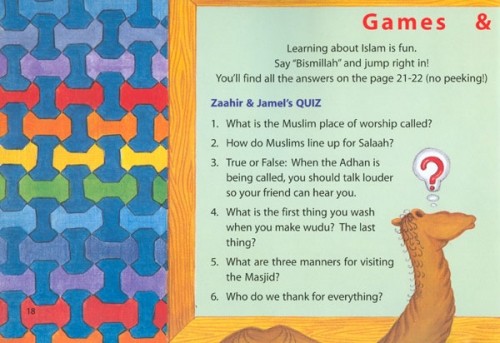
The book is 23 pages, but the story is really only 17 pages.  The story is followed by Games and Activities including a quiz and a crossword puzzle, and then a Glossary.  The quiz is great when reading aloud to a group or even just at bed time to make sure the children understood the key points.

zaahir3

The book is small and rectangular, which makes it work better in smaller groups (6.6 x 9.5), but for a book that cost less than a dollar online, it really should be in every child’s library.  Its a great review for little ones before Jumaah or just as a gentle reminder that praying in the mosque is something that all Muslims have in common.  It also works well for parents of non muslim kids that might be coming to the mosque and want to know what to expect, and how to act.

zaahir4


Alana’s Bananas by Mariam Hussein illustrated by Saima Riaz

Standard
Alana’s Bananas by Mariam Hussein illustrated by Saima Riaz

alanabanana

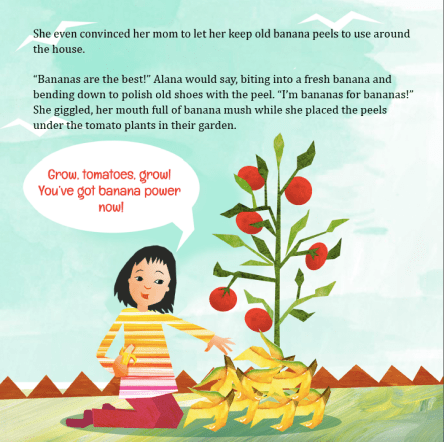
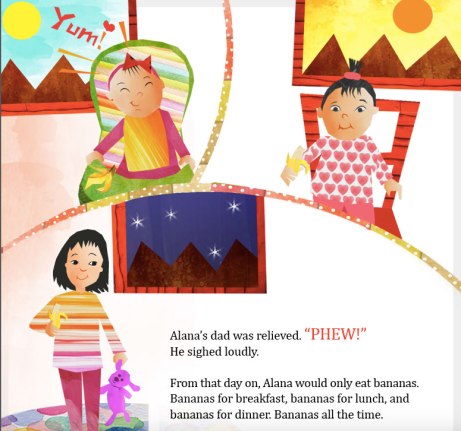
A silly, silly book about a girl’s love of bananas and her despair when a storm wipes out the banana crops in Costa Rica.  The moral of the story is to try new foods, and in 36 pages I think the reader will grasp just how over the top Alana’s obsession with bananas truly is and the lesson will be learned.

alana3

My only stumbling block is I’m not sure what age the book is for.  The bright silly pictures work well for ages 3 and up.  The theme works well for ages 4 and up.  The amount of text on the page, however, is more 6 or 7 and up, and the concepts of where banana’s come from, multiple uses for banana peels is about the same.  The character in the book, Alana, is eight and goes to the library and reads cook books and cooks independently, but the way her parents trick her into eating other foods is to hide eggs, peanut butter, rice, avocados and anything else they could find in banana peels, which keeps with the silliness of it all, but seems a bit off for 8 years old. Also talk about very patient parents allowing their 8 year old to only eat bananas for so long, and then not being upset when they have to resort to extreme levels of trickery.

alana1

There is nothing islamic in the text, and the only islamic elements are the author, illustrator, and the family based on the illustrations.  The mom wears hijab, but it is neither mentioned or referenced and no islamic vocabulary or phrases are in the story. In a scene at school, the girl sitting next to Alana is wearing hijab.

alana2

The book is about 10×10 and sturdy in its construction.  The back cover has a recipe for Alana’s Banana Breakfast Muffins. Enjoy!

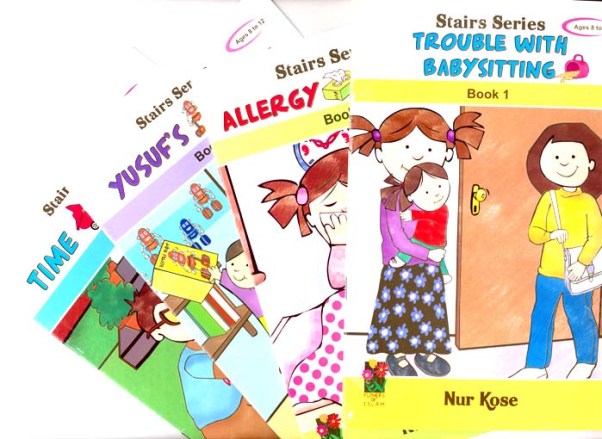
Stairs Series: Trouble with Babysitting, Allergy Attack, Yusuf’s Robot & Time Travel by Nur Kose illustrated by Shaista Asad and Ayesha Khatib

Standard
Stairs Series: Trouble with Babysitting, Allergy Attack, Yusuf’s Robot & Time Travel by Nur Kose illustrated by Shaista Asad and Ayesha Khatib

stairs series

This set of books claim to be for children ages 8 to 12, but I think they work better for 7 to 10 year olds.  They look like leveled readers, and resemble them in their simple linear story lines.  They are broken up in to chapters, that really are not necessary, but because of the volume of text on each page, allows for a young reader to take a break.  All four books in the series are connected chronologically and contain the same characters.  They more or less present a problem, bring over their friends, have one of the friends offer some advice tied to a hadith or ayat from the Quran, and the advice is tested, and then shared once more.  They are about 20 pages and have activities at the end that range from solving clues to writing paragraphs.  The sentences and vocabulary are about a second grade level, with translations of Arabic and Turkish words, along with references to the Quran and Hadith appearing in the footnotes on the page they are mentioned on.

stairs series characters

The best part of the books is that they are written by an 8th Grader, mashaAllah.  I think they teach a lesson in a simple way, and while not terribly suspenseful or comical, they do succeed in showing Islamic lessons in relatable situations for kids.  Some of the details seem excesses or meandering, but again, the fact that it is written by a kid, will inspire readers to listen differently to lessons about patience, accepting Allah’s will, recognizing one’s own limitations, and putting Allah (swt) above all else.

stairs inside

The pictures are colorful and simple.  They appear every few pages in the book and provide a nice break from the text.  They are sweet and not detailed, but sufficient for the story and level.

stairs pictute

Hamza Learns about Charity by Ameena Chaudhry

Standard
Hamza Learns about Charity by Ameena Chaudhry

hamza learns about charity

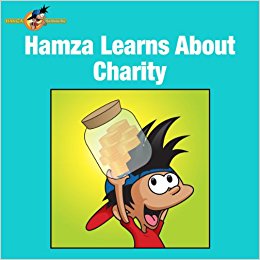
It is hard to believe I haven’t reviewed any of the seven Hamza books in the series.  They are perfect for 2-6 year olds (older kids will enjoy them too), and all are both informative and silly.  This book is 20 pages and is seven and half inch square in shape.

In Hamza Learns About Charity.  Hamza learns what the word charity means as his mom is packing up his old toys to donate to the less fortunate.  He also learns you can give money and how donating and taking care of the poor is required in Islam.  Hamza’s mom tells how Prophet Muhammad (saw) lived a simple life and was very generous with whatever he had.  Hamza also learns the word for charity in Arabic.  When his mom leaves to take the stuff, Hamza decides to show that he understands and is ready to give everything away and live a simple life.  Alhumdulillah, mom returns in time to shoo the neighbors away and convince them that the house, and car, and household items are not for sale.  Thus, Hamza also learns that we aren’t required to give everything away, and when making big decisions we should get our parents’ permission first.

The illustrations are cute and colorful.  They are not overly detailed, but Hamza’s facial expressions are engaging and expressive.  The book works well for story time and bedtime and seems to be geared for Muslim children.

The Treasure at Bayan Bluffs by Farah Zaman illustrated by Kim Zaman

Standard
The Treasure at Bayan Bluffs by Farah Zaman illustrated by Kim Zaman

img_2961

At 231 pages this book claims to be for ages 9 to 18 and that’s a pretty large spread for a mystery, yet alone an Islamic fiction one by a first time author.   In a tone reminiscent of Nancy Drew and the Hardy Boys,  it should really should just say 9 and up, I was hooked!

SYNOPSIS:

Adam and Layla along with their younger twin brothers Hassan and Hakeem from America are visiting their family home of Bayan Bluffs in Midan for the summer.  Their grandfather and great aunt and a few long time servants aren’t much entertainment for the children, so their parents arrange for their college friends kids’ Zaid and Zahra from Crescent City, a few hours away, on the other side of Midan to join them.  The children get along right away and decide to try and solve a mystery of a hidden treasure that they have heard bits and pieces of over the years.  Their search for the Moon of Masarrah starts innocently enough, but quickly escalates as they learn they aren’t the only ones searching for the missing gem.  As they learn more about the jewel and the circumstances of its disappearance the gem and the murder of Adam and Layla’s great grandfather get further entwined.  With a few of the suspects still alive and many of their family members still in the city, the children soon find they themselves in danger as well.

WHY I LIKE IT:

The biggest reason I like it, is it is well written.  There aren’t confusing passages, or too many characters or boring preachy paragraphs.  The plot is good, the dialogue believable and the fact that they are Muslim children, just depth to the story.  They plan to meet after asr or before Jummah, and they say inshaAllah and mashaAllah, and its just a really good balance of who they are, but not all they are.  In retrospect, maybe they all get a long a little too well, but it isn’t syrupy and they have some minor annoyances, so it doesn’t hinder the story.  The only thing I caught myself looking back on was the age of the twins.  At times they seem like toddlers and at other times much, much older.  Even the author says they are “about six years old,” and having a six year old myself, I do believed that they can vacillate to both extremes in any given moment and thus I accepted their antics and let it go.  Additionally I wish she included a map.  It isn’t confusing, but it would have been great to look back upon as the action speeds up, and would definitely help younger readers visualize the details.  The terrain vocabulary for anyone younger than nine might need some explanation.  There is a glossary at the end for some of the Arabic words, and for some of the specific ships and weapons mentioned.  Their are a few illustrations that I think help the younger readers, they aren’t needed for the story, but they don’t impede it either.  I wasn’t crazy about them within the story, but I did appreciate that they show the girls in hijab and the illustrator clearly put a lot of work in to them.

bayan.jpeg

I wish that the cover was more appealing, for a story that was so good, I wish it begged to be picked up.  InshaAllah word of mouth will carry the book, so that more like it are written and published.

FLAGS:

None, mashaAllah it is clean and wholesome.  There are good and bad Muslims and no judgement is put in a religious context.  There is some violence, but it is nothing even a seven year old would find offensive.  Alhumdulillah.

TOOLS FOR LEADING THE DISCUSSION:

I would love to do this as a Book Club book for 5th through 8th grade.  The writing quality and the different characters the students would be able to identify with, would make it a lot of fun.  There isn’t any deep or though provoking discussion points to accompany the book, but I think the genre is hard to come by and Muslim kids seeing Muslim kids solving a crime and going on a treasure hunt, is just exciting.  I couldn’t find any study guides or even much information on the book or author, but none is needed to enjoy the story.  Farah Zaman if somehow you see this review, know that I hope you keep writing, and I thoroughly enjoyed your book!  Happy Reading Everyone!


Ms. Marvel No Normal & Generation Why by G. Willow Wilson illustrated byAdrian Alphona & Jacob Wyatt

Standard
Ms. Marvel No Normal & Generation Why by G. Willow Wilson illustrated byAdrian Alphona & Jacob Wyatt

I have to be completely honest these are the first comic books I’ve ever read from cover to cover.  So, while I’m in no position to review the art work, or historical role of the original Ms. Marvel or even have a valid opinion on the superhero story lines, I do want to cover the Islamic elements because even as someone as outside the comic book world as I am, I knew that Marvel’s new Ms. Marvel is a Pakistani-American Muslim girl from Jersey and that’s pretty big.

I was intimidated to read No Normal, I ordered it from Scholastic and have had it on my shelf for a while, I was excited, but nervous. But then I ordered the second one, which is also a collection of 5 comic books, and thought, let’s do this.  Both collections are easy reads, and the text and what to read first in each story frame is clear.  As with comics and graphic novels the pictures convey much of the story so there isn’t a lot of “explanation,” but the story is compelling enough, that even a novice like me didn’t get too hung up on what was going on and how it could be possible.   While it may tempt younger children, I would hold off until the reader is a teen, especially if the reader is Muslim.  There is a bit of drug use and alcohol in No Normal and obviously violence, but at it’s core it is a story of a girl trying to discover who she is and there is some angsty teenage stuff that someone who hasn’t gone through the emotions, might take as attacks on Islam, parents, and culture.

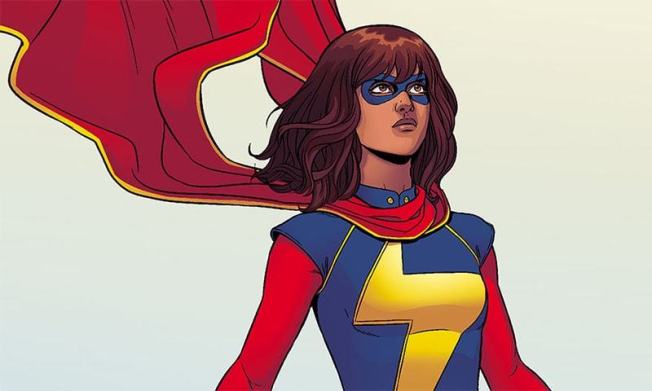
Kamala Khan is a high school student in Jersey City, New Jersey.  She has a Muslim friend, Nakia, who wears hijab, and non Muslim friends of both genders that seem to support her faith and culture, almost more than she does.  The story opens with her sniffing bacon and her friends humoring her oddness.  Having grown up with the same group of friends around her, they understand her quirks and nerdiness and she seems to fit in.  As with most teens though, she feels on the “outside” and Kamala right away tries to seem cool with the more popular crowd.  She  is struggling to find herself within her Pakistani culture, her American life, her Islamic beliefs and teenage friends, information all presented in the first few pages while at the local convenience store hangout.  A lot for Kamala to balance and she hasn’t even discovered her “powers” yet.

Kamala’s parents initially seem more “cultural” than religious as her father chastises Kamala’s brother Aamir for being too religious, yet is constantly on Kamala, presumably because she is a girl.  In a fit of defiance against her parents strict curfew, Kamala sneaks out of the house to attend a party, accidentally drinks alcohol (she spits it out) and gets caught in some “fog” that gives her morphing, stretching, embiggening, and quick healing powers.

As Kamala tests how her powers work, and what they mean, there are a few funny asides that appeal to Muslim readers: she attempts to use her Burkini as a base for her super hero disguise, and her mother threatens to send her to the Sheikh if she gets caught sneaking out again.  Her parents start to grow on you though, the mom is a very stereotypical immigrant mother who cares for her daughter in a worrying nagging way, the dad actually tries to communicate with Kamala and comes across a little more genuine toward the end of the first collection.  Her brother seems to be level headed, but a minor influence.  He sticks up for her and tries to help, but it doesn’t seem like they are that close.   The final scene in No Normal left a little bit of a bitter taste in my mouth and I was glad that I already had Generation Why to dive right into and not let the conclusion of the first one fester in my head.  Kamala shows up to a wedding late, complete in Shalwar Kameez (Pakistani clothing) and gets in an argument with her mom.  Kamala says, “You and Baba want me to be a perfect little Muslim Girl–straight A’s, med school, no boys, no booze, then some hand picked rich husband from Karachi and a billion babies.”  The mom says, “Your father and I want the best for our only daughter our expectations are high so that your successes will be many.”  It goes back and fourth then the mom says she is grounded and the book ends with Kamala retorting, “wanna bet…?”  While I’m sure most every Muslim American teen has felt this way, I don’t think I’d want my 9 year-old-daughter thinking that is how narrow success is defined, or that being the best you can be is a punishment. It’s probably a realistic gripe, but to have it be the last impression, naturally brought out my defensive instincts.

A lot of the awkwardness and stage setting in No Normal is resolved by Generation Why and I found I enjoyed it a lot more than I thought I would.  I might even be anxiously waiting to see what happens next.  Kamala is sent to the Sheikh and while she is intentionally vague about telling him what is going on with her, she does suffice it to say she is trying to help people and he responds by telling her to do it with as much honor and skill as she can. I love that he wasn’t putting her down, but rather trying to mentor her spiritually to find her self and do so honorably.  Really the only other religious/cultural scene is when Lockjaw a giant dog with transporting abilities shows up to help Kamala and her parents say he can stay, but outside because he isn’t clean.  I don’t know if non-Muslims will fully understand why, but it made me chuckle.  It also made me like her family a bit more.  They are strict, but not unreasonable.  They didn’t say, “no” they found a compromise.

Generation Why contains more action than back story.  I’m not entirely sure why Wolverine shows up, I have no idea who the lady in charge of stuff is with Captain America, and I’m not sure why no one finds it odd that the Inventor is a bird man, but hey it is fun.  And it definitely had me cheering on Ms. Marvel as she empowers her generation and learns that being American Muslim might be the easiest of her identity issues when she learns she is inhuman.  It gets a little cheesy, but the foundation of comic books being good against evil, lends itself to that right?

Overall, I think I would recommend both collections are read together, as it gives a better picture of what Ms. Marvel is and can be.  I think thus far the author has done a good job of showing that she is Muslim and that her faith adds depth to the character.  Her tenacity, persistence, determination, compassion for animals, her humor, her nerdiness, all make her very like-able and admirable.  I probably wouldn’t do it as a Book Club selection, because our school only goes to 8th grade and being an Islamic School I don’t know that most of the students feel the identity crisis until possibly much later if at all.  But I think the books would work well for discussion with older kids.  Topics of what youth can do, their role in preserving the planet, discovering your sense of self and purposes are all there in comic book, super hero, action packed form!
Kamala Khan