Tag Archives: Muslim Family

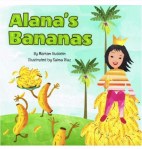
Alana’s Bananas by Mariam Hussein illustrated by Saima Riaz

Standard
Alana’s Bananas by Mariam Hussein illustrated by Saima Riaz

alanabanana

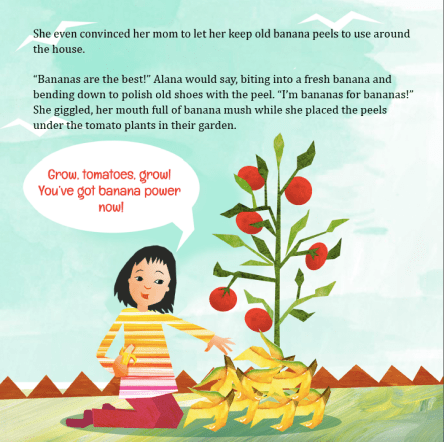
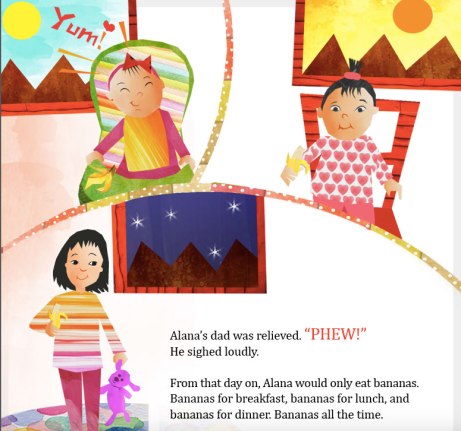
A silly, silly book about a girl’s love of bananas and her despair when a storm wipes out the banana crops in Costa Rica.  The moral of the story is to try new foods, and in 36 pages I think the reader will grasp just how over the top Alana’s obsession with bananas truly is and the lesson will be learned.

alana3

My only stumbling block is I’m not sure what age the book is for.  The bright silly pictures work well for ages 3 and up.  The theme works well for ages 4 and up.  The amount of text on the page, however, is more 6 or 7 and up, and the concepts of where banana’s come from, multiple uses for banana peels is about the same.  The character in the book, Alana, is eight and goes to the library and reads cook books and cooks independently, but the way her parents trick her into eating other foods is to hide eggs, peanut butter, rice, avocados and anything else they could find in banana peels, which keeps with the silliness of it all, but seems a bit off for 8 years old. Also talk about very patient parents allowing their 8 year old to only eat bananas for so long, and then not being upset when they have to resort to extreme levels of trickery.

alana1

There is nothing islamic in the text, and the only islamic elements are the author, illustrator, and the family based on the illustrations.  The mom wears hijab, but it is neither mentioned or referenced and no islamic vocabulary or phrases are in the story. In a scene at school, the girl sitting next to Alana is wearing hijab.

alana2

The book is about 10×10 and sturdy in its construction.  The back cover has a recipe for Alana’s Banana Breakfast Muffins. Enjoy!

A Bedtime Prayer for Peace by Akila Dada & Sukaina Dada illustrated by Michael Wagstaffe

Standard
A Bedtime Prayer for Peace by Akila Dada & Sukaina Dada illustrated by Michael Wagstaffe

MKPLC308-Bedtime-Front-Cover_frontzoom

This is a slow, deliberate, thoughtful book, that does a good job or setting a prayerful tone with short rhyming sentences.  Intended for preschool age children, early elementary children also will enjoy this book in rotation at bedtime or nap time.  

FullSizeRender (9)

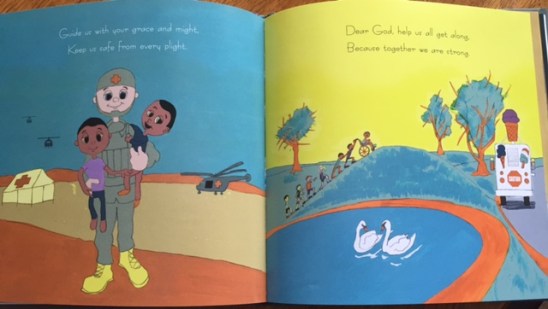
The book thanks the creator and asks for protection for all things small and large, seen and unseen, in a gentle dreamlike manner that really could go on for so much longer than the 32 pages present.  Some items mentioned like the plants and trees a preschooler will know, but some of the concepts introduce little ones to something bigger, “Give shelter to families who need a home, Help all the people who feel alone,” “Guide us with your grace and might, keep us safe from every plight.”  

FullSizeRender (8)

The prayer is voiced by a mom to her young boy, Esa, and the illustrations show traditional subcontinent dress as well as western clothes being worn.  The author’s are Muslim but the book is not overtly Islamic.  Sometimes the mom is in hijab, but when in the home she is not.  More distinctly, the word Allah is not used, only God is, and thus the book and prayer, really would work for any monotheistic child as the book does say, “Dear God, protect my beautiful son, You are the Truth. You are the One.”

FullSizeRender (10)

The true treasure of this book is that the main character is in a wheelchair.  Showing different abled characters is always such a blessing as it normalizes it and inshaAllah makes us more accepting when out and about.  The illustrations don’t wow me, but their quiet simplicity keeps the pace of the book, and don’t scream for attention.  Some of the smaller details are endearing and help sleepy eyes linger on page without feeling rushed.

With a hard 8×8 cover, the book is a good size for little hands to read over and over again, alhumdulillah. 


Blackout! by Sumayyah Hussein illustrated by Majd Massijeh

Standard
Blackout! by Sumayyah Hussein illustrated by Majd Massijeh

blackout.png

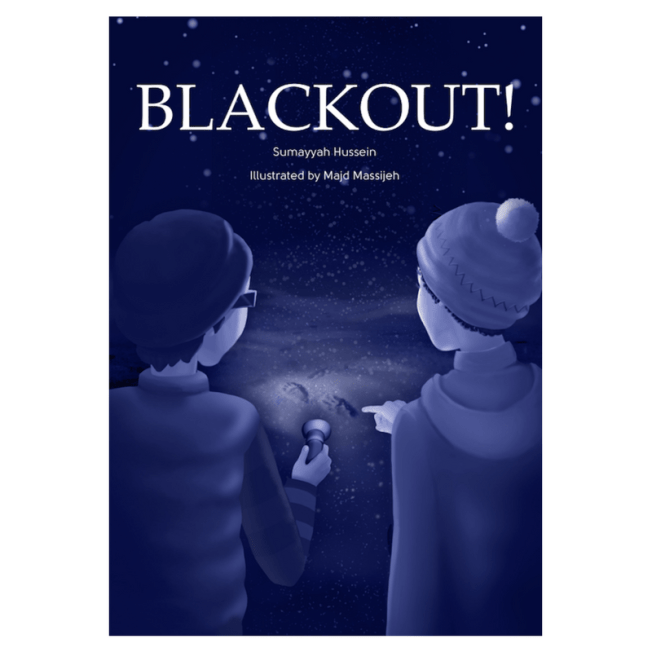
Presenting the stories of refugees to young children often involves a balancing act of fact, emotion, and restraint, all while finding the common ground to create empathy in the reader.  Increasingly on bookshelves are successful picture books that use illustrations to build bridges of understanding and bright colors to convey hope.  For older children there are books that can devote time to explain issues or offer first hand accounts along with political back stories and historical events.  For elementary age children 2nd and 3rd grade particularly, chapter books on refugees are not very common.  Children this age seem to relish in silly outlandish characters with a few font happy sentence and pictures on each page or stick to series that are easily predictable as they present tidbits of history or simple mysteries.  All reasons to encourage your child to read Blackout! and break the monotony and gain some empathy.  As delicate as the subject matter is, the book manages to resonate with most children how good they have it and how fortunate they are, without getting preachy or pretentious.

SYNOPSIS:

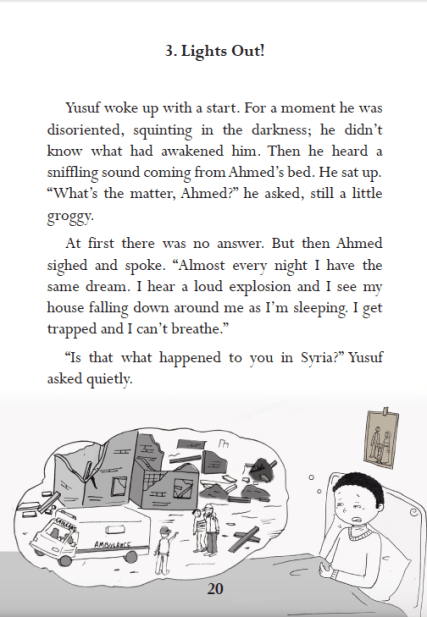
Yusuf, a 12-year-old Canadian boy is anxiously waiting the arrival of his cousin Ahmed from Syria.  Ahmed recently lost his father when their makeshift boat capsized, and while coming to Canada is a blessing, he is still haunted in his dreams and memories by all that he has seen and endured.  This idea that being safe now, doesn’t erase all the pain and fears experienced, is a concept most adults understand, but I was surprised that my children had to talk it out a bit.  They understood that he would be sad, but hadn’t really thought how hearing loud noises would immediately remind him of the explosions he heard in Syria and of his home and buildings crumbling down.
blackout inside

The story’s focus is the present however, and follows Yusuf.   The backstory of Syria and Ahmed’s escape is juxtaposed with an ice storm turning Toronto powerless and cold.  As Yusuf deals with the annoyance of a few days without electricity he learns a bit of compassion for others in the world, who endure a similar situation indefinitely.  In a beautiful way, Ahmed’s enduring optimism changes Yusuf as they find reasons to smile at the raccoon rummaging through their food put outside to stay cold, or playing in the snow to pass the time.  The characters have a lot of heart, for a short book, and you really feel like you get to know them and feel for them.  Yes, Yusuf whines, but he is a kid who’s winter vacation plans have gone awry and is frustrated and bored.  Ahmed, while a survivor, still struggles, but maintains a personality much more than just victim.  The other family members are background, but they aren’t flat, they have warmth and humor and pain in equal parts, implying if the book was longer, we’d get to know more about them too, and probably like them as well.

Despite the refugee story line, and the blackout, the crux of the story is actually helping one another and being neighborly.  Ahmed at one point is telling a story of how he began helping someone in a refugee camp and that it gave him purpose.  This reminds Yusuf that they have an elderly neighbor and the radio alerts had encouraged people to check on one another.  The boys rush over to find Mr. Caldwell, suffering from carbon monoxide poisoning brought on by his kerosene heater. Luckily an ambulance is able to get there just in the nick or time. On the third day of the blackout, the Imam speaks about helping one another and making this obstacle into something positive.   Ahmed tells Yusuf how the neighbors in Syria would gather in the winter to share what food they had.  This brilliant idea gets the support of Yusuf’s dad, the Imam and the whole congregation as they rush home to invite the neighbors to a neighborhood BBQ.  The perishable food needs to be consumed, so what better way to enjoy it, than to share it.

When the power comes back on, Yusuf is not the same kid, he has grown in compassion, and patience, and inshaAllah the reader will be similarly affected for the better.

WHY I LIKE IT:

I love that the book addresses a hard topic on a kid level.  It does not overwhelm the reader or frighten them.  MashaAllah, it balances what they can understand, with something bigger.  The illustrations keep it light in their doodle like appearance and the font, spacing, chapter length and presentation are perfect for the target audience.

blacout2

The women wear hijab, they pray, they go to the mosque, yet they don’t quote hadith or Quran or say a lot of mashaAllah and Alhumdulillah, making the book work easier for non Muslims.  The coming together of community is nice.  No one asks or worries what religion, race, or ethnicity anyone in the neighborhood is, they just come together to share a meal and welcome Ahmed and his mom to Canada.  The Imam is relatable and the dad is involved and generous, the mom is competent and respected, all normal behaviors that reinforce community and normalize diversity and acceptance.

FLAGS:

The violence of war may affect young children differently.  Nothing is sensationalized or graphic, but Ahmed does get stuck in the rubble when his house is destroyed, and his father’s drowning is discussed.  Nothing is talked about in depth, but the ideas are presented.

TOOLS FOR LEADING THE DISCUSSION:

This book would be perfect for a young book club.  I’m looking forward to reading it with my six-year-old son and my eight-year-old niece so that I can see how what they get from the book.  There is a brief explanation on refugees at the back of the book, and I think current events would naturally make a book club discussion easy to facilitate.  I think gathering items and meeting refugees after, would also be a wonderful way to turn the fictional story into real action.  It is also worth noting 100% of profits from this book will be going to the Syrian Canadian Foundation‘s mental health and wellness initiative for Syrian newcomers.

blackout1

Yippee! Ramadan is over, It’s Eid by Farjana Khan

Standard
Yippee! Ramadan is over, It’s Eid by Farjana Khan

yipee

A friend loaned me this book from the local public library, so I was not only excited that a book about Eid was readily available, but also hopeful that it was good quality.  Then I saw the title.  I mean I get that the “Yippee!” is a title part of a series of books on the different holidays Muslim’s celebrate, but for as excited as Muslims are for Eid, they are usually very sad that Ramadan is over.

Nevertheless, I opened it up and hoped to be swept away.  The list of Eid activities and rituals however, were very dry and anticlimactic.  The characters are not named, the pages are meant for pre-schoolers I would imagine, but the lack of excitement in the language is disappointing.

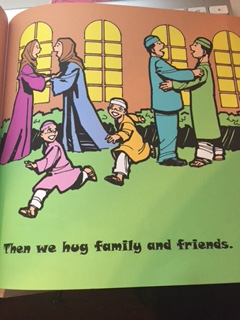
yippi hugThere are 19 pages of text, and the first few pages start off pretty well with a little boy seeing the Eid moon.  Then the family goes to the mosque and learn that Eid marks the end of fasting and the month of the Quran.  The boys father then gives money to the mosque, it doesn’t say that it is charity, but if one is familiar with Eid, one could assume. However, the book seems to be for those unfamiliar with Eid, so for me, this is where the book started to be lacking.  The next page also is where the list seems to start, and some of the items on the list are a bit of a stretch.  “We hug family and friends,”  followed a few pages later by a whole page dedicated to “My mother sets the table.”

yippi table

The book is also obviously desi as they eat parathas and firni.  At one point the kids play a game, not sure what game, it only says what sister’s favorite game is, and then a page is dedicated to the fact that “sister’s team wins.”

yippi fries

Perhaps I am too harsh, as the book is colorful and shows family and friends happily interacting.  There are women covered, not covered and with niqab, and there isn’t anything erroneous in what is written.  I just would hope for more.  The book is small in size, 8.5 x 8.5, and could have been fleshed out a lot more.  It reads like a child’s rough draft, each page or so, being a topic sentence, without the details.

I really don’t know what one would learn or get out of this book, that they wouldn’t get out of a fictionalized account or even a character driven story at Eid time.  Online prices don’t convince me the book is a stand out either.  There are much more fun, engaging, and memorable Eid books out there, not sure why the library chose to invest in this one, but alhumdulillah, I suppose it is better than nothing.

My Dad’s Beard by Zanib Mian & Laura Ewing

Standard
My Dad’s Beard by Zanib Mian & Laura Ewing

cover-my-dads-beard

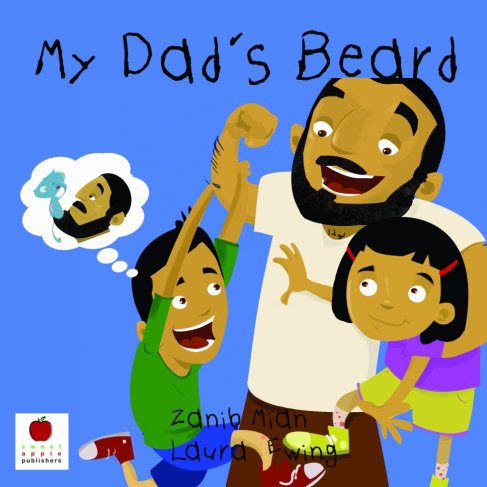
I honestly don’t think this 11×11, 32 page book could be any sweeter.  With just a few words on each page the simple sentences convey such love and warmth from a boy to his dad, by way of his beard.

MyDadsBeard3


The boy articulates that his father’s beard is different from his uncle’s and his grandfather’s and that his kisses tickle because of it.  He knows his sister loves his dad’s beard too because she holds it when she is scared.  Grandma says it makes him look like a real man, and the way it looks in the morning, is just silly.

dad's beard

The author is Muslim, but there is no overt Islamic content or depiction except for the one page that any Muslim would take to reference Prophet Muhammad (saw), see picture below.  Which is a great segue to talking about Rasulullah and his sunnah.

beardThe large bold pictures and simple words make this story perfect for kids a year old and up.  The book definitely deserves a place on every bearded baba’s book shelf.  I challenge you to read this book and not smile, I am confident it will win you over, no matter how many times your little one asks you to read it.

My-Dads-Beard-book1

My only complaint, is that given the size of the book, and how perfect it is for little kids and in story time, the soft pages flop over.  It is impossible to hold the book, read it, and show the pictures in one go, you have to juggle a bit more than one would want. Additionally something to note, is that on the pages where the boy talks about his uncle and granddad, the diction is clearly more British than English. My older kids remarked, but it definitely wasn’t a problem.

Here is a link for the book trailer: https://www.youtube.com/watch?v=Uf7tbvJ5aSw


Welcome Ramadan by Lila Assiff-Tarabain illustrated by Gurmeet

Standard

welcome ramadan.jpg

As many of us are setting out our Ramadan decorations and pulling our Ramadan books from the shelves, or realistically browsing Amazon, the quality and presentation of Islamic picture books is impressive.  And with this new expectation, there is also an increase in price, this book however, is the opposite.  Ranging from .97 cents to $3 online this little 6.5 inch by 9.5 inch 24 page book is a lot of bang for your buck.welcome ramadan1

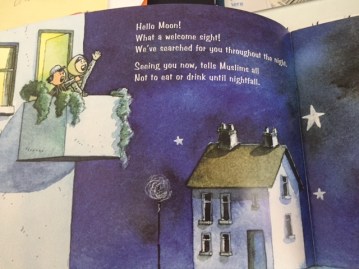
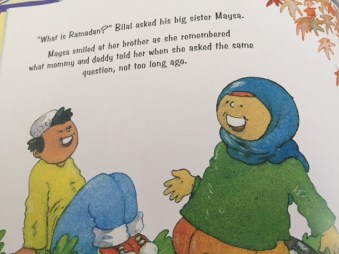
Starting with finding the moon, big sister Maysa tells her younger brother Bilal all about Ramadan, in (mostly) rhyming couplets none the less.  She tells him about walking up before dawn and explains that yes that means no lunch.  She also explains that because they are little they aren’t required to fast. They then explore breaking the fast, going to the mosque to pray, having good manners, and learning that a full moon means that Ramadan is half way over.  Reading the Quran is discussed as well as how we have to be generous with what Allah swt has given us. It concludes with Eid and a Parent/Teacher guide at the end to help Muslim and non Muslims alike learn about Ramadan.

welcome ramadan3

The pictures are cute and comical, albeit small given the overall size of the book.  It covers Ramadan on a level kids of all ages can understand, and because of its easy reading style even older kids can skim through it and find it enjoyable.  There isn’t really a story, it is just a fun way to share the “facts” but a welcome addition to any book shelf both at home and in a classroom setting.

Hamza Learns about Charity by Ameena Chaudhry

Standard
Hamza Learns about Charity by Ameena Chaudhry

hamza learns about charity

It is hard to believe I haven’t reviewed any of the seven Hamza books in the series.  They are perfect for 2-6 year olds (older kids will enjoy them too), and all are both informative and silly.  This book is 20 pages and is seven and half inch square in shape.

In Hamza Learns About Charity.  Hamza learns what the word charity means as his mom is packing up his old toys to donate to the less fortunate.  He also learns you can give money and how donating and taking care of the poor is required in Islam.  Hamza’s mom tells how Prophet Muhammad (saw) lived a simple life and was very generous with whatever he had.  Hamza also learns the word for charity in Arabic.  When his mom leaves to take the stuff, Hamza decides to show that he understands and is ready to give everything away and live a simple life.  Alhumdulillah, mom returns in time to shoo the neighbors away and convince them that the house, and car, and household items are not for sale.  Thus, Hamza also learns that we aren’t required to give everything away, and when making big decisions we should get our parents’ permission first.

The illustrations are cute and colorful.  They are not overly detailed, but Hamza’s facial expressions are engaging and expressive.  The book works well for story time and bedtime and seems to be geared for Muslim children.

A Long Pitch Home by Natalie Dias Lorenzi

Standard
A Long Pitch Home by Natalie Dias Lorenzi

a long pitch

The correlation between baseball and cricket provides the foundation for detailing the relationship of  Bilal’s first year in America after having to leave Pakistan in a hurry: the same, but different.  This 248 page book written on an AR 4.6 pivots around sports, but has a lot of heart as themes of family, friendship, and longing, take center stage.  Throw in a whole new culture, the English language, Ramadan and prom and you have a whole lot to cover in this well crafted story.

SYNOPSIS:

Bilal has a good life in Karachi, Pakistan.  He is the oldest of three kids and at 10 years old, his world pretty much involves Cricket, friends, and his dad.  When his father disappears things get frantic, and when his father returns, the family decides to move to America.  Unfortunately Bilal’s dad can’t come.  As Bilal, his mom, his younger sister Hira and younger brother Humza, board a plan to Virginia, everything Bilal knows is left behind.

Virginia is home to Bilal’s maternal Uncle, his wife, and their teenage son, Jalaal.  Jalaal plays baseball and arranges to have Bilal join him at baseball camp for the summer.  Learning the new sport, and a new language, and the nuances of life in a new land are frustrating and often comical as Bilal points out how confusing navigating American life can be.  He also keeps an ongoing list of new things in America to share with his dad over Skype, as they swap memories of an old life in preparation for a new one.  The supporting characters on the field are generally kind and accepting of Bilal, because they have a bigger problem then a foreign boy, there is a girl on the team, Jordan.  Jordan is new too, and the coaches niece at that, naturally they become friends, but its not easy, Bilal has to learn what being a friend really means.

The majority of the book stems from the tension of waiting to hear from Bilal’s father, and to see if he can come to America.  The passing of time with baseball games and school are anecdotal to the larger arc that sets the pace of the book.  Will Baba be able to come, and if so, when?

WHY I LIKE IT:

Interestingly religion has a pretty big role in Bilal’s life and the author does explain some tenants in Islam.  He wakes up for fajr (although he does miss it occasionally), he only eats halal zabiha, the family fasts in Ramadan, and they celebrate Eid.  Bilal wants to fast, but him mom tells him he is too young when they are coming to America, and the following year he doesn’t because of baseball, which is unfortunate, because a lot of kids fast and play sports all over the world.  They go to the mosque on Eid only, and it mentions that the women in his family do not wear hijab like some of the women at the mosque.  His older cousin Jalaal wants to take the neighbor girl, Olivia, to prom, which the family explains awkwardly as something that Muslims don’t really do until they are older, or at least that is how Bilal understands it.  In the end, they let Jalaal go with Olivia and a group of friends, and the whole family Skype’s the family in Pakistan and sees them off.  Even more funny is that they don’t join their friends for dinner before the dance, because Jalaal is fasting and can’t eat until later.  I don’t know if this will confuse 4th and 5th grade readers, but as an adult I found it hysterical, because these cultural contradictions are more common than not.  I did like that nothing was done behind the parent’s backs.  Things were discussed and worked out instead of lied about.

Another thing that I found interesting, but since finishing the book, I have come to appreciate, is that there is no Islamaphobia in the story, or even xenophobia.  The kids are accepting of Bilal’s faith and culture.  He is far more self conscious about being different or not understanding than those around him are.  Its idealistic perhaps, but at the same time, I think it would distract from the core of the story.

While the book focuses on sports, I think even non sports fans will be able to enjoy the story.  The author doesn’t get too technical and it moves steadily with mini climaxes and triumphs through out.  Girls and boys will enjoy the book, Muslims and non Muslims too, the readers might even learn something about baseball or cricket or Pakistan, or even about themselves along the way.

FLAGS:

The book is remarkably clean and what you would expect for a good quality, solid 4th grade and up story.  There is the “prom” issue, but there is no hugging, kissing, longing etc.  They “like” each other, but it isn’t more explicit than that.

TOOLS FOR LEADING THE DISCUSSION:

I don’t know if I would use this for a Book Club.  One could, but I think it would require a lot of coaxing to get kids to give a book about baseball/cricket a try.  I have no doubt if they started it, they would finish it, but it might be a tough sell.  The confusion in American life would make for an awesome discussion after being read, because everyone can relate to some of the oddities of the English language, and challenges of learning a new language and culture.  I think how Islam is handled would also make for some good discussion in addressing how each family handles things differently as they arise.  Although written on a 4.6 level if I were to do it in a school setting, I would probably do it for middle school kids who could articulate their own life parallels to the story.

An interview with the author:

http://wordspelunking.blogspot.com/2016/09/a-long-pitch-home-blog-tour-interview.html

Overall a solid decent book about an immigrant Muslim boy making his way in America, while not losing or giving up on who he is, alhumdulillah.


The Treasure at Bayan Bluffs by Farah Zaman illustrated by Kim Zaman

Standard
The Treasure at Bayan Bluffs by Farah Zaman illustrated by Kim Zaman

img_2961

At 231 pages this book claims to be for ages 9 to 18 and that’s a pretty large spread for a mystery, yet alone an Islamic fiction one by a first time author.   In a tone reminiscent of Nancy Drew and the Hardy Boys,  it should really should just say 9 and up, I was hooked!

SYNOPSIS:

Adam and Layla along with their younger twin brothers Hassan and Hakeem from America are visiting their family home of Bayan Bluffs in Midan for the summer.  Their grandfather and great aunt and a few long time servants aren’t much entertainment for the children, so their parents arrange for their college friends kids’ Zaid and Zahra from Crescent City, a few hours away, on the other side of Midan to join them.  The children get along right away and decide to try and solve a mystery of a hidden treasure that they have heard bits and pieces of over the years.  Their search for the Moon of Masarrah starts innocently enough, but quickly escalates as they learn they aren’t the only ones searching for the missing gem.  As they learn more about the jewel and the circumstances of its disappearance the gem and the murder of Adam and Layla’s great grandfather get further entwined.  With a few of the suspects still alive and many of their family members still in the city, the children soon find they themselves in danger as well.

WHY I LIKE IT:

The biggest reason I like it, is it is well written.  There aren’t confusing passages, or too many characters or boring preachy paragraphs.  The plot is good, the dialogue believable and the fact that they are Muslim children, just depth to the story.  They plan to meet after asr or before Jummah, and they say inshaAllah and mashaAllah, and its just a really good balance of who they are, but not all they are.  In retrospect, maybe they all get a long a little too well, but it isn’t syrupy and they have some minor annoyances, so it doesn’t hinder the story.  The only thing I caught myself looking back on was the age of the twins.  At times they seem like toddlers and at other times much, much older.  Even the author says they are “about six years old,” and having a six year old myself, I do believed that they can vacillate to both extremes in any given moment and thus I accepted their antics and let it go.  Additionally I wish she included a map.  It isn’t confusing, but it would have been great to look back upon as the action speeds up, and would definitely help younger readers visualize the details.  The terrain vocabulary for anyone younger than nine might need some explanation.  There is a glossary at the end for some of the Arabic words, and for some of the specific ships and weapons mentioned.  Their are a few illustrations that I think help the younger readers, they aren’t needed for the story, but they don’t impede it either.  I wasn’t crazy about them within the story, but I did appreciate that they show the girls in hijab and the illustrator clearly put a lot of work in to them.

bayan.jpeg

I wish that the cover was more appealing, for a story that was so good, I wish it begged to be picked up.  InshaAllah word of mouth will carry the book, so that more like it are written and published.

FLAGS:

None, mashaAllah it is clean and wholesome.  There are good and bad Muslims and no judgement is put in a religious context.  There is some violence, but it is nothing even a seven year old would find offensive.  Alhumdulillah.

TOOLS FOR LEADING THE DISCUSSION:

I would love to do this as a Book Club book for 5th through 8th grade.  The writing quality and the different characters the students would be able to identify with, would make it a lot of fun.  There isn’t any deep or though provoking discussion points to accompany the book, but I think the genre is hard to come by and Muslim kids seeing Muslim kids solving a crime and going on a treasure hunt, is just exciting.  I couldn’t find any study guides or even much information on the book or author, but none is needed to enjoy the story.  Farah Zaman if somehow you see this review, know that I hope you keep writing, and I thoroughly enjoyed your book!  Happy Reading Everyone!


One Hundred Ice Creams by Sumayyah Hussein illustrated by Derry Maulana

Standard

one-hundred-ice-creams

This book on my first reading reminded me a lot of Amira’s Totally Chocolate World in that it takes a religious idea, in this case Jannah or heaven, and uses a child’s excitement for a favorite food to explore it.  Not a bad technique, and alhumdulillah the author was able to stay on the idea of heaven and add some additional information then just the silliness of having all the ice cream you could imagine.  The book is 36 pages and can probably be read by a first or second grader independently and appeal to story time ages of preschool 4 and up.  The book unfortunately takes a while to get going. I struggled with the first few pages, which I found really wordy, and puzzling.  The kids seem to be about 6 years old in the illustrations and in their mannerisms, but they start off the book complaining about homework and needing a break from it, which even my own children found confusing and remarked on it.  There also seems to be some unnecessary description too, in setting the stage: the day, the vehicle, the season, that it’s their favorite park, that they haven’t been there in a while, that they took a breath of fresh air, that they waited 10 minutes, etc..

Thankfully I think once the reader’s get that the park is crowded, that the kids couldn’t enjoy the swings and slide and decide to explore the nearby woods, the story finds its rhythm and engages the reader quite well.  A few minor hiccups throughout the book are again, the abundance of details that don’t further the story and aren’t developed. The river is described when they cross the bridge, and then there is another one, or possibly the same one, as this one is now rushing, and it jars the story as there seems to be a lot of rivers in this park.   There is also a rabbit that pops up and excites the kids and then shows up at the end again, which is cute and brings the story to a happy close, but I don’t really love how the parents dismissed it.  Why not let the kids see that he is scared of them and figure out that he doesn’t know they won’t hurt him/her,  rather than have mom tell them they won’t see him again and dad quickly steering them in another direction. Granted this is my personal preference, but I like when kids figure stuff out in books and solve things themselves, rather than how perhaps it is in real life, with mom and dad constantly calling the shots.ice-creams1I really like how when discussing Jannah, they talk about the rivers of milk and honey, and I absolutely loved how they talk about Grandpa (hopefully) being in Jannah and being young and strong.  I couldn’t figure out why when in the woods and marveling at nature the characters didn’t use Islamic expressions like, mashaAllah, subhanAllah, and inshaAllah, and when I read it aloud I had to add them when we got to the pages about Grandpa.  It seemed awkward not too.  The book is clearly for Muslim children, there is a reference page in the back with the ayats from the Quran and hadeeth that tell us about Paradise, and the characters are discussing an Islamic concept, so I’m not sure why their language isn’t reflective of that.ice-creams-2

The illustrations are simple and colorful and complimentary to the story.  I don’t know why the color of the character’s skin is yellowish green.  It seems to match the ice cream and on some pages seemed more noticeable then others.  Dad’s face when he is swatting the fly is a little angry and the color of the skin makes him look mean.  Not sure why the flies are mentioned. And the illustration is not reflective of his personality in the rest of the book.
cream.JPG

Overall the book has a good message, I think I have just loved all the books at Ruqaya’s Bookshelf so much, that my expectations may have been a little too high.  I’ve never written a book and I have no idea what the publishing process for this book was, but I feel like a a few minor adjustments from an editor or proofer would have made this book absolutely phenomenal.  That is not to say it isn’t a good book,  children undoubtedly, will get a tangible understanding of Jannah after reading the story.  An additional plus is that it is on their level in both content and in perspective, meaning that there is lots to chat about after.  Concepts that the children can discuss based on what they understood from the story with little prodding from an adult.  Points from how the kids are treated at the playground, to adding what they would want they are in Jannah, and ultimately steps we can take to increase our chances of getting there, inshaAllah.