Tag Archives: growing up

Diana and the Island of No Return by Aisha Saeed

Standard
Diana and the Island of No Return by Aisha Saeed

dianaThis Wonder Woman story of Princess Diana as a young girl is not noteworthy because of its groundbreaking storytelling, but more for the fact that the series and story is by a Pakistani-American Muslim author.  I am not sure how authors are assigned or chosen to  write these reimagined character series, but I think it is a great compliment to her writing and a great mainstream representation of diversity that we should celebrate.  Even more exciting is the subtle addition of Diana’s best friend, Princess Sakina, daughter of Queen Khadijah to the story, and that while they are citizens of fictitious world of Greek gods, they seem to spout Islamic wisdom on occasion, and be equally strong and important to the adventure at hand.  The book is meant for middle grades and at 288 pages is a fun light read for girls and boys of all ages.

SYNOPSIS:

Young Diana is anxiously waiting for the start of the yearly Chara Festival, when strong women from all over the world come to her island home of Themyscira to celebrate their different cultures and strengths.  Most of all Diana is waiting to spend the week with her best friend Sakina.  Frustrated that her mother is not allowing her to train with the other Amazonian women, Sakina listens to her and they hope to persuade Queen Hippolyta that this is the year.

As the women are arriving and gathering in the palace, Diana discovers a boy near the ships, Augustus.  Boys are not allowed on Themyscira.  There is no exception, but when all the women in the palace are drugged to sleep, her and Sakina are forced to trust him to try and save their loved ones.

Augustus confesses that a demon has hypnotized everyone on his island home, and that he was told to break the spell he needed to bring Princess Diana to the demon.  With no options and determined to prove her self, Diana and Sakina and her trusty bird fly off on a chariot to another world.

With tests around every corner, literally, the trio has to work together, to stay alive, gather the ingredients to make a potion to save the people on both islands, and push themselves to be brave.

WHY I LIKE IT:

So the story is ok, it is fun, I’m sure most kids that like superheroes and even many that don’t will enjoy the quick paced plot of the story.  There are definitely little nuggets of inspiration and motivation that make the book a positive influence on the reader.  The trio discuss bravery and how being scared doesn’t make you less brave, they encourage one another to push themselves and they forgive each other when they make mistakes.

Sakina and her people are scholars and on occasion says deep thoughts.  She says at one point, “My mother always says we are supposed to enjoin the right and forbid the wrong.” Which is a general principal, but the word choice sounds a lot like Surah 3 verse 110 “enjoining what is right, forbidding what is wrong,”

FLAGS:

There is talk of Zeus and the other gods.  There is lying.

TOOLS FOR LEADING THE DISCUSSION:

I probably wouldn’t do this as a book club book, but I would definitely encourage kids to read it.  I think muslim kids will get a kick out of seeing the names Sakina and Khadijah in the book and feel like its a bit of a shoutout, which I think is awesome.  It seems like it is book one in a three part series, so I hope to have my kids read them all and make sure the 3rd-5th grade teachers at their school have them as well.


Stuck in the Middle by Sumayyah Hussein illustrated by Diana Silkina

Standard
Stuck in the Middle by Sumayyah Hussein illustrated by Diana Silkina

middle

At 122 pages this early chapter book with frequent illustrations is a great book to share with 2nd-5th graders.  It is has a great message and lesson with lots for children to relate to with regards to life with siblings, getting frustrated, making mistakes and recovering.  The lesson is strong, but doesn’t become preachy as the protagonists voice rings true to her age.  Mistakes are made by many characters and situations are fleshed out so the reader can understand why things are done.   By showing that there isn’t one side to a story, and that knee jerk reactions are common, readers will get that ultimately we are still responsible for how we act, and learning from our transgressions is part of growing up.

5343F790-E06E-47DB-96D9-A85A7EAEFA9E

SYNOPSIS:

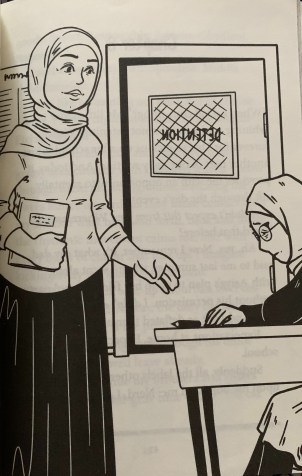
Salma is the middle child in a busy family, and very little is in her control.  When her frustration over her brother stealing a chocolate bar, causes her to lose her cool, and then she is forced to run errands with her family, homework doesn’t get done in time and she finds her self in detention.  Normally a very good student, teachers and other students are shocked that Salma is in trouble.  Things don’t improve when her brother steals her carrot cake the next day, and in a plot to get even, Salma ruins her brothers brand new PS4 controller.  She also turns a blind eye at school when she sees someone picking on him.

Doing her best to avoid being discovered as the culprit, or being in a position to see her brother being bullied, her guilt starts to get to her.  When an ambulance has to come to the school for a kid that got pushed and needs stitches, she realizes she has to make things right, even if that means getting in trouble.

7E60CD43-7DCB-41AE-BFF8-6CA415A5BDA2

WHY I LIKE IT:

I love that it is so relatable, honestly switch Salma with my middle son Haroon, and the 13 year old boy that doesn’t want to go out with the family, with my 13 year old daughter that doesn’t want to go out and we are looking in a mirror, haha.  The family is Muslim and they practice and let the religion shape their view of the world and how to function within it.  The girls wear hijab and use the hadith premise that they have to fix a bad deed with a good deed to provide the solution to the mistakes made earlier in the story.

AE60B7D6-48FA-4A46-A4E7-4F0BB40351AD

FLAGS:

None

46612FC3-B196-4A59-9BB8-AA54F7ADBD3F

TOOLS FOR LEADING THE DISCUSSION:

I already made my middle child read the book, and because of the length it wouldn’t lend itself to a book club, but I can see teachers having kids read it and then discussing, just like I am doing in my family.  It is sweet and well done and a great addition to your bookshelf.


Neither This Nor That by Aliya Husain

Standard
Neither This Nor That by Aliya Husain

neither this nor that

This 251 page novel reads like a biography that has no climax or real conflict in its linear retelling of the protagonist from 3rd grade to a junior in college.  If you are part or all Desi, raised in America in the ’80s and ’90s and have fond memories of NBC’s Must See TV, rolling your pants up, your family packing Corning Ware sets to take to the homeland, and the joys of TJ Maxx, you might enjoy the nostalgic similarities you too experienced, but even at that, with no plot or character arcs, the book is easily forgettable and you might forget to finish it.  For all my critiques of Muslim stories that don’t read authentic, this one definitely does, she doesn’t rebel, she doesn’t ever go against Islam, but because she is similarly not ever tempted to, I think most readers won’t relate to this fictional girl, who’s biggest worry is smelling like her mother’s cooking.  The book seems to just want to tell her life story, and getting through it is the point of the book, not making emotional connections, giving the reader something to think about or even inspiring others, which is ultimately a missed opportunity that this book could and should have capitalized on.

SYNOPSIS:

It is the first day of school for Fatima Husein the eldest of many daughters in her Indian American suburban home.  With a mother who doesn’t speak much English and parents that don’t seem to understand Fatima’s desire to fit in, the stage is set that will carry through the entire book of Fatima loving to study and separating herself as the girl at school pretending to be more American than she really is, and the girl at home pretending to be more Indian than she feels.  As the book follows the character through college, along the way Fatima and her family have extended maternal family move to America from India and then move back, they take a trip to India which is not enjoyed at all, her dad’s family then moves from India and settles near them, they move to be closer to the masjid, and they go for Hajj.  Characters bounce in and out: school friends, community friends, cousins, etc.. The only real constant is Fatima’s love of school and her paternal grandmother grumbling about her getting married. There are the ups and downs of life that are shared, most very specific to a ABCD (American Born Confused Desi) living in the ’90s.  Fatima is religious and Islam is important to her and she never waivers in her black and white view of things.  It does take her a little while to wear hijab, but there is no real self reflection and catharsis, it is just states she wants to fit in and isn’t ready.  The conclusion is she finally accepts a proposal from the son of an old family friend who lives in Chicago.  Not so much because she likes him, but more because she has no reason not to say yes and her parents are in favor it.

WHY I LIKE IT:

If this were a biography and it was someone famous, the minutia of day to day living might be compelling, but as it is fiction and you have no idea where the story is going, it just seems to tell a story about a typical girl doing typical things.  It has value in that it shows how normal and boring even, a normal Muslim family is, but it gets really preachy at times and really dry.  None of the side characters are memorable.  I have no idea how many sisters Fatima has, when her grandfather passed away I felt nothing, when two who families died in a car accident Eid morning on their way to prayers, I had to flip back to see if the characters had ever been mentioned before.  It seems like the whole point is to get to the end, and more heart and less tedium would have made this book an amazing example of American Muslims in America.  The first page mentions friends and there is no follow up to where they are or what happened to them, and this happens all through out the book, there are no emotional connections, nor attachments among the characters to include the reader into their plight as well.  The protagonist one must assume gains her voice from the author’s experiences herself, but it just lacks internal dialogue and conviction.

Fatima lives through the Gulf War and makes big changes and has to find her place, yet the book just tells us all this, it doesn’t show us how she internalizes and processes and emerges from the experiences shared, it just gives an example and then comments on it.  The font and layout visually looks like a text book, and at times, the internal structure reads like an essay, sharing an anecdote, backing it up, and moving on to the next event on the time line.

I feel like I know the character, it definitely comes from a place of shared experience and credibility, but you have no idea where it is going, and just like I doubt anyone would want to read my life story, the book needs a little direction and editing.  In the author interview posted below in the “Tools to Lead the Discussion” she mentions that mainstream publishers wanted more rebelling and she wouldn’t compromise.  I agree with her, we need books that don’t follow that assumed track, I think that the presentation of the story, however, as it is, is lacking.  The integrity is there, but the character is really flat, and there are plenty of literary tools that could enhance the story without compromising Fatima’s character to drugs and alcohol and boys.  The book was self published in 2010 and I really hope at some point the author will re-edit it, to make it relevant to preteens and teens today and more personable.  Ultimately making it so that the successes Fatima has are cheered on by the reader, who are also inspired by her accomplishments while staying true to her beliefs.

FLAGS:

Considering how many pages are dedicated to how she and her sister are to behave in India as to not seem naughty or as arrogant Americans, the curse words flow pretty regularly in the book, and the way she speaks to her elders and in front of her elders is not always kind.  There are side comments about hooking up, STDs, and drinking, nothing any of the characters engage in, but judgments regarding these topics for those that do is present. She also talks about her mom’s failure to discuss menstruation before hand, to exemplify how things are only discussed once they need to be dealt with.

TOOLS FOR LEADING THE DISCUSSION:

I don’t know that as a book club selection today’s youth would voluntarily pick up and read this book.  There might be some ability for a teacher to assign it and then turn around and make the students write something similar about their experiences in a fictionalized form.  I think students would struggle to relate to Fatima with the outdated references and the lack of conflicts and climaxes in the narrative.


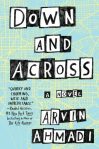
Down and Across: A Novel by Arvin Ahmadi

Standard
Down and Across: A Novel by Arvin Ahmadi

down and across

This 320 page book featuring an Iranian American lead written by an Iranian American is a coming of age story written on an AR 5.2 level, that I don’t think most reading this blog would want their child to identify with.  It is an OWN voice book from what I can gather in the author’s interviews online, and sure many Muslims definitely receive the label of “Muslim” more from others than from their own self identity, but I don’t know that many would want their children seeing themselves in the main character who runs away from home, hangs out in bars getting drunk, picks up girls as a challenge, and basically tells one lie after another, especially while being completely endearing and quirky and someone you really find charming.

SYNOPSIS:

Sakeet Ferdowsi aka Scott, is an only child of Iranian immigrants who really love him and want him to do well in life.  The story opens with 16 year old Scott chatting with his dad at McDonalds about his lack of direction, his lack of interest in his summer internship, and his parents leaving him alone for the summer as they journey to Iran.  Sakeet’s dad tells him of a professor at Georgetown University who writes about “grit” and how grit, not wealth or IQ is the greatest predictor of success.  With a track record of not seeing things through, Scott is told he needs to find some grit and some direction in life.  Drawn to this idea, Sakeet lasts a few days at his mouse poop research internship before become obsessed with grit, jumping on a greyhound bus and heading from Philadelphia to Washington, D.C. to get help face-to-face with Professor Cecily Mallard.

On the bus, he tries to position his backpack to prevent having a seatmate, but a college girl, calls his bluff and forces him to chat with her.  Fiona is not like most people with her free spirited ways and her love of crossword puzzles, and with her now in his life, Scott’s four week DC adventure is set to be memorable.

While in DC Scott learns a lot about himself from the people he meets, the situations he finds himself in, and in general the freedom from his parents.  He is mistaken as a college student and keeps the ruse running to everyone he meets outside of Fiona, Professor Mallard, and Trent.  Trent saves Scott after he crashes a stolen bike (he didn’t know it was stolen) and is being chased by its owner.  They quickly discover they both know Fiona and the big hearted southern helps Scott get a fake ID to get in to bars, and a job working behind the bar to pay for his time in DC.   Trent dreams about working with his favorite senator, which is a big part of the climax, as is the fact that he has been cut off by his well-to-do family because he is gay.  Throw in an ultra conservative “girlfriend” who Sakeet picks up on a dare at the National Zoo and Sakeet to discover if in fact he has grit.

WHY I LIKE IT:

The book reads really easy and smooth, hence the middle grade AR level, but I don’t think any elementary kids should read it, or even middle school for that matter.  As a coming of age book, early high school would probably be the best fit, but with such a focus on drinking and bars, and sex I kind of feel like the rave reviews are coming from adults who find the antics quaint and idyllic as a way for Scott to grow, not as something they would want their own child to identify with.  Online reviews praise the person of color protagonist and the Muslim representation, but really I don’t find either of them overtly influential in the story.  Yes, Scott is straddling two worlds as a child of immigrants and must balance parental expectation with his own mysterious wants (he doesn’t know what he wants), but I don’t know that culture or religion shape him other than his parents not letting him go to overnight camps growing up.

When he is called a terrorist by a drunk guy, or dumped by a girl for being Muslim, he takes it, he doesn’t deny it, but he doesn’t let it really rile him either.  At one point Scott amends Fiona’s statement of calling him a Muslim.  “‘ish,’ I said.  ‘A long time ago I asked my parents what religion I was, and accepted what they told me.  Haven’t gotten around to reevaluating it or whatever.'”  Other’s call him a Muslim, but I don’t know that he every really says it himself, which ironically I kind of appreciate.  In a few phone conversations with his parents he says “Salam” or “inshaAllah,” but there is no Islamic practice or conscious or even expectation in the book.  I think for readers they will respond to Sakeet and his faith based on where they are in life.  For Muslims, they may find such a careless label frustrating and belittling, or possibly relatable.  Non Muslims may understand Sakeet’s practice means Islamic rules are not followed, and those that do follow them more “extreme.”   Islam is fluid and we are all flawed, so I don’t expect a fictional or real character to be perfect, I’m just pointing out what my concerns would be to have this book in an Islamic school library.  As a reader, I appreciated that the author had the character articulate that he is Muslim-ish only, and have other people call him Muslim and have him not constantly use his faith and culture to set himself apart.  He is fallible and growing and he has a lot of parts to his persona not just these markers.  Incidentally the parts he is exploring and questioning and learning about himself as he looks to his future don’t involve Persian culture or Islam.

FLAGS:

Alcohol, getting drunk and hungover, cursing, some violence, theft, nudity, kissing, talk of sex, sexting, talk of making out, a gay character, lying, drug addiction, getting high.

TOOLS FOR LEADING THE DISCUSSION:

I wouldn’t use this book as a book club selection because of the themes and inconsistency of values, also because of the inconsistency of topics and writing style.

Author’s website: https://www.arvinahmadi.com/

Interviews with author:

https://mashable.com/article/mashreads-podcast-down-and-across-arvin-Ahmadi/

https://ew.com/books/2017/08/03/the-hate-u-give-author-angie-thomas-interviews-arvin-ahmadi/

https://www.npr.org/2018/01/27/580837850/a-puzzled-teen-seeks-answers-and-finds-crosswords-in-down-and-across


Towers Falling by Jewell Parker Rhodes

Standard
Towers Falling by Jewell Parker Rhodes

towers falling


I realize the inherent difficulty of writing books for middle grades about the events of September 11, 2001: the author lived through it, the readers did not.  Yet, it seems like at some point a book regarding it, will just feel right, and I don’t think for this age group, I’ve found it yet.  This AR 3.3, 228 page book is a quick read, and while some of the characters have spunk and personality, a few of the storylines seem incredibly forced and the overall timeline and holes in the story will be ultimately disappointing for most readers.

SYNOPSIS:

Deja is starting a new school now that her family has gotten a room at a homeless shelter.  Immediately her fifth grade classmates are given an assignment about home, with the end goal that eventually this project will transform in to being about the change of New York’s skyline fifteen years ago.  The details regarding the attacks of September 11, are not given forthright and as Deja knows nothing about the attacks, and the fall of the towers, her inability to get answers adds to her frustration at home and school.

Deja is angry as she bares a lot on her young shoulders.  Her dad can’t hold a job, and his moods and ill health put caring for her younger siblings on her.  Her mom works as a waitress and is always tired.  They lost their house, lived in their car for a while, and now occupy one room in a shelter.  Deja refuses to lie about her home life and thus her aggressive attitude is always on guard.  Another new kid, Ben, joins the class and he and Turkish American popular girl, Sabeen, all quickly become really good friends.  Each have something brewing beneath the surface that they are dealing with, but their friendship helps them cope and bonds them together.

As the trio of kids work on their projects together, Ben finally shows Deja online footage of the attacks and clues her in to what everyone else in their Brooklyn class seems to know and has failed to tell her.  Deja links her father’s declining health to that fateful morning and decides she needs to go to Ground Zero and get some answers.

She doesn’t really get answers, but at least it is the catalyst for an overdue conversation with her and her father, and hopefully a start on the road to healing the family rifts.

WHY I LIKE IT:

Much like the book Nine, Ten there seems to be the token Muslim girl in the story to offer her perspective on the Islamaphobia that occurred after the attacks.  In this case Sabeen doesn’t detail anything specific happening to her, other than a clerk at a store telling her to go back to Saudi and her uncle getting screened regularly at the airport.  Of all the characters I feel like Sabeen gets the short end of the stick.  She is incredibly flat, stereotyped and undeveloped.  Her family is Turkish, she is wealthy, her mom wears niqab and they are all overly kind and sweet, which is great, but when Deja goes over for lunch, they ask her if she prays, which seemed so random and off to me.  A lot of the basics about the character the author got right, she says that the terrorists were Muslim, but they weren’t, sharing a sentiment many of us Muslims feel. She wears hijab, and takes it off when she gets home.  I don’t like that the mom speaks English, Arabic and Turkish, but is first introduced having Sabeen translate for her with another parent.  Seems incredibly pretentious and misleading.  Ultimately her storyline is just overly forced.  She has to leave Ben’s house when they talk about September 11, because she is so affected by it.  She wasn’t even alive when it happened, and I get that when it is discussed us Muslims are on guard, but the author makes it seem like it is her whole world and influences everything around her.  If you live in New York, especially, I’d imagine at some point you’ve had to come to terms with it, no?

That’s why I also struggled with Deja’s dad.  He is so debilitated by the events of 9/11 he can’t function, yet they happened 15 years ago, presumably before he met Deja’s mom and they started a family.  So, really she fell in love with him in his current condition and thought having three kids with him was a good idea? He was fine and then wasn’t? For 15 years he hasn’t been able to get some sort of help for his PTSD type symptoms?  Seems like a stretch in the timeline, and one that is hard to excuse even for 3rd and 4th graders.

I really like how Deja’s homelessness is brought out and hopefully readers can learn some empathy from her.  Unfortunately the entire 5th grade class is so idyllic that I don’t know that most if any kids reading the book will relate to such a well behaved, so accepting, forgiving and generous group of kids. I mean yeah that’s the goal, but its way too overdone.  Ben, Sabeen, and Deja are best friends after the first meeting even though Deja is rude, mean, and doesn’t like them.  I’m not even sure what Ben and Sabeen get out of being friends with Deja?  Deja undoubtedly benefits from them, but there aren’t a lot of compelling reasons given why they’d be so drawn to her.

And finally, I struggled with the theme of how being “American” united them all.  It makes sense when discussing it as a class, that it doesn’t matter their color, income, life experience, whether they were immigrants or born in America, but the concept comes up again at a critical point when Ben and Deja are on the subway and seems so misplaced to me.  On the subway there would be plenty of tourists and visitors, that wouldn’t be American, no?

FLAGS:

The book is clean, it does mention some drunk people at the shelter, but nothing specific, just in passing.

TOOLS FOR LEADING THE DISCUSSION:

I wouldn’t do this as a book club selection because the target age is lower than who I meet with.  But, even despite some of my criticisms I’d recommend this book be in classrooms and school libraries as it does offer up a perspective on historical fiction that hopefully could lead to a slightly deeper understanding of the events at a young age.


The Night Diary by Veera Hiranandani

Standard
The Night Diary by Veera Hiranandani

night diary

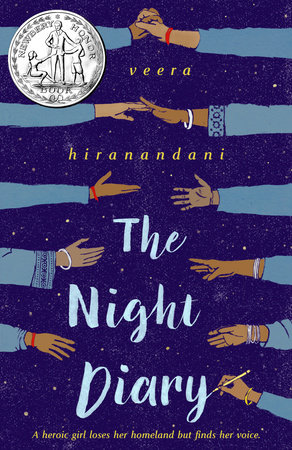
I was curious to see how partition would be presented in this book by an Indian Hindu author featuring characters who are half Hindu and half Muslim relocating to Hindu India.  Told in journal entries written by 12 year old Nisha to her deceased Muslim mother, the 264 page AR 4.5 book is wonderfully done, extremely compelling, and about so much more than the politics that birthed India and Pakistan.

SYNOPSIS:

Nisha and her twin brother Amil are opposites, yet they complete each other and care for each other in such a tangible and heart swelling way, that you can’t cheer for one while not rooting for the other one to find success and their place in the world as well.  As the twins turn 12 and Nisha is gifted with a journal from the families beloved cook Kazi, India and Pakistan too are about to come to fruition and Nisha’s journal entries detail her understanding of the larger events around her as well as her own struggles to come in to her own.

For Nisha words do not come easily.  She excels at school and loves to cook, but talking to people, or making friends eludes her and her longing for her deceased mother, make her a quiet reflective child.   She observes and  takes in so much around her, internalizes it, ruminates on it, and pieces it back together in a gifted way when she writes, that reading her entries, and the voice the author creates for her, is really amazing and fluid.  You feel like you really know Nisha and what makes her tick, what she fears, and how she thinks, you also get emotional attached to her and her world and find yourself surprised at how invested you are in not only her family’s successful migration across the new border, but also in her finding her voice and the confidence to use it.

Amil’s voice comes through Nisha, but her love for him and the way his strengths are her weaknesses and vice versa allows insight into the other family dynamics and attitudes to the two children.  Amil is an amazing artist, that suffers from dyslexia and does poorly in school.  He is weak and wiry, but fast, and he can talk and charm and ask all the questions that Nisha wants asked but can’t find the words for.  He and their physician father are rarely on good terms, as he isn’t the ideal strong boy with a medical degree in his future.

When it is decided that the family must leave their city where Muslims and Hindus and Sikhs live together and journey into Hindu India, the twins, their father, and their father’s mother, Dadi, must rely on each other to survive the riots and violence of the mass migration.  Nisha must also survive the understanding that with a Hindu father and Muslim mother there is so much about her own place in the world she doesn’t understand, and thus the journey is both an internal and external one, that will change Nisha forever.

WHY I LIKE IT:

I love that the protagonists voice is so steady and believable.  I truly fell in love with Nisha and felt her pain, happiness, anguish and overall got emotional for her, it was a rollercoaster.  The author does an amazing job of painting the politics of Jinnah, Nehru, Gandhi and Mountbatten in broad strokes, but believable ones to the understanding of a 12 year old.  She sees that one India held people of all faiths and that this breaking up of everything is leading to violence, upheaval, and horrors previously unimaginable.  She doesn’t understand why people had issues with her mother being of one faith and her father another, she loves her Muslim cook and loves listening to him pray five times a day as her paternal grandmother sings Hindu prayers in the other room.  She is both Hindu and Muslim and doesn’t see the contradiction within herself, suspending the reader’s own opinions on partition (if they have them), because how she sees it, does make sense for the story’s narrative.  The author takes Gandhi’s side of non violence and staying together, but balances very well and very intentionally that atrocities and humanity was seen from people of various faiths and political persuasions.  The role of British colonization and freedom from it, is slightly glossed over to the point of disservice, but again, being the target age of the reader and the age of the characters, I’m willing to over look it.  Families with Indian and Pakistani heritage will want to take the lacking information and help their children to fill in the blanks.

I love that the backdrop is the action of the story, but the relationship between the characters is truly the heart.  A lot of growth and compassion is conveyed very succinctly and powerfully.  Nisha wants so desperately to speak, but can’t, and her internal struggle and the pain she feels when she can’t speak up to help and participate in the world around her is gut wrenching.  As she confides in her diary, you realize that kids understand so much more than we adults often give them credit for.  The lesson is not lost on me.  I initially thought a book steeped in subcontinent history, with religious conflict and foreign words, wouldn’t appeal to a western elementary aged readers, after reading it, however, I now think this heartwarming story should be thrust upon them all.

FLAGS:

There is violence and death.  Not sensationalized, but detailed enough to set the tone of how serious the journeys were between the two countries when British rule stopped  There is some bullying and mention of the father smoking socially with friends.

TOOLS FOR LEADING THE DISCUSSION:

There is an Author’s Note, and a glossary at the back, and the inside covers have maps showing the journey the characters take.  I would absolutely do this as a Book Club selection for upper elementary, and will consider it even for middle school.  A lot of tools for teaching the book are available online, here are just a few:

Educator’s Guide: https://www.penguin.com/wp-content/uploads/2018/02/The-Night-Diary_Educator-GuideWEB.pdf

Children’s Discussion Questions: https://www.readbrightly.com/brightlys-book-club-for-kids-the-night-diary/

Classroom Bookshelf: http://www.theclassroombookshelf.com/2018/06/the-night-diary/


Ayesha at Last by Uzma Jalaluddin

Standard
Ayesha at Last by Uzma Jalaluddin

ayesha at last.jpg

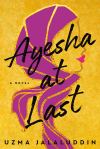
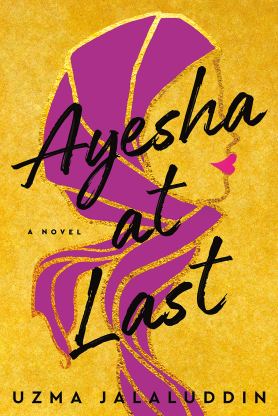
This is not a YA book.  The back of the book and about 75% of the story could really make it seem ok for mature middle school and early high school readers, but I’m reviewing it as a “public service announcement,” that it really isn’t appropriate for a young adult demographic.  No where does the book claim to be YA, I’ve just seen a lot of people online ask if their 13-16 year old (ish) daughters would like it.  That being said, the 351 pages of halal romantic comedy a’ la Pride and Prejudice inspiration, really is a fun light summer read that I enjoyed and feel young college age girls and up will too.

SYNOPSIS:

Set in Canada, Ayesha is 27 and still sorting out what she wants in life while considering expectation, obligation, and passion.  Born in India, she came to Canada after her father died in secretive circumstances, and with a workaholic mom against marriage, a Nani who once studied to be a police officer, a Nana who quotes Shakespeare at all times, Clara, a best friend, and a flighty beautiful younger richer cousin, this cast of characters cheer her on, gently nudge her, and support her, giving a diverse and nuanced view of what a Muslim family looks like and how they interact.  Then throw in Khalid.  A very black and white character in his views on Islam, and culture and pretty much everything, and you have a storyline with a lot of potential, twists, and interconnections.  

Khalid works with Clara, lives across the street from Ayesha, and has an incredibly controlling mom who has just sent a marriage proposal to Ayesha’s flighty cousin Hafsa.  When a conference at the masjid forces Ayesha and Khalid to work together after meeting earlier, tension and sparks fly, and to top it all off Ayesha is pretending to be Hafsa. 

Khalid has his own team of supporting characters, Amir an alcoholic- womanizing-homeless colleague who for some reason is considered a friend, a sister who was banished to India and forced into an arranged marriage 12 years earlier, an Islamaphobe boss, and his own baggage regarding his father’s sudden death. 

Bring in the Wickham character of Tarek and the cast of characters is complete for all the action to go down at the mosque and give the Aunty Brigade a whole lot of gossip to process and spread.

WHY I LIKE IT:

The book is fairly predictable in the major story arcs, but there are a lot of twists that keep you hooked, and the author’s writing is smooth and fluid.  Being it is a loose retelling of a classic, I wasn’t expecting much and was pleasantly surprised how well the story would stand alone as an OWN voice piece about growing, maturing, changing and willing to challenge oneself. 

I love that every Muslim and desi character in the book is different and unique and not a cookie cutter of stereotypes and tropes.  Most of the females cover, but they are nuanced in how they do it, what it means, how they carry themselves etc., some shake hands with males some don’t, some are comfortable in bars, some are more reserved, some have never had a boyfriend, some have, and they really show the reader that Islam is a deeply personal conviction and the rules are interpreted and challenged differently for each person.  It also shows different male approaches and the internal struggles of doing what you want to do and what you know you should or shouldn’t do in a very realistic non preachy way.

My favorite relationship by far is that of Ayesha and Clara, I love that Ayesha’s non Muslim friend knows that Khadijah (RA) proposed to Prophet Muhammad (SAW) and jokes about rishtas and frequently asks “What would Nana do.”  Seriously, as someone of  Paki background, who started covering in high school, who is half American and proud to be Muslim, this is friendship goals!

The book is perfect for the beach, or a day at the pool, it is light and silly and really you just go with the outrageousness of some of the details.  There are a few thought provoking themes, but really it is just fun and sweet.

FLAGS:

I was really impressed how halal the main story romance remained, however a few of the side stories are a little intense for younger readers and don’t really appear until about 2/3rds of the way into the book.  Yes, Clara has a live in boyfriend and there are a few jokes and situations involving  hooking up, virginity and porn, along with some characters smoking and drinking and being around alcohol, but then the climax really puts more mature situations on center stage. 

Khalid’s sister had an abortion resulting from a pre-marriage relationship and thus was sent to India.  Amir shows Khalid a porn website where hijabi and niqabis strip and pose, a website that is discovered Tarek runs and Hafsa is featured on. The website and the pregnancy/abortion really are the crux of the book and it becomes a big portion of the last third of the book.  It isn’t that the content is overly detailed, it just what the concept presents.  It isn’t salacious or pornographic or titillating in presenting the information to the reader, but the mere presence of it in the story would make it inappropriate for a YA book or younger readers.

TOOLS FOR LEADING THE DISCUSSION:

No way the book could be taught in an Islamic school book club setting, however, if the teachers wanted to start a book club, this one would be a great candidate.


More to the Story by Hena Khan

Standard
More to the Story by Hena Khan

more to the story.jpg

For a book written by an accomplished author for 3rd to 7th graders focusing on a Muslim family, I was surprised at how despite wanting to absolutely love this book, I only kind of liked it.  For the first 100 of 271 pages, I really kept hoping there was going to be more to the story.  Luckily the story did pick up, but I couldn’t get passed how much crushing all the sisters were doing on the one boy in the story, and how much stronger I wanted the main character to become.

SYNOPSIS:

Told from Jameela, “Jam’s” perspective, the second of four daughters living with their parents in Georgia, the story focuses on the interpersonal relationships of the members of the family and their parents’ close friends who’s nephew has moved in with them from England, Ali.  All the kids are close in age and of Pakistani ethnicity, and are Muslim.  As the reader gets to know Maryam, Jam, Bisma, and Aleeza, you see the characters develop pretty well and their quirks and personalities emerge.  Jam is more tomboyish than the gorgeous Maryam who likes to bake.  Jam and Bisma share a room and are closer than Jam and Aleeza, the baby of the family who Jam finds is becoming a brat.  Jam also enjoys watching football and eating spicy food with her dad and desperately wants to be an award winning journalist like her grandfather.  She puts out a family newsletter and is ecstatic to be named the feature’s editor as she starts 7th grade.  Ali is a year older and has moved to stay with his aunt and uncle until his mom and sister can join them.  He spends a lot of time with the sisters and in Little Women inspired fashion the little ones want his attention, Jam is a little jealous to learn he finds himself tongue tied when talking to the beautiful Maryam and Maryam in 9th grade is drawn to Ali, but doesn’t vocalize it too much.  And then as the story picks up speed, Jam says, “In a matter of weeks, Baba got a new job and moved across the world, Bisma got sick and has to be in the hospital, and I messed up everything with Ali and the paper. How did my whole life get turned upside down so quickly?”  

The rest of the book is dealing with Baba working in the Middle East, Bisma being diagnosed with lymphoma, Jameela learning some journalistic basics, and Ali and Jameela becoming a bit more than just friends. 

WHY I LIKE IT:

I love that a Muslims desi family is being represented in an own voice novel that mentions religion as a natural part of their life, and doesn’t apologize or overly explain it.  That being said, I feel like the book is trying to present “us” to the outside so to speak, rather than empower our own.  And I point this out, because I feel like it could have done both.  Dialogue between Ali and Jameela about how they might date as they get older, how Ali can’t see any of the sisters having an arranged marriage.  How when Maryam gets asked to a dance her mom doesn’t mention any religious reason her daughter should say no.  None of the girls wear hijab, and they mention that they don’t wear hijab, at one point Jam knows she should get up and pray, but doesn’t.  I don’t expect a fictional story to teach our upper elementary age kids how to behave that is a parent’s job, but to have some basic Islamic tenants brushed aside after being mentioned is worth noting.  Had the book just been more cultural, maybe I wouldn’t be so critical, but Muslim girls are going to be excited to see themselves in this book and some of the messages might tilt a little more liberal than some parents would expect.  It is one thing when our girls read a book with a romantic twist and we say that, that is not for us, but when a book celebrates us not just crushing, but vocalizing those crushes and moving in to a gray area (they hug but it could be an innocent friend hug) and they make a point to be next to each other, Muslim parents should be aware.  In the larger society it wouldn’t even register on the radar, hence I point it out.

Another thing that kind of bothered me and was again related to Jameela and Ali’s relationship was that when Jameela cut her hair in support of Bisma losing hers with chemo treatments, she seems to need Ali’s approval.  I get that she wanted him to see her and all that, but I really wanted her to be strong enough in and of her self that even if she looked awful she would own it and not let it define her and not let a boy’s opinion about her physical appearance weigh that heavily on her.  Again I know 4th grade girls start noticing boys and having crushes and middle school is only worse, but I just was hoping that her strength and confidence would come from her own growth arc, not from someone else, let alone someone she likes. Side-note here too about the hair, it is donated to make a wig, which I know might also be a sensitive subject regarding if that is allowed in Islam or not.

In terms of the cancer and the sister’s rallying together all that I thoroughly enjoyed and found the most interesting passages in the book.  I think the understanding of a real subject and finding a way to help and deal with this was executed expertly and powerfully without sensationalizing the concern or simplifying the experience either.

FLAGS:

The book is clean, but there is a lot of mention of how Ali affects the girls.  And potentially depending your own opinions on the hair being donated.

TOOLS FOR LEADING THE DISCUSSION:

I wouldn’t do this as a book club book, I’m actually hesitant in even recommending it to my 12 year old daughter.  I know she has read worse, but again me handing her a book about Muslim girls might make her understanding of what we expect regarding boy/girl interactions to be a bit muddled.


Other Words for Home by Jasmine Warga

Standard
Other Words for Home by Jasmine Warga

other words for home.jpg

Three hundred and forty pages written in verse that beautifully consume you and leave you emotionally changed and vulnerable and humbled all at once.  The book claims it is for middle grades, but I think middle school will appreciate it more, and I sincerely hope everyone of all ages will take a couple of hours to fall under the spell that is woven to tell a story of a refugee leaving home and starting anew in America.

SYNOPSIS:

Jude is a 12 year old girl living on the beach in Syria, watching American movies with her friends and hanging out at her dad’s store.  With an older brother and a little sister on the way, life as told from her own perspective is pretty good.  Until it is not.  Until the crimes they only hear about happening in Aleppo and Damascus start to hit closer to home.  Until her brother starts sneaking out to meetings with other youth hoping to change the politics of their country.  Until a raid almost catches Jude and her brother and her parent’s decide it is time for Jude and her mother to journey to America, for a little while, to visit her mom’s brother and deliver the baby.

America is not like it is in the 90’s movies that Jude loves: Pretty Woman, Legally Blond, Miss Congeniality.  Her American aunt and her Uncle that seems to have forgotten his Syrian upbringing, are gracious and welcoming and their daughter, Sarah, who is less than a year older than Jude waxes and wanes in her approach to her cousin.  Adjusting to school, life without baba and her brother, and all the other adaptations that moving to a new country entail are brought to life through Jude’s eyes and understanding of the world around her.  As she comes of age and decides to wear hijab, as Islamaphobia shakes her sense of justice, and her little sister is born, the reader sees her grow and change and mature and find themselves hoping that she will soar.

WHY I LIKE IT:

I love that the style of the story telling somehow gives life to so much.  With verse some things are highlighted in detail and other things skimmed over and yet at the end, not only do you feel like you understand Jude, but a lot of the side characters as well, which caught me off guard.  Truly the writing is strong and deliberate.  A lot of the politics and war crimes occurring in Syria are not detailed, and I have to assume that is because the point of view is a 12 year old girl that is blissfully in her own world.  I imagine this is also why the target audience is listed as 8-12 year olds, because it simplifies a truly horrific situation.  Also because despite moments of raw vulnerability, the book stays pretty optimistic and hopeful.  

I like that the characters are Muslim, and that the mom scolds her brother for not going to the mosque.  The book does talk about Jude’s period starting and thus Jude starting to wear hijab, which is one of the reasons I feel like early middle school might be a bit more appropriate age group.  There isn’t too much talk about faith and Islamic beliefs, but a few tidbits are sprinkled in, prayer, not eating pork, modesty.  The book is not gender exclusive, but I think girls will gravitate much more to Jude’s perspective, experiences and voice.

The only thing I found a bit off is that the book takes place in modern time, present day, yet none of them have cell phones or social media.  Jude Skypes her dad, yet writes letters to her friend back in Syria and is distraught when they don’t have a forwarding address to send them to after her friend also leaves home.  It seems that social media, email, a cell phone number, something would be available for them to all keep in touch.

FLAGS:

There is mention of Jude and her friends having to sneak in to see Pretty Woman because Julia Roberts is a prostitute, and mention of blood between one’s legs and periods starting.  The book otherwise is pretty clean.  It hints at her kind of crushing on a boy that is in the play with her, but nothing more than friendship is explored.  Violence mentioned is minimal and language is clean even when dealing with hate crimes in America.

TOOLS FOR LEADING THE DISCUSSION:

There is a good chance that next year the students joining the middle school book club will be all girls, so if that is the case and the school counselor feels all the girls can handle the puberty aspects mentioned I would totally do this book.  The book reads very quick and might be a good way to get new kid to give a book club a try as well.

Author’s website: http://jasminewarga.com/about

Q & A with the Author: https://www.publishersweekly.com/pw/by-topic/childrens/childrens-authors/article/80127-q-a-with-jasmine-warga.html

Interview with the Author: https://www.hbook.com/2019/04/authors-illustrators/publishers-previews/spring-2019-publishers-preview-five-questions-for-jasmine-warga/


Love, Hate & Other Filters by Samira Ahmed

Standard
Love, Hate & Other Filters by Samira Ahmed

love hate and other.jpg

I seriously wish I could get back the few hours I spent reading this 281 page AR 4.8 book.  The blurbs talks about a girl being torn between the world around her and the world her Muslim-Indian-American parents want for her, unfortunately the protagonist is rather unlikeable and her worlds are actual not that different.  Islam is not represented at all, it is just mentioned as a checkpoint almost for the main character to continually justify her identity as “other” and try and illicit sympathy.  It seems to be a part of the story so that the story line of Islamaphobia can be addressed, but the book is cultural at best, and even that is rather lacking.

SYNOPSIS:

Maya Aziz is 17 and missing a dance her senior year to attend a wedding because she is not allowed to go to such events as the daughter of conservative Indian Muslim (dentist) immigrants living in Illinois.  But, immediately the hypocrisy shows itself as at the wedding, a boy, Kareem, deemed suitable by her parents is presented to try and woo Maya and possibly marry her, and the two of them wander off together, and consider meeting up at an after party.  As the reader gets to know Maya and her circle of characters, we meet her “cool” Aunt who lives alone and wants Maya to have a life of boys and partying and going to school in New York.  Her parents are never really defined except to maintain the stereotype of being controlling, focused on food and appearances, and not understanding their only daughter.  At school Maya has a best friend Violet who loves to flirt and remains loyal to Maya throughout, a cute boy Phil, who she has been crushing on for years, and some side figures that stir up some trouble.  

The premise of the book is that Maya loves film and wants to go to NYU to attend film school, her parents, want her to live at home and go to the University of Chicago.  The idea is that because they are immigrants, and culture and religion dictate all, that she get educated and married.  This conflict is intensified by Kareem, her sudden relationship with Phil, and a terrorist act that is first blamed on Muslims occurring hundreds of miles away in Chicago and giving someone at Maya’s school a reason to take out his anger on her and her family.

WHY I LIKE IT:

I don’t like it.  The book is presented as an own voice minority representation piece, but it isn’t.  I get that Islam is personal and that people identify with it and choose different paths, but this isn’t a case of her looking at Islam and saying it isn’t for me, this is a book that is billed as Islamic fiction, yet the character does nothing Islamic, seems to know nothing of Islam and has no moral conscious for anything about the faith.  She says she doesn’t pray or go to the mosque, the parents lament after hate crimes materialize against them, that maybe they should have gone to the mosque at some point.  She wears shorts, and tank tops and a bikini and doesn’t feel a tinge or reflection.  Even if she were to remark that this is an act of rebellion the reader would know, oh because she was perhaps raised with modesty, but no, she wears whatever.  She constantly mentions that she can’t have a boyfriend because she is Muslim, but then makes out with Kareem on like their second meeting, kisses him in her parents living room before deciding she doesn’t like him, repeatedly kisses Phil, practically spends a night with him, and then in the epilogue is kissing a Hindu guy she kind of just met.  Yes, there are Muslims that do this, I’m not judging, but how exactly is being Muslim then stopping you from doing that you want to be doing?  At one point when out with Kareem, he is drinking wine, Maya remarks she has had it before, and that at least it isn’t eating pork.  Misguided and off the mark, yes  some Muslims do drink, but with all build up that she can’t do things like that, only to find out she has, and it isn’t a big deal, and she doesn’t even see it as a deal breaker or worth mentioning to her parents who have set her up on this whole path to semi arranged marriage, seems so off.

Anyone hoping to pick up a pice of Islamic fiction to identify with, are going to be so completely let down.  The book seems to be written for non Muslims to feel good about having read a book with a minority character.  It’s like a coming of age story, except there is no self reflection or understanding of the world, no lessons learned, or wisdom gained, unfortunately.

I kept reading hoping that if even the Islam was poorly done that the love story would be sweet, or the presentation of hate and Islamaphobia would be on point, but it also was shallow.  Really only one kid had it out for Muslims, and yes he got violent with Maya and threw a brick through her parent’s dental practice, but it could have been used to show light on misguided hate and it didn’t, I don’t really even know what it was used to show.  Maya’s parents got scared and wanted to keep her close, thus forbidding her from going to NYU, but they were already on the fence about it.  Yes, maybe it added to the catalyst of her running away from home an in to the arms of Phil, but even that ended up seeming lame, as she left for NYU and was in someone else’s arms by the end of the book.  So, not sure really, what religion at all had to do with anything, and why the author and publishing team would want to advertise the book with such a strong religious angle, or even cultural one for that matter.  The parents are both successful dentists, who let their daughter do whatever, yes they have an opinion on her future, but Maya reads like a brat, I wish I could like her, and take her side against her tyrant parents, but they don’t actually seem written that bad, and Maya doesn’t make any effort, so she really comes across as whiney, privileged, and entitled.  

FLAGS:

Alcohol, lying, hate crime, terrorism, physical altercation, kissing, hand holding, talk of condoms, sneaking out.  I would not let a 4th grader read this or even a 7th grader, based on content.  Quality, I’d encourage most kids to skip it altogether.

TOOLS FOR LEADING THE DISCUSSION:

I wouldn’t consider this as a book club, I considered not even reviewing it, with the fear that people wouldn’t read the whole review and would just assume I was throwing my support behind it.  I am a bit disappointed that the book is available through Scholastic as its back flap reads very different than the text within.