Tag Archives: evil

Aya and the Star Chaser by Radiya Hafiza illustrated by Kaley McKean

Standard
Aya and the Star Chaser by Radiya Hafiza illustrated by Kaley McKean

Most people probably don’t read as much Islamic rep fiction as I do. Add in I’m an adult reading MG, who consistently shares thoughts on books that fit a slim criteria, and the result is I’m nitpicky and hard to please.  But, because I read a lot of a very small niche genre, the stark contrast to books with Islamic representation done well, compared to those done poorly or somewhere in the middle is hard to ignore. This 213 page book has an all Muslim cast, but has very little Islam, and what is there is terribly presented. It has one Assalamualaikum, one mention of salat, a reference to shoes worn on eid, and the mother sings Quran.  Yes the characters wear hijab, but it is only ever called a headscarf, so while the pieces are there they don’t add up to much, which I predict leaves Muslim readers disappointed and non Muslim readers chalking it up to more pointless details that serve as filler, and provide no real fleshing out of the characters on the page. I forced myself to read it, the desire at page 12 when stars and meteors are used interchangeably to dnf was strong, and to the book’s credit, I was mildly rewarded with the last 65 pages or so being slightly better written. The plot holes, repetition, inconsistencies, the reliance of the mother simply refusing to answer the daughters questions, and overall surface level of the book makes it regrettable, but can I see young readers that love quirky characters, balls, royalty, and happily ever afters enjoying the read? Yes. And being there is nothing blatant in the book that would warrant you not letting them dive in, you can take my criticisms with a grain of salt, or stardust.

SYNOPSIS:
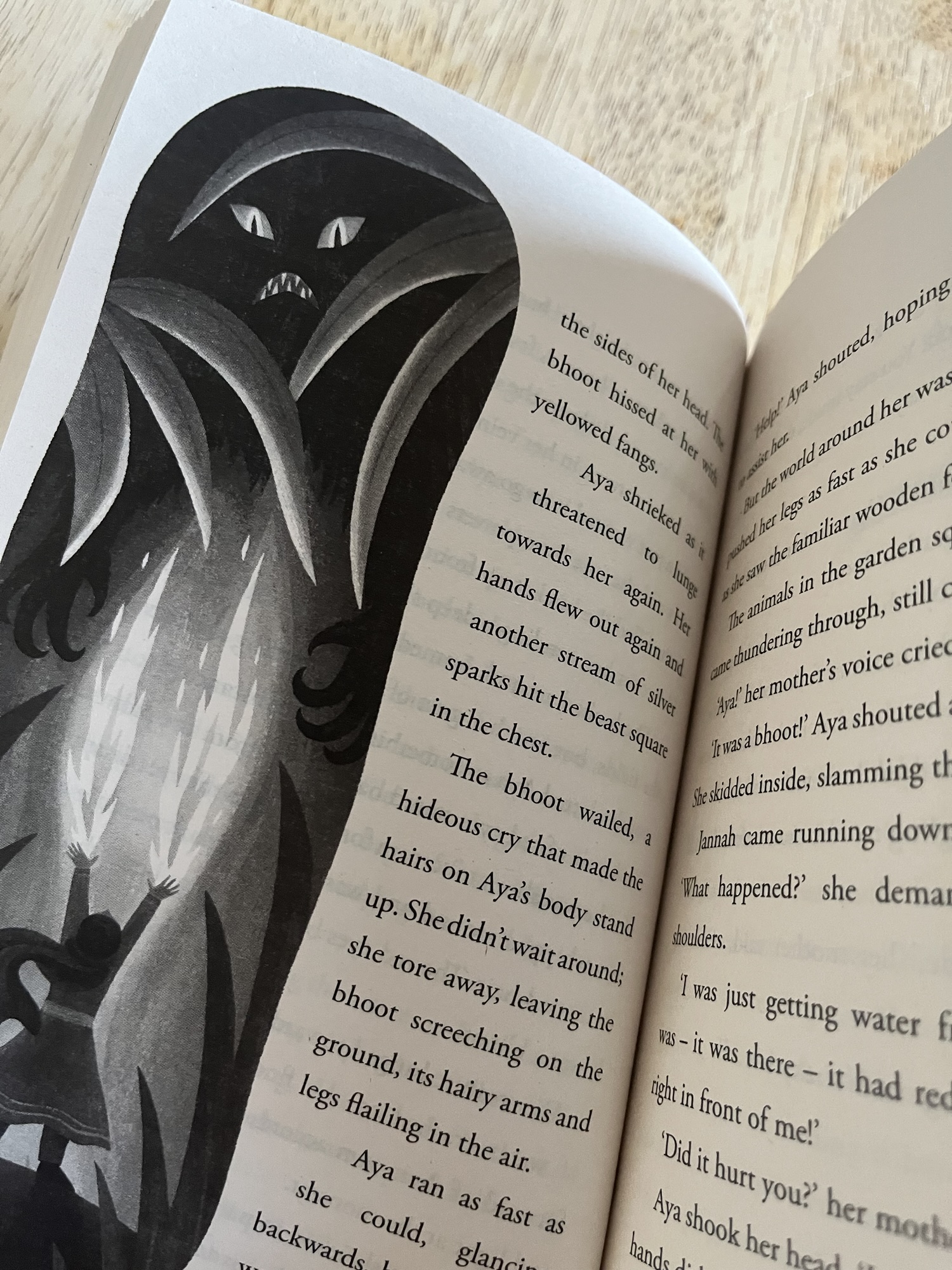
Aya and her mother, who is “stern with a big heart” live in kingdom of Alferra.  Her father has been gone for seven years, she doesn’t even know his name, as Aya and her mother, Jannah, have a strained relationship. Aya loves the ocean and the night sky and dislikes school, the only friend she has is Naznen, and on the night of the Perseids meteor shower the two girls meet in the middle of the night to watch the sky.  One star (is it not a meteor?) hits Aya and give her powers: she can shoot fire and cry flowers. Desperate for answers Aya and Jannah head to the Somerfest Ball at the palace to meet a seer.  When they do they learn of a prophecy and the remainder of the book is Aya and her mother running away to avoid the prophecy, before Aya reluctantly has no choice, but to face the villain, and thus see the prediction through.  I don’t want to spoil spoil it, but there is an Evil queen and demons of sorts with red eyes referred to as bhoots, and a battle that takes place in true fairytale format before the happily ever after occurs.
WHY I LIKE IT:

I do like that Aya is strong and determined, her strength however, is undermined by her sickness, sleepiness, and lack of determination to find the answers her mother refuses to give though, which is unfortunate.  The biggest problem with the book is the writing quality just isn’t great.  Even the religious representation aside.  Why have a whole conversation about wearing matching clothes to the ball between Aya and Naznen for Jannah to gift Aya a gown of a different color and no mention of wanting to match with her friend revisited. Why have Naznen sneak through the window just to have Aya go through the door using the spare key under the mat? Why mention a strange lady at school dismissal, that is never explained? Why is everyone scared to be out because people are missing, just to have Naznen alone, show up with Aya’s homework? I could go on and on, the book brings things up and then dismisses them using them to be page filler it seems. So many details do not provide insight in to the story or the characters or the setting, they are just random fleeting observations.

I didn’t like that the prince is described as having a “lover,” there are better less abrupt identifiers that could have been used, or perhaps in British vernacular it isn’t as pointed as it is in the US.  I also didn’t love that they bowed down to the Evil Queen Abnus. This highlights a place where an Islamic lens would have fleshed out that the characters are Muslim, not wanting to bow, as we bow to Allah swt alone, but perhaps being struck and forced.  Other easy inclusions of Islam would be seeing the meteor shower and saying SubhanAllah, being so sick from the star hitting you and asking Allah swt to heal you, asking Allah swt for strength in a dozen scenarios the book presents.  Duas before leaving the house with people going missing, it really seemed blaringly absent given the nature of the book to not have little sprinkles woven in, yet it halts the story early on to have those labels noted. It definitely could have used some polishing to make it part of the story or characters or taken out all together.

TOOLS FOR LEADING THE DISCUSSION:

I wouldn’t rush out to buy this book for your school, library, or home book shelf, but if you have it, there is no need to remove it.  There is not enough Islam nor literary value.  There is not even enough character development or details to show the change in the mother-daughter relationship to foster conversation.  One page they claim they have no secrets when the mother and her secrets is the bulk of the backstory, to the next page where the mother simply discloses all the letters and answers that Aya needs to move forward.

FLAGS:
Lying, sneaking out, scary evil villains, disowning, abandonment, disobeying parents, death, killing, prophecy, fortune tellers/seers, magical powers, abuse, imprisonment,

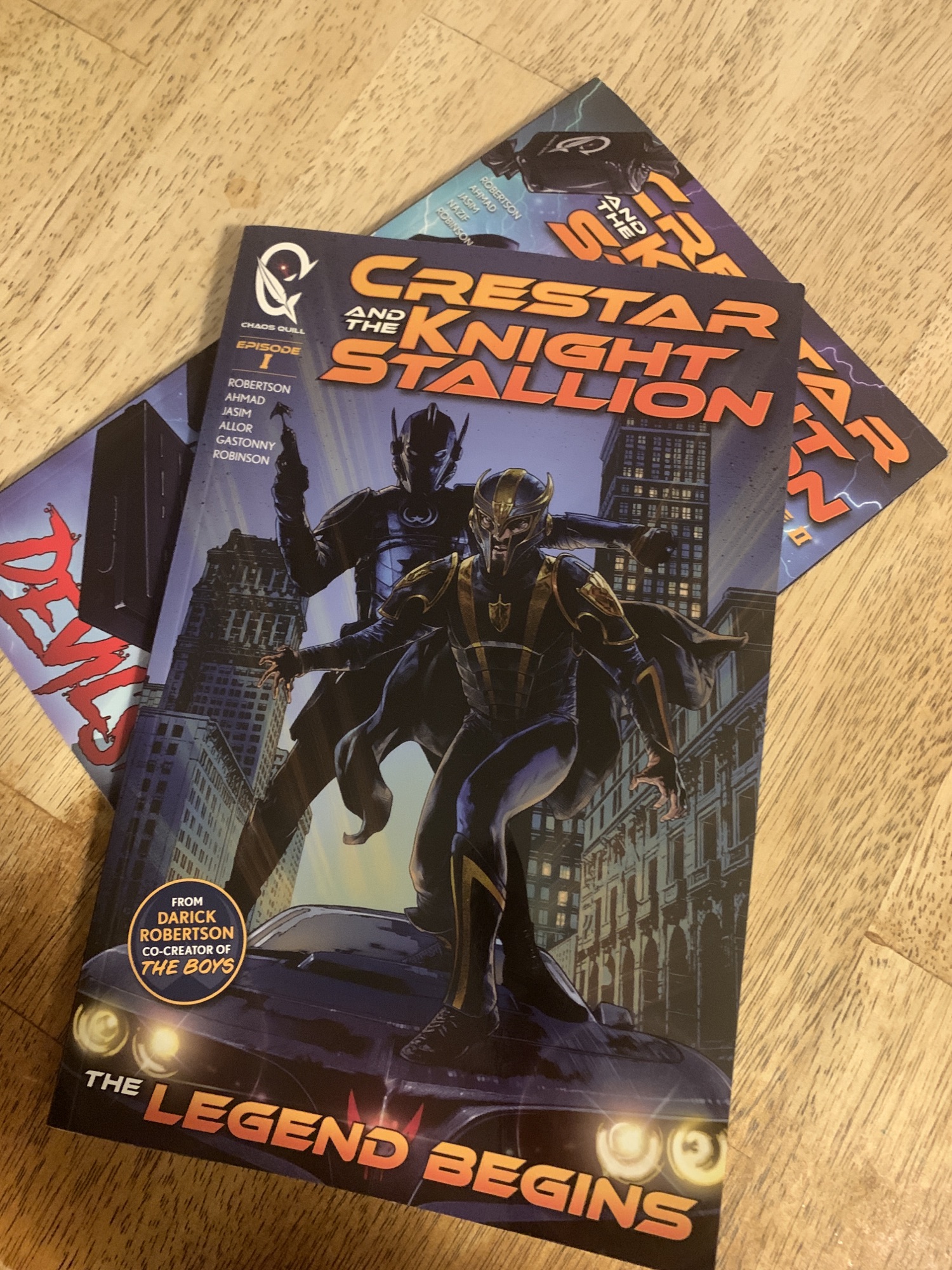
Crestar and the Knight Stallion: The Legend Begins by Robertson, Ahmad, Jasim, Gastonny, and Robinson

Standard
Crestar and the Knight Stallion: The Legend Begins by Robertson, Ahmad, Jasim, Gastonny, and Robinson

This new comic book series combines a lot of exciting elements.  It is a comic book and soon to be live action movie, it is both action and comedic,  it features Desi (Pakistani) and Arab (Iraqi) representation in the title roles, as it is in part written and created by the “characters” themselves. There are Muslim hijabi side characters, cultural Islamic phrases, and a whole lot of saving the day in a plagued Dearborn, Michigan setting.  I admittedly am still very much an outsider to comic books, what all goes in to them, their target audience, and what norms and expectations they carry.  So, I say what I am about to say from a very non critical, simply informative stance, when I say it has what I would consider mature content for elementary aged kids.  The comedy found in the offhand comments, the profanities that are substituted with symbols, surprised me. I anticipated a level of violence and killing, and appreciate that this book doesn’t have the near naked females being shown as many comics do, but I don’t think it is appropriate for younger audiences, probably more middle school and up.  I have not seen the live action, in a different format it might hit different so to speak, but I’m sharing some pictures of the text so that families can decide if the comic books are a good fit for their readers or not.

I love the idea of Muslim rep superheroes, that one is an Iraqi immigrant having to find himself in American society and accept himself, that Crestar is mysterious and his background and motives not known, the cultural and religious infusions, and matchmaking stresses are all amazing subplots to the evil that is destroying the community.  Theft and killings are the norm, Crestar is fighting back, when he discovers Ali has survived an explosion, he begins testing him with the hopes he will join him as the Knight Stallion. The first book is an introduction to the characters, the setting, and the protagonists meeting, it ends hinting that Crestar and the Knight Stallion will be working together, which isn’t much of a surprise given the title of the series, but it sets the stage.

I am not going to write a full review, because I can’t. I just really don’t know if the superhero parts are new and unique or tired and tropey because I don’t know enough about comics to have a valid opinion.  There are trailers online and the first two comic books available are top industry quality in terms of graphics, binding, length etc.

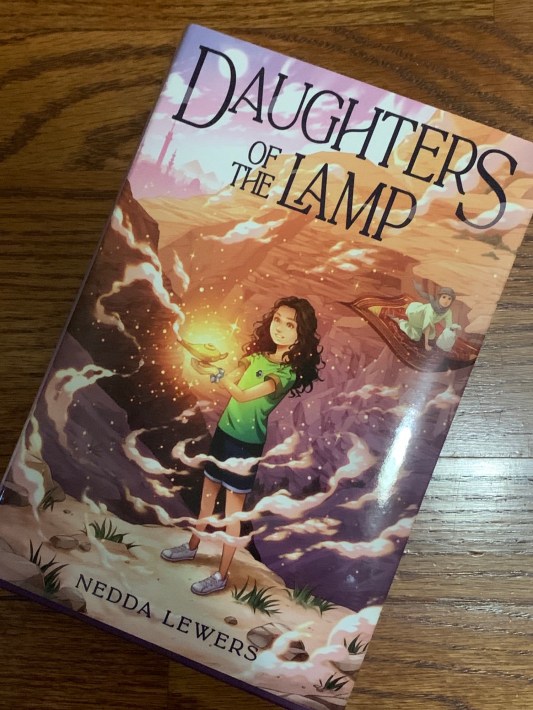
Daughters of the Lamp by Nedda Lewers

Standard
Daughters of the Lamp by Nedda Lewers

img_2600-1

This 352 page middle grade fantasy grounded in Egypt and America didn’t initially impress me.  In fact the first few chapters felt a little forced, the voice a little off, and the threads of Islam were making me a little bit nervous, but I was advised to keep reading by a trusted friend (@muslimmommyblog), and so I did.  And I really don’t know when it happened, perhaps when Sahara finally got to Egypt, but truly the slow quiet book won me over.  It has a lot of heart and I found myself throughout the day thinking about the story, trying to sneak a few minutes here and there to read just a little bit more, and staying up past my bedtime to finish.  That isn’t to say the book is perfect, but it is a solid read despite some plot holes, and a 12-year-old protagonist who seems to not really practice Islam even though her dad and family do. If you do not feel that Islam allows for fantasy books with magic, then steer clear of this.  If you are fine with it or on the fence, know that the book quite often articulates that Allah swt is always the creator in charge of everything, but there are magical elements, fortunes told, and evil deception.  I’ve never seen anyone read tea leaves or coffee grounds, let alone believe in them, if it is something that culturally you have seen and find reflect sihr, know that it is present in the story, but it absolutely clarifies, that Allah swt is the one who controls the future.  I don’t think any reader of any age would think this story is or could be real.  I would be comfortable with middle graders reading this book.  It is long, and a bit dense for early middle graders, but it is clean, and really centers family, being a good friend, and working together to save the day.

SYNOPSIS:

Sahara Rashid is tired of being teased as being the only kid who hasn’t gone to Merlin’s Crossing, when 6th grade comes to an end, she is hoping the surprise her dad has for her is a trip to the amusement park.  Instead they are going to Egypt, her first trip there ever.  Her maternal uncle is unexpectedly getting married and her dad and her haven’t been back since her mother died giving birth to Sahara.  Shocked by the news and desperately disappointed, Sahara goes to bed and dreams of her mother. When she awakes, her aunt, her father’s sister and mom’s friend, has a necklace for her and a message that matches her dream.  Interspersed with Sahara’s story is Morgana’s.  A girl long ago who is a servant to a mawlay, Ali Baba, who has been tasked to guard treasures: lamps, apples, flying carpets, and the like.

When Sahara gets to Egypt her adventures begin, she meets her cousins, Fanta and Naima, and Sittu, her grandma, who she has always feared blames her for her mother’s death, but finds instead a loving matriarch who welcomes her wholeheartedly.  She also meets the bride-to-be a woman named Magda, a woman the cousins call, El Ghoula, the witch.  When someone tries to break into the family’s grocery store, Sahara’s necklace goes missing, and El Ghoula starts to act suspicious, Sahara and Naima formulate a plan that backfires tremendously and will test their trust, determination, and ability to save the day.

WHY I LIKE IT:
I love that Islam is woven in, but I truly do not understand how Sahara’s dad prays five times a day, her aunt in the USA who lives with them prays, but not regularly, but Sahara doesn’t pray.  Her mom wore hijab, but she doesn’t know much about hijab, yet is incredible self-conscious that she doesn’t wear it, while simultaneously being comfortable in shorts.  She also questions her dad why she needs to cover her head in front of the imam, and she brings it up a lot with her cousin Naima, who does cover.  It feels like it comes from a place of love and respect, and probably real conversations, but it seems stilted and vague which I feel like some sensitivity reading perhaps would have helped with.

The beginning of the book really sounds outdated, but I’m not sure why.  It reads like an older person trying to write a young protagonist contemporary voice and it doesn’t work, it is even cringey at times.  Once the action picks up, the voice and tone and pacing is fine, but truly the first few chapters of Sahara are cumbersome.  I do not understand why Sahara is constantly homesick.  She is on vacation and is not going to be in Egypt for two weeks, and the regular insertion that she is missing home and counting down days, is very odd.  If she was suddenly living there, or staying months, perhaps it would make sense, but truly it initially really makes liking Sahara yet another obstacle in the early chapters, that has to be overcome.  By the end, she is very likeable, but those early chapters don’t connect her to the reader which is unfortunate.

The story and action are fun, the relationship building with the family is very tender and sweet.  Her helping her cousin in a street dance battle and feeling the love from her grandma are cathartic and memorable.  Plot wise there are some holes, like how did all the sleeping victims get home, where is the dad’s family, why didn’t the mom know the family secret, why did the family let Sahara’s mom leave, how did Sahara’s mom and her paternal aunt know each other, and why doesn’t Sahara pray and why hasn’t she ever heard the fajr athan before?

FLAGS:
Magic, lying, music, dancing, evil, plotting, scheming, killing, murder, dying, theft, poisoning, attempted kidnapping, slander.

TOOLS FOR LEADING THE DISCUSSION:

This would be a fun book to read aloud in a classroom setting during lunch when it is too cold to go outside.  I think it would be fun for an upper elementary book club as well.  I think kids will reach for it, and with a recommendation will get through the first few chapters to be swept away on a magic carpet,  enjoying the story.

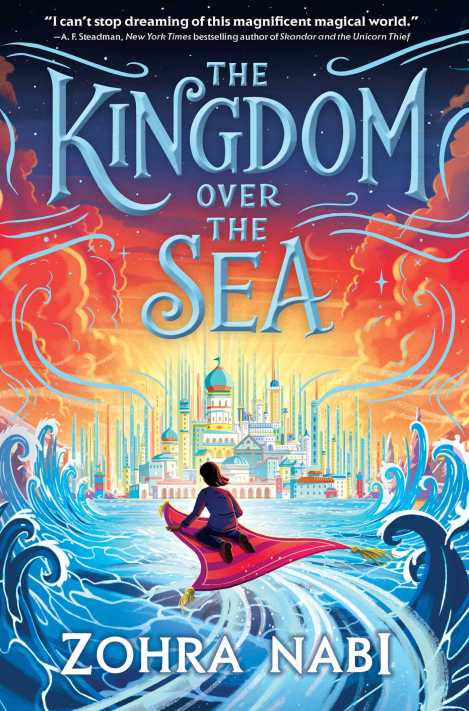
The Kingdom Over the Sea by Zohra Nabi

Standard
The Kingdom Over the Sea by Zohra Nabi

kigdom

This 336 page middle grade fantasy book had a lot of promise for me, but ultimately fell a little flat.  The protagonist was likeable, there was emotion, the story was compelling, and I know it is widely said that debut novels tend to be a little weak or be underdeveloped or having pacing problems, yet I hesitate these days to use this as an excuse.  I’ve been around the industry a few years and it seems many author’s debut novel, is not, in fact, the first book they’ve written or even the first book they’ve “sold.” Books are written and finalized years before they are released for some genres particularly of late, so I’m trying not to let myself get caught up in the author’s writing journey (I’m sure I’m all sorts of wrong about what I think it would be anyway), and just review the book in front of me. This book has no religion, and I don’t know if the author identifies as Muslim.  There are a hodgepodge of Arab and Desi cultural references in the characters’ names, and in the sprinkling in of salwar qamis, abaya, head scarf, sambusak, and there is a ma’a salama at one point along with the presence of jinn (not religiously referenced). There is also mention of medicinal wine, magic, a lady who has a crush on another lady in her youth, music, and dancing. The book held my interest as I wanted to see how it unraveled, and I recognize that there is a book two, so some of my thoughts might be premature, but I struggled with the premise of the protagonist trying to understand the journey her deceased mother has sent her on, and how the person she was supposed to find for the answers simply won’t talk, even though the two are living together.  It made the story really drag in places and seem underdeveloped.  The world building, the backstories, the adventure at hand, really is imaginative, but the development of the relationships in the story are absolutely non existent, and the book overall suffers because of it. Also the ease in which rising action is resolved is often the kids just throwing an idea out and it being right.  I read and review through a critical lens and many recent middle grade fantasy books have been absolutely incredible, perhaps it isn’t fair to compare, but this book just came up short for me in developing memorable characters and plot, even though all the elements were present, capitalizing on bringing it all together stayed just out of reach unfortunately.

SYNOPSIS:

Yara’s mother has died and when she finds a letter with instructions of what to do and where to go should this moment arrive, she decides to dodge her social worker and journey to a world of magic across the sea.  Unsure of her own background, she thinks she might be Iraqi, but doesn’t speak Arabic, she longs to find a place to belong, and when she arrives in Zehaira and hears the language of her mother, she is hopeful that this Leyla Khatoun, who lives in the third to last house on Istehar Way, will provide her with answers. But alas Leyla is not there, the Sultan’s alchemists are, and Yara is now on the run in a foreign land.  Help finds her and with a little magic she finds Leyla.  Leyla begrudgingly takes her in, but refuses her any insight into her past, her relationship with her mother, or why the letter directed Yara to her.  As the alchemists poison the sorcerers, Leyla and some other kids (friends?) have to find a way to save the settlement and magic in the land.

WHY I LIKE IT:

Yara as a character is likeable, she is plucky, resourceful, determined, and despite her circumstance does not want or need pity or handouts.  She advocates for animals, the poor, is a grassroots organizer, and unapologetic in how she carries herself.  I love that she isn’t whiney or helpless, and that she trusts herself to problem solve and isn’t afraid to think outside the box, while maintaining her kindness and appreciation for those around her.

As someone who doesn’t like Alice in Wonderland type stories, this book grounded the world building in an easily consumable way, so even though it is Yara leaving the UK and stepping into a new world, the functioning of the new world didn’t feel random or surprising.  While this was beneficial for someone like me, it made the focus of the story more on the characters’ relationships in enhancing the plot, and the book wasn’t strong in showing those connections.  Yara meets a map maker for a moment and a cat, and months later recalls the cat and the map maker by name and face.  A boy, Rafi, who is also studying magic and Yara don’t get along, yet are friends because it says so, the book doesn’t show us their bond.  Rafi meets some great uncle and the great uncle is painfully underdeveloped (along with his “friend”) and the tangent weak in reinforcing the major climax. The relationship between Yara and Leyla is the center of the story and so glossed over, there is no tangible connection, or cathartic release when details emerge, it was very disappointing to say the least. Yara and Ajal, the jinn, what is that relationship even, she frees him à la Aladdin freeing the Genie, but they are friends, not friends, he looks out for her, but doesn’t like her, the telling and the showing don’t align.  Even Yara’s relationship with the settlement and the inhabitants is disconnected from the plot of saving magic.  The climax is weak because we, the reader, don’t feel any connection to any magical folk.  The emotion of the mother dying at the beginning and the slight retrospection (I’m not going to spoil it) of the mother’s love at the end, was developed and made me invested in Yara, that same energy did not present itself, sadly, in any other relationships in the book.


FLAGS:

Death, loss, poison, imprisonment, magic, mention of medicinal wine, one line mention of a female character liking another female character as more than a friend, dancing, singing, jinn, torture, male and female friendships, destruction, lying, sneaking.

TOOLS FOR LEADING THE DISCUSSION:

I wouldn’t use this as a book club selection and wouldn’t go out of my way to shelve it in the school library or classroom library.  I will probably read the second book though and see where the series goes and reevaluate. I will also probably read future works from the author as the sparks of good story telling and writing definitely show promise for the author even though this particularly book wasn’t “magical” for me.


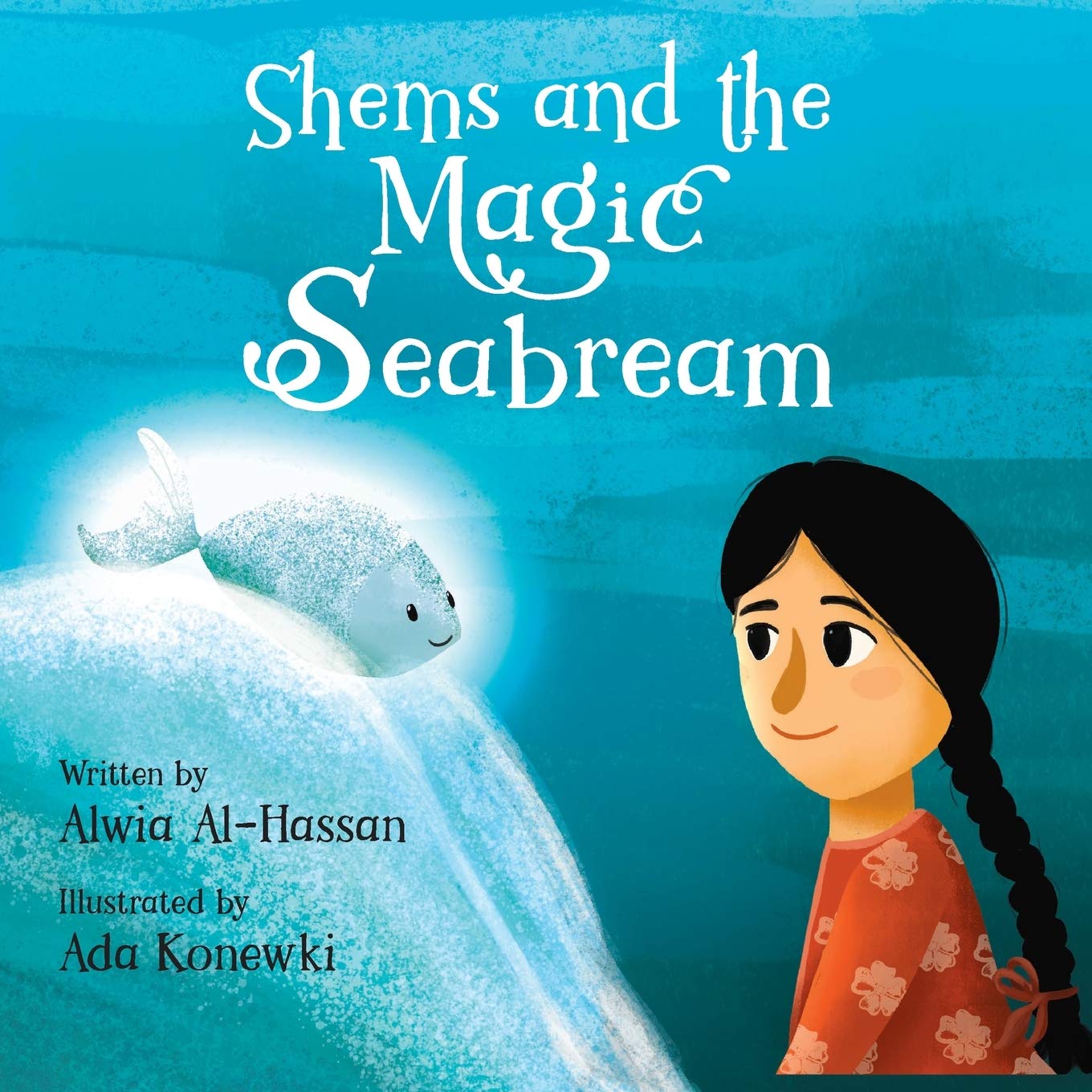
Shems and the Magic Seabream by Alwia Al-Hassan illustrated by Ada Konewki

Standard
Shems and the Magic Seabream by Alwia Al-Hassan illustrated by Ada Konewki

seabream

I don’t know how to review this book, I truly don’t, it claims to be based on Saudi folklore, it has #muslimsintheillustrations, and references Allah swt once, it is by a Muslim author, but it isn’t religious. And it definitely isn’t for everyone. It is terrible, and yet you can’t look away. Every stereotype about appearance and trope about step-mothers, it is all there, but EVIL CACKLE, the book is delicious, and not in the cooking the children and eating them sort of way, that is in the book too, but in the laugh-out-loud, gasp in disbelief, and be shocked at the complete disregard for political correctness, moral messaging, and lesson teaching that leaves a brightly illustrated dark tale for kids, and adults, to thoroughly enjoy. It pulls you in, it suspends reality, it makes good and bad so black and white that you accept the attempts at murder as justified, and it ultimately reminds you of the horrors that all fairytales build upon to entertain. I remember the first time as an adult I was asked to read Hansel and Gretel to a young niece. I knew the story, and started not thinking much of it, and then I froze: children are lost, they seek shelter in a home where they are not allowed to leave, the owner of the home wants to cook them and eat them. Yeah, this book is like that.

img_5299

Shems and her twin sister Shareefa live in a small town with their fisherman father. They are poor, but happy, until their father remarries and the stepmother is horrid. She is ugly and fat and covered in greasy spots, negative connotations that reflect her personality. (FLAGS: superficial judgement and body shaming). She hates children. (FLAG: Yes it uses the word hate, and calls children fat while contrasting them with cute children).

img_5300

She especially hates Shems and Shareefa. She tries to get rid of them: she puts them in the oven, abandons them in a field, tries to drown them in the night. But the girls somehow always escape and their father believes that it was all a misunderstanding. (FLAG: attempted murder).

img_5301

Now that the girls are older, they are forced to serve Mama Ouda, and when food runs low, she considers eating them. (FLAGS: abuse and threats). Luckily they are much too thin. One day when Mama Ouda is craving fish, Shems heads out to catch some seabream, yes that is a real type of fish. And the only one she catches is a magical one. (FLAG: magic).

img_5302

The next day Shems dressed as Shareefa recalls the fish’s promise near the water, and a basket of fish appears with pieces of sparkling gold. The girls eat like queens, hide the gold, and keep Mama Ouda fed. This carries on until they get caught and a murder and mermaid and moving out of their mud hut conclude the story and set up a potential sequel.

img_5298

The dad is pretty clueless and that has its own negative assumptions to counter, but if you and your kids can handle the over the top darkness, the story written in playful rhymes is sure to entertain and be asked for repeatedly. (FLAGS: stereotypes about fathers and stepmothers).