Tag Archives: Bullies

Spell it Like S-A-M-A-R by Shifa Saltagi Safadi illustrated by Saliha Caliskan

Standard
Spell it Like S-A-M-A-R by Shifa Saltagi Safadi illustrated by Saliha Caliskan

img_7225

This 36 page book for kindergarten and up shows the role perseverance, confidence, and believing in yourself can play in conquering bullies, carving out a space for yourself and finding success.  While the book is a little predictable on the surface, older kids will understand that by winning the spelling bee, Samar didn’t just benefit by standing up to the bully, but in proving to herself what she is capable of and ultimately being more confident of her place in a new country.  The book is presented on large 8.5 by 11 full color glossy pages and features discussion questions at the end.

img_7227

Samar is in 3rd grade after recently moving to America from Syria, where she was the best student in her class.  ESL wasn’t difficult, but mainstream class is proving to be a challenge, mostly because of Jenna, the class bully.

img_7228

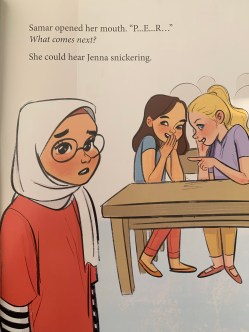
Jenna, snickers when it is Samar’s turn to spell words in front of the class, she teased her about her jump rope songs not being in English, and she makes fun of her for her accent.  With the help of a kind friend, Angela, the two girls decide the school spelling bee will be the best chance to prove how smart Samar is, by winning.

img_7229

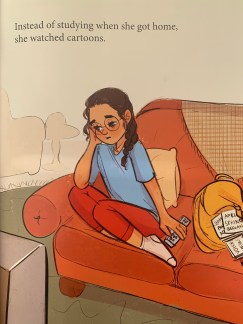
The first step Samar must do is convince her teacher, Ms. Bryan to help her study.  To  show her commitment she offers to give up her recess to study.  The teacher agrees, but on the way home Jenna teases her saying she’ll never win when she can’t even speak English properly.  Deflated, when Samar gets home, she doesn’t study the flashcards and opts to watch cartoons instead.

img_7230

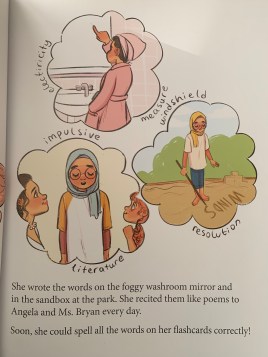
When later in the week her teacher quizzes her, Samar admits she didn’t study.  Ms. Bryan encourages her by sharing her own story of coming to America and having to learn English.  When Samar gets home she sees her mother, a former dentist in Syria, studying for the exams to be a dentist in America. This is the spark she needs and she studies hard, everywhere, and with anyone who will help.

On the day of the bee, Samar spells word after words correctly and after saying bismillah before spelling the final word, wins the competition and beats Jenna. The audience cheers and the next day Samar and Angela are jumping rope and Samar is singing in Arabic.

img_7231

I love that Samar and her mom wear hijab while out, but not at home, that they speaks Arabic, and Samar says bismillah.   Samar’s mom is clearly highly educated and determined and mom and dad are supportive.  I love that Samar’s drive, however, comes from her own determination, no one forces her or guilts her, it is her leading the way and understanding what her mother is going through and her teacher has gone through, and using that as inspiration.  I love that at the end she doesn’t rub it in Jenna’s face that she won, and the symbolism of Jenna just disappearing from the story makes this clear as Samar steps in to her own.  I truly love that for every Jenna in the wold there is also an Angela.  Be kind, be supportive, be a good friend!

I got this book from http://www.Ruqayasbookshelf.com and it can also be found at my favorite book store http://www.crescentmoonstore.com as well.  Happy Reading!

My Friend the Alien by Zanib Mian illustrated by Sernur Isik

Standard
My Friend the Alien by Zanib Mian illustrated by Sernur Isik

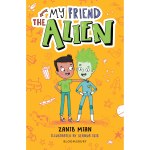
This adorable 96 page book is a great early reader for second graders and up. The play on the concept of being an “alien” is filled with a lot of heart, humor, and thought provoking concepts on what it means to be human, have feelings, and be a good friend. There is nothing religious in this book by a Muslim author meant for all children, but with the name Jibreel and him being a refugee (“alien”) many Muslim children might assume and relate to his plight a little stronger.

SYNOPSIS:

Maxx the alien has come to Earth to understand human feelings. His trip was ok and landing successful, but he hasn’t heard from home and the Filandoo Sperk is broken. Told in diary form, the fart jokes start rights away as he lands in a cow pasture. He heads to a city disguised as a human and discovers chocolate. He also discovers Google and uses it to help him understand human emotions.

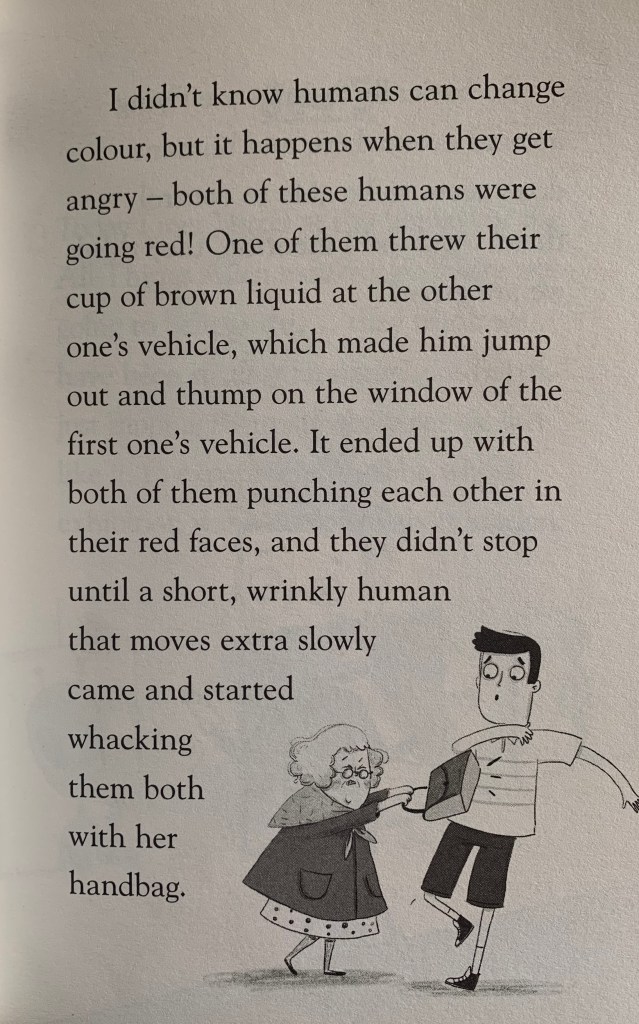
As he gets on public transportation he finds that humans smell different, and some are not so nice. At the park he finds how humans talk about baby dogs, he forgets the name for those, very odd, and love very gross. On Day 4 he makes a friend, Jibreel, who is looking at books and magazines about Aliens. He knows he isn’t supposed to talk to humans, but since no one from home is talking to him, he figures it might be ok. When the boys head outside they see two grown men fighting about a parking space and turning red, they punch each other and don’t stop until an old lady whacks them with her purse. Emotions are flying around everywhere and Maxx hopes Jibreel can help him understand it all.

Maxx and Jibreel head to the library the next day for the “All Things Alien Exhibit” and boy do we have it all wrong. As Maxx tries to correct the exhibit and explain the truth about aliens, Jibreel just finds him funnier and funnier, not believing that Maxx is from outer space.

The two boys become good friends and when bullies from Jibreel school start giving Jibreel a hard time, Maxx learns about hugs, and helping a friend out. Maxx starts having feelings. When the boys get called aliens and Maxx makes them both go invisible, Jibreel realizes Maxx is an alien from another planet and Maxx learns that Jibreel is a refugee. He also learns that Jibreel’s misses his mom who wasn’t able to escape with Jibreel and his brother, and is still back in their country.

Maxx makes the bullies look foolish to help Jibreel, but Jibreel is not happy and Maxx has to learn about being kind even when you really want to be mean. Now that Maxx is having all sorts of feelings, he too confides in Jibreel that he is worried about not hearing from home and Jibreel offers to help him fix the Filandoo Sperk.

The only problem is the spaceship after the initial tour, goes missing. And so are the bullies. I won’t completely spoil the ending, but there is a surprise and happy ending for everyone.

WHY I LIKE IT:

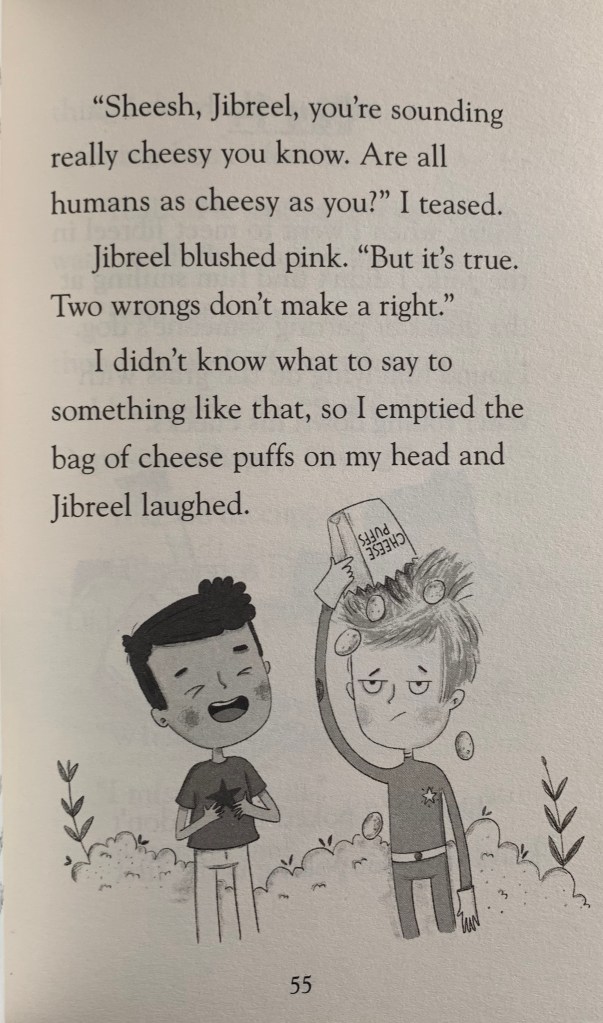
Oh I love how the story weaves feelings and emotions in with bullies and friendship in such a smart way. The book is silly with the fart humor and assumptions about aliens, but it really is clever. The vocabulary doesn’t talk down to the reader with words such as abomination and the observations of someone new to Earth offer the reader a chance to add their own silly persepective to the fictional set up. American children might need a bit of help with the British jokes, like the name of the chocolate bars, but it really is such a universal story that will stick with adults and kids alike.

The end has some questions and activities to do with the book, and with the exception of Jibreel’s name being spelled wrong on one these last pages, they do a good job of helping make sure kids grasp the story.

FLAGS:

There are fart jokes, and mention and illustrations of kissing on the cheek as being gross. Bullying, being mean, and two men fighting.

TOOLS FOR LEADING THE DISCUSSION:

The book is great for 2nd and third graders to read and discuss. I don’t do a book club for that age, but I did have my 2nd grade nephew read it to start a conversation about feelings and emotions with him and it worked great. We talked about how things make us feel, understanding when we see other people acting a certain way how they might be feeling. We discussed how even if we think someone deserves something, our own integrity needs to come first. We talked about being a good friend and how being away from our mom and family would make us feel. From top to bottom this little chapter book, packs a lot of discussion options under its silly superficial layer.

You Must Be Layla by Yassmin Abdel-Magied

Standard
You Must Be Layla by Yassmin Abdel-Magied

layla

This OWN story, upper middle grades book, is heavy on the pop culture, relatable on the Islamic family presentation and honest in its portrayal of Islamaphobia, yet somehow the tidiness in which everything wrapped up seemed too forced and a bit flat.  At 293 pages, including a three page glossary, the book is a quick read meant mainly for girls.  It involves robotics, academic achievement, and invention, while also discussing crushes, a character coming out to his family and friends, and mention of girls not praying at certain times of the month.

SYNOPSIS:

Layla lives in Australia and goes to the Islamic School of Brisbane. Her Sudanese family: older brother, younger twin brothers, and parents, her Doctor mom and medical machine tech dad, are active Muslims and proud of their culture.  They assimilate to Australian norms in varying degrees, but with all the kids at ISB, Layla doesn’t feel all that different in her school and social life.  Unfortunately she wants more, she wants to be an adventurer, and when she meets Adam over the break and learns about the various opportunities he has it his school, Layla decides she wants to prove herself on a larger stage.  Going in to “shut down” mode Layla has tunnel vision to ace the scholarship and entrance exam and go to a new school.

She gets in to Mary Maxmillion Grammar School and when she goes to meet the board they let her know that the decision to accept a girl like her was not unanimous.  Layla is an immigrant, she is black, she wears hijab, she is loud and proud, and apparently very smart, but as one trustee asks, is she brave?  On the first day of school she arrives late to first period, insults the teacher repeatedly and also makes friends with a group of slightly diverse boys.  At the end of the day however, Peter, a boy who had insulted her earlier, reinforces his disapproval of her being allowed at their school and pushes her.  Standing her ground, she verbal attacks and then head butts the boy in front of a large portion of the school at dismissal.  No one offers any help, nor speaks up when she is suspended for a week, her scholarship and admission put on probation, no one even asks for her side of the story, Peter, is let off completely free, as he is also the son of the Board Chairman.

Layla decides to prove she belongs at the school she is going to win a prestigious robotics competition and since everyone already is on a team, she decides to go for it solo.  The only problem, is she doesn’t know what to invent.  When she returns to school, her friend that she is crushing hard on is acting weird, and she gets caught up in a lie of sorts that serves as both the idea and silliness turned cleverness of the book.  While choking on gummy worms, she says she is working on an edible actuator for her robot, and somehow has to make that come to fruition.

The rest of the book is Layla making a lot of silly errors of judgement: missing classes being in SD mode in the workshop, forgetting to file the paperwork and registration to actually compete in the competition, and leads up to the resolution between her and Peter, learning her crush is gay, and deciding to be herself and proud of it.

WHY I LIKE IT:

I actually like the majority of the book, I really like how Islam is presented and lived.  They pray and say salam and cover, and recite tasbeeha to reflect, and quote hadith very naturally, even how others attack them, and the anger that Layla’s brother Ozzie feels at his inability to get a part time job reads and feels very authentic.  I also like how one of the teacher’s own experience as being a descendant of the forgotten generation and being a first nations ethnicity is woven in.  I felt the side character being gay was added and forced in as an after thought and I don’t know why, as it didn’t show Layla to be a particularly good friend.  She handled his coming out well, but when he was miserable she was wrapped up in her own stuff and didn’t reach out very well, even though he ended up being the spark for her invention.  Her friend at ISB is also an under developed character, that while I get is used to show another side of Layla, in many ways also showed her to be a rather poor friend.

I found the pop culture references annoying, not in and of themselves, but in knowing that they will date and make the book irrelevant in a few short years.  There is a lot of repetition of phrases and ideas that a few times when I put the book down I struggled to re-find my place (I know bookmarks, right?) but certain refrains and paragraphs seem so very similar.  I

There is a lot of good information about Sudan and their food and culture and traditions.  There is also a decent amount about Muslims in Australia.  I like that even within her family there are different views on how much to assimilate, and how much to fight back against perceptions, the fact that there is a lot of gray makes non Muslims and non immigrants reading the book hopefully realize how diverse all people are and to not assume anyone is only one way.  I would have liked more about Layla’s mom and being recruited to come to Australia, and how she was perceived at work, by patients and colleagues.  I also would have liked some sort of resolution about Ozzie and his job search.  Really though my biggest complaint is Layla, herself.  What does it even mean to want to be an adventurer? I like that she is fallible and human and in some ways she does grow, but I felt like her being smart and a go-getter is the foundation of the story, but that she didn’t seem to have much common sense seems a bit off.  Yes she is loud and funny and puts in hard work, but the way she talks to teachers, and misses classes and deadlines, and behaves seems like a disconnect from the pages constantly telling me how smart she is.  To me, part of being smart is knowing when to lash out and when to listen, I don’t feel like her growth arc was all that great, in a nut shell, she changed schools and confronted a bully, that is the story, while not a bad story, it could have been so much more.

FLAGS:

There is crushing, violence, a gay character, mention of alcohol at a party Layla didn’t attend, talk of hooking up in passing and some language.  There is lying but it is acknowledged guiltily, and not familiar with Australian slang, regular use of the phrase, Janey Mack, which according to google is a replacement for Jesus Christ.

TOOLS FOR LEADING THE DISCUSSION:

I don’t know why I wouldn’t use this book as a book club selection.  It just didn’t strike me as something they would benefit from.  I wouldn’t be opposed to someone picking it up and reading it in my house, but I doubt I’ll recommend it to my daughter and she is the ideal reader: she wears hijab, is in 8th grade at an Islamic school, and loves to read.  The book is really not memorable as good or bad, it just fell flat and I doubt I’ll read it again, luckily it only took two sittings to read, so I don’t feel like it was a waste of time, but seeing as I had to pay cover price and international shipping, I kind of regret rushing to buy it.

Teacher guide: https://www.penguin.com.au/content/resources/TR_YouMustBeLayla.pdf

Lulu and the Very Big Meanies by Mac McGooshie illustrated by Alexis Hogwood

Standard
Lulu and the Very Big Meanies by Mac McGooshie illustrated by Alexis Hogwood

Lulu.jpg

I don’t know what is more frustrating: quality books that are poorly packaged (binding, illustrations, font, spacing, etc.) or beautiful books that miss the mark in storytelling and basic writing skills.  Both are equally annoying, and while yes, a good story should be the basis, this book is really well written that the presentation of it just makes me sad.  At 116 pages, the book is perfect for 3rd graders.  My daughter and son read it a few years ago when I first picked it up.  I made them read it.  And last week when I pulled it out to read myself, both remarked that it was a good story.  The fact that they remembered it and remembered liking it are huge pluses, and made the fact that I had to make them read it all the more disheartening.  I’m certain if you can get your kids to read eight maybe 10 pages they will zoom through the rest of the book.  It is the getting them to pick it up and start, that is the tricky part.  The book is paperback, thick and glossy, but the cover looks homemade almost.  If you thumb through it the font is too small, spaced too tight and the illustrations mean well, but don’t deliver.  Unfortunate, because like my children, I too think the story is fun and I’m disappointed that the book was published in 2013 as #1 in the Lulubug’s Week in the Life Series, and no further books have come out.

SYNOPSIS:

Laila (Lulu), and her family are American Muslims living in Southern Virginia.  Lulu’s mom is a lawyer and a convert, her dad is from Egypt and owns an Italian restaurant, and her older twin brothers are 12 and keep an eye on her.  Being incredibly bright Lulu has skipped third grade and is having trouble with some bullies in her new fourth grade class: Veronica B. and Veronica C.  aka the Veries.  Using help from her brothers, her neighbor and friend Toni, and some friends in class, a trap is set to get the bullies to confess to their evil mischief, but that unfortunately isn’t the only thing Lulu is going through this week.  Throw in her parent’s sudden decision to move closer to the masjid in another city, a litter of kittens abandoned on the side of the road, and some weird noises coming from the woods behind their house, and Lulu has a lot to deal with.

WHY I LIKE IT:

I love that it shows the day-to-day of a typical Muslim family in a normal presentation.  They pray together, they watch what they eat, they know their neighbors and worry about each other.  It doesn’t idolize the family, making them better than anyone or preachy, but makes them very relatable and likable in a realistic way.  When bees are discovered or the kittens need carrying for, sunnahs and ayats are identified, but very seamlessly, that non Muslim kids will learn a bit about Islam and Muslim kids will be excited to see themselves.  My favorite scene regarding this is when the mom finds out there will be a middle-school dance, and even though the boys are not planning to go, know that it isn’t for them, and don’t even seem tempted by it, they still have a family meeting about it, to discuss.  I also like that at one point Lulu meets another Muslim girl and they don’t hit it off right away, the girls work through it, but it is nice to see some diversity in even the way Muslims are presented and possibly misunderstood even amongst one another.

There is a lot going on in the book in terms of action items, but there still is a lot of character development and dimensions to Lulu.  Lulu has to navigate relationships with her family and friends that ring true and aren’t over simplified.  Her friend and neighbor, Toni, expects Lulu to act different at school now that they are in the same class, but returns to her silly self once they are home.  Lulu clashes a lot with her mom, but can smile and get her way super easy with her dad and manipulates that a lot.  She has to balance her sassiness with her teacher and principal, pick her battles with the Veries, and abide by other adults’ rules and expectations.  The book reads in a similar vein as Junie B. Jones, or Clementine, just maybe a more mature and less obnoxious reincarnation.

I wish the adventure involving the backyard noises, was a bit more dramatic, and maybe even the unveiling of the trap involving the dye was more resolved.  At times the book seemed rushed to wrap up all the stories introduced and I think they deserved a little more time to be explored and enjoyed.  If the font and spacing and pictures could be tweaked I think the book would really speak to kids in a fun way.  Third and fourth graders can easily handle a 150-160 page book that has good pacing and is packaged in a tempting, non intimidating way.  I’m holding out hope that maybe the author will write some more, tweak this one, and give it the chance at reaching an audience that would benefit from the smart, fun, grounded life of Lulu.

FLAGS:

Clean, it does mention that Toni likes a boy, but Lulu thinks that boys are trouble.

TOOLS FOR LEADING THE DISCUSSION:

If I still did an elementary book club, I think this book would work.  I think kids need a nudge to give it a try, but once the book gets going, girls and boys alike will enjoy it.  I may read it for a Lunch Bunch choice (I read once a week to 4th and 5th graders while they eat their lunch).  Kids will love seeing themselves, their stresses, their families, and their faith presented well.

Nanni’s Hijab by Khadijah Abdul-Haqq illustrated by Vitchapol Taerattanachai

Standard
Nanni’s Hijab by Khadijah Abdul-Haqq illustrated by Vitchapol Taerattanachai

Nanni's Hijab

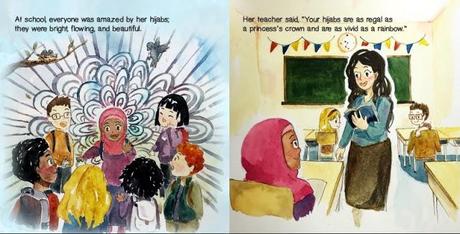
MashaAllah, there are so many things to like about this 36 page, brightly illustrated, elementary aged story.  Nanni, the main character, is spunky.  Not only is she strong enough to wear hijab to school, but she also is brave enough to confidently handle a bully on her own.  Surrounded by a supportive teacher, friends, classmates, and her mom, Nanni’s creativity and understanding that Allah swt will help her find a way to handle her predicament results in a happy ending, and many empowering messages.

nannis-hijab-childrens-book-review-L-Yo6YBS

The book would work for most children, but I think second grade and up would get the most out of it.  The girl might be young to be wearing hijab, but it seems like she wears it because she wants too.  I like that the illustrations have her and her mom uncovered at home, and that there is a glossary at the back, opening up the book to muslim and non muslim kids alike.

DVBz_rcVwAILbLM

I also really like the larger messages of acceptance, trying new things, and doing better when you know better.  The supporting cast in the book resonates with muslims who go to schools where they are the minority, but have support and encouragement to practice their faith none-the-less.  Nanni’s teacher remarks that her “hijabs are as regal as a princess’s crown,” and the other students like seeing what color or design she is wearing each day.  Although a children’s book, the author does very clearly explain that the hijab is part of Nanni’s faith, although not mentioned by name, and that it is an act of worship. Nanni wants to handle the problem on her own, and for as bad as she wants to punch Leslie, she knows it isn’t the right thing to do.  As she wrestles with what is the best approach, she puts her trust in Allah, swt, which perhaps is the greatest lesson for us all in the book, alhumdulillah.

Umar and the Bully by Shabana Mir illustrated by Asiya Clarke

Standard

Umar and the Bully.jpg

With it being October and Bullying Prevention Month, I thought to review a book that has been on my bookshelf for a long, long time.  It won the Islamic Foundation Story Writing Competition in 1996 and is just as relevant today.  At 44 pages, the story, the layout, and writing style appeal to children on a second or third grade level.

SYNOPSIS:

Umar stumbles across some older kids plotting something covertly in the school yard and some money being exchanged.  He then encounters a younger student upset.  Being a kind person, Umar gets Asad to confide in him what the bullies, Harith and David, are up to, and vows to keep Asad safe.  While all that seems simple enough, the true battle begins within Umar,  as he has to figure out what is he going to do, and how is he going to stop the bullying.

WHY I LIKE IT:

I love the length and the target audience.  My six-year-old son summed it up perfectly when he finished.  “Woah, that was a good book, I didn’t expect it would give me so much to think about.”  The author follows the bullying strategy of telling an adult, or a teacher, but gives some depth when that teacher doesn’t care or take the time to help.  It also shows a variety of people that you can go to for help and characteristics you should look for when deciding who a good person to talk to would be.  Umar decides to talk to a good friend of his about what is happening to Asad and devise a plan to help.  Mohammad is kind and trustworthy.  He also gets some advice and encouragement to be brave from Mohammad’s older sister and brother.  All this is done within an Islamic context of asking Allah swt for help, of finding inspiration from stories of his namesake Syedina Umar Al-Farooq. It also, as we get in Umar’s head, reveals how he himself is scared of facing the bully.  This is great because it shows that it can be scary to confront someone even if you are not the victim.  Umar feels he shouldn’t be scared because he is a Muslim, which I really don’t understand, but he turns to Allah swt asking for bravery to do what is right and to be strong.  And beautifully, after it undoubtedly raps up in a happily ever after children’s story way, he does remember to thank Allah (swt) for being there for him and gives credit to Allah for giving him strength.  The book shows the responsibility we have to do what is right even if it isn’t being done directly to us.  It also shows one or two children can make a difference.  I really like that the point of view is from Umar, not the one doing the bullying or receiving it.  Allowing the reader to see how empathetic he is to another person is a wonderful lesson in and of itself.

The book also has mostly Muslim characters, but a few names sprinkled through out as victims and perpetrators could suggest non muslims as well. This is great in showing that bullies are everywhere and that perhaps being in an Islamic school or in a majority Muslim school does not mean bullying doesn’t exist.  Similarly it is good to see that bullying isn’t just non Muslims disliking Muslims, as often time books about bullying for Muslims would suggest.  I think the book could be for Muslims and non Muslims alike, but with the religious reliance, it is geared more for Muslim readers.

FLAGS:

The book is clean, it mentions that the bullies are violent, and possibly smoking.  The children being bullied obviously are lying but it is clear that it is done out of fear, not because they are deceitful by nature.

TOOLS FOR LEADING THE DISCUSSION:

There aren’t any reading guides or activities to accompany the book that I could find online, but I think the natural discussion that would follow make it a great option to read as a book club book, or in small groups.  There are a lot of very easy places to ask children what they would do, if Umar made a good decision, and how they would feel as the story unfolds.


Circle of Sandcastles by Mariam Al-Kalby, Illustrated by Yee Von Chan

Standard

circle of sandcastles

The second book by Mariam Al-Kalby in The Prophet Says Series, is just as good, if not better than the first book, The Apple Tree.  Dedicated to her second daughter Maimuna, this story focuses on the hadith, “Whoever amongst you sees an evil, he must change it with his hands; if he is not able to do so, then with his tongue; and if he is not able to do so, then with his heart; and that is the weakest form of Faith” (Sahih Muslim).

The book follows shy Maimuna as she goes from stopping bullies picking on a deaf classmate within her heart, with her tongue and finally as she has to get her hands involved.  Once again the illustrator does a wonderful job bringing the story to life with joyful playful illustrations and detail.  I used this book with the preschoolers at story time when talking about the five senses and with the kindergartners when talking about bullying and being mean, in both scenarios the book had a strong impact on the students.  I’ve had students remind me in passing how we should handle bullies in our heart or with our tongue and even my own 4 year old has referenced the book when seeing people communication in sign language.  Like the first book, the discussion that follows can be different with each reading, which keeps it in regular rotation.  The bullies are not all bad, but one doesn’t feel guilty giving lots for the reader to speculate upon if they so choose. Shy Maimuna has to be courageous and assess the situation if it is something she feels she can get involved with or not.  Mu’min, the child’s whose sandcastles keep getting destroyed, shows us that Allah swt made us each different, but really the same too.

The book has four Urdu words in it, that actually kind of seem awkward and forced, I simply translated them to English when reading to students (there is a glossary in the back), if you are familiar with Urdu they are fine, but rather unnecessary in my opinion.  The book has 32 pages, is hardback and beautiful inside and out. The author’s website has a cute coloring page http://apocketfulofnotes.com/2013/11/14/circle-of-sandcastles-coloring-sheet/ and inshaAllah your kids enjoy the book as much as mine do, I can’t wait to see what she writes next.