Category Archives: YA FICTION

Odd Girl Out by Tasneem Abdur-Rashid

Standard
Odd Girl Out by Tasneem Abdur-Rashid

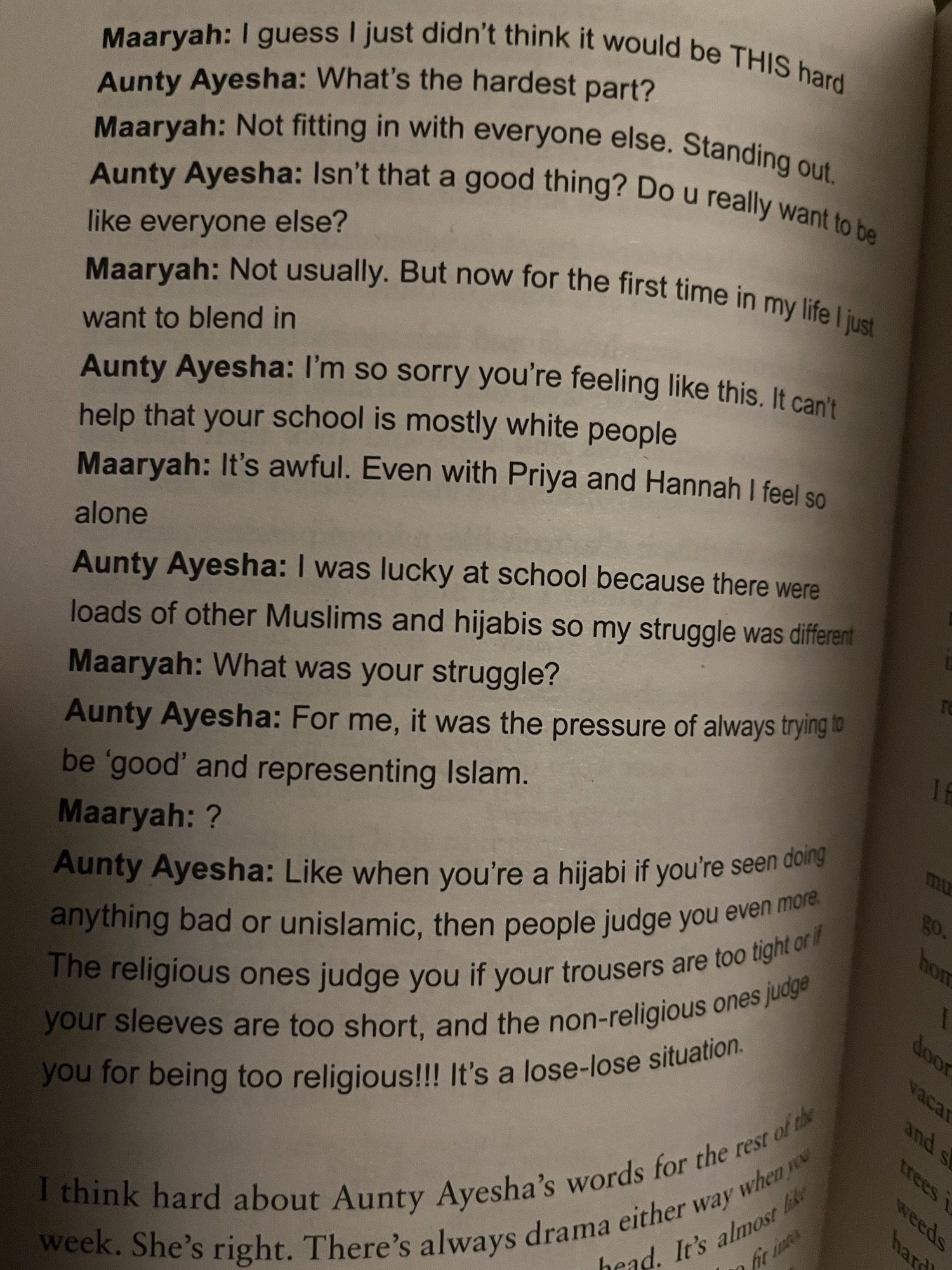
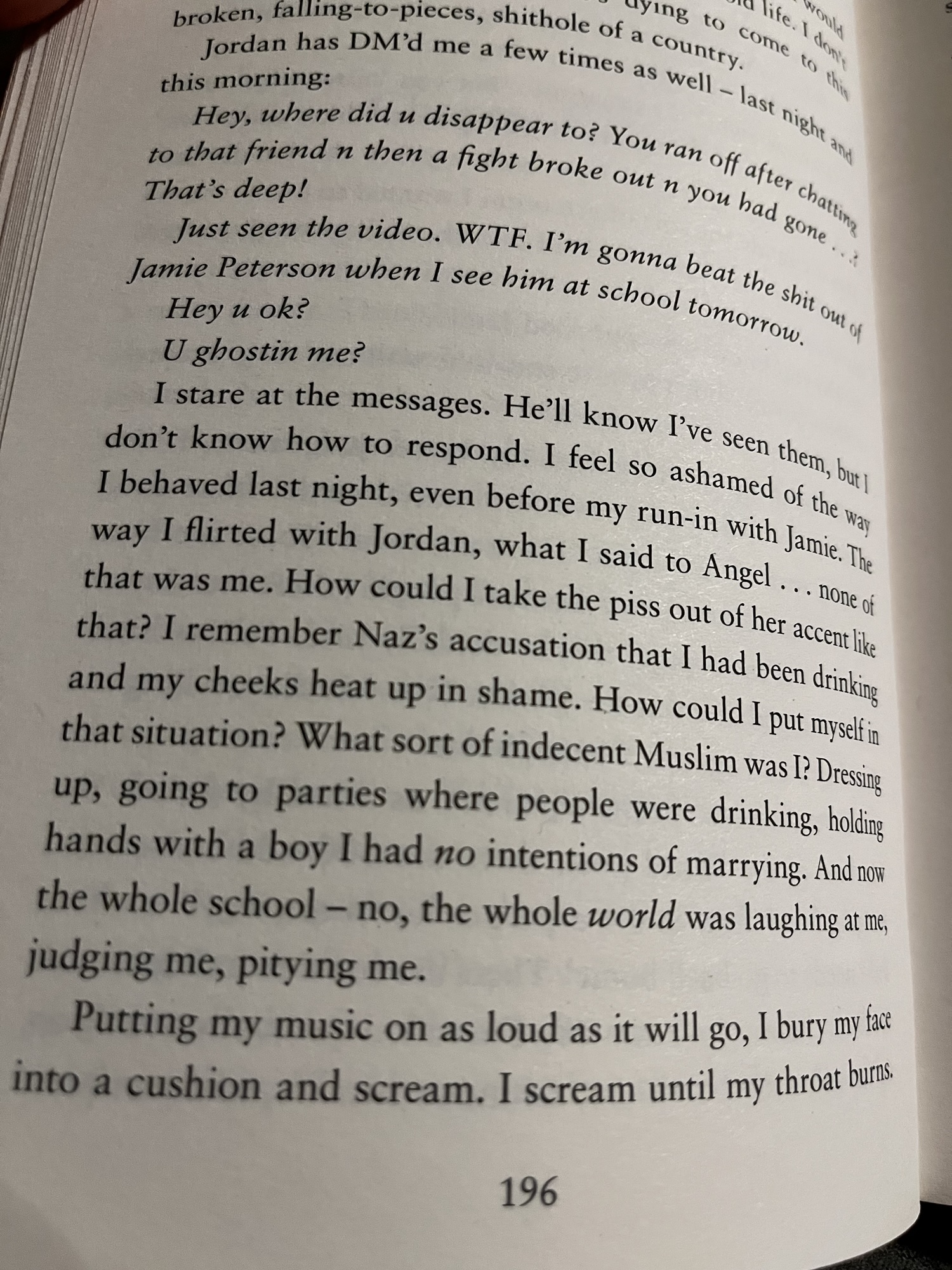
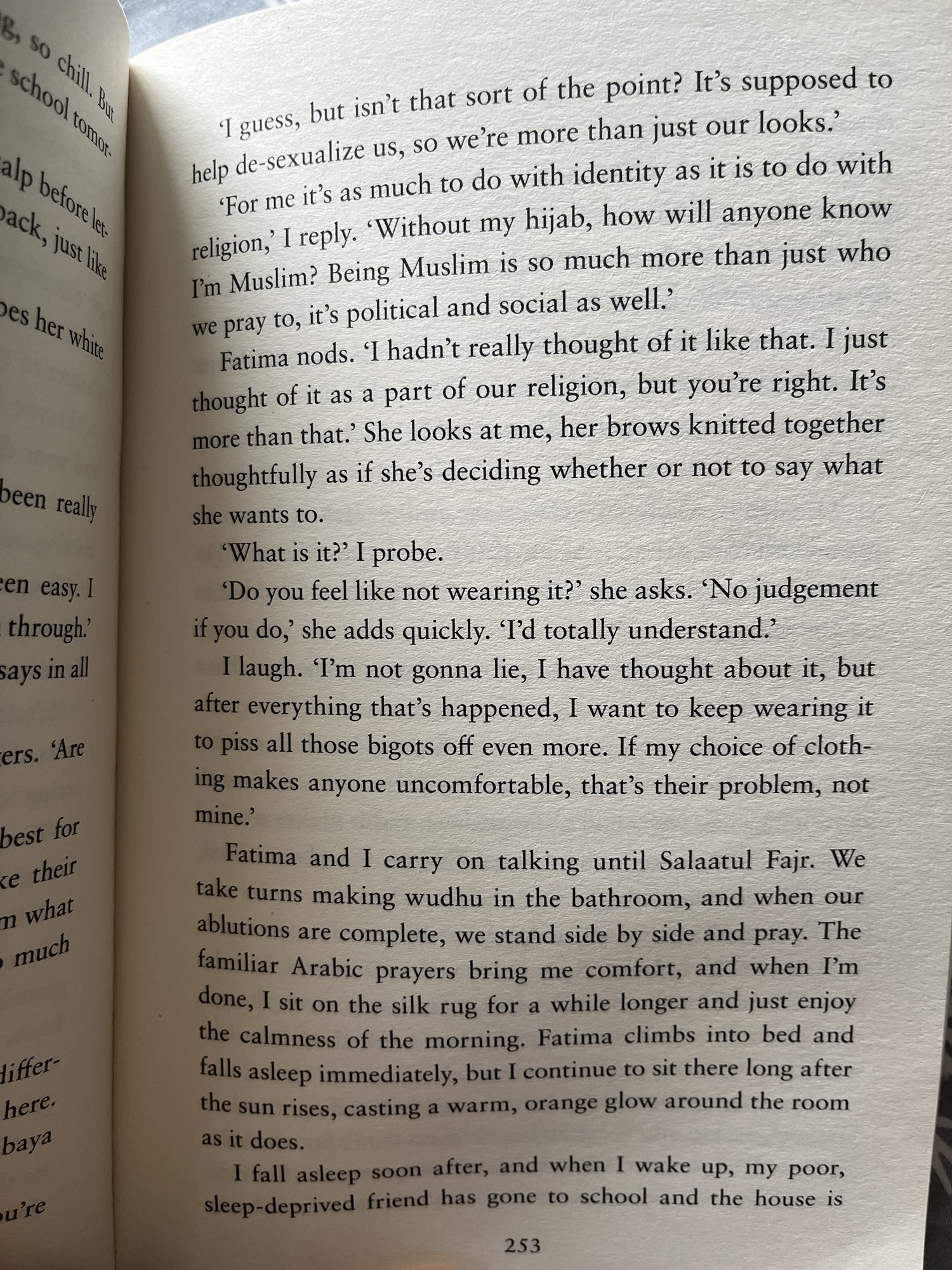
At 368 pages this identity centered mature YA book really hooked me and had me invested, which is impressive because Islamophobia stereotypes and being the new kid in a new place tropes are pretty frequently done, and often after a while, feel repetitive.  For me the charm of this book is actually not Maaryah and her peers/friends/bullies storylines, but the protagonist’s relationship with her parents and what caused her mom and dad to divorce.  Obviously as a mom of teens, I’m not in the target audience, but I feel like I benefited from the Muslim authored, Islam centered book, and think older teens, perhaps 17 and up, will also find the book enjoyable and reflective of views they have, challenges they face, and boundaries they have to establish.  I don’t want to spoil it, but SPOILER, had my dear friends that have read the book clued me in that the book will toe and slightly cross the haram lines, but ultimately show Maaryah deciding to re-establish her boundaries after being tempted not to, i.e. making a poor choice to attend a party with boys and alcohol present, and dressed in a way not typical to her hijabi style, I wouldn’t have read the last hundred and twenty pages or so with my jaw clenched in fear. The book shows a lot of Islam in practice, salat, duas, discussions about hijab, but not everyone will agree with decisions Maaryah makes or the rationale behind them as they vacillate between culture, religion, and family expectations.  I love that Maaryah is fallible and never abandons her faith, and that who we are is more than a singular mistake or instance of poor judgement. The book is not preachy, most will just take it as a girl finding her place in her new family dynamic in a new country, who happens to Muslim.  I think, an assumption really, based on what the author has said about her previous adult books, something along the lines that they are not meant to be Islamic fiction, but are stories with Muslim characters, and I think this book should probably be viewed the same.  There is swearing, hand holding, a side hug, normalized boy girl friendships, lying, running away, deceit, cheating, alcohol, mention of hookups, dating, vaping, music, flirting, hijab questioning, bullying, physical assault.  My biggest concern about the book is that it brings up Palestine, but doesn’t discuss Palestine. A side character is a non practicing Jew that visits Tel Aviv and Maaryah wants to discuss the occupation with her, but hesitates and the moment passes.  It is never revisited which I really wish it would have.  It could have modeled a bit how to have those conversations, I know it isn’t that type of book, but Maaryah mentions repurposing kaffiyehs in her designs and so it hints that it matters to her, but never pulls on that thread.  At one point it also mentions another character posted something pro Isr@*l during the genocide, which I can only assume the author thought that by the time of publication would have ended.  SubhanAllah ya Raab.

SYNOPSIS:
The tag line on the cover “From Dubai Girl to London Nobody…” very succinctly summarizes the plot.  Maaryah had an idyllic life in Dubai with her parents and close friends, spending her holidays with her mom’s family in London, and securing an internship with a famous designer.  All is going well until her parents get divorced, her mom moves her to the UK, not near her extended family, and the lack of Muslims, let alone hijabis, at her high school has her bullied with no friends to have her back.  With her mom in survival mode, their once close relationship is non-existent, and the 15 year old is left to sort through it all on her own.

WHY I LIKE IT:

There is a little pulling of punches so to speak of asserting that the boundaries are Islamic, but for the most part I think Muslim readers will see that Maaryah does view a lot of what she experiences through an Islamic lens which I appreciate. I also like that the protagonist’s connection to salat and faith is hers, it isn’t forced on her and I think for this demographic that is good micro messaging and framing.

I was very grateful that the book answered the questions about Maaryah’s family dynamic, so often parental problems are pushed to the void and let to be resolved or understood off the page. And while in the first half it was teased a little as we aren’t having that conversation right now, I did ultimately by the end feel like it was sufficiently resolved.  I also felt the mom was blaringly absent at weird times and I get that it was a plot device to get her out of the way, but if you are dragging at the 100 page mark, I do encourage you to keep reading, it does pick up.

This book isn’t meant to be didactic, and I recognize I’m putting that on it a bit, but I do think the Gaza framing missed an opportunity to show readers how to navigate that very real scenario through the power of fictional characters.
FLAGS:

Copied from above: There is swearing, hand holding, a side hug, normalized boy girl friendships, lying, running away, deceit, cheating, alcohol, mention of hookups, dating, vaping, music, flirting, hijab questioning, bullying, physical assault.

TOOLS FOR LEADING THE DISCUSSION:

I would shelve this in an upper high school classroom, I think that decision to be at the party is clearly shown to be a mistake, to put herself in that situation is something she regrets, and I think showing that she comes out from it offers a lot to be discussed.

My Perfect Family by Khadijah VanBrakle

Standard
My Perfect Family by Khadijah VanBrakle

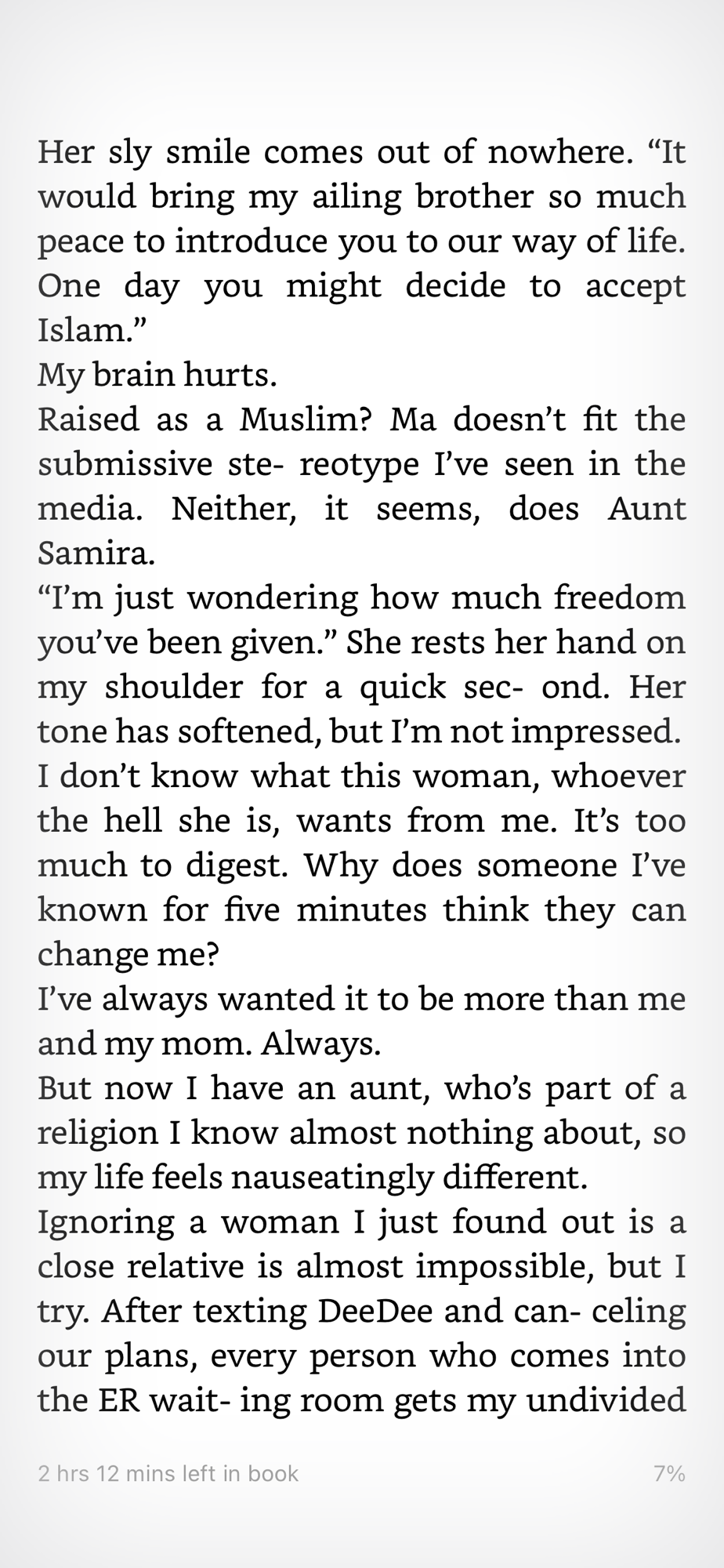
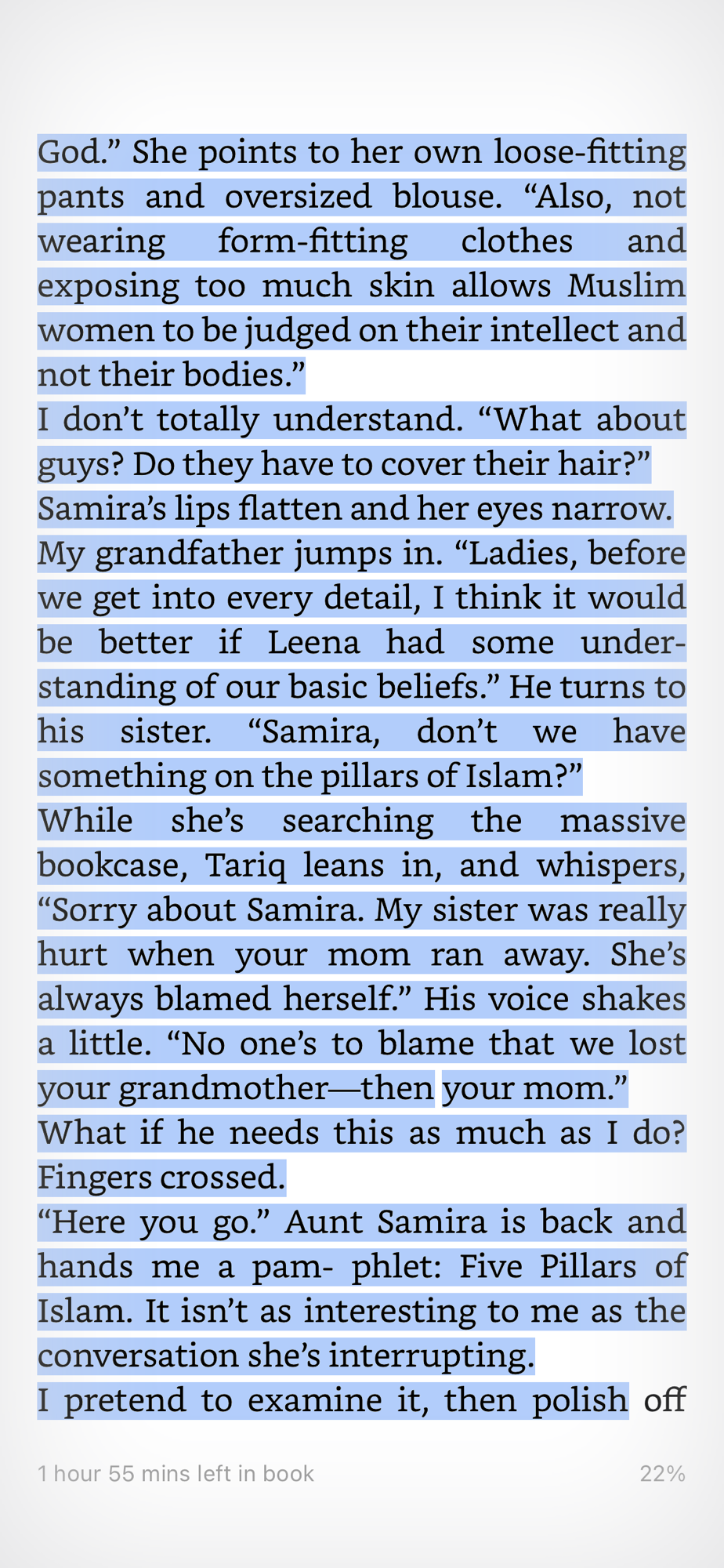
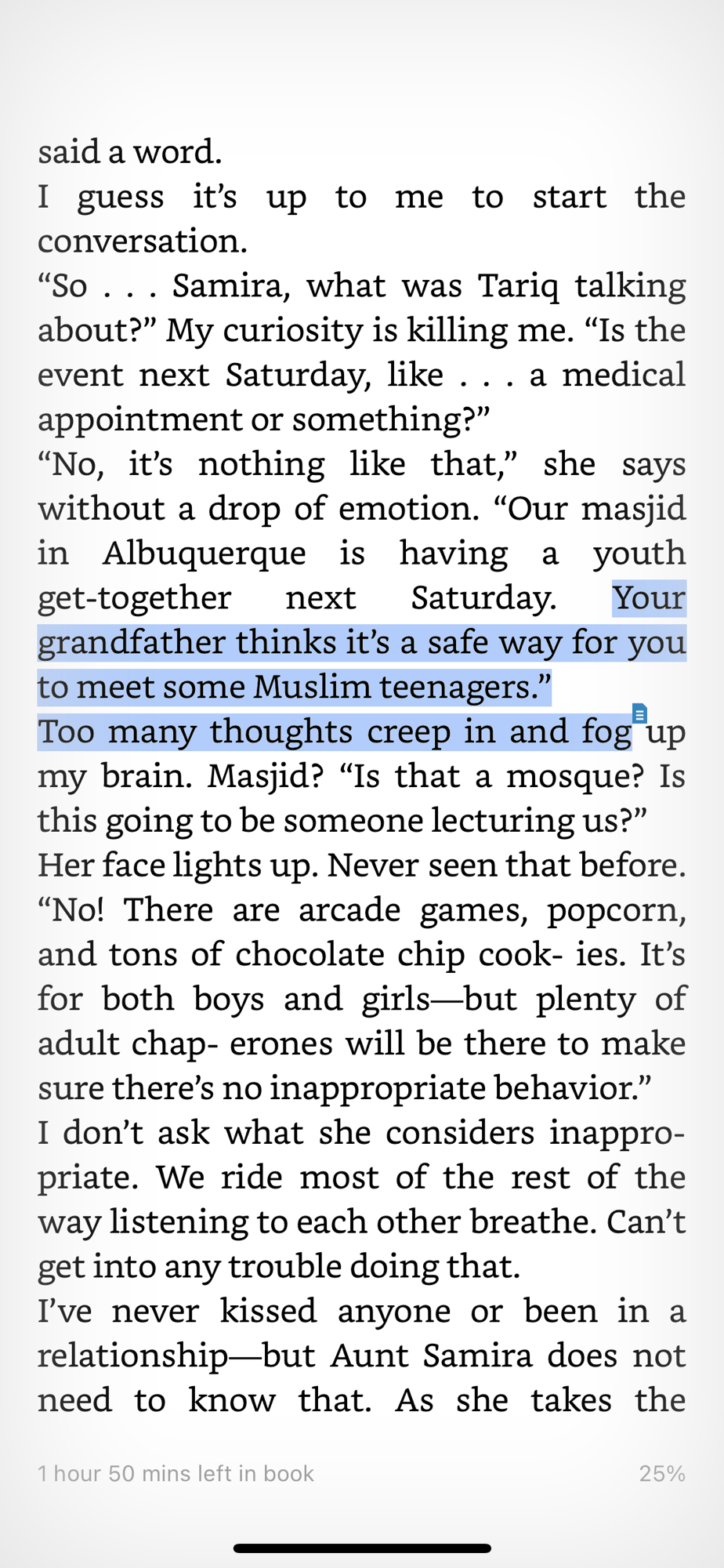
Oh Dear. The very premise alone of this book requires the author to expertly thread the needle of numerous pitfalls, which in my opinion did not occur.  A girl, Leena, learns about family members at age 16, who are Muslim, and the practice of Islam being the “reason” her mother ran away from her family when she herself was 16, means that for Muslim readers the representation needs to be clear that the family’s interpretation is to blame and not the religion itself.  It also means that as Leena learns the reader learns, and non Muslims (or honestly even Muslims) are not going to want a heavy handed preachy 256 page YA book. The Islam “taught” to Leena has to align with the readers interpretation or show why the characters believe as they do, and the conclusion regarding religion and identity needs to make sense for the character aside from what reader wants to have happen.  Unfortunately the copy I read contained numerous errors, repetitive paragraphs, a weak resolution, dropped plot threads, and had me cringing at how harsh Islam was being presented through the great aunt character, that honestly if Islam was just presented as no dating and dressing modestly, or else you will get married off, I can see why one would run away.  The book contains a lot of cursing, and features dating, having a child out of wedlock, death, and gambling by non Muslim characters.

SYNOPSIS:
Leena has always wanted a big family, but her and her single mom, Asiyah tackle life together.  Leena and her best friend Deidre are employed by Asiyah’s in home daycare and are as close as sisters, but she wants more.  When Asiyah finds out her father has had a heart attack, Leena learns she has a grandfather and great aunt that live an hour away, in Santa Fe.  From the moment Leena sets foot in the hospital, under the gaze of her Aunt Samira, the judgmental overtones begin regarding clothing, education, food choices, and dating.  As a result Asiyah is reassured that she made the right decision all those years ago to leave Islam and her family.  Leena however, has had her entire world changed, and is willing to endure the abrasive Samira to get to know her grandfather Tariq.

WHY I LIKE IT:
I like that family drama and secrets were teased, even if I didn’t think that they were presented and resolved well. I wish they took more of the focus and that Islam being a reason for the animosity was downplayed.  I think religion could and should have been one of many factors, having it be the ONLY factor put a lot of pressure on the presentation, which fell short.  It also means that the resolution needed to resolve the Islam hanging in the air, SPOILER,  it didn’t.  The conclusion has Asiyah realizing her father never stopped loving her, but how did that resolve the relationship with her and Samira? And suddenly Samira just backed off her singular Islamic identity? A bit of whiplash with it all happening off the page, left me unsatisfied.  Speaking of pages, the book spends a lot of page space having characters drive the one hour one way to have conversations that are less than 15 minutes and could have been done over the phone or even texted.  Nothing exciting or revealing comes from these drives, they just make the story drag. Tariq should have ridden along, so we could see why he was “such a great man,” see why Leena kept enduring the harshness of her Aunt to get to know him, and have the family she always dreamed of.

Islam is presented through the harshest of harsh characters, a few side characters are brought in that make Islam more realistic in practice and fleshed out, but it really feels like it is too little too late.  I think a non Muslim would feel Islam is just modest dress, no interacting with boys, marrying early, and rigid rules.  Leena is harassed from the first moment she meets her family, no easing in to it, she is even handed brochures on her first visit to her grandfather’s home.  Yet, Leena never shows any interest in learning about Islam, she could Google it if she was curious, even when at the masjid, she doesn’t go and watch them pray, no connection to Allah is ever discussed, it is just dos and do nots.  Consistently throughout it feels like Islam is weaponized and perhaps that is the author’s experience or intent, but it is odd coming from a Muslim writer in a fictional setting.  We get enough of that stereotyping from the non Muslim real world.

The emphasis on Islam being the only thing that matters for these characters means that whether they are religious or not, the characters are painted very one dimensional. Leena is a terrible friend, she counts on Deidre to drive her around, she never follows up on asking about her dates or reciprocating the effort for her other than feeding her.  Asiyah has an ex-boyfriend show up, and then goes out with a friend, but there is no context for their abrupt arrivals and then departures from the story, they do not serve as a foil to reveal any pertinent information or connection. A plot device used quite often in the book, and one I am not a fan of, is when things can be solved by characters simply having a conversation.  It is never the right time, they will talk later, even the fruition that started the family fracturing could have been eased by, you guessed it, the characters talking, not even agreeing, just talking.  While I’m running through my top gripes, might I add, that I have spent a few too many minutes on the cover as well.  Presumably Leena is in the middle, her young single mom Asiyah on the right, but who is the young hijabi? Her aunt does not read young at all, and she would not have her neck showing, that would go against her core characterization. So before you come at me that I have no right to my opinions and that I’m too mean, please solve the mystery of who is on the cover, thank you.

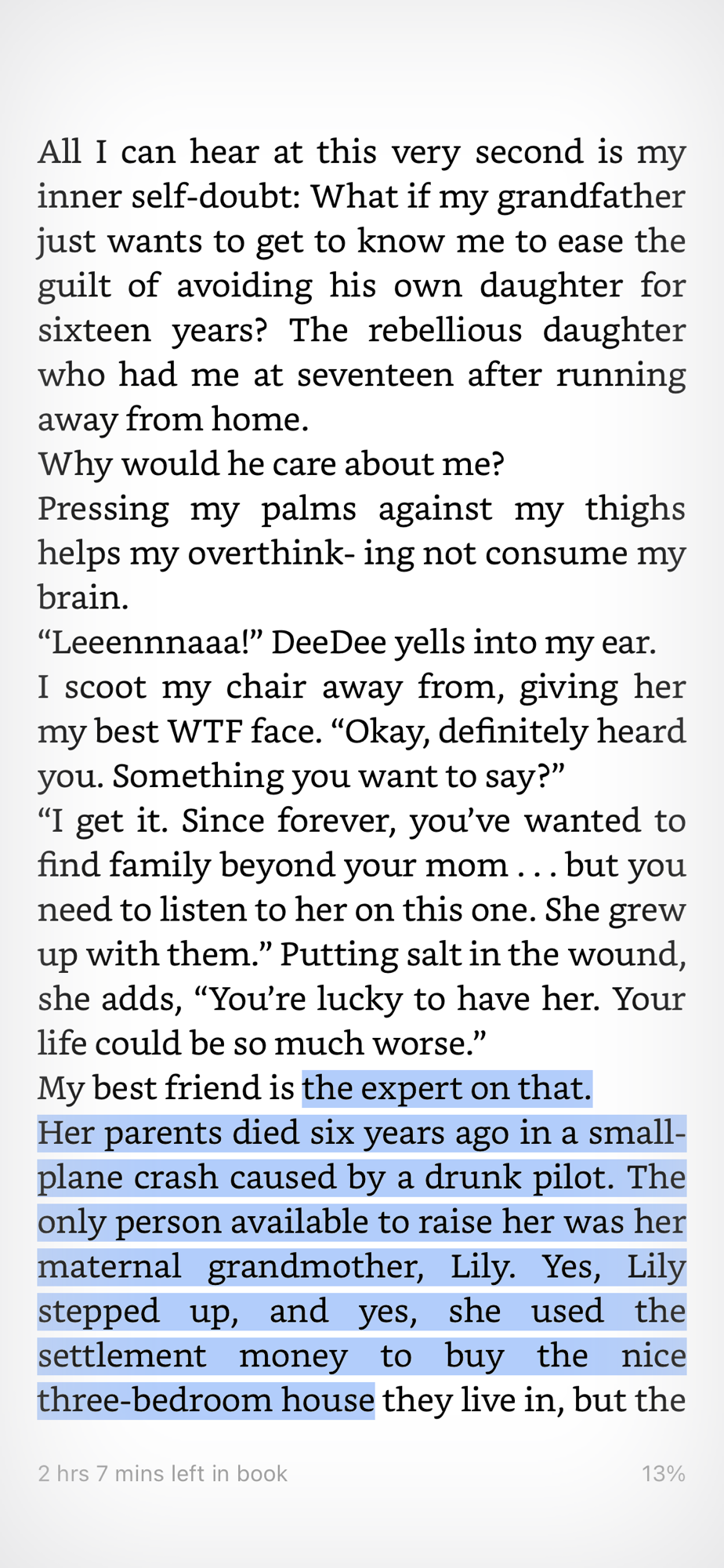
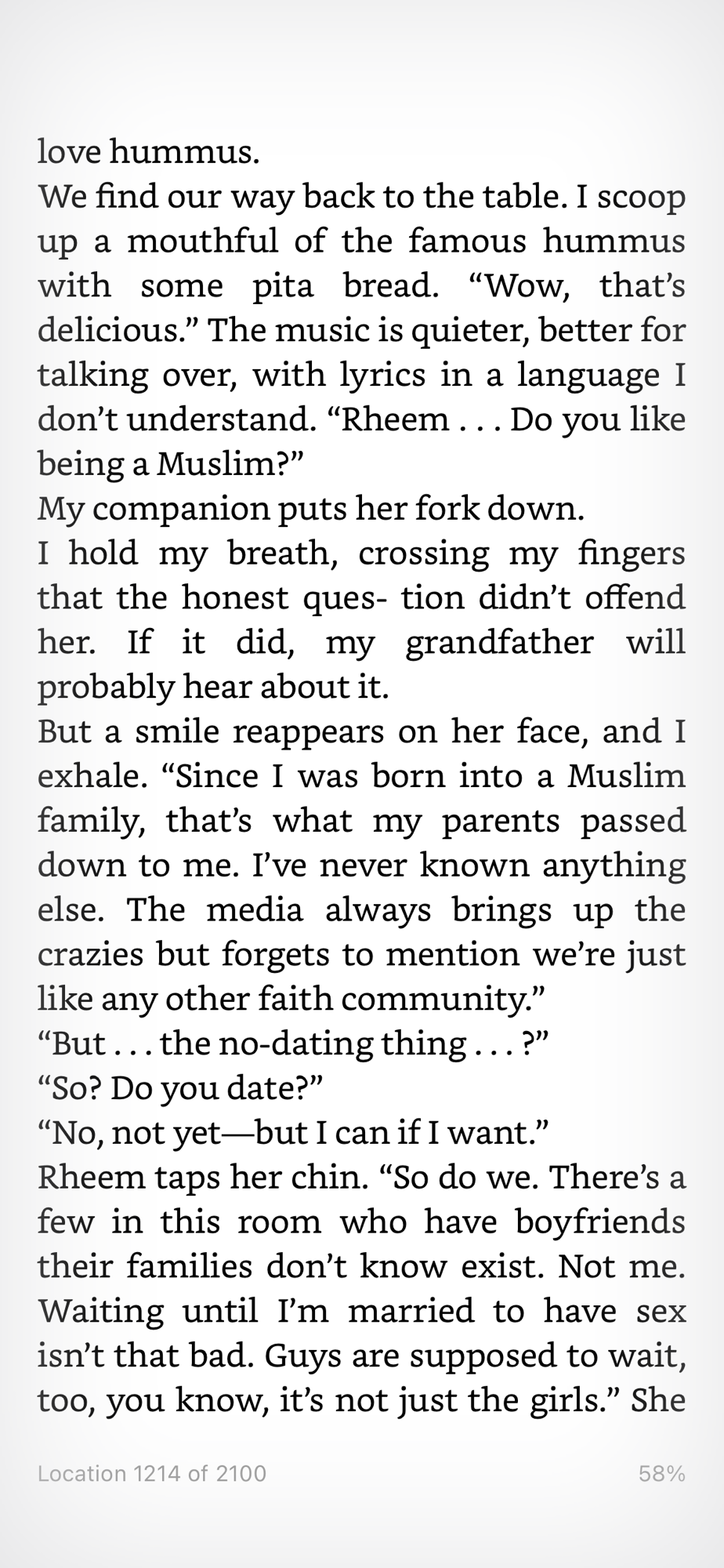
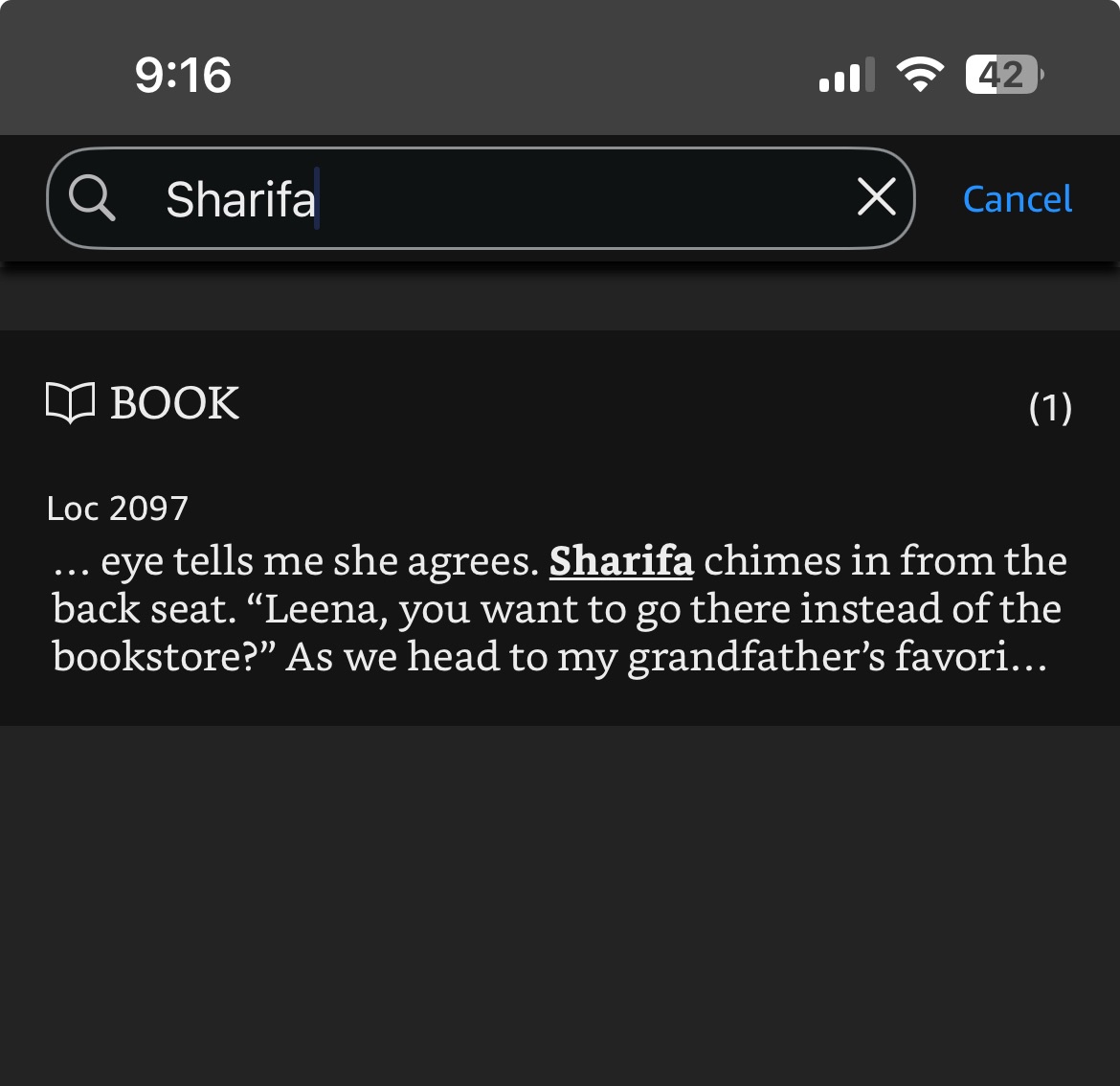
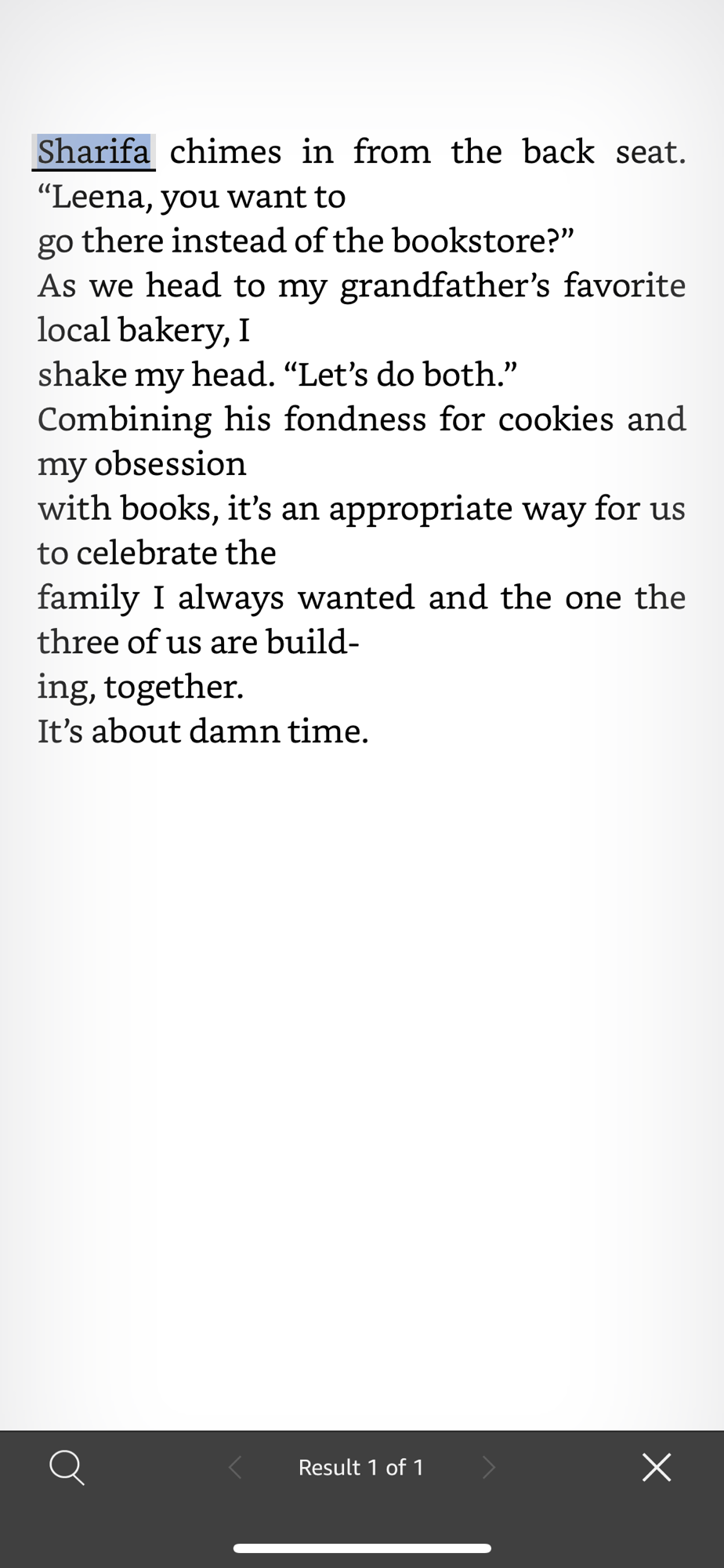
I read an ARC so I am aware that changes could have occurred, I’ve requested the book from my library and it is on order, and I will come back and correct this paragraph if needed.  The story of tae kwon do is repeated in two different spots almost word for word as if the information that Asiyah was good at tae kwon do both times is news to Leena.  Clearly it is in error.  It also has Deidre’s grandmother getting their house with the insurance money from Deidre’s parents dying and then a few lines later saying how the grandma doesn’t let Diedre forget that the spare room was changed to a bedroom for Diedre when she moved in.  A friend, Rheem, is brought in guide Leena academically, and is described as being homeschooled and changing to an online program for her senior year to also take dual enrollment classes, a few chapters later they are going to her Islamic High School for a party.  Side note, the sign on the high school says, “ALHIDAAYAH ISLAMIC SCHOOL: Grades sixth through twelfth.  We want our children learning it’s okay to be both American and Muslim.” The last page of the book also has a “Sharifa” in the back seat, and there is no Sharifa previously mentioned in the book.

FLAGS:
Cursing, judgement, dating, running away from home, anger, death, loss, lying, flirting, gambling, child out of wedlock, cutting family ties, clothing shaming, music, othering.

TOOLS FOR LEADING THE DISCUSSION:
I wouldn’t shelve or use this book for a book club read.  I think Muslim kids would be annoyed by the way Islam is presented.  I think they would be ok that Leena SPOILER didn’t take an interest in Islam, but I think they would be bothered by the flat, angry portrayal that it has in the book.

Always Be My Bibi by Priyanka Taslim

Standard
Always Be My Bibi by Priyanka Taslim

I had pretty low expectations going into this 368 page YA romcom- as often YA is really “adult” and if the characters/author are Muslim in a “romance” it tends to become a heavy handed rebellion against Islamic principles. So imagine my surprise when the book really is meant for teenage readers. The protagonist loves her culture, and it is established really early on that they are Muslim, but aren’t religious.  Sure as an “Islamic School Librarian,” I wish the characters practiced Islam, and that the the kissing and hugging was labeled as haram, but for the fictional story on the page, that is cultural based, it is a delightfully chaotic and fun read.  Note, the kissing and haramness occurs when they are “sneaking out,” and reads as if they are sneaking out from parental rules, not Islamic ones, as they do not view the world through an Islamic lens.  The protagonist’s sister is presented as religious in that she wears hijab, and left a prestigious private school to attend a local Islamic one, but it is not a major plot point, and if anything shows that Islam is not a monolith or something forced, really though it just shows how different the siblings are.  Does that mean the writing is some literary genius? No, not really, but it is a quick light summer read that I enjoyed. The main character, Habiba, aka Bibi, reads as a Bangladeshi Cher from Clueless through and through, and while at the start it was a bit annoying, I ultimately found her endearing by the end.  There are plot holes, but I didn’t care too much given the quick pace and the nature of the book. The ending though, was drawn out and too long, and the book could have been easily 50 pages shorter. All in all it was fun to be transported to a tea estate in Bangladeshi for a wedding, and I wouldn’t have a problem with 15 – 16 year olds or so reading the book.

SYNOPSIS:

Bibi is in hot water with her father for sneaking off to prom with a boy, the deal has always been no dating until her older, perfect, law school bound, sister Halima gets married.  And her punishment for the summer is working at the family restaurant, one of the many Royal Fried Chicken locations in the chain they started that makes her family, chicken royalty. When hijab wearing, no haram dating Halima springs on her family that she is getting married, the family all heads to Bangladesh for the summer to get to know the groom’s family on the massive tea estate, and celebrate the wedding. Oh and Bibi’s punishment will be transferred from working fast food, to working in the fields under her new brother-in-law to be’s grumpy, serious, younger brother, Sohel.  Bibi also holds her father to his end of the deal and when the big book of biodatas arrives, she is ready to have her chaperoned dates as promised.

As the prickly family of inlaws look down on Bibi and her family, Bibi and surprisingly, Sohel join forces to break the pair up. As the book unfolds their mission changes, the bio data book causes drama, old flames are sought after, and the wedding takes some surprising turns.

WHY I LIKE IT:

As I write this, I’m rolling my eyes at the fact that I really did read it in two sittings and was amused. Bibi is spoiled and clueless and yet does have a good heart.  As with most romantically inclined books, a whole lot of suspension of reality takes place and side characters are not fully fleshed out.  Halima and Sunny met in college, and there families are from the same part of Sylhet, infact Baba worked on the Rahman’s tea estate before coming to America.  The grandma is woefully underdeveloped, I get that she is a side character but the girls spend so little time with this woman they love so dearly is a blaring hole. I really didn’t get some of the scenes after the midpoint, they felt like filler and they felt forced: friends coming from America, the bachelorette party turned amusement park trip, Sohel not sticking up for Bibi, the half hearted love triangle, and the Bibi Baba multiple rehashings.

I did like that the title of the book though comes from something Baba says to Bibi, and not from a love interest, that made me smile. And I liked that the “dates” were supervised, it is vague if the dates in America would have been, or if once Halima was married she would have been allowed to “date” with a western definition, but I kind of liked that it wasn’t defined.

FLAGS:

Disrespect, sneaking out, kissing, hugging, close boy girl friendships, sneaking out, language.

TOOLS FOR LEADING THE DISCUSSION:
Definitely not a book to spotlight as a book club selection, but one that I would have on the shelf and not mind older high schoolers reading.

Huda F Wants to Know? by Huda Fahmy

Standard
Huda F Wants to Know? by Huda Fahmy

Huda Fahmy books always make me laugh, but this is the first one that made me cry. Centering mental health and her parents divorce, we see Huda grappling with change, loss, anger, and resolve in a raw vulnerable way. While ever hopeful, and at times comical, the book is also incredibly moving and insightful.  Whether as part of the Huda F series or her two graphic novels prior, her autobiographic books always tackle heavy topics in a joyful, hilarious, honest way that appeal to girls and boys from middle school and up.  I know at 263 pages, this book is a YA read, but in my house my kids (daughter and sons) have loved reading her perspective about hijab, arranged marriages, identity, and sibling relationships. The unapologetic Muslim authenticity is unparalleled, and that non Muslims champion her books as well, truly shows the value of good story telling, and gives me hope in an often bleak world. Huda’s books are staples: new books are anxiously awaited, previous books are regularly reread, and Huda F Wants to Know? continues in that tradition.  This book isn’t just fun, it is important- it normalizes mental health, empowers families shaken up by change, and makes us all feel seen and less alone. SubhanAllah.

The book starts with Huda’s plan for her junior year in high school, her friend Nabz and her are determined to buckle down and get scholarships.  When Huda’s parents call a family meeting, she thinks she just might be getting a car, but instead she and her sisters learn, their parents are getting a divorce. The book then rewinds to show a little lead up before Huda’s world shatters, and junior year’s blue print is tossed aside.  We see her going to the masjid for weekly halaqas where Sr Amal discusses topics like societal pressures, family expectations, gender bias in education, and other relevant topics.  At one such gathering, Dr Haifa came to talk about mental health.  We also see her crushing on a boy at school, fighting with her mom and sisters, and the girls going on a road trip to a Muslim convention.

Every storyline, every twist, every page really, has Islam woven in.  It is the way the characters see themselves, see their world, handle stresses, find peace.  Mental health is not separate from the hadith and sunnah, it is blended and approached in a holistic manner.  Divorce is understood Islamically, and the clarity in which it is articulated will, I imagine, be so reassuring for Muslims who have gone through it, and seen others go through it.  Just as my boys years ago read That Can Be Arranged, and became incredibly curious about marriage in Islam, I have no doubt that this book, will also be a powerful conversation starter for so many.  I don’t know if that is part of why Huda write, but it definitely is a result of her books.  I wish I could ask her, I’d also want to know how she decides what to share of her own life, where the line of reality and fiction for her is and how she sets and maintains those boundaries? I also desperately would like to ask her if she plans to write forever, because the world benefits from her books, needs her books, I know I do.  No pressure or anything.

 There are resources for mental health at the back of the book, some even specifically for Muslims. Please preorder this book and/or request it at your local public library as a show of support, it releases in April.

MetalGhost: Kashif and the Echoes from a Past Life by Ali Mohammad Rizwan

Standard
MetalGhost: Kashif and the Echoes from a Past Life by Ali Mohammad Rizwan

img_8377-1

This 350 page YA book (14/15+) does not hit the ground running, but once it finds its stride, it is a lot of fun.  I handed the book to my son, who loves Islamic fiction, and at 30 pages he brought it back saying it was terrible. I upped the ante and bribed him with goalie gear to read to 100 pages, but he couldn’t stop, he finished the book, and returned the favor by encouraging me to move it to the top of my TBR pile.  Like him, I truly wanted to dnf it early on. There are too many names, too many line edit errors (mistakes, repetitive phrases, adverbs), and a little too many forced cheesy (halal) romance scenes. And then the writing gets a little better, the plot strengthens, the Islam is more than just the character’s religion, but something that actively engage with, humor is woven in, twists develop, emotional threads are pulled, and you find yourself absorbed and invested in the story.  The writing at the end unravels as well, it feels  forced, much like the beginning, but perhaps that is the vigilante/superhero genre’s norm to get readers to pick up the next book in the series for answers and clarity. I’m glad the book was nominated for the Muslim Book Awards, I may not have heard about it otherwise, and I love that my son, who is currently re-reading it, found a book that is relevant, appealing, and has an Islamic heart.  Think a mix of Batman and Green Arrow, with a splash of Ironman all wrapped up in a thobe, and being advised by his mother and the local imam to go pray.

SYNOPSIS:

Life is going pretty well for Kashif Razvi, he is about to marry his longtime crush, with both families’ blessings and excitement, he is busy at work but enjoys it, and he hangs out in his free time with his tech friend Samir, developing robotic and cutting edge devices, but then everything falls apart.  When his father dies because of a mysterious power outage in the ICU, Kashif can’t let it go, and starts looking for answers.  He comes up empty following the legal, traditional routes and decides to take matters into his own hands.  He throws on a suit designed by Samir and takes to the streets as MetalGhost, becoming the city’s new hope.  He follows leads to avenge his loss, uncovers corrupt police, cracks down on human trafficking, and seeks to set right other ails of the city.  No matter the crime, a few names always seem to be in the mix, and as the city starts to fall apart, copycat vigilantes start popping up, and MetalGhost finds it won’t be as easy as he thought to hang up his thobe and leave his crime fighting life behind.

WHY I LIKE IT:

Everyone wants a Muslim super hero, but usually they come across as overly juvenile, or their faith and culture performative. This book finds a nice balance of action, contemporary relevance and Islam. The structure feels formulaic, but it works as it seems to track with superhero movies.  You get the emotional tragedy, then the plot, then the resolution. The middle of the story flows and draws in seerah, sahaba inspiration, humor, and action.  The beginning and the end, though are just really stilted.  I’m not going to spoil anything, but the end was not as strong as it should have been, the reveals and twists were not articulated well and they should have been, they were so shocking.  The numerous names and characters at the beginning really need to be edited and simplified, they linger in the middle, but honestly the reader stops caring and just reads for the plot, hoping that it will get sorted.

FLAGS:

I love that the relationship beats are halal, there are a few tinges that might lean into the line, but are gray at most.  There is killing, death, torture, human trafficking, crime, lying, vigilantism.  For teens it is fine.

TOOLS FOR LEADING THE DISCUSSION:

My son and I have chatted about the book, but I think to take to a larger group, I really would want it to have another round of edits.  The idea of the story is wonderful, and to read by yourself I think it excels at what it is.  But to have teens, sitting around picking it apart to discuss and reflect on, will need the writing to be cleaner and stronger.

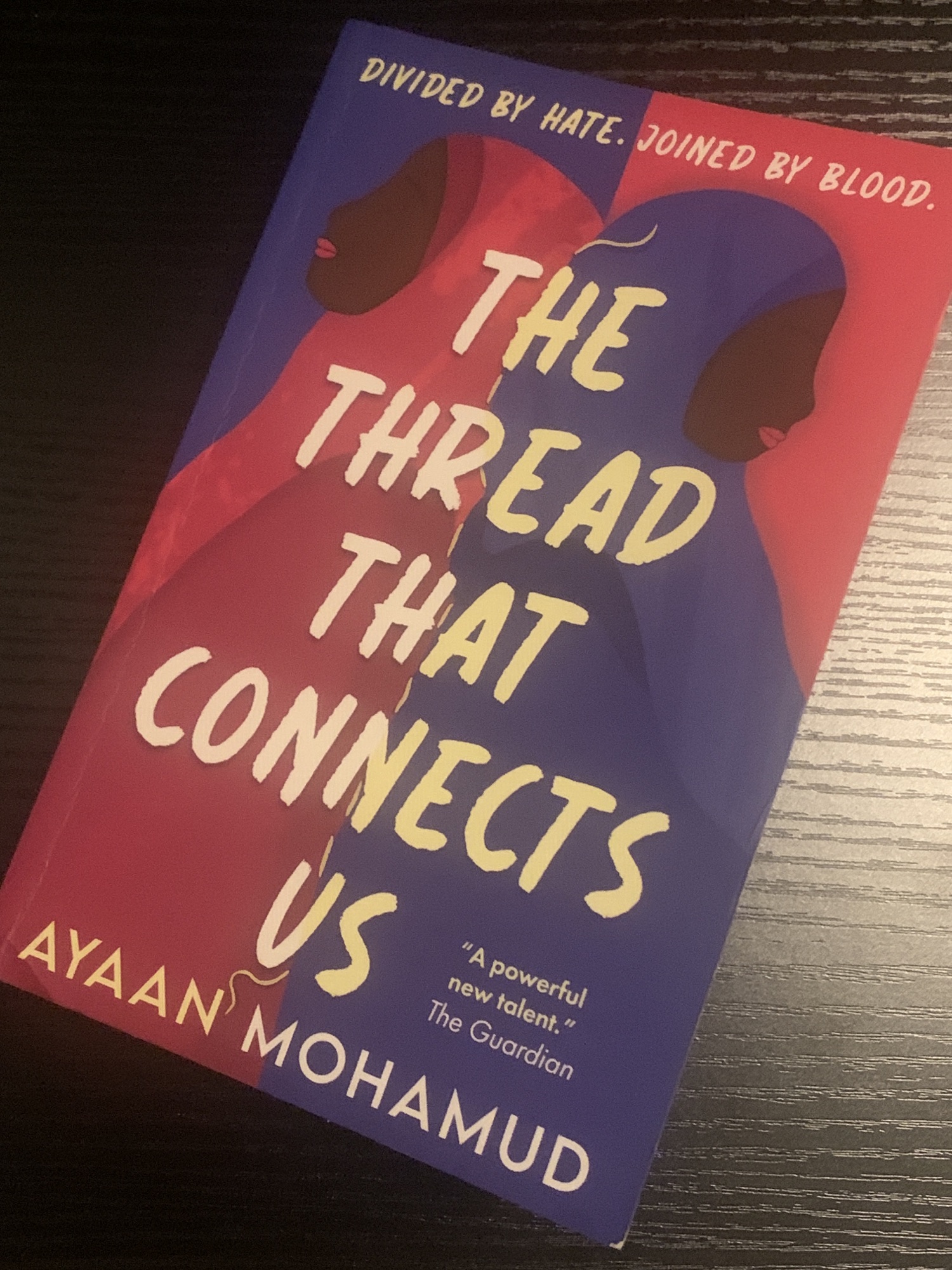
The Thread that Connects Us by Ayaan Mohamud

Standard
The Thread that Connects Us by Ayaan Mohamud


At just over 400 pages this book expertly blends the stresses of school, bullies, and friends in the UK with the twists and secrets of broken families, shattered hearts, and a past that needs to be reckoned with.  Told in dual perspectives from girls thrown together by the actions of their parents, Safiya and Halima maintain distinct voices that are rich with Somali culture, Islam, vulnerability, and ultimately love and hope.  The book is YA, but the premise is a bit mature and is better suited to older teens in my opinion, I think a high school book club would be wise to consider this book, as once you start reading, it is difficult to put the book down. 

SYNOPSIS:

Safiya is mature beyond her years.  Since her father abandoned her and her mother five years prior, she has managed the bills, the upkeep of the home, and for the most part her grades. Hooyo checked out and is rarely more than a silent being curled up unable to care for herself, much less her daughter.  With the the help from the community, particularly her best friends and neighbors Muna and Yusuf, Safiya has a found family that helps her weather the tough times.  When her dad moves back to London with his new family from Somalia, Safiya is forced to deal with not only all the painful memories of her past, but also the very real presence of her family living in her neighborhood, showing up to Eid prayers, and taking over the safe haven that school has often served as when home life has been so cold and lonely.

Halima’s father died when she was young, and life with her Hooyo in Mogadishu was good until her mother remarried, Safiya’s dad.  Her two younger half brothers that came further added to the rift between her and her mother, and now that they are moving to England with the husband, despite her protests, has her plotting a way to return to her home.  The language, the culture, the weather, are all added stresses to finding her way, and are compounded when she gets paired up to have Safiya show her around and help translate for her in school.  

The two girls hate each other, at least they have that in common, but their inability to avoid each other forces them to interact more than either wish to do.  As questions, and secrets are voiced, the two girls realize that they might have to work together to get what they want, and figure out their past.

WHY I LIKE IT:
I really enjoyed the owning of the characters’ language and culture and faith and how easy it was to be invested in their world.  Nothing pulls you out of the story, it is rich and lush and the reader can figure out why even though there is a crush, nothing is going to happen, and why they are wearing hijabs, and waking up to pray fajr, the balance is both inviting and educating, without the reader even realize it is happening, because hello, we are to busy trying to figure out what these two girls’ parents have done. 

The story has layers, and the emotional attachment I feel to both these girls, made me glad the story was over, they deserve some peace, but also desperate to know that they are going to be ok in the future too.  I can’t say too much without the risk of spoiling, but the writing is strong, the plot solid, the details intentional and relatable, and the characters very real.

FLAGS:

Lying, bullying, fighting, assault, crush, drug use, arrest, accusation, gossip, abandonment, relationships, edibles, affairs.

TOOLS FOR LEADING THE DISCUSSION:
This would be such a great upper high school read, the way the story unfolds will keep readers hooked from the first page and motivate those that start, to finish.  Students will see themselves in the characters, and be sleuths themselves trying to uncover what secrets are true and how do the pieces of the puzzle fit together.


Vultures in the House of Silence by A.R. Latif

Standard
Vultures in the House of Silence by A.R. Latif

img_7966-1

This 312 page richly imagined Islamic fantasy is both engaging and compelling.  It is too advanced for me to review as it weaves a complex tale based on history, religion, fantasy, and imagination.  I do know that it was for the most part well written, I have some issue when the character’s diction would include words that felt too contemporary slang, but it didn’t happen too often.  The pacing though, unfortunately for me, was definitely off.  Undoubtedly the author has tremendous skill.  The emotional pulls, the world building, the consistent cliffhangers at the end of each chapter, kept me curious to see what would unfold.  The story beats just dragged more often than they should have for no clear reason in developing the plot, defining character arcs, or adding to the rising action.  I don’t think I ever stopped reading at the end of a chapter, those hooks were well placed, but when I stopped in the middle of the chapter, it often took four or five days for me to be motivated enough to open the book back up.  I truly think it just needs a good editor to help cut certain scenes, and smooth out the tempo.  The idea and layers are great, and if I, as someone who struggles with middle grade fantasy, couldn’t walk away from this YA/Adultish read, I’m sure lovers of fantasy, jinn, monsters, Islamic history, found family, gray characters and action, will find this book an enjoyable read, even the slow parts, that  I struggled with.  So no this is not a negative review,  I am hopeful my teenagers will read it and enjoy it, I just really hope the author will consider working with an editor to elevate the text as it truly has potential.

SYNOPSIS:

I don’t know that I can retell the story, it has a lot going on and I’ll probably inadvertently spoil something, so here is the summary from the back of the book:

“A boy wakes up surrounded by corpses. Unable to move, he is assaulted by vultures who stop pecking at him only when he speaks. To survive this nightmarish ordeal, he tells them the story of how he ended up on their menu…

What follows is the wild tale of the young gardener Khurafa, coping with the aftermath of the Mongol invasion of Baghdad and the death of his parents amidst the bloodshed. After a vivid dream and several supernatural encounters, he becomes convinced that an ancient group of nine sorcerers called the Servants are bent on world domination. Accompanied by his scholarly mentor Shaykh Nariman, and the sly, uncannily perceptive Zakiyya, he seeks saintly help against the Servants, but finds mostly monsters instead.”

WHY I LIKE IT:

I love the opening, it really grabs you, the emotion of Khurafa and the loss of his parents and his predicament with the vultures connects you to him and his vulnerabilities.  The twists are also well developed and keep the book interesting.  I feel like the end needed more, and the middle needed less.  SPOILERS: I didn’t get the cat, or the going from village to village.  All the names, and all the drama at each village, dragged for me.

It appears the book is meant to be a series, so I wonder if many of the characters that died will return, but I feel like the final battle was a little disappointing, and anti-climatic.  All the build up and then it went so quick.  I appreciated the full circle on the House of Silence, and the answering of some of the questions, but for all the emotion  at the start, the end didn’t mirror that in the cathartic way I hoped it would.

I say all this with full acknowledgement that I am not drawn to fantasy, I am not well versed in Islamic history, and it is absolutely possible, that I just don’t get it. In brief, I am not the target audience.

TOOLS FOR LEADING THE DISCUSSION:

I think this book could be a good book club selection, with some motivation to get to the end, I think readers will be happy that they did, and I would imagine they would be willing to read the next book in the series. For many I would imagine it would be the first Islamic fantasy they will have read that has the layers, richness, and intrigue that this book does, and inspire them.

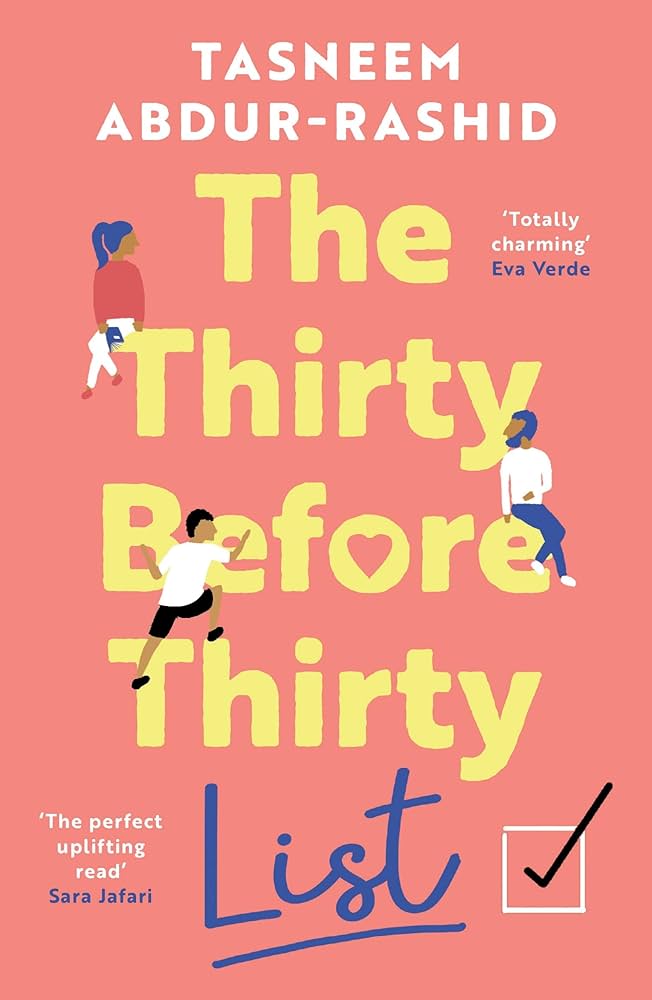
The Thirty Before Thirty List by Tasneem Abdur-Rashid

Standard
The Thirty Before Thirty List by Tasneem Abdur-Rashid

This is the second book I’ve read by the author and while I didn’t do a full review of the first (Finding Mr Perfectly Fine), I am going to do a full review of this one, because the book might not be “halal, halal” or intentionally Islam centered, but with a robust Muslim cast it stays impressively clean and there is a lot of Islam present.  I’m glad I bought a physical copy so my nieces or my daughter can pick it up and enjoy Rana’s growth and antics.  The book is nearly 400 pages long, but they fly by, and if you are 16 and up looking for a rom com style escape book this will fit the bill.  The only thing that really gave me pause is an early label the protagonist slaps on her self as “not being a devout Muslim.”  I get the point is to not let the stereotype of an arranged marriage and strict brown parents overshadow the initial impression of the book, but the author is a better writer than that early statement indicates.  As the story progresses you see her Islam IS very much part of her identity, her environment, her outlook, and the author shows it in relatable nuanced ways that the early “telling” was not needed.  Yes, the book has the protagonist and a different boy or two alone at times, and there is some hand holding and a few hugs, but the intention is always to find a spouse, and religious lines are usually clearly on the character’s radar.  There is some talk about mortgages, and a side Muslim character that has a girlfriend he keeps secret as they go on holiday together, but again, nothing obscene, or defensive, just realistic actions from contemporary characters viewing things their own way and doing the best they can.

SYNOPSIS:

Maya’s life is pretty predictable, she lives at home, goes to work, hangs out with her childhood friend on the weekend, and dodges any attempts to be set up for marriage.  Then one day on the tube a mysterious stranger, Noah, his leather bound notebook, and everyone else in her life moving forward, prompts her to open the notebook and copy his 30 before 30 list.  Adapting what doesn’t make sense at all for her life, she never peeks ahead, but rather takes one adventure at a time.  When people from different circles in her life start interacting, and Noah reenters her life, Maya will have decisions to make and a new list to commit to, her own.

WHY I LIKE IT:

I needed a diversion, I was going to be spending a few consecutive days in waiting rooms at hospitals and knew I’d need something light, easy to read, pause, and return to, and something to make me smile.  Maya is likeable, and her family and friends relatable.  Her Bangladeshi and British culture add depth and I was genuinely surprised and appreciative with how much Islam managed to find its way in to the plot and character arcs.

FLAGS:

Relationships outside of marriage, nude model, lying, hugs, hand holding.

TOOLS FOR LEADING THE DISCUSSION:

This would make a great adult, college, or even 12th grade book club selection, for just a fun book to laugh about and enjoy with friends.  It isn’t that deep, but there are threads that will hit, and to chat about it will bring friends closer together.

The Hysterical Girls of St. Bernadette’s by Hanna Alkaf

Standard
The Hysterical Girls of St. Bernadette’s by Hanna Alkaf

This 352 page young adult mystery, thriller could possibly be classified as magical realism, or speculative fiction, I’m not really sure, but I do know, that my expectations were really low, and I was so pleasantly surprised by how the story pulled me in and kept me engaged.  Told primarily by dual points of view, Khadijah and Rachel, the book offers commentary on sexual assault and believing victims.  The book starts with a trigger warning of “ghosts and monsters, some of whom hide beneath human faces. It includes discussions and descriptions of sexual assault, trauma, and PTSD,” before diving in to a prestigious Malaysian girls school full of secrets, hysteria, and a past that seems to be repeating itself.  There are no religious identity crisis or issues, the student body is diverse and it is a non-issue, Khadijah recites Ayat ul Kursi, makes time to pray, and wears hijab as she tries to figure out what is making the students at St. Bernadette’s scream, what happened to those that have gone missing, and how to overcome the trauma that has made her stop speaking.  The symbolism is solid, the book starts out with the screams, but builds on it by adding backstory to the main characters, mystery with the disappearance, and numerous red herrings to keep the reader guessing.  I told myself to get to the midpoint before calling it quits, but once I was there, I read the second half of the book in one sitting. I appreciated that the book was unique, there was no relationship side stories, the cultural authenticity heightened the reading experience, and that I understood the haunting magical elements.

SYNOPSIS:

St. Bernadette’s is an old prestigious all-girls school, but one day a chain reaction of girls screaming starts and the hysteria doesn’t seem to be stopping any time soon.  When Khadijah, who is dealing with her own trauma of being sexually assaulted by her step-father, starts to look into the causes, more questions than answers arise.  In efforts to protect her younger sister, Khadijah discovers not only has this happened as their school before, but it doesn’t stop with the screaming, and the shadows, last time a girl went missing.

Rachel’s life is controlled by her single mother, who is determined that Rachel is successful and a reflection of how perfect and successful they are, despite, Rachel’s father abandoning them.  When in an act of rebellion Rachel signs up for monologue competition, she plans to get into character, not to become the character.  As Rachel starts to lose her self to the girl with pink lipstick and white ribbons in her hair, she starts to notice sights and sounds around the school, but when she falls victim to the screaming hysteria herself, will anyone care enough to save her?

WHY I LIKE IT:

So often with magical realism, I honestly don’t get it, so I’m not sure if my excitement of having it all be clear means the book was a bit simplistic, if I’m getting better the more of the genre I read, or if the writing was just good.  If I’m being honest, it is probably a little bit of all of it.  Often with the author’s book, the story is really good, until it is not, and I honestly feel like this is her best book yet, with the threads coming through, the ending feeling satisfying, the pacing being consistent, and the plot not getting lost on tangents and over explanation.

I loved the symbolism of screaming and it being largely brushed aside as society’s collective apathy to victims of sexual assault.  No one at the school has answers, no one likes questions being asked, everyone just wants to carry on as if nothing is happening, and the juxtaposition of the silence and the hysteria for me was powerful. A few plot holes were the result of telling over showing such as the case of the Khadijah and her sisters relationship, but that Khadijah stayed largely silent throughout the book, did not mean she was unable to communicate or not present, and I thought it was shown in a meaningful way.

I liked that the overbearing mom, with high expectations, and lacking emotional maturity was not from the Muslim parent, at least in Western literature, that is a common trope.  But it is worth noting that presumably the rapists mentioned in the story are Muslim.  Their faith is not a factor, but I noticed, and so I do feel that should be shared.

FLAGS:

Sexual assault, ptsd, rape, kidnapping, trauma, hysteria, lying, ghosts, monsters, magic, fear

TOOLS FOR LEADING THE DISCUSSION:
I think this would be a great high school book club read.  The conversation about sexual assault, both in the story and in real life would be important to have in a safe space.  The triggers would require some evaluation if the book is a good fit, but I think the elements that unfold and the commentary on expectation, honesty, trauma, monsters, etc. would create incredible discussion.

With All My Heart by Aasia Khan (Book One in the Exciting New Maren Springs Series)

Standard
With All My Heart by Aasia Khan (Book One in the Exciting New Maren Springs Series)

img_6993-1

I would assume this 185 page book sets out primarily to be a wholesome halal romance and to that end it probably meets its goal and gives teen Muslim girls a sweet idyllic fluffy love story within the bounds of Islamic rules. The main couple are hinted at as being alone a few times, but they are aware of it, and there is no touching, the intent is always to marry, it is worth noting there are birthdays celebrated, females singing in front of males, some element of threat, murder, criminal activity and hinted at (not described) obscene images. So for what it is, it is a fine, but for anyone not clamoring for any and all clean halal romance books, the plot is very, very weak, the climax none existent, the lacking rising action incredibly frustrating given the premise and thus potential of the book. Even the plot holes are a bit hard to overcome, even given their propensity in the genre. Written in third person omniscient keeps the book at arms length, and further prevented me from connecting with any of the characters.  The entire path the book will take is established in the first few pages, and with no twists or turns, or emotional connection, the book drags.  The perfect wealthy family of hafizes, that have no flaws, fix and provide everything and make no mistakes, are too unrealistic for me, and I found it off-putting, which isn’t to say your 14 year old dreamy eyed daughter won’t absolutely love it, but for me it is rather forgettable.

SYNOPSIS:

Two brothers, married two sisters and each have a son, the boys are raised as brothers.  At some point a family friend’s daughter, Layla, drinks from a bottle that contains the breast milk of Asad’s mom, and thus Layla becomes his “foster” sister, but not Usmans.  The baby the milk was intended for passed away early on, and through it all the families stay in touch, but never again meet.  The children, Usman and Layla have not met since Usman was 5 and Layla 1, yet they think of each other often and don’t know why the families keep apart.   Both can sense each other, identify what they have touched, and where they have been.  When Layla’s parents are killed and Layla turns up at the family’s estate in Maren Springs, Usman knows he will marry Layla, as the family welcomes their missing foster daughter/niece home.

WHY I LIKE IT:

I honestly had to read the prologue five times, and I flipped back to it while reading at least that many more times, and the book is not long.  The term “foster” threw me off which is my own ignorance, but alhumdulillah the book does eventually explain it and my Lit Sisters helped me to understand that in Arabic it is Radhaa’a which translates to “foster” to describe when mother’s milk is shared and the relationships that result.  I don’t know that the family tree is necessary, I suppose it helps since the parents are called by their first names, but it should have been in the front if included, it was a bit odd at the end.  Similarly odd is the book claiming itself “exciting” on the cover.  Blurbs are usually from others describing their thoughts or excitement about the book, not part of the title from the author, I also don’t understand why the fictional location is Maren Springs is in the title, when the four main characters work and live 4 or so hours away in Orkney. They should just live and work in Maren Springs, I didn’t see the benefit of them commuting every other chapter for no reason, and taking up unnecessary page space detailing if they were here or there, coming or going.

I feel like the book would be better in dual point of view, the characters as written don’t stand out, and there is too much telling and not enough showing.  Layla is shown to be helpless, but told to be strong, and the brothers too overly good, there needs to be more backstory of the characters, to ground them, flesh them out, and make them more interesting.  As for the plot, (SPOILERS) had the cause of why Layla was running, the murder of her parents been a looming threat, the blackmail emails with doctored images, the witness protective program been woven in, the book would have had readers intrigued, and on the edge of their seats.  Sadly it is all glaringly absent, and thus it becomes so dry just to read page after page about everything being perfect and then when it isn’t, the brothers just take care of everything in a few sentences to resume it to being, you guessed it, perfect.  The idea of Layla being on the run after her parents’ death and finding refuge in old family friends, is a great set up, but there is absolutely zero follow through. Layla doesn’t even know where the boys work, the name of the company, the reader is never really sure what they do, what anyone’s skill or academic background is, it is very vague.  At times it is downright juvenile that the heads of the company are called “big bosses,” the magical realism connection between the couple, referred to as the “alien” or “Martian” connection. Clearly the premise of the relationships and the positioning of bringing everyone together was thought through by the author, but the execution on the page sadly doesn’t reflect it.

I know in the romance genre the plot holes are always present, but to have them so early before any character development has occurred provides little incentive for the reader to overlook them because they are invested in the story.  A love connection between a 1 and 5 year old is a pretty big leap the reader is expected to be ok with, no backstory showing how close the families were, no phone calls or Facetime sessions, just letter writing, doesn’t convince the reader that there is a foundation to revisit when tragedy strikes.  The ease in which the “climax” is resolved and minimized feels dismissive and will highlight the missed opportunity even to younger readers.

I know this reads as a harsh review, but I wouldn’t have bothered writing my thoughts up if I didn’t think there was some potential for revisions to be made. The book isn’t awful, it just really is close to being a lot better than it currently is, and I hope the author will consider revisiting the story and elevating it (the benefit of Amazon print on demand) to a book that our Muslim teens can fall in love with.

FLAGS:

Some threat, birthday celebrations, singing in the car in mixed company, murder referenced, fear

TOOLS FOR LEADING THE DISCUSSION:

I purchased the book and will get it to the Islamic school library, but it isn’t a candidate for a book club selection as there is nothing really to discuss.