
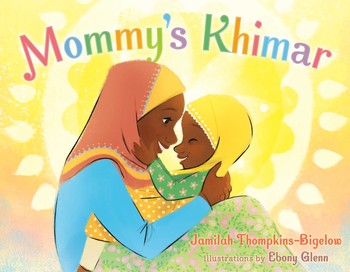
Children playing dress-up with their mother’s clothes is a universal activity, that most can relate to. Playing dress-up in your mother’s khimar is what makes this book both familiar and stereotype breaking in a way that is actually pretty powerful.

In this 40 page hardback book targeting 4-8 year olds, Salaam Reads, once again brings Muslim characters to the masses, without alienating or talking down to either Muslim or non Muslims readers.
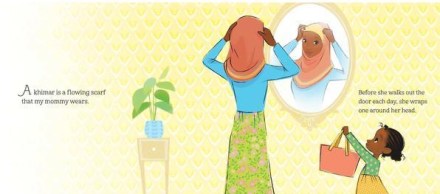
The story starts off with a little girl explaining that “A khimar is a flowing scarf that my mommy wears. Before she walks out the door each day, she wraps one around her head.” She then marvels at the variety of scarves her mother has, commenting on the colors, and prints, and designs, that by the time she is ready to use them as her favorite make-believe accessory, readers will be wishing they too could have such an assortment.

From using a khimar to be a queen with a golden train, to being a shooting star, the reader also along the way learns that she loves the connection the khimars offer her of her mother, when she isn’t near. The ladies at the masjid are also part of that connection so that when she dreams of all the fantastical pretend things she can be, she also knows they too are with her. Even her grandma, Mom-Mom, who exclaims “Sweet Jesus” when she sees her in her yellow khimar, and loves her although she doesn’t go to the mosque like the little girl does, is a part of the love and support the little girl feels by those around her when she is wrapped up in her mother’s khimar.  I love that it stresses even though her grandma is not Muslim they love each other because they are family. Muslims and Islam are never mentioned outright, just the mosque and the ladies saying Assalamu alaikum, hint at the khimar being worn for religious reasons.

Perhaps the best part is the pictures. The illustrations with their yellowish hues radiate warmth and the faces and smiles are good for the soul. You can feel the love the little girl both receives and gives to those around her through the pictures that perfectly compliment the simple text.
The diversity of the book in the main character being a girl, a child of color, and a Muslim, is such a beautiful thing to see. Stories like this are powerful tools when children see themselves in books with positive messages, and remind us all how much more diversity it needed in literature to both highlight our differences, and celebrate our similarities.











 The story definitely makes readers appreciate the life they have, and realize how simple and harsh others’ lives can be. I like the mention of the foods, giving insight into the culture, but I didn’t like the harshness of the adults. The calling the boys lazy, not taking Muktar food as he tends the camels, not being concerned about the injured camel until Muktar insists he notices, all made me a bit sad. Yes I was glad that Muktar was able to resume a nomadic life with camels, but he wasn’t given a say in it. And sure I’m glad that his friend Ismail will get books and be able to work toward being a teacher, but somehow it wasn’t a warm book, and I can’t quite identify why.



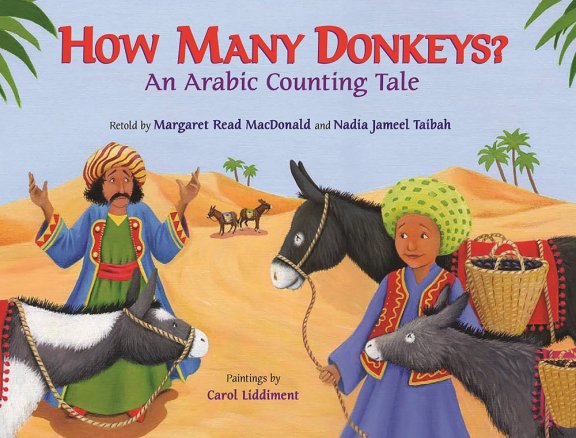
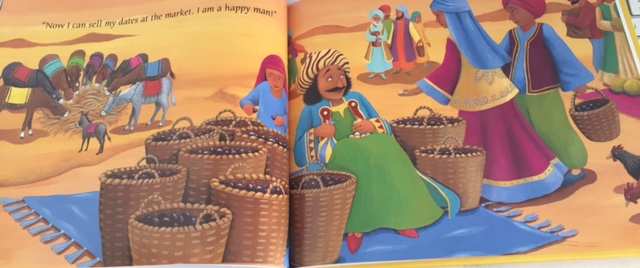
 Even if you know how already, your little one will enjoy figuring out why the main character Jouha can’t figure out how many camels he has in his caravan. While Jouha thinks, it has to do with whether one runs off while he is riding, and comes back when he is walking, hopefully by the second or third time, most kids will realize that he isn’t lucky or unlucky, he is just forgetting to count the one he is riding atop of. Probably good for ages 3-7, the book is silly in its repetition, and the beautiful painted illustrations bring the characters emotions to life.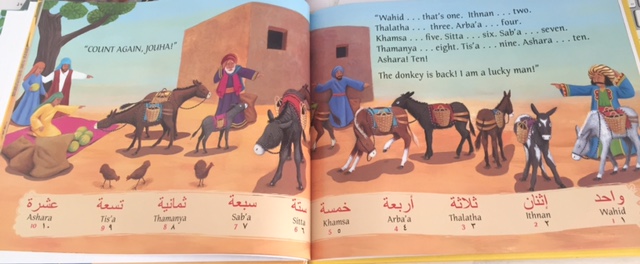
 Islamic School Librarian