Category Archives: Kg-2nd

The Great Henna Party by Humera Malik illustrated by Sonali Zohra

Standard
The Great Henna Party by Humera Malik illustrated by Sonali Zohra

img_3465-1

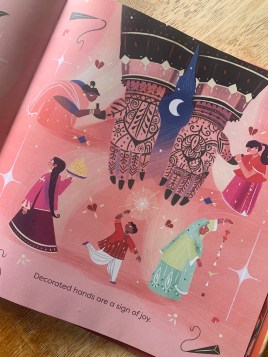
This 32 page story shares a desi family at a henna party before a wedding.  There is nothing Islamic in this book by a Muslim author, it is simply cultural.  The story on its own is fine.  It is sweet and joy filled, as a girl tries to decide who’s name to have hidden in her henna design.  I do wonder though, if the book is meant to be a window into desi culture, why the Urdu word “mehndi” isn’t used instead of henna.  It mentions it in the backmatter, that mehndi is the Urdu word, but it seems a little inauthentic and western gaze presenting throughout the story, and honestly I really struggled to get past it.
img_3466-1

The book starts with Noor entering the henna party, the night before her cousins wedding, to sing with the ladies of the family and have their hands painted.  Her mother asks her if she knows about the name game, where the bride hides the grooms name on her hands, and if he finds it, he wins, and if he does not, the bride wins. Noor asks if she can hide someone’s name and her mom says yes, just tell the artist.

img_3467-1

She watches her dad setting up decorations and wonders if she should have his name hidden.  She then sees her Mama playing the dholki and singing and wonders if she should hide her mother’s name.  She continues through various family members before making her decision.  Along the way the reader learns about the music, the food, the clothes, and how the paste dries and leaves a color.

img_3468-1

The page on food starts with spices, then talks of samosa and then they are eating ladoo, and while I’m glad there is not a glossary, I don’t know that the lacking context clues make any of those scrumptious foods known. I do like that her grandfather helped her pick out her lehenga, and her father is shown decorating to show full family involvement.

Ultimately, though I think the tricky thing about cultural weddings, is that every family has their own traditions, and while in a desi wedding some things might be widespread, when presenting them to readers outside your culture, it is hard to know how they will be perceived.  I almost feel like this book makes it seem that every family hides names in the mehndi as a staple of the festivities. And based on other reviews I’ve read, people seem to feel that this is insightful into the culture, or that hiding and finding names has more weight, a stress even, than just being fun.

img_3469-1

I could be over thinking it, but it feels like even the backmatter is trying to cast a wide net over every religion and culture that uses henna and ends up being oddly vague in this specific example.  Like I said the book is adequate, I like that the little protagonist Noor, loves so many people and solves her dilemma on her own, it has plot, and conflict and resolution, it just seems to lack the exciting tone and thus fails in immersing the reader into the henna party.

Until You Find the Sun by Maryam Hassan illustrated by Anna Wilson

Standard
Until You Find the Sun by Maryam Hassan illustrated by Anna Wilson

I don’t know that this book is particularly unique or mind blowing, but I read a digital copy a few weeks ago and was surprised when some tears fell, I read it when I got the physical copy to my kids and my throat caught again, and here I am writing this review and feeling all vulnerable.  It is as if I too am a little girl in a new place missing her grandfather on the other side of the world, which clearly I’m not.  The book is sweet, and moving, and I find myself emotionally invested every time I read through the 32 pages and get lost in the large sweeping illustrations.  The book is not Islamic, there are a few hijabis in the background and text that articulates friends saying salaam before the girl moves.  Additionally, the main character’s name is Aminah, and the author is of Pakistani decent, and has a Muslim sounding name.  The story though, at its core is universal, heartfelt, reassuring, hopeful, and lovely to share in all spaces. It begs to be read aloud and holds the attention of toddlers to early elementary aged children.

The book starts with a happy little Aminah in a bright sparkly environment of sunshine, mangoes, and salaams.  Every night she listens to Da’s stories of adventure as she snuggles next to her grandfather.  One day she finds out they are moving, going on an adventure.  Only Da won’t be joining them and Aminah is devastated.

The new home is gray, and cold, and no adventure at all.  She wants to go back, but Da reassures her during their nightly conversations that things will get better.  And sure enough, with a bit of bright yellow inspiration, she starts to discover the adventures awaiting in her new home.

Kids will find the end hopeful and resolved, but I somehow found it a little bittersweet.  Da loves his grand daughter and wants her happy, but the adult me, realizes their relationship will never be the same, and Da will miss her in many ways, alone, as she embarks on her own life.  I know I’m projecting, but the ability to see both perspectives adds a nice layer to the book.

The book is available here from Amazon and will be in local libraries in June 2024.

Ilyas & Duck: Spectacular Salah by Omar S. Khawaja illustrated by Mattia Cerato

Standard
Ilyas & Duck: Spectacular Salah by Omar S. Khawaja illustrated by Mattia Cerato

img_3321-1

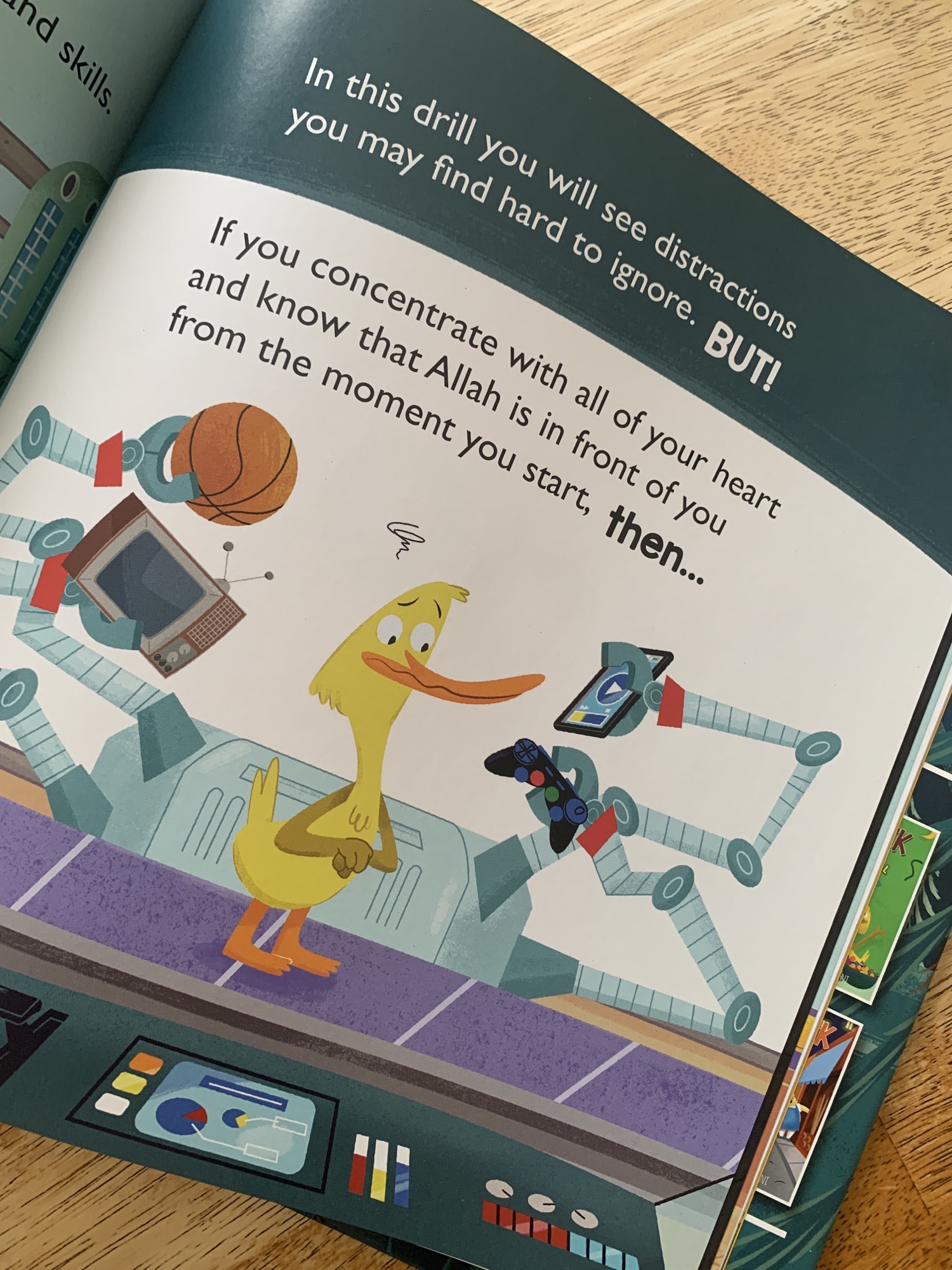
It has been a minute since we have had a new Ilyas & Duck book to read and share with our kids, and this one focusing on prayer is informative, fun, and was well worth the wait.  It is also long, 48 pages long to be exact.  There is a lot of information and works best for ages six or seven and up.  The clever rhyme and engaging illustrations tell about wudu, the times of the five daily prayers, Surah Al Fatiha, facing the Kabah, having the right intention, connecting with Allah, and not being distracted. I love the framing that salah is not just an obligation, but is an opportunity to talk to Allah swt and should be spectacular.  The author reads his books aloud a lot to kids, so if you have ever seen one of his readings, I highly recommend channeling the voices and energy, to hold the audiences attention if using the book at story time.  If reading at bedtime, or if handing to an independent reader, take the opportunity to discuss the points, check understanding, and reflect upon what Duck is learning.  As always the banter between Duck and Ilyas keeps the kids laughing, the story moving, and the information flowing, alhumdulillah.

The book starts with two verses from the Quran and the hashtag #freepalestine, before entering the world of Ilyas and Duck one summer afternoon,.  An alarm goes off and Ilyas heads off to make wudu and pray.  Duck couldn’t get up though, he prayed earlier, so he thought he was done.  Ilyas explains that there are five prayers in the day, and Duck is seriously worried that Fajr, Dhuhr, Asr, Maghrib, and Isha are going to cut in to his game time, snack time, and movie time.
When Ilyas tells Duck that prayers don’t take long and it is when you speak to Allah swt, Duck in his enthusiastic way is determined to make each and every prayer spectacular. He drafts a plan, learns the steps and what to say, finds the direction, makes his intention, says Allahu Akbar and starts training. 

He is praying all over the Earth whenever the time comes, but then he learns he can do more and goes to visit the Professor.  He learns about connection and closeness to Allah.  He also learns about using his heart and staying focused, before rushing back to tell Ilyas all that he has learned.

The book covers a lot of ground, and gets kids excited to pray.  I like that the information is a mix of highly detailed specifics, general knowledge, and humor.  The way the salah times are described and the emphasis on connecting with Allah swt and making your prayers heartfelt is not often seen in books for this age group, and I think it gives the book a wider lasting appeal.  My 8 year old did point out after reading it independently and laughing, that if Duck prayed Fajr didn’t he know a little bit about prayer already?  Also, given the length of the book, a line clarifying that infact not all places on Earth are ok to pray upon, would have been nice. 

img_3327-1

I hope this book signals more books in the series are heading our way.  I notice that the illustrator is not the same, but the pictures are similar enough I doubt most kids will notice. The book is widely available and can be purchased from Amazon here or from Crescent Moon here

Khadija and the Elephant Toothpaste Experiment by Farah Qaiser and Hajer Nakua illustrated by Natalya Tariq

Standard
Khadija and the Elephant Toothpaste Experiment by Farah Qaiser and Hajer Nakua illustrated by Natalya Tariq

img_3251-1

This 26 page book is set on Eid, it does not specify Eid al-Fitr or Eid al-Adha, but it isn’t overly impactful on the story outside of the framing, so really it is a non issue.  The book shows a Muslim family and is a benefit for appealing to women and girls in science, unfortunately it has some plot holes though.  A big point of the book is the girl, Khadija, wondering if she can be a scientist who wears hijab because she doesn’t see any scientists at the fair wearing one. When she voices this concern to her parents, her father reassures her saying, “Anyone can be a scientist.  Scientists can wear a hijab like Amma, or glasses like me.”  First of all, I don’t like it equating hijab to glasses, hijab is a religious practice, not a tool to help you see or an accessory.  I’m well aware not every book has to have Islam centered, but I do worry that if hijab is relegated to an article of clothing, and Khadija doesn’t wear hijab, that readers might just be confused and not be able to connect the dots.  With weak writing, a confusing premise, and a climax of doing an experiment, that is not included for the readers to do at home, included in the book; I am struggling to recommend this for every bookshelf.  It isn’t a bad read, it just should be better.  I love the joyful engaging illustrations, I like the female Muslim science representation even. I just ultimately think the weak writing drags the book down and will have some kids confused why she is worried about a scarf she doesn’t wear impeding on a career she doesn’t have, and be unable to see that as a Muslima she will want to wear hijab as an act of worship when she grows up.

img_3252-1

The book starts with Khadija and her family heading to her school for the science fair after Eid salah.  She sees lots of scientists, but notices none wearing hijab.  She gets a science kit to do at home and then the family starts to prepare for guests coming over for dinner.

img_3253-1

Khadija can’t wait to do her experiment so she quietly gathers up supplies, and heads to the bathroom to make elephant toothpaste. It works, a little too well, but then it is everywhere and mom and dad show up to help her clean.  Khadija wonders if she is not cut out to be a scientist.  Mom and dad console her, the people arrive for an Eid party, and her parents and her do the experiment for all to see.

The story is pretty straightforward, but I sure have a lot of questions: why is the “big day” the science fair and not Eid.  It is at her school but the science fair is not students sharing projects, but professional scientists? And does she purchase a science kit, why does her mom give it to her at the fair, but then she asks the scientist is she can do it at home? What else did she see or learn at the science fair, she just went saw scientists in lab coats, got the kit and left?  How was it still morning when she got home after the fair, after Eid salah?  There is a whole page of her getting an Eid gift and squealing with delight, but never shares what the gift is.  I also really, really wish it had the experiment in the book. I want to know what it is and why it is called, “elephant toothpaste.” I truly do not know why this book has no backmatter.  Information about women in science, how to do the experiment, maybe something about hijab or Eid. A link or scannable QR code to see the experiment would have even added something to increase knowledge and excitement for science, representation, and dreaming big.

img_3256-1

Happy Holidays! Eid al-Fitr by Rebecca Sabelko

Standard
Happy Holidays! Eid al-Fitr by Rebecca Sabelko

img_3127-1

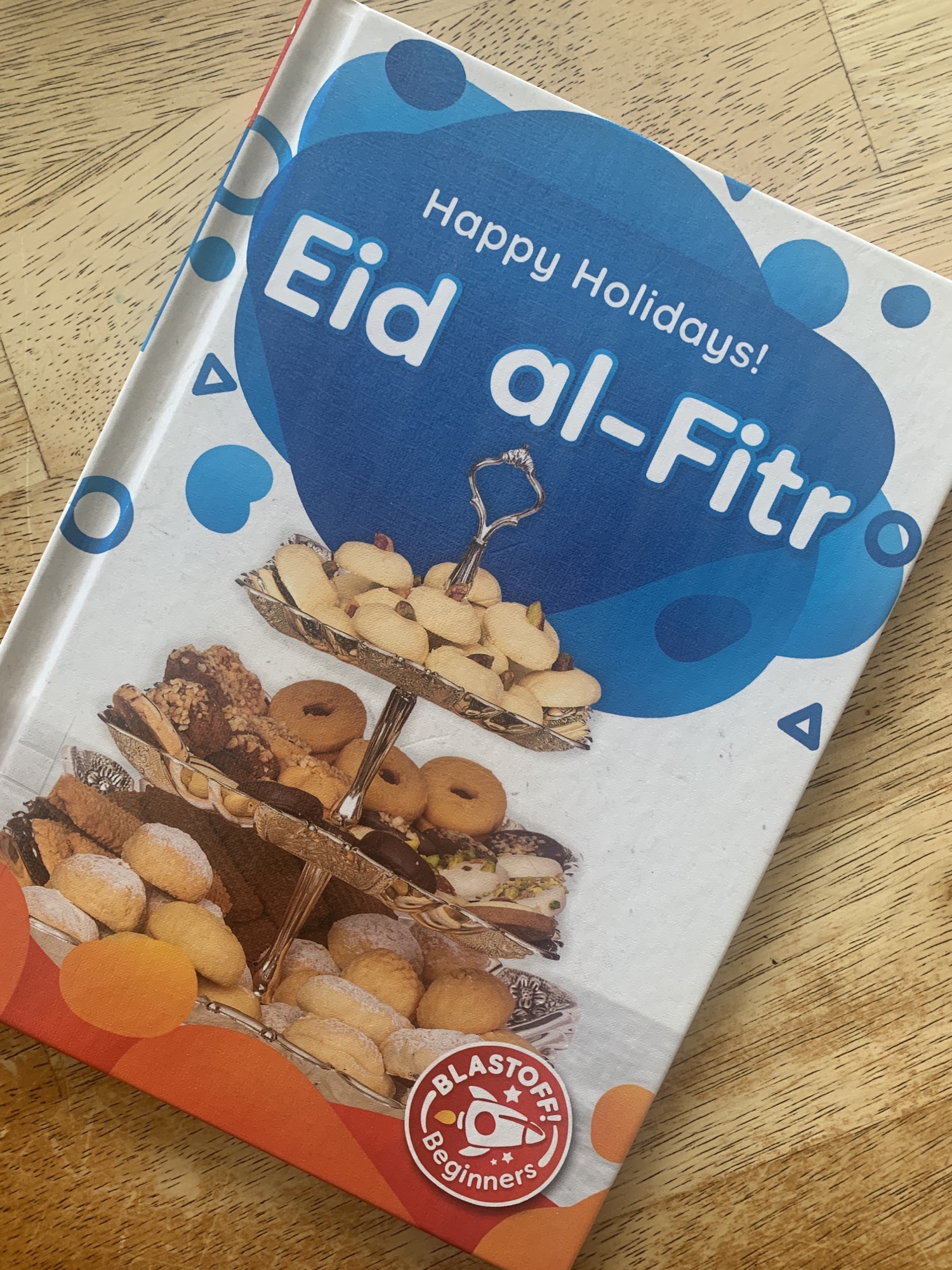
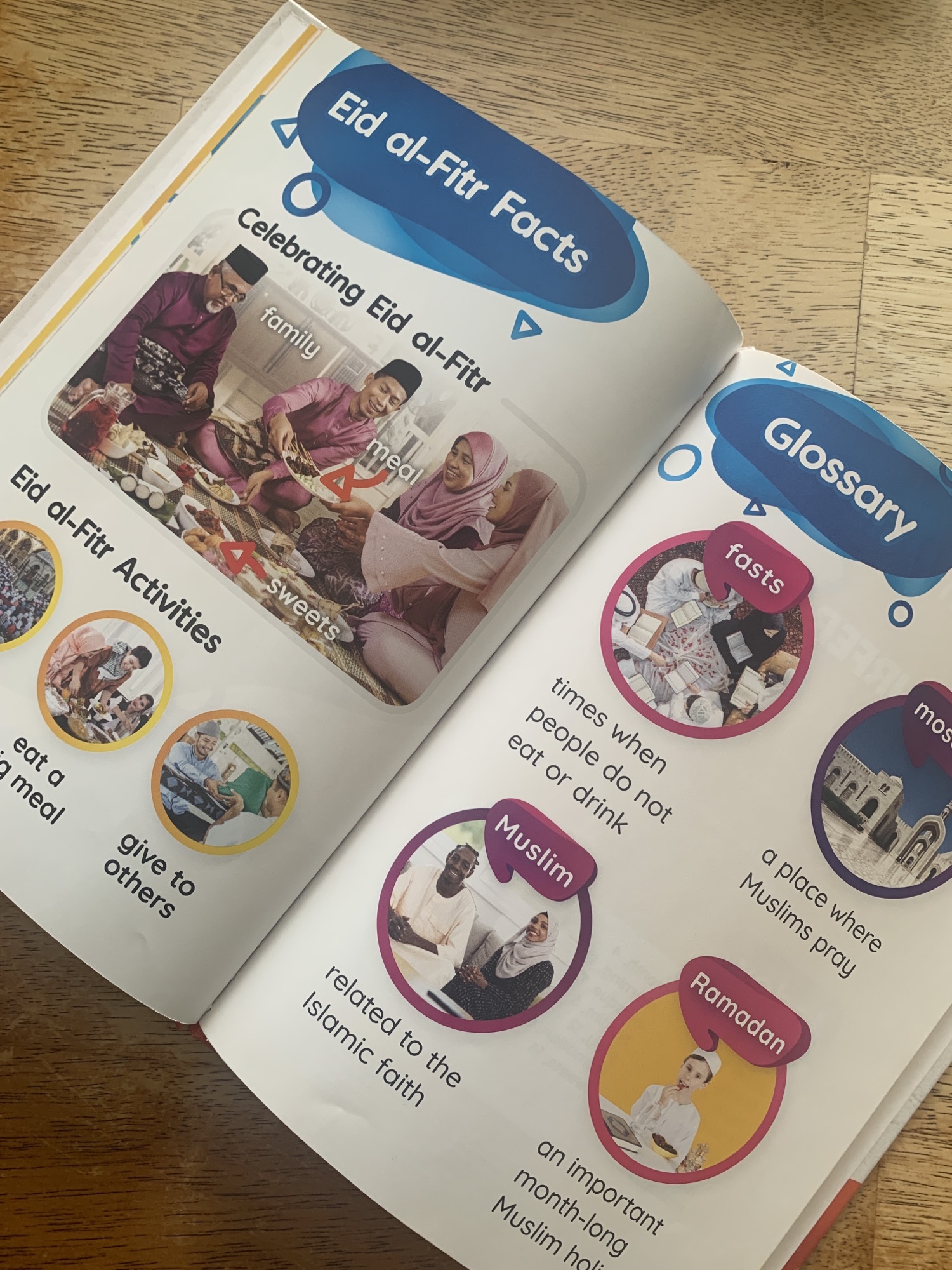
This 24 page 2023 published non fiction book about Eid, is meant for babies to seven year old according to the publisher.  A large spread of comprehension abilities that is thus required to be vague, simplistic, and at times not very successful at conveying much of anything. The large font and bright colors are engaging, and it starts out strong with sight words, and identifying Ramadan is a Muslim holiday followed by Eid al-Fitr, but then erroneously states Eid is three days.  There is then unnecessary statements such as “They honor their beliefs.” That have no clear meaning, and in fact feel a bit othering.  It seems the book is scared to say “Muslims,” saying it only once, it prefers “they,” and “people.”  Some pages are clear and accurate, but many are just awkward, such as “Happy Eid! People pray each morning.  They go to a mosque.”  It seems so stilted.  The picture glossary at the end is mostly accurate, but it defines Muslim as “related to the Islamic faith.” Overall, it seems like a little editing would clarify, correct, and even make this book a benefit, but as it is it just feels like token rep to add to a holiday library series.

The book starts with a table of contents and divides a very short book into chapters.  The first three pages tell that Ramadan is fasting, Eid is after Ramadan, and a Muslim holiday.  It erroneously says Eid is three days, and then says “the dates move each year.”  If you are aware of the lunar calendar this makes sense, I’m sure a five year old would not understand that it isn’t just a randomly selected day.

img_3129-1

Pages 10 and 11 seem vague at best, “People end their fast.  They honor their beliefs.” The previous page was taking about Eid, the following spread is about Eid, it is almost like the pages were plucked from a similar Ramadan book and erroneously dropped in to this one.

We then are at the mosque, and told people pray each morning.  I’m not sure if this is on Eid day, or every day, we do pray five times a day, and while it is good to pray at the mosque it is not required, so ultimately another unclear page.

img_3131-1

The remaining Eid tradition pages are accurate, visit family and friends and say Eid Mubarak, eating big meals and sweets, giving to others in need, and giving gifts and money.  The photographs show joy, and are bright and engaging. The Facts and Glossary at the end are then followed by an index and ways to learn more.

Looking for the Eid Moon by Sahtinay Abaza illustrated by Sandra Eide

Standard
Looking for the Eid Moon by Sahtinay Abaza illustrated by Sandra Eide

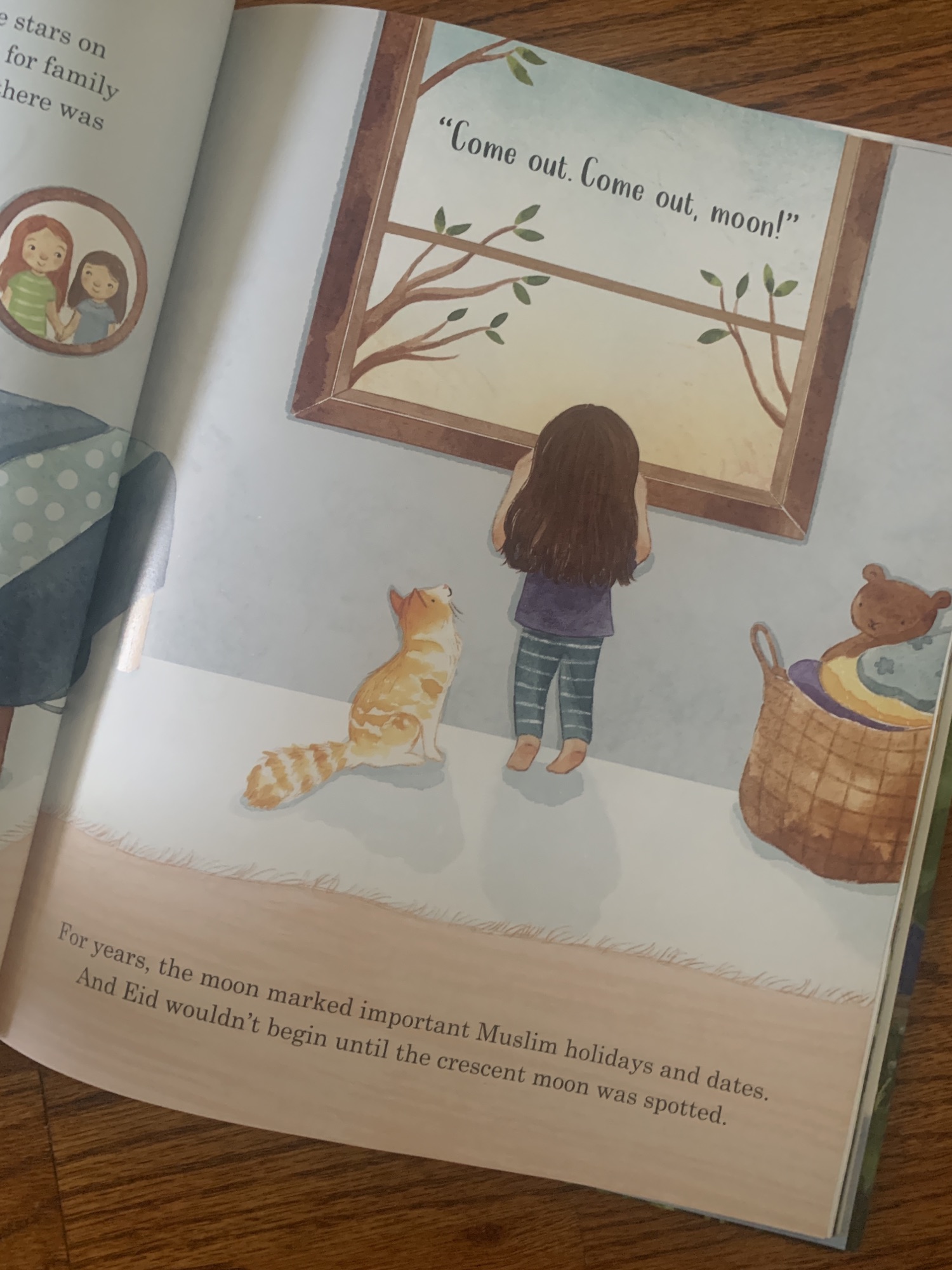
The illustrations and sister bonding in this story are sweet, but it isn’t exciting, and doesn’t feel very Ramadan or Islamic rep or even very purposeful.  I was really surprised that there wasn’t a craft activity or science tie in at the end, it seemed to be heading in that direction seeing as Eid joy, iftar, and anything religious are all completely absent. The plot really is just the title, “looking for the Eid moon.” The text feels abrupt, it doesn’t flow, and feels othering.  “For years, the moon marked important Muslim holidays and dates. And Eid wouldn’t begin until the crescent moon was spotted.” Numerous communities still rely on local sighting and have hilal committees marking all moon phases and months.   This framing of it being an antiquated practice, feels off.  The sisters are young, but Sara is old enough “to know the crescent moon is faint and hard to see,” yet she doesn’t even acknowledge iftar time, they don’t pray maghrib.  The complete removal of Islam makes looking for the Eid moon seem like they could just be looking for Mars or a comet.  It says they are excited for an Eid party, but clearly not enough to be excited it is Eid the next day, they are simply sad that they didn’t see the moon.  I’ve read the book a few times, and I truly can’t make it make sense, and I don’t understand how silver paint glows, shouldn’t it be glow in the dark paint? Sigh.

The book starts with Sara looking at her Eid dress saying she is excited for the Eid party, but first she has something to do.  She packs her flashlight and binoculars and grabs her little sister Lulu and the head out to spot the Eid moon. On their way out they pass mom hanging decorations, and she wishes them well.

In the backyard the girls watch the sky change colors and the sky is cloudy.  As it gets darker, the girls get a little scared, but mom finds them and tells them the moon has been spotted elsewhere.  The girls are sad and Sara comes up with a way to cheer up Lulu.  SPOILER she paints a ball silver, fills it with coins, and writes a note that it is from the Eid Moon, claiming this is a moon rock.  Lulu proclaims it the “best Eid ever.”

The Author’s note tells of the family’s tradition to hide and find moon rooks with coins in them, in what sounds akin to an Easter egg hunt.  It also erroneously says that Eid al Fitr is a three day holiday.  I don’t get the connection to the moon being brave and a source of light to refugees in the book, if that was the author’s intent, to show the moon as hope “when times are bleak and dark,” I’m sorry but the message was not conveyed.

Trouble at Taraweeh by Rosalind Noor illustrated by Rania Hasan

Standard
Trouble at Taraweeh by Rosalind Noor illustrated by Rania Hasan

img_3132-1

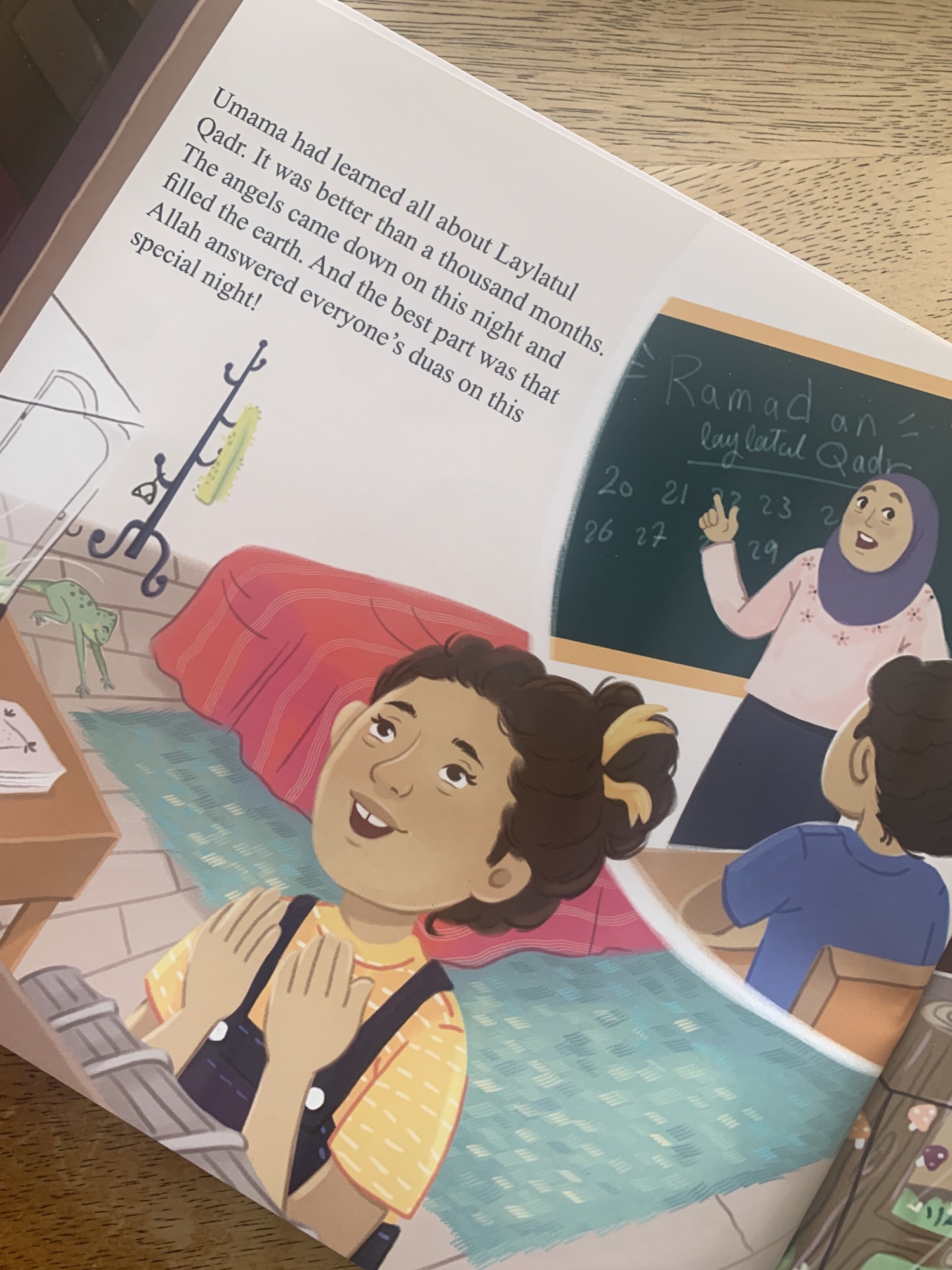
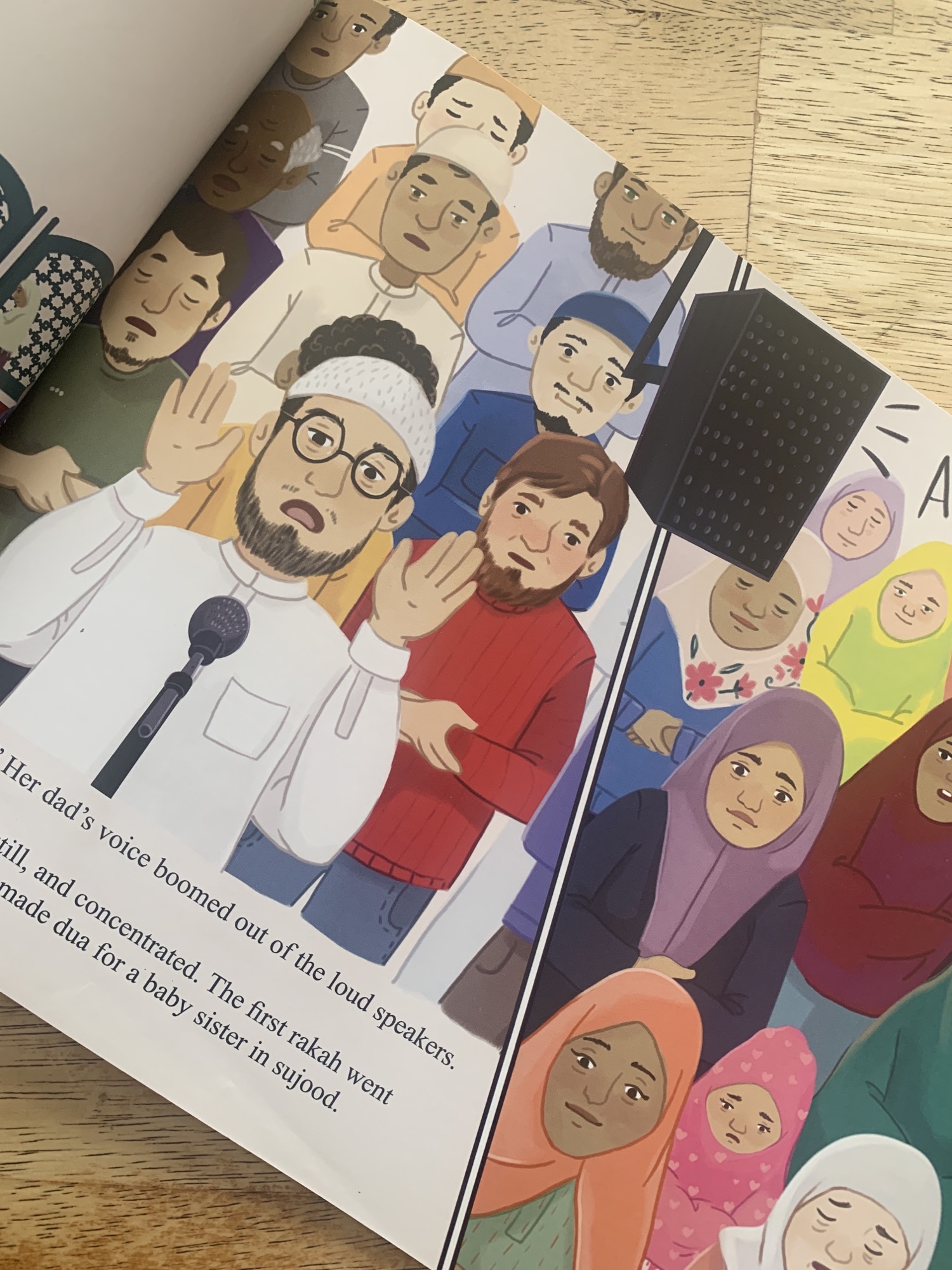
I love funny books that are Islamically accurate, Muslim filled, and informative as well.  Alhumdulliah for this outrageous Ramadan tale, that gets kids laughing and parents horrified.  A frog on the loose at Taraweeh on the 21st night, and a little girl who is a self proclaimed “trouble magnet,” focuses on Laylatul Qadr, good intentions, and Allah swt hearing our prayers.  It is text heavy, so for a read aloud, think slightly older children, seven or up, would be the ideal audience, but in a bedtime story setting the illustrations will keep younger ones engaged.

img_3133-1

The book starts with Umama looking forward to Laylatul Qadr.  She knows duas are answered that night when the angels come down and fill the earth, and she has a special dua to make, she really wants a little sister.  It is the first odd night of the last ten days and she has had an eventful Ramdan so far.  She accidently flooded the wudu area, she tripped on her prayer skirt and knocked people over, she even tried to organize the shoes, but then no one could find their shoes.

img_3134-1

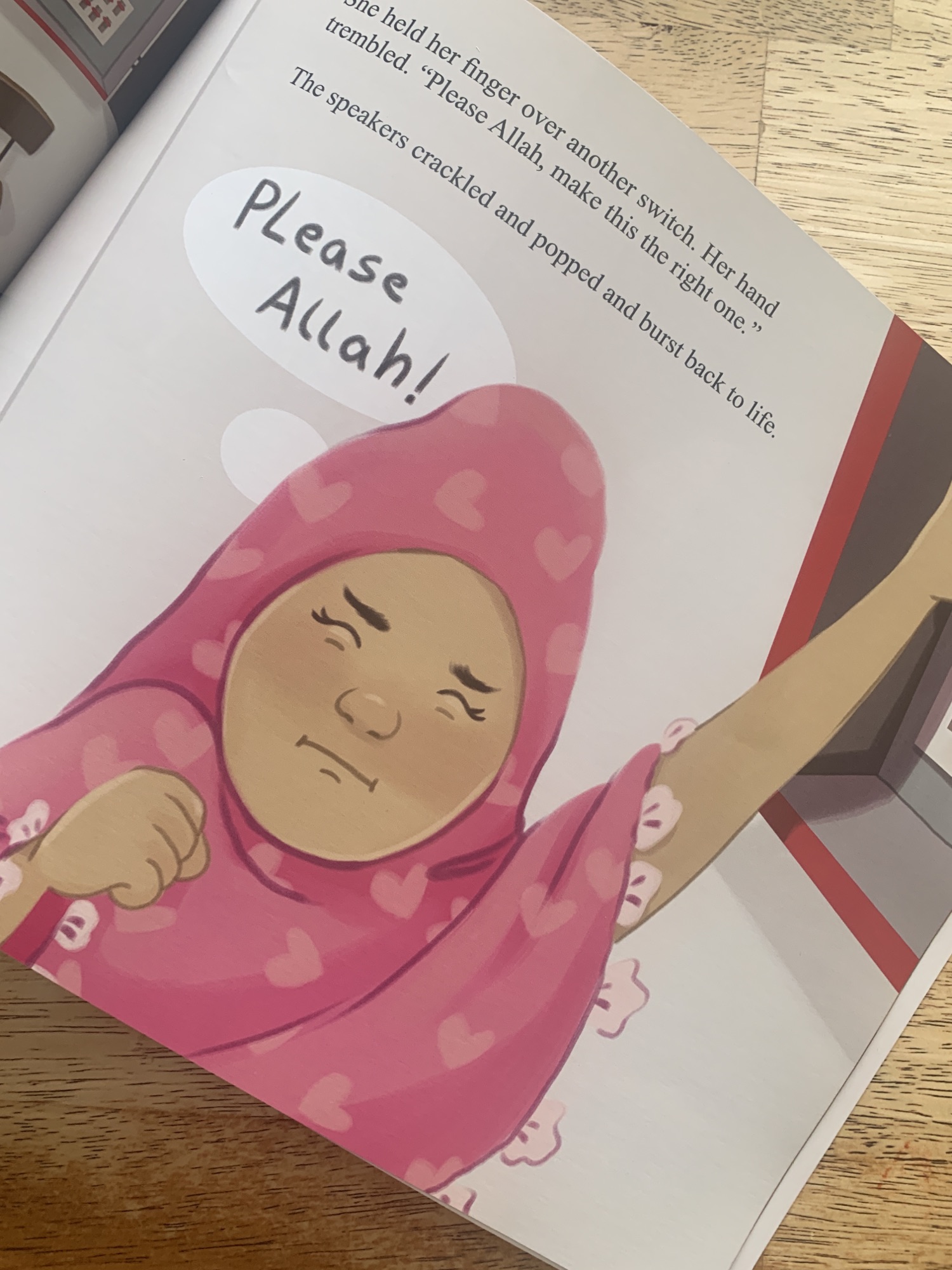
Tonight she is determined will be trouble free, which naturally means, it won’t be.  Fluffy, her frog, gets loose.  She apologizes to the woman as she scoops him off her head, but then…he gets away from Umama, and the chase is on.

img_3135-1

With plugs getting yanked, breakers being flipped, and little Umama asking Allah swt to help her make it right. The imam, her dad, keeps his cool and somehow you find yourself, parents included, feeling bad for Umama and hoping she has a smooth remaining Ramadan.

img_3136-1

The expressive illustrations are  bright and complementary to the story.  Kids enjoy looking at them and they really do help hold the kid’s attention as the story unfolds.  So many of my Ramadan staples come from Ruqaya’s bookshelf, and this is a great addition to the shelf.

The book is available here at Crescent Moon Store

img_3137-1

Read for a Better World: Ramadan and Eid Al-Fitr: A First Look by Percy Leed

Standard
Read for a Better World: Ramadan and Eid Al-Fitr: A First Look by Percy Leed

img_3108-1

I honestly don’t know who this 24 page book is for and to what purpose it would be read.  It is non fiction, it is listed for 5-7 year olds.  But the sparse text feels toddler-ish, and it is so simplified, that it doesn’t teach, educate, or inform anyone about Muslims or Ramadan, it does an ok job at showing Eid though, for the age level, I will admit that.  I know I struggle with non-fiction, it is a me problem, and I know children can handle more than we credit them for, think dinosaur and construction vehicles, but if the person reading this book with the child knows nothing to add, this book really doesn’t give even the most well-meaning adult, guardian or second grade teacher, much of anything to work with. They would do better with a fiction book and Google.  Sigh. 

img_3109-1

The book starts out with an Educators Toolbox before beginning, it encourages guidance to ask what children think the book will be about, asks them what they already know, and what they would like to learn.  It then encourages sounding out words, looking at pictures for clues, and praising the child.

img_3113-1

The first page of text has the headline of Ramadan and Eid al-Fitr with the line, “Ramadan last for one month,” immediately below, already kind of confusing an early reader, why Eid was mentioned and then not discussed.  The next page says “Muslims have a holy book.  They read it at this time.” Yes, we do, but we read it at all other times, too. The sparse words give extra weight to the words chosen, and in this case, it makes an erroneous assertion.

img_3110-1

I wish it said Muslims pray five times a day instead of “People pray five times a day,” same with when it says that People fast.  It does get it correct that we fast from dawn to sunset, so I do appreciate that.

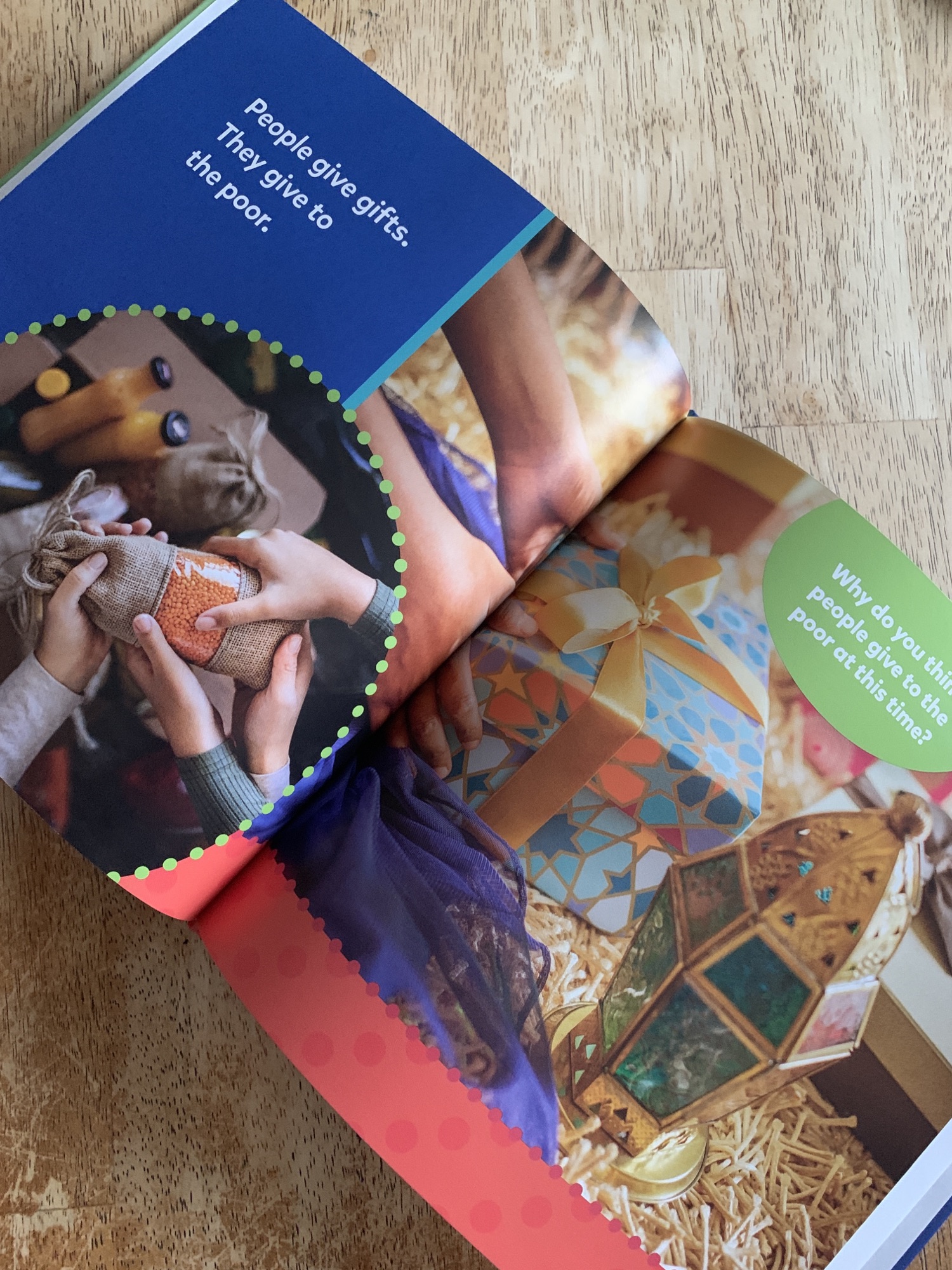
It then moves to Eid al Fitr and does a decent job highlighting that people dress up, pray together, give gifts and give to the poor, which is clear and accurate.  Again I wish it said Muslims dress up, pray together, etc. since the word Muslim is only mentioned once in the book, Islam not at all, I don’t know that the connection will be made. 

img_3111-1

The last page I don’t even know what it means, “Ramadan is for faith.  Eid al-Fitr is for giving thanks.” Faith and thanks are intrinsic to both Ramadan and Eid, so I can’t make sense of the statement.

img_3112-1

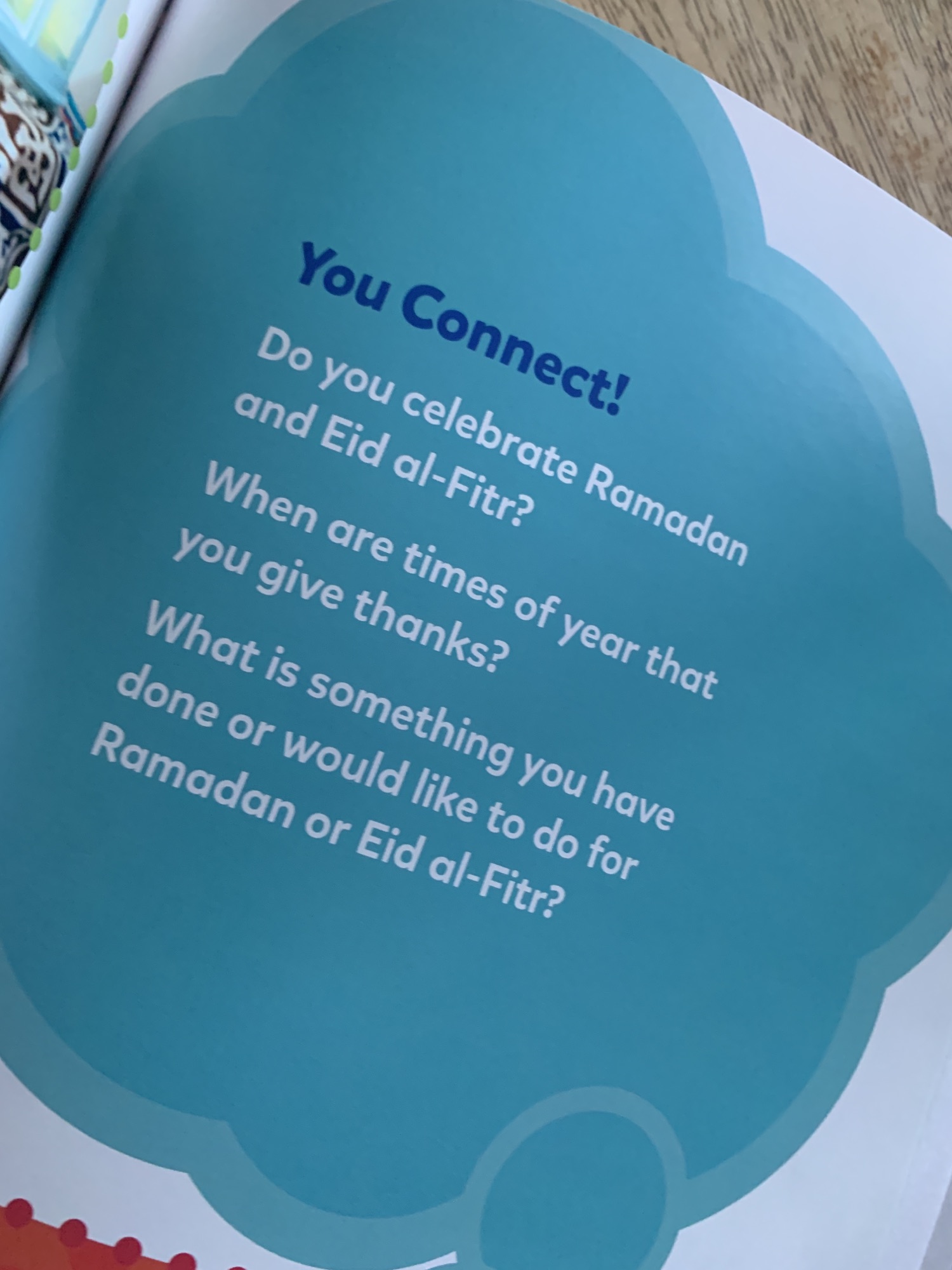
The book then has some connection questions, Social and Emotional Snapshot, Photo Glossary, and a Learn More section.  It seems like it is part of a series that ticks checkboxes for inclusion in well funded school and public libraries.  I don’t know where this book would be sought after, useful, or informative unfortunately.

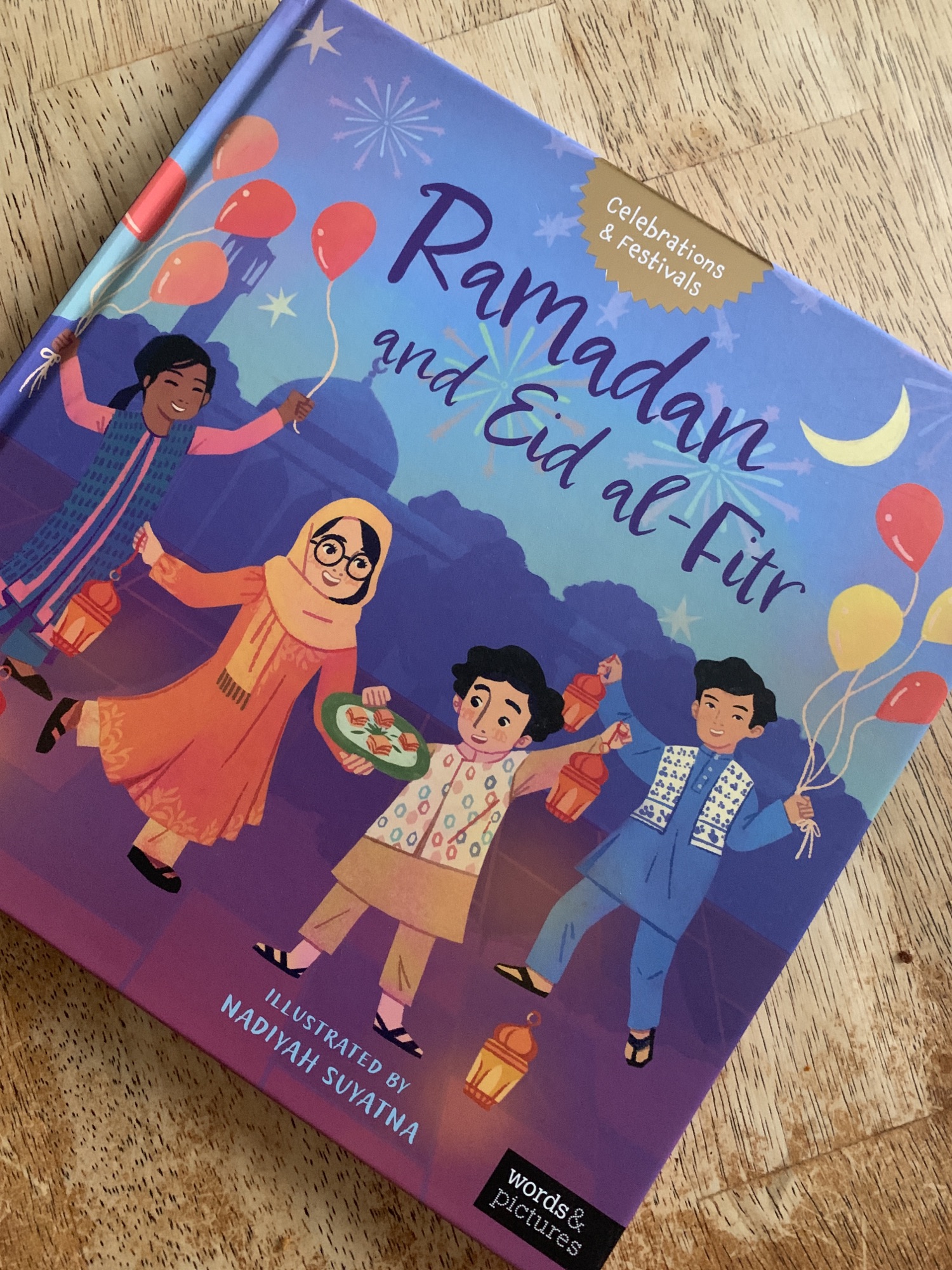
Celebrations and Festivals: Ramadan and Eid al-Fitr by Sara Khan illustrated by Nadiyah Suyatna

Standard
Celebrations and Festivals: Ramadan and Eid al-Fitr by Sara Khan illustrated by Nadiyah Suyatna

img_3101-1

This 48 page, informational based book is told through a little girl explaining her Ramadan and Eid days in a fictionalized story format. The information is not new, nor is the framing, and it has my pet peeve  line of “Ramadan is the ninth month in the lunar calendar,” but aside from that, the book does a good job of showing the joy, the activities, the faith, and the importance without self-othering, unrealistic cluelessness, or watering down. For whatever predictability the story has, the back matter is excellent. The additional information about Islam, the crafts, and even the quiz, make this book a standout in a crowded category. The book does not talk down to readers and thus works for Muslim and non Muslims alike. It also is unapologetic and informative making it a good book to share with non Muslim classrooms wanting to learn about Ramadan without crossing into “preaching.” The illustrations are warm and joyful bringing the lengthy book to life.

The story starts with Raya introducing Ramadan and then herself to the reader. She then details her Ramadan day. From sighting the moon to doing the good deed suggestions on the countdown calendar. It explains Allah swt and that adults are required to fast but kids are not. Raya spends time exploring how hard it is to skip snacks, but remains hopeful that when she is ready to fast she will be able. Her father also reminds her about other aspects of Ramadan and being on your best behavior as Raya helps set the table, donates to charity, and reads Quran. Throughout it all, informative details about Muslims are threaded through. Focusing on Raya herself also breaks some stereotypes as she discusses the joy found in a wide variety of foods from many cultures, Eid prep, looking for the moon, having henna put on, and heading out for Eid prayers and festivities. There are numerous details universal to all Muslims presented, as well as unique highlights specifics to Raya’s family such as showing the family bowling and reflecting on mini golf last year, activities that even her grandparents can participate in.

img_3104-1

The robust back matter starts with Fun Facts about Islam, stats about Muslims, details about the five pillars, etc.. The next two page spread is about the lunar calendar and has a pullout bubble explaining the use of the phrase “peace be upon him.” Then there are directions for a pop-up Ramadan card, Then information about the month of Mercy, Laylat al-Qadr, paradise, a recipe for Ramadan Cookies, info about Masjids, and finally a quiz, with answers.

img_3105-1

I like that the book balances showing joy through Raya’s personal experience, with facts about Ramadan, Eid, and Islam. I also like that Raya knows all this, my hatred of the formulaic child waking up and wondering why her family is up so early eating breakfast or a child wanting to fast and the family not supporting them is not widely realistic, and I appreciate that this book feels very reflective of what our kids feel, experience, and know about the blessed month. I also like that it features food, but does not dwell on it, and yes there are presents for Eid, but again it doesn’t make it the central factor in the joy she is feeling of being with her family.

Noura’s Crescent Moon by Zainab Khan illustrated by Nabila Adani

Standard
Noura’s Crescent Moon by Zainab Khan illustrated by Nabila Adani

img_3075-1

I know, I know, another Ramadan book about the moon and a little girl’s first fast, but this one is slightly different.  The moon they are searching for is the Eid moon and the focus is on whether they will see it and Eid will begin, or if there is one more day of fasting.  The story itself would not make sense if it wasn’t Ramadan and the characters Muslim, but the story only subtly sprinkles in bits of Islam, the backmatter though, is where the Islam really shines.  The tone of the book with the lyrical text and full color illustrations is very relatable to Muslims that both want to see the moon and celebrate, while at the same time being sad the the blessed month of Ramadan is over.  It comes from a Desi centric approach to the foods, and traditions, but their aren’t a lot of Urdu words used either, and those that are, are defined at the end.  The book works for Muslims and non Muslims, and would benefit both groups with a bit of discussion. Overall, not a particularly memorable book, but one that stands out for focusing on the tradition of looking for the moon and being together as a family.

I love that the notes at the end do mention that Muslims fast to “show love and obedience for the Creator,” under the Ramadan header.  The other backmatter headings are Eid ul-Fitr, Suhoor, Iftar, Chaand Raath, Pakora, Gulab Jamun, Sheer Khurma, and The Islamic Calendar and the New Moon.  A lot of space is dedicated to food, explaining those mentioned in the story.  It gets it right that Muslims begin fasting at dawn, it shows mom not wearing hijab at home, but wearing it when they go out, yet, it doesn’t just say the maghrib athan it refers to it as the “call for the twilight prayer.”  And it doesn’t mention or show them praying, which would have been a nice inclusion.

img_3080-1

The book starts with Noura playing outside and her tummy rumbling on this 29th day of Ramadan, and her first fast.  Mama, Papa and Noura all help make and pack up iftar, as they get ready to go look for the Eid moon.

img_3079-1

Before they go, Mama shows Noura her new dress, and they add some henna cones to the items they are taking, they then set out to the countryside.  All along, Noura is hoping to see the moon and her parents are reminding her how rare it is to see it.

When they get to the hill there are other families already there, and Noura has done it, completed her first fast.  Unfortunately the moon is not there as hoped, or is it?

img_3078-1

I wish some duaas or Islamic expressions, and salat would have made it into the book, but the large hardback size makes this a good book to read at story times, and a nice way to explain why we don’t know when we will miss school to celebrate Eid, or how many days we will fast.