Category Archives: 3rd grade and up

The Silly Chicken by Idries Shah illustrated by Jeff Jackson

Standard

silly-chicken.jpg

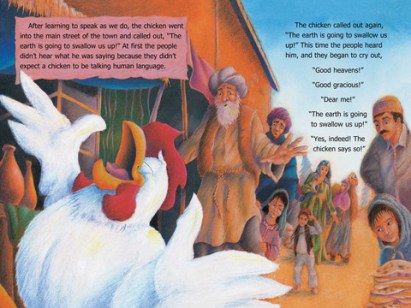
This story reads wonderfully aloud as it is silly, repetitive, and the message is more clear than in some of Idries Shah’s other Sufi inspired teaching books.  Written on an AR 4.0 level with 32 pages.  Some pages are heavily text laden while others just sprinkle a few words across a beautifully illustrated page.  Like his other books, the illustrations are truly spot on.  The lively faces on the characters, and colorful scenes bring the story to life and keep the audience engaged and giggling.

chicken

A man decides to learn how to speak “chicken,” when that doesn’t work, he teaches the chicken to speak our kind of language.  Fluent and conversational, the chicken then tells the villagers that, “The earth is going to swallow us up!”.  Everyone runs in all directions, up the mountain, down the mountain, across the meadow, around the world, but they can never get away from the earth.  When they return, they are upset with the chicken and ask how he knows that the earth is going to swallow them up, to which he replies that he doesn’t.  After they recap all the trouble he has put them through he poignantly laughs at them and asks, ” You think a chicken knows something just because he can talk?” Realizing how foolish they have been the chicken begins telling more outlandish things, just to make the people laugh, and isn’t taken seriously again.

silly chicken1

The message is clear, the characters funny, and the illustrations engaging. I finally found an Idries Shah book that I like! Yay, I guess for me they are hit or miss, and this one was definitely a hit!

chick

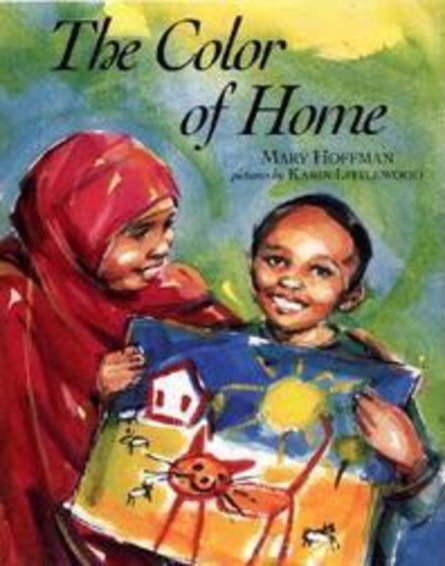
The Color of Home by Mary Hoffman illustrated by Karin Littlewood

Standard
The Color of Home by Mary Hoffman illustrated by Karin Littlewood

color of home

This powerful book about Hassan’s first day at school is a bit graphic, and incredibly important.  While it is a picture book, it is definitely not meant for small children.  The rich water color illustrations and the impactful text match the AR level 3.6 and would really appeal to thoughtful 2nd through 4th grade students.

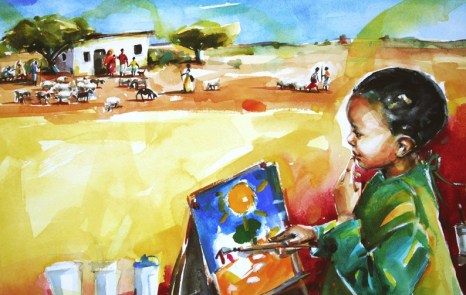
A refugee from Somalia, Hassan finds it “tiring remembering even a few English words.”  He misses the color of Somalia, his cat, the warmth of the sun, and the freedom of learning out doors.  He doesn’t miss the violence though.

colour3(1)

When it is time to paint, Hassan paints his home and his family, all 9 of them, and his pets, in bright happy hews, much to the delight of his teacher.  But then, Hassan, engulfs his house with the red paint of flames, smudges out his Uncle Ahmed when the black bullets that take him down, and Hassan communicates his sadness to his teacher.

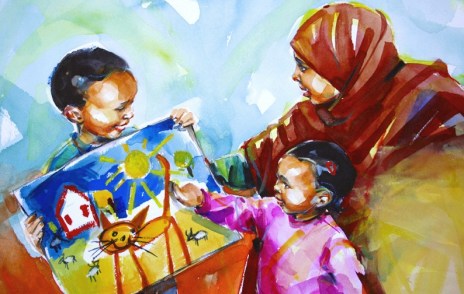
Hassan doesn’t take his picture home, he knows it will upset his mom and little sister, Naima.  The next day, a translator comes to help Hassan.  Fela is Somali and wears a black hijab, like Hassan’s mom, but western clothes, a new concept to the young boy.

color

Through Fela, Hassan opens up to his teacher and explains what it was like when the soldiers came and he had to hide under the bed.  How they had to leave without any of their stuff, including his beloved pet cat Musa.  All they could take was his father’s prayer rug and the Quran, as they set off on foot in the night.  He tells about leaving his grandparents and cousins behind and being scared on the plane.

Being able to share his fears, seems to help as he paints a new picture to share with his mom.  This one filled with his animals, and not with fire and bullets.  There is hope for Hassan as he looks forward to adding color to his new life and reminds himself to learn the english word for “home.”

colour2(1)

The book  is great for seeing the experience through Hassan’s eyes, and taking the reader through some of his adult like fears, and childish stresses.  Older kids should appreciate that what he has lived through is horrific, but his understanding as a child is slightly limited.  It should increase empathy, compassion, and kindness.

While the illustrations are rich and detailed they are very realistic.  This adds to the somberness of the book, and keeps this work of fiction a very real reminder of the world and what trials so many go through.

The characters are visibly Muslim, but there is no mention of religious doctrine, and readers may not know what a prayer rug is or a Quran.  They will be able to use context clues to figure out hijab, but there is not a glossary in the back.

nine, ten: A September 11 Story by Nora Raleigh Baskin

Standard
nine, ten: A September 11 Story by Nora Raleigh Baskin

nine, ten.jpg

I still struggle with the fact that 9/11/2001 is taught as history, it seems so current and fresh in my mind, that I really struggle with how works of fiction (and non fiction too) try to tell me about the pulse and the mood and the impact of something that I lived through and recall so clearly.  I suppose this isn’t a unique predicament, but because of the magnitude, one that I still wrestle with.  The author of nine, ten glosses over the big picture and in a lot of ways, the events of 9/11, but instead tries to show the paradigm shift that occurred and the division drawn as life before and life after.  She attempts to do this on an AR 4.8 and in 197 pages.  No easy feat, but one that definitely has some hits, and for me at least,  a few misses too.

SYNOPSIS:

Told from four different perspectives that intersect at the opening and at the close, the reader meets the characters two days leading up to 9/11, spends some of September 11 with them, and then peeks in on them again a year later.  The characters all cross paths at Chicago’s O’Hare Airport.

The first character is Will.  A middle school boy struggling to come to terms with how his father died helping someone on the side of the road.  Often more responsible and mature for his age as he helps his mom with his younger siblings, he lives in Shanksville, Pennsylvania and finds healing with helping those affected by the plane that goes down there.

Next we meet Aimee, who has just moved to California and is starting a new school.  Her daily drama is more missing her mom who travels a lot to New York for business, but is relatable as she tries to make new friends, fit in, and find her place in a new environment.  Her mom is in New York during the duration of the book, and has a meeting in one of the Twin Towers on the 11th.

Sergio lives in Brooklyn, New York and is a math wiz who gets a special award and recognition for his achievements.  He lives with his loving grandma, but it is the stressful encounter with his deadbeat father that sets him on a fateful subway trip that introduces him to Gideon, a New York fire fighter.

Naheed is the fourth character, and is an Iranian American Muslim girl, who is struggling to handle friends, and new questions about the hijab she wears.  Her friend drama consumes her, until 9/11 happens and she has to now prove her love of America at every turn.

The characters each take chapters divided by dates and while short, they do form a connection in their snapshots.  You feel like you get to know the characters and you do feel a tinge of stress knowing how they are all related geographical to what will transpire on the 11th. But in the afterward, the author explains why she intentionally keeps the carnage at bay to show how connected we all are, especially children, at the forefront of her fictionally retelling, and to show how much we all were affected that day.

WHY I LIKE IT:

I like that breaking up of the story, it adds some dimension to the book.  I know some reviews feel it is over done, but I think it is deliberate, and highlights how we all are inter connected and for late elementary, early middle school readers, I think the choppiness it allows, keeps the book on their level.  I like that each character has their own struggles, it isn’t that life was rosy and then 9/11 ruined everything, these kids have their own issues and stresses and realistic personalities before and after.  I also like that the Muslim character is not from the Middle East, it further shows how groups get lumped together for different reasons giving the book a bit more for readers to consider.

There are however, some real issues in how they present Naheed, which seems odd, since the book is so politically correct, and given the topic, you’d think the author and editors would work overtime to get the islamic parts correct.  But alas at one point Naheed’s visiting Uncle wants to know why Naheed doesn’t pray the mid day prayer, thuhr, at school, to which the mom replies, “she makes up her prayers at third prayer.” What? Yes I laughed out loud, no one calls the prayers by their numbers! I have never used numbers to describe our prayers, they have names, and we use their timings to describe them to others, not numbers. At one point, Naheed is making wudu, ablution, and the author gets it wrong. “And lastly, feet.  Right foot with right hand. Left foot with left.  Toes to ankles.” Left hand for both feet.  I also take some issue with Naheed having to wear hijab at age nine.  Hijab becomes required at puberty, so yes it could have been when it became required of her, but it seems a little young for her, and it seemed a bit forced.

In terms of plot, I would have liked a day or two after 9/11 to juxtapose the differences in priorities and the lens of how we got to a year later, or two years later, or 15.  Also, how they all went to New York on the anniversary to tie the story together made for a nice ending, but why they all went was a bit of a stretch, ok a big stretch.

FLAGS:

For a book about 9/11 there is relatively no violence.  The only death is in talking about Will’s father and the only blood is when Sergio helps a man on the subway.  There is some hate speech at the end, but even that is minimal.  Will does kiss a girl he likes. And both Will and Sergio skip school.  Aimee worries if her mom is having an affair (implied) and if her parents are getting divorced, but it isn’t explicit.

TOOLS FOR LEADING THE DISCUSSION:

I think this would be a good book for a younger book club.  With its overt commitment to political correctness and breaking down stereotypes, it reinforces how similar we all are through strengthening bonds of humanity, rather than being divided by our skin color, or religion.  I think it would also lead so easily into faccilitating discussion of today’s kids putting themselves in the story.  What in their lives wouldn’t matter any more or what would matter more. There is a Reading Group Guide at the end of the book, along with an Author’s Note and Acknowledgement, that easily lend themselves to more discussion ideas.

Curriculum Guide: http://www.norabaskin.com/nine-ten-curriculum-guide/


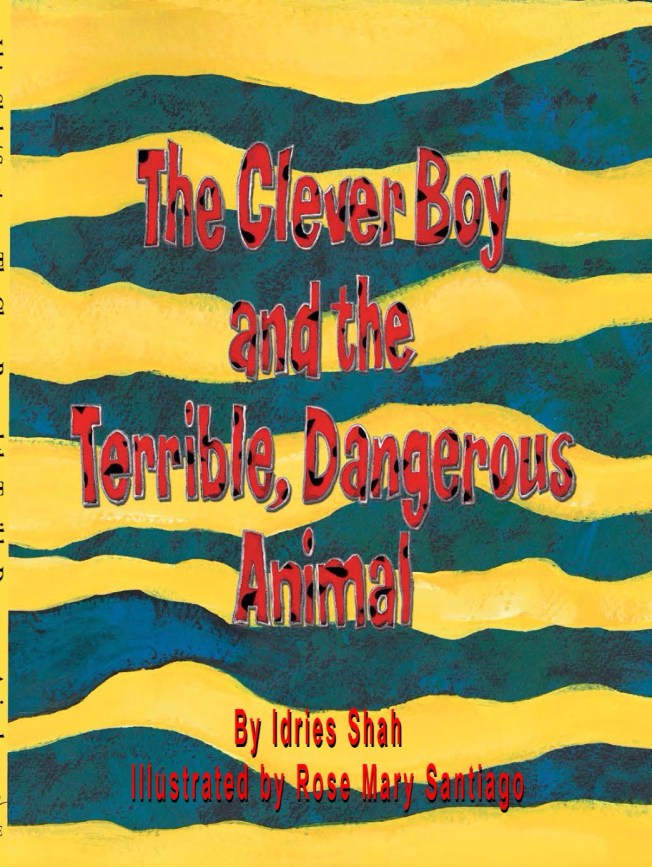
The Clever Boy and the Terrible, Dangerous Animal by Idries Shah illustrated by Rose Mary Santiago

Standard
The Clever Boy and the Terrible, Dangerous Animal by Idries Shah illustrated by Rose Mary Santiago

clever-boy.jpg

This book makes me forgive the author for his other books that left me puzzled as to his popularity.  This is wonderful, timeless and so simplistic, yet full of wisdom, lessons, and reflection that I’m thinking of gifting it to many of my teacher friends.  In its 32 pages written on an AR third grade, 2nd month level, the simple and powerful lesson of how ridiculous it can be to be afraid of what you don’t know is driven home.

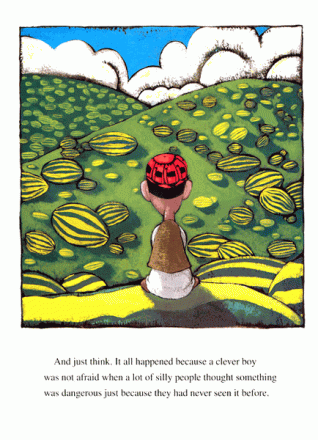
And just think. It all happened because a clever boy was not afraid when a lot of silly people thought something was dangerous just because they had never seen it before.

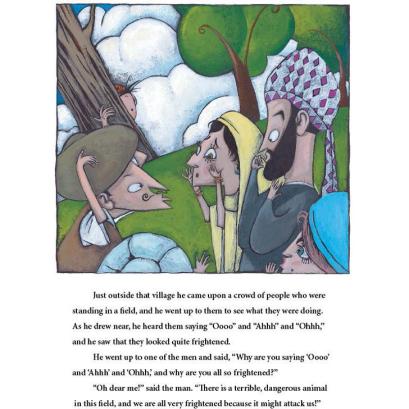
A boy goes to a neighboring village and finds the villagers afraid of, wait for it, a watermelon.  The boy laughs and laughs, and pulls out a knife to cut it and enjoy its sweet juices.  The villagers then fear the boy, until experience and knowledge about what it is and how to grow it, change everyone’s opinion and the village renames itself Watermelon Village. Oh, the power of knowledge.

clever 2

I can see this book being so great to introduce kids to how a little knowledge, asking questions, trying something can do everything from finding something you like, to breaking down stereotypes, to shifting your paradigm.  I feel like Islamaphobia, among so many other things, could be done away with by and large if people would just get to know us!

clever 3

The villagers depicted wear kufis and hijabs and kurtas, and the author writes to share his stories from his oral Sufi tradition, but there isn’t anything overtly Islamic in the text.  The kids as young as preschool will enjoy this at storytime.  They will find being afraid of a watermelon preposterous and silly, making the point that much stronger.

I like that the cover doesn’t given much away, and most children will take the title at its word and think that it is an animal.  Getting student’s ideas of what the terrible animal will be adds to the creative thinking and discussing after as well.  The pictures are wonderful and endearing and many editions come in two language formats.

clever1

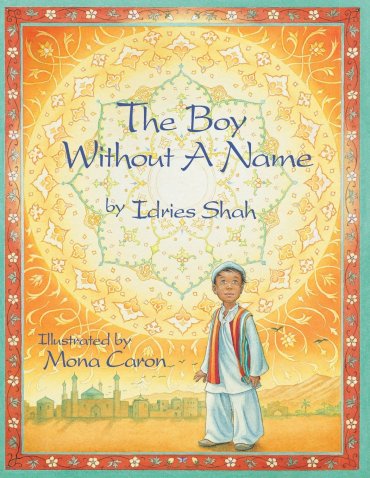
The Boy Without A Name by Idries Shah illustrated by Mona Caron

Standard
The Boy Without A Name by Idries Shah illustrated by Mona Caron

the-boy-without-a-name_orig.jpg

It is hard to know what a child would get out of this 32 page 3.2 AR level, but even if they just get lost in the pictures, and swept away by the idea of a boy searching for his name and a dream, I suppose there is value.  Some, ok most of Idries Shah’s, Sufi teaching stories are beyond my comprehension, but they are lyrical and often silly just the same. He has written over 30 and the libraries have quite a few, and people online seem to love so many of them, so perhaps I’m just not clever enough or philosophical enough to grasp them.  Which is neither here nor there, but maybe don’t buy one until you read one and see what you get out of them.  I keep checking them out and hoping I too will fall in love with one, I’ll keep you posted.

no name1

Before they can name their son an old man comes and tells the parents to not name him and to wait.  The boy grows up searching for a name, hoping someone has one he can have.  At one point he is made aware that he has nothing, even to trade for a name.  He responds that he has an old dream he no longer wants.  He and his friend Anwar then go to the wise man and he receives his name and a new dream.

The synopsis claims that patience and determination is learned, but I couldn’t get over the fact that the parents just didn’t name their child, and I never felt like I learned why he was such an important boy.

boywithoutname2

The pictures are wonderful with the scenic village’s tall minarets and colorful hijab clad women in the market place.  I particularly like the magic spilling out of the boxes in the old man’s house when the boys are finding names and dreams.  There is nothing overtly Islamic in the text, I’m not aware of how strong the Sufi origin is, not being Sufi, or having studied it.  But the illustrations definitely place the book in an Islamic cultural environment and the names reinforce this.


The Farmer’s Wife by Idries Shah illustrated by Rose Mary Santiago

Standard
The Farmer’s Wife by Idries Shah illustrated by Rose Mary Santiago

farmers-wife.jpg

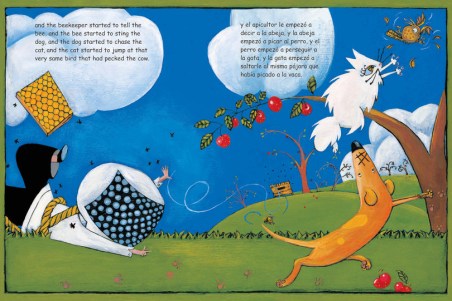
The book reads very much like the western children’s story/song, “I know an old lady who swallowed a fly,” but in this Sufi inspired repetitive story, An old Farmer’s wife can’t get an apple out of a hole.  

The silliness starts right away when she wants to get a bird to fly down the hole to get it for her.  When the bird says, “tweet,” which means no, she deems him naughty and then moves on to asking a cat to jump on the bird, to get the bird to get the apple.  The funny thing is the chain of events is funny and illogical at points. She wants water in a puddle, to put out a fire to burn a rope, the rope to tie up a bee keeper, and so on.  Luckily the wind finally blows the apple out of the hole and they all live happily ever after.

farmer2.jpg

The book supposedly is to teach patience, I am hoping to use it when I do a lesson on thinking outside the box and how sometimes that is great, but the trick is knowing when it might also be easier to reach down and pick up the apple.  

The book is AR 3.4 and 32 pages.  Many versions are dual languages.  The pictures are great with the abiya wearing woman and the chunky cartoonish side characters making the silly story fun to read a loud.  There is nothing “islamic” other than the illustrations showing the woman in hijab, and the author being a well known sufi writer who uses lessons from the Sufi tradition to teach lessons to children.

farmer1


Stepping Stones: A Refugee Family’s Journey by Margriet Ruus Artwork by Nizar Ali Badr

Standard
Stepping Stones: A Refugee Family’s Journey by Margriet Ruus Artwork by Nizar Ali Badr

stepping stones

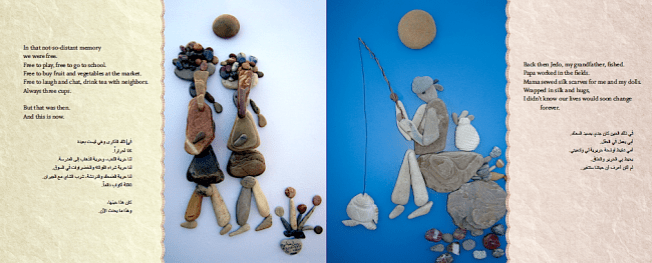
I usually have a running lists of books to check and see if the library has in their catalogue, and another list for when I have a few extra dollars and/or a reason/excuse to purchase books for my own.  I’ve seen this book recommend by countless critics, educators, refugee resettlement volunteers etc., and was thrilled that I could get it from the local public library.  However, it isn’t enough to have this book and mull over the artwork and prose for three weeks, it deserves a permanent place on the shelf.  Or better yet, open hands to pass the book around to within your home, to reflect on the humanity that binds us all, and the plight of so many in the world.

FullSizeRender (12)

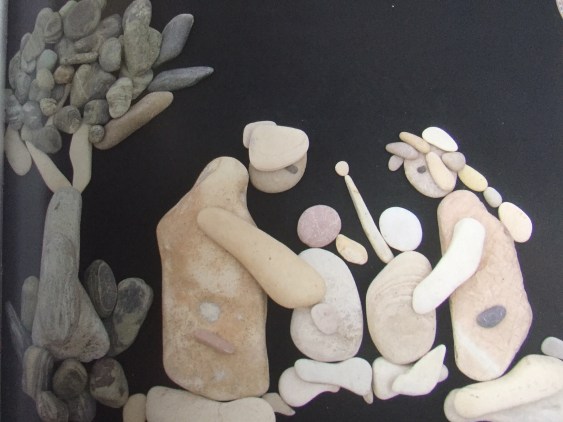
The story is fairly simple, Rama and her family have a good life in Syria and the war changes that, forcing her and her family to flee on foot to Europe with what they can carry.  The emotions on the other hand, are not that simple.  The book is illustrated in stone, but the reader would have to have a heart of stone to not be moved.  Written on an AR 3.2 with 28 pages, the book is written in both English and Arabic.  The book is not sensational, but it does discuss the shortage of food, and going hungry, how they are not free, not really, how bombs fall and kill people going to the market,  and it does show that people were lost in crossing the sea.  The family has to walk, there is no going to the airport or cars to take them across borders so easily, this is contrasted to the beginning of the book where Rama was free to play and go to school, things the reader can relate too.

stones

Ultimately the book is full of hope.  The fictionalized account of a horrific reality still on going, pales only to the story of how the book came to be.  The Foreword is wonderful and gives the book so much more warmth and heart.  How the author saw the artisans work, sought him out, and built the story around his pieces, gives even the youngest reader a sense of reality for an unfathomable situation.  After the story is more information about the author and the illustrator, as well as a list of resources to volunteer, donate and help.  Portions of the book sales go to help resettlement organizations across North America.

stones2

The publishers page gives info and has a youtube book trailer as well: https://steppingstonesthebook.com/
FullSizeRender (11)

The book would be great at story time or in a classroom setting followed by an activity with making pictures with stones previously collected.  At bedtime the book is great to read aloud and let the words sweep your listener toward empathy and compassion.  Check your library first, and if it isn’t there, I don’t think you’ll regret your purchase.

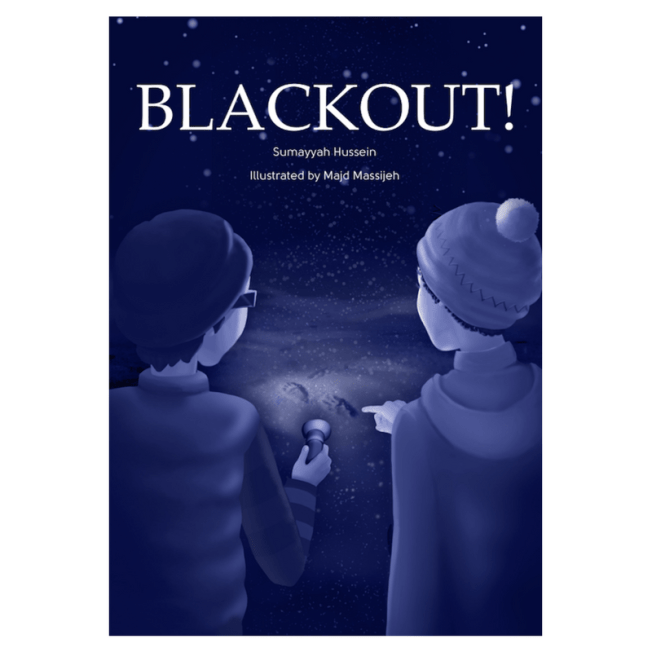
Blackout! by Sumayyah Hussein illustrated by Majd Massijeh

Standard
Blackout! by Sumayyah Hussein illustrated by Majd Massijeh

blackout.png

Presenting the stories of refugees to young children often involves a balancing act of fact, emotion, and restraint, all while finding the common ground to create empathy in the reader.  Increasingly on bookshelves are successful picture books that use illustrations to build bridges of understanding and bright colors to convey hope.  For older children there are books that can devote time to explain issues or offer first hand accounts along with political back stories and historical events.  For elementary age children 2nd and 3rd grade particularly, chapter books on refugees are not very common.  Children this age seem to relish in silly outlandish characters with a few font happy sentence and pictures on each page or stick to series that are easily predictable as they present tidbits of history or simple mysteries.  All reasons to encourage your child to read Blackout! and break the monotony and gain some empathy.  As delicate as the subject matter is, the book manages to resonate with most children how good they have it and how fortunate they are, without getting preachy or pretentious.

SYNOPSIS:

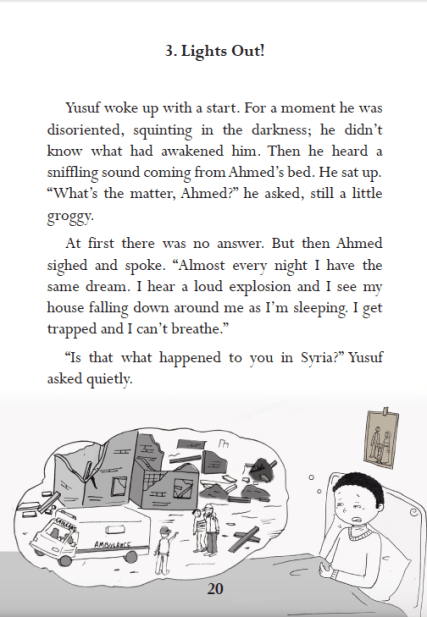
Yusuf, a 12-year-old Canadian boy is anxiously waiting the arrival of his cousin Ahmed from Syria.  Ahmed recently lost his father when their makeshift boat capsized, and while coming to Canada is a blessing, he is still haunted in his dreams and memories by all that he has seen and endured.  This idea that being safe now, doesn’t erase all the pain and fears experienced, is a concept most adults understand, but I was surprised that my children had to talk it out a bit.  They understood that he would be sad, but hadn’t really thought how hearing loud noises would immediately remind him of the explosions he heard in Syria and of his home and buildings crumbling down.

blackout inside

The story’s focus is the present however, and follows Yusuf.   The backstory of Syria and Ahmed’s escape is juxtaposed with an ice storm turning Toronto powerless and cold.  As Yusuf deals with the annoyance of a few days without electricity he learns a bit of compassion for others in the world, who endure a similar situation indefinitely.  In a beautiful way, Ahmed’s enduring optimism changes Yusuf as they find reasons to smile at the raccoon rummaging through their food put outside to stay cold, or playing in the snow to pass the time.  The characters have a lot of heart, for a short book, and you really feel like you get to know them and feel for them.  Yes, Yusuf whines, but he is a kid who’s winter vacation plans have gone awry and is frustrated and bored.  Ahmed, while a survivor, still struggles, but maintains a personality much more than just victim.  The other family members are background, but they aren’t flat, they have warmth and humor and pain in equal parts, implying if the book was longer, we’d get to know more about them too, and probably like them as well.

Despite the refugee story line, and the blackout, the crux of the story is actually helping one another and being neighborly.  Ahmed at one point is telling a story of how he began helping someone in a refugee camp and that it gave him purpose.  This reminds Yusuf that they have an elderly neighbor and the radio alerts had encouraged people to check on one another.  The boys rush over to find Mr. Caldwell, suffering from carbon monoxide poisoning brought on by his kerosene heater. Luckily an ambulance is able to get there just in the nick or time. On the third day of the blackout, the Imam speaks about helping one another and making this obstacle into something positive.   Ahmed tells Yusuf how the neighbors in Syria would gather in the winter to share what food they had.  This brilliant idea gets the support of Yusuf’s dad, the Imam and the whole congregation as they rush home to invite the neighbors to a neighborhood BBQ.  The perishable food needs to be consumed, so what better way to enjoy it, than to share it.

When the power comes back on, Yusuf is not the same kid, he has grown in compassion, and patience, and inshaAllah the reader will be similarly affected for the better.

WHY I LIKE IT:

I love that the book addresses a hard topic on a kid level.  It does not overwhelm the reader or frighten them.  MashaAllah, it balances what they can understand, with something bigger.  The illustrations keep it light in their doodle like appearance and the font, spacing, chapter length and presentation are perfect for the target audience.

blacout2

The women wear hijab, they pray, they go to the mosque, yet they don’t quote hadith or Quran or say a lot of mashaAllah and Alhumdulillah, making the book work easier for non Muslims.  The coming together of community is nice.  No one asks or worries what religion, race, or ethnicity anyone in the neighborhood is, they just come together to share a meal and welcome Ahmed and his mom to Canada.  The Imam is relatable and the dad is involved and generous, the mom is competent and respected, all normal behaviors that reinforce community and normalize diversity and acceptance.

FLAGS:

The violence of war may affect young children differently.  Nothing is sensationalized or graphic, but Ahmed does get stuck in the rubble when his house is destroyed, and his father’s drowning is discussed.  Nothing is talked about in depth, but the ideas are presented.

TOOLS FOR LEADING THE DISCUSSION:

This book would be perfect for a young book club.  I’m looking forward to reading it with my six-year-old son and my eight-year-old niece so that I can see how what they get from the book.  There is a brief explanation on refugees at the back of the book, and I think current events would naturally make a book club discussion easy to facilitate.  I think gathering items and meeting refugees after, would also be a wonderful way to turn the fictional story into real action.  It is also worth noting 100% of profits from this book will be going to the Syrian Canadian Foundation‘s mental health and wellness initiative for Syrian newcomers.

blackout1

Zachariah’s Perfect Day by Farrah Qazi illustrated by Durre Waseem

Standard
Zachariah’s Perfect Day by Farrah Qazi illustrated by Durre Waseem

IMG_4757I was really excited to learn about this book from the author, as it seemed to be a book that would stand out in a very crowded genre and work for both Muslim and non Muslim kids.  When I tore off the package however, the face on the cover seemed a bit off for my taste, the glossary is on the back cover and while the pages are full size and full color, the book starts on the first page and somehow seemed more “home done” than “professional.”  Which isn’t a bad thing, and I’m happy to support local writers, but alas I do often judge books by their covers and format, and my first impression had to be stuffed away so I could give the book a fair chance.

The book is 20 pages with the 20th page being recipes.   I would guess children 5 and up would be considered the target audience.  It basically is a book telling about Ramadan with the author trying to blend in a story, that for me, sometimes worked and sometimes really didn’t.

FullSizeRender (3)

It starts with Zachariah, a 12 year-old-boy waiting for his mom to wake him up to fast, a day he has been waiting his whole life for.  Why he had to wait to fast at age 12 is not clear to me or made clear in the story.  His 10 year-old-sister only does half days, but in the illustrations she seems to only look about 3 years old, so I’m not sure where the arbitrary age requirements for fasting come from.  There is also a third sibling in the pictures that is never mentioned, not sure why, my kids and I speculated a lot more on that than we probably should have.  It isn’t told from Zachariah’s point of view but he is the focus as his day gets started.

The characters are undoubtedly desi as the book is very steeped in subcontinent cultural over tones.  Sehri, the pre dawn meal, is described in abundance of detail, “His mom made omelets, fried potatoes, with curry and tomatoes and his favorite parathas: thin leavened dough that is friend in olive oil or butter”  It’s a bit detailed of how the items are prepared for a kid’s book, and that is just page one of two pages dedicated to detailing the food on the table for breakfast.  Iftar the meal to break the fast is also two pages of description and cooking methods, but about double the amount of text.

FullSizeRender

Culture is often food, and Ramadan has its own food traditions, but there is a lot of space dedicated to food in this book,  and it kind of takes away from the message of fasting, and moderation, and not going in excess.  Later in the book the mom does pack up some of the food to take to the less fortunate which is great, but she does it while the rest of the family is breaking their fast.  Not sure why she couldn’t have done it before or after and joined them.

After sehri is presented the family talks about Ramadan and what it means and what they like best about it.  There is a bit of dialogue that is actually sweet and funny, and gives some warmth to the story.  It is clear the author is just trying to flesh out the facts about Ramadan, but for a kid’s book, I think getting the facts in and presenting them in a fictionalized setting is a useful tool.

FullSizeRender (2)

The story seems a bit lopsided when it shrinks Zachariah’s day at school to one five line paragraph saying it was wonderful and then moves on saying “Later, he helps his mom.”  After spending 10 pages on the predawn meal, I would have liked to know a bit more how school went for him, it is his perfect day after all.  Also, the lapse in time by the narrator seemed a bit off to me in the sequential flow of the story, as it was following him in real time so to speak, and then fast forwards the bulk of the day only touching on lunch time, and

FullSizeRender (1)

Alhumdulillah, the family is sweet and excited for Ramadan. They pray together and are seen with smiling faces.  There isn’t much diversity in the pictures, the family has darker skin, the friends at lunch are more fair.  The mom wears hijab and is in the kitchen, dad doesn’t seem to be, but Zachariah helps his mom.

The book is colorful, and busy.  I’m not sure if the pictures are meant to be a stylized reality or look computer generated, but they seem a little blurry in places.  The font and backgrounds are nice.  There is a verse from the Quran in English and Arabic, as well as the athan and some Islamic calligraphy.

Overall, there is nothing “wrong” with the book, it just isn’t memorable.  There are some really good Ramadan books out there, and this one does it’s job of explaining Ramadan, but lacks the characters to leave an impression.  I definitely don’t regret buying it, but I don’t know that my kids or I will read it again this Ramadan, it doesn’t create that reaction.  It will probably stay on the shelf until next year, when we can’t recall many of the details and give it another go.

IMG_4748 (1)


Lost and Found Cat: The True Story of Kunkush’s Incredible Journey by Doug Kuntz and Amy Shrodes illustrated by Sue Cornelison

Standard
Lost and Found Cat: The True Story of Kunkush’s Incredible Journey by Doug Kuntz and Amy Shrodes illustrated by Sue Cornelison

kunkush

Often children’s stories of refugees fleeing war are hopeful in a forced way that seems to want to protect them from the reality of what is going on in the world.  As adults we often cling to the ones with happy endings for our children and for ourselves, because the tragic ones are too numerous and overwhelming to comprehend.  This book marvelously does a great job for those older children in the middle that are beginning to understand the world around them, while not bombarding them with the severity of how cruel we can be to one another.  This true story instead focuses on a beloved cat and all the humans of different backgrounds, all over the world that help reunite her with her family.  Giving hope, but also showing the difficulty in the world, and the effects even one person can have in making a difference.

cat

Kunkush’s family goes to great pains to get themselves (all 6 of them) out of Mosul, and away from the war.  That the fact they sneak their beloved cat with them, shows just how much a member of the family he is. They drive through the night, and walk for days over a mountain, they reach a Kurdish village where they sneak the cat on a bus to Turkey, they then have to cross the Aegean Sea to Greece, only to land in Lesbos and have Kunkush disappear.  The family searches as long as they can, but alas have to move on to their new home.  From here the story switches from following the family to following the cat and all the people determined to reunite him with his family.  Unfortunately, they don’t know where the family is.  Amy, a volunteer, takes the cat to the vet to get cleaned up, and then creates an internet campaign to try and find his family.  People from all over the world donate to his care, and his travel expenses.  Eventually, Amy takes the cat to Germany, where many refugees have resettled and continues her search.  Finally, word gets to the family in Norway, and Doug, a photographer, arranges to fly the cat to her new home. Alhumdulillah.

img_3838.jpgOne could argue that countless people are misplaced each day due to war, and we overlook it because it is easier than dealing with it, so why care about a cat.  And to that I challenge the skeptic, animal lover or not, to read this book and not have your heart-strings tugged.

IMG_3839The book is done beautifully.  The pictures are warm and endearing and are the only proof that the family is Muslim, by their hijabs.  The love the family has for their pet is expressed in the illustrations, and even more so by the real photographs at the end of the book following the Note from Doug and Amy.  At 48 pages the book works really well for 3rd grade and up (it isn’t AR) who can marvel at the cat’s journey.  I particularly think this book is a great way to show children another aspect of refugees.  There are a fair amount of books that talk about the refugee experience or show refugees getting adjusted to a new home.  But, this is a great way to show that refugees are not just defined by a word.  They are vibrant individual people just like everyone else.  By focusing on the cat and his journey, the reader sees what a refugee goes through, particularly this family, and hopefully will stop and think about it.   But it doesn’t just show the family in that capacity, it shows them as a vibrant family who loves and desperately misses their cat- something more children may be able to relate to.

kunkush (1)