Category Archives: 3rd grade and up

Iqbal and His Ingenious Idea: How a Science Project Helps One Family and the Planet by Elizabeth Suneby and Rebecca Green

Standard
Iqbal and His Ingenious Idea: How a Science Project Helps One Family and the Planet by Elizabeth Suneby and Rebecca Green

iqbal

It is a bit odd that this story is fiction, when it reads so much like a piece of nonfiction.  It is a picture book, but has an AR level of 4th grade 4th month.  So, while the story is great and highlights a country and culture, Bangladesh, not often seen, I don’t know that this book would appeal to many kids.  The kids that it does appeal to though and that can find it in a library or bookstore (not sure where it would be shelved), I think will not just like it, but possibly find it both inspiring and worth reading again and again.
IMG_2086

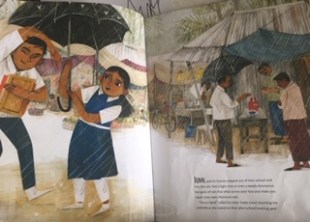
It is monsoon season in Bangladesh and the rains make Iqbal’s mom have to cook indoors.  As a result, she and the baby, Rupa are constantly coughing from breathing all the smoke from the woodburning stove.  Iqbal’s father mentions a propane stove he saw in the market, but the family cannot afford it, despite wishing that they could. 

Iqbal’s school has just announced the School Science Fair and the winners get cash prizes, if Iqbal can win, maybe he can buy his family the new stove.  His little sister Sadia offers her services to help him win and be his assistant.
IMG_2087

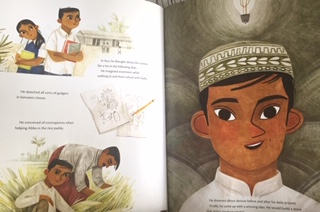
After a lot of thinking, pondering, and dreaming, Iqbal decides on the perfect project: a stove that didn’t produce smoke.

With the help of his teacher at school to find ideas and articles and plans on the internet, Iqbal and his sister build a solar cooker with foil and an old umbrella. 

IMG_2088

The science fair is a success, Iqbal wins, the family buys the stove and propane with the winnings, and when it isn’t raining, the family is able to use the solar stove Iqbal and Sadia built.

The book draws on ideas of sustainability, pollution, economic viability, problem solving, and education.  The culture provides the backdrop making all of these issues relevant and real, and mentioning Ramadan, Eid, and prayer provides some depth to the characters and adds to their culture.

IMG_2089

A lot of reviews online criticize that the mom is cooking and that the kids test an egg on the solar cooker and call her to eat it if it is supposed to be Ramadan, but I personally promise you, during Ramadan, we are always cooking.  And if she is nursing the baby, the mom wouldn’t be required to fast, there’s a lot of other reason she couldn’t/wouldn’t be fasting, but really, it is such a small portion mentioned in passing, no detail needs to be given, and it didn’t bother me at all.

Another complaint about the book is that if money is so tight the kids wouldn’t be at a school where they can just make copies, and buy eggs on their own.  I think there is some truth to this, but maybe a wealthy doner funds the school.  I think you could argue it either way.  I don’t know that the family is poor, it is the overall society, so kids could have pocket money, a propane stove is probably imported at least from a larger city so the expense would be more, similarily the infustruction of electricity and gas lines could hint more at why they cook the way they do.  Needless to say the family is smiling in the pictures, they have food, and they seem to be doing ok.  So the fact that the school printed a few articles and the kids bought some eggs without asking permission, didn’t bother me greatly.

IMG_2090

The illustrations are expressive and show the family connections and emotions.  I like that they bring to life a country many wouldn’t know, even if I wish it weren’t a work of fiction, but based on some child actually there.  

The end of the book has information about clean cookstoves, how to build one yourself, and a glossary.  The large 9×12 hardbound book would hold up well to multiple readings, and the amount of text on the pages would work well as a read-a-loud to younger kids who would find the subject matter interesting.  

IMG_2091


Power Forward: Zayd Saleem, Chasing the Dream by Hena Khan illustrated by Sally Wern Comport

Standard
Power Forward: Zayd Saleem, Chasing the Dream by Hena Khan illustrated by Sally Wern Comport

power forward

I enjoy Hena Khan’s books, I love basketball, and I love that this three book series is written for 3rd-5th graders.  I didn’t love the cover, however, which I attribute to the reason I waited so long to start reading the book, I know, lame.  But luckily the books were in the public library and I had a few hours on my hands and was able to consume the first two books, and look into ways to get the third one ASAP!  Written on an AR 3.8 level the 126 pages fly by, the second book On Point is 130 pages and an AR 4.0, and the third book in the series, Bounce Back comes out in October.

SYNOPSIS:

Zayd Saleem is in 4th grade and is desperately trying to move from the D squad basketball team to the Gold team with his best friend Adam.  The only problem is he is a pretty scrawny kid, and he has committed a lot of his day to practicing violin.  His desperation forces him to be less than honest and the consequences that follow may strip him of the chance to even try out for the team at all.  The basketball story is intertwined with a rich cultural Pakistani-American backdrop and familial characters that are relatable and fairly fleshed out.  Zayd’s mamoo, maternal uncle, has agreed to meet someone to consider marriage, which brings out some humor as the whole family, including grandma and grandpa, have big roles to play.  Zayd also has to figure out why he gets such stomach aches as he makes regular notes in his food diary, and has to balance the universal themes of friends, school, and homework, as well.

WHY I LIKE IT:

The font and spacing is wonderful for the target demographic, sprinkle in the illustrations and the book is not intimidating in length or size.  The book is very real and relatable, kids of all backgrounds will relate to the basketball storyline and the video games and players mentioned.  I loved the cultural environment.  My kids absolutely loved the mentioning of the Pakistani food that they eat, and customs they participate in, and dynamics they know all too well.  I don’t know that a non Desi (someone from the Indian subcontinent) will get it, love it, and not be turned off by it.  The books are published through Salaam Reads and I would imagine the author and publisher know what they are doing, and the library has numerous copies, so clearly, I’m over thinking it, but I really want to get feedback on the cultural aspect, because it is done really well and I think it would show promise for future books.  

I love that the book is about a boy and basketball, but it isn’t limited to being a boy book or a sports book.  The story moves seamlessly through all facets of the characters life that makes it pretty memorable for what could have just been a sports story with a moral.  The “life lessons” are clear and obvious, but not overly elevated.  The little mistakes that Zayd makes are a part of his life, as are the consequences, but his family helps him through them, and help him learn.

There isn’t anything preachy or blatant about Islam in the book, but the characters are Muslim and it mentions that the parents are heading to the mosque at one point to help with a fundraiser.  

FLAGS:

There is lying, but that is kind of the lesson being worked through.

TOOLS FOR LEADING THE DISCUSSION:

I recently agreed to help a teacher with her “Lunch Bunch.”  Once a week students can opt to eat lunch in the library and have a book read to them.  They must commit for the duration of the book and I think for a 4th and 5th grade group this book would be a lot of fun.  It would probably only take two sessions to read and with the diverse class I can see if they get the cultural stuff or if it just bogs down the story to them.

Author’s website: https://www.henakhan.com/power-forward/


Love by Matt de la Pena illustrated by Loren Long

Standard
Love by Matt de la Pena illustrated by Loren Long

love.jpg

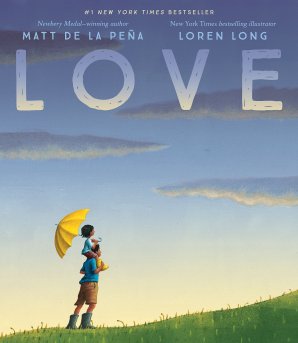
This 40-page-book may have a simple title, but most of us know, there is nothing simple about love, and this book shows love in many forms from a child’s perspective as they grow.  Sometimes picture books are basic and inspired to teach, or simply entertain.  Sometimes when picture books try to do more, the audience is confused when the pictures and amount of text on page don’t seem to align.  And sometimes, large pictures, with thoughtful poetry make the pages come to life and sing.  The book is written on an AR 3.7, so people thinking this book is for preschool aged children seem to be upset by the concepts hinted at and illustrated, but for older kids, this book has amazing power, and beauty that can show just how complex this universal feeling is.  

Love is your parent’s voice, love is burnt toast, love is the stars after your house burns down, love is in your grandpa’s wrinkles, love is staring back at you in the bathroom mirror.  But sometimes love also burns out and love is shielding you from things that might hurt you, and love separates people too. 


As humans, we can all relate to the same emotions, whether we give and receive love the same, the book shows the value and meaning it has to us all.  Hurray for illustrator Loren Long, because page after page, shows diversity of color, mobility, socio economics, age, and religion.  On a page where the love of the child is keeping her from seeing the TV that the family is crowded around a cross is present, and then a few pages later,bam, there is a girl in hijab looking up at the trees and listening to the love shared in their rustling. 

IMG_1901

I had no idea this illustration was present, and gasped aloud.  I said nothing to my daughter, finished the book, and handed it to her to read.  She turned the page and gasped aloud as well saying, “there’s a muhajaba, haha, we are in it too.”  Granted she is my daughter, so environment and genes account for something, but EVERY PAGE I think resonates with someone, and that gasp in my living room from me, from her, could come from anyone who turns a page in this book and bam suddenly feels represented, feels included, feels validated.  That my friends, is LOVE. 

IMG_1900

We are more alike than different.


The Worst-Case Scenario Ultimate Adventure Novel: Amazon & The Worst-Case Scenario Ultimate Adventure Novel: Mars by Hena Khan and David Borgenicht

Standard
The Worst-Case Scenario Ultimate Adventure Novel: Amazon & The Worst-Case Scenario Ultimate Adventure Novel: Mars by Hena Khan and David Borgenicht

There is nothing Islamic or religious, with either of these books, but I wanted to review them, as the author Hena Khan, who has brought such lovely picture books to our book shelves (Night of the Moon, Golden Domes and Silver Lanterns, Crescent Moons and Pointed Minarets), inspiring elementary books to the mainstream (Amina’s Voice, On Point, Power Forward), and who showed Curious George what Ramadan is all about, is Muslim.  She has done a tremendous job of blending culture and religion with everyday life making her stories relatable and found on bookshelves across America.  She also has written books that are just good books void of any religion and culture, that hopefully they remind our youth that you can write books about anything, appeal to everyone, and be successful as well.

Both books are like the “Choose Your Own Adventure” books that I remember from the 1980s except these are much better written, and I think I might have learned facts about Mars, space travel, and the Amazon from them, without even realizing it.  Aimed at 3rd to 5th graders, these two books were checked out from the library and read countless times by my kids and myself alike.  They are entertaining and not easy to predict.  It is worth noting that while I did make it the entire length of the Amazon, after four tries I gave up trying to survive the journey to Mars and back.

IMG_1796

SYNOPSIS:

In both books the cast of teammates is given at the beginning and shows a good diversity of men and women from all over the world with a variety of skills and backgrounds to be on the expedition.  The books then give the set up of where you are going, and how you got chosen.  You then are advised to flip to the back of the book to look through the files and notes that will give you knowledge about what you will encounter.  These pages are in full color and are in diary, note style.  The adventure then begins and you make choices that lead you down different paths to success, or demise, it is up to you to decide how to survive.  

WHY I LIKE THEM:

I love that you learn while making decisions and attempting to make the story continue.  The books are fun and most of the choices aren’t obvious, naturally a few are, but they are well done.  There are comic book style pictures sprinkled throughout and regular black and white illustrations on many of the pages.  I particularly liked that the kids read them more than once and learned a bit about space travel, mars, what would be needed to set up a colony, the Amazon, various animals, and survival skills in the rain forest.

FLAGS:

You might get burned up, or bitten by a snake, but nothing too graphic, as you are the reader and obviously know it isn’t real.  

TOOLS FOR LEADING THE DISCUSSION:

These books wouldn’t work as book club selections, but I think 3rd and 4th grade classrooms and school libraries would benefit from having these fun books on hand.  Struggling readers will enjoy the fast pace and the number of pages (about 200 each), irregardless of if they are read or not, and advanced readers will enjoy trying again and again to reach the successful end.


Amal Unbound by Aisha Saeed

Standard
Amal Unbound by Aisha Saeed

amal unbound.jpg

This book was suggested to me and I was thrilled to find it at the public library so quickly after its May 8, 2018 release date.  I love that it is an AR 4.2 and 226 pages about a girl standing up for her self, determined to be educated, and facing whatever society, and culture, and circumstance throw at her.  The protagonist is 12, but I think most middle school readers will find the story a bit too idyllic, perhaps even too simplistic and neat.  I really think the AR level of 4.2 is spot on in terms of writing level, interest, and story telling: 3rd through 5th graders will benefit the most from this inspiring, memorable and informative tale.

SYNOPSIS:

Amal lives in a small Pakistani village.   The book opens with her begrudgingly having to take time off from school, as the oldest, to help her mother who is about to deliver her fifth daughter.  The stage is quickly set to show a supportive father, but the cultural stress involved in educating a girl is incredibly strong.  The priority is to care for the home when push comes to shove and this fight is simplified in the book, but not completely belittled.  Right away we also see some class divisions with servants and landowners and the various positions in between.  It is easy to judge those with money as being evil, but the author does show some nuances in character aside from wealth and position.  As Amal’s mom struggles with recovering after the baby, it is decided that Amal will miss more school.  This devastates Amal who dreams of being a teacher.  Burdened by keeping up the house and carrying for everyone’s meals, laundry, and watching her younger sisters constantly, frustration mounts and she snaps when an arrogant man tries to take her pomegranate in the market.  Her simply saying no, is the catalyst that changes her life as the man she stands up to, Jawad Sahib, is the wealthy land owner everyone in town is indebted to.  Saved by his mother, Nasreen Baji, who is in need of a personal servant, Amal is now forced to pay off an impossible debt to a cruel powerful family. 

In  many ways the story doesn’t really get good, until Amal enters the Khan family’s world, about 50 pages in to it, but obviously the character building and detail is necessary, so if you find your kid is getting a bit bored, encourage them to keep going.  

Once, she arrives at the Khan compound, she begins to make friends, and enemies, and similarly see just how ruthless Jawad Sahib is, and can be.  As she finds her own voice and realizes her own role in determining how others treat her, what her future holds, and what power she does have, she is forced to wrestles with the choices in front of her. Ultimately, the reader will cheer for her to take a stand and be bold in doing what is right, no matter the cost.  And while one can guess, because of the target demographic, that it has a happy ending, I won’t spoil the climax, the resolution, or outcome of the young heroine.

WHY I LIKE IT:

I love that despite the themes, the story isn’t depressing, in many ways it is informative and inspiring. I think the fact that things are not left to ponder but clearly articulated, has its merits in a book for elementary children who might be overwhelmed by the cultural aspects to think critically on their own.  At the beginning, with the birth of yet another daughter, the biggest concern is that the mom is depressed because she hasn’t had a boy.  The mom even apologizes to the dad about this.  The neighbors, friends, everyone seems so upset about it, but Amal doesn’t understand why the women particularly seem disappointed, when they themselves were little girls once, and this simplistic point of view on such a complex and real issue, is so spot on and obvious, I loved it.  The mom and dad point out that it is God’s doing and they clarify that they are not sad the baby is a girl, and to me it seems obvious the mom is suffering from postpartum depression, but the book only describes it, it doesn’t identify it.  I also love that there is perspective on how while Amal is in forced servitude and thus not free, either is her female boss, who is unable to go visit her family, or to garden.  This helps amplify that even the wealthiest woman, is still limited to be truly free in the context of the character’s world.  

I like that the book is culturally authentic and not judgemental.  There are strong females, supportive male friends, and plenty of details to show that the author is writing about what she knows, and that she loves her culture.  Islam is mentioned only a few times with regards to prayer time, but nothing more.  There is nothing about praying for anything specific, or covering, or religious beliefs, practices, or traditions.   The book like the author’s first book Written in the Stars, almost oddly leaves religion out, and stresses culture.  Because this book is for a younger audience, it isn’t as obvious, and if I didn’t write reviews about books I probably wouldn’t notice.  

The presentation of culture, the idea of indentured servitude, and females being educated is balanced and explained pretty well.  At most many of the readers will know little of Pakistan, but may have heard of Malala, and the author talks about her in the Author Note.  I like that this book shows a fictional strong female in a similar vein as Malala, but also shows that it isn’t an outside force, the Taliban, preventing her from an education, but in some ways a whole societal view.  I think this expansion of paradigm is really the most powerful thing about this book.  It is important to understand that people may want their daughters educated, and opportunities may be available, but sometimes more is needed.   A lot more to change tradition, on a lot of different fronts.

The book also does a good job of showing some of the paradoxes that exist in developing countries as well: Amal rides in a car for the first time, but also is handed a cell phone from her mom, she knows all about email but has never used a computer.  For readers to see that somethings are very similar to their own lives, and some things are foreign, will make Amal and what she stands for have staying power and relevance, long after the end of the book.

FLAGS:

There is talk of physical violence when people are murdered, crops burned, and Amal is slapped.  There is some lying, but the truth comes out. Overall: clean.


TOOLS FOR LEADING THE DISCUSSION:

I would absolutely present this book as an Elementary Book Club selection and I would encourage teachers to use it as a novel study.  There is a lot of perspective to be had from this book, and its clean simple style will keep the keep points in focus.

Author’s website: http://aishasaeed.com/amalunbound/

Q & A with the Author: https://www.publishersweekly.com/pw/by-topic/childrens/childrens-authors/article/76814-q-a-with-aisha-saeed.html

Discussion Guide: http://www.penguin.com/wp-content/uploads/2018/05/AmalUnbound_Brochure.pdf

Ramadan Around The World by Ndaa Hassan illustrated by Azra Momin

Standard
Ramadan Around The World by Ndaa Hassan illustrated by Azra Momin

IMG_0251

I started this blog because I know the value fiction can have in empowering and exciting people when they see themselves reflected in story lines.  As Muslims, it is a needed tool both for our own children and for teaching other children about us.  So, imagine my surprise when I felt my back straighten up and a smile stain my face for a long while after I finished reading this beautiful book about Ramadan traditions all over the world.  Not because it showed so many beautiful Muslims from rich colorful backgrounds sharing the common bond of loving Allah in Ramadan, that was expected.  Nor was it for the diversity of skin tones, and cultures, and ages, and head coverings, throughout.  No, it was because there are characters with autism, and one that is hearing impaired, one in a wheel chair, and a little girl with diabetes who cannot eat all the candy, just a few.  I didn’t realize how strong that notion hit me.  Me, an adult, a type 1 diabetic since I was 11, there in print, in a book about Muslims.  Yes, I may have had tears, I might still as I write this review.  It is powerful people, to see yourself in a fictional character, at any age.  May Allah swt reward all the authors out there writing books for our children to feel proud of who they are, one beautiful page at a time. You are making a difference.

FullSizeRender (90)

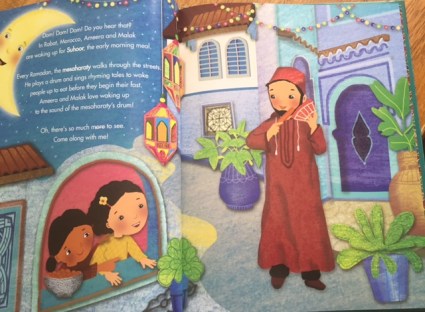
Emotions aside, this book is wonderful in and of itself.  It starts with the moon telling a bit about how Ramadan is fasting from sunrise to sunset, doing good deeds, being kind, and how it is celebrated all over the world.  The moon then takes us on a journey to twelve countries: The US, Turkey, Mexico, Brazil, Australia, Scotland, Malaysia, Egypt, Morocco, Madinah, Palestine, and Senegal.  Each location gets a two-page spread of text and gorgeous illustrations that tell about a Ramadan celebration, or tradition, and stress something about the month in general such as iftar, or sadaqah, going to the mosque, helping orphans, the adhaan, saying salaam.  The book concludes with Ramadan ending and the moon signing off.  There is a glossary followed by more information about Ramadan. 

FullSizeRender (89)

In all the book is 40 pages, hardbound, and large enough to make it perfect for story time and bedtime alike.  In small bursts the book would work for 4 year olds and up and first graders and up will understand how universal Islam is and relish at the diversity in celebrating “the most wonderful time of the year.”

FullSizeRender (92)

My hope is to read this book at a Masjid Ramadan Storytime and to have a few of the countries set up as “stations” for the children to visit.  I can’t wait to try it out and see if we can remind ourselves how blessed we are to be united all around the world as Muslims, alhumdulillah.  For non Muslims this book is not preachy, it shows how a holiday is celebrated in different places, and would do a great job of showing the joy Ramadan contains for Muslims with universal core principals, but how culture and traditions of celebration make it a diverse experience.  

FullSizeRender (91)


Muktar and the Camels by Janet Graber illustrated by Scott Mack

Standard
Muktar and the Camels by Janet Graber illustrated by Scott Mack

FullSizeRender (39)

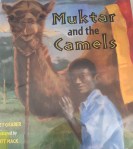
On the border of Somalia and Kenya, there isn’t a library, or a book mobile, there is a traveling camel library! While the main character is more excited about the camels, at least his friend is excited about the books in this AR 3.2 story.

Muktar is an orphan who dreams of his life before his parents were killed as a nomad tending to their camels.  Their teacher, Mr. Hassan calls him lazy as he dreams of the camels he misses, but one day, a librarian from Garissa comes on camel to bring books to the orphanage, and while Ismail and the other kids are excited for the books, Muktar is drawn to the desert beasts.  Muktar notices that one of the three camels is injured and recalling the root to help sooth the ailment, he tears his shirt, treats the wound, and covers it.  When seeing his abilities, the librarian, Mr. Mohamed asks him to come with him to tend the camels as they travel with books through the desert.

muktar insideThe story definitely makes readers appreciate the life they have, and realize how simple and harsh others’ lives can be.  I like the mention of the foods, giving insight into the culture, but I didn’t like the harshness of the adults.  The calling the boys lazy, not taking Muktar food as he tends the camels, not being concerned about the injured camel until Muktar insists he notices, all made me a bit sad.  Yes I was glad that Muktar was able to resume a nomadic life with camels, but he wasn’t given a say in it.  And sure I’m glad that his friend Ismail will get books and be able to work toward being a teacher, but somehow it wasn’t a warm book, and I can’t quite identify why.

The pictures, however, are warm and detailed in the present, with Muktar’s memories being more hazy and muted.  There isn’t any mention of religion, but being the characters are Somali and their names being what they are you can assume they are Muslim. There is a short author’s note at the end that tells about the war causing the nomads to become orphans and the library service that works to share books.

FullSizeRender (38)

The Muslims by Zanib Mian

Standard
The Muslims by Zanib Mian

the muslims.png

After reading this book, I really, really want to meet (and be friends with) the author, she writes from the point of view of Omar, a nine year old boy, and his perspective and voice are so authentic and relevant that while the book targets 3rd through 5th grade, I am certain kids and adults, Muslims and non-muslims, boys and girls, and everyone else, will all thoroughly enjoy this laugh-out-loud 164 page book.  

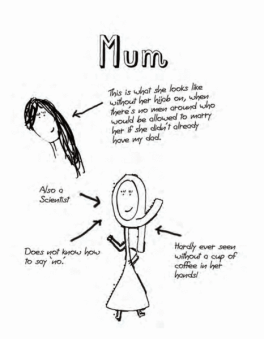
muslims mum.png

SYNOPSIS:

Omar is starting at a new school, we don’t know why, and while he is nervous, he has a good attitude about it.  His parents are supportive scientists and he has an older sister, Maryam who can be a bit mean in a big sister way, and a little brother Esa, who he secretly loves.  All are practicing muslims who remind me a lot of the people I know.  We say our duaas, we pray, we laugh at the funny stereotypes and just try and be good neighbors and people.  Omar’s neighbor is hilarious, Mrs. Rogers, doesn’t like Omar’s family, or “the Muslims” as she calls them, but they just keep being themselves and when she falls and gets hurt, she starts to realize they are good people who care about her.  She even starts showing up for iftar every night in Ramadan and counts down like a space ship launch until it is time to eat. 

Using his Islamic upbringing, and seeing how is family handles problems, gives Omar a lot of tools for starting at a new school.  But Omar is the protagonist, the hero, so he also has a super imagination that involves H2O, his dragon, that shows up to help him out when things get rough.  And unfortunately, a bully by the name of Daniel makes things rough for Omar.  He tells Omar that all Muslims and all Asians are going to be kicked out of the country, and this really sticks with Omar.  He verifies it with a cousin, and learns it could be a possibility.  So, the underlying anxiety is there, but most of the book that focuses on the bullying aspects involve the day-to-day comments, physical pushing, and efforts of Omar to avoid Daniel.  When they do meet up, however, the result is often comical, as Omar and H20 confidently navigate the situation at hand.  Between visiting a different mosque in London each week, learning to read the Quran, celebrating Ramadan, and just being a kid with new friends and a fun family, Omar eventually does win Daniel over after the two of them get lost in the London Underground.  And all of us that came along for the ride are better for it, alhumdulillah.

FullSizeRender (46)

WHY I LIKE IT:

There is so much to love about this book.  Seriously.  The accuracy of family life depicted is spot on and the Islamic elements are so interwoven that non Muslims would truly learn about Islam through learning about Omar, but not in a preachy way, and Muslims will see themselves on every. single. page.  I love that Omar doesn’t ever seem embarrassed to be who he is.  He is a cool kid for his confidence alone, and being able to laugh at a bully and not have it shake your core belief and self image is so powerful.  The characters are well developed, from little Esa to Omar’s teacher, by viewing them through his eyes, you see enough of their personality to remember them, and appreciate them.  The only exception to this was Maryam, I really didn’t feel like I got much on her, but I have a feeling there will be more books, and she will develop too.  The book reads like a diary, until a tinge of foreshadowing of the changing relationship between Omar and Daniel pops up to setup the climax.  The chapters are short, the fonts and doodles endearing and engaging, and the size of the book, really makes it fun for elementary aged children.  The only possible gripe for American children, is that it is a British book, and you might have to google or ask what a few things are, yeah we are selfish like that, but its good for us to learn what pains au chocolate are, or crumpets, or nappies.  

FullSizeRender (47)

FLAGS:

The book is clean. 

TOOLS FOR LEADING THE DISCUSSION:

Oh this should be required reading for every kid.  I know I will be trying to implement this every where I go.  This would be awesome for a elementary book club, and especially great in Islamic schools for struggling readers.  In much the same way that teachers use humor to engage students, this book has heart and humor and a surprising amount of information, that I can see it being connected to a lot character building supplements in various curriculums, at least I hope it is, we need voices like this, both within our community and to serve as a representative of us to the larger society.

Book Trailer:  https://www.youtube.com/watch?v=AIKtoxt3InM

Author’s website: http://www.muslimchildrensbooks.co.uk/


Razia’s Ray of Hope: One Girl’s dream of an Education by Elizabeth Suneby illustrated by Suana Verelst

Standard
Razia’s Ray of Hope: One Girl’s dream of an Education by Elizabeth Suneby illustrated by Suana Verelst

razia

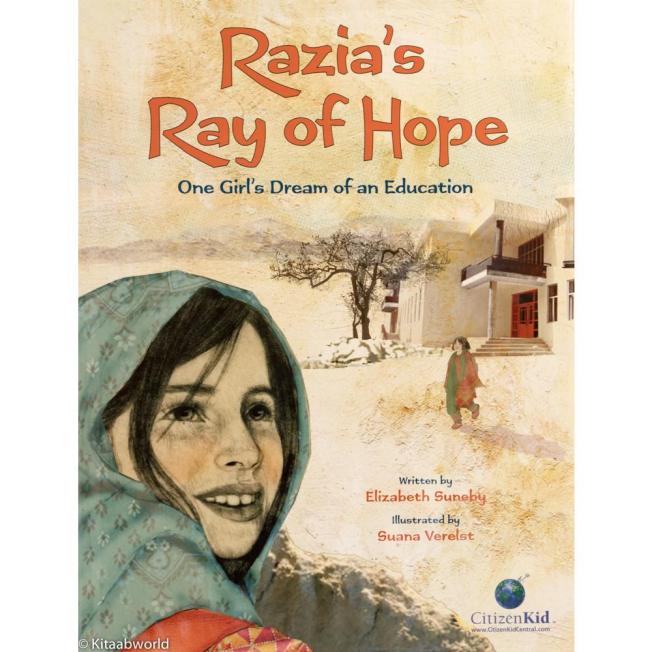
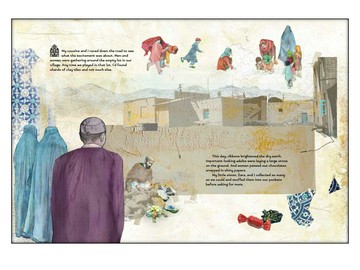
I usually love books about girls, and education and hope, but for some reason, I didn’t love this book.  I really like the pictures with their mixed media feel and textures, but I found small things annoying in the book, that based on other online reviews really put me in the tiny minority.  Most people seem to drool over this 32 page AR 4.1 picture book, I, however, think there are a lot of inspiring books about girls in Afghanistan dreaming of an education that one needs to do something different, and do it well to win me over.

So the basic premise, in this text heavy, tiny font, book, is that Razia learns they are building a new school close to her home in Afghanistan for girls, and wants to go.  Her grandfather also wants her to go, but one of her older brothers, Aziz, won’t allow it, so she isn’t allowed to go.  No historical lead up explaining why her grandfather talks about days when women were educated, and now it is a rarity.  No summation on the Taliban or the 17 years of war that the grandfather mentions.  So, unless the reader knows some background on Afghanistan, the story may not resonate with them or provide needed context for connection and appreciation.  Even the afterward, about the real founder of the school, offers very little context.  The brother’s decision is final until one day he falls ill and can’t read the medication directions, and Razia can, eventually he relents and she is allowed to go. The story hints that the rocks around the school are from the quarry he works at so he now feels confident she will be safe, and that his initial refusal was a concern for safety.  They hug and seem loving, and once school starts Razia has to learn as much as she can to be able to go home and teach Aziz and her mom.

razia1

I like that when she initially is told no, she doesn’t sit and assume a helpless manner, but rather goes to the school and meets the founder herself.  I find it odd, and irksome that the head of the school is also named Razia and it isn’t even noted. I get that is her real name, but why have the two main characters in a book have the same name and then not even acknowledge it? I didn’t get why the little girl couldn’t have a different name, seems distracting to me, and imply that every girl has the same name in Afghanistan.  I also didn’t get the hierarchy. The grandfather wants her to go, the father and uncles have legit concerns of where she is needed in helping the family farm and orchard, but why did the brother’s opinion trump them all? There is no mention of Islam, but they wear hijabs and burkas, so I think the stereotype is implied.  And that was another thing, they made it seem like she would be corrupted if she went out alone or without the burka on, but then Aziz shakes the headmistress’s hand, as if that isn’t against religious and custom norms. I felt that the kindness of the brother at the end was disjointed too, a bit too forced. The grandpa seemed kind, but the rest of the family seemed cold and rigid and not overtly concerned with Razia’s well being and growth.  Yes, they did have a jerga, to discuss and consider it, but I felt like Razia never had a voice, and while education is important, having a voice is too.  More has to change in society and in literature to give me real hope, and this book sadly fell short.

razia2

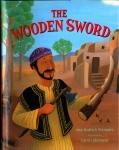
The Wooden Sword by Ann Redisch Stampler illustrated by Carol Liddiment

Standard
The Wooden Sword by Ann Redisch Stampler illustrated by Carol Liddiment

wooden sword

A Muslim Afghani Shah tests a poor Jewish man in this “softened” Jewish folktale.  I say softened because the author’s note at the end implies that she is retelling a well-known story in the Jewish tradition that often features mean-spirited characters.  In this version, however, the interaction between the rich Shah and the poor man, the Muslim and the Jew, are framed in contrast to show mutual respect, similar values, and the trust one has in God.  

sword3

This 32 page, AR 4.6 picture book, is beautifully illustrated and would work fabulous in interfaith settings, as well as in any lesson teaching how we should trust God in all things.  For children not of Islamic, or Jewish, or Afghani backgrounds, there is very little preaching and would still work very well as a moral narrative or even as a culture lesson, as it is a folktale.  From a current events standpoint, it would also do well with older children, as it shows that Muslim and Jews co-existed quite nicely once upon a time in Afghanistan as well.  

sword

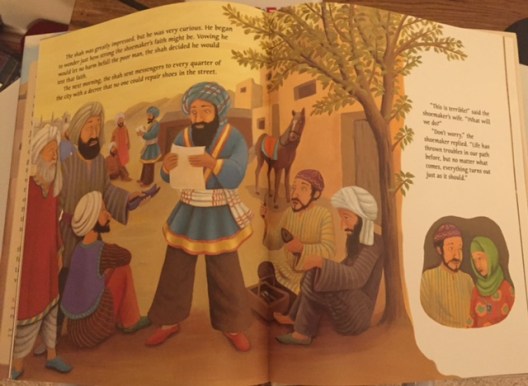
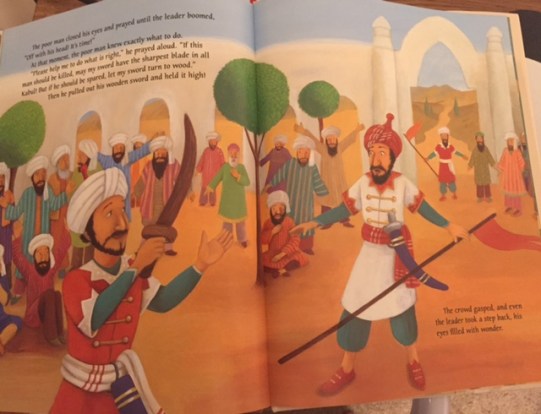
The plot is warm, although the Shah is clearly abusing his power as he meets a poor shoemaker and passes royal decree after royal decree to test the man’s faith that “everything turns out just as it should” and that God will provide.  The Shah decrees no one can repair shoes in the street, followed by banning the selling of water in the streets, and so on, until finally the poor man finds him self in the Shah’s Royal Guard without a sword, ordered to kill someone.  Not wanting to spoil how he handled the prediciment, I’ll suffice to say, in the end the poor man is made the shah’s advisor and presumably all is well. 

sword1

Throughout the tests, we also meet the poor man’s wife, who is supportive and very hospitable as they feed the Shah dressed as a peasant and offer him what little they have.  Her clothing is incredibly similar to what Muslims in Afghanistan wear, and makes me want to research this aspect for accuracy and to satisfy my own curiosity.    

Overall, a sweet interfaith folktale that I hope to share at our next interfaith storytime.