Tag Archives: young adult

Always Be My Bibi by Priyanka Taslim

Standard
Always Be My Bibi by Priyanka Taslim

I had pretty low expectations going into this 368 page YA romcom- as often YA is really “adult” and if the characters/author are Muslim in a “romance” it tends to become a heavy handed rebellion against Islamic principles. So imagine my surprise when the book really is meant for teenage readers. The protagonist loves her culture, and it is established really early on that they are Muslim, but aren’t religious.  Sure as an “Islamic School Librarian,” I wish the characters practiced Islam, and that the the kissing and hugging was labeled as haram, but for the fictional story on the page, that is cultural based, it is a delightfully chaotic and fun read.  Note, the kissing and haramness occurs when they are “sneaking out,” and reads as if they are sneaking out from parental rules, not Islamic ones, as they do not view the world through an Islamic lens.  The protagonist’s sister is presented as religious in that she wears hijab, and left a prestigious private school to attend a local Islamic one, but it is not a major plot point, and if anything shows that Islam is not a monolith or something forced, really though it just shows how different the siblings are.  Does that mean the writing is some literary genius? No, not really, but it is a quick light summer read that I enjoyed. The main character, Habiba, aka Bibi, reads as a Bangladeshi Cher from Clueless through and through, and while at the start it was a bit annoying, I ultimately found her endearing by the end.  There are plot holes, but I didn’t care too much given the quick pace and the nature of the book. The ending though, was drawn out and too long, and the book could have been easily 50 pages shorter. All in all it was fun to be transported to a tea estate in Bangladeshi for a wedding, and I wouldn’t have a problem with 15 – 16 year olds or so reading the book.

SYNOPSIS:

Bibi is in hot water with her father for sneaking off to prom with a boy, the deal has always been no dating until her older, perfect, law school bound, sister Halima gets married.  And her punishment for the summer is working at the family restaurant, one of the many Royal Fried Chicken locations in the chain they started that makes her family, chicken royalty. When hijab wearing, no haram dating Halima springs on her family that she is getting married, the family all heads to Bangladesh for the summer to get to know the groom’s family on the massive tea estate, and celebrate the wedding. Oh and Bibi’s punishment will be transferred from working fast food, to working in the fields under her new brother-in-law to be’s grumpy, serious, younger brother, Sohel.  Bibi also holds her father to his end of the deal and when the big book of biodatas arrives, she is ready to have her chaperoned dates as promised.

As the prickly family of inlaws look down on Bibi and her family, Bibi and surprisingly, Sohel join forces to break the pair up. As the book unfolds their mission changes, the bio data book causes drama, old flames are sought after, and the wedding takes some surprising turns.

WHY I LIKE IT:

As I write this, I’m rolling my eyes at the fact that I really did read it in two sittings and was amused. Bibi is spoiled and clueless and yet does have a good heart.  As with most romantically inclined books, a whole lot of suspension of reality takes place and side characters are not fully fleshed out.  Halima and Sunny met in college, and there families are from the same part of Sylhet, infact Baba worked on the Rahman’s tea estate before coming to America.  The grandma is woefully underdeveloped, I get that she is a side character but the girls spend so little time with this woman they love so dearly is a blaring hole. I really didn’t get some of the scenes after the midpoint, they felt like filler and they felt forced: friends coming from America, the bachelorette party turned amusement park trip, Sohel not sticking up for Bibi, the half hearted love triangle, and the Bibi Baba multiple rehashings.

I did like that the title of the book though comes from something Baba says to Bibi, and not from a love interest, that made me smile. And I liked that the “dates” were supervised, it is vague if the dates in America would have been, or if once Halima was married she would have been allowed to “date” with a western definition, but I kind of liked that it wasn’t defined.

FLAGS:

Disrespect, sneaking out, kissing, hugging, close boy girl friendships, sneaking out, language.

TOOLS FOR LEADING THE DISCUSSION:
Definitely not a book to spotlight as a book club selection, but one that I would have on the shelf and not mind older high schoolers reading.

Huda F Wants to Know? by Huda Fahmy

Standard
Huda F Wants to Know? by Huda Fahmy

Huda Fahmy books always make me laugh, but this is the first one that made me cry. Centering mental health and her parents divorce, we see Huda grappling with change, loss, anger, and resolve in a raw vulnerable way. While ever hopeful, and at times comical, the book is also incredibly moving and insightful.  Whether as part of the Huda F series or her two graphic novels prior, her autobiographic books always tackle heavy topics in a joyful, hilarious, honest way that appeal to girls and boys from middle school and up.  I know at 263 pages, this book is a YA read, but in my house my kids (daughter and sons) have loved reading her perspective about hijab, arranged marriages, identity, and sibling relationships. The unapologetic Muslim authenticity is unparalleled, and that non Muslims champion her books as well, truly shows the value of good story telling, and gives me hope in an often bleak world. Huda’s books are staples: new books are anxiously awaited, previous books are regularly reread, and Huda F Wants to Know? continues in that tradition.  This book isn’t just fun, it is important- it normalizes mental health, empowers families shaken up by change, and makes us all feel seen and less alone. SubhanAllah.

The book starts with Huda’s plan for her junior year in high school, her friend Nabz and her are determined to buckle down and get scholarships.  When Huda’s parents call a family meeting, she thinks she just might be getting a car, but instead she and her sisters learn, their parents are getting a divorce. The book then rewinds to show a little lead up before Huda’s world shatters, and junior year’s blue print is tossed aside.  We see her going to the masjid for weekly halaqas where Sr Amal discusses topics like societal pressures, family expectations, gender bias in education, and other relevant topics.  At one such gathering, Dr Haifa came to talk about mental health.  We also see her crushing on a boy at school, fighting with her mom and sisters, and the girls going on a road trip to a Muslim convention.

Every storyline, every twist, every page really, has Islam woven in.  It is the way the characters see themselves, see their world, handle stresses, find peace.  Mental health is not separate from the hadith and sunnah, it is blended and approached in a holistic manner.  Divorce is understood Islamically, and the clarity in which it is articulated will, I imagine, be so reassuring for Muslims who have gone through it, and seen others go through it.  Just as my boys years ago read That Can Be Arranged, and became incredibly curious about marriage in Islam, I have no doubt that this book, will also be a powerful conversation starter for so many.  I don’t know if that is part of why Huda write, but it definitely is a result of her books.  I wish I could ask her, I’d also want to know how she decides what to share of her own life, where the line of reality and fiction for her is and how she sets and maintains those boundaries? I also desperately would like to ask her if she plans to write forever, because the world benefits from her books, needs her books, I know I do.  No pressure or anything.

 There are resources for mental health at the back of the book, some even specifically for Muslims. Please preorder this book and/or request it at your local public library as a show of support, it releases in April.

MetalGhost: Kashif and the Echoes from a Past Life by Ali Mohammad Rizwan

Standard
MetalGhost: Kashif and the Echoes from a Past Life by Ali Mohammad Rizwan

img_8377-1

This 350 page YA book (14/15+) does not hit the ground running, but once it finds its stride, it is a lot of fun.  I handed the book to my son, who loves Islamic fiction, and at 30 pages he brought it back saying it was terrible. I upped the ante and bribed him with goalie gear to read to 100 pages, but he couldn’t stop, he finished the book, and returned the favor by encouraging me to move it to the top of my TBR pile.  Like him, I truly wanted to dnf it early on. There are too many names, too many line edit errors (mistakes, repetitive phrases, adverbs), and a little too many forced cheesy (halal) romance scenes. And then the writing gets a little better, the plot strengthens, the Islam is more than just the character’s religion, but something that actively engage with, humor is woven in, twists develop, emotional threads are pulled, and you find yourself absorbed and invested in the story.  The writing at the end unravels as well, it feels  forced, much like the beginning, but perhaps that is the vigilante/superhero genre’s norm to get readers to pick up the next book in the series for answers and clarity. I’m glad the book was nominated for the Muslim Book Awards, I may not have heard about it otherwise, and I love that my son, who is currently re-reading it, found a book that is relevant, appealing, and has an Islamic heart.  Think a mix of Batman and Green Arrow, with a splash of Ironman all wrapped up in a thobe, and being advised by his mother and the local imam to go pray.

SYNOPSIS:

Life is going pretty well for Kashif Razvi, he is about to marry his longtime crush, with both families’ blessings and excitement, he is busy at work but enjoys it, and he hangs out in his free time with his tech friend Samir, developing robotic and cutting edge devices, but then everything falls apart.  When his father dies because of a mysterious power outage in the ICU, Kashif can’t let it go, and starts looking for answers.  He comes up empty following the legal, traditional routes and decides to take matters into his own hands.  He throws on a suit designed by Samir and takes to the streets as MetalGhost, becoming the city’s new hope.  He follows leads to avenge his loss, uncovers corrupt police, cracks down on human trafficking, and seeks to set right other ails of the city.  No matter the crime, a few names always seem to be in the mix, and as the city starts to fall apart, copycat vigilantes start popping up, and MetalGhost finds it won’t be as easy as he thought to hang up his thobe and leave his crime fighting life behind.

WHY I LIKE IT:

Everyone wants a Muslim super hero, but usually they come across as overly juvenile, or their faith and culture performative. This book finds a nice balance of action, contemporary relevance and Islam. The structure feels formulaic, but it works as it seems to track with superhero movies.  You get the emotional tragedy, then the plot, then the resolution. The middle of the story flows and draws in seerah, sahaba inspiration, humor, and action.  The beginning and the end, though are just really stilted.  I’m not going to spoil anything, but the end was not as strong as it should have been, the reveals and twists were not articulated well and they should have been, they were so shocking.  The numerous names and characters at the beginning really need to be edited and simplified, they linger in the middle, but honestly the reader stops caring and just reads for the plot, hoping that it will get sorted.
FLAGS:

I love that the relationship beats are halal, there are a few tinges that might lean into the line, but are gray at most.  There is killing, death, torture, human trafficking, crime, lying, vigilantism.  For teens it is fine.

TOOLS FOR LEADING THE DISCUSSION:

My son and I have chatted about the book, but I think to take to a larger group, I really would want it to have another round of edits.  The idea of the story is wonderful, and to read by yourself I think it excels at what it is.  But to have teens, sitting around picking it apart to discuss and reflect on, will need the writing to be cleaner and stronger.

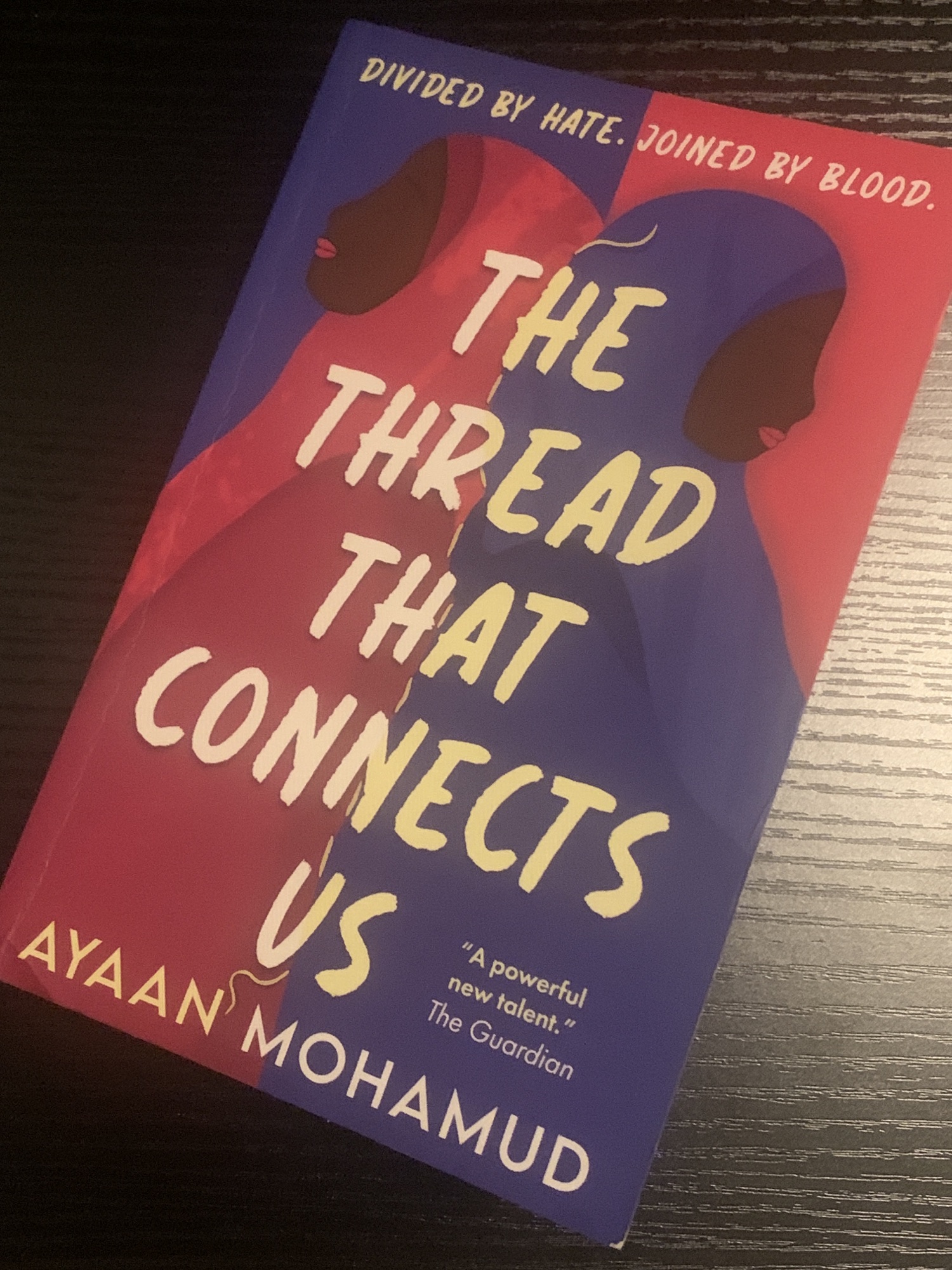
The Thread that Connects Us by Ayaan Mohamud

Standard
The Thread that Connects Us by Ayaan Mohamud


At just over 400 pages this book expertly blends the stresses of school, bullies, and friends in the UK with the twists and secrets of broken families, shattered hearts, and a past that needs to be reckoned with.  Told in dual perspectives from girls thrown together by the actions of their parents, Safiya and Halima maintain distinct voices that are rich with Somali culture, Islam, vulnerability, and ultimately love and hope.  The book is YA, but the premise is a bit mature and is better suited to older teens in my opinion, I think a high school book club would be wise to consider this book, as once you start reading, it is difficult to put the book down. 

SYNOPSIS:

Safiya is mature beyond her years.  Since her father abandoned her and her mother five years prior, she has managed the bills, the upkeep of the home, and for the most part her grades. Hooyo checked out and is rarely more than a silent being curled up unable to care for herself, much less her daughter.  With the the help from the community, particularly her best friends and neighbors Muna and Yusuf, Safiya has a found family that helps her weather the tough times.  When her dad moves back to London with his new family from Somalia, Safiya is forced to deal with not only all the painful memories of her past, but also the very real presence of her family living in her neighborhood, showing up to Eid prayers, and taking over the safe haven that school has often served as when home life has been so cold and lonely.

Halima’s father died when she was young, and life with her Hooyo in Mogadishu was good until her mother remarried, Safiya’s dad.  Her two younger half brothers that came further added to the rift between her and her mother, and now that they are moving to England with the husband, despite her protests, has her plotting a way to return to her home.  The language, the culture, the weather, are all added stresses to finding her way, and are compounded when she gets paired up to have Safiya show her around and help translate for her in school.  

The two girls hate each other, at least they have that in common, but their inability to avoid each other forces them to interact more than either wish to do.  As questions, and secrets are voiced, the two girls realize that they might have to work together to get what they want, and figure out their past.

WHY I LIKE IT:
I really enjoyed the owning of the characters’ language and culture and faith and how easy it was to be invested in their world.  Nothing pulls you out of the story, it is rich and lush and the reader can figure out why even though there is a crush, nothing is going to happen, and why they are wearing hijabs, and waking up to pray fajr, the balance is both inviting and educating, without the reader even realize it is happening, because hello, we are to busy trying to figure out what these two girls’ parents have done. 

The story has layers, and the emotional attachment I feel to both these girls, made me glad the story was over, they deserve some peace, but also desperate to know that they are going to be ok in the future too.  I can’t say too much without the risk of spoiling, but the writing is strong, the plot solid, the details intentional and relatable, and the characters very real.

FLAGS:

Lying, bullying, fighting, assault, crush, drug use, arrest, accusation, gossip, abandonment, relationships, edibles, affairs.

TOOLS FOR LEADING THE DISCUSSION:
This would be such a great upper high school read, the way the story unfolds will keep readers hooked from the first page and motivate those that start, to finish.  Students will see themselves in the characters, and be sleuths themselves trying to uncover what secrets are true and how do the pieces of the puzzle fit together.


The Hysterical Girls of St. Bernadette’s by Hanna Alkaf

Standard
The Hysterical Girls of St. Bernadette’s by Hanna Alkaf

This 352 page young adult mystery, thriller could possibly be classified as magical realism, or speculative fiction, I’m not really sure, but I do know, that my expectations were really low, and I was so pleasantly surprised by how the story pulled me in and kept me engaged.  Told primarily by dual points of view, Khadijah and Rachel, the book offers commentary on sexual assault and believing victims.  The book starts with a trigger warning of “ghosts and monsters, some of whom hide beneath human faces. It includes discussions and descriptions of sexual assault, trauma, and PTSD,” before diving in to a prestigious Malaysian girls school full of secrets, hysteria, and a past that seems to be repeating itself.  There are no religious identity crisis or issues, the student body is diverse and it is a non-issue, Khadijah recites Ayat ul Kursi, makes time to pray, and wears hijab as she tries to figure out what is making the students at St. Bernadette’s scream, what happened to those that have gone missing, and how to overcome the trauma that has made her stop speaking.  The symbolism is solid, the book starts out with the screams, but builds on it by adding backstory to the main characters, mystery with the disappearance, and numerous red herrings to keep the reader guessing.  I told myself to get to the midpoint before calling it quits, but once I was there, I read the second half of the book in one sitting. I appreciated that the book was unique, there was no relationship side stories, the cultural authenticity heightened the reading experience, and that I understood the haunting magical elements.

SYNOPSIS:

St. Bernadette’s is an old prestigious all-girls school, but one day a chain reaction of girls screaming starts and the hysteria doesn’t seem to be stopping any time soon.  When Khadijah, who is dealing with her own trauma of being sexually assaulted by her step-father, starts to look into the causes, more questions than answers arise.  In efforts to protect her younger sister, Khadijah discovers not only has this happened as their school before, but it doesn’t stop with the screaming, and the shadows, last time a girl went missing.

Rachel’s life is controlled by her single mother, who is determined that Rachel is successful and a reflection of how perfect and successful they are, despite, Rachel’s father abandoning them.  When in an act of rebellion Rachel signs up for monologue competition, she plans to get into character, not to become the character.  As Rachel starts to lose her self to the girl with pink lipstick and white ribbons in her hair, she starts to notice sights and sounds around the school, but when she falls victim to the screaming hysteria herself, will anyone care enough to save her?

WHY I LIKE IT:

So often with magical realism, I honestly don’t get it, so I’m not sure if my excitement of having it all be clear means the book was a bit simplistic, if I’m getting better the more of the genre I read, or if the writing was just good.  If I’m being honest, it is probably a little bit of all of it.  Often with the author’s book, the story is really good, until it is not, and I honestly feel like this is her best book yet, with the threads coming through, the ending feeling satisfying, the pacing being consistent, and the plot not getting lost on tangents and over explanation.

I loved the symbolism of screaming and it being largely brushed aside as society’s collective apathy to victims of sexual assault.  No one at the school has answers, no one likes questions being asked, everyone just wants to carry on as if nothing is happening, and the juxtaposition of the silence and the hysteria for me was powerful. A few plot holes were the result of telling over showing such as the case of the Khadijah and her sisters relationship, but that Khadijah stayed largely silent throughout the book, did not mean she was unable to communicate or not present, and I thought it was shown in a meaningful way.

I liked that the overbearing mom, with high expectations, and lacking emotional maturity was not from the Muslim parent, at least in Western literature, that is a common trope.  But it is worth noting that presumably the rapists mentioned in the story are Muslim.  Their faith is not a factor, but I noticed, and so I do feel that should be shared.

FLAGS:

Sexual assault, ptsd, rape, kidnapping, trauma, hysteria, lying, ghosts, monsters, magic, fear

TOOLS FOR LEADING THE DISCUSSION:
I think this would be a great high school book club read.  The conversation about sexual assault, both in the story and in real life would be important to have in a safe space.  The triggers would require some evaluation if the book is a good fit, but I think the elements that unfold and the commentary on expectation, honesty, trauma, monsters, etc. would create incredible discussion.

With All My Heart by Aasia Khan (Book One in the Exciting New Maren Springs Series)

Standard
With All My Heart by Aasia Khan (Book One in the Exciting New Maren Springs Series)

img_6993-1

I would assume this 185 page book sets out primarily to be a wholesome halal romance and to that end it probably meets its goal and gives teen Muslim girls a sweet idyllic fluffy love story within the bounds of Islamic rules. The main couple are hinted at as being alone a few times, but they are aware of it, and there is no touching, the intent is always to marry, it is worth noting there are birthdays celebrated, females singing in front of males, some element of threat, murder, criminal activity and hinted at (not described) obscene images. So for what it is, it is a fine, but for anyone not clamoring for any and all clean halal romance books, the plot is very, very weak, the climax none existent, the lacking rising action incredibly frustrating given the premise and thus potential of the book. Even the plot holes are a bit hard to overcome, even given their propensity in the genre. Written in third person omniscient keeps the book at arms length, and further prevented me from connecting with any of the characters.  The entire path the book will take is established in the first few pages, and with no twists or turns, or emotional connection, the book drags.  The perfect wealthy family of hafizes, that have no flaws, fix and provide everything and make no mistakes, are too unrealistic for me, and I found it off-putting, which isn’t to say your 14 year old dreamy eyed daughter won’t absolutely love it, but for me it is rather forgettable.

SYNOPSIS:

Two brothers, married two sisters and each have a son, the boys are raised as brothers.  At some point a family friend’s daughter, Layla, drinks from a bottle that contains the breast milk of Asad’s mom, and thus Layla becomes his “foster” sister, but not Usmans.  The baby the milk was intended for passed away early on, and through it all the families stay in touch, but never again meet.  The children, Usman and Layla have not met since Usman was 5 and Layla 1, yet they think of each other often and don’t know why the families keep apart.   Both can sense each other, identify what they have touched, and where they have been.  When Layla’s parents are killed and Layla turns up at the family’s estate in Maren Springs, Usman knows he will marry Layla, as the family welcomes their missing foster daughter/niece home.

WHY I LIKE IT:

I honestly had to read the prologue five times, and I flipped back to it while reading at least that many more times, and the book is not long.  The term “foster” threw me off which is my own ignorance, but alhumdulillah the book does eventually explain it and my Lit Sisters helped me to understand that in Arabic it is Radhaa’a which translates to “foster” to describe when mother’s milk is shared and the relationships that result.  I don’t know that the family tree is necessary, I suppose it helps since the parents are called by their first names, but it should have been in the front if included, it was a bit odd at the end.  Similarly odd is the book claiming itself “exciting” on the cover.  Blurbs are usually from others describing their thoughts or excitement about the book, not part of the title from the author, I also don’t understand why the fictional location is Maren Springs is in the title, when the four main characters work and live 4 or so hours away in Orkney. They should just live and work in Maren Springs, I didn’t see the benefit of them commuting every other chapter for no reason, and taking up unnecessary page space detailing if they were here or there, coming or going.

I feel like the book would be better in dual point of view, the characters as written don’t stand out, and there is too much telling and not enough showing.  Layla is shown to be helpless, but told to be strong, and the brothers too overly good, there needs to be more backstory of the characters, to ground them, flesh them out, and make them more interesting.  As for the plot, (SPOILERS) had the cause of why Layla was running, the murder of her parents been a looming threat, the blackmail emails with doctored images, the witness protective program been woven in, the book would have had readers intrigued, and on the edge of their seats.  Sadly it is all glaringly absent, and thus it becomes so dry just to read page after page about everything being perfect and then when it isn’t, the brothers just take care of everything in a few sentences to resume it to being, you guessed it, perfect.  The idea of Layla being on the run after her parents’ death and finding refuge in old family friends, is a great set up, but there is absolutely zero follow through. Layla doesn’t even know where the boys work, the name of the company, the reader is never really sure what they do, what anyone’s skill or academic background is, it is very vague.  At times it is downright juvenile that the heads of the company are called “big bosses,” the magical realism connection between the couple, referred to as the “alien” or “Martian” connection. Clearly the premise of the relationships and the positioning of bringing everyone together was thought through by the author, but the execution on the page sadly doesn’t reflect it.

I know in the romance genre the plot holes are always present, but to have them so early before any character development has occurred provides little incentive for the reader to overlook them because they are invested in the story.  A love connection between a 1 and 5 year old is a pretty big leap the reader is expected to be ok with, no backstory showing how close the families were, no phone calls or Facetime sessions, just letter writing, doesn’t convince the reader that there is a foundation to revisit when tragedy strikes.  The ease in which the “climax” is resolved and minimized feels dismissive and will highlight the missed opportunity even to younger readers.

I know this reads as a harsh review, but I wouldn’t have bothered writing my thoughts up if I didn’t think there was some potential for revisions to be made. The book isn’t awful, it just really is close to being a lot better than it currently is, and I hope the author will consider revisiting the story and elevating it (the benefit of Amazon print on demand) to a book that our Muslim teens can fall in love with.

FLAGS:

Some threat, birthday celebrations, singing in the car in mixed company, murder referenced, fear

TOOLS FOR LEADING THE DISCUSSION:

I purchased the book and will get it to the Islamic school library, but it isn’t a candidate for a book club selection as there is nothing really to discuss.

If You’re Not the One by Farah Naz Rishi

Standard
If You’re Not the One by Farah Naz Rishi

I suggest one reads my ENTIRE review of this book before deciding if it is right for you, because just the first few lines might signal that I liked this book, and honestly it was just ok, but I really liked parts of it. The protagonist is Muslim, it isn’t something that guides her view of the world or dictates her actions, but she is unapologetic, and it is not something she is grappling with. She prays, makes duas, it mentions a hadith, so I appreciate that it is there and always just below the surface. The “romance” might not be halal, halal, but it definitely isn’t raunchy and stays close to the line even when it crosses it. The male and female character are very close friends, and spend a lot of time alone together even before SPOILER there is hugging and a kiss, it is a rom-com after all. I loved the annotations, especially reading an e-version flipping to the protagonists commentary of her thoughts and then flipping back was easy and fun. I think my favorite line in a long time in the book is her translating rice to chawal (see images). My biggest frustration though, with the book is how close it mirrors the author’s biography, Sorry for the Inconvenience, which I read just over a month ago. Truly, it was like the biography was the book and this was the movie adaptation. Sure the younger brother was switched out for a younger sister, and this wasn’t as gritty or traumatic, but the romantic literary beats were all more or less the same: childhood betrothed, falling for a friend who made a bad first impression, dad being sick, parents and their on again off again divorce, medical diagnosis, it really is two versions of the same story, which meant I was never invested in the fictionalized characters, or on the edge of my seat to see what would happen next. When you have seen the behind the scenes inside scoop so to speak, it is hard to get on board with the faded carbon copy. Add in the consistent lack of communication, telling instead of showing, unlikability of the protagonist, and the non existent foundation of any of the relationships, and it made it hard to get lost in the fluff of the moment.


Side note: I had a whole paragraph rant about the cover, but when I went to post my review on Goodreads (still banned from Amazon) I saw that there is a newer cover with Marlow wearing yellow crocs. I have no idea why the illustrator and publisher would have arcs with the male lead in flip flops, but I think by now it is common knowledge there is often a lack of communication between authors and illustrators. sigh.


SYNOPSIS:
Anisa is in college, she has worked hard to get in to the all girl’s school near where her almost fiancé Isaac is already enrolled. When she takes a class on Isaac’s campus she meets Marlow, who makes a poor first impression on the very “perfect” Anisa. When Marlow and Anisa get paired up for a class paper, Marlow also offers his services as a “love coach” to help Anisa reconnect with a drifting away Isaac. The more time Anisa and Marlow spend together, and the more Anisa learns about Isaac , the more she ultimately learns about herself and what she wants out of a partner.


WHY I LIKE IT: (SPOILERS)
I’ve read a few of the author’s books, so I know she can write, which irritated me even more that this book felt so flat. Anisa and Isaac have been “together” for over six years, but know nothing about each other, don’t talk or text, and as much as the book wants to make it seem like it is an all of the sudden thing, it provides no real tangible suggestion that they have ever had any sort of connection. So why did they decide to be potentially engaged???? All the parents are on board, but how did the two of them set this into motion? With the exception of Isaac visiting her one late night before he went to school, there is so little for the reader to be emotionally invested in. Anisa has terrible communication with every character in the book, not just Isaac, even with Marlow and her family, the side characters all keep in touch just fine, and it is never addressed as a quirk, it just is accepted. If your dad was sick, or your parents divorcing, wouldn’t you be texting them periodically, or non stop? And text between characters are shown on the page, so how is Anisa texting Marlow throughout the 352 pages, but then goes MIA the last 20? It didn’t work for me clearly.

Additionally, I was so tired about hearing how perfect Anisa is, when it never seemed to show it, sure the duplicity with her outward appearance and home appearance was well done, but it never really shows up in any other facet of her life. She is unorganized, has few friends, doesn’t seem to be a very present daughter and sister, the repetitive telling and lack of showing, gave the book no foundation. I know romance-y type books often have to fudge common sense at times, but with no foundation at all, it was hard to be invested in any twists or swooning gestures. I think I just didn’t really like Anisa, and I weirdly feel guilty about it, because she so closes mirrors the author, and I liked the author’s self portrayal in her earlier memoir.


FLAGS:
Close male/female friendships, hugging, kissing, lying, “cheating,” talk of titillating role playing video games (otome) not details so much as shaming and teasing about Anisa playing them (the word porn is tossed in a few times).

TOOLS FOR LEADING THE DISCUSSION:
I think I’d shelve this book in an Islamic school library for high school students. I don’t think I would promote it, but I think those romance loving high school girls will enjoy and be able to handle this story. It won’t work for a book club, but it does make clear that Anisa “dates” with intent to marry, there is reassurance that she wants to marry a Muslim, that Marlow has been reading about Islam, but that Anisa isn’t going to force him, and that societal expectations and appearances aren’t impossible to push back on- which I think are good considerations for 16 and up readers to see fleshed out.

This Book Won’t Burn by Samira Ahmed

Standard
This Book Won’t Burn by Samira Ahmed

burn

It is clear that this 384 page contemporary YA book is about the hot topic of burn banning in America, and I would imagine most are aware that the overwhelming number of books that have been recently banned or pulled because of objection, are by BIPOC and queer authors featuring BIPOC and queer themes and representation.  So I read it not so much to see the author’s perspective, but more to see how the Muslim author had the Muslim identifying characters in the book approach the topic.  The book is very black and white: book banning is wrong, Republican right wing MAGA members are fascist, and liberal freedom of speech supporters are LGBTQ+ identifying and allies and upholder of first amendment rights.  Islam and the character’s Indian heritage is ingrained in the characters’ being, and a label they are comfortable with, unfortunately, it has no impact on how they act, think, or the lens in which they view their world. Every 50 pages or so some vague mention of Ramadan, or a tasbeeh, or mosque appears, only to disappear just as abruptly. The Muslim protagonist, Noor, likes two different boys, is often alone with one or the other, nearly kisses both, and with the support of her family attends prom. Her younger sister, Amal, is unsure if she wants a boyfriend or a girlfriend, it is not a major part of the story and is just mentioned in passing.  A major side character is lesbian, and starts a bit of a relationship with another girl, they hold hands, and there are a few kisses on cheeks, nothing overly detailed.  There is profanity in the book, arson, threats, racism, and stereotypes.

SYNOPSIS:
Noor and her family move to a small town from Chicago when her dad abruptly abandons the family.  It is the end of Noor’s senior year, and with the grief, stress, and emotional upheaval of her family, Noor just wants to get to graduation.  Quick friendships with Faiz and Juniper, and realizing that she is the daughter of her activist parents though, thrusts her into making enemies her first week in the conservative town by questioning the school’s book banning policies. Add in her strained relationship with her mom, her conflicting feelings for Andrew and Faiz, and her sisterly concern for Amal, and Noor has a lot on her plate as she shakes up a small town.

WHY I LIKE IT:
The first chapter is incredibly written, no doubt.  I hated the dad, actually more than that, I was so disappointed in him, and so concerned for Noor, Amal and their mom.  To feel such strong emotions for characters just introduced is a testament the author’s abilities.  Sadly, insight into why their dad left never came, and  perhaps no answers is something the characters had to grapple with, but as the reader, I felt it wasn’t really explored, or articulated, it just was unresolved, and I really wanted some closure.  In terms of literary quality, the book went down hill pretty quick for me.  The middle was slow and repetitive with the heavy handed views on book banning.  Some shades of gray, or some discourse would have prodded the readers to maybe think about the implications of banning books, but the narrative never allowed for that.  It is right vs wrong, us vs them from the start.  There really is no growth of the protagonist, she doesn’t have much of a character arc, and the supporting cast is not fleshed out.  I wanted to see more of Noor and her Mom, not just be told repetitively how absent she is, I wanted to see Faiz as a full person, not just the only other brown Muslim at the school and who likes to cook. Where are his parents, do they support his activism, that he is going to prom? Truly, there is no Islam in practice it is just a label that gets dropped when it furthers the notion of raging against an established bias system.  I’m not saying they need to be praying and reading Quran on every page, but I don’t know that the story would be much different if the family was not Muslim Indian American. Really the catalyst is that they are a new family, and a visible minority.

FLAGS:

Straight and LGBTQ+ relationships, arson, threats, stereotypes, racism, bullying, cursing.

The Djinn’s Apple by Djamila Morani translated by Sawad Hussain

Standard
The Djinn’s Apple by Djamila Morani translated by Sawad Hussain

img_4352-1

This short, 160 page YA book is really quite gripping. Admittedly, during the first third of the book, which is primarily world building, I had no idea what was really going on, but I was intrigued and by the half way mark, I was so invested, I truly could not put the book down. I received an early digital copy so I am not sure if the grammar errors, typos, and lacking punctuation is because it had not been through line edits yet, or a result of translation oversights, none-the-less I thoroughly enjoyed this book and read it in a single sitting. I wish this book was 500 pages long, with details about the time and environment, and build up to the conclusion, and angst to the romance, but it is not there, it is short, and rushed, and I don’t really know how to review it, because to point out all that is wrong, doesn’t convey all that was right. I am a self appointed reviewer, so I’m going to break my own standards and just copy and paste the teasing blurb, I can’t say it better, you are welcome: “Historical fiction meets crime fiction in The Djinn’s Apple , an award-winning YA murder mystery set in the Abbasid period—the golden age of Baghdad. A ruthless murder. A magical herb. A mysterious manuscript. When Nardeen’s home is stormed by angry men frantically in search of something—or someone—she is the only one who manages to escape. And after the rest of her family is left behind and murdered, Nardeen sets out on an unyielding mission to bring her family’s killers to justice, regardless of the cost…”

SYNOPSIS:

See above, I know my standards are slacking, but that blurb is what helped guide me when I got lost a little lost with the words on the pages.

WHY I LIKE IT:

I love the map and in this case the glossary and backmatter really helped me to understand the setting because the text assumes the reader knows about Harun Al-Rashid, the Golden Age of Baghdad, and the Abassids. I appreciated the Reader’s Guide and further information about the Bimaristan, as well.

I like that it showed the family as being practicing Muslims, them being accused of being infidel Zoroastrian, and the adopted father and teacher being Jewish, it added a layer that entices the reader to reconsider stereotypes and look further into the society. The book doesn’t offer much commentary about it, but does highlight the different religious groups and show them interacting.

The book really pulls you in and considering that I was lost and there were grammar errors and typos, really speaks to the story and heart of the writing. I am glad I read it, it will stay with me, and I may not be able to pass an AR test on it, but I do plan to get a physical copy for the library and for myself, so that I can read it again.

FLAGS:

Murder, plotting, revenge, poison, romantic feelings.

TOOLS FOR LEADING THE DISCUSSION:
I need to read the book again, but yes, it would be awesome as a book club selection for Middle School or even High School to discuss, pick apart, analyze, research, and enjoy.

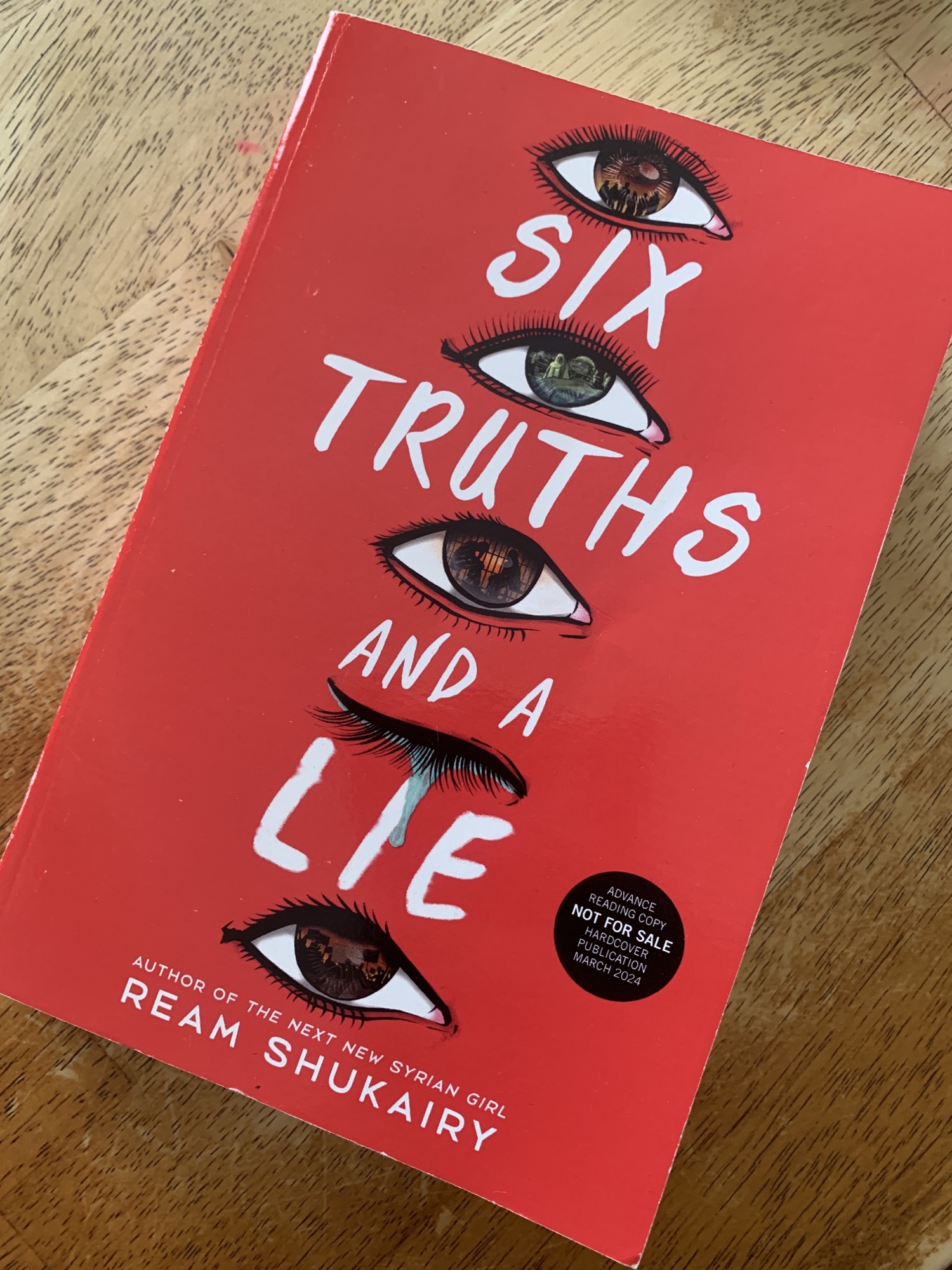
Six Truths and a Lie by Ream Shukairy

Standard
Six Truths and a Lie by Ream Shukairy

Woah baby, that was a wildly fantastic ride of a read.  The very first page grabs you and makes you sit up and pay attention.  I have never been so happy to sit in a waiting room so that I could read in peace.  This 387 page book is mature YA, I was gifted the knowledge prior to reading that there is a line that is toed, possibly stepped on, but not carelessly crossed, so I will gift that knowledge on to you, so that you might enjoy the story without that anxiety. Told from numerous perspectives, a group of Muslim teens find themselves arrested for an act of terror.  Strangers from different schools, different backgrounds, and different dreams for their future, are fiction, but their stories, their secrets, the broken system that they find themselves in, all feels very real.  The plausibility and commentary from an OWN Muslim author is incredible, I do wish their was more spiritual centering, Islamic framing, or even a more Muslim conscience present. Some of the characters do discuss hijab and one does find solace in prayer, but none of them really pour their heart out to Allah swt in the isolation of their cells, and in the predicament they are placed in, and it seems like they would.  Ultimately though the writing is remarkable, it has been a long time since I was truly tempted to skip ahead and read the last few pages because my heart was racing.  There is just one storyline thread that is so overly emphasized that comes close to a haram line, that I wish was a little down played so that I, as an Islamic school librarian, could encourage younger teens to pick up the book and dive in.

SYNOPSIS:
It is the fourth of July, and the MSA kids from the local different high schools are gathering at the beach for bonfires, fireworks, and socializing.  Everyone present will witness a crime, six teens though will be accused of committing it.  Qays, the Palestinian golden soccer boy who can charm everyone and anyone.  Nasreen, the outcast from a private Catholic school there to meet someone.  Samia the hijab wearing social media star. Muzhda the Afghan refugee with undocumented parents.  Zamzam the girl with a singular dream to be a doctor, and Abdullahi, the quiet EMT in training.  Six strangers whose histories and alibies link them to the outside world, but leave them skeptical of one another as they face charges in a world not concerned with the truth.

WHY I LIKE IT:

I love that the characters are Muslim and feel so real and developed. The characters are not tropes or their families stereotypical.  They know what Islamophobia faces them from others, they know what internalized issues they are dealing with, and they are not having a religious identity crises amidst everything else they are experiencing.  The writing allows each voice to be unique and clear, which is quite impressive as there are a lot of perspectives that move the plot along.  It is really hard to write a review that doesn’t spoil the book, so yes I’m being vague, and you are welcome.

FLAGS:

There are a lot of profanities not just when the stakes are high, but normalized as well throughout.  There are close relationships between boys and girls.  They take about dating.  There is weed, and the legalities of using, being in possession, and being high.  There is lying, death, incarceration, Islamophobia, some physical abuse mentioned.  There is a story line of a girl that doesn’t know if she is attracted to girls, she doesn’t act on it, but it is something that has tangled up her alibi and she choses not to explore it, but it keeps coming back up.

TOOLS FOR LEADING THE DISCUSSION:

This would be an awesome mature YA book club, just like some of the characters are being held in juvie and some being tried as adults, I think for Muslim readers a little older will benefit and be able to process, discuss, and see themselves in the book.  The book mentions that it could happen to anyone, and for a Muslim audience, to recognize and discuss that concept would be beneficial and engaging.