Tag Archives: Razeena Omar Gutta

Zamzam for Everyone: Sharing Water at Hajj by Razeena Omar Gutta illustrated by Bassent Dawoud

Standard
Zamzam for Everyone: Sharing Water at Hajj by Razeena Omar Gutta illustrated by Bassent Dawoud

This joyful 32 page picture book is both adorable and educational. Layers of Hajj and Zamzam threaded through with the global reach of Islam, generosity, food, language, and a little girl with a big smile brightening every encounter, is heartfelt and tender. Each reading has me smiling and marveling at the illustrations, amount of information simply conveyed, and the way it all comes together to offer both a window and a mirror for readers of all ages, particularly 3 and up.  The robust backmatter allows older readers to benefit, and with pronunciation guides, cultural and religious oversight noted, this book will be a favorite at bedtime and story times in Islamic and public schools, libraries, and gatherings.  SubhanAllah, the book is really well done and such a gift to us all to see Hajj and Zamzam unapologetically and proudly presented through little Mariam’s eyes.  It will leave children feeling like they just had a warm hug, and inshaAllah making dua’a that they too will be invited to Hajj soon.  

The book starts with Mariam feeling blessed to be one of the millions of people at Hajj. Her mother encourages her to be good, share, and be grateful all while staying hydrated, as it will be tiring.  She tries to come up with what she can do to get blessings, in addition to smiling, when she realizes sharing her Zamzam water will be the most beneficial. 

She helps an old lady find a seat and gives her some Zamzam, the Pakistani lady says, “shukria” and gives her dates in return. When she shares with some Indonesian sisters and is told “Terimah Kasih” she is handed some pandan cookies in gratitude.  This continues all throughout her Umrah with pilgrims and workers from different countries thanking her in different languages and sharing something back with her.  

It carries on through the steps of her Hajj, even when Makkah is far away. And even when she returns to her home, she shares the Zamzam to bring a part of Hajj to those that stayed at home.

The backmatter tells the story of Zamzam, information about the treats mentioned from around the world, information about Hajj with a glossary as well as the steps of Umrah and Hajj, information about the author and illustrator, and who helped insure accuracy of all the cultural and religious content included.

The book comes out in January 2026, and appears to be available in both hardback and paperback, please preorder to show support.


Maymoona’s Moon: A Special Eid Story by Razeena Omar Gutta illustrated by Zayneb Haleem

Standard
Maymoona’s Moon: A Special Eid Story by Razeena Omar Gutta illustrated by Zayneb Haleem

I love the illustrations of this book and have been trying to get it since it released in Australia to no avail, it finally is being released here in America and the 32 page hardback book is so cute to look through.  The story is, well, sigh.  It isn’t bad or wrong, but for a religious centered book, it has no Islam, no Eid feels, no faithful reliance.  Rather than using religion to bring the sighting of the moon to little Muslims and non Muslims, and blending it with the protagonists desire to be an astronaut as the framing of the story, it just focuses on the celestial intrigue.  “Cosmic compasses,” “galactic goggles,” and a cheering squad are needed for “Operation Galaxy Gaze,” there are no “Bismillahs” or “Alhumdulillahs” when looking for the moon, and ultimately seeing it.  Again, it isn’t wrong, it just seems a little unfortunate.  This book will be read in Islamic and public schools, libraries, and everywhere else children, preschool to early elementary, gather with hopes of hearing a Ramadan or Eid story.  I’m just fairly confident, none will leave knowing what Eid is, or why it is important to Muslims.  They will get that Maymoona loves the stars, there is an “inshaAllah” when she dreams of being an astronaut some day, but even the backmatter entitled, “Why is Seeing the Moon so Important for Eid?” focuses on just that, the seeing of the moon, not the month of Ramadan ending and Eid joy prevailing.  I know I’m harsh when it comes to Islamic rep, this one just skirted the line of telling us about searching for the moon, leaving Ramadan behind, and the excitement of Eid, when it so easily could have shown us, and left a lasting impression long after the book closed.

The book starts with the sights and sounds of Eid approaching. There is only one thing left to do and that is something Maymoona takes very seriously, looking for the moon.  It is the most exciting part of Eid for her, as she dreams of being a future astronaut.  She assembles her team to plot and plan, her gear to give her the best chance of success, and she squashes her nerves and makes her ascent to the best vantage point.  And then she waits, patiently to see if the wind will move the clouds, if her dreams of landing on the moon will come to fruition, if tomorrow will be Eid.

The large 8.5 x 11 pages with a matte finish make this book easy to share in small groups or at bedtime, and really let the pictures charm the audience on each and every spread.

Ramadan on Rahma Road: A Recipe Storybook by Razeena Omar Gutta recipes by Faaiza Osman illustrated by Atieh Sohrabi

Standard
Ramadan on Rahma Road: A Recipe Storybook by Razeena Omar Gutta recipes by Faaiza Osman illustrated by Atieh Sohrabi


I would not know where to shelve this 40 page in a library, it has beautiful pictures, it is informative, resourceful, useful, and interesting- I’ve only delayed sharing it because I really have had to think, how best to use this book to its maximum potential, to make it truly effective. It is formatted externally as a picture book, but it reads much like an chapter book anthology with the stories connected by the road the diverse folks live on, Rahma Road, all coming together for a communal iftar, with some fasting and some not.  The spreads feature vignettes on the left of what each house is making, including tidbits of culture, facts about Ramadan, insights about method or ingredients, with the facing page being the recipe.  The book is incredibly meticulous and intentional in appealing to Muslims and non Muslims alike, as well as a variety of ages.  It works as a book for Muslims to see themselves in, non Muslims to get a peek at iftaar excitement through, messages about community and diversity celebrated, foodies to see new recipes that they can try, cultures to explore through food and native words, a story framing to feel connection, I really could go on and on with the layers and inclusions this book provides, alhumdulillah.  I think the best way to use and share the book is going to be for me to read it with my 5 and 9 year old children a week or so before Ramadan.  Where I can read the story portion, getting us excited for Ramadan, slipping in some reminders, appreciating Islam’s global presence, and then talking about the recipes so that they can pick dishes to try in Ramadan and add needed ingredients to the shopping list (I wish I made the effort to be this organized all year long).  I then will plan to leave the book out and have my teens flip through to find any recipes that they think sound good and will commit to making.  The book would work all year long, but as a new release, I’m sharing my plan with hopes that it can help your family as well. 

The book contains 25 globally inspired recipes, featuring 11 with accompanying stories.  I absolutely love that at the bottom of the recipes are page numbers for additional items that would pair nicely, or be condiments or beverages or desserts for the dish.  This allows easy personalization, fusion meals, and more importantly a way for different age groups to be able to help each other in the preparation.  Maybe koshari is a bit advanced for your kid, but the mint lemonade paired with it might be something they can tackle a bit more independently. 

The framing of everyone on the road coming together book ends with the neighbors sharing a meal at the end,  I love the backmatter explaining Ramdan, about the recipes, even about Rahma Road.  The message to the reader and the naming of consultants really is a credit to the time and effort put into this book.

A few of the dishes and countries featured are: Atayef from Palestine, African American Sweet Potato Pie, Nigerian Puff Puff, Japanese Temaki Sushi, Morrocan Harira, Uyghur Lamp Stir-Fry, Guatemalan Dobiadas, Turkish Chicken Gozleme, Malaysian Teh Tarik, Australian Mini Strawberry Pavlovas, South African Bunny Chow, Mexican Elotes  .I can’t wait to report back if my plan was successful, if the dishes prepared were a hit, and ideas for further maximizing the use of the contents it contains.

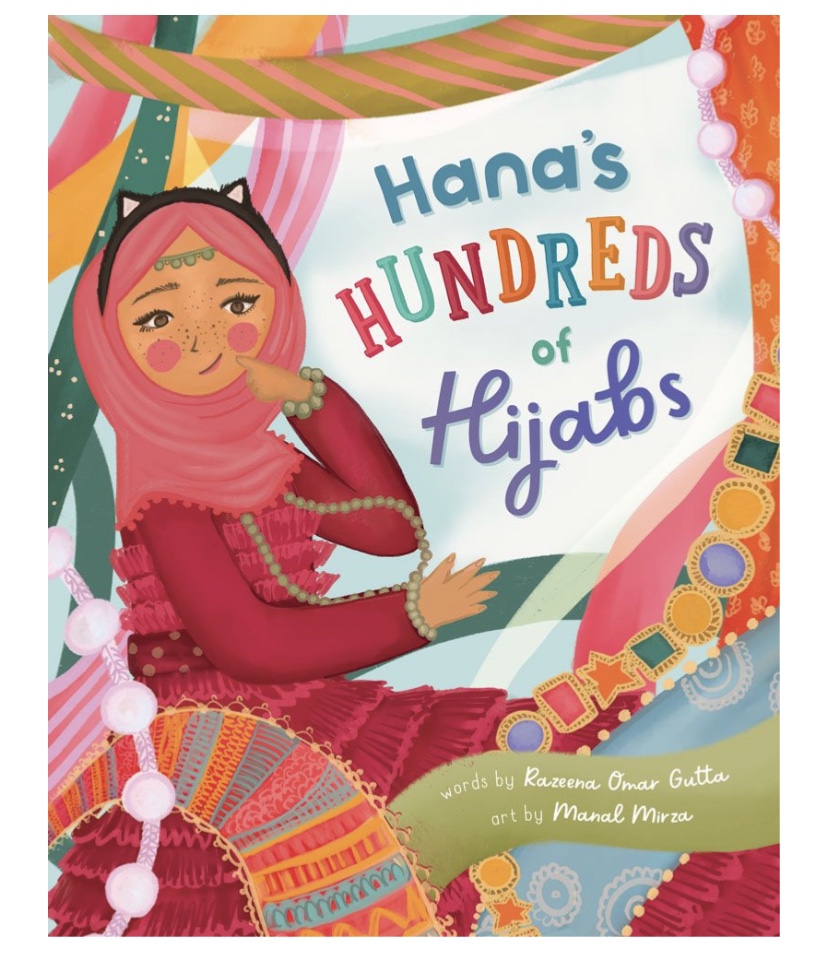
Hana’s Hundreds of Hijabs by Razeena Omar Gutta illustrated by Manal Mirza 

Standard
Hana’s Hundreds of Hijabs by Razeena Omar Gutta illustrated by Manal Mirza 

img_1826

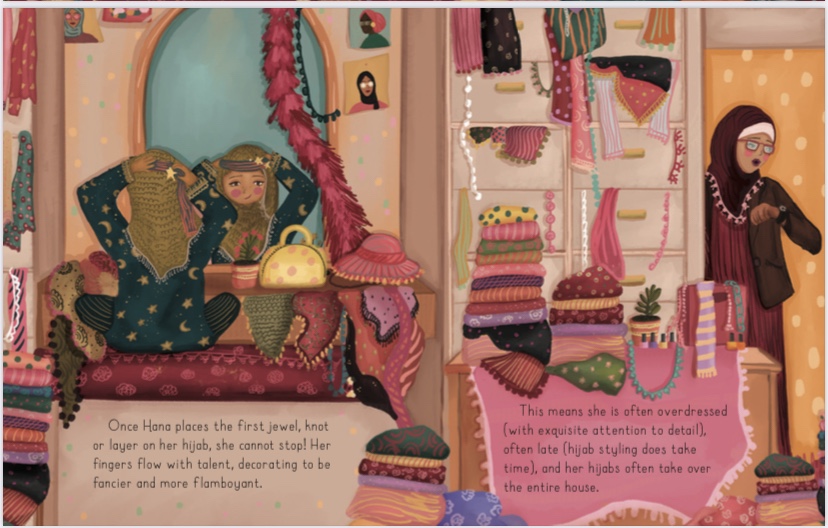
I love the idea of this book and I can see me reading it at story time to KG-2nd graders with great success. The illustrations are rich and detailed, the over the top bedazzling is fun and extra, the plot however, is non existent, surface level at best, the Islamic representation incredibly shallow, and the inconsistencies puzzling.  I’ve read this book a lot of times trying to articulate why it just rubs me the wrong way, and I think it is because it really reduces hijab to a fashion piece.  You can change the word “hijab” to hat or t-shirt or sock and the story would be EXACTLY the same. There is no connecting hijab to Islam, no showing or telling why a woman would even where it.  It presents hijab as being a costume or a decoration.  If you don’t read the author’s note at the end, you would have no idea that hijab is an obligation on Muslim women.  Even at story time in an Islamic school I don’t know that the author’s note will make the case clear enough, and I do plan to discuss with the classes how important it is to realize that hijab means something and is an act of worship and faith, and not something frivolous.  The 24 page book is cute, no doubt, but I wish it had just a bit more substance.

img_1827

A few other readers have shared that they found the story “offensive” and “triggering” for the main character’s judgmental and snooty attitude of criticizing others’ fashion sense.  As someone who doesn’t care much what I wear, I didn’t feel attacked, but their points are valid, so I share them. Hijab is incredibly personal and many women struggle with dressing for the sake of Allah swt with the messaging all around and pressures to compromise in one way or another, and this book for some could definitely add fuel to the fire of telling a woman how to dress.

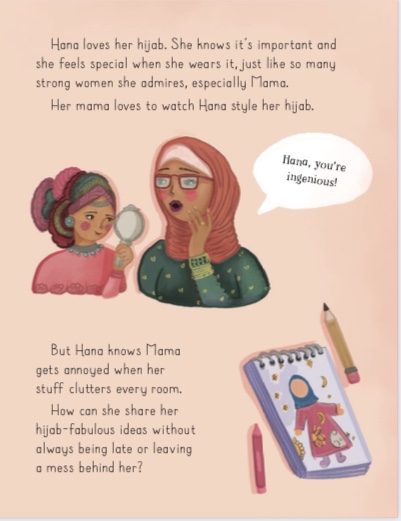
img_1828

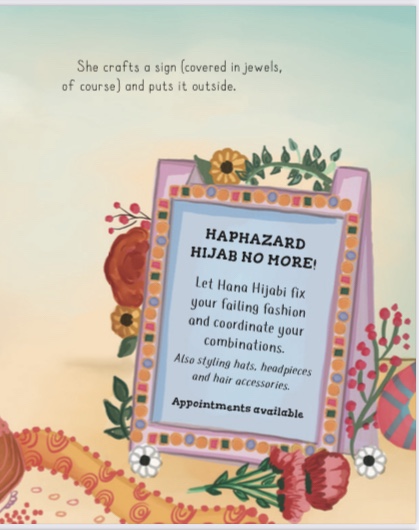
My plot concerns mainly pivot around Hana’s mom.  Why is the mom presented as irritated at the beginning and then so supportive at the end, what changed? Why doesn’t the mom remind her daughter about why one wears hijab when given the chance?  At least add the word “Muslim” in the above page between “strong” and “women.” I know the book is supposed to be fun and surface level, but connecting hijab to Islam isn’t preachy, it is logical. It is a key piece to the premise of the story.  Also, how does offering her services of styling solve the problem- wouldn’t it in fact make it worse?

img_1829

The fun illustrations and the extreme decorations really could have made the book a little girl favorite, but as it is, I don’t know that it will be requested more than once, or lend itself to being remembered once story time is over.  It draws on Fancy Nancy extremes, and thinking outside the box, but because of the faith based article at the core, it seems to miss the importance and true beauty that hijab represents.  I think Muslims will pick it up and be excited on first glance, but be left wondering what the point was, and non Muslims will probably be left with more questions than answers.