Tag Archives: Politics

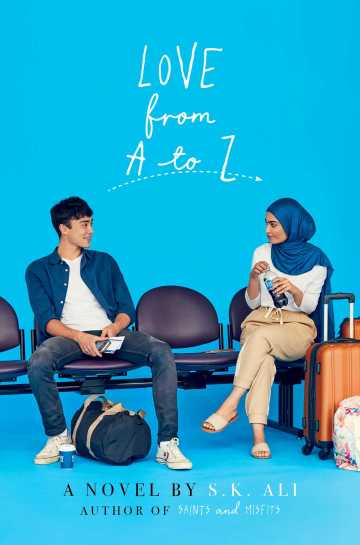
Love from A to Z by S.K. Ali

Standard
Love from A to Z by S.K. Ali

love from a to z.jpg

Now that there is legitimately a genre of YA Islamic Romance out there told in Own Voice, the expectations are high that a book is compelling, realistic, and unique somehow.  While the author’s first book, Saints and Misfits was pretty ground breaking, this 342 page was a great read, but not nearly as remarkable or memorable.  Granted it is not fair to compare the two books, and each day I do age out of the target demographic, but while the story reads authentic and true, albeit a bit serendipitous, it doesn’t have the teeth or grit I was kind of hoping for, and with a mother who suffers from multiple sclerosis my emotions were pretty invested.

SYNOPSIS:

Told from both Adam and Zayneb’s perspectives by way of their individual “Oddities and Marvels” journals, our two characters are presented by a narrator who keeps their story on track and interjects when their versions of an event differ. 

Zayneb is a high schooler and activist who has recently been expelled for threatening a teacher who consistently lets his Islamaphobic beliefs take over the days lessons.  In an environment filled with micro aggressions against Muslims, Zeynab’s parents are at a loss at how to keep their daughter from making waves, and thus allow her to leave her Indiana home a week before spring break to visit her aunt in Doha, Qatar.

Adam is at University in London where he has recently been diagnosed with MS and as a result has stopped going to classes, and is literally “making” the most of the time he has by making things.  As the term ends and he officially withdraws from school, he heads home to Doha to tell his dad and sister that he has the same disease that took his mother’s life years early.

The two characters meet at the airport briefly and then again on the plane and then at Adam’s house and the needless to say  their accidental meetings allow for friendship to grow, attraction to be built upon and a relationship to develop. Both characters have their own lives and own obstacles and own maturity that needs to occur in order for a happy ending to take place, and thus the book keeps you interested, invested and cheering them on.

WHY I LIKE IT:

I love the dynamic of how the book and characters are set up.  Both are practicing Muslims, both characters don’t cross a line, both characters have diverse mixed cultural backgrounds, and one is a convert and the other the daughter of a convert.  She is fiery and impulsive and emotional, he is pragmatic and calm and quiet.  While they have some background in common, their life experiences are rather different and it is very much a story about opposites attracting.  

I’ve been waiting for this book to come out, and so I knew my expectations would be too high.  That being said the book warns it is a love story and in some ways, that was what I kind of felt was lacking.  There was the physical attraction that was mentioned fairly often, but the deep connection of ideas or growing seemed a bit lacking.  

I really liked Adam, and his internal stresses and struggles and coming to grips with his disease seemed pretty developed.  Somehow though, and I’m probably in the minority, I didn’t love Zayneb.  She is impulsive and definitely learned and grew from the start of the book to the end, but I didn’t love her nuances with dealing with the Emmas and her friends back home and unraveling her teacher, it felt kind of forced and I can’t articulate why.  I’m glad she matured and she got answers about her grandmother, but maybe I should have felt so much in common with her and when I didn’t, I felt a little irritated.  Clearly I get too invested in fictional characters, I’ll admit that.

I like that Islam is presented in a non defensive way.  The parents aren’t evil, there is no rebelling, even the awful teacher spawns backlash and allies to Zayneb and her cause. There is no apologizing or overly explaining if the characters are pushing boundaries established by Islam or if they are establishing their own boundaries based on their understanding of Islam.  I like this, because it shows that Muslims are not a monolith, we are not one way good or bad.  Zayneb covers and prays and has friends that are boys and her family is kept in the loop of what she does, which alone breaks so many of the predominate stereotypes about Muslims.  Adam himself converted at age nine and plays the guitar and has friends that are girls, and is close to his sister, and likes dogs.  A side character is noted to be incredibly religious, but doesn’t cover.  The story takes place in an Islamic majority country, but attitudes at the swimming pool don’t allow Zayneb to dress modestly while she swims.  

Overall, the book is a delightful read that manages to keep the religious integrity in the characters and show their personalities as they come of age.  It may not be memorable years after reading, but what you do remember will be positive, and while you are reading it, you will have a hard time putting it down.

FLAGS:

There is angsty romance, and talk of sex.  The two main characters keep it pretty clean, but the side characters joke about hooking up, being horny, and sneaking off to hotel rooms.  The non Muslim aunt has a secret alcohol and cigarette stash that she gets called out on, but nothing more is mentioned about it. I think 9th or 10th grade and up will be perfectly ok to read.

TOOLS FOR LEADING THE DISCUSSION:

There is a lot to unpack in this book and I think if one just listens, teens will naturally add their own opinions and perspectives on EVERYTHING the characters experience, feel, question, and cope with.  The book just came out, but I would imagine that over time discussion questions will appear.

Author’s website: https://skalibooks.com/books/

Interview with the author: https://www.barnesandnoble.com/blog/teen/an-interview-with-s-k-ali-author-of-love-from-a-to-z/


Anything But Okay by Sarah Darer Littman

Standard
Anything But Okay by Sarah Darer Littman

anything but ok.jpg

This 345 page contemporary book is brand new from Scholastic and isn’t yet in the AR database, it is billed as appropriate for ages 12 and up and is probably pretty accurate.  The cover, in my opinion, is rather a disservice for the audience.  The book would appeal to girls and boys, and isn’t really about school drama, which is the vibe I got from the cover.  The story is actually pretty deep and thought provoking, on a wide range of issues facing many young adults today.

SYNOPSIS:

Told from Stella Walker’s perspective, the book opens with her and her friends, Ken and Farida, reviewing old movies.  Farida, an Iraqi immigrant, is constantly pointing out the stereotypes, tropes, and bias they engage in regularly and see depicted around them.  She is constantly nagging her friends to recognize their privilege and check it.  Stella tries to get it, but it’s not that easy. Nor are the obstacles that the book explores. 

Stella’s parents are vets, and her brother, Rob, has just returned from his second tour in Afghanistan and is suffering from PTSD.  Additionally, Rob’s best friend commits suicide and yet, Stella’s family doesn’t involve her in the conversations and concerns, and as a result she doesn’t talk to her best friend Farida.  This tension is amplified when Farida wants to run for class president, but her parents advise her against it, as Islamaphobia is on the rise with the mayor, up for re-election, spouting hate speech, and his son, already in the race to lead the school. 

Stella, as a result, is convinced to run with the help and support of her friends.  All should be going well, but in a desperate attempt to get Rob out of the house, a trip to the mall to watch a movie results in Rob sticking up for a Sikh kid being bullied, and breaking the instigators nose.  The police are called in, and the real drama of the book takes center stage, as social media, a bigoted mayor, and a family’s member friendship with a Muslim paint Rob as a radicalized terrorist.  The Walker’s house is vandalized and Farida’s family’s restaurant is suffering and the mayoral election and class office election will all require some tough decisions and insights into honesty, framing, perseverance and friendship.

WHY I LIKE IT:

I don’t think I was expecting the book to explore so many topics and to do it, in a rather real and raw way.  The arc of concepts covered provides a lot of juice and relevance and the quick pace, makes it a quick read.  Some pages are letters written by Rob, a number of pages are the various police reports taken after the mall assault and the various points of view are great.  It explores how media editing and framing can change a narrative to one side or another. 

I love Farida, bless her, she is annoying and one-dimensional, but yet so relatable.  She is the token minority that ties it all together and is the billboard representation of “other.”  I can so relate to her, being the minority and the one that constantly had to be the gadfly on the masses.  

The school election is a little cheesy and overly elevated in importance, but it is the catalyst, so while I wasn’t really invested in who won, I liked the concepts it brought to the forefront of the characters lives.  The family struggles and retaking the truth and owning it, was the real strength of the book, and introducing kids to the horrors of war, returning from war, mental illness, the blind eye of politicians, the struggles of the VA, the power of the media, friendship, and concepts of patriotism, privilege, pride, suicide, and moving forward.

My biggest complaint is the awkward and forced romance.  It isn’t even romance really.  After the mall incident, Stella confides in a classmate, Adam,  who comes over to see if she is okay and they hold hands and kiss.  It is so out of left field and so awkward I would imagine for most readers, not just me the conservative muslim mama looking for books for my kids and their school book club.  In all they kiss five times I think, and mentions them holding hands twice.  It isn’t lamented or dwelled on, it just kind of boom, jumps in to the story and then yes, they kind of snuggle after the election results, which is a little more fitting (but still irritating).  Rob meets a girl, and again later on when she comes to celebrate the plea deal its nice that she is there, but they talk like once and he completely falls for her, kind of intense and random.  The discussions about letting someone in to your life and all is good, and more natural and they don’t kiss, but they do have “feelings” for each other.  

There isn’t much about Islam other than that Farida is Muslim and that her mom wears hijab.  Even the Islamaphobia is mentioned more for political and prejudicial purposes than as a segway in to understanding Islam.

FLAGS:

Kissing (see above), suicide, war, violence.  Beer is mentioned at the end when a college veteran gets one out of the fridge.  

TOOLS FOR LEADING THE DISCUSSION:

I really want to do this as a Middle School Book Club choice, yes I’m hosting those again.  I need to talk to the school counselor about the kissing stuff.  I think they can handle it, but I don’t know the kids well enough just yet, to verify this.   Being it isn’t the Muslim characters, I can’t imagine it is any different from what they see on TV or in Disney Movies, but still, I can’t confidently say it will happen.  Twelve and up is the non Muslim age point, I’ll have to think it over and update this once I investigate. 

Author’s website: https://sarahdarerlittman.com/books_2/young-adult/anything-but-okay-coming.html

Reading Guide: https://sarahdarerlittman.com/books_2/young-adult/abo-teaching-reading-guide.pdf


Amal Unbound by Aisha Saeed

Standard
Amal Unbound by Aisha Saeed

amal unbound.jpg

This book was suggested to me and I was thrilled to find it at the public library so quickly after its May 8, 2018 release date.  I love that it is an AR 4.2 and 226 pages about a girl standing up for her self, determined to be educated, and facing whatever society, and culture, and circumstance throw at her.  The protagonist is 12, but I think most middle school readers will find the story a bit too idyllic, perhaps even too simplistic and neat.  I really think the AR level of 4.2 is spot on in terms of writing level, interest, and story telling: 3rd through 5th graders will benefit the most from this inspiring, memorable and informative tale.

SYNOPSIS:

Amal lives in a small Pakistani village.   The book opens with her begrudgingly having to take time off from school, as the oldest, to help her mother who is about to deliver her fifth daughter.  The stage is quickly set to show a supportive father, but the cultural stress involved in educating a girl is incredibly strong.  The priority is to care for the home when push comes to shove and this fight is simplified in the book, but not completely belittled.  Right away we also see some class divisions with servants and landowners and the various positions in between.  It is easy to judge those with money as being evil, but the author does show some nuances in character aside from wealth and position.  As Amal’s mom struggles with recovering after the baby, it is decided that Amal will miss more school.  This devastates Amal who dreams of being a teacher.  Burdened by keeping up the house and carrying for everyone’s meals, laundry, and watching her younger sisters constantly, frustration mounts and she snaps when an arrogant man tries to take her pomegranate in the market.  Her simply saying no, is the catalyst that changes her life as the man she stands up to, Jawad Sahib, is the wealthy land owner everyone in town is indebted to.  Saved by his mother, Nasreen Baji, who is in need of a personal servant, Amal is now forced to pay off an impossible debt to a cruel powerful family. 

In  many ways the story doesn’t really get good, until Amal enters the Khan family’s world, about 50 pages in to it, but obviously the character building and detail is necessary, so if you find your kid is getting a bit bored, encourage them to keep going.  

Once, she arrives at the Khan compound, she begins to make friends, and enemies, and similarly see just how ruthless Jawad Sahib is, and can be.  As she finds her own voice and realizes her own role in determining how others treat her, what her future holds, and what power she does have, she is forced to wrestles with the choices in front of her. Ultimately, the reader will cheer for her to take a stand and be bold in doing what is right, no matter the cost.  And while one can guess, because of the target demographic, that it has a happy ending, I won’t spoil the climax, the resolution, or outcome of the young heroine.

WHY I LIKE IT:

I love that despite the themes, the story isn’t depressing, in many ways it is informative and inspiring. I think the fact that things are not left to ponder but clearly articulated, has its merits in a book for elementary children who might be overwhelmed by the cultural aspects to think critically on their own.  At the beginning, with the birth of yet another daughter, the biggest concern is that the mom is depressed because she hasn’t had a boy.  The mom even apologizes to the dad about this.  The neighbors, friends, everyone seems so upset about it, but Amal doesn’t understand why the women particularly seem disappointed, when they themselves were little girls once, and this simplistic point of view on such a complex and real issue, is so spot on and obvious, I loved it.  The mom and dad point out that it is God’s doing and they clarify that they are not sad the baby is a girl, and to me it seems obvious the mom is suffering from postpartum depression, but the book only describes it, it doesn’t identify it.  I also love that there is perspective on how while Amal is in forced servitude and thus not free, either is her female boss, who is unable to go visit her family, or to garden.  This helps amplify that even the wealthiest woman, is still limited to be truly free in the context of the character’s world.  

I like that the book is culturally authentic and not judgemental.  There are strong females, supportive male friends, and plenty of details to show that the author is writing about what she knows, and that she loves her culture.  Islam is mentioned only a few times with regards to prayer time, but nothing more.  There is nothing about praying for anything specific, or covering, or religious beliefs, practices, or traditions.   The book like the author’s first book Written in the Stars, almost oddly leaves religion out, and stresses culture.  Because this book is for a younger audience, it isn’t as obvious, and if I didn’t write reviews about books I probably wouldn’t notice.  

The presentation of culture, the idea of indentured servitude, and females being educated is balanced and explained pretty well.  At most many of the readers will know little of Pakistan, but may have heard of Malala, and the author talks about her in the Author Note.  I like that this book shows a fictional strong female in a similar vein as Malala, but also shows that it isn’t an outside force, the Taliban, preventing her from an education, but in some ways a whole societal view.  I think this expansion of paradigm is really the most powerful thing about this book.  It is important to understand that people may want their daughters educated, and opportunities may be available, but sometimes more is needed.   A lot more to change tradition, on a lot of different fronts.

The book also does a good job of showing some of the paradoxes that exist in developing countries as well: Amal rides in a car for the first time, but also is handed a cell phone from her mom, she knows all about email but has never used a computer.  For readers to see that somethings are very similar to their own lives, and some things are foreign, will make Amal and what she stands for have staying power and relevance, long after the end of the book.

FLAGS:

There is talk of physical violence when people are murdered, crops burned, and Amal is slapped.  There is some lying, but the truth comes out. Overall: clean.


TOOLS FOR LEADING THE DISCUSSION:

I would absolutely present this book as an Elementary Book Club selection and I would encourage teachers to use it as a novel study.  There is a lot of perspective to be had from this book, and its clean simple style will keep the keep points in focus.

Author’s website: http://aishasaeed.com/amalunbound/

Q & A with the Author: https://www.publishersweekly.com/pw/by-topic/childrens/childrens-authors/article/76814-q-a-with-aisha-saeed.html

Discussion Guide: http://www.penguin.com/wp-content/uploads/2018/05/AmalUnbound_Brochure.pdf

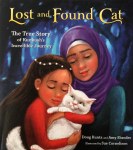
Lost and Found Cat: The True Story of Kunkush’s Incredible Journey by Doug Kuntz and Amy Shrodes illustrated by Sue Cornelison

Standard
Lost and Found Cat: The True Story of Kunkush’s Incredible Journey by Doug Kuntz and Amy Shrodes illustrated by Sue Cornelison

kunkush

Often children’s stories of refugees fleeing war are hopeful in a forced way that seems to want to protect them from the reality of what is going on in the world.  As adults we often cling to the ones with happy endings for our children and for ourselves, because the tragic ones are too numerous and overwhelming to comprehend.  This book marvelously does a great job for those older children in the middle that are beginning to understand the world around them, while not bombarding them with the severity of how cruel we can be to one another.  This true story instead focuses on a beloved cat and all the humans of different backgrounds, all over the world that help reunite her with her family.  Giving hope, but also showing the difficulty in the world, and the effects even one person can have in making a difference.

cat

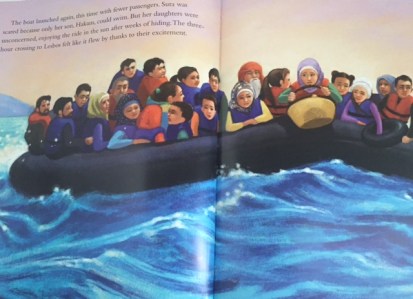
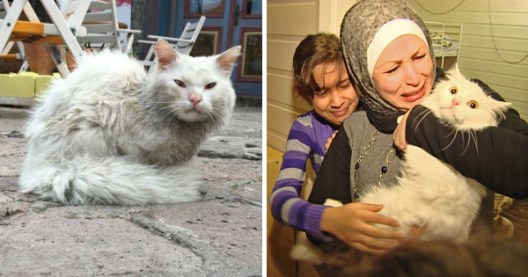
Kunkush’s family goes to great pains to get themselves (all 6 of them) out of Mosul, and away from the war.  That the fact they sneak their beloved cat with them, shows just how much a member of the family he is. They drive through the night, and walk for days over a mountain, they reach a Kurdish village where they sneak the cat on a bus to Turkey, they then have to cross the Aegean Sea to Greece, only to land in Lesbos and have Kunkush disappear.  The family searches as long as they can, but alas have to move on to their new home.  From here the story switches from following the family to following the cat and all the people determined to reunite him with his family.  Unfortunately, they don’t know where the family is.  Amy, a volunteer, takes the cat to the vet to get cleaned up, and then creates an internet campaign to try and find his family.  People from all over the world donate to his care, and his travel expenses.  Eventually, Amy takes the cat to Germany, where many refugees have resettled and continues her search.  Finally, word gets to the family in Norway, and Doug, a photographer, arranges to fly the cat to her new home. Alhumdulillah.

img_3838.jpgOne could argue that countless people are misplaced each day due to war, and we overlook it because it is easier than dealing with it, so why care about a cat.  And to that I challenge the skeptic, animal lover or not, to read this book and not have your heart-strings tugged.
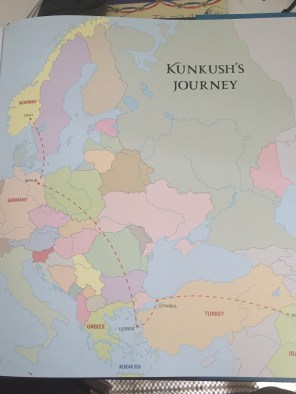
IMG_3839The book is done beautifully.  The pictures are warm and endearing and are the only proof that the family is Muslim, by their hijabs.  The love the family has for their pet is expressed in the illustrations, and even more so by the real photographs at the end of the book following the Note from Doug and Amy.  At 48 pages the book works really well for 3rd grade and up (it isn’t AR) who can marvel at the cat’s journey.  I particularly think this book is a great way to show children another aspect of refugees.  There are a fair amount of books that talk about the refugee experience or show refugees getting adjusted to a new home.  But, this is a great way to show that refugees are not just defined by a word.  They are vibrant individual people just like everyone else.  By focusing on the cat and his journey, the reader sees what a refugee goes through, particularly this family, and hopefully will stop and think about it.   But it doesn’t just show the family in that capacity, it shows them as a vibrant family who loves and desperately misses their cat- something more children may be able to relate to.
kunkush (1)

Malcolm Little: The Boy Who Grew Up to Become Malcolm X by Ilyasah Shabazz illustrated by AG Ford

Standard
Malcolm Little: The Boy Who Grew Up to Become Malcolm X by Ilyasah Shabazz illustrated by AG Ford

malcolm-little-9781442412163_hr.jpg

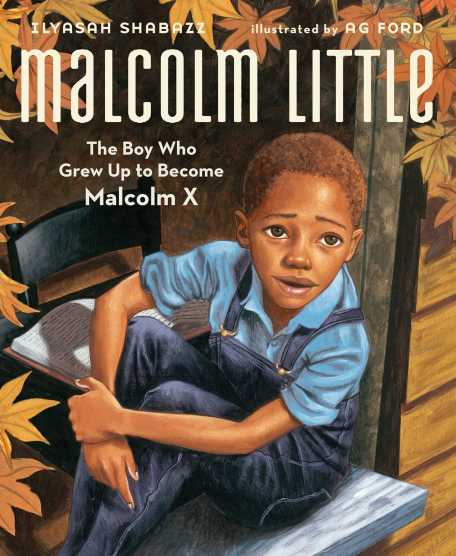
I had hoped to have a handful of selections to review for Black History Month, but alas I started too late in collecting titles, inshaAllah next year I will be better organized.  I did want to share this beautiful book though, as a great story of hope and love, that I don’t think is often included when we study Malcolm X or talk about him today.  This is the story of his parents and the philosophy of equality they tried to raise him in before hatred and bigotry destroyed his family, before he went to prison, before he became “Detroit Red,” a member of the Nation of Islam, before he became a civil rights leader, a Muslim, before he became Malcolm X.  This is a story, based on love, written by his daughter to give children of all ages something to think about.

malcolm-louise-300x300

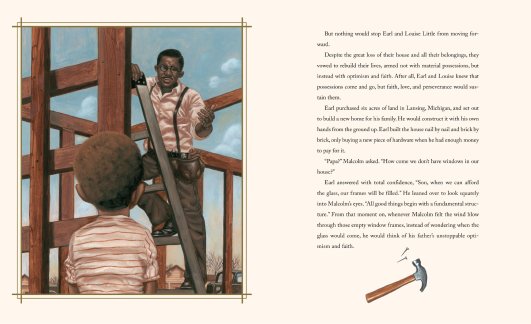
The story of Malcolm Little, is a story that I feel cannot be rushed, it is very heavy in text and at 48 pages, the warm beautiful pictures make it accessible in pieces to younger children, but it is written on an AR 6.5 level (sixth grade fifth month).  The book tells about how his mother and father met, believed in universal equality and justice, and started a family where these values took center stage.  The family suffered for their beliefs and their home was burnt down, but they rebuilt and the family continued to find strength and see the power of possibility.  The books shows the lessons taught in everyday activities such as raising a garden, doing laundry, reading books, doing homework, and even fishing.

When Malcolm’s father was killed, however, and his mother taken away, the family was forced to separate and Malcolm to deal with an unwelcoming world, more or less alone.  The book ends with Malcolm in 7th grade so, to young readers who have maybe only heard his name in passing the book is full of hope and roots for the man he would become.  It is almost a fairytale start to a man who would be cut down in his prime years later.  They will understand how unfair society treated his family, how warm and educated and strong his mother, Louise was, and how inspiring his father as a preacher was. The takeaway will be how Malcolm’s upbringing and personality allowed for him to rise up and refuse to stay down during horrific events in his life.

malcolmx.jpg

For older elementary and middle schoolers it is a story of possibility, of how quickly things can change, and the effect of hate.  They should also see how institutionalized and normative the oppression of African Americans was and how it really wasn’t that long ago.  When Malcolm’s English teacher Mr. Ostrowski tells Malcolm that he as an African American should not have such high expectations, readers should realize that the acts of the Ku Klux Klan may be viewed as “extreme” but society as a whole was systematically enabling such bigoted acts.  The lessons passed on to Malcolm by his parents are universal themes of hope and love and equality that still have to be stood up for today, and even young listeners can grasp that, and also grasp that because of their skin color alone they were seen as second class citizens.

The book shows depth to a historical character that gives some insight to what made him so dynamic.  Many young readers will be surprised at how quickly Malcolm’s world unraveled, and some of the reasons why, while empathizing with the injustice of it.  The Author’s Note at the end is also fascinating as it details the family members and their stories about the characters in the book.   I liked the softness of the book and the smaller lessons for children that it presented.  It didn’t shy away from the violence and prejudice that the Little family faced, but presented it through a lens of optimism to hopefully inspire children to carry on with the social activism that still needs to be done.


Sitti’s Secrets by Naomi Shihab Nye illustrated by Nancy Carpenter

Standard
Sitti’s Secrets by Naomi Shihab Nye illustrated by Nancy Carpenter

sitti

Sitti’s Secret was published in 1994 and given the events of the week, I’d say it is more relevant today than it was when written.  And if by some chance the events of the week haven’t affected your children, then the poetry and soul of the book still makes it an amazingly powerful story.

Mona travels from America to Palestine to visit her grandma, her Sitti.  Without the ease of speaking the same language, Sitti and Mona learn to communicate and build a tight bond cut too short by a vacation coming to an end.  When Mona returns she sees the news and writes a letter to the President, telling her Sitti’s secrets, telling him they would be great friends, and telling him they only want peace.

Truly Nye is a poet, even in Turtle of Oman her words transport you to a place where time slows down and the connection between a child and a grandparent make you nostalgically yearn for a simpler time.  Having spent my summer’s abroad visiting my grandma I could relate to so much of this book and truly had to still my heart.  The little things, like examining your grandma’s hand, or hanging out laundry, or brushing her hair. Even that dreaded final hug as you prepare to leave,  I could relate and it was enchanting.

No where in the book does it mention the Middle East or Islam, only at the beginning does she hint at it by dedicating the book to her 105 -year-old Sitti in Palestine, it mentions that she speaks Arabic and a few words are sprinkled in. And the Grandma does wear a scarf.  Other than that the book is by and large not political.  If you know that Nye has a Palestinian father and American mother and often writes semi auto biographical pieces, the book can take a bit of a different role to the reader.  Many reviews criticize the activism upon her return (the letter to the President), and found it disjointed to the rest of the story.  But in today’s climate I found it empowering and hopeful.  The world will only find peace when we put a face to those that are different to us, and even children can change our stereotypes.  I love that my children are seeing that they can make a change in the world today, and to see it reinforced in literature was gratifying.

The book is 32 pages and written on an AR 3.9 level.  The illustrations are beautiful.  They bring the words to life in a tender and heartfelt way.  The detail is subtle but deep and i have found myself thumbing back through the pages to get lost in the illustrations multiple times.  I think the book works on different levels for different age groups.  If you have a family that has to overcome great distances to be together, even younger readers will be able to identify with the story’s tenderness.  If you are in 3rd-6th grade and are aware of what is happening in the world you will be inspired.  If you just are looking for a sweet book, subhanAllah it manages to fulfill that category too.

The Tyrant’s Daughter by J.C. Carleson

Standard

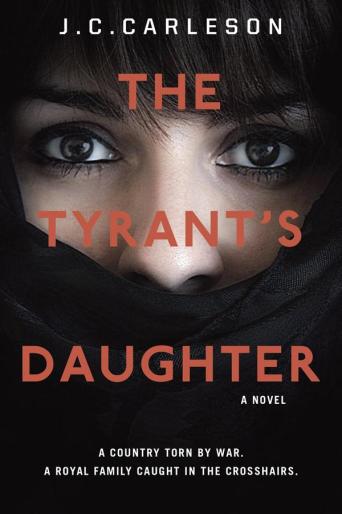
the tyrant's daughterI was intrigued to see this book offered by Scholastic in the teen Reading Club Catalog as it sounded both action packed and cultural.  The jacket cover summary was vague in describing the characters as being from an “unnamed Middle Eastern country,” but with the slightly veiled girl on front, I figured they probably are Muslim, and I should at the very least how they/we are being portrayed.  The book is 295 pages long and that includes the story, the Author’s Note, and a  Truth in Fiction section.  The author is a former undercover CIA officer and the intense action, intertwined with cultural  understandings, leave the reader second guessing and on the edge until the end.  The AR level is 5.1, but with the profanity, sexual situations, and violence I would recommend the book to those in high school and up (15+).

SYNOPSIS:

Fifteen-year-old Laila flees her homeland, when her father, the head of the county, is killed.  Trying to fit in, in Washington, D.C. is not easy for a girl raised like a princess.  She has to navigate not only the social norms and high school drama that most kids her age do, but she also has to examine what type of ruler her father was and what price her privilege came at.   There are a lot of plot twists, and her mother’s efforts to broker deals with rebel fractions and CIA operatives, keep the plot moving forward.  The interpersonal relationships in the background give the characters some depth and memorable traits by contrasting the intensity of a country on edge with the daily dramas of daily life.  Surprisingly with so much going on, I thought the book was well written, my only major critique being,  I wish i knew more about Laila, the main character telling the story.

WHY I LIKE IT:

It’s a fun story, simple as that. The plausible political plot, the young adult characters with their own heightened sense of self worth, is well crafted by-in-large and the book was engaging.  I read it quickly because I wanted to see how it unraveled and it kept my interest.  Will I remember it a month from now? Probably not, but often books like this as YA or adult fiction are delicious empty calories and nothing more-or-less than that.

FLAGS:

The “royal” family is “Muslim.” Yes, the quotes are intentional, because they don’t identify as Muslim, yet those in America identify them as such.  A teacher asks her if she is ok with dissecting a fetal pig and she seems confused as to why that would be a problem.  A boyfriend is nervous to make a move, and again she seems taken aback that there would be a religious reason not to, as she sees it as a cultural one only.  Even at the end when she is discussing going back to her country her mother remarks that she hates wearing a veil and Leila says she never really minded it.  Laila’s mom drinks alcohol and always has, as many heads-of-states of Muslim countries are assumed to do. There is violence, some crude language, and some relationship situations.  Again I would not recommend it for younger teens.

One aspect that is worth noting is how the “bad guy,” Laila’s uncle, is painted as being “religious.”   I would hope that readers would realize that he is an extremist, an exception to the mainstream followers of Islam.  But I don’t know if they would.  He is harshly critical of how Laila and her mom dress calling them “whores,”  he uses religion as a means of power to oppress and condemn others and is just generally awful.  I think the author by largely leaving religion and the name of the country out of the book, isn’t making a judgement on the faith or region, as much as providing plausible pieces to craft an interesting story.  That is just my opinion though, and it could probably be changed.

TOOLS FOR LEADING THE DISCUSSION:

I wouldn’t teach this book, or use it for Book Club, but the supplemental information in the back of the book is definitely interesting, and I think among friends, good discussions about the story’s origins would be fruitful, speculative and engaging.

In a high school setting you could definitely connect it to a Social Studies unit or the Arab Spring.